Results by title
459 books match the query 'Criminology' and 19 start with l

La Pinta
Chicana/o Prisoner Literature, Culture, and PoliticsBy B. V. Olguín
University of Texas Press, 2009
In this groundbreaking study based on archival research about Chicana and Chicano prisoners—known as Pintas and Pintos—as well as fresh interpretations of works by renowned Pinta and Pinto authors and activists, B. V. Olguín provides crucial insights into the central roles that incarceration and the incarcerated have played in the evolution of Chicana/o history, cultural paradigms, and oppositional political praxis.
This is the first text on prisoners in general, and Chicana/o and Latina/o prisoners in particular, that provides a range of case studies from the nineteenth century to the present. Olguín places multiple approaches in dialogue through the pairing of representational figures in the history of Chicana/o incarceration with specific themes and topics. Case studies on the first nineteenth-century Chicana prisoner in San Quentin State Prison, Modesta Avila; renowned late-twentieth-century Chicano poets Raúl Salinas, Ricardo Sánchez, and Jimmy Santiago Baca; lesser-known Chicana pinta and author Judy Lucero; and infamous Chicano drug baron and social bandit Fred Gómez Carrasco are aligned with themes from popular culture such as prisoner tattoo art and handkerchief art, Hollywood Chicana/o gangxploitation and the prisoner film American Me, and prisoner education projects.
Olguín provides a refreshing critical interrogation of Chicana/o subaltern agency, which too often is celebrated as unambiguously resistant and oppositional. As such, this study challenges long-held presumptions about Chicana/o cultures of resistance and proposes important explorations of the complex and contradictory relationship between Chicana/o agency and ideology.
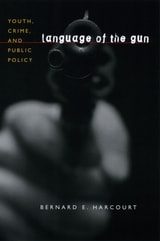
Language of the Gun
Youth, Crime, and Public PolicyBernard E. Harcourt
University of Chicago Press, 2006
Home to over 150 repeat offenders ranging in age from twelve to seventeen, the Catalina Mountain School is made up of a particular stratum of boys—those who have committed the most offenses but will still be released upon reaching adulthood. In an effort to understand the symbolic and emotional language of guns and gun carrying, Harcourt interviewed dozens of these incarcerated Catalina boys. What do these youths see in guns? What draws them to handguns? Why do some of them carry and others not? For Harcourt, their often surprising answers unveil many of the presuppositions that influence our laws and policies.

Law and Order
Images, Meanings, MythsValverde, Mariana
Rutgers University Press, 2006
But with television courtrooms appearing more like the studio of The Jerry Springer Show than institutions of justice, and with weekly dramas seamlessly blending cutting-edge forensic science with exaggerated fictions, it calls to question: just what is it about these shows that has the public so captivated? And, what effects do the images of crime and order presented through the media have on society's view of the actual legal and criminal justice systems?
In Law and Order: Images, Meanings, Myths, Mariana Valverde draws on examples from film, television, and newspapers to examine these questions and to demonstrate how popular culture is creating an unrealistic view of crime and crime control. Valverde argues that understanding the impact of media representations of courtrooms, police departments, prisons, and the people who populate them is essential to comprehending the reality of criminal justice.
Introducing a wealth of resources in social and cultural studies along with suggestions for classroom discussions and assignments, this book pushes the field of criminology in new and exciting theoretical directions. It is essential reading for students and scholars of criminal justice and law.

Law and the Environment
A Multidisciplinary ReaderRobert Percival
Temple University Press, 1997
Law and the Environment: A Multidisciplinary Reader brings together for the first time some of the most important original work on environmental policy by scientists, ecologists, philosophers, historians, economists, and legal scholars. Each of the book's four parts provides a different focus on the nature and scope of environmental problems and attempts to use public policy to address these concerns. Part I examines how ecology, economics, and ethics analyze environmental problems and why they support collective action to respond to them. Part II examines the history and present state of environmental law, from early attempts to engage the government to current debate over the effectiveness of environmental policy. Part III explores the process by which environmental law gets translated into regulatory policy. Part IV considers the future of environmental law at a time when international environmental concerns have become a major force in global diplomacy and international trade agreements.
In drawing together a wide variety of perspectives on these issues, Robert V. Percival and Dorothy C. Alevizatos offer a comprehensive examination of how society has responded to the difficult challenges posed by environmental problems. The selections provide a rich introduction to the complexities of environmental policy disputes.

Law and the Social Sciences
The Second Half CenturyJulius Stone
University of Minnesota Press, 1966
Law and the Social Sciences was first published in 1966. Minnesota Archive Editions uses digital technology to make long-unavailable books once again accessible, and are published unaltered from the original University of Minnesota Press editions.
The author, a distinguished authority on law, provides an illuminating and challenging discussion of the social aspects of law and legal problems. As a background to some penetrating observations, he takes stock of the contributions and interrelations of the bodies of knowledge, from both the juristic and the social science side, which bear upon the study of law at the present time. He is concerned to show the respects in which jurisprudential ideas in this area have been stimulated and clarified by work in the social sciences, and, conversely, to draw attention to the need for the increased interest of social scientists in this area to take account of juristic insights, many of them of long standing. He points out some of the dangers, not limited to waste of effort, arising from "parochialism" on the part of either the lawyer or the social scientist. The final section is devoted to a study of the contributions, potentialities, and limits of behavioralist and computer techniques in understanding and operating the appellate judicial process.
The book is based on a series of three lectures given by the author as the William S. Pattee Memorial Lectures sponsored by the University of Minnesota Law School.
Legal Inversions
Lesbians, Gay Men, and the Politics of the Lawedited by Didi Herman and Carl Stychin
Temple University Press, 1995
Law reform struggles have always been a part of the grassroots lesbian and gay agenda. These critical essays examine the politics of these engagements, of lesbians, gay men, and the law in the United States, Canada, and the United Kingdom. From a wide range of perspectives, the contributors combine new conceptual insights with a concern for the practicalities of political engagements, tackling such vital topics as legal definitions of homosexuality, AIDS activism, and race and sexuality.
Contributors: Katherine Arnup, Susan Boyd, Peter M. Cicchino, Davina Cooper, Bruce R. Deming, Mary Eaton, William F. Flanagan, Leo Flynn, Shelley A. M. Gavigan, Leslie J. Moran, Katherine M. Nicholson, Cynthia Petersen, Ruthann Robson, and the editors.
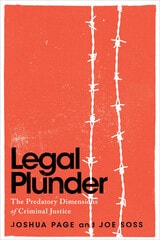
Legal Plunder
The Predatory Dimensions of Criminal JusticeJoshua Page and Joe Soss
University of Chicago Press, 2025
A searing, historically rich account of how US policing and punishment have been retrofitted over the last four decades to extract public and private revenues from America’s poorest and most vulnerable communities.
Alongside the rise of mass incarceration, a second profound and equally disturbing development has transpired. Since the 1980s, US policing and punishment have been remade into tools for stripping resources from the nation’s most oppressed communities and turning them into public and private revenues. Legal Plunder analyzes this development’s origins, operations, consequences, and the political struggles that it has created.
Drawing on historical and contemporary evidence, including original ethnographic research, Joshua Page and Joe Soss examine the predatory dimensions of criminal legal governance to show how practices that criminalize, police, and punish have been retrofitted to siphon resources from subordinated groups, subsidize governments, and generate corporate profits. As tax burdens have declined for the affluent, this financial extraction—now a core function of the country’s sprawling criminal legal apparatus—further compounds race, class, and gender inequalities and injustices. Legal Plunder shows that we can no longer afford to overlook legal plunder or the efforts to dismantle it.

Legal Plunder
The Predatory Dimensions of Criminal JusticeJoshua Page and Joe Soss
University of Chicago Press, 2025
This is an auto-narrated audiobook version of this book.
A searing, historically rich account of how US policing and punishment have been retrofitted over the last four decades to extract public and private revenues from America’s poorest and most vulnerable communities.
Alongside the rise of mass incarceration, a second profound and equally disturbing development has transpired. Since the 1980s, US policing and punishment have been remade into tools for stripping resources from the nation’s most oppressed communities and turning them into public and private revenues. Legal Plunder analyzes this development’s origins, operations, consequences, and the political struggles that it has created.
Drawing on historical and contemporary evidence, including original ethnographic research, Joshua Page and Joe Soss examine the predatory dimensions of criminal legal governance to show how practices that criminalize, police, and punish have been retrofitted to siphon resources from subordinated groups, subsidize governments, and generate corporate profits. As tax burdens have declined for the affluent, this financial extraction—now a core function of the country’s sprawling criminal legal apparatus—further compounds race, class, and gender inequalities and injustices. Legal Plunder shows that we can no longer afford to overlook legal plunder or the efforts to dismantle it.
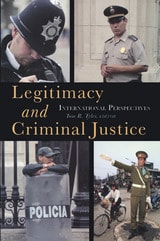
Legitimacy and Criminal Justice
An International PerspectiveTom R. Tyler
Russell Sage Foundation, 2007

Lethal Injection
Capital Punishment in Texas during the Modern EraBy Jon Sorensen and Rocky LeAnn Pilgrim
University of Texas Press, 2006
Few state issues have attracted as much controversy and national attention as the application of the death penalty in Texas. In the years since the death penalty was reinstated in 1976, Texas has led the nation in passing death sentences and executing prisoners. The vigor with which Texas has implemented capital punishment has, however, raised more than a few questions. Why has Texas been so fervent in pursuing capital punishment? Has an aggressive death penalty produced any benefits? Have dangerous criminals been deterred? Have rights been trampled in the process and, most importantly, have innocents been executed? These important questions form the core of Lethal Injection: Capital Punishment in Texas during the Modern Era.
This book is the first comprehensive empirical study of Texas's system of capital punishment in the modern era. Jon Sorensen and Rocky Pilgrim use a wealth of information gathered from formerly confidential prisoner records and a variety of statistical sources to test and challenge traditional preconceptions concerning racial bias, deterrence, guilt, and the application of capital punishment in this state. The results of their balanced analysis may surprise many who have followed the recent debate on this important issue.
Lethal Punishment
Lynchings and Legal Executions in the SouthVandiver, Margaret
Rutgers University Press, 2005
Why did some offenses in the South end in mob lynchings while similar crimes led to legal executions? Why did still other cases have nonlethal outcomes? In this well-researched and timely book, Margaret Vandiver explores the complex relationship between these two forms of lethal punishment, challenging the assumption that executions consistently grew out of-and replaced-lynchings.
Vandiver begins by examining the incidence of these practices in three culturally and geographically distinct southern regions. In rural northwest Tennessee, lynchings outnumbered legal executions by eleven to one and many African Americans were lynched for racial caste offenses rather than for actual crimes. In contrast, in Shelby County, which included the growing city of Memphis, more men were legally executed than lynched. Marion County, Florida, demonstrated a firmly entrenched tradition of lynching for sexual assault that ended in the early 1930s with three legal death sentences in quick succession.
With a critical eye to issues of location, circumstance, history, and race, Vandiver considers the ways that legal and extralegal processes imitated, influenced, and differed from each other. A series of case studies demonstrates a parallel between mock trials that were held by lynch mobs and legal trials that were rushed through the courts and followed by quick executions.
Tying her research to contemporary debates over the death penalty, Vandiver argues that modern death sentences, like lynchings of the past, continue to be influenced by factors of race and place, and sentencing is comparably erratic.
Life after Death Row
Exonerees' Search for Community and IdentitySaundra D. Westervelt and Kimberly J. Cook
Rutgers University Press, 2012
Life after Death Row examines the post-incarceration struggles of individuals who have been wrongly convicted of capital crimes, sentenced to death, and subsequently exonerated.
Saundra D. Westervelt and Kimberly J. Cook present eighteen exonerees’ stories, focusing on three central areas: the invisibility of the innocent after release, the complicity of the justice system in that invisibility, and personal trauma management. Contrary to popular belief, exonerees are not automatically compensated by the state or provided adequate assistance in the transition to post-prison life. With no time and little support, many struggle to find homes, financial security, and community. They have limited or obsolete employment skills and difficulty managing such daily tasks as grocery shopping or banking. They struggle to regain independence, self-sufficiency, and identity.
Drawing upon research on trauma, recovery, coping, and stigma, the authors weave a nuanced fabric of grief, loss, resilience, hope, and meaning to provide the richest account to date of the struggles faced by people striving to reclaim their lives after years of wrongful incarceration.
Linking Community and Corrections in Japan
Elmer H. Johnson with Carol H. Jonnson
Southern Illinois University Press, 2000
Completing Elmer H. Johnson’s impressive three-volume examination of corrections in Japan, Linking Community and Corrections in Japan (written with the assistance of Carol H. Johnson) focuses on the Rehabilitation Bureau’s responsibilities regarding probation, parole, and aftercare as well as the Correction Bureau’s role in Japan’s version of community-oriented corrections. Johnson first outlines the tasks of the Rehabilitation Bureau, then turns to historical and contemporary views of community and corrections. In discussions of the probation and parole system for both adults and juveniles, he describes in detail the Japanese version of supervision and the return of prisoners to the community. One strength of this study is Johnson’s impartiality. As an investigator, he functions as a "friend of the court," an adviser who is free to conduct an objective pursuit of the fundamental strengths and shortcomings of the Japanese prison system. He also follows the Foucauldian dictum: "With the prisons there would be no sense of limiting oneself to discourses about prisons; just as important are the discourses which arise within the prison, the decisions and regulations which are among its constituent elements, its means of functioning, along with its strategies."
Living Between Danger and Love
The Limits of ChoiceJones, Kathleen B.
Rutgers University Press, 1999

Locked Up, Locked Out
Young Men in the Juvenile Justice SystemAnne M. Nurse
Vanderbilt University Press, 2010
Status is key to everyday life in prison, and it is often played out in demonstrations of masculinity, misogyny, and violence. Some gangs and some "area codes" (as the old neighborhoods are called) are seen as tougher than others and are given more respect. Even letters from family members and girlfriends are important signs of whether a prisoner matters: one young man says, "I'd write letters every day to people to beg 'em to write me back." Another reports, "There would be people in there writing girls, saying, hey, write me this nasty letter of things we're going to do and things we did. And they'd write back with these letters. And now he'll get to walk around with his letter bragging, like, hey, check this out. These are the kind of girls I got."
Incarcerated youth also work hard at impression management. Coping with prison requires a young man to present one face to fellow prisoners and another to the authorities who will decide his release date.
The author pays substantial attention to the programs youth are offered, including those focusing on education, anger management, job training, and parenting skills. Another section looks at contact between incarcerated youth and the outside world, including a discussion of the impact of incarceration on families.
Based on her extensive knowledge of policies in other states, the author also provides a broad overview of the juvenile justice system nationally, describing how the system is organized, administered, and funded. Readers are taken through the juvenile justice process from conviction through parole with special attention paid to new state initiatives and sentencing structures.

Los Zetas Inc.
Criminal Corporations, Energy, and Civil War in MexicoBy Guadalupe Correa-Cabrera
University of Texas Press, 2017
The rapid growth of organized crime in Mexico and the government’s response to it have driven an unprecedented rise in violence and impelled major structural economic changes, including the recent passage of energy reform. Los Zetas Inc. asserts that these phenomena are a direct and intended result of the emergence of the brutal Zetas criminal organization in the Mexican border state of Tamaulipas. Going beyond previous studies of the group as a drug trafficking organization, Guadalupe Correa-Cabrera builds a convincing case that the Zetas and similar organizations effectively constitute transnational corporations with business practices that include the trafficking of crude oil, natural gas, and gasoline; migrant and weapons smuggling; kidnapping for ransom; and video and music piracy.
Combining vivid interview commentary with in-depth analysis of organized crime as a transnational and corporate phenomenon, Los Zetas Inc. proposes a new theoretical framework for understanding the emerging face, new structure, and economic implications of organized crime in Mexico. Correa-Cabrera delineates the Zetas establishment, structure, and forms of operation, along with the reactions to this new model of criminality by the state and other lawbreaking, foreign, and corporate actors. Since the Zetas share some characteristics with legal transnational businesses that operate in the energy and private security industries, she also compares this criminal corporation with ExxonMobil, Halliburton, and Blackwater (renamed “Academi” and now a Constellis company). Asserting that the elevated level of violence between the Zetas and the Mexican state resembles a civil war, Correa-Cabrera identifies the beneficiaries of this war, including arms-producing companies, the international banking system, the US border economy, the US border security/military-industrial complex, and corporate capital, especially international oil and gas companies.

Lost Causes
Blended Sentencing, Second Chances, and the Texas Youth CommissionBy Chad R. Trulson, Darin R. Haerle, Jonathan W. Caudill, and Matt DeLisi<br>Foreword by James W. Marquart
University of Texas Press, 2016
What should be done with minors who kill, maim, defile, and destroy the lives of others? The state of Texas deals with some of its most serious and violent youthful offenders through “determinate sentencing,” a unique sentencing structure that blends parts of the juvenile and adult justice systems. Once adjudicated via determinate sentencing, offenders are first incarcerated in the Texas Youth Commission (TYC). As they approach age eighteen, they are either transferred to the Texas prison system to serve the remainder of their original determinate sentence or released from TYC into Texas’s communities.
The first long-term study of determinate sentencing in Texas, Lost Causes examines the social and delinquent histories, institutionalization experiences, and release and recidivism outcomes of more than 3,000 serious and violent juvenile offenders who received such sentences between 1987 and 2011. The authors seek to understand the process, outcomes, and consequences of determinate sentencing, which gave serious and violent juvenile offenders one more chance to redeem themselves or to solidify their place as the next generation of adult prisoners in Texas. The book’s findings—that about 70 percent of offenders are released to the community during their most crime-prone years instead of being transferred to the Texas prison system and that about half of those released continue to reoffend for serious crimes—make Lost Causes crucial reading for all students and practitioners of juvenile and criminal justice.
Lost Classroom, Lost Community
Catholic Schools' Importance in Urban AmericaMargaret F. Brinig and Nicole Stelle Garnett
University of Chicago Press, 2014
More than just educational institutions, Catholic schools promote the development of social capital—the social networks and mutual trust that form the foundation of safe and cohesive communities. Drawing on data from the Project on Human Development in Chicago Neighborhoods and crime reports collected at the police beat or census tract level in Chicago, Philadelphia, and Los Angeles, Margaret F. Brinig and Nicole Stelle Garnett demonstrate that the loss of Catholic schools triggers disorder, crime, and an overall decline in community cohesiveness, and suggest that new charter schools fail to fill the gaps left behind.
This book shows that the closing of Catholic schools harms the very communities they were created to bring together and serve, and it will have vital implications for both education and policing policy debates.

Lynching in Colorado, 1859-1919
Stephen J. Leonard
University Press of Colorado, 2022