Results by title
2706 books match the query 'European' and 92 start with l
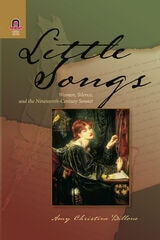
LITTLE SONGS
WOMEN, SILENCE, AND THE NINETEENTH-CENTURY SONNETAMY CHRISTINE BILLONE
The Ohio State University Press, 2002
LOST CAUSES
Historical Consciousness in Victorian LiteratureJason B. Jones
The Ohio State University Press, 2006
What if we didn’t always historicize when we read Victorian fiction?
Lost Causes shows that Victorian writers frequently appear to have a more supple and interesting understanding of the relationship between history, causality, and narrative than the one typically offered by readers who are burdened by the new historicism. As a return to these writers emphasizes, the press of modern historicism deforms Victorian novels, encouraging us to read deviations from strict historical accuracy as ideological bad faith. By contrast, Jason B. Jones argues through readings of works ranging from The French Revolution to Middlemarch that literature’s engagement with history has to be read otherwise.Perhaps perversely, Lost Causes suggests simultaneously that psychoanalysis speaks pressingly to the vexed relationship between history and narrative, and that the theory is neither a- nor anti-historical. Through his readings of Victorian fiction addressing the recent past, Jones finds in psychoanalysis not a set of truths, but rather a method for rhetorical reading, ultimately revealing how its troubled account of psychic causality can help us follow literary language’s representation of the real. Victorian narratives of the recent past and psychoanalytic interpretation share a fascination with effects that persist despite baffling, inexplicable, or absent causes.
In chapters focusing on Thomas Carlyle, Charles Dickens, Charlotte Brontë, and George Eliot, Lost Causes demonstrates that history can carry an ontological, as well as an epistemological, charge—one that suggests a condition of being in the world as well as a way of knowing the world as it really is. From this point of view, Victorian fiction that addresses the recent past is not a failed realism, as it is so frequently claimed, but rather an exploration of possibility in history.
La donna del lago
Melodramma in Two Acts by Andrea Leone TottolaGioachino Rossini
University of Chicago Press, 1990
La littérature est un voyage de découverte
Tom Bishop en conversation avec Donatien GrauTom Bishop and Donatien Grau
Diaphanes, 2021
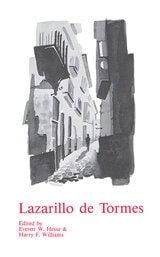
La vida de Lazarillo de Tormes y de sus fortunas y adversidades
Edited by Everett W. Hesse and Harry F. Williams
University of Wisconsin Press, 1961
First published in 1554 and banned by the Inquisition, the anonymous Lazarillo de Tormes begat a whole new genre—the picaresque novel. This classic has had enduring popularity as a literary expression of Spanish identity and emotion. Through its daring autobiographical form the reader observes the magnificent, conquering Spain of Charles the Fifth through the inner consciousness of the humble Lazarillo.
This editon includes the annotated Spanish-language text and prologue (with modernized and regularized spelling) , a full vocabulary, and concise footnotes explaining allusions and translating phrases of varying difficulty.
Spanish-language with introductions in English
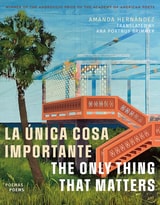
La única cosa importante / The Only Thing That Matters
Poemas / PoemsAmanda Hernández; Translated by Ana Portnoy Brimmer
University of Arizona Press, 2027
The poems featured in this award-winning collection contemplate the realities of the contemporary Puerto Rican experience. Rooted in the archipelago’s landscapes and the emotional topographies of diaspora, this collection confronts the fallout from colonialism while celebrating the sustaining power of friendship, memory, artistry, and collective love.
Holding together a scattered geography, the poems recognize land as both tangible territory and collective imaginary, reflecting on interconnected political, social, and economic crises that shape the intimacies of everyday life. With striking clarity and intimate reverence, Amanda Hernández names the fractures—and the hopes—that shape contemporary Puerto Rican life, ultimately affirming love as the force that endures.

Ladie Borlase's Receiptes Booke
David E. Schoonover
University of Iowa Press, 1998
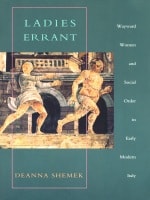
Ladies Errant
Wayward Women and Social Order in Early Modern ItalyDeanna Shemek
Duke University Press, 1998
Seeing errancy as an act of resistance rather than of error, Shemek carries her study beyond the didactic and prescriptive literature on femininity in early modern Italy to an arena in which theories about femininity are considered jointly with real and fictional instances of women’s waywardness. As prostitutes, warriors, lovers, and poets, the women of Shemek’s study are found in canonical texts, marginal works, and popular artistic activity, appearing, for instance, in literature, paintings, legal proceedings, and accounts of public festivals. By juxtaposing these varied places of errancy—from Ariosto’s chivalric Orlando furioso to the prostitutes’ race in the Palio di San Giorgio—Shemek points to the important contact between elite and popular cultures in early modernity, revealing the strength and flexibility of a gender boundary fundamental to early modern conceptions of social order.
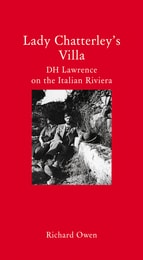
Lady Chatterley's Villa
D. H. Lawrence on the Italian RivieraRichard Owen
Haus Publishing, 2014
But before long Frieda found herself irresistibly attracted to their landlord, a dashing Italian army officer, and the resulting affair served as the background for Lawrence’s writing: while in the villa, he turned out two stories, “Sun” and “The Virgin and the Gypsy,” both prefiguring Lady Chatterley’s Lover in their depiction of women fatally drawn to earthy, muscular men.
Built on the unpublished, and previously unexplored, letters and diaries of Rina Secker, the Anglo-Italian wife of Lawrence’s publisher, and featuring never-before-published letters from Lawrence, Lady Chatterley’s Villa reconstructs the drama of the tempestuous marriage, and the ways it fired Lawrence’s creativity. Along the way, Richard Owen offers a new accounting of Lawrence’s passion for Italy, tracing his travels along the coasts and islands and his deep engagement with Italian culture. This exploration of a little-studied, but crucial period of the writer’s life will be a must for Lawrence’s many fans.
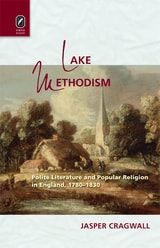
Lake Methodism
Jasper Cragwall
The Ohio State University Press, 2013
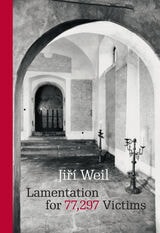
Lamentation for 77,297 Victims
Jirí Weil
Karolinum Press, 2020
So begins Jiří Weil’s unforgettable prose poem, Lamentation for 77, 297 Victims, his literary monument to the Czech Jews killed during the Holocaust. A Czech-Jewish writer who worked at Prague’s Jewish Museum both during and after the Nazi Occupation—he survived the Holocaust by faking his own death and hiding out until the war had ended—Weil wrote Lamentation while he served as the museum’s senior librarian in the 1950s. This remarkable literary experiment presents a number of innovative approaches to writing about a horror many would deem indescribable, combining a narrative account of the Shoah with newspaper-style reportage on a handful of the lives ended by the Holocaust and quotes from the Hebrew Bible to create a specific and powerful portrait of loss and remembrance. Translated by David Lightfoot, Lamentation for 77,297 Victims is a startling and singular introduction to a writer whose works have been acclaimed by Philip Roth, Michiko Kakutani, and Siri Hustvedt.
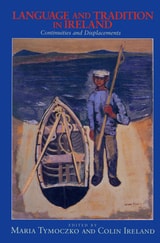
Language and Tradition in Ireland
Continuities and DisplacementsMaria Tymoczko
University of Massachusetts Press, 2003
If language and culture are intimately connected, then cultures involving people who speak more than one language must have special characteristics, as well as particular social issues to negotiate. What are the challenges faced by a people with two or more languages as their heritage? How does that multiple heritage affect cultural forms, including literature and the arts? How does linguistic difference influence the conceptualization and writing of history? And if the meeting of languages within a people has involved contestation and power, how are those conflicts negotiated?
This volume uses the tools of critical theory to explore such questions with respect to the complex, multilingual history of Ireland. Avoiding the simplistic polarized oppositions popular with cultural nationalists, the contributors examine the nexus of language, tradition, and authority in Ireland that has created such a rich, multivalent culture.
Although the linguistic interface of Irish and English has dominated cultural negotiations in Ireland over the last five hundred years, the island has an even longer history of linguistic and cultural exchange. Arguing that tradition is never static, the essays in this volume challenge the concept of a monolithic cultural origin, while insisting on the importance of inherited discourses in the continuity of culture through time and across linguistic difference. The chapters cover a broad range of topics from early Irish narratives and Latin hagiography to literary works by such writers as Yeats, Joyce, Friel, Montague, and McGahern, as well as other cultural forms, including traditional Irish music. Several chapters address issues of politics and power, from the role of interpreters in the relations between linguistic communities in Ireland to the politicization of language in Northern Ireland since the 1980s. Taken together, the essays illuminate scholarly domains as varied as postcolonial theory, the relationship between language and nation, the nature of tradition, and Irish literature of all periods.
In addition to the editors, contributors include Michael Cronin, Joanne Findon, Helen Fulton, Declan Kiberd, Jeremy Lowe, Gordon McCoy and Camille O'Reilly, Catherine McKenna, Cóilín Owens, Thomas Dillon Redshaw, and Sally K. Sommers Smith.

Language, Sign and Gender in Beowulf
Gillian R. Overing
Southern Illinois University Press, 1990
Not a book about what Beowulf means but how it means, and how the reader participates in the process of meaning construction.
Overing’s primary aim is to address the poem on its own terms, to trace and develop an interpretive strategy consonant with the extent of its difference. Beowulf’s arcane structure describes cyclical repetitions and patterned intersections of themes which baffle a linear perspective, and suggest instead the irresolution and dynamism of the deconstructionist free play of textual elements.
Chapter 1 posits the self/reader as a function of the text/language, examining the ways in which the text "speaks" the reader. Chapter 2 develops an interactive semiotic strategy in an attempt to describe an isomorphic relation between poem and reader, between text and self. Chapter 3 addresses the notions of text and self as more complex functions or formulations of desire, and thus complicates and expands the arguments of the two preceding chapters. The final chapter examines the issue of desire in the poem, and, to a lesser extent, desire in the reader (insofar as these may legitimately be viewed as distinct from each other).
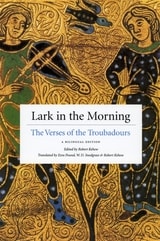
Lark in the Morning
The Verses of the Troubadours, a Bilingual EditionEdited by Robert Kehew
University of Chicago Press, 2005
Lark in the Morning honors the meter, word play, punning, and sound effects in the troubadours' works while celebrating the often playful, bawdy, and biting nature of the material. Here, Robert Kehew augments his own verse translations with those of two seminal twentieth-century poets—Ezra Pound and W. D. Snodgrass—to provide a collection that captures both the poetic pyrotechnics of the original verse and the astonishing variety of troubadour voices. This bilingual edition contains an introduction to the three major periods of the troubadours—their beginning, rise, and decline—as well as headnotes that briefly put each poet in context. Lark in the Morning will become an essential collection for those interested in learning about and teaching the origins of Western vernacular poetry.
Late Colonial Sublime
Neo-Epics and the End of RomanticismG. S. Sahota
Northwestern University Press, 2018
By bringing together distinct literary canons—both metropolitan and colonial, hegemonic and subaltern, Western and Eastern, all of which took shape upon the common realities of imperial capitalism—Late Colonial Sublime takes an original dialectical approach. It experiments with fragments, parallaxes, and constellational form to explore the aporias of modernity as well as the possible futures they may signal in our midst. A bold intervention into contemporary debates that synthesizes a wealth of sources, this book will interest readers and scholars in world literature, critical theory, postcolonial criticism, and South Asian studies.
Laughter and Civility
The Theater of Emma GadLynn R. Wilkinson
University of Wisconsin Press, 2020
Laughter and Civility, the first biographical and scholarly volume to examine and contextualize her dramas, deeply explores how and why influential women are so often excluded from the canon. Lynn R. Wilkinson provides insightful readings into all twenty-five of Gad’s plays and demonstrates how writers and intellectuals of the time, including Georg and Edvard Brandes, took her critically acclaimed work seriously. This volume rightfully reinstates Emma Gad’s work into the repertory of European drama and is crucial for scholars interested in turn‐of‐the‐century Scandinavian drama, literature, culture, and politics.
Laughter at the Foot of the Cross
Michael A. Screech
University of Chicago Press, 2015
But we are fortunate in our guide: drawing on his immense knowledge of the classics and of humanists like Erasmus and Rabelais—who used Plato and Aristotle to interpret the Gospels—and incorporating the thoughts of Aesop, Calvin, Lucian of Samosata, Luther, Socrates, and others, Screech shows that Renaissance thinkers revived ancient ideas about what inspires laughter and whether it could ever truly be innocent. As Screech argues, in the minds of Renaissance scholars, laughter was to be taken very seriously. Indeed, in an era obsessed with heresy and reform, this most human of abilities was no laughing matter.
Laura Battiferra and Her Literary Circle
An Anthology: A Bilingual EditionLaura Battiferra degli Ammannati
University of Chicago Press, 2006
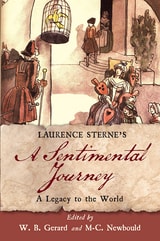
Laurence Sterne’s A Sentimental Journey
A Legacy to the WorldW. B. Gerard
Bucknell University Press, 2021
Le nozze di Teti, e di Peleo
Azione coro-drammatica by Angelo Maria RicciGioachino Rossini
University of Chicago Press, 1993
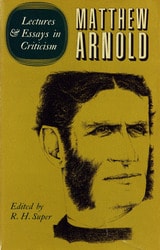
Lectures and Essays in Criticism
The Complete Prose Works of Matthew ArnoldMatthew Arnold; Edited by R. H. Super
University of Michigan Press, 1962
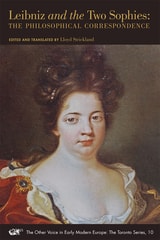
Leibniz and the Two Sophies
The Philosophical CorrespondenceGottfried Wilhelm Leibniz, Sophie Electress of Hanover, Queen Sophie Charlotte of Prussia
Iter Press, 2011
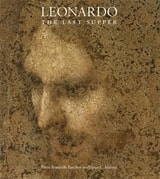
Leonardo, The Last Supper
Pinin Brambilla Barcilon and Pietro C. Marani
University of Chicago Press, 2001
The technical problems with the Last Supper began as soon as Leonardo started to paint it. He jettisoned the traditional fresco technique of applying paint to wet plaster, a method unsuited to Leonardo's slow and thorough execution, and created the work instead with an experimental technique that involved painting directly on the dry plaster. With this renegade method, Leonardo rendered one of the most enduring painting techniques volatile and unstable. Added to this initial complication have been centuries of pollution, tourists, candle smoke, and the ravages of age, not to mention food fights in the refectory staged by Napoleonic soldiers and Allied bombs in 1943. By the middle of the twentieth century, the Last Supper was in desperate need of a complete restoration.
Pinin Brambilla Barcilon was chosen to head this twenty-year project, and Leonardo, The Last Supper is the official record of her remarkable effort. It first documents the cleaning and removal of the overpainting performed in the other attempts at restoration and then turns to Barcilon's meticulous additions in watercolor, which were based on Leonardo's preparatory drawings, early copies of the painting, and contemporary textual descriptions. This book presents full-scale reproductions of details from the fresco that clearly display and distinguish Leonardo's hand from that of the restorer. With nearly 400 sumptuous color reproductions, the most comprehensive technical documentation of the project by Barcilon, and an introductory essay by art historian and project codirector Pietro C. Marani that focuses on the history of the fresco, Leonardo, The Last Supper is an invaluable historic record, an extraordinarily handsome book, and an essential volume for anyone who appreciates the beauty, technical achievements, and fate of Renaissance painting.
Lessons from the Past
The Moral Use of History in Fourth-Century ProseFrances Pownall
University of Michigan Press, 2003
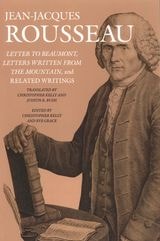
Letter to Beaumont, Letters Written from the Mountain, and Related Writings
Jean-Jacques Rousseau
Dartmouth College Press, 2012
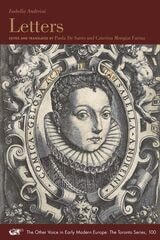
Letters
Isabella Andreini
Iter Press, 2023
Isabella Andreini (1562–1604) was a commedia dell’arte diva who toured Italy and France as part of the Compagnia dei Comici Gelosi. Letters is a collection of epistles written by Andreini in fictional, anonymous, male, and female voices, a “hermaphroditic” alternation of gender unlike any that had been seen in letter writing to that time. In her letters, Andreini remade the humanistic epistolary genre into a distinctive fusion of literary and dramatic performance. The guise of epistolary intimacy cedes to a knowing artificiality, which allows for the emergence of Andreini’s modern critique of the gendered self as a uniform entity. The collection centers on love and examines—from surprising perspectives—pertinent issues such as death, the birth of a girl, prostitution, patriarchal marital practices, love in old age, courtiership, country and city life, human nature, and defenses and critiques of both sexes.
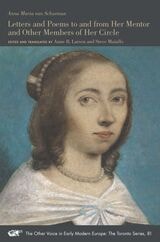
Letters and Poems to and from Her Mentor and Other Members of Her Circle
Anna Maria van Schurman
Iter Press, 2021
This volume presents in translation a remarkable collection of her letters and poems—many of which were previously unpublished—that span almost four decades of her life, from 1631 to 1669.
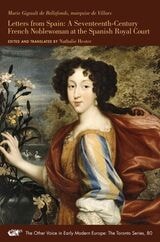
Letters from Spain
A Seventeenth-Century French Noblewoman at the Spanish Royal CourtMarie Gigault de Bellefonds
Iter Press, 2021
This volume includes her surviving letters from Madrid to her friend Madame de Coulanges and an appendix of her letters sent from Paris and Turin. The letters from Spain, written between 1679 and 1681, paint a vivid and engaging picture of the royal court and its new queen.
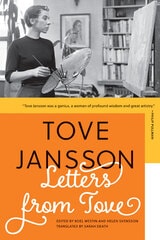
Letters from Tove
Tove Jansson
University of Minnesota Press, 2021
A virtual memoir in letters by the beloved creator of the Moomins
Tove Jansson’s works, even her famed Moomin books, fairly teem with letters of one kind or another, from messages bobbing in bottles to whole epistolary novels. Fortunately for her countless readers, her life was no different, unfolding as it did in the letters to family, friends, and lovers that make up this volume, a veritable autobiography over the course of six decades—and the only one Jansson ever wrote. And just as letters carry a weight of significance in Jansson’s writing, those she wrote throughout her life reflect the gravity of her circumstances, the depth of her thoughts and feelings, and the critical moments of humor, sadness, and grace that mark an artist’s days.
These letters, penned with characteristic insight and wit, provide an almost seamless commentary on Jansson’s life within Helsinki’s bohemian circles and on her island home. Shifting between hope and despair, yearning and happiness, they describe her immersion in art studies and her ascension to fame with the Moomins. They speak frankly of friendship and love, loneliness and solidarity, and also of politics, art, literature, and society. They summon a particular place and time reflected through a mind finely attuned to her culture, her world, and her own nature—all clearly put into biographical and historical context by the volume’s editors, both longtime friends of Tove Jansson—and, in the end, draw a complex, intimate self-portrait of one of the world’s most beloved authors.
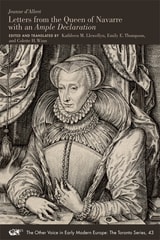
Letters from the Queen of Navarre with an Ample Declaration
Jeanne d’Albret
Iter Press, 2016
This edition presents in English, for the first time, Jeanne d’Albret’s Letters to the king, his mother, his brother, her own brother-in-law, and the queen of England, together with her Ample Declaration (1568) defending her decampment to the Protestant stronghold of La Rochelle. A historical-biographical introduction situates these writings in the larger context of Reformation politics and examines in detail the specific literary characteristics of her memoir. In her works, Jeanne d’Albret asserts her own position as legal sovereign of Béarn and Navarre and situates herself at the nexus of overlapping political, religious, and familial tensions.
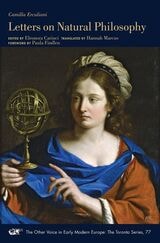
Letters on Natural Philosophy
The Scientific Correspondence of a Sixteenth-Century Pharmacist, with Related TextsCamilla Erculiani
Iter Press, 2020
This edition presents the first full English translation of Erculiani’s book and other relevant texts, bringing to light the cultural context and scientific thought of this unique natural philosopher.
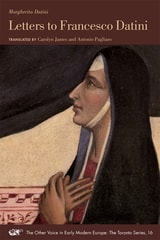
Letters to Francesco Datini
Margherita Datini
Iter Press, 2012
—Jane Tylus
Professor of Italian Studies and vice provost for academic affairs, New York University
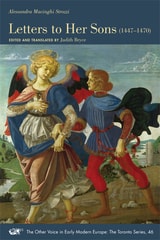
Letters to Her Sons, 1447–1470
Alessandra Macinghi Strozzi
Iter Press, 2016
The seventy-three surviving letters written by Florentine widow, Alessandra Macinghi Strozzi (c.1406–1471), to her distant sons first appeared in print well over a century ago, but are here translated into English in their entirety for the first time. Whether for the professional historian or for the general reader interested in Renaissance Florence, they constitute a most precious testimony regarding both private and public life in the mid-fifteenth century, with themes ranging from familial relations, motherhood, marriage, and aspects of material culture to the harsh realities of political exile meted out by the Medici to their perceived opponents, these latter including her husband and, subsequently, her sons.
Letters, Numbers, Forms
Essays, 1928-70Raymond Queneau
University of Illinois Press, 2007
Compiled from two volumes of Raymond Queneau's essays (Bâtons, chiffres et lettres and Le Voyage en Grèce), these selections find Queneau at his most playful and at his most serious, eloquently pleading for a certain classicism even as he reveals the roots of his own wildly original oeuvre. Ranging from the funny to the furious, they follow Queneau from modernism to postmodernism by way of countless fascinating detours, including his thoughts on language, literary fashions, myth, politics, poetry, and other writers (Faulkner, Flaubert, Hugo, and Proust). Translator Jordan Stump provides an introduction as well as explanatory notes about key figures and Queneau himself.
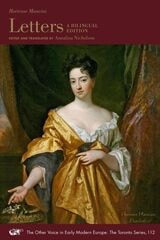
Letters
A Bilingual EditionHortense Mancini
Iter Press, 2025
During the seventeenth century, Hortense Mancini, Duchess of Mazarin (1646–99), became an icon of women’s emancipation. In 1668, she shocked Europe when she fled her coercive husband and began a nomadic exile. Her notoriety increased in 1675 with the publication of her memoir—one of the first to appear in French by a woman—and was later magnified by her stint as the royal mistress of Charles II of England and by her establishment of a freethinking salon in London. As a salonnière, an exile, and a litigant fighting for legal separation from her husband, Mancini’s letters were a means of connection, collusion, and survival as well as cultural collaboration. Collected and translated here for the first time, this correspondence charts her struggle for autonomy in her own words.
Liberalism After Communism
The Implications of the 1993 Elections to the Federal AssemblyJerzy Szacki
Central European University Press, 1995
Liberty and the Search for Identity
Ivan Zoltan Denes
Central European University Press, 2006
Life's a Dream (<i>La Vida es Sueño</i>)
Pedro Calderón de la Barca
University Press of Colorado, 2004
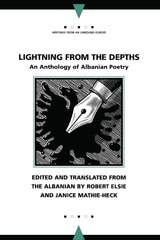
Lightning from the Depths
An Anthology of Albanian PoetryRobert Elsie and Janice Mathie-Heck
Northwestern University Press, 2008
If a people
Have no poets
And no poetry of their own
For a National Anthology
Then treachery and barking
Will do the trick
With these words, a challenge is laid down in this new volume of Albanian poetry. Albania, however, has a dynamic tradition of literature. Lightning from the Depths is the first English collection to present the full range of Albanian verse. Albanian literature has had many lives. The early Christian traditions disappeared as Islam and the Ottoman Empire took over. Muslim literature, too, withered when the nation strove to become an independent European country. The beginnings of a modern tradition were quashed by the Stalinists. All along this rocky path, poets have turned the political strife, poverty, and isolation their nation has often experienced into culture, both celebrating and questioning the society in which they live. Lightning from the Depths opens readers’ eyes to a new political and cultural world populated artists who can spin despair into poetry.

Lightwork
Texts on and from Collaborative Multimedia TheatreEdited by Alex Mermikides and Andy Lavender
Intellect Books, 2021
The artist-led theater company Lightwork specializes in collaborative multimedia performance. The company experimented with several performance forms that emerged at the turn of the twenty-first century including devised and improvisation-led approaches. This volume brings together performance texts from nine productions by Lightwork and one play-text from Lightwork’s precursor company Academy Productions. The twelve-year span covered by the work reflects a period in British performance practice when the interrelation of page and stage, process and production, and text and “non-text” were being radically rethought.
Like Bits of Wind
Selected Poetry and Poetic Prose, 1974-2014Pierre Chappuis
Seagull Books, 2016
Lionheart
Thorvald Steen
Seagull Books, 2012
Listening to Homer
Tradition, Narrative, and AudienceRuth Scodel
University of Michigan Press, 2002
---Greece & Rome
---Irene J.F. de Jong, Gnomon

Literal Figures
Puritan Allegory and the Reformation Crisis in RepresentationThomas H. Luxon
University of Chicago Press, 1995
Why did Puritan Christianity repeatedly turn to allegorical forms of representation in spite of its own intolerance of "Allegorical fancies?" Luxon demonstrates that Protestant doctrine itself was a kind of allegory in hiding, one that enabled Puritans to forge a figural view of reality while championing the "literal" and the "historical". He argues that for Puritanism to survive its own literalistic, anti-symbolic, and millenarian challenges, a "fall" back into allegory was inevitable. Representative of this "fall," The Pilgrim's Progress marks the culminating moment at which the Reformation's war against allegory turns upon itself. An essential work for understanding both the history and theory of representation and the work of John Bunyan, Literal Figures skillfully blends historical and critical methods to describe the most important features of early modern Protestant and Puritan culture.
Literary Celebrity, Gender, and Victorian Authorship, 1850-1914
Alexis Easley
University of Delaware Press, 2011
This study examines literary celebrity in Britain from 1850 to 1914. Through lively analysis of rare cultural materials, Easley demonstrates the crucial role of the celebrity author in the formation of British national identity. As Victorians toured the homes and haunts of famous writers, they developed a sense of shared national heritage. At the same time, by reading sensational accounts of writers’ lives, they were able to reconsider conventional gender roles and domestic arrangements. As women were featured in interviews and profiles, they were increasingly associated with the ephemerality of the popular press and were often excluded from emerging narratives of British literary history, which defined great literature as having a timeless appeal. Nevertheless, women writers were able to capitalize on celebrity media as a way of furthering their own careers and retelling history on their own terms. Press attention had a more positive effect on men’s literary careers since they were expected to assume public identities; however, in some cases, media exposure had the effect of sensationalizing their lives, bodies, and careers. With the development of proto-feminist criticism and historiography, the life stories of male writers were increasingly used to expose unhealthy domestic relationships and imagine ideal forms of British masculinity.
The first section of Literary Celebrity explores the practice of literary tourism in Victorian Britain, focusing specifically on the homes and haunts of Charles Dickens, Christina Rossetti, George Eliot, Elizabeth Barrett Browning, and Harriet Martineau. This investigation incorporates analysis of fascinating cultural texts, including maps, periodicals, and tourist guidebooks. Easley links the practice of literary tourism to a variety of cultural developments, including nationalism, urbanization, spiritualism, the women’s movement, and the expansion of popular print culture. The second section provides fresh insight into the ways that celebrity culture informed the development of Victorian historiography. Easley demonstrates how women were able to re-tell history from a proto-feminist perspective by writing contemporary history, participating in architectural reform movements, and becoming active in literary societies. In this chapter she returns to the work of Harriet Martineau and introduces a variety of lesser-known contributors to the field, including Mary Gillies and Mary Ward. Literary Celebrity concludes with a third section focused on the expansion of celebrity media at the fin de siècle. These chapters and a brief coda link the popularization of celebrity news to the de-canonization of women writers, the professionalization of medicine, the development of the open space movement, and the institutionalization of English studies. These investigations elucidate the role of celebrity media in the careers of Charlotte Robinson, Marie Corelli, Mary Braddon, Harriet Martineau, Thomas Carlyle, Ernest Hart, and Octavia Hill.
Published by University of Delaware Press. Distributed worldwide by Rutgers University Press.
Literary Circles and Cultural Communities in Renaissance England
Edited by Claude J. Summers & Ted-Larry Pebworth
University of Missouri Press, 2001
Although the literary circle is widely recognized as a significant feature of Renaissance literary culture, it has received remarkably little examination. In this collection of essays, the authors attempt to explain literary circles and cultural communities in Renaissance England by exploring both actual and imaginary ways in which they were conceived and the various needs they fulfilled. The book also pays considerable attention to larger theoretical issues relating to literary circles.
The essayists raise important questions about the extent to which literary circles were actual constructs or fictional creations. Whether illuminating or limiting, the circle metaphor itself can be extended or reformulated. Some of the authors discuss how particular circles actually operated, and some question the very concept of the literary circle. Literary Circles and Cultural Communities in Renaissance England will be an important addition to seventeenth-century studies.
Literary Conclusions
The Poetics of Ending in Lessing, Goethe, and KleistOliver Simons
Northwestern University Press, 2022
Simons examines the interrelations of Lessing’s literary endings with modes of logical conclusion; he highlights how Goethe’s narrative closures are forestalled by an uncontrollable vital force that was discussed in the sciences of the time; and he reveals that Kleist conceived of literary genres themselves as forms of reasoning. Kleist’s endings, Simons demonstrates, mark the beginning of modernism. Through close readings of these authors and supplemental analyses of works by Walter Benjamin, Friedrich Hölderlin, and Georg Wilhelm Friedrich Hegel, he crafts an elegant theory of conclusions that revises established histories of literary genres and forms.
Literary Diseases
Theme and Metaphor in the Italian NovelBy Gian-Paolo Biasin
University of Texas Press, 1975
Disease—real or imagined, physical or mental—is a common theme in Western literature and is often a symbol of modern alienation. In Literary Diseases, a comprehensive analysis of the metaphorical and symbolic force of disease in modern Italian literature, Gian-Paolo Biasin expands the geography of the discussion of this important theme. Using as a backdrop the perspective of European experiences of the previous hundred years, Biasin analyzes the theme of disease as a reflection of certain sociological and historical phenomena in modern European novels, as a metaphor for the world visions of selected Italian novelists, and especially as a vehicle for understanding the nature and function of fiction itself.
The core of Biasin’s study is found in his discussion of the works of four major Italian writers. In his criticism of the novels of Giovanni Verga, who stood at the center of many complex developments in the nineteenth century, he examines the antecedents of modern Italian prose. He then scrutinizes the works of Italo Svevo and Luigi Pirandello, who together inaugurated the modern novel in Italy. Of particular interest is his exploration of their critical use of psychoanalysis and madness climaxed by apocalyptic visions. He then discusses the prose of Carlo Emilio Gadda, which epitomizes the problems of the avant-garde in its experimentalism and expressionism.
Biasin utilizes a broad spectrum of critical approaches—from sociology, psychoanalysis, and different trends in modern French, American, and Italian literary criticism—in shaping his own methodology, which is a thematic and structural symbolism. He concludes that disease in literature should be considered as a metaphor for writing (écriture) and as a cognitive instrument that calls into question the anthropocentric values of Western culture. The book, with its textual comparisons and unusual supporting examples, constitutes a significant methodological contribution as well as a major survey of modern Italian prose, and will allow the reader to see traditional landmarks in European fiction in a new light.
Literary Histories in Portuguese
João Cezar De Castro Rocha
Tagus Press, 2014
Literary Intellectuals and the Dissolution of the State
Professionalism and Conformity in the GDREdited by Robert von Hallberg
University of Chicago Press, 1996
What drove leading thinkers, including those of the avant-garde who publicly embraced intellectual freedom, to serve as government informants? Why were they content to work within a repressive system rather than challenging it outright? This collection of interviews with more than two dozen writers and literary scholars, including several Stasi informants, provides a gripping, often dismaying picture of the motivations, compromises, and illusions of East German intellectual life.
In conversations with Robert von Hallberg, writers such as best-selling novelist Hermann Kant, playwright Christoph Hein, and avant-garde poet-publisher Sascha Anderson talk about their lives and work before the fall of the wall in 1989—about the constraints and privileges of Communist Party membership, experiences of government censorship and self-censorship, and relations with their readers. They reflect on why the possibilities of opposition to the state seemed so limited, and on how they might have found ways to resist more aggressively. Turning to the controversies that have emerged since reunification, including the Stasi scandals involving Anderson and Christa Wolf, they discuss their feelings of complicity and the need for further self-examination. Two interviews with Anderson—one conducted before he was exposed as a Stasi collaborator and one conducted afterward—offer unique insight into the double life led by many writers and scholars in the German Democratic Republic.