Results by title
668 books match the query 'History & Surveys' and 25 start with l
L. Annaeus Cornutus
Greek Theology, Fragments, and TestimoniaGeorge Boys-Stones
SBL Press, 2018
The first English translation of Greek Theology
The first-century CE North African philosopher Cornutus lived in Rome as a philosopher and is best known today for his surviving work Greek Theology, which explores the origins and names of the Greek gods. However, he was also interested in the language and literature of the poets Persius and Lucan and wrote one of the first commentaries on Virgil. This book collects and translates all of our evidence for Cornutus for the first time and includes the first published English translation of Greek Theology. This collection offers entirely fresh insight into the intellectual world of the first century.
Features
- Translation based on the latest critical text
- The first truly holistic picture of Cornutus’s intellectual profile
- A new account of the early debate over Aristotle’s Categories and the Stoic contribution to it
Language and Death
The Place of NegativityGiorgio Agamben
University of Minnesota Press, 2006
Law and the Good Life
On the Political Philosophy of AristotleRobert C. Bartlett
University of Chicago Press, 2026
A fresh reading of the relationship between moral and political philosophy in Aristotle’s thought.
Our democracies promise the rights to life, liberty, and the pursuit of happiness—at least, within the confines of the law. Yet the law is an ineffective guide to the good life; laws can be arbitrary, even immoral. What other limit, then, should direct us as we pursue our own fulfillment?
In Law and the Good Life, philosopher Robert C. Bartlett examines Aristotle’s consideration of this question. Rather than defer to authority, Aristotle invites us to ground ourselves in moral virtue and intellectual fulfillment, an argument he develops in both Politics and Nicomachean Ethics. As political creatures, Aristotle tells us, we are capable of moral action and therefore must embrace that capacity; at the same time, as rational creatures, we must understand what is true, even without regard to action. In taking these insights together, Bartlett offers a new reading of Aristotle’s political philosophy, one he hopes might serve as a prudent lodestar in our own turbulent times.
Leading a Human Life
Wittgenstein, Intentionality, and RomanticismRichard Eldridge
University of Chicago Press, 1997
Eldridge sees Wittgenstein as a Romantic protagonist, engaged in an ongoing internal dialogue over the nature of intentional consciousness, ranging over ethics, aesthetics, and philosophy of mind. The picture of the human mind that emerges through this dialogue unsettles behaviorism, cognitivism, and all other scientifically oriented orthodoxies. Leading a human life becomes a creative act, akin to writing a poem, of continuously seeking to overcome both complacency and skepticism. Eldridge's careful reconstruction of the central motive of Wittgenstein's work will influence all subsequent scholarship on it.
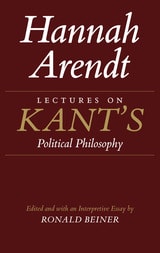
Lectures on Kant's Political Philosophy
Hannah Arendt
University of Chicago Press, 1982
Leo Strauss On Plato's Symposium
Leo Strauss
University of Chicago Press, 2001
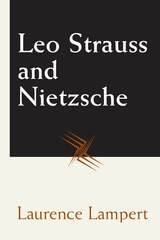
Leo Strauss and Nietzsche
Laurence Lampert
University of Chicago Press, 1995
In Leo Strauss and Nietzsche, the eminent Nietzsche scholar Laurence Lampert offers a controversial new assessment of the Strauss-Nietzsche connection. Lampert undertakes a searching examination of the key Straussian essay, "Note on the Plan of Nietzsche's Beyond Good and Evil." He shows that this essay, written toward the end of Strauss's life and placed at the center of his final work, reveals an affinity for and debt to Nietzsche greater than Strauss's followers allow. Lampert argues that the essay comprises the most important interpretation of Nietzsche ever published, one that clarifies Nietzsche's conception of nature and of human spiritual history and demonstrates the logical relationship between the essential themes in Nietzsche's thought—the will to power and the eternal return.
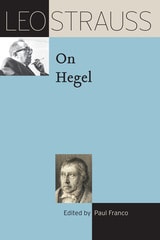
Leo Strauss on Hegel
Leo Strauss
University of Chicago Press, 2019
Leo Strauss on Hegel reconstructs Strauss’s seminar on Hegel, supplemented by passages from an earlier version of the seminar from which only fragments of a transcript remain. Strauss focused his seminar on the lectures collected in The Philosophy of History, which he considered more accessible than Hegel’s written works. In his own lectures on Hegel, Strauss continues his project of demonstrating how modern philosophers related to ancient thought and explores the development and weaknesses of modern political theory. Strauss is especially concerned with the relationship in Hegel between empirical history and his philosophy of history, and he argues for the primacy of religion in Hegel’s understanding of history and society. In addition to a relatively complete transcript, Leo Strauss on Hegel also includes annotations, which bring context and clarity to the text.
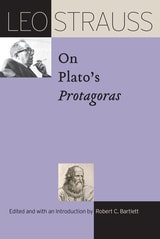
Leo Strauss on Plato’s "Protagoras"
Leo Strauss
University of Chicago Press, 2022
This book offers a transcript of Strauss’s seminar on Plato’s Protagoras taught at the University of Chicago in the spring quarter of 1965, edited and introduced by renowned scholar Robert C. Bartlett. These lectures have several important features. Unlike his published writings, they are less dense and more conversational. Additionally, while Strauss regarded himself as a Platonist and published some work on Plato, he published little on individual dialogues. In these lectures Strauss treats many of the great Platonic and Straussian themes: the difference between the Socratic political science or art and the Sophistic political science or art of Protagoras; the character and teachability of virtue, its relation to knowledge, and the relations among the virtues, courage, justice, moderation, and wisdom; the good and the pleasant; frankness and concealment; the role of myth; and the relation between freedom of thought and freedom of speech.
In these lectures, Strauss examines Protagoras and the sophists, providing a detailed discussion of Protagoras as it relates to Plato’s other dialogues and the work of modern thinkers. This book should be of special interest to students both of Plato and of Strauss.
Leo Strauss' Published but Uncollected English Writings
Leo Strauss
St. Augustine's Press, 2023
The most complete record of Strauss's thought includes his books together with his other published and unpublished writings and lectures. The achievement of this volume is to present in one collection every piece Strauss chose to publish in English that he did not himself include in a collection or a book. The material is arranged chronologically so as to avoid undue categorization by the editors.
Among the highlights of these works published between 1937 and 1972 are striking formulations not to be found in his books on the relationship between philosophy and society, which is perhaps the most prominent theme in Strauss’s corpus taken as a whole; rare ‘personal’ statements that shed light on his self-understanding as a philosopher; his first writing devoted solely to a classical thinker (“The Spirit of Sparta or the Taste of Xenophon”); his first piece devoted to Plato, “On a New Interpretation of Plato’s Political Philosophy,” his most searching engagement with Jean-Jacques Rousseau; his first treatment of the thought of Niccolò Machiavelli and a wonderful, later treatment of Machiavelli’s relation to ancient writers; and a critical review of a book on Xenophon’s Hellenica.
This complete collection of Strauss’s scattered work in English is invaluable for those interested in the political philosopher, to be sure. But it is also an important contribution to the field in general as well as the history of philosophy.
Letters of Peter Abelard, Beyond the Personal
Peter Abelard
Catholic University of America Press, 2008
Letters on Ethics
To LuciliusLucius Annaeus Seneca
University of Chicago Press, 2015
Written as much for a general audience as for Lucilius, these engaging letters offer advice on how to deal with everything from nosy neighbors to sickness, pain, and death. Seneca uses the informal format of the letter to present the central ideas of Stoicism, for centuries the most influential philosophical system in the Mediterranean world. His lively and at times humorous expositions have made the Letters his most popular work and an enduring classic. Including an introduction and explanatory notes by Margaret Graver and A. A. Long, this authoritative edition will captivate a new generation of readers.
Letters on Natural Philosophy
The Scientific Correspondence of a Sixteenth-Century Pharmacist, with Related TextsCamilla Erculiani
Iter Press, 2020
This edition presents the first full English translation of Erculiani’s book and other relevant texts, bringing to light the cultural context and scientific thought of this unique natural philosopher.
Light in Germany
Scenes from an Unknown EnlightenmentT. J. Reed
University of Chicago Press, 2015
Reed looks closely at the arguments, achievements, conflicts, and controversies of these major thinkers and how their development of a lucid and active liberal thinking matured in the late eighteenth century into an imaginative branching that ran through philosophy, theology, literature, historiography, science, and politics. He traces the various pathways of their thought and how one engendered another, from the principle of thinking for oneself to the development of a critical epistemology; from literature’s assessment of the past to the formulation of a poetic ideal of human development. Ultimately, Reed shows how the ideas of the German Enlightenment have proven their value in modern secular democracies and are still of great relevance—despite their frequent dismissal—to us in the twenty-first century.
Lineages of European Political Thought
Explorations along the Medieval/Modern Divide from John of Salisbury to HegelCary J. Nederman
Catholic University of America Press, 2009
Lines of Thought
Discourse, Architectonics, and the Origin of Modern PhilosophyClaudia Brodsky Lacour
Duke University Press, 1996
While Cartesianism has long served as a synonym for rationalism, the contents of Descartes’s method and cogito have remained infamously resistant to rational analysis. Similarly, although modern phenomenological analyses descend from Descartes’s notion of intuition, the “things” Cartesian intuitions represent bear no resemblance to phenomena. By returning to what Descartes calls the construction of his “foundation” in the Discours, Brodsky Lacour identifies the conceptual problems at the root of Descartes’s literary and aesthetic theory as well as epistemology. If, for Descartes, linear extension and “I” are the only “things” we can know exist, the Cartesian subject of thought, she shows, derives first from the intersection of discourse and drawing, representation and matter. The crux of that intersection, Brodsky Lacour concludes, is and must be the cogito, Descartes’s theoretical extension of thinking into material being. Describable in accordance with the Géométrie as a freely constructed line of thought, the cogito, she argues, extends historically to link philosophy with theories of discursive representation and graphic delineation after Descartes. In conclusion, Brodsky Lacour analyzes such a link in the writings of Claude Perrault, the architectural theorist whose reflections on beauty helped shape the seventeenth-century dispute between “the ancients and the moderns.”
Part of a growing body of literary and interdisciplinary considerations of philosophical texts, Lines of Thought will appeal to theorists and historians of literature, architecture, art, and philosophy, and those concerned with the origin and identity of the modern.
Lire Marx
Reiner Schürmann
Diaphanes, 2020
Le titre est, bien entendu, inspiré par Althusser (“Lire Le Capital”) – mais de façon polémique. Par “lire Marx” j'entends lire Marx et non pas Engels, Mao, Gramsci, Lukács, Marcuse, Althusser et ainsi de suite. En d'autres termes : le but de ce cours est, avant tout, de délibérément désintriquer la pensée de Marx de la pensée marxiste. Une polémique avec certains marxistes sera ainsi menée en sous-main, par des allusions ponctuelles. Un tel programme véhicule trois implications majeures : Qu'il y a effectivement une différence de pensée entre Marx et le marxisme. Ce premier point sera établi à travers une lecture philosophique de Marx : l'hypothèse étant que ce qui se trouve de plus original dans Marx, ce n'est ni sa pensée politique, ni sa pensée sociologique ou économique, mais bien sa charpente philosophique. Cette charpente philosophique détermine et situe ses autres théories. La seconde implication, c'est qu'un clivage entre Marx et les marxistes existe comme tel, qu'il peut être défini par certaines caractéristiques générales, et que ces caractéristiques générales différent de la pensée originale de Marx ou la restreignent. Il s'agit là d'un sujet passablement complexe, voire compliqué ; mais on peut résumer ce clivage en disant que le marxisme
a surtout retenu de Marx les éléments utiles à l'action politique dans une situation donnée, urgente. Une théorie de la “praxis révolutionnaire” a donc pris la place de la philosophie. La troisième implication est la précompréhension qui préside à l'approche du texte. Un texte est quelque chose d'imprimé : il représente comme tel un objet clos, constitué, fini. Mais nous n'en obtiendrons de réponses décisives que si nous le soumettons à des questions décisives. Et la question décisive que soulèvent les marxistes, c'est l'urgence d'une situation révolutionnaire (qu'elle existe de fait ou doive être réalisée). Leur question est donc généralement homothétique à celle de Lénine : “Que faire ?” C'est la question de ceux qu'Althusser appelle les “intellectuels militants” (pour Marx 24), et qui participent directement aux luttes de la classe ouvrière. Une telle “ lecture” de Marx est stratégique. Or, je tiens que la lecture stratégique ne peut que rester aveugle, de par sa nature même, au questionnement philosophique. Notre précompréhension des textes de Marx n'a, par conséquent, rien de stratégique ; elle est bien plutôt qu'ils proposent une réponse à la plus ancienne question de la philosophie occidentale : ti to on, savoir : qu'est-ce que l'être ? ou : qu'est-ce que la réalité, ainsi que son corollaire : qu'est-ce que la vérité ? Donc : Marx versus marxisme ; le concept de “praxis” comme étant le concept différenciant Marx du marxisme ; une double théorie des textes. Développons plus avant ces trois points
Logic and Pragmatism
Selected Essays by Giovanni VailatiClaudia Arrighi, Paola Cantu, Mauro de Zan, and Patrick Suppes
CSLI, 2009
Logic and Pragmatism features a number of the key writings of Giovanni Vailati (1863–1909), the Italian mathematician and philosopher renowned for his work in mechanics, geometry, logic, and epistemology. The selections in this book—many of which are available here for the first time in English—focus on Vailati’s significant contributions to the field of pragmatism. Accompanying these pieces are introductory essays by the volume’s editors that outline the traits of Vailati’s pragmatism and provide insights into the scholar’s life.

Logic and Sin in the Writings of Ludwig Wittgenstein
Philip R. Shields
University of Chicago Press, 1992
"Shields argues that the appearance throughout Wittgenstein's writings of such concepts as ritual, limit, transgression, a change of will, pride, temptation, and judgment implies a relation between religion and the logical aspects of Wittgenstein's philosophy."—Choice
"Of the many recent books about Wittgenstein, Logic and Sin is one of the very few that are well worth having"—Fergus Kerr, Modern Theology
"What Shields has uncovered in Wittgenstein's religious sensibility is something genuine and profound. . . . Shields has not just written an important book on Wittgenstein but an enlightening work that invites further reflection."—Eric O. Springsted, Cross Currents
Lonergan and Historiography
The Epistemological Philosophy of HistoryThomas J. McPartland
University of Missouri Press, 2010
Love Song for the Life of the Mind
An Essay on the Purpose of ComedyGene Fendt
Catholic University of America Press, 2007
Love and Friendship in the Western Tradition
From Plato to PostmodernityJames McEvoy
Catholic University of America Press, 2023
Lukács After Communism
Interviews with Contemporary IntellectualsEva L. Corredor
Duke University Press, 1997
The scholars featured in this collection—Etienne Balibar, Peter Bürger, Terry Eagleton, Fredric Jameson, Jacques Leenhardt, Michael Löwy, Roberto Schwarz, George Steiner, Susan Suleiman, and Cornel West—discuss a broad array of literary and political topics and present provocative views on gender, race, and economic relations. Corredor’s introduction provides a biographical synopsis of Lukács and discusses a number of his most important theoretical concepts. Maintaining the ongoing vitality of Lukács’s work, these interviews yield insights into Lukács as a philosopher and theorist, while offering anecdotes that capture him in his role as a teacher-mentor.
Lunar Voices
Of Tragedy, Poetry, Fiction, and ThoughtDavid Farrell Krell
University of Chicago Press, 1995
Krell pursues important philosophical motifs such as time, rhythm, and desire, through texts by Nietzsche, Trakl, Empedocles, Kafka, and Garcia Marquez. He surveys instances in which poets or novelists explicitly address philosophical questions, and philosophers confront literary texts—Heidegger's and Derrida's appropriations of Georg Trakl's poetry, Blanchot's obsession with Kafka's tortuous love affairs, and Garcia Marquez's use of Nietzsche's idea of the Eternal Return—all linked by the tragic hero Empedocles.
In his search to understand the insatiable desire for completeness that patterns so much art and philosophy, Krell investigates the identification of the lunar voice with woman in various roles—lover, friend, sister, shadow, and narrative voice.
L’Écologique de l’Histoire
Valentin Husson
Diaphanes, 2020
Il y a plaisir à saluer l‘arrivée d’un philosophe tout neuf qui soudain bondit dans le cortège dionysiaque. Plus on est de fous, plus on pense, le proverbe dit vrai et notre temps de misère a plus que besoin de se refaire – s’il se peut – une vigueur spéculative. Il y a plus que du plaisir, une vraie jubilation lorsque le tout neuf philosophe affirme une pensée de la jouissance, de l’abondance et de la dépense au sens de Bataille (ici toujours discrètement mais efficacement présent). Une pensée énergique au sens le plus – oserais-je dire « vitalisant » du terme. L’energeia n’a-t-elle de sens que depuis l’être ? N’y a-t-il pas une autre énergie à penser ? Une énergie non pas de l’être, ni relative à celle extraite de la nature pour des fins productives et économiques, mais une énergie excédentaire, une sorte de « dépense improductive » (Bataille) de la vie ? Une énergie qui serait le luxe biologique du vivant. Ce luxe biologique, Valentin Husson le pense comme – on ne peut plus dire « ontologique » – comme existence en un sens qui se dérobe à Heidegger et à son « sens de l’être » pour affirmer un avoir à être selon lequel l’être se dissipe au-delà de toute consistance tandis que l’avoir à prend toute l’énergie d’une vie en débordante envie d’elle-même. Jean-Luc Nancy