Results by title
1445 books match the query 'Life Sciences' and 38 start with l

La Selva
Ecology and Natural History of a Neotropical Rain ForestEdited by Lucinda A. McDade, Kamaljit S. Bawa, Henry A. Hespenheide, and Gary S.
University of Chicago Press, 1994
the most intensively studied and best-understood tropical field sites
in the world. For over thirty years, La Selva has been a major focus
of research on rainforest ecology, flora, and fauna. This volume
provides the first comprehensive review of this research, covering La
Selva's geographical history and physical setting, its plant and
animal life, and agricultural development and land use.
Drawing together a wealth of information never before available in a
single volume, La Selva offers a substantive treatment of the
ecology of a rainforest. Part 1 summarizes research on the physical
setting and environment of the rainforest, as well as the history of
the research station. Some chapters in this part focus on climate,
geomorphology, and aquatic systems, while others look at soils,
nutrient acquisition, and cycles of energy.
Part 2 synthesizes what is known about the plant community. It begins
with chapters on vegetation types and plant diversity, and also
explores plant demography, spatial patterns of trees, and the impact
of treefall gaps on forest structure and dynamics. Other chapters
address plant physiological ecology, as well as plant reproductive
systems.
Part 3 covers the animal community, summarizing information on the six
best-known animal taxa of the region: fishes, amphibians, reptiles,
birds, mammals, and butterflies. This part includes an overview of
faunal studies at La Selva and a chapter on animal population biology,
which examines animal demography and abundance, and interactions
between predators and prey. Part 4 addresses interactions between
plants and animals and the effects of these interactions on species
diversity.
Part 5 considers the impact of land use and agricultural development
on La Selva and other areas of Costa Rica. One chapter examines land
colonization and conservation in Sarapiqui, another covers subsistence
and commercial agricultural development in the Atlantic lowlands
region, and a third looks at the forest industry in northeastern Costa
Rica. This part also assesses the role and research priorities of La
Selva.
La Selva provides an introduction to tropical ecology for
students and researchers at La Selva, a major source of comparative
information for biologists working in other tropical areas, and a
valuable resource for conservationists.
Laboratory Epistemologies
A Hands-On PerspectiveJenny Boulboullé
Duke University Press, 2024
Land Bridges
Ancient Environments, Plant Migrations, and New World ConnectionsAlan Graham
University of Chicago Press, 2018
In this book, paleobotanist Alan Graham traces the formation and disruption of key New World land bridges and describes the biotic, climatic, and biogeographic ramifications of these land masses’ changing formations over time. Looking at five land bridges, he explores their present geographic setting and climate, modern vegetation, indigenous peoples (with special attention to their impact on past and present vegetation), and geologic history. From the great Panamanian isthmus to the boreal connections across the North Atlantic and North Pacific Oceans that allowed exchange of organisms between North America, Europe, and Asia, Graham’s sweeping, one-hundred-million-year history offers new insight into the forces that shaped the life and land of the New World.
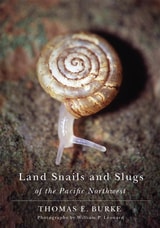
Land Snails and Slugs of the Pacific Northwest
Thomas E. Burke
Oregon State University Press, 2013
Primarily an identification guide, this richly illustrated volume offers complete information on the range of terrestrial mollusk shapes, sizes, and characteristics. It presents an overview of their habitat requirements as well as details of land snail and slug ecology, collection and preservation methods, and biogeography.
Land Snails and Slugs of the Pacific Northwest is an essential reference for biologists, horticulturalists, gardeners, and naturalists, and anyone wishing to identify species in the field.
• Identification keys and species accounts for most of the 245 taxa of terrestrial slugs and snails in the region
• 280 full-color photographs of 155 species and subspecies
• Range maps for most species
Land and Wine
The French TerroirCharles Frankel
University of Chicago Press, 2014
For centuries, France has long been the world’s greatest wine-producing country. Its wines are the global gold standard, prized by collectors, and its winemaking regions each offer unique tasting experiences, from the spice of Bordeaux to the berry notes of the Loire Valley. Although grape variety, climate, and the skill of the winemaker are essential in making good wine, the foundation of a wine’s character is the soil in which its grapes are grown. Who could better guide us through the relationship between the French land and the wine than a geologist, someone who deeply understands the science behind the soil? Enter scientist Charles Frankel.
In Land and Wine, Frankel takes readers on a tour of the French winemaking regions to illustrate how the soil, underlying bedrock, relief, and microclimate shape the personality of a wine. The book’s twelve chapters each focus in-depth on a different region, including the Loire Valley, Alsace, Burgundy, Champagne, Provence, the Rhône valley, and Bordeaux, to explore the full meaning of terroir. In this approachable guide, Frankel describes how Cabernet Franc takes on a completely different character depending on whether it is grown on gravel or limestone; how Sauvignon yields three different products in the hills of Sancerre when rooted in limestone, marl, or flint; how Pinot Noir will give radically different wines on a single hill in Burgundy as the vines progress upslope; and how the soil of each château in Bordeaux has a say in the blend ratios of Merlot and Cabernet-Sauvignon. Land and Wine provides a detailed understanding of the variety of French wine as well as a look at the geological history of France, complete with volcanic eruptions, a parade of dinosaurs, and a menagerie of evolution that has left its fossils flavoring the vineyards.
Both the uninitiated wine drinker and the confirmed oenophile will find much to savor in this fun guide that Frankel has spiked with anecdotes about winemakers and historic wine enthusiasts—revealing which kings, poets, and philosophers liked which wines best—while offering travel tips and itineraries for visiting the wineries today.
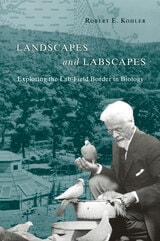
Landscapes and Labscapes
Exploring the Lab-Field Border in BiologyRobert E. Kohler
University of Chicago Press, 2002
In Landscapes and Labscapes, Robert E. Kohler explores the people, places, and practices of field biology in the United States from the 1890s to the 1950s. He takes readers into the fields and forests where field biologists learned to count and measure nature and to read the imperfect records of "nature's experiments." He shows how field researchers use nature's particularities to develop "practices of place" that achieve in nature what laboratory researchers can only do with simplified experiments. Using historical frontiers as models, Kohler shows how biologists created vigorous new border sciences of ecology and evolutionary biology.
Landscapes of Movement and Predation
Perspectives from Archaeology, History, and AnthropologyBrenda J. Bowser and Catherine M. Cameron
University of Arizona Press, 2024
Landscapes of predation also developed in precolonial times in places where people were subjected to repeated ruthless attacks and dislocation. With contributions from archaeologists and a historian, the book provides a startling new perspective on an aspect of the past that is often overlooked: the role of violence in shaping where, how, and with whom people lived. Using ethnohistoric, ethnographic, historic, and archaeological data, the authors explore the actions of both predators and their targets and uncover the myriad responses people took to protect themselves.
Contributors
Fernando Almeida
Thomas John Biginagwa
Brenda J. Bowser
Catherine M. Cameron
Charles Cobb
Robbie Ethridge
Thiago Kater
Richard M. Leventhal
Lydia Wilson Marshall
Cliverson Pessoa
Neil Price
Ben Raffield
Andrés Reséndez
Samantha Seyler
Fabíola Andréa Silva
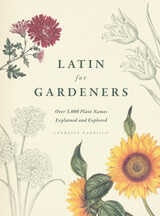
Latin for Gardeners
Over 3,000 Plant Names Explained and ExploredLorraine Harrison
University of Chicago Press, 2012
Since Latin became the standard language for plant naming in the eighteenth century, it has been intrinsically linked with botany. And while mastery of the classical language may not be a prerequisite for tending perennials, all gardeners stand to benefit from learning a bit of Latin and its conventions in the field. Without it, they might buy a Hellebores foetidus and be unprepared for its fetid smell, or a Potentilla reptans with the expectation that it will stand straight as a sentinel rather than creep along the ground.
An essential addition to the gardener’s library, this colorful, fully illustrated book details the history of naming plants, provides an overview of Latin naming conventions, and offers guidelines for pronunciation. Readers will learn to identify Latin terms that indicate the provenance of a given plant and provide clues to its color, shape, fragrance, taste, behavior, functions, and more.

Lebanese Amber
The Oldest Insect Ecosystem in Fossilized ResinGeorge Poinar Jr.
Oregon State University Press, 2001
Legumes of Africa
a checklistJ. M. Lock
Royal Botanic Gardens, Kew, 2000
Legumes of West Asia
a checklistJ. M. Lock and K. Simpson
Royal Botanic Gardens, Kew, 2000
Les aires protégées terrestres de Madagascar
leur histoire, description et biota, tome 1: IntroductionEdited by Steven M. Goodman, Marie Jeanne Raherilalao, and Sébastien Wohlhauser
Association Vahatra, 2020
The purpose of the French-language Les aires protégées terrestres de Madagascar is to present a large-scale update of information available from 98 terrestrial protected areas, various analyses to understand general trends in the conservation of these sites, and a synthesis to assess the needs for future scientific programs. Beautifully illustrated throughout with color maps, graphs, and photos, these three volumes will be an important reference for students, researchers, protected area managers, conservationists, and visiting ecotourists. Volume one provides a comprehensive introduction.
Les aires protégées terrestres de Madagascar
leur histoire, description et biota, tome 2: Le Nord et l'Est de MadagascarEdited by Steven M. Goodman, Marie Jeanne Raherilalao, and Sébastien Wohlhauser
Association Vahatra, 2020
The purpose of the French-language Les aires protégées terrestres de Madagascar is to present a large-scale update of information available from 98 terrestrial protected areas, various analyses to understand general trends in the conservation of these sites, and a synthesis to assess the needs for future scientific programs. Beautifully illustrated throughout with color maps, graphs, and photos, these three volumes will be an important reference for students, researchers, protected area managers, conservationists, and visiting ecotourists. Volume two covers northern and eastern Madagascar.
Les aires protégées terrestres de Madagascar
leur histoire, description et biota, tome 3: L'Ouest et le Sud de Madagascar - SynthèseEdited by Steven M. Goodman, Marie Jeanne Raherilalao, and Sébastien Wohlhauser
Association Vahatra, 2020
The purpose of the French-language Les aires protégées terrestres de Madagascar is to present a large-scale update of information available from 98 terrestrial protected areas, various analyses to understand general trends in the conservation of these sites, and a synthesis to assess the needs for future scientific programs. Beautifully illustrated throughout with color maps, graphs, and photos, these three volumes will be an important reference for students, researchers, protected area managers, conservationists, and visiting ecotourists. Volume three covers western and southwestern Madagascar, as well as provides a valuable synthesis.
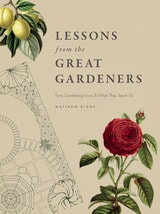
Lessons from the Great Gardeners
Forty Gardening Icons and What They Teach UsMatthew Biggs
University of Chicago Press, 2016
Entries for each gardening great highlight their iconic plants and garden designs, revealing both the gardeners’ own influences and the seeds—sometimes literal—that they sowed for gardens yet to sprout. From André Le Nôtre in seventeenth-century France, who drew on his training as an architect and hydraulic engineer to bring the topiary form to Vaux-le-Vicomte and Versailles, to the work of High Line and Lurie Garden designer Piet Oudolf, and Thomas Jefferson’s advice on creating protected garden microclimates for help growing early crops and tender fruit like figs (with peas, a Jefferson favorite), Lessons from the Great Gardeners is a resource as rich as the soil from which it springs.
Featuring lush illustrations harvested from the archives of the Royal Horticultural Society, as well as sections on a dozen international gardens that showcase the lessons of the greats, this homage to the love of good, clean dirt is sure to inspire readers to get out in the sun and dig.
Letters from Alabama
Chiefly Relating to Natural HIstoryPhilip Henry Gosse, introduction by Harvey H. Jackson III, edited by Virginia Hamilton
University of Alabama Press, 1993
A naturalist's captivating portrait of Alabama's wildlife, landscapes, and people.
Philip Henry Gosse (1810-1888), a British naturalist, left home at age 17 and made his way to Alabama in 1838, where he had heard educated people were in demand. He was employed by Judge Reuben Saffold at Pleasant Hill in Dallas County as a teacher for about a dozen children of local landowners, but his principal interest was natural history. During the eight months he lived in th Black Belt he watched, listened, thought, took notes, and made sketches--activities that eventually led to Letters from Alabama. He lived among Alabamians, talked and listened to them, saw them at their best and their worst, and came to understand their hopes and fears. They were a part of the natural world, and he paid attention to them as any good scientist would. With the skills of a scientist and the temperament of an artist, Gosse set down an account of natural life in frontier Alabama that has no equal. Written to no one in particular, a common literary device of the period, the letters were first published in a magazine, and in 1859 appeared as a book. By that time Gosse was an established scholar and one of England’s most noted scientific illustrators.
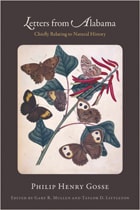
Letters from Alabama
Chiefly Relating to Natural HistoryPhilip Henry Gosse, Edited by Gary R. Mullen and Taylor D. Littleton
University of Alabama Press, 2013
New and improved edition of a naturalist's captivating portrait of Alabama's wildlife, landscapes, and people.
Philip Henry Gosse (1810–1888), a British naturalist, left home at age seventeen and made his way to Alabama in 1838. He was employed by Judge Reuben Saffold and other planters near Pleasant Hill in Dallas County as a teacher for about a dozen of their children, but his principal interest was natural history. Letters from Alabama is a personalized record of Gosse’s perceptive observations during his eight-month residence in this small antebellum community. The work addresses a Victorian readership, including entomologists, who Gosse believed were relatively uninformed about the novelty and beauty of this “hilly region of the State of Alabama.” Written in an engaging literary style and organized as a series of epistolary discussions, the book is unparalleled in its detailed evocations of the natural history and cultural conditions of frontier Alabama. By the time Letters from Alabama appeared in 1859, Gosse’s scientific publications and fine illustrations had led to his being elected a Fellow of the Royal Society of London.
Edited by Gary R. Mullen and Taylor D. Littleton, this authoritative edition features thirty grayscale lithographs shot directly from the 1859 edition, reset type for easier reading, a new introduction and index by the two foremost scholars of Gosse in Alabama, a new appendix that provides modern scientific and common names for the plant and animal species described by Gosse, and a four-color cover featuring one of the plates from Gosse’s Entomologia Alabamensis.
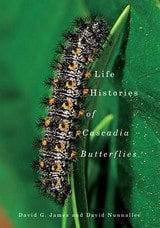
Life Histories of Cascadia Butterflies
David G. James
Oregon State University Press, 2011

Life Out of Balance
Homeostasis and Adaptation in a Darwinian WorldJoel B. Hagen
University of Alabama Press, 2021
Exploring how scientists came to understand life's balance between stability and adaptation.
Life Out of Balance focuses on a period in history when new ideas of self-regulation, adaptation, and fitness became central to a variety of biological disciplines. During the decades surrounding World War II, these ideas developed in several quite different contexts and led to greater debates about the merits of such models as applied to larger systems, including society at large. Particularly in its later cybernetic form, homeostasis seemed to provide new ways of discussing balance and regulation that avoided discredited approaches of earlier champions of vitalism and mechanism. It provided a common perspective and terminology for discussing self-regulating “systems,” whether biological, mechanical, or social. Although enormously fruitful and influential, homeostatic perspectives also generated numerous controversies when critics questioned the degree to which biological systems are characterized by balance and self-regulation. Resolving these controversies continues to be a challenge in modern biology.
If natural selection constitutes the first law of biology, scientists who champion homeostasis as a theoretical model claim that it is a second law, equally important and closely related to the first. Such claims notwithstanding, homeostasis has generated a series of controversies since it was formalized by Walter Cannon in the late 1920s. Critics contended that Cannon took a too-optimistic view of life, not only ignoring pathological deviations from normality but also failing to adequately explain the ability of living things to respond adaptively to environmental challenges.
Underlying these controversies was the unresolved problem of integrating physiology and other areas of functional biology with the emerging evolutionary synthesis of Mendelian genetics and Darwinian natural selection. The physiological idea of homeostasis as the adaptive “fit” between the organism and its environment and the Darwinian idea of adaptation and fitness in terms of reproductive success might seem to be complementary in an unproblematic way, but historically they have had an uneasy relationship.
Life Out of Sequence
A Data-Driven History of BioinformaticsHallam Stevens
University of Chicago Press, 2013
Life Underground
The Biology of Subterranean RodentsEdited by Eileen A. Lacey, James L. Patton, and Guy N. Cameron
University of Chicago Press, 2000
Life Underground provides the first comprehensive review of the biology of subterranean rodents. Arranged by topic rather than by taxon to facilitate cross-species comparisons, chapters cover such subjects as morphology, physiology, social behavior, genetic variation, and evolutionary diversification. Two main questions run throughout the book. First, to what extent has subterranean life shaped the biology of these animals, leading to similar adaptations among otherwise dissimilar species? Second, how have the distinct evolutionary histories of these groups led to different solutions to the challenges posed by life underground?
Life in the Cold
An Introduction to Winter Ecology, fourth editionPeter J. Marchand
University Press of New England, 2014
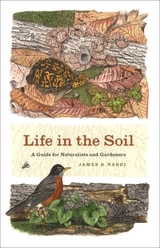
Life in the Soil
A Guide for Naturalists and GardenersJames B. Nardi
University of Chicago Press, 2007
Leonardo da Vinci once mused that “we know more about the movement of celestial bodies than about the soil underfoot,” an observation that is as apt today as it was five hundred years ago. The biological world under our toes is often unexplored and unappreciated, yet it teems with life. In one square meter of earth, there lives trillions of bacteria, millions of nematodes, hundreds of thousands of mites, thousands of insects and worms, and hundreds of snails and slugs. But because of their location and size, many of these creatures are as unfamiliar and bizarre to us as anything found at the bottom of the ocean.
Lavishly illustrated with nearly three hundred color illustrations and masterfully-rendered black and white drawings throughout, Life in the Soil invites naturalists and gardeners alike to dig in and discover the diverse community of creatures living in the dirt below us. Biologist and acclaimed natural history artist James B. Nardibegins with an introduction to soil ecosystems, revealing the unseen labors of underground organisms maintaining the rich fertility of the earth as they recycle nutrients between the living and mineral worlds. He then introduces readers to a dazzling array of creatures: wolf spiders with glowing red eyes, snails with 120 rows of teeth, and 10,000-year-old fungi, among others. Organized by taxon, Life in the Soil covers everything from slime molds and roundworms to woodlice and dung beetles, as well as vertebrates from salamanders to shrews. The book ultimately explores the crucial role of soil ecosystems in conserving the worlds above and below ground.
A unique and illustrative introduction to the many unheralded creatures that inhabit our soils and shape our environment aboveground, Life in the Soil will inform and enrich the naturalist in all of us.
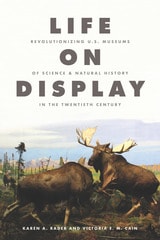
Life on Display
Revolutionizing U.S. Museums of Science and Natural History in the Twentieth CenturyKaren A. Rader and Victoria E. M. Cain
University of Chicago Press, 2014
Rader and Cain explain why science and natural history museums began to welcome new audiences between the 1900s and the 1920s and chronicle the turmoil that resulted from the introduction of new kinds of biological displays. They describe how these displays of life changed dramatically once again in the 1930s and 1940s, as museums negotiated changing, often conflicting interests of scientists, educators, and visitors. The authors then reveal how museum staffs, facing intense public and scientific scrutiny, experimented with wildly different definitions of life science and life science education from the 1950s through the 1980s. The book concludes with a discussion of the influence that corporate sponsorship and blockbuster economics wielded over science and natural history museums in the century’s last decades.
A vivid, entertaining study of the ways science and natural history museums shaped and were shaped by understandings of science and public education in the twentieth-century United States, Life on Display will appeal to historians, sociologists, and ethnographers of American science and culture, as well as museum practitioners and general readers.
Life's Splendid Drama
Evolutionary Biology and the Reconstruction of Life's Ancestry, 1860-1940Peter J. Bowler
University of Chicago Press, 1996
"Intriguing and insightful."—William Kimler, American Scientist
"[A] volume of impressive scholarship and extensive references."—Library Journal
"One of Bowler's best."—Kevin Padian, Nature
"[Bowler's] comprehensive review of the various debates and ideas in taxonomy, morphology, and vertebrate evolution . . . deserves the attention of biologists and other scholars interested in the history of ideas."—Choice
"The persistence of pre-Darwinian modes of thought in contemporary biology underlines the importance of Bowler's book. Its value is not only in the history it provides, but also in the way it illumines the present."—Peter J. Causton, Boston Book Review
Lifebirds
Levine, George
Rutgers University Press, 1995
In the tradition of Annie Dillard, this book is a set of meditations on nature, in this case specifically on the way birds and birding are entangled with life, with work, family, and friends. While it delicately narrates loving engagement with birds, it is not a field guide. Its author is a birder, not a professional ornithologist. Although the book does in fact offer a surprising amount of detail about birds, it is primarily a consideration of the experience and human significance of seeing birds, rather than of the birds in themselves as objects of systematic study. It attempts to convey something of the extraordinary variety and excitement of birding, the complications and subtleties of bird identification, the implication of birding in the imagination and the world against which it is usually defined.
While one doesn’t have to be interested in birds to read it with pleasure, it attempts to seduce the reader into the birding experience through a series of autobiographical memoirs with birds at their center. It is not meant for experts, except as experts might be interested in how a journeyman experiences their more significantly constructed world. In the end the book is about a lot more than birds. It is about “lifebirds,” with all the many meanings that word might seem to imply.
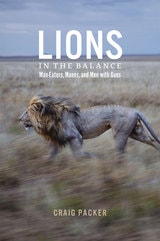
Lions in the Balance
Man-Eaters, Manes, and Men with GunsCraig Packer
University of Chicago Press, 2015
Monsters take many forms: from man-eating lions to the people who hunt them, from armed robbers to that midnight knock at the door of a cheap hotel room in Dar es Salaam. And celebrated biologist Craig Packer has faced them all. Head on.
With Lions in the Balance, Packer takes us back into the complex, tooth-and-claw world of the African lion, offering revealing insights into both the lives of one of the most iconic and dangerous animals on earth and the very real risks of protecting them. A sequel to his prize-winning Into Africa—which gave many readers their first experience of fieldwork in Africa, of cooperative lions on dusty savannas, and political kidnappings on the shores of Lake Tanganyika—this new diary-based chronicle of cutting-edge research and heartbreaking corruption will both alarm and entertain. Packer’s story offers a look into the future of the lion, one in which the politics of conservation will require survival strategies far more creative and powerful than those practiced anywhere in the world today.
Packer is sure to infuriate millionaires, politicians, aid agencies, and conservationists alike as he minces no words about the problems he encounters. But with a narrative stretching from far flung parts of Africa to the corridors of power in Washington, DC, and marked by Packer’s signature humor and incredible candor, Lions in the Balance is a tale of courage against impossible odds, a masterly blend of science, adventure, and storytelling, and an urgent call to action that will captivate a new generation of readers.
Liquidity, Flows, Circulation
The Cultural Logic of EnvironmentalizationEdited by Mathias Denecke, Holger Kuhn, and Milan Stürmer
Diaphanes, 2022
Placed at the intersection of art, media, and cultural studies as well as economic theory, Liquidity, Flows, Circulation investigates the cultural logic of environmentalization. As flows, circulations, and liquidity resurface in all aspects of recent culture and contemporary art, this volume investigates the hypothesis of a genuine cultural logic of environmentalization through these three concepts.
It thus brings together two areas of research that have been largely separate. On the one hand, this volume takes up discussions about ecologies with and without nature and environmentalization as a contemporary form of power and capital. On the other hand, it takes its cue from Fredric Jameson’s notion that each stage of capitalism is accompanied by a genuine cultural logic. The volume introduces this current of materialist thinking into the ongoing discussions of ecologies and environmentalization. By analyzing contemporary art, architecture, theater, films, and literature, the fifteen contributions by scholars and artists explore different fields where liquid forms, semantics flow, or processes of circulation emerge as a contemporary cultural logic.
Listening to Beauty
Rhetorics of Science in Sea and SoundMegan Poole
University of Chicago Press, 2025
Our attempts to understand the world are always more than simply rational. Our bodies learn through lived experience, our natural environments challenge what we think we know, and we take lessons from our nonhuman kin. Even scientists, often considered paragons of rationality, frequently describe their findings in the language of beauty. For rhetorician Megan Poole, beauty is integral to how scientific research works.
Drawing on interviews with leading biologists, Poole explores what happens when scientists set aside objectivity and listen for beauty around them. The wonder we feel at the plumage of birds, the melodies of whales, or the caretaking of elephants may not help us (on its own) to isolate a given fact, but such encounters may teach us to open ourselves to a different way of knowing entirely. Through stories about researchers’ encounters with wonder, Listening to Beauty reveals how scientific discovery happens sometimes unsystematically, sometimes incoherently, often beautifully.
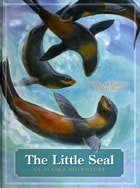
Little Seal
An Alaska AdventureWritten and Illustrated by Ram Papish
University of Alaska Press, 2009
The northern fur seal spends most of its life in the open ocean of the North Pacific, from California up through Alaska and down to Japan. These seals travel hundreds of miles, farther than any other seal or sea lion, to reach their remote breeding grounds. Most fur seals go to the Pribilof Islands of Alaska, where, historically, several million fur seals converged annually, but the population counted in the Pribilofs in 2008 was less than one million and dropping rapidly. Ram Papish’s richly illustrated story follows these magnificent—and increasingly vulnerable—creatures through the most important part of their lives.
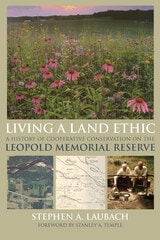
Living a Land Ethic
A History of Cooperative Conservation on the Leopold Memorial ReserveStephen A. Laubach
University of Wisconsin Press, 2014
Living a Land Ethic chronicles the formation of the 1,600-acre reserve surrounding the Shack. When the Leopold Memorial Reserve was founded in 1967, five neighboring families signed an innovative agreement to jointly care for their properties in ways that honored Aldo Leopold's legacy. In the ensuing years, the Reserve's Coleman and Leopold families formed the Sand County Foundation and the Aldo Leopold Foundation. These organizations have been the primary stewards of the Reserve, carrying on a tradition of ecological restoration and cooperative conservation. Author Stephen A. Laubach draws from the archives of both foundations, including articles of incorporation, correspondence, photos, managers' notes, and interviews to share with readers the Reserve's untold history and its important place in the American conservation movement.
Living in the Plastic Age
Perspectives from Humanities, Social Sciences and Natural SciencesEdited by Johanna Kramm and Carolin Völker
Campus Verlag, 2022
The anthology Living in the Plastic Age focuses on the multidimensional facets of plastics and microplastics from different disciplinary angles. Small plastic fragments (microplastics) and larger plastic waste can be found even on the remotest island. Plastic waste all over the planet is the visual footprint of humanity’s consumerism and mass production. Plastics shape the relationship between society and nature in such a profound way that we can today speak of the “Plastic Age.” This anthology aims to question the role of plastics in our society and the implications plastics have for the environment and human health. The detection of this emergent contaminant opens up a new field of scientific engagement for natural sciences on the effects of (micro-) plastics for the environment and the social sciences on new governance regimes on marine litter as well as on solution strategies to combat plastic waste.
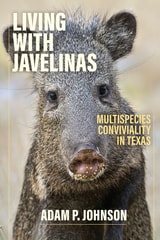
Living with Javelinas
Multispecies Conviviality in TexasAdam P. Johnson
University of Texas Press, 2026
An ethnography on how both humans and javelinas can thrive in shared space.
As human settlements expand into formerly wild lands, coexistence with wildlife is no longer optional––it’s a daily negotiation. In Living with Javelinas, Adam Johnson explores what it means to share space and adapt in a more-than-human world. Often mistaken for wild pigs, javelinas unsettle the boundaries between nuisance and neighbor. Johnson traces the other species that shape their lives––feral hogs, prickly pear, mountain cedar––and examines how folklore, perception, and memory influence human–javelina encounters. Drawing on ethnographic, ecological, and ethological research across Texas, he shows how coexistence becomes a practical, albeit often uneasy, conviviality.
In much of Texas, decades of hunting have made javelinas wary. Through extended time with rancher Roger Gray, who encounters and feeds javelinas daily, Johnson reveals how repeated contact can foster a mutually responsive relationship. Bringing anthropology into dialogue with ecology, Living with Javelinas argues that coexistence is not harmony but an ongoing adjustment. In a time of ecological strain, situated acts of accommodation point toward more ethical and sustainable ways of living together.
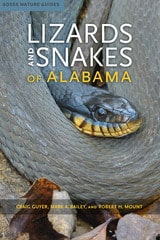
Lizards and Snakes of Alabama
Craig Guyer, Mark A. Bailey, and Robert H. Mount
University of Alabama Press, 2019
The Definitive Guide to Alabama’s Reptilian Wildlife.
Lizards and Snakes of Alabama is the most comprehensive taxonomy gathered since Robert H. Mount’s seminal 1975 volume on the reptiles and amphibians of Alabama. This richly illustrated guide provides an up-to-date summary of the taxonomy and life history of lizards and snakes native to, or introduced to, the state.
Alabama possesses one of the most species-rich biotas in north temperate areas and this richness is reflected in some groups of lizards, such as skinks, and especially in snakes. The authors examine all known species within the state and describe important regional variations in each species, including changes in species across the many habitats that comprise the state. Significant field studies, especially of Alabama’s threatened and endangered species, have been performed and are used to inform discussion of each account.
The life-history entry for each species is comprised of scientific and common names, full-color photographs, a morphological description, discussion of habits and life cycle, and a distribution map depicting the species range throughout the state, as well as notes on conservation and management practices. The illustrated taxonomic keys provided for families, genera, species, and subspecies are of particular value to herpetologists.
This extensive guide will serve as a single resource for understanding the rich natural history of Alabama by shedding light on an important component of that biodiversity. Accessible to all, this volume is valuable to both the professional herpetologist and the general reader interested in snakes and lizards.
Long-Shadowed Forest
Helen Hoover
University of Minnesota Press, 1998
Longevity, Senescence, and the Genome
Caleb E. Finch
University of Chicago Press, 1990
To enhance gerontology's focus on human age-related dysfunctions, Caleb E. Finch provides a comparative review of all the phyla of organisms, broadening gerontology to intersect with behavioral, developmental, evolutionary, and molecular biology. By comparing species that have different developmental and life spans, Finch proposes an original typology of senescence from rapid to gradual to negligible, and he provides the first multiphyletic calculations of mortality rate constants.
Lords of the Fly
Drosophila Genetics and the Experimental LifeRobert E. Kohler
University of Chicago Press, 1994
In Lords of the Fly, Robert E. Kohler argues that fly laboratories are a special kind of ecological niche in which the wild fruit fly is transformed into an artificial animal with a distinctive natural history. He shows that the fly was essentially a laboratory tool whose startling productivity opened many new lines of genetic research. Kohler also explores the moral economy of the "Drosophilists": the rules for regulating access to research tools, allocating credit for achievements, and transferring authority from one generation of scientists to the next.
By closely examining the Drosophilists' culture and customs, Kohler reveals essential features of how experimental scientists do their work.
Lousy Sex
Gerald N. Callahan
University Press of Colorado, 2013
In his stories about where we came from and who we are, Callahan uses autobiographical episodes to illustrate his scientific points. Through stories about the sex lives of wood lice, the biological advantages of eating dirt, the question of immortality, the relationship between syphilis and the musical genius of Beethoven, and more, this book creates another way, a chimeric way, of seeing ourselves. The general reader with an interest in science will find Lousy Sex fascinating.