Results by title
22279 books match the query 'Social Science' and 714 start with l

L.A. Private Eyes
Dahlia Schweitzer
Rutgers University Press, 2019
Watch a video of the author speaking about this topic: https://goo.gl/Xr9RFD
And also: https://www.dropbox.com/s/mkqw3mplruf7jje/Detective%20Talk%20Full.mp4?dl=0 (https://www.dropbox.com/s/mkqw3mplruf7jje/Detective%20Talk%20Full.mp4?dl=0)
L.A. Story
Immigrant Workers and the Future of the U.S. Labor MovementRuth Milkman
Russell Sage Foundation, 2006

LA Sports
Play, Games, and Community in the City of AngelsWayne Wilson
University of Arkansas Press, 2018
LEARNING TO BE AN ANTHROPOLOGIST
SELECTED WRITINGSDr. Beatrice Medicine
University of Illinois Press, 2001
For half a century, Dr. Medicine has defied stereotypes, racism, and sexism in her life and work while combating the reductive, patronizing views of Native Americans perpetuated by mainstream anthropologists. This retrospective collection reflects her unswerving commitment to furthering Native Americans' ability to speak for themselves and deal with the problems of contemporary life.
Learning to Be an Anthropologist and Remaining "Native" includes Medicine's clear-eyed views of assimilation, bilingual education, and the adaptive strategies by which Native Americans have conserved and preserved their ancestral languages. Her discussions of sex roles in contemporary Native American societies encompass homosexual orientation among males and females and the "warrior woman" role among Plains Indians as one of several culturally accepted positions according power and prestige to women. The volume also includes Medicine's thoughtful assessments of kinship and family structures, alcoholism and sobriety, the activism implicit in the religious ritual of the Lakota Sioux Sun Dance, and the ceremonial uses of Lakota star quilts.
"The Native American is possibly the least understood ethnic minority in contemporary American society," Medicine observes. Her decades of deliberate, generous, dedicated work have done much to reveal the workings of Native culture while illuminating the effects of racism and oppression on Indian families, kinship units, and social and cultural practices.

LGBT Youth in America's Schools
Jason Cianciotto and Sean Cahill
University of Michigan Press, 2012
Jason Cianciotto and Sean Cahill, experts on lesbian, gay, bisexual, and transgender public policy advocacy, combine an accessible review of social science research with analyses of school practices and local, state, and federal laws that affect LGBT students. In addition, portraits of LGBT youth and their experiences with discrimination at school bring human faces to the issues the authors discuss.
This is an essential guide for teachers, school administrators, guidance counselors, and social workers interacting with students on a daily basis; school board members and officials determining school policy; nonprofit advocates and providers of social services to youth; and academic scholars, graduate students, and researchers training the next generation of school administrators and informing future policy and practice.

LGBT Youth in America's Schools
Jason Cianciotto and Sean Cahill
University of Michigan Press, 2012
Jason Cianciotto and Sean Cahill, experts on lesbian, gay, bisexual, and transgender public policy advocacy, combine an accessible review of social science research with analyses of school practices and local, state, and federal laws that affect LGBT students. In addition, portraits of LGBT youth and their experiences with discrimination at school bring human faces to the issues the authors discuss.
This is an essential guide for teachers, school administrators, guidance counselors, and social workers interacting with students on a daily basis; school board members and officials determining school policy; nonprofit advocates and providers of social services to youth; and academic scholars, graduate students, and researchers training the next generation of school administrators and informing future policy and practice.
LGBTQ Politics in Nicaragua
Revolution, Dictatorship, and Social MovementsKaren Kampwirth
University of Arizona Press, 2022
Karen Kampwirth is a renowned scholar of the Nicaraguan Revolution, who has been writing at the intersection of gender and politics for decades. In this chronological telling of the last fifty years of political history in Nicaragua, Kampwirth deploys a critical new lens: understanding politics from the perspective of the country’s LGBTQ community. Kampwirth details the gay and lesbian guerrillas in the 1960s and 1970s, Nicaragua’s first openly gay television wizard in the 1980s, and the attempts by LGBTQ revolutionaries to create a civil rights movement and the subsequent squashing of that movement by the ruling Sandinista party. She analyzes the shifting political alliances, the rise of strong feminist and LGBTQ movements in Nicaragua, and the attempts by the administration of Daniel Ortega to co-opt and control these movements.
Ultimately, this is a story of struggle and defeat, progress and joy. This timely book provides a well-documented review of LGBTQ politics in modern Nicaragua, helping us to see the Sandinista Revolution and its ongoing aftermath in a new light.

LITIGATION AS LOBBYING
REPRODUCTIVE HAZARDS & INTEREST AGGREGATIONJULIANNA S. GONEN
The Ohio State University Press, 2003

LONGTERM and PEAKSCAN
Neutron Activation Analysis Computer ProgramsThomas Meyers and Mark Denies
University of Michigan Press, 1972
LULAC
The Evolution of a Mexican American Political OrganizationBy Benjamin Márquez
University of Texas Press, 1993
The League of United Latin American Citizens (LULAC) is one of the best-known and active national organizations that represent Mexican Americans and their political interests. Since its founding in Corpus Christi, Texas, in 1929, it has served as a vehicle through which Mexican Americans can strive for equal rights and economic assimilation into Anglo American society.
This study is the first comprehensive political history of LULAC from its founding through the 1980s. Márquez explores the group’s evolution from an activist, grassroots organization in the pre– and post–World War II periods to its current status as an institutionalized bureaucracy that relies heavily on outside funding to further its politically conservative goals. His information is based in part on many primary source materials from the LULAC archives at the University of Texas at Austin, the Houston Public Library, and the University LULAC publications, as well as interviews with present and past LULAC activists.
Márquez places this history within the larger theoretical framework of incentive theory to show how changing, and sometimes declining, membership rewards have influenced people’s participation in LULAC and other interest groups over time. Ironically, as of 1988, LULAC could claim fewer than 5,000 dues-paying members, yet a dedicated and skillful leadership secured sufficient government and corporate monies to make LULAC one of the most visible and active groups in Mexican American politics.
Given the increasing number of interest groups and political action committees involved in national politics in the United States, this case study of a political organization’s evolution will be of interest to a wide audience in the political and social sciences, as well as to students of Mexican American and ethnic studies.
La Calle
Spatial Conflicts and Urban Renewal in a Southwest CityLydia R. Otero
University of Arizona Press, 2010
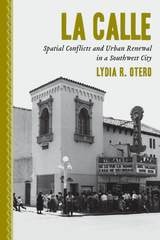
Otero examines conflicting claims to urban space, place, and history as advanced by two opposing historic preservationist groups: the La Placita Committee and the Tucson Heritage Foundation. Otero gives voice to those who lived in, experienced, or remembered this contested area, and analyzes the historical narratives promoted by Anglo American elites in the service of tourism and cultural dominance.
La Calle explores the forces behind the mass displacement: an unrelenting desire for order, a local economy increasingly dependent on tourism, and the pivotal power of federal housing policies. To understand how urban renewal resulted in the spatial reconfiguration of downtown Tucson, Otero draws on scholarship from a wide range of disciplines: Chicana/o, ethnic, and cultural studies; urban history, sociology, and anthropology; city planning; and cultural and feminist geography.
La Consentida
Settlement, Subsistence, and Social Organization in an Early Formative Mesoamerican CommunityGuy David Hepp
University Press of Colorado, 2019
La Consentida explores Early Formative period transitions in residential mobility, subsistence, and social organization at the site of La Consentida in coastal Oaxaca, Mexico. Examining how this site transformed during one of the most fundamental moments of socioeconomic change in the ancient Americas, the book provides a new way of thinking about the social dynamics of Mesoamerican communities of the period.
Guy David Hepp summarizes the results of several seasons of fieldwork and laboratory analysis under the aegis of the La Consentida Archaeological Project, drawing on various forms of evidence—ground stone tools, earthen architecture, faunal remains, human dental pathologies, isotopic indicators, ceramics, and more— to reveal how transitions in settlement, subsistence, and social organization at La Consentida were intimately linked. While Mesoamerica is too diverse for research at a single site to lay to rest ongoing debates about the Early Formative period, evidence from La Consentida should inform those debates because of the site’s unique ecological setting, its relative lack of disturbance by later occupations, and because it represents the only well-documented Early Formative period village in a 300-mile stretch of Mexico’s Pacific coast.
One of the only studies to closely document multiple lines of evidence of the transition toward a sedentary, agricultural society at an individual settlement in Mesoamerica, La Consentida is a key resource for understanding the transition to settled life and social complexity in Mesoamerican societies.
La Florida del Inca and the Struggle for Social Equality in Colonial Spanish America
Jonathan D. Steigman
University of Alabama Press, 2005
A cross-disciplinary view of an important De Soto chronicle.
Among the early Spanish chroniclers who contributed to popular images of the New World was the Amerindian-Spanish (mestizo) historian and literary writer, El Inca Garcilaso de la Vega (1539-1616). He authored several works, of which La Florida del Inca (1605) stands out as the best because of its unique Amerindian and European perspectives on the De Soto expedition (1539-1543). As the child of an Indian mother and a Spanish father, Garcilaso lived in both worlds--and saw value in each. Hailed throughout Europe for his excellent contemporary Renaissance writing style, his work was characterized as literary art. Garcilaso revealed the emotions, struggles, and conflicts experienced by those who participated in the historic and grandiose adventure in La Florida. Although criticized for some lapses in accuracy in his attempts to paint both the Spaniards and the Amerindians as noble participants in a world-changing event, his work remains the most accessible of all the chronicles.
In this volume, Jonathan Steigman explores El Inca’s rationale and motivations in writing his chronicle. He suggests that El Inca was trying to influence events by influencing discourse; that he sought to create a discourse of tolerance and agrarianism, rather than the dominant European discourse of intolerance, persecution, and lust for wealth. Although El Inca's purposes went well beyond detailing the facts of De Soto’s entrada, his skill as a writer and his dual understanding of the backgrounds of the participants enabled him to paint a more complete picture than most--putting a sympathetic human face on explorers and natives alike.
La Frontera
Forests and Ecological Conflict in Chile's Frontier TerritoryThomas Miller Klubock
Duke University Press, 2014
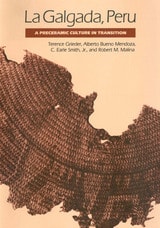
La Galgada, Peru
A Preceramic Culture in TransitionBy Terence E. Grieder, Alberto Bueno Mendoza, C. Earle Smith, Jr., and Robert M. Malina
University of Texas Press, 1988
Excavations over many years in the Peruvian Andes and coastal regions have revealed that the village settlements on the west coast of South America were one of the early centers of world civilization. One of these settlements, La Galgada, flourished from 3000 B.C. to 1700 B.C. Its extraordinarily complete cultural remains help to reconstruct a picture of human life, health, activities, and trade relations as they were 4,000 years ago and allow us to enter the mental and artistic life of this early civilization.
The location of La Galgada on Peru’s Tablachaca River midway between the highlands and the coast caused it to be influenced by the culture of both those regions. The remains found at La Galgada tie together important textile collections from the coastal region with important architectural remains from the Andean highland to give a picture of a complete preceramic culture in ancient Peru. Numerous illustrations provide an exciting visual catalog of the finds at La Galgada. What also makes La Galgada such a significant site are the changes in art and architecture that can be documented in considerable detail from about 2500 B.C. to about 1700 B.C. During that period, La Galgada and the other preceramic communities in northern Peru were transformed with a rapidity that must have seemed shocking and revolutionary to their inhabitants. These changes record the first appearance of the powerful and intimidating Chavín culture that was to dominate the region for the next thousand years. They also allow us to watch a people change and adapt as they try to cope with the powerful pressure of technical and social development in their region.
La Gente
Hispano History and Life in ColoradoVincent C. De Baca
University Press of Colorado, 1998
Several essays address the employment patterns of the early part of this century, when desperate native-born Hispanos and Mexican immigrants competed by the thousands for jobs at mining and agricultural corporations throughout Colorado. Four essays study particular expressions of this conflict, including the infamous Ludlow coal strike of 1913-1914; Colorado's sugar beet industry, where Mexican immigrants faced constant discrimination; the growth of the state's sugar industry, the collapse of which devastated Mexicans (the preferred labor force in the field); and a New Deal-era experiment in which laid-off miners were trained to weave Río Grande-style blankets, in the process revitalizing a dying folk art.
Finally, four essays encompass the recent political and cultural rebirth of Hispanos, including a study of the origins of the Crusade for Justice, Denver's leading Chicano rights organization of the 1960s, which - based on declassified FBI documents - proves that government agencies tried to suppress the Crusade and its popular leader, Corky Gonzales.
La Gente
Struggles for Empowerment and Community Self-Determination in SacramentoLorena V. Márquez
University of Arizona Press, 2020
Though diverse in their cultural and generational backgrounds, la gente were constantly negotiating acts of resistance, especially when their lives, the lives of their children, their livelihoods, or their households were at risk. Historian Lorena V. Márquez documents early community interventions to challenge the prevailing notions of desegregation by barrio residents, providing a look at one of the first cases of outright resistance to desegregation efforts by ethnic Mexicans. She also shares the story of workers in the Sacramento area who initiated and won the first legal victory against canneries for discriminating against brown and black workers and women, and demonstrates how the community crossed ethnic barriers when it established the first accredited Chicana/o and Native American community college in the nation.
Márquez shows that the Chicana/o Movement was not solely limited to a handful of organizations or charismatic leaders. Rather, it encouraged those that were the most marginalized—the working poor, immigrants and/or the undocumented, and the undereducated—to fight for their rights on the premise that they too were contributing and deserving members of society.
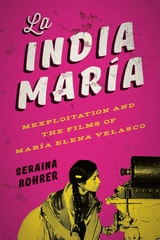
La India María
Mexploitation and the Films of María Elena VelascoBy Seraina Rohrer
University of Texas Press, 2017
La India María—a humble and stubborn indigenous Mexican woman—is one of the most popular characters of the Mexican stage, television, and film. Created and portrayed by María Elena Velasco, La India María has delighted audiences since the late 1960s with slapstick humor that slyly critiques discrimination and the powerful. At the same time, however, many critics have derided the iconic figure as a racist depiction of a negative stereotype and dismissed the India María films as exploitation cinema unworthy of serious attention. By contrast, La India María builds a convincing case for María Elena Velasco as an artist whose work as a director and producer—rare for women in Mexican cinema—has been widely and unjustly overlooked.
Drawing on extensive interviews with Velasco, her family, and film industry professionals, as well as on archival research, Seraina Rohrer offers the first full account of Velasco’s life; her portrayal of La India María in vaudeville, television, and sixteen feature film comedies, including Ni de aquí, ni de allá [Neither here, nor there]; and her controversial reception in Mexico and the United States. Rohrer traces the films’ financing, production, and distribution, as well as censorship practices of the period, and compares them to other Mexploitation films produced at the same time. Adding a new chapter to the history of a much-understudied period of Mexican cinema commonly referred to as “la crisis,” this pioneering research enriches our appreciation of Mexploitation films.

La Partera
Story of a MidwifeFran Leeper Buss
University of Michigan Press, 2001
This is Jesusita's story, told in her own words. She describes her early training as a midwife, her forced departure from home due to two unmarried pregnancies, and her solitary struggle to support her children. La Partera tells how she gradually emerged as a leader in her community, painstakingly building by hand a small maternity center for her patients while gaining the respect of the Anglo medical community.
As Jesusita's story unfolds, so too does the story of the women of the region. Supplemental sections by the author illuminate Jesusita's culture and past, along with a historical account of the network of medical care provided by Hispanic and Anglo female healers. Illustrated with photographs of both people and places, La Partera reflects the culture of an era through the prism of Jesusita's hard and useful life.
Fran Leeper Buss lives and teaches in Tucson, Arizona.
La Partera
Story of a MidwifeFran Leeper Buss
University of Michigan Press, 1980
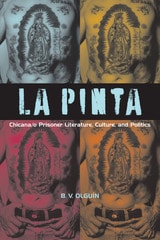
La Pinta
Chicana/o Prisoner Literature, Culture, and PoliticsBy B. V. Olguín
University of Texas Press, 2009
In this groundbreaking study based on archival research about Chicana and Chicano prisoners—known as Pintas and Pintos—as well as fresh interpretations of works by renowned Pinta and Pinto authors and activists, B. V. Olguín provides crucial insights into the central roles that incarceration and the incarcerated have played in the evolution of Chicana/o history, cultural paradigms, and oppositional political praxis.
This is the first text on prisoners in general, and Chicana/o and Latina/o prisoners in particular, that provides a range of case studies from the nineteenth century to the present. Olguín places multiple approaches in dialogue through the pairing of representational figures in the history of Chicana/o incarceration with specific themes and topics. Case studies on the first nineteenth-century Chicana prisoner in San Quentin State Prison, Modesta Avila; renowned late-twentieth-century Chicano poets Raúl Salinas, Ricardo Sánchez, and Jimmy Santiago Baca; lesser-known Chicana pinta and author Judy Lucero; and infamous Chicano drug baron and social bandit Fred Gómez Carrasco are aligned with themes from popular culture such as prisoner tattoo art and handkerchief art, Hollywood Chicana/o gangxploitation and the prisoner film American Me, and prisoner education projects.
Olguín provides a refreshing critical interrogation of Chicana/o subaltern agency, which too often is celebrated as unambiguously resistant and oppositional. As such, this study challenges long-held presumptions about Chicana/o cultures of resistance and proposes important explorations of the complex and contradictory relationship between Chicana/o agency and ideology.
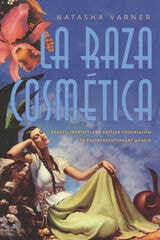
La Raza Cosmética
Beauty, Identity, and Settler Colonialism in Postrevolutionary MexicoNatasha Varner
University of Arizona Press, 2020
Critically examining beauty pageants, cinema, tourism propaganda, photography, murals, and more, Natasha Varner shows how postrevolutionary understandings of mexicanidad were fundamentally structured by legacies of colonialism, as well as shifting ideas about race, place, and gender. This interdisciplinary study smartly weaves together cultural history, Indigenous and settler colonial studies, film and popular culture analysis, and environmental and urban history. It also traces a range of Indigenous interventions in order to disrupt top-down understandings of national identity construction and to “people” this history with voices that have all too often been entirely ignored.
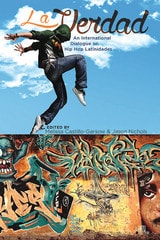
La Verdad
An International Dialogue on Hip Hop LatinidadesEdited by Melissa Castillo-Garsow and Jason Nichols
The Ohio State University Press, 2016
A truly international effort, La Verdad: An International Dialogue on Hip Hop Latinidades brings together exciting new work about Latino/a hip hop across more than a dozen countries, from scholars and practitioners in the United States and in Latin America, highlighting in new ways the participation of women, indigenous peoples, and Afro-descendants in a reimagined global, hip hop nation. From graffitera crews in Costa Rica and Nicaragua to Mexican hip hop in New York, from Aymara rap in Bolivia to Chicano rap in Taiwan, this volume explodes stereotypes of who and how hip hop is consumed, lived, and performed. Examining hip hop movements in Spanish, English, Portuguese, Aymara, and Creole, La Verdad demonstrates that Latino hip hop is a multilingual expression of gender, indigeneity, activism, and social justice.
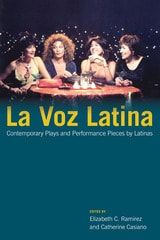
La Voz Latina
Contemporary Plays and Performance Pieces by LatinasEdited by Elizabeth C. Ramirez and Catherine Casiano
University of Illinois Press, 2011
Contributors: Yareli Arizmendi, Josefina Báez, The Colorado Sisters, Migdalia Cruz, Evelina Fernández, Cherríe Moraga, Carmen Peláez, Carmen Rivera, Celia H. Rodríguez, Diane Rodriguez, and Milcha Sanchez-Scott. The volume also includes commentary by Kathy Perkins and Caridad Svich.
La proyección del neoliberalismo
Las transformaciones del cine mexicano (1988–2012)Ignacio M. Sánchez Prado
Vanderbilt University Press, 2019

La réalité des médias de masse
Niklas Luhmann
Diaphanes, 2012
Labor Histories
Class, Politics, and the Working-Class ExperienceEdited by Eric Arnesen, Julie Greene, and Bruce Laurie
University of Illinois Press, 1998
Labor Market Issues along the U.S.-Mexico Border
Edited by Marie T. Mora and Alberto Dávila
University of Arizona Press, 2009
The contributors take up issues that dominate the current discourse— migration, trade, gender, education, earnings, and employment. They analyze labor conditions and their relationship to immigration, and also provide insight into income levels and population concentrations, the relative prosperity of Mexico’s border region, and NAFTA’s impact on trade and living conditions.
Drawing on demographic, economic, and labor data, the chapters treat topics ranging from historical context to directions for future research. They cover the importance of trade to both the United States and Mexico, salary differentials, the determinants of wages among Mexican immigrant women on the U.S. side, and the net effect of Mexican migration on the public coffers in U.S. border states. The book’s concluding policy prescriptions are geared toward improving conditions on the U.S. side without dampening the success of workers in Mexico.
Written to be equally accessible to social scientists, policy makers, and concerned citizens, this book deals with issues often overlooked in national policy discussions and can help readers better understand real-life conditions along the border. It dispels misconceptions regarding labor interdependence between the two countries while offering policy recommendations useful for improving the economic and social well-being of border residents.

Labor Of Dionysus
A Critique of the State-FormMichael Hardt
University of Minnesota Press, 1994
“Labor is the living, form-giving fire,” Marx wrote. “It is the transitoriness of things, their temporality, as their transformation by living time.” How is it, then, that labor, with all its life-affirming potential, has become the means of capitalist discipline, exploitation, and domination in modern society? The authors expose and pursue this paradox through a systematic analysis of the role of labor in the processes of capitalist production and in the establishment of capitalist legal and social institutions. Critiquing liberal and socialist notions of labor and institutional reform from a radical democratic perspective, Hardt and Negri challenge the state-form itself.
In the twentieth century, labor has become central to the material and formal constitution of the State, as a complex nexus of value and right. And yet, in living labor and social cooperation, which cut across the divisions of workdays and wage relations, the authors identify a total critique of capitalist practice as well, presenting not only the negation of the present social order but also the affirmation of an alternative system of value, norms, and desires. The forms in which this potential is expressed, from the social movements of the 1960s to those of the 1990s, are the “prerequisites of communism” already existing in contemporary society.
Labor and Community
Mexican Citrus Worker Villages in a Southern California County, 1900-1950Gilbert G. González
University of Illinois Press, 1994
Labor and the Chinese Revolution
Class Strategies and Contradictions of Chinese Communism, 1928–1948S. Bernard Thomas
University of Michigan Press, 1983
Labor in State-Socialist Europe, 1945–1989
Contributions to a History of WorkMarsha Siefert
Central European University Press, 2020
Labor regimes under communism in East-Central Europe were complex, shifting, and ambiguous. This collection of sixteen essays offers new conceptual and empirical ways to understand their history from the end of World War II to 1989, and to think about how their experiences relate to debates about labor history, both European and global.
The authors reconsider the history of state socialism by re-examining the policies and problems of communist regimes and recovering the voices of the workers who built them. The contributors look at work and workers in Albania, Bulgaria, Czechoslovakia, the German Democratic Republic, Hungary, Poland, Romania, and Yugoslavia. They explore the often contentious relationship between politics and labor policy, dealing with diverse topics including workers’ safety and risks; labor rights and protests; working women’s politics and professions; migrant workers and social welfare; attempts to control workers’ behavior and stem unemployment; and cases of incomplete, compromised, or even abandoned processes of proletarianization. Workers are presented as active agents in resisting and supporting changes in labor policies, in choosing allegiances, and in defining the very nature of work.
Labor of Fire
The Ontology of Labor between Economy and CultureBruno Gullì
Temple University Press, 2005
Gullì lays the groundwork for his book by offering a critique of productive labor, and then maps out his productive/living labor distinction in detail, reviewing the work of Marx and others.

Labor of Love
Gestational Surrogacy and the Work of Making BabiesJacobson, Heather
Rutgers University Press, 2016
For more, visit http://www.heatherjacobsononline.com/
Labor's Lot
The Power, History, and Culture of Aboriginal ActionElizabeth A. Povinelli
University of Chicago Press, 1994
In Labor's Lot, Povinelli shows how everyday activities shape Aboriginal identity and provide cultural meaning. She focuses on the Belyuen women's interactions with the countryside and on Belyuen conflicts with the Australian government over control of local land. Her analysis raises serious questions about the validity of Western theories about labor and culture and their impact on Aboriginal society.
Povinelli's focus on women's activities provides an important counterpoint to recent works centering on male roles in hunter-gatherer societies. Her unique "cultural economy" approach overcomes the dichotomy between the two standard approaches to these studies. Labor's Lot will engage anyone interested in indigenous peoples or in the relationship between culture and economy in contemporary social practice.
Labor's Love Lost
The Rise and Fall of the Working-Class Family in AmericaAndrew J. Cherlin is the Benjamin H. Griswold III Professor of Public Policy in the Department of Sociology at the Johns Hopkins University.
Russell Sage Foundation, 2014
Labor's Outcasts
Migrant Farmworkers and Unions in North America, 1934-1966Andrew J. Hazelton
University of Illinois Press, 2022

Laboratory Epistemologies
A Hands-On PerspectiveJenny Boulboullé
Duke University Press, 2024
Laboring Below the Line
The New Ethnography of Poverty, Low-Wage Work, and Survival in the Global EconomyFrank Munger
Russell Sage Foundation, 2002

Laboring For Rights
edited by Gerald Hunt
Temple University Press, 1999
The chapters included in Laboring for Rights give a global vision to the increasingly important subject of equity in the workplace. They offer a much-needed look at labor's involvement with current international workplace conditions from such diverse countries as the United States, Canada, Australia, Germany, Britain, France, the Netherlands, and South Africa, as well as parts of the South Pacific. Some of these countries have strong and progressive labor unions; some, like the U.S., have relatively weak labor organizations. But whatever the context, as these articles demonstrate, there seems to be a growing and in some instances prospering gay/lesbian labor alliance in many parts of the world.
Laboring for Rights is a pioneering text in an important new area of labor study. It will engage readers interested in equality in the workplace, labor and organizational studies, gay and lesbian activism, and international, comparative studies.
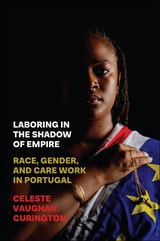
Laboring in the Shadow of Empire
Race, Gender, and Care Work in PortugalCeleste Vaughan Curington
Rutgers University Press, 2024
Winner of the ASA Race, Gender, and Class section's Distinguished Contribution to Scholarship Award
Winner of the ASA Racial and Ethnic Minorities section’s Oliver Cromwell Cox Book Award
Laboring in the Shadow of Empire: Race, Gender, and Care Work in Portugal examines the everyday lives of an African-descendant care service workforce that labors in an ostensibly “anti-racial” Europe and against the backdrop of the Portuguese colonial empire. While much of the literature on global care work has focused on Asian and Latine migrant care workers, there is comparatively less research that explicitly examines African care workers and their migration histories to Europe. Sociologist Celeste Vaughan Curington focuses on Portugal—a European setting with comparatively liberal policies around family settlement and naturalization for migrants. In this setting, rapid urbanization in the late twentieth century, along with a national push to reconcile work and family, has shaped the growth of paid home care and cleaning service industries. Many researchers focus on informal work settings, where immigrant rights are restricted and many workers are undocumented or without permanent residence status. Curington instead examines workers who have accessed citizenship or permanent residence status and also explores African women’s experiences laboring in care and service industries in the formal market, revealing how deeply colonial and intersectional logics of a racialized and international division of reproductive labor in Portugal render these women “hyper-invisible” and “hyper-visible” as “appropriate” workers in Lisbon.
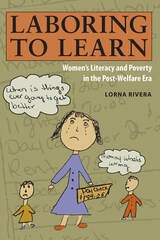
Laboring to Learn
Women's Literacy and Poverty in the Post-Welfare EraLorna Rivera
University of Illinois Press, 2007
The American adult education system has become an alternative for school dropouts, with some state welfare policies requiring teen mothers and women without high school diplomas to participate in adult education programs to receive aid. Currently, low-income women of color are more likely to be enrolled in the lowest levels of adult basic education. Very little has been published about women's experiences in these mandatory programs and whether the programs reproduce the conditions that forced women to drop out in the first place.
Lorna Rivera bridges the gap with this important study, the product of ten years' active ethnographic research with formerly homeless women who participated in adult literacy education classes before and after welfare reform. She draws on rich interviews with organizers and participants in the Adult Learners Program at Project Hope, a women's shelter and community development organization in Boston's Dudley neighborhood, one of the poorest in the city.
Analyzing the web of ideological contradictions regarding "work first" welfare reform policies, Rivera argues that poverty is produced and reproduced when women with low literacy skills are pushed into welfare-to-work programs and denied education. She examines how various discourses about individual choice and self-sufficiency shape the purposes of literacy, how low-income women express a sense of personal responsibility for being poor, and how neoliberal ideologies and practices compromise the goals of critical literacy programs. Throughout this study, the voices and experiences of formerly homeless women challenge cultural stereotypes about poor women, showing in personal and structural terms how social and economic forces shape and restrict opportunities for low-income women of color.
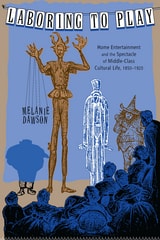
Laboring to Play
Home Entertainment and the Spectacle of Middle-Class Cultural Life, 1850-1920Melanie Dawson
University of Alabama Press, 2005
Where Leisure Became Labor and the Parlor Became a Stage for American Middle-Class Identity.
The changing styles of middle-class home entertainments, Melanie Dawson argues, point to evolving ideas of class identity in U.S. culture. Drawing from 19th- and early-20th-century fiction, guidebooks on leisure, newspaper columns, and a polemical examination of class structures, Laboring to Play interrogates the ways that leisure performances (such as parlor games, charades, home dramas, and tableaux vivants) encouraged participants to test out the boundaries that were beginning to define middle-class lifestyles.
From 19th-century parlor games involving grotesque physical contortions to early-20th-century recitations of an idealized past, leisure employments mediated between domestic and public spheres, individuals and class-based affiliations, and ideals of egalitarian social life and visible hierarchies based on privilege. Negotiating these paradigms, home entertainments provided their participants with unique ways of performing displays of individual ambitions within a world of polite social interaction.
Laboring to Play deals with subjects as wide ranging as social performances, social history (etiquette and gentility), literary history, representations of childhood, and the history of the book.

Labour Statistics for a Market Economy
Challenges and Solutions in the Transition Countries of Central and Eastern Europe and the Former Soviet UnionIgor Chernyshev
Central European University Press, 1995
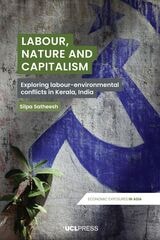
Labour, Nature and Capitalism
Exploring Labour-Environmental Conflicts in Kerala, IndiaSilpa Satheesh
University College London, 2025
Set against the industrial belt of Eloor-Edayar, Labour, Nature and Capitalism investigates the uneasy tensions between trade unions and environmental movements in Kerala, complicating the celebrated “Kerala Model” of development. Through ethnographic research and document analysis, Silpa Satheesh studies how capitalist interests shape and divide movements that appear to share common ground. The book challenges the simplistic “environment versus development” binary, depicting how industrial labor and grassroots environmental activism frequently find themselves at odds, despite both being embedded in struggles for justice.
By foregrounding the lived experiences of movement actors and examining the ideological fractures that emerge in postcolonial capitalism, Satheesh provides a much-needed intervention into debates on labor and ecology in the Global South. This interdisciplinary work is particularly valuable for scholars and activists working at the intersection of environmental justice and working-class mobilization, shedding light on the possibilities and limits of solidarity in the fight for just transitions.

Labs of Our Own
Feminist Tinkerings with ScienceSig / Sara Giordano
Rutgers University Press, 2025

Labyrinths
Explorations in the Critical History of IdeasRichard Wolin
University of Massachusetts Press, 1995
This book offers a series of probing reflections on issues at the heart of recent debates in philosophy, literary theory, and intellectual history. In ten powerfully articulated essays, Richard Wolin calls into question the implied radicalism of the so-called postmodern turn, exposes the unstated agenda of neoconservative cultural theory, and provides a major reinterpretation of Walter Benjamin’s place in contemporary cultural studies.
At the center of the book lie the peculiar and troubling affinities between two groups of cultural critics usually seen as antithetical: the radical conservative thinkers of Germany’s Weimar Republic and the French poststructuralists who came to the prominence in the aftermath of the May 1968 uprising.
Wolin concludes the volume with a cogent reappraisal of “antihumanism” as a leitmotif of postwar French intellectual culture, along with a reassessment of the “de Man affair” and its implications for the poststructuralist interpretation of fascism.

Ladies Errant
Wayward Women and Social Order in Early Modern ItalyDeanna Shemek
Duke University Press, 1998
Seeing errancy as an act of resistance rather than of error, Shemek carries her study beyond the didactic and prescriptive literature on femininity in early modern Italy to an arena in which theories about femininity are considered jointly with real and fictional instances of women’s waywardness. As prostitutes, warriors, lovers, and poets, the women of Shemek’s study are found in canonical texts, marginal works, and popular artistic activity, appearing, for instance, in literature, paintings, legal proceedings, and accounts of public festivals. By juxtaposing these varied places of errancy—from Ariosto’s chivalric Orlando furioso to the prostitutes’ race in the Palio di San Giorgio—Shemek points to the important contact between elite and popular cultures in early modernity, revealing the strength and flexibility of a gender boundary fundamental to early modern conceptions of social order.

Ladies and Gents
Public Toilets and Genderedited by Olga Gershenson and Barbara Penner, foreword by Judith Plaskow, afterword by Peter Greenaway
Temple University Press, 2009
Public toilets provide a unique opportunity for interrogating how conventional assumptions about the body, sexuality, privacy, and technology are formed in public spaces and inscribed through design across cultures. This collection of original essays from international scholars is the first to explore the cultural meanings, histories, and ideologies of public toilets as gendered spaces.
Ladies and Gents consists of two sets of essays. The first, "Potty Politics: Toilets, Gender and Identity," establishes the importance of accessible, secure public toilets to the creation of inclusive cities, work, and learning environments. The second set of essays, "Toilet Art: Design and Cultural Representations," discusses public toilets as spaces of representation and representational spaces, with reference to architectural design, humor, film, theater, art, and popular culture. Compelling visual materials and original artwork are included throughout, depicting subjects as varied as female urinals, art installations sited in public restrooms, and the toilet in contemporary art.
Taken together, these seventeen essays demonstrate that public toilets are often sites where gendered bodies compete for resources and recognition—and the stakes are high.
Contributors include: Nathan Abrams, Jami L. Anderson, Johan Andersson, Kathryn H. Anthony, Kathy Battista, Andrew Brown-May, Ben Campkin, Meghan Dufresne, Peg Fraser, Deborah Gans, Clara Greed, Robin Lydenberg, Claudia Mitchell, Alison Moore, Frances Pheasant-Kelly, Bushra Rehman, Alex Schweder, Naomi Stead, and the editors.
Ladies of the Canyons
A League of Extraordinary Women and Their Adventures in the American SouthwestLesley Poling-Kempes
University of Arizona Press, 2015
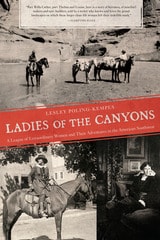
Educated, restless, and inquisitive, Natalie Curtis, Carol Stanley, Alice Klauber, and Mary Cabot Wheelwright were plucky, intrepid women whose lives were transformed in the first decades of the twentieth century by the people and the landscape of the American Southwest. Part of an influential circle of women that included Louisa Wade Wetherill, Alice Corbin Henderson, Mabel Dodge Luhan, Mary Austin, and Willa Cather, these ladies imagined and created a new home territory, a new society, and a new identity for themselves and for the women who would follow them.
Their adventures were shared with the likes of Theodore Roosevelt and Robert Henri, Edgar Hewett and Charles Lummis, Chief Tawakwaptiwa of the Hopi, and Hostiin Klah of the Navajo. Their journeys took them to Monument Valley and Rainbow Bridge, into Canyon de Chelly, and across the high mesas of the Hopi, down through the Grand Canyon, and over the red desert of the Four Corners, to the pueblos along the Rio Grande and the villages in the mountains between Santa Fe and Taos.
Although their stories converge in the outback of the American Southwest, the saga of Ladies of the Canyons is also the tale of Boston’s Brahmins, the Greenwich Village avant-garde, the birth of American modern art, and Santa Fe’s art and literary colony.
Ladies of the Canyons is the story of New Women stepping boldly into the New World of inconspicuous success, ambitious failure, and the personal challenges experienced by women and men during the emergence of the Modern Age.