Results by title
22279 books match the query 'Social Science' and 714 start with l
Lithic Debitage
William Andrefsky
University of Utah Press, 2003
Debitage, the by-product flakes and chips from stone tool production, is the most abundant artifact type in prehistoric archaeological sites. For much of the period in which archaeology has employed scientific methodology, debitage has been discarded or ignored as debris. Now archaeologists have begun to recognize its potential to provide information about the kinds of tools produced and the characteristics of the technology being employed. Debitage can even provide clues regarding human organizational systems such as settlement mobility and site functions.
This volume brings together some of the most recent research on debitage analysis and interpretation. It presents stone tool production experiments and offers detailed archaeological investigations for interpreting variability at the individual and collective levels. Although there are a number of volumes that focus on general analysis of lithic artifacts, this is the first volume to address debitage and should be of use to a wide range of archaeological researchers.
Lithic Technologies in Sedentary Societies
Rachel A. Horowitz
University Press of Colorado, 2019
Lithic analysis focused on sedentary societies, especially in places like Mesoamerica, has previously been neglected mostly because of the high frequency of informal tools, but such bias limits the ways in which both lithic production and economic organization are investigated. Bringing the importance of studying such technologies to the fore and emphasizing the vital anthropological questions that lithics can answer, Lithic Technologies in Sedentary Societies is a valuable resource for scholars and students of lithic technology and sedentary, complex societies.
Contributors: Fumi Arakawa, Mary A. Davis, James Enloe, Dan Healan, Francesca Manclossi, Theodore Marks, Jayur Madhusudan Mehta, Jason S. R. Paling, Steve Rosen, John Whittaker
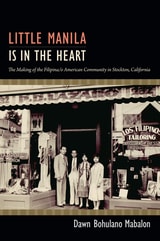
Little Manila Is in the Heart
The Making of the Filipina/o American Community in Stockton, CaliforniaDawn Bohulano Mabalon
Duke University Press, 2013
Mabalon draws on oral histories, newspapers, photographs, personal archives, and her own family's history in Stockton. She reveals how Filipina/o immigrants created a community and ethnic culture shaped by their identities as colonial subjects of the United States, their racialization in Stockton as brown people, and their collective experiences in the fields and in the Little Manila neighborhood. In the process, Mabalon places Filipinas/os at the center of the development of California agriculture and the urban West.

Little Red Riding Hood
A CasebookAlan Dundes
University of Wisconsin Press, 1989
Following versions of the tale by Perrault and the Brothers Grimm, the essays by an international group of scholars provide an impressive cross-section of theoretical approaches.

Little Saigons
Staying Vietnamese in AmericaKarin Aguilar–San Juan
University of Minnesota Press, 2009
Karin Aguilar-San Juan examines the contradictions of Vietnamese American community and identity in two emblematic yet different locales: Little Saigon in suburban Orange County, California (widely described as the capital of Vietnamese America) and the urban "Vietnamese town" of Fields Corner in Boston, Massachusetts. Their distinctive qualities challenge assumptions about identity and space, growth amid globalization, and processes of Americanization.
With a comparative and race-cognizant approach, Aguilar-San Juan shows how places like Little Saigon and Fields Corner are sites for the simultaneous preservation and redefinition of Vietnamese identity. Intervening in debates about race, ethnicity, multiculturalism, and suburbanization as a form of assimilation, this work elaborates on the significance of place as an integral element of community building and its role in defining Vietnamese American-ness.
Staying Vietnamese, according to Aguilar-San Juan, is not about replicating life in Viet Nam. Rather, it involves moving toward a state of equilibrium that, though always in flux, allows refugees, immigrants, and their U.S.-born offspring to recalibrate their sense of self in order to become Vietnamese anew in places far from their presumed geographic home.
Little Tools of Knowledge
Historical Essays on Academic and Bureaucratic PracticesPeter Becker and William Clark, Editors
University of Michigan Press, 2001
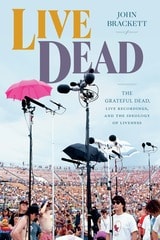
Live Dead
The Grateful Dead, Live Recordings, and the Ideology of LivenessJohn Brackett
Duke University Press, 2023
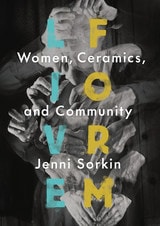
Live Form
Women, Ceramics, and CommunityJenni Sorkin
University of Chicago Press, 2016
Sorkin focuses on three Americans who promoted ceramics as an advanced artistic medium: Marguerite Wildenhain, a Bauhaus-trained potter and writer; Mary Caroline (M. C.) Richards, who renounced formalism at Black Mountain College to pursue new performative methods; and Susan Peterson, best known for her live throwing demonstrations on public television. Together, these women pioneered a hands-on teaching style and led educational and therapeutic activities for war veterans, students, the elderly, and many others. Far from being an isolated field, ceramics offered a sense of community and social engagement, which, Sorkin argues, crucially set the stage for later participatory forms of art and feminist collectivism.
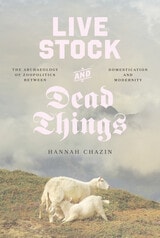
Live Stock and Dead Things
The Archaeology of Zoopolitics between Domestication and ModernityHannah Chazin
University of Chicago Press, 2024
In Live Stock and Dead Things, Hannah Chazin combines zooarchaeology and anthropology to challenge familiar narratives about the role of nonhuman animals in the rise of modern societies. Conventional views of this process tend to see a mostly linear development from hunter-gatherer societies, to horticultural and pastoral ones, to large-scale agricultural ones, and then industrial ones. Along the way, traditional accounts argue that owning livestock as property, along with land and other valuable commodities, introduced social inequality and stratification. Against this, Chazin raises a provocative question: What if domestication wasn’t the origin of instrumentalizing nonhuman animals after all?
Chazin argues that these conventional narratives are inherited from conjectural histories and ignore the archaeological data. In her view, the category of “domestication” flattens the more complex dimensions of humans’ relationship to herd animals. In the book’s first half, Chazin offers a new understanding of the political possibilities of pastoralism, one that recognizes the powerful role herd animals have played in shaping human notions of power and authority. In the second half, she takes readers into her archaeological fieldwork in the South Caucasus, which sheds further light on herd animals’ transformative effect on the economy, social life, and ritual. Appealing to anthropologists and archaeologists alike, this daring book offers a reconceptualization of human-animal relationships and their political significance.
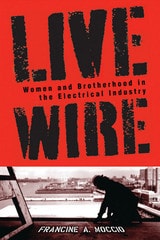
Live Wire
Women and Brotherhood in the Electrical IndustryAuthored by Fran Moccio
Temple University Press, 2010
Belonging to a union can bring higher wages, fringe benefits, greater job security and, sometimes, training. But unions—still known as "brotherhoods"—often remain rigidly segregated by gender, despite the fact that sexual harassment and discrimination in employment are illegal. Live Wire is an in-depth case study of Local 3 of the International Brotherhood of Electrical Workers, arguably the most powerful and influential building trades local in the United States. Francine Moccio brings to life forty years of public policy failure that has resulted in restricted opportunities for women in skilled blue-collar jobs.
Live Wire is a unique foray into the gender dynamics of one trade and one union in historical depth, based on extensive primary, secondary, and archival research. It contributes much-needed research about sex segregation in blue-collar occupations, particularly in unions and fraternal organizations. And it provides important insights into complex interactions of work, union, and family life.

Live and Be Well
A Celebration of Yiddish Culture in AmericaVicki Gold Levi
Rutgers University Press, 2000
Like a warm family album, this lively book heralds and documents the rich and vibrant traditions of Yiddish-speaking immigrants and their children in “the golden land,” from the first arrivals to the Second World War.
Meet the famous, the infamous, and the unknown—from hotelier Jenny Grossinger to mobster Jake “Greasy Thumb” Guzik to Moses Solomon, the would-be “Jewish Babe Ruth;” from anarchist Emma Goldman to entertainer Eddie Cantor.
Share the struggles and the triumphs of the labor unions, of Yiddish playwrights and poets. Enter the sweatshops of New York’s Lower East Side and the first Jewish settlements in Los Angeles and Chicago. Taste pastrami from Canter’s Deli in Los Angeles, knishes from Yonah Shimmel’s in New York City, and the famous “smookmit” of the Montreal ghetto.
Lavishly illustrated with photos, cartoons, theater posters, and song sheets, here is a book to delight and inform. It is a joyous celebration of life.

Live from Atlantic City
The Miss America Pageant Before, After, and In Spite of TelevisionA. R. Riverol
University of Wisconsin Press, 1992
A. R. Riverol takes the reader to times and places where no television camera has focused. Drawing upon (and sometimes debating with) primary and secondary sources, the author paints a vivid picture of life in Atlantic City during pageant week—whether that week be in 1944 or 1984. More than just chronicling events, the author also presents two opposing perspectives on the pageant: the pageant as celebration and idealization of American womanhood and the pageant as sexist, exploitative anachronism.
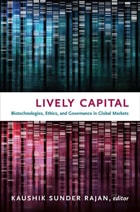
Lively Capital
Biotechnologies, Ethics, and Governance in Global MarketsKaushik Sunder Rajan, ed.
Duke University Press, 2012
Contributors. Timothy Choy, Joseph Dumit, Michael M. J. Fischer, Kim Fortun, Mike Fortun, Donna Haraway, Sheila Jasanoff, Wen-Hua Kuo, Andrew Lakoff, Kristin Peterson, Chloe Silverman, Elta Smith, Kaushik Sunder Rajan, Travis J. Tanner
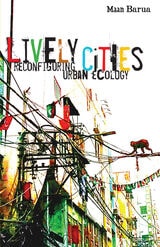
Lively Cities
Reconfiguring Urban EcologyMaan Barua
University of Minnesota Press, 2023
A journey through unexplored spaces that foreground new ways of inhabiting the urban
One of the fundamental dimensions of urbanization is its radical transformation of nature. Today domestic animals make up more than twice the biomass of people on the planet, and cities are replete with nonhuman life. Yet current accounts of the urban remain resolutely anthropocentric. Lively Cities departs from conventions of urban studies to argue that cities are lived achievements forged by a multitude of entities, drawing attention to a suite of beings—human and nonhuman—that make up the material politics of city making.
From macaques and cattle in Delhi to the invasive parakeet colonies in London, Maan Barua examines the rhythms, paths, and agency of nonhumans across the city. He reconceptualizes several key themes in urban thought, including infrastructure, the built environment, design, habitation, and everyday practices of dwelling and provides a critical intervention in animal and urban studies. Generating fresh conversations between posthumanism, postcolonialism, and political economy, Barua reveals how human and nonhuman actors shape, integrate, subsume, and relate to urban space in fascinating ways.
Through novel combinations of ethnography and ethology, and focusing on interlocutors that are not the usual suspects animating urban theory, Barua’s work considers nonhuman lifeworlds and the differences they make in understanding urbanicity. Lively Cities is an agenda-setting intervention, ultimately proposing a new grammar of urban life.
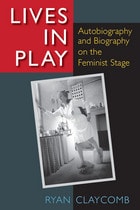
Lives in Play
Autobiography and Biography on the Feminist StageRyan Claycomb
University of Michigan Press, 2014
Lives in Play explores the centrality of life narratives to women's drama and performance from the 1970s to the present moment. In the early days of second-wave feminism, the slogan was "The personal is the political." These autobiographical and biographical "true stories" have the political impact of the real and have also helped a range of feminists tease out the more complicated aspects of gender, sex, and sexuality in a Western culture that now imagines itself to be "postfeminist."
The book covers a broad range of texts and performances, from performance artists like Karen Finley, Holly Hughes, and Bobby Baker to playwrights like Suzan-Lori Parks, Maria Irene Fornes, and Sarah Kane. The book examines biography and autobiography together to link their narrative tactics and theatrical approaches and show the persistent and important uses of life writing strategies for theater artists committed to advancing women's rights and remaking women's representations.
Lives in Play argues that these writers and artists have not only responded to the vibrant conversations in feminist theory but also have anticipated and advanced these ideas, theorizing gender onstage for specific ends. Ryan Claycomb demonstrates how these performances work through tensions between performative identity and the essentialized body, between the truth value of life stories and the constructed nature of gender and narrative alike, and between writing and performing as modes of feminist representation.
The book will appeal to scholars in performance studies, women's studies, and literature, including those in the growing field of auto/biography studies.
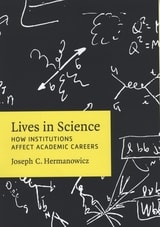
Lives in Science
How Institutions Affect Academic CareersJoseph C. Hermanowicz
University of Chicago Press, 2009
What can we learn when we follow people over the years and across the course of their professional lives? Joseph C. Hermanowicz asks this question specifically about scientists and answers it here by tracking fifty-five physicists through different stages of their careers at a variety of universities across the country. He explores these scientists’ shifting perceptions of their jobs to uncover the meanings they invest in their work, when and where they find satisfaction, how they succeed and fail, and how the rhythms of their work change as they age. His candid interviews with his subjects, meanwhile, shed light on the ways career goals are and are not met, on the frustrations of the academic profession, and on how one deals with the boredom and stagnation that can set in once one is established.
An in-depth study of American higher education professionals eloquently told through their own words, Hermanowicz’s keen analysis of how institutions shape careers will appeal to anyone interested in life in academia.
Lives in Two Languages
An Exploration of Identity and CultureLinda Watkins-Goffman
University of Michigan Press, 2001
Lives in Two Languages focuses on the experience of multicultural authors--like Richard Rodriguez, Amy Tan, Eva Hoffman, Chang-rae Lee, and Julia Alvarez--whose experiences can be related to anyone who has moved from one culture or subculture to another. As such, this text is an excellent comprehensive introduction to the multicultural experience for teachers and educators in all disciplines, as well as of interest to anyone interested in language culture and psychological process of identity.
Lives of Dust and Water
An Anthropology of Change and Resistance in Northwestern MexicoMaría Luz Cruz-Torres
University of Arizona Press, 2004
A political ecology of human survival in one of the most important ecological regions of Mexico, it describes how these communities contest environmental degradation and economic impoverishment arising from political and economic forces beyond their control. María Luz Cruz-Torres evokes the rich and varied experiences of the people who live in the villages of Celaya and El Cerro, showing how they invent and utilize their own social capital to emerge as whole persons in the face of globalization. She traces the histories of the two villages to illustrate the complex variation involved in community formation and to show how people respond to and utilize Mexican law and reform. Surrounded by limited resources, poverty, illness, sudden death, and daily oppression, these men and women create innovative social and cultural forms that mitigate these impacts.
Cruz-Torres reveals not only how they manage to survive in the midst of horrendous circumstances but also how they transcend those impediments with dignity. She details the participation of household members in the subsistence, formal, and informal sectors of the economy, and how women use a variety of resources to guarantee their families’ survival. A sometimes tragic but ultimately vibrant story of human resistance, Lives of Dust and Water offers an important look at a little-studied but dynamically developing region of Mexico. It contributes to a more precise understanding of how rural coastal communities in Mexico emerged and continue to develop and adjust to the uncertainties of the globalizing world.
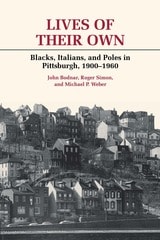
Lives of Their Own
Blacks, Italians, and Poles in Pittsburgh, 1900-1960John Bodnar, Roger Simon, and Michael P. Weber
University of Illinois Press, 1982
Lives on the Edge
Single Mothers and Their Children in the Other AmericaValerie Polakow
University of Chicago Press, 1994
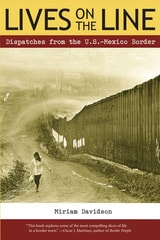
Lives on the Line
Dispatches from the U.S.-Mexico BorderMiriam Davidson
University of Arizona Press, 2000
In Lives on the Line, Miriam Davidson tells five true stories from these border cities to show the real-life effects that the maquiladora boom and the law enforcement crackdown have had on the people of "Ambos (Both) Nogales." Readers will meet Yolanda Sánchez, a single mother who came to work in the factories; Jimmy Teyechea, a cancer victim who became an outspoken environmental activist; Dario Miranda Valenzuela, an undocumented immigrant who was shot and killed by a U.S. Border Patrol agent; Cristina, a "tunnel kid" who aspired to flee the gang lifestyle; and Hope Torres and Tom Higgins, maquiladora managers who have made unique contributions to the community.
In sharing these stories of people transformed by love and faith, by pain and loss, Davidson relates their experiences to larger issues and shows that, although life on the border is tough, it is not without hope.
Lives on the Line is an impassioned look at the changes that have swept the U.S.-Mexico border: the rising tension concerning free trade and militarization, the growing disparity between the affluent and the impoverished. At the same time, the book highlights the positive aspects of change, revealing challenges and opportunities not only for the people who live on the border but for all Americans.
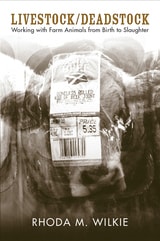
Livestock/Deadstock
Working with Farm Animals from Birth to SlaughterAuthored by Rhoda M. Wilkie
Temple University Press, 2010
The connection between people and companion animals has received considerable attention from scholars. In her original and provocative ethnography Livestock/Deadstock, sociologist Rhoda Wilkie asks, how do the men and women who work on farms, in livestock auction markets, and slaughterhouses, interact with—or disengage from—the animals they encounter in their jobs?
Wilkie provides a nuanced appreciation of how those men and women who breed, rear, show, fatten, market, medically treat, and slaughter livestock, make sense of their interactions with the animals that constitute the focus of their work lives. Using a sociologically informed perspective, Wilkie explores their attitudes and behaviors to explain how agricultural workers think, feel, and relate to food animals.
Livestock/Deadstock looks at both people and animals in the division of labor and shows how commercial and hobby productive contexts provide male and female handlers with varying opportunities to bond with and/or distance themselves from livestock. Exploring the experiences of stockpeople, hobby farmers, auction workers, vets and slaughterers, she offers timely insight into the multifaceted, gendered, and contradictory nature of human roles in food animal production.
Livestreaming
An Aesthetics and Ethics of Technical EncounterEL Putnam
University of Minnesota Press, 2024
An inquiry into how livestreaming can help us meaningfully connect
Livestreaming is ubiquitous in our Covid-19-inflected era. In this book, EL Putnam takes up the implications of this technology, arguing that livestreamed internet broadcasts perform aesthetic and ethical encounters that invite distinctive means of relating to others. Treating humans and technologies as inherently relational, Putnam considers how livestreaming constitutes new patterns of being together that are complex, ambivalent, and transformative. Understood in such a way, we see how livestreaming exceeds quantifying and calculating metrics, challenges emphasis on content generation, and introduces an entirely new—and dynamic—means of social engagement.
Living Between Danger and Love
The Limits of ChoiceJones, Kathleen B.
Rutgers University Press, 1999
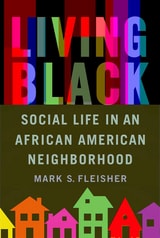
Living Black
Social Life in an African American NeighborhoodMark S. Fleisher
University of Wisconsin Press, 2015
Mark S. Fleisher offers a window into daily life in this neighborhood, particularly through the stories of Mo and Memphis Washington, who fight to sustain a stable home for their children, and of Burpee, a local man who has returned to the North End to rebuild his life after years of crime and punishment in Chicago.
“Outstanding” books for public & secondary school libraries from university presses, American Library Association
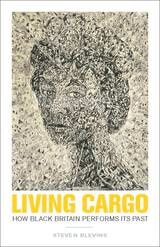
Living Cargo
How Black Britain Performs Its PastSteven Blevins
University of Minnesota Press, 2016
Offering a wide-ranging study of contemporary literature, film, visual art, and performance by writers and artists who live and work in the United Kingdom but also maintain strong ties to postcolonial Africa and the Caribbean, Living Cargo explores how contemporary black British culture makers have engaged with the institutional archives of colonialism and the Atlantic slave trade in order to reimagine blackness in British history and to make claims for social and political redress.
Steven Blevins calls this reimagining “unhousing history”—an aesthetic and political practice that animates and improvises on the institutional archive, repurposing it toward different ends and new possibilities. He discusses the work of novelists, including Caryl Phillips, Fred D’Aguiar, David Dabydeen, and Bernardine Evaristo; filmmakers Isaac Julien and Inge Blackman; performance poet Dorothea Smartt; fashion designer Ozwald Boateng; artists Hew Locke and Yinka Shonibare; and the urban redevelopment of Bristol, England, which unfolded alongside the public demand to remember the city’s slave-trading past.
Living Cargo argues that the colonial archive is neither static nor residual but emergent. By reassembling historical fragments and traces consolidated in the archive, these artists not only perform a kind of counter-historiography, they also imagine future worlds that might offer amends for the atrocities of the past.
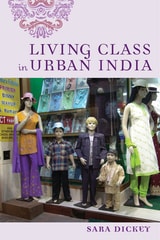
Living Class in Urban India
Dickey, Sara
Rutgers University Press, 2016
Many Americans still envision India as rigidly caste-bound, locked in traditions that inhibit social mobility. In reality, class mobility has long been an ideal, and today globalization is radically transforming how India’s citizens perceive class. Living Class in Urban India examines a nation in flux, bombarded with media images of middle-class consumers, while navigating the currents of late capitalism and the surges of inequality they can produce.
This book is also freely available online as an open-access digital edition, published with the support of the National Endowment for the Humanities.
Living Color
Race and Television in the United StatesSasha Torres, ed.
Duke University Press, 1998
Ranging across television genres, historical periods, and racial formations, Living Color—as it positions race as a key element of television’s cultural influence—moves the discussion out of a black-and-white binary and illustrates how class, gender, and sexuality interact with images of race. In addition to essays on representations of "Oriental" performers and African Americans in the early years of television, this collection also examines how the celebrity of the late MTV star Pedro Zamora countered racist and homophobic discourses; reveals how news coverage on drug use shifted from the white middle-class cocaine user in the early 1980s to the black "crack mother" of the 1990s; and takes on TV coverage of the Rodney King beating and the subsequent unrest in Los Angeles. Other essays consider O.J. Simpson’s murder trial, comparing television’s treatment of Simpson to that of Michael Jackson, Magic Johnson, Michael Jordan, and Clarence Thomas and look at the racism directed at Asian Americans by the recurring "Dancing Itos" on Jay Leno’s Tonight Show.
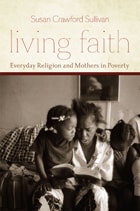
Living Faith
Everyday Religion and Mothers in PovertySusan Crawford Sullivan
University of Chicago Press, 2012
Living Folklore, 2nd Edition
An Introduction to the Study of People and Their TraditionsMartha Sims and Martine Stephens
Utah State University Press, 2011
Living Folklore is a comprehensive, straightforward introduction to folklore as it is lived, shared and practiced in contemporary settings. Drawing on examples from diverse American groups and experiences, this text gives the student a strong foundation—from the field's history and major terms to theories and interpretive approaches.
Living Folklore moves beyond genres and classifications, and encourages students who are new to the field to see the study of folklore as a unique approach to understanding people, communities, and day-to-day artistic communication.
This revised edition incorporates new examples, research, and theory along with added discussion of digital and online folklore.
Living Folklore
Introduction to the Study of People and their TraditionsMartha Sims and Martine Stephens
Utah State University Press, 2005
Living Folklore is a comprehensive, straightforward introduction to folklore as it is lived, shared and practiced in contemporary settings. Drawing on examples from diverse American groups and experiences, this text gives the student a strong foundation—from the field’s history and major terms to theories, interpretive approaches, and fieldwork.
Many teachers of undergraduates find the available folklore textbooks too complex or unwieldy for an introductory level course. It is precisely this criticism that Living Folklore addresses; while comprehensive and rigorous, the book is specifically intended to meet the needs of those students who are just beginning their study of the discipline. Its real strength lies in how it combines carefully articulated foundational concepts with relevant examples and a student-oriented teaching philosophy.
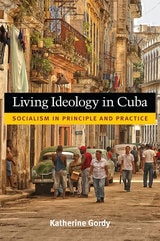
Living Ideology in Cuba
Socialism in Principle and PracticeKatherine A. Gordy
University of Michigan Press, 2015

Living Metal
Metal Scenes around the WorldEdited by Bryan Bardine and Jerome Stueart
Intellect Books, 2021
This edited volume expands the research in the field of metal studies by examining metal music communities around the world, from Dayton, Ohio, to Estonia to post-apartheid South Africa and beyond. The chapters are detailed, richly embedded in local histories and contexts, and provide important analyses of their respective scenes. The diversity of the chapters connects metal to other disciplines in the music field and a foreword by Henkka Seppälä, former bassist of the Finnish extreme metal band Children of Bodom, accompanies the essays. Living Metal is a groundbreaking contribution to the field, with much appeal for fans and scholars of metal music as well as those in the fields of anthropology, musicology, and history.
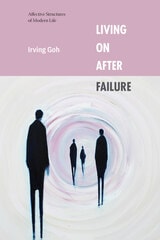
Living On After Failure
Affective Structures of Modern LifeIrving Goh
Duke University Press, 2025
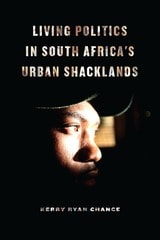
Living Politics in South Africa’s Urban Shacklands
Kerry Ryan Chance
University of Chicago Press, 2018
Tracking everyday practices and interactions between poor residents and state agents in South Africa’s shack settlements, Chance investigates the rise of nationwide protests since the late 1990s. Based on ethnography in Durban, Cape Town, and Johannesburg, the book analyzes the criminalization of popular forms of politics that were foundational to South Africa’s celebrated democratic transition. Chance argues that we can best grasp the increasingly murky line between “the criminal” and “the political” with a “politics of living” that casts slum and state in opposition to one another. Living Politics shows us how legitimate domains of politics are redefined, how state sovereignty is forcibly enacted, and how the production of new citizen identities crystallize at the intersections of race, gender, and class.
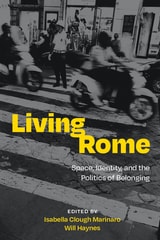
Living Rome
Space, Identity, and the Politics of BelongingEdited by Isabella Clough Marinaro and Will Haynes
Lever Press, 2026
Living Rome: Space, Identity, and the Politics of Belonging looks beyond the romanticized image of Rome, towards a kaleidoscopic view of the city shaped by inequalities, socio-political challenges, and acts of resistance and solidarity. In the wake of urban developments related to migration, housing shortages, COVID-19, crime, and other social changes, this volume offers a grounded approach, mapping the contemporary realities of Italy’s capital from a variety of methodological standpoints. Contributors argue that the unseen fringes, both geographically peripheral and those embedded within the very heart of Rome, are crucial for understanding its social dynamics. These ‘hidden’ geographies foster vibrant communities, challenge ideas of home and belonging, and act as key sites of creativity, resistance and everyday life.
Bringing together urban sociologists, anthropologists, geographers, demographers, criminologists, decolonizing and feminist scholars, this study contributes to a growing body of research on the city and its social movements, aiming to inform policy and contribute to a more just and sustainable Rome. Using a variety of methods, from quantitative cartography and policy analysis to (auto)ethnography and creative methodologies, this volume speaks well beyond Rome, to conversations about cities worldwide.

Living Rooms as Factories
Class, Gender, and the Satelite Factory System in TaiwanPing-Chun Hsiung
Temple University Press, 1996
In Taiwan, small-scale subcontracting factories of thirty employees or less make items for export, like the wooden jewelry boxes that Ping-Chun Hsiung made when she worked in six such factories. These factories are found in rice fields and urban areas, front yards and living rooms, mostly employing married women in line with the government slogan that promotes work in the home—"Living Rooms as Factories."
Hsiung studies the experiences of the married women who work in this satellite system of factories, and how their work and family lives have contributed to Taiwan's 9.1 percent GNP growth over the last three decades, the "economic miracle." This vivid portrayal of the dual lives of these women as wives, mothers, daughters-in-law and as manufacturing workers also provides sophisticated analyses of the links between class and gender stratification, family dynamics, state policy, and global restructuring within the process of industrialization.
Hsiung uses ethnographic data to illustrate how, in this system of intersecting capitalist logic and patriarchal practices, some Taiwanese women experience upward mobility by marrying into the owners' family, while others remain home and wage workers. Although women in both groups acknowledge gender inequality, this commonality does not bridge divergent class affiliations. Along with a detailed account of the oppressive labor practices, this book reveals how workers employ clandestine tactics to defy the owners' claims on their labor.
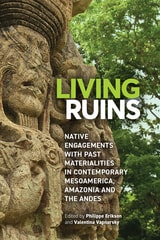
Living Ruins
Native Engagements with Past Materialities in Contemporary Mesoamerica, Amazonia, and the AndesPhilippe Erikson
University Press of Colorado, 2022
Ten case studies from the Maya region, Amazonia, and the Andes detail and contextualize narratives, rituals, and a range of practices and attitudes toward different kinds of vestiges. The chapters engage with recently debated issues such as regimes of historicity and knowledge, cultural landscapes, conceptions of personhood and ancestrality, artifacts, and materiality. They focus on Indigenous perspectives rather than mainstream narratives such as those mediated by UNESCO, Hollywood, travel agents, and sometimes even academics. The contributions provide critical analyses alongside a multifaceted account of how people relate to the place/time nexus, expanding our understanding of different ontological conceptualizations of the past and their significance in the present.
Living Ruins adds to the lively body of work on the invention of tradition, Indigenous claims on their lands and history, “retrospective ethnogenesis,” and neo-Indianism in a world where tourism, NGOs, and Western essentialism are changing Indigenous attitudes and representations. This book is significant to anyone interested in cultural heritage studies, Amerindian spirituality, and Indigenous engagement with archaeological sites in Latin America.
Contributors: Cedric Becquey, Laurence Charlier Zeineddine, Marie Chosson, Pablo Cruz, Philippe Erikson, Antoinette Molinié, Fernando Santos-Granero, Emilie Stoll, Valentina Vapnarsky, Pirjo Kristiina Virtanen
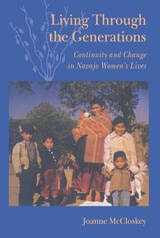
Living Through the Generations
Continuity and Change in Navajo Women’s LivesJoanne McCloskey
University of Arizona Press, 2007
Drawing on ethnographic interviews with 77 women in Crownpoint, New Mexico, and surrounding chapters in the Eastern Navajo Agency, Joanne McCloskey examines the cultural traditions evident in Navajo women’s lives. Navajo women balance the demands of Western society with the desire to preserve Navajo culture for themselves and their families.
Living Up to the Ads
Gender Fictions of the 1920sSimone Weil Davis
Duke University Press, 2000
Materials from advertising firms—including memos, manuals, meeting minutes, and newsletters—are considered alongside the fiction of Sinclair Lewis, Nella Larsen, Bruce Barton, F. Scott Fitzgerald, and Zelda Fitzgerald. Davis engages such books as Babbitt, Quicksand, and Save Me the Waltz in original and imaginative ways, asking each to participate in her discussion of commodity culture, gender, and identity. To illuminate the subjective, day-to-day experiences of 1920s consumerism in the United States, Davis juxtaposes print ads and industry manuals with works of fiction. Capturing the maverick voices of some of the decade’s most influential advertisers and writers, Davis reveals the lines that were drawn between truths and lies, seduction and selling, white and black, and men and women.
Davis’s methodology challenges disciplinary borders by employing historical, sociological, and literary practices to discuss the enduring links between commodity culture, gender, and identity construction. Living Up to the Ads will appeal to students and scholars of advertising, American studies, women’s studies, cultural studies, and early-twentieth-century American history.
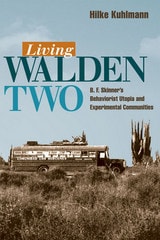
Living Walden Two
B. F. Skinner's Behaviorist Utopia and Experimental CommunitiesHilke Kuhlmann
University of Illinois Press, 2004
In the novel, behavioral engineers use positive reinforcement in organizing and "gently guiding" all aspects of society, leaving the rest of the citizens "free" to lead happy and carefree lives. Among the real-world communities, a recurrent problem in moving past the planning stages was the nearly ubiquitous desire among members to be gentle guides, coupled with strong resistance to being guided.
In an insightful and often hilarious narrative, Hilke Kuhlmann explores the dynamics of the communities, with an in-depth examination of the two surviving Skinnerian communities: Comunidad Los Horcones in Mexico, and Twin Oaks in Virginia. Drawing on extensive interviews with the founders and key players in the Walden Two communities, Kuhlmann redefines the criteria for their success by focusing on the tension between utopian blueprints for a new society and communal experiments' actual effects on individual lives.
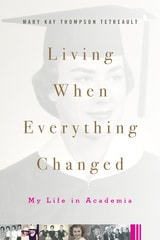
Living When Everything Changed
My Life in AcademiaMary Kay Thompson Tetreault
Rutgers University Press, 2019
In this compelling memoir, Mary Kay Thompson Tetreault describes how a Catholic girl from small-town Nebraska discovered her callings as a feminist, as an academic, and as a university administrator. She recounts her experiences at three very different schools: the small progressive Lewis & Clark College, the massive regional university of Cal State Fullerton, and the rapidly expanding Portland State University. Reflecting on both her accomplishments and challenges, she considers just how much second-wave feminism has transformed academia and how much reform is still needed.
With remarkable candor and compassion, Thompson Tetreault provides an intimate personal look at an era when both women’s lives and university culture changed for good.
The Acknowledgments were inadvertently left out of the first printing of this book. We apologize for the oversight, and offer them here instead. Future printings will include this information. (https://d3tto5i5w9ogdd.cloudfront.net/wp-content/uploads/2019/08/29185420/Thompson-Tetreault-Acknowledgments.pdf)
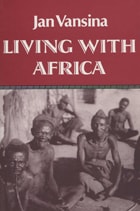
Living With Africa
Jan M. Vansina
University of Wisconsin Press, 1994
"I'm not an ethnologist, I'm a historian!" Vansina was to repeat again and again to those who assumed that people without written texts have no history. His discovery that he could analyze Kuba oral tradition using the same methods he had learned for interpreting medieval dirges was a historiographical breakthrough, and his first book, Oral Tradition as History, is considered the seminal work that gave the study of precolonial African history both the scholarly justification and the self-confidence it had been lacking.
Living with Africa is a compelling memoir of Vansina's life and career on three continents, interwoven with the story of African history as a scholarly specialty. In the background of his narrative are the collapse of colonialism in Africa and the emergence of newly independent nations; in the foreground are the first conferences on African history, the founding of journals and departments, and the efforts of Africans to establish a history curriculum for the schools in their new nations.

Living Worth
Value and Values in Global Pharmaceutical MarketsStefan Ecks
Duke University Press, 2022
Living a Feminist Life
Sara Ahmed
Duke University Press, 2017
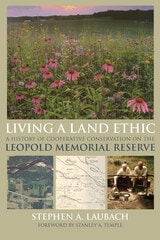
Living a Land Ethic
A History of Cooperative Conservation on the Leopold Memorial ReserveStephen A. Laubach
University of Wisconsin Press, 2014
Living a Land Ethic chronicles the formation of the 1,600-acre reserve surrounding the Shack. When the Leopold Memorial Reserve was founded in 1967, five neighboring families signed an innovative agreement to jointly care for their properties in ways that honored Aldo Leopold's legacy. In the ensuing years, the Reserve's Coleman and Leopold families formed the Sand County Foundation and the Aldo Leopold Foundation. These organizations have been the primary stewards of the Reserve, carrying on a tradition of ecological restoration and cooperative conservation. Author Stephen A. Laubach draws from the archives of both foundations, including articles of incorporation, correspondence, photos, managers' notes, and interviews to share with readers the Reserve's untold history and its important place in the American conservation movement.
Living and Dying in São Paulo
Immigrants, Health, and the Built Environment in BrazilJeffrey Lesser
Duke University Press, 2025
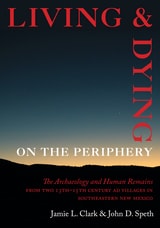
Living and Dying on the Periphery
The Archaeology and Human Remains from Two 13th-15th Century AD Villages in Southeastern New MexicoJamie L. Clark and John D. Speth
University of Utah Press, 2022
Summarizing results from eight seasons of research, Clark and Speth document human burials and associated grave offerings from the two sites. They discuss evidence for pathologies and trauma, raising questions about the nature and causes of violence that led to the demise of Henderson and Bloom Mound, and the abandonment of many other farming-hunting communities in the surrounding region.
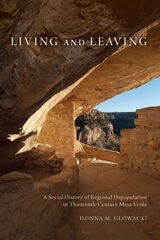
Living and Leaving
A Social History of Regional Depopulation in Thirteenth-Century Mesa VerdeDonna M. Glowacki
University of Arizona Press, 2015
Much of the focus on this topic has been directed at understanding the role of climate change, drought, violence, and population pressure. The role of social factors, particularly religious change and sociopolitical organization, are less well understood. Bringing together multiple lines of evidence, including settlement patterns, pottery exchange networks, and changes in ceremonial and civic architecture, this book takes a historical perspective that naturally forefronts the social factors underlying the depopulation of Mesa Verde.
Author Donna M. Glowacki shows how “living and leaving” were experienced across the region and what role differing stressors and enablers had in causing emigration. The author’s analysis explains how different histories and contingencies—which were shaped by deeply rooted eastern and western identities, a broad-reaching Aztec-Chaco ideology, and the McElmo Intensification—converged, prompting everyone to leave the region. This book will be of interest to southwestern specialists and anyone interested in societal collapse, transformation, and resilience.
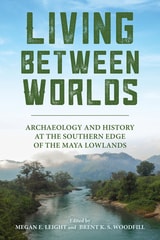
Living between Worlds
Archaeology and History at the Southern Edge of the Maya LowlandsEdited by Megan E. Leight and Brent K. S. Woodfill
University of Alabama Press, 2026
The first in-depth exploration of the narrow but vital region between the pre-Columbian Maya highlands and lowlands in Guatemala called the Northern Transversal Strip.
Living between Worlds: Archaeology and History at the Southern Edge of the Maya Lowlands is the first in-depth exploration of the narrow but vital region between the pre-Columbian Maya highlands and lowlands in Guatemala. This groundbreaking volume brings together the results of a twenty-five-year, multidisciplinary collaboration that reshapes our understanding of Maya civilization.
Long overlooked due to the absence of towering monuments and stone cities, the Northern Transversal Strip was nevertheless a hub of commerce, culture, and political interaction. Spanning multiple Classic Maya city-states, conquest-era ethnic groups, and modern geopolitical boundaries, the region played a crucial role as a transportation corridor and resource center. Archaeologists, art historians, ethnohistorians, biologists, and paleoecologists join forces in this volume to reconstruct its complex past, uncovering its deep connections to the broader Maya world.
From its role in the trade of cacao, salt, and quetzal feathers to its enduring significance through the Spanish conquest and modern conflicts, the Northern Transversal Strip emerges as a dynamic and pivotal region. Through detailed analyses of ceramics, figurines, obsidian exchange networks, and settlement patterns, this volume reveals the intricate web of interregional ties that defined the Maya civilization.
With cutting-edge research and fresh perspectives, Living Between Worlds offers a comprehensive synthesis of archaeological discoveries, historical insights, and environmental studies. By literally and metaphorically bridging the highland-lowland divide, this volume transforms how scholars and readers alike perceive this once-marginalized but essential part of the Maya world.