Results by title
28164 books match the query 'History' and 932 start with l
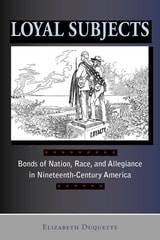
Loyal Subjects
Bonds of Nation, Race, and Allegiance in Nineteenth-Century AmericaDuquette, Elizabeth
Rutgers University Press, 2010
Loyal Subjects considers how the Civil War complicated the cultural value of emotion, especially the ideal of sympathy. Through an analysis of literary works written during and after the conflict-from Nathaniel Hawthorne's "Chiefly About War Matters" through Henry James's The Bostonians and Charles Chestnutt's "The Wife of His Youth," to the Pledge of Allegiance and W.E.B. Du Bois's John Brown, among many others-Duquette reveals that although American literary criticism has tended to dismiss the Civil War's impact, postwar literature was profoundly shaped by loyalty.

Loyalty and Liberty
American Countersubversion from World War 1 to the McCarthy EraAlex Goodall
University of Illinois Press, 2013
Identifying varied interest groups such as business tycoons, Christian denominations, and Southern Democrats, Goodall demonstrates how countersubversive politics was far from unified: groups often pursued clashing aims while struggling to balance the competing pulls of loyalty to the nation and liberty of thought, speech, and action. Meanwhile, the federal government pursued its own course, which alternately converged with and diverged from the paths followed by private organizations. By the end of World War II, alliances on the left and right had largely consolidated into the form they would keep during the Cold War. Anticommunists on the right worked to rein in the supposedly dictatorial ambitions of the Roosevelt administration, while New Deal liberals divided into several camps: the Popular Front, civil liberties activists, and embryonic Cold Warriors who struggled with how to respond to communist espionage in Washington and communist influence in politics more broadly.
Rigorous in its scholarship yet accessible to a wide audience, Goodall's masterful study shows how opposition to radicalism became a defining ideological question of American life.
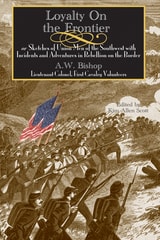
Loyalty on the Frontier
Sketches of Union Men of the South-West with Incidents and Adventures in Rebellion on the BorderA.W. Bishop
University of Arkansas Press, 2003
First published in 1863, this book has the immediacy, passion, and intimacy of its wartime context. It tells the remarkable story of Albert Webb Bishop, a New York lawyer turned Union soldier, who in 1862 accepted a commission as lieutenant colonel in a regiment of Ozark mountaineers. While maintaining Union control of northwest Arkansas, he collected stories of the social coercion, political secession, and brutal terrorism that scarred the region.
His larger goal, however, was to popularize and inspire sympathy for the South’s Unionists and to chronicle the triumph of Unionism in a Confederate state. His account points to the complex and divisive nature of Confederate society and in doing so provides a perspective that has long been absent from discussions of the Civil War
Lucian and the Latins
Humor and Humanism in the Early RenaissanceDavid Marsh
University of Michigan Press, 1998
Until now, no study has attempted to connect the Latin translators and imitators of Lucian with his wider European influence. In Lucian and the Latins, David Marsh describes how Renaissance authors rediscovered the comic writings of Lucian. He traces how Lucianic themes and structures made an essential contribution to European literature beginning with a survey of Latin translations and imitations, which gave new direction to European letters in the fifteenth and sixteenth centuries. The Lucianic dialogues of the dead and dialogues of the gods were immensely popular, despite the religious backlash of the sixteenth century. The paradoxical encomium, represented by Lucian's "The Fly" and "The Parasite," inspired so-called serious humanists like Leonardo Bruni and Guarino of Verona. Lucian's "True Story" initiated the genre of the fantastic journey, which enjoyed considerable popularity during the Renaissance age of discovery. Humanist descendants of this work include Thomas More's Utopia and much of Rabelais' Pantagruel.
Lucian and the Latins will attract readers interested in a wide variety of subjects: the classical tradition, the early Italian Renaissance, the origins of modern European literature, and the uses of humor and satire as instruments of cultural critique.
David Marsh is Professor of Italian, Rutgers University.
Lucian’s Laughing Gods
Religion, Philosophy, and Popular Culture in the Roman EastInger N.I. Kuin
University of Michigan Press, 2023
In Lucian's Laughing Gods, author Inger N. I. Kuin argues that in ancient Greek thought, comedic depictions of divinities were not necessarily desacralizing. In religion, laughter was accommodated to such an extent as to actually be constituent of some ritual practices, and the gods were imagined either to reciprocate or push back against human laughter—they were never deflated by it. Lucian uses the gods as comic characters, but in doing so, he does not automatically negate their power. Instead, with his depiction of the gods and of how they relate to humans—frivolous, insecure, callous—Lucian challenges the dominant theologies of his day as he refuses to interpret the gods as ethical models. This book contextualizes Lucian’s comedic performances in the intellectual life of the second century CE Roman East broadly, including philosophy, early Christian thought, and popular culture (dance, fables, standard jokes, etc.). His texts are analyzed as providing a window onto non-elite attitudes and experiences, and methodologies from religious studies and the sociology of religion are used to conceptualize Lucian’s engagement with the religiosity of his contemporaries.
Lucifer of Cagliari and the Text of 1-2 Kings
Tuukka Kauhanen
SBL Press, 2018
The most up-to-date study of the text history of 1 and 2 Kings
In this book, Tuukka Kauhanen approaches the challenging case of the textual history of 1 and 2 Kings through citations of the text found within the writings of the fourth-century bishop of Sadinia, Lucifer of Cagliari. Kauhanen presents evidence that Lucifer's Latin text sheds important light on lost Hebrew and Greek pieces of the textual puzzle in Kings. In doing so, he compares all of Lucifer's extensive quotations of Kings to extant Greek witnesses as well as Old Latin witnesses where available and subsequently analyzes the probable reasons for textual variations. In each instance he attempts to choose the best possible candidate for the Old Greek reading and where that reading might reflect a now-lost Hebrew text.
Features
- Use of the most current research into the text of the Hebrew Bible and the Septuagint, including the Hebrew Bible: A Critical Edition series and the forthcoming Göttingen Septuagint edition of King
- An appendix listing readings from the analysis sections arranged according to agreement patterns and other meaningful criteria
- Charts comparing readings
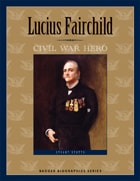
Lucius Fairchild
Civil War HeroStuart Stotts
Wisconsin Historical Society Press, 2010
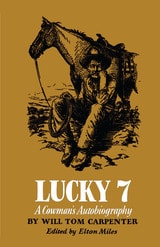
Lucky 7
A Cowman's AutobiographyBy Will Tom Carpenter
University of Texas Press, 1957
"No. 7"—as Carpenter, the youngest of seven children, called himself—was born in Missouri in 1854 and moved west with his family, first to Kansas, then to the settlements near Pikes Peak, and finally, in 1872, to Texas with his elder brother. From the time he made his first cattle drive, he wanted no other life but that of herding longhorns across the free and flat grasslands of the West. His schooling was the trail, the campfire, the saddle. In 1900, after a full and active life, he retired to his own ranch west of the Pecos. As the years passed, he sadly watched the fences go up and the free range disappear. Thus this book came to be written from the longing memory of a time-stranded cowman. He tells his story in the hard-punching, gritty language, direct humor, and attachment to bald fact and frank opinion that characterize the true Westerner.
Elton Miles has provided an introduction that fills in the details of Carpenter's life and completes a "vivid picture of the genuine old-time cowman," as Southwest Review observed.

Lucy Stone
Speaking Out for EqualityKerr, Andrea M
Rutgers University Press, 1992
Lucy Stone was a Massachusetts newspaper editor, abolitionist, and charismatic orator for the women's rights movement in the last half of the nineteenth century. She was deeply involved in almost every reform issue of her time. Charles Sumner, Frederick Douglass, William Lloyd Garrison, Julia Ward Howe, Horace Greeley, and Louisa May Alcott counted themselves among her friends. Through her public speaking and her newspaper, the Woman's Journal, Stone became the most widely admired woman's rights spokeswoman of her era. In the nineteenth century, Lucy Stone was a household name.
Kerr begins with Stone's early roots in a poor family in western Massachusetts. She eventually graduated from Oberlin College and then became a full-time public speaker for an anti-slavery society and for women's rights. Despite Stone's strident anti-marriage ideology, she eventually wed Henry Brown Blackwell, and had her first child at the age of thirty-nine.
Although Kerr tells us about Stone's public accomplishments, she emphasizes Stone's personal struggle for autonomy. "Lucy Stone (Only)" was Stone's trademark signature following her marriage. Her refusal to surrender her birth name was one example of her determination to retain her individuality in an era where a woman's right to a separate identity ended with marriage.
Of equal importance is Kerr's discussion of Stone's relationship with Susan B. Anthony and Elizabeth Cady Stanton, as well as her revisionist treatment of the schism which eventually divided Stone from Stanton and Anthony. Stone urged legislators not to ignore the need for women's suffrage as they rushed to enfranchise black males. Stanton and Anthony dwelt only on the need for women's suffrage, at the expense of black suffrage. Women's historians, the general reader, and historians of the family will appreciate the story of Stone's attempt to balance the conflicting demands of career and family.
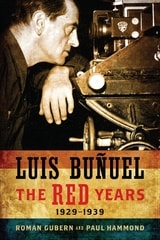
Luis Buñuel
The Red Years, 1929–1939Román Gubern
University of Wisconsin Press, 2011
The turbulent years of the 1930s were of profound importance in the life of Spanish film director Luis Buñuel (1900–1983). He joined the Surrealist movement in 1929 but by 1932 had renounced it and embraced Communism. During the Spanish Civil War (1936–39), he played an integral role in disseminating film propaganda in Paris for the Spanish Republican cause.
Luis Buñuel: The Red Years, 1929–1939 investigates Buñuel’s commitment to making the politicized documentary Land without Bread (1933) and his key role as an executive producer at Filmófono in Madrid, where he was responsible in 1935–36 for making four commercial features that prefigure his work in Mexico after 1946. As for the republics of France and Spain between which Buñuel shuttled during the 1930s, these became equally embattled as left and right totalitarianisms fought to wrest political power away from a debilitated capitalism.
Where it exists, the literature on this crucial decade of the film director’s life is scant and relies on Buñuel’s own self-interested accounts of that complex period. Román Gubern and Paul Hammond have undertaken extensive archival research in Europe and the United States and evaluated Buñuel’s accounts and those of historians and film writers to achieve a portrait of Buñuel’s “Red Years” that abounds in new information.
Lulu Linear Punctated
Essays in Honor of George Irving QuimbyEdited by Robert C. Dunnell, Donald K. Grayson, and Walter N. Koelz
University of Michigan Press, 1983
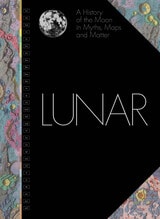
Lunar
A History of the Moon in Myths, Maps, and MatterEdited by Matthew Shindell
University of Chicago Press, 2024
President John F. Kennedy’s rousing “We will go to the Moon” speech in 1961 before the US Congress catalyzed the celebrated Apollo program, spurring the US Geological Survey’s scientists to map the Moon. Over the next eleven years a team of twenty-two, including a dozen illustrator-cartographers, created forty-four charts that forever changed the path of space exploration.
For the first time, each of those beautifully hand-drawn, colorful charts is presented together in one stunning book. In Lunar, National Air and Space Museum curator Matthew Shindell’s expert commentary accompanies each chart, along with the key geological characteristics and interpretations that were set out in the original Geologic Atlas of the Moon. Interwoven throughout the book are contributions from scholars devoted to studying the multifaceted significance of the Moon to humankind around the world. Traveling from the Stone Age to the present day, they explore a wide range of topics: the prehistoric lunar calendar; the role of the Moon in creation myths of Ancient Egypt, Greece, and Rome; the role of the Moon in astrology; the importance of the Moon in establishing an Earth-centered solar system; the association of the Moon with madness and the menstrual cycle; how the Moon governs the tides; and the use of the Moon in surrealist art.
Combining a thoughtful retelling of the Moon’s cultural associations throughout history with the beautifully illustrated and scientifically accurate charting of its surface, Lunar is a stunning celebration of the Moon in all its guises.
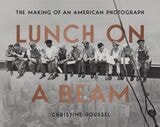
Lunch on a Beam
The Making of an American PhotographChristine Roussel
Brandeis University Press, 2026
Lunch on a Beam, also known as Lunch Atop a Skyscraper, shows ironworkers eating lunch on a steel beam during the construction of Rockefeller Center’s RCA Building in 1932. It’s a photo so famous you can likely picture it in your mind: seated in a row, eleven men chat and break bread 850 feet above the ground, the dense cityscape behind them. While the scene may look spontaneous, the photo was taken during a publicity shoot to promote Rockefeller Center’s new skyscraper. And despite the image’s renown, for years, little information was available about its subjects or its photographer.
In Lunch on a Beam, Rockefeller Center archivist Christine Roussel interweaves the art, architectural, and social history behind the photograph with her personal experience as a confidante to the financiers who developed Rockefeller Center. She tells the stories of the fearless photographers, brazen publicity men, the ironworkers, and their immigrant and Indigenous communities. This portrait of eleven construction workers, she points out, is also a celebration of the nation’s richest man. She examines how, in the depths of the Great Depression, John D. Rockefeller, Jr., took it upon himself to build a monument to American industry and sell it to the public.
Featuring striking images from the Rockefeller Center Archives, Lunch on a Beam calls attention to the fascinating paradoxes contained in a single photo and celebrates the men who built an architectural marvel at great personal risk. This is a story of art and commerce, and the role of a photograph in the mythmaking of New York City.
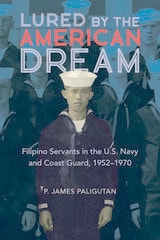
Lured by the American Dream
Filipino Servants in the U.S. Navy and Coast Guard, 1952-1970P. James Paligutan
University of Illinois Press, 2022
Insightful and dramatic, Lured by the American Dream is the untold story of how Filipino servicepersons overcame tradition and hierarchy in their quest for dignity.
Lusophone Africa
Beyond IndependenceFernando Arenas
University of Minnesota Press, 2010
Exploring the evolving relationship of Lusophone Africa with Portugal, its former colonial power, and Brazil, Fernando Arenas situates the countries on the geopolitical map of contemporary global forces. Drawing from popular music, film, literature, cultural history, geopolitics, and critical theory to investigate the postcolonial condition of Portuguese-speaking Africa, Arenas offers an entirely original discussion of world music phenomenon Cesária Évora, as well as the most thorough examination to date of Lusophone African cinema and of Angolan post-civil-war fiction.
Throughout, Arenas evokes the rich multidimensionality of this community of African nations as a whole and of its individual parts: Angola, Cape Verde, Guinea-Bissau, and Mozambique, and São Tomé and Príncipe since they gained their independence in the mid-1970s. In doing so, he puts forth a conceptual framework for understanding, for the first time, recent cultural and historical developments in Portuguese-speaking Africa.
Lustron Stories
Charles Mintz
The Ohio State University Press, 2016
A remarkable cross section of individuals and families live in these modest (~1100 sq. ft.) homes. While certainly diverse in age and place in life, the homeowners are still firmly working class. Everyone who lives in a Lustron home has an opinion about it. The material is miserable to cut or drill into. Repairs are more about metalworking and enamel finishing than carpentry or house painting. And magnets tend to be a popular solution for hanging objects inside and outside the steel walls.
Four years ago, Charles Mintz set out to photograph the people living in these homes. The residents, owners, or both were photographed outside and occasionally inside. Mintz used a large format wooden camera and available light. This book features 65 of the resulting photographs and essays from Shannon Thomas Perich, Curator of the Photographic History Collection at Smithsonian’s National Museum of American History, and Jeffrey Head, author and architecture critic.
Lviv – Wroclaw, Cities in Parallel?
Myth, Memory and Migration, c. 1890-PresentJan Fellerer
Central European University Press, 2020
After World War II, Europe witnessed the massive redrawing of national borders and the efforts to make the population fit those new borders. As a consequence of these forced changes, both Lviv and Wrocław went through cataclysmic changes in population and culture. Assertively Polish prewar Lwów became Soviet Lvov, and then, after 1991, it became assertively Ukrainian Lviv. Breslau, the third largest city in Germany before 1945, was in turn "recovered" by communist Poland as Wrocław. Practically the entire population of Breslau was replaced, and Lwów's demography too was dramatically restructured: many Polish inhabitants migrated to Wrocław and most Jews perished or went into exile. The forced migration of these groups incorporated new myths and the construction of official memory projects.
The chapters in this edited book compare the two cities by focusing on lived experiences and "bottom-up" historical processes. Their sources and methods are those of micro-history and include oral testimonies, memoirs, direct observation and questionnaires, examples of popular culture, and media pieces. The essays explore many manifestations of the two sides of the same coin—loss on the one hand, gain on the other—in two cities that, as a result of the political reality of the time, are complementary.
Lydia Sigourney
Critical Essays and Cultural ViewsMary Louise Kete
University of Massachusetts Press, 2018
During her lifetime, Lydia Sigourney was acclaimed as nineteenth-century America's most popular woman poet and published widely as a historian, travel writer, essayist, and educator. While serious critical attention to her work languished following her death and into the twentieth century, a growing number of critics and writers have reexamined Sigourney and her large body of writing and have given her a central place in the “new canon.”
This first collection of original essays devoted to the poet's work puts many of the best scholars on Sigourney together in one place and in conversation with one another. The volume includes critical essays examining her literary texts as well as essays that unpack Sigourney's participation in the cultural movements of her day. Holding powerful opinions about the role of women in society, Sigourney was not afraid to advocate against government policies that, in her view, undermined the promise of America, even as she was held up as a paragon of American womanhood and middle-class rectitude. The resulting portrait promises to engage readers who wish to know more about Sigourney's writing, her career, and the causes that inspired her.
Along with the volume editors, contributors include Ann Beebe, Paula Bernat Bennett, Janet Dean, Sean Epstein-Corbin, Annie Finch, Gary Kelly, Paul Lauter, Amy J. Lueck, Ricardo Miguel-Alfonso, Jennifer Putzi, Angela Sorby, Joan Wry, and Sandra Zagarell.
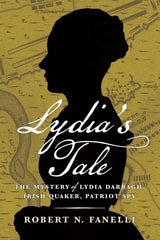
Lydia's Tale
The Mystery of Lydia Darragh, Irish Quaker, Patriot SpyRobert N. Fanelli
Westholme Publishing, 2025
Lydia’s Tale:The Mystery of Lydia Darragh, Irish Quaker, Patriot Spy by Robert N. Fanelli uncovers a myriad of previously unknown records, knitting together for the first time the life and experiences of this remarkable heroine of the American Revolution who lived in the heart of Philadelphia. Behind her story we find an assertive woman who took an active hand in the affairs of her family and her community. Drawing on genealogical sources, legal documents, and other correspondence, the author reconstructs Lydia Darragh’s early life in Dublin, her livelihood in Pennsylvania, and how the Revolution shaped her and her children’s lives. Exploring the context of Lydia’s tale sheds light on the activities of women in Revolutionary Philadelphia, reveals the complex issues faced by pacifist Quakers in a time of war, and brings to light the contributions of Irish immigrants in securing America’s freedom.
The author’s careful research reveals little known details and corrects historians’ common misapprehensions about the Revolutionary period. Along the way, we meet often overlooked figures, including diarist Christopher Marshall and his family, the irascible Quaker recluse Bathsheba Bowers, and Blair McClenachan, the wealthy Patriot financier who also served his adopted country as a common soldier. Lydia Darragh is frequently included among that small group of women cited as Revolutionary heroines. This detailed microhistory demonstrates how legend can inform the study of history, describing how one woman’s personal reminiscence morphed into a piece of American mythology, now recovered in the historical context it deserves.
Lynching Beyond Dixie
American Mob Violence Outside the SouthEdited by Michael J. Pfeifer
University of Illinois Press, 2013
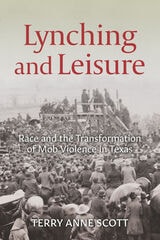
Lynching and Leisure
Race and the Transformation of Mob Violence in TexasTerry Anne Scott
University of Arkansas Press, 2022
Winner, 2022 Ottis Lock Endowment “Best Book” Award from the East Texas Historical Association
In Lynching and Leisure, Terry Anne Scott examines how white Texans transformed lynching from a largely clandestine strategy of extralegal punishment into a form of racialized recreation in which crowd involvement was integral to the mode and methods of the violence. Scott powerfully documents how lynchings came to function not only as tools for debasing the status of Black people but also as highly anticipated occasions for entertainment, making memories with friends and neighbors, and reifying whiteness. In focusing on the sense of pleasure and normality that prevailed among the white spectatorship, this comprehensive study of Texas lynchings sheds new light on the practice understood as one of the chief strategies of racial domination in the nineteenth- and twentieth-century South.
Lynching in Colorado, 1859-1919
Stephen J. Leonard
University Press of Colorado, 2022
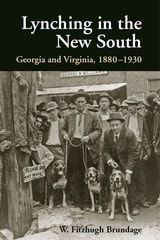
Lynching in the New South
Georgia and Virginia, 1880-1930W. Fitzhugh Brundage
University of Illinois Press, 1993
A groundbreaking study, Lynching in the New South is a classic portrait of the tradition of violence that poisoned American life.
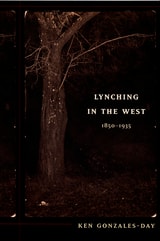
Lynching in the West
1850-1935Ken Gonzales-Day
Duke University Press, 2006
An artist and writer, Gonzales-Day began this study by photographing lynching sites in order to document the absences and empty spaces that are emblematic of the forgotten history of lynching in the West. Drawing on newspaper articles, periodicals, court records, historical photographs, and souvenir postcards, he attempted to reconstruct the circumstances surrounding the lynchings that had occurred in the spaces he was photographing. The result is an unprecedented textual and visual record of a largely unacknowledged manifestation of racial violence in the United States. Including sixteen color illustrations, Lynching in the West juxtaposes Gonzales-Day’s evocative contemporary photographs of lynching sites with dozens of historical images.
Gonzales-Day examines California’s history of lynching in relation to the spectrum of extra-legal vigilantism common during the nineteenth century—from vigilante committees to lynch mobs—and in relation to race-based theories of criminality. He explores the role of visual culture as well, reflecting on lynching as spectacle and the development of lynching photography. Seeking to explain why the history of lynching in the West has been obscured until now, Gonzales-Day points to popular misconceptions of frontier justice as race-neutral and to the role of the anti-lynching movement in shaping the historical record of lynching in the United States.
Lyon College, 1872-2002
The Perseverance and Promise of an Arkansas CollegeBrooks Blevins
University of Arkansas Press, 2003
Lyric Poetry and Social Identity in Archaic Greece
Jessica M. Romney
University of Michigan Press, 2020
All non-English text and quotes are translated, with the original languages given alongside the translation or in the endnotes.
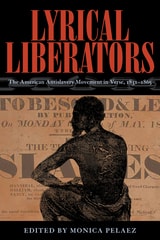
Lyrical Liberators
The American Antislavery Movement in Verse, 1831–1865Monica Pelaez
Ohio University Press, 2018
Before Black Lives Matter and Hamilton, there were abolitionist poets, who put pen to paper during an era when speaking out against slavery could mean risking your life. Indeed, William Lloyd Garrison was dragged through the streets by a Boston mob before a planned lecture, and publisher Elijah P. Lovejoy was fatally shot while defending his press from rioters. Since poetry formed a part of the cultural, political, and emotional lives of readers, it held remarkable persuasive power. Yet antislavery poems have been less studied than the activist editorials and novels of the time.
In Lyrical Liberators, Monica Pelaez draws on unprecedented archival research to recover these poems from the periodicals—Garrison’s Liberator, Frederick Douglass’s North Star, and six others—in which they originally appeared. The poems are arranged by theme over thirteen chapters, a number that represents the amendment that finally abolished slavery in 1865. The book collects and annotates works by critically acclaimed writers, commercially successful scribes, and minority voices including those of African Americans and women.
There is no other book like this. Sweeping in scope and passionate in its execution, Lyrical Liberators is indispensable for scholars and teachers of American literature and history, and stands as a testimony to the power of a free press in the face of injustice.
Lyrics and Borrowed Tunes of the American Temperance Movement
Edited & Compiled by Paul D. Sanders
University of Missouri Press, 2006
Cold water is the drink for me / Of all the drinks the best, sir; / Your grog, of whate’er name it be, / I dare not for to taste, sir.
Such a lyric, sung to the tune of “Yankee Doodle,” was typical ammunition in the temperance movement’s battle against alcohol. By the 1830s, Americans drank an average of 9.5 gallons of hard liquor each year. From the 1840s until the beginning of Prohibition, well over one hundred temperance songbooks were published in which inspirational lyrics were set to mostly borrowed tunes in the hope of persuading citizens to put down the bottle.
Lysistrata
A New Verse TranslationAristophanes, Translated by David Mulroy, with Introduction and Notes
University of Wisconsin Press, 2020
A perennial classroom and stage favorite as well as the basis of Spike Lee’s Chi-Raq, the play is as relevant today as it was 2,500 years ago. The premise is simplicity itself: to end the Peloponnesian War, women decide to withhold sex from their husbands until the fighting stops.
The play is by turns raucous, bawdy, frantic, and funny. David Mulroy’s exciting new translation retains the original’s verse format, racy jokes, and vibrancy—setting it apart from previous efforts, which are typically reproduced as prose or depart from meaning and meter. His introduction offers a concise summary of Aristophanes’ life and social milieu, including a brief overview of the Peloponnesian War, which took place during the playwright’s lifetime. The appendices include guides on translating meter and Greek pronunciation for aspiring thespians.
Léon Blum
Humanist in PoliticsJoel Colton
Duke University Press, 0
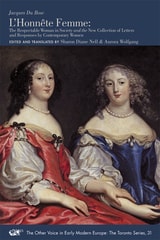
L’Honnête Femme
The Respectable Woman in Society and the New Collection of Letters and Responses by Contemporary WomenJacques Du Bosc
Iter Press, 2014
—Reverend John J. Conley, SJ
Knott Professor of Philosophy, Loyola University Maryland

L’Écologique de l’Histoire
Valentin Husson
Diaphanes, 2020
Il y a plaisir à saluer l‘arrivée d’un philosophe tout neuf qui soudain bondit dans le cortège dionysiaque. Plus on est de fous, plus on pense, le proverbe dit vrai et notre temps de misère a plus que besoin de se refaire – s’il se peut – une vigueur spéculative. Il y a plus que du plaisir, une vraie jubilation lorsque le tout neuf philosophe affirme une pensée de la jouissance, de l’abondance et de la dépense au sens de Bataille (ici toujours discrètement mais efficacement présent). Une pensée énergique au sens le plus – oserais-je dire « vitalisant » du terme. L’energeia n’a-t-elle de sens que depuis l’être ? N’y a-t-il pas une autre énergie à penser ? Une énergie non pas de l’être, ni relative à celle extraite de la nature pour des fins productives et économiques, mais une énergie excédentaire, une sorte de « dépense improductive » (Bataille) de la vie ? Une énergie qui serait le luxe biologique du vivant. Ce luxe biologique, Valentin Husson le pense comme – on ne peut plus dire « ontologique » – comme existence en un sens qui se dérobe à Heidegger et à son « sens de l’être » pour affirmer un avoir à être selon lequel l’être se dissipe au-delà de toute consistance tandis que l’avoir à prend toute l’énergie d’une vie en débordante envie d’elle-même. Jean-Luc Nancy