Results by title
2706 books match the query 'European' and 92 start with l

Literature Among Discourses
The Spanish Golden AgeWlad Godzich and Nicholas Spadaccini, EditorsIntroduction by Wlad Godzich and Nicholas Spadaccini
University of Minnesota Press, 1986
Literature Among Discourses was first published in 1986. Minnesota Archive Editions uses digital technology to make long-unavailable books once again accessible, and are published unaltered from the original University of Minnesota Press editions.
Literature in the High Middle Ages referred to anything written. Those who institutionalized the study of literature in the eighteenth and nineteenth centuries ignored this medieval meaning, and literary history, especially in the hands of teachers, became what Wlad Godzich and Nicholas Spadaccini call a peregrination from one masterpiece to another. In Spanish literature, a cluster of such masterpieces came to be identified quite early, constituting a siglo de oro,a Golden Age. These outstanding works of the sixteenth and seventeenth centuries became a paradigm of achievement for the German romantics who formulated the project of literary history; for this reason, the authors of Literature among Discourses have chosen to begin their own exploratory voyage with the Spanish Golden Age.
Their intent is not simply to complete the historical record by studying "popular" texts alongside the canonical works, nor is it to establish these texts as a treasure trove of raw materials awaiting entry into and transformation by the masterpiece. They ask, rather, why the masterpiece came to occupy its place—how specific texts (or classes of texts) came to be differentiated from other discursive entities and labeled "literature." Taken together, their essays reveal an era in which literature is never a given, but is instead constantly being forged in a manner as complex as the social dynamic itself.
Contributors include: the editors, José Antonio Maravall, Michael Nerlich, Ronald Sousa, Constance Sullivan, Jenaro Talens, José Luís Canet, and Javier Herrero. Wlad Godzich is director of the Center for Humanistic Studies, and Nicholas Spadaccini, professor of Spanish and Portuguese, at the University of Minnesota.
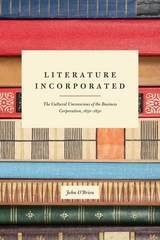
Literature Incorporated
The Cultural Unconscious of the Business Corporation, 1650-1850John O'Brien
University of Chicago Press, 2015
Examining British and American essays, poems, novels, and stories from the seventeenth through the nineteenth centuries, O’Brien pursues the idea of incorporation as a trope discernible in a wide range of texts. Key authors include John Locke, Eliza Haywood, Harriet Martineau, and Edgar Allan Poe, and each chapter is oriented around a type of corporation reflected in their works, such as insurance companies or banks. In exploring issues such as whether sentimental interest is the same as economic interest, these works bear witness to capitalism’s effect on history and human labor, desire, and memory. This period’s imaginative writing, O’Brien argues, is where the unconscious of that process left its mark. By revealing the intricate ties between literary models and economic concepts, Literature Incorporated shows us how the business corporation has shaped our understanding of our social world and ourselves.
Literature Is a Voyage of Discovery
Tom Bishop in Conversation with Donatien GrauTom Bishop and Donatien Grau
Diaphanes, 2021
Tom Bishop has, for over sixty years, helped shape the literary, philosophical, cultural, artistic, and political conversation between Paris and New York. As professor and director of the Center for French Civilization and Culture at New York University, he made the Washington Square institution one of the great bridges between French innovation and a New York scene in full transformation. Bishop was close to Beckett, championed Robbe-Grillet in the United States, befriended Marguerite Duras and Hélène Cixous, and organized historic public encounters—such as the one between James Baldwin and Toni Morrison. He was also a scholar, a recognized specialist in the avant-garde, notably the Nouveau Roman and the Nouveau Théâtre.
In 2012, Bishop invited Donatien Grau to give a talk at NYU. This invitation led to conversations—many of which are presented in this book—and a friendship. Literature Is a Voyage of Discovery gathers their dialogues, retracing Bishop’s career, his own history, his departure from Vienna, his studies, his meetings, his choices, his conception of literature and life, his relationship to the political and economic world, and the way he helped define the profession of “curator” as it is practiced today, offering a thought-provoking look into one of the leading minds of our time.
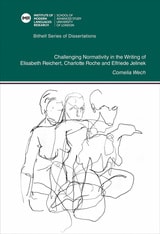
Literature as Intervention
Challenging Normativity in the Writing of Elisabeth Reichert, Charlotte Roche and Elfriede JelinekCornelia Wech
University of London Press, 2020
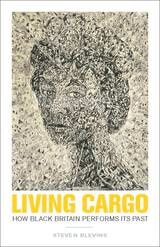
Living Cargo
How Black Britain Performs Its PastSteven Blevins
University of Minnesota Press, 2016
Offering a wide-ranging study of contemporary literature, film, visual art, and performance by writers and artists who live and work in the United Kingdom but also maintain strong ties to postcolonial Africa and the Caribbean, Living Cargo explores how contemporary black British culture makers have engaged with the institutional archives of colonialism and the Atlantic slave trade in order to reimagine blackness in British history and to make claims for social and political redress.
Steven Blevins calls this reimagining “unhousing history”—an aesthetic and political practice that animates and improvises on the institutional archive, repurposing it toward different ends and new possibilities. He discusses the work of novelists, including Caryl Phillips, Fred D’Aguiar, David Dabydeen, and Bernardine Evaristo; filmmakers Isaac Julien and Inge Blackman; performance poet Dorothea Smartt; fashion designer Ozwald Boateng; artists Hew Locke and Yinka Shonibare; and the urban redevelopment of Bristol, England, which unfolded alongside the public demand to remember the city’s slave-trading past.
Living Cargo argues that the colonial archive is neither static nor residual but emergent. By reassembling historical fragments and traces consolidated in the archive, these artists not only perform a kind of counter-historiography, they also imagine future worlds that might offer amends for the atrocities of the past.
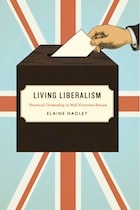
Living Liberalism
Practical Citizenship in Mid-Victorian BritainElaine Hadley
University of Chicago Press, 2010
In the mid-Victorian era, liberalism was a practical politics: it had a party, it informed legislation, and it had adherents who identified with and expressed it as opinion. It was also the first British political movement to depend more on people than property, and on opinion rather than interest. But how would these subjects of liberal politics actually live liberalism?
To answer this question, Elaine Hadley focuses on the key concept of individuation—how it is embodied in politics and daily life and how it is expressed through opinion, discussion and sincerity. These are concerns that have been absent from commentary on the liberal subject. Living Liberalism argues that the properties of liberalism—citizenship, the vote, the candidate, and reform, among others—were developed in response to a chaotic and antagonistic world. In exploring how political liberalism imagined its impact on Victorian society, Hadley reveals an entirely new and unexpected prehistory of our modern liberal politics. A major revisionist account that alters our sense of the trajectory of liberalism, Living Liberalism revises our understanding of the presumption of the liberal subject.

Locating the Audience
How People Found Value in National Theatre WalesKirsty Sedgman
Intellect Books, 2016
Locomotrix
Selected Poetry and Prose of Amelia Rosselli, a Bilingual EditionAmelia Rosselli
University of Chicago Press, 2012
A musician, musicologist, and self-defined “poet of research,” Amelia Rosselli (1930–96) was one of the most important poets to emerge from Europe in the aftermath of World War II. Following a childhood and adolescence spent in exile from Fascist Italy between France, England, and the United States, Rosselli was driven to express the hopes and devastations of the postwar epoch through her demanding and defamiliarizing lines. Rosselli’s trilingual body of work synthesizes a hybrid literary heritage stretching from Dante and the troubadours through Ezra Pound and John Berryman, in which playful inventions across Italian, English, and French coexist with unadorned social critique. In a period dominated by the confessional mode, Rosselli aspired to compose stanzas characterized by a new objectivity and collective orientation, “where the I is the public, where the I is things, where the I is the things that happen.” Having chosen Italy as an “ideal fatherland,” Rosselli wrote searching and often discomposing verse that redefined the domain of Italian poetics and, in the process, irrevocably changed the Italian language.
This collection, the first to bring together a generous selection of her poems and prose in English and in translation, is enhanced by an extensive critical introduction and notes by translator Jennifer Scappettone. Equipping readers with the context for better apprehending Rosselli’s experimental approach to language, Locomotrix seeks to introduce English-language readers to the extraordinary career of this crucial, if still eclipsed, voice of the twentieth century.
London in Quotations
Compiled by Jaqueline Mitchell
Bodleian Library Publishing, 2014
“When a man is tired of London, he is tired of life; for there is in London all that life can afford.” Samuel Johnson spoke highly of London in Boswell’s famous biography, but not all have shared his enthusiasm. Since, the capital has been characterized as a “riddle,” a “cesspool,” and a “modern Babylon”—the last by none other than Prime Minister Benjamin Disraeli. No tribute to the city would be complete without reference to the notoriously inclement weather, which caused Jane Austen to complain that, “in London it is always a sickly season.”
For fans, foes, and those planning a trip to the city in the hopes of forming an opinion, this collection will be welcomed.
London, Radical Culture, and the Making of the Dickensian Aesthetic
Sambudha Sen
The Ohio State University Press, 2012
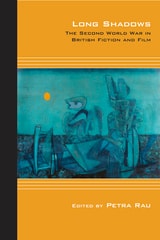
Long Shadows
The Second World War in British Fiction and FilmEdited by Petra Rau
Northwestern University Press, 2016
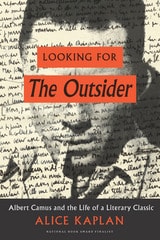
Looking for The Outsider
Albert Camus and the Life of a Literary ClassicAlice Kaplan
University of Chicago Press, 2016
How did a young man in his twenties who had never written a novel turn out a masterpiece that still grips readers more than seventy years later? With Looking for “The Outsider”, Alice Kaplan tells that story. In the process, she reveals Camus’s achievement to have been even more impressive—and more unlikely—than even his most devoted readers knew.
Born in poverty in colonial Algeria, Camus started out as a journalist covering the criminal courts. The murder trials he attended, Kaplan shows, would be a major influence on the development and themes of The Outsider. She follows Camus to France, and, making deft use of his diaries and letters, re-creates his lonely struggle with the novel in Montmartre, where he finally hit upon the unforgettable first-person voice that enabled him to break through and complete The Outsider.
Even then, the book’s publication was far from certain. France was straining under German occupation, Camus’s closest mentor was unsure of the book’s merit, and Camus himself was suffering from near-fatal tuberculosis. Yet the book did appear, thanks in part to a resourceful publisher, Gaston Gallimard, who was undeterred by paper shortages and Nazi censorship.
The initial critical reception of The Outsider was mixed, and it wasn’t until after liberation that The Outsider began its meteoric rise. As France and the rest of the world began to move out of the shadow of war, Kaplan shows, Camus’s book— with the help of an aggressive marketing campaign by Knopf for their 1946 publication of the first English translation—became a critical and commercial success, and Camus found himself one of the most famous writers in the world. Suddenly, his seemingly modest tale of alienation was being seen for what it really was: a powerful parable of the absurd, an existentialist masterpiece.
Few books inspire devotion and excitement the way The Outsider does. And it couldn’t have a better biographer than Alice Kaplan, whose books about twentieth-century French culture and history have won her legions of fans. No reader of Camus will want to miss this brilliant exploration.
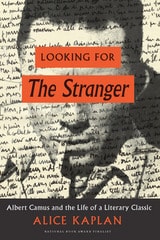
Looking for The Stranger
Albert Camus and the Life of a Literary ClassicAlice Kaplan
University of Chicago Press, 2016
How did a young man in his twenties who had never written a novel turn out a masterpiece that still grips readers more than seventy years later? With Looking for “The Stranger”, Alice Kaplan tells that story. In the process, she reveals Camus’s achievement to have been even more impressive—and more unlikely—than even his most devoted readers knew.
Born in poverty in colonial Algeria, Camus started out as a journalist covering the criminal courts. The murder trials he attended, Kaplan shows, would be a major influence on the development and themes of The Stranger. She follows Camus to France, and, making deft use of his diaries and letters, re-creates his lonely struggle with the novel in Montmartre, where he finally hit upon the unforgettable first-person voice that enabled him to break through and complete The Stranger.
Even then, the book’s publication was far from certain. France was straining under German occupation, Camus’s closest mentor was unsure of the book’s merit, and Camus himself was suffering from near-fatal tuberculosis. Yet the book did appear, thanks in part to a resourceful publisher, Gaston Gallimard, who was undeterred by paper shortages and Nazi censorship.
The initial critical reception of The Stranger was mixed, and it wasn’t until after liberation that The Stranger began its meteoric rise. As France and the rest of the world began to move out of the shadow of war, Kaplan shows, Camus’s book— with the help of an aggressive marketing campaign by Knopf for their 1946 publication of the first English translation—became a critical and commercial success, and Camus found himself one of the most famous writers in the world. Suddenly, his seemingly modest tale of alienation was being seen for what it really was: a powerful parable of the absurd, an existentialist masterpiece.
Few books inspire devotion and excitement the way The Stranger does. And it couldn’t have a better biographer than Alice Kaplan, whose books about twentieth-century French culture and history have won her legions of fans. No reader of Camus will want to miss this brilliant exploration.
Lord Byron's Cain
Twelve essays and a text with variants and annotationsEdited by Truman Guy Steffan
University of Texas Press, 1968
Cain has been ranked as one of the two best dramatic poems written in England in the nineteenth century. Because of its religious heterodoxy, which veiled a political iconoclasm, and also because of Byron’s notoriety, Cain stirred up a storm among Tories and clergymen “from Kentish town to Pisa.” From 1821 to 1830 more was printed about its eighteen hundred alarming lines than about the twenty thousand of Don Juan. One solemn Frenchman even translated the work in order to supply his countrymen with a text that he could then rewrite and confute.
After the initial controversy, readers began to regard Cain not merely as revolutionary propaganda but as a fictional portrait of common youthful experience: a sequence of aspiration, discontent, uncertainty, confusion, misunderstood isolation, fear, frustration, anger, and finally a rash, inevitable, but futile revolt that led to a future of hopeless regret.
Truman Guy Steffan here presents a text, arrived at by collation of the first and several later editions with the original manuscript (presently in the Stark Collection of the Miriam Lutcher Stark Library at the Harry Ransom Center, the University of Texas at Austin).
The first eight essays, which comprise Part I, cover a number of literary topics: Byron’s defense of his purposes in Cain and the relevance of his dramatic theory to the poem; the characterization that is an ideological confrontation, a revelation of personal conflict, as well as a rendering of individuals who have an existence independent of the author; the principles that controlled Byron’s absorption and expansion of biblical materials; the integration of the imagery with the dramatic substance; the incongruities of the language; the metrical heterodoxy; and a description of the manuscript and of Byron’s insertions.
Part II contains the text of Cain, accompanied by notes on the variants, the manuscript cancellations and additions, certain linguistic details, and the scansion of some unusual verses. Then follow annotations on allusions, sources, and analogues, and on a few passages of the play that have elicited unusual conflict over interpretation.
Part III provides a history of Cain criticism, from the opinions of Byron’s social and literary circle and of the major periodicals and pamphlets to the more complicated contribution of the twentieth century.
This important work stands not only as a valuable addition to Byron scholarship but also as an illuminating record of the changing critical and cultural attitudes from the early nineteenth century to the 1960s. Steffan has done a remarkable job in bringing together and synthesizing an enormous body of material.
Loss, A Love Story
Imagined Histories and Brief EncountersSophie Ratcliffe
Northwestern University Press, 2024
Part memoir, part imagined history, this unique personal essay depicts the intimate experience of childhood bereavement, lost love affairs, and the complicated realities of motherhood and marriage. Framed by an extended train journey, author Sophie Ratcliffe turns to the novels, novelists, and heroines who have shaped her emotional and romantic landscapes. She transports us with her to survey the messiness of everyday life, all while reflecting on steam propulsion and pop songs, handbags and honeymoons, Anna Karenina and Anthony Trollope, former lovers and forgotten muses. Frank, funny, tender, and transporting, Loss, A Love Story asks why we fall in, and out, of love—and how we might understand doing so amid the ongoing upheavals and unwritten futures of the twenty-first century.

Lost Property
The Woman Writer and English Literary History, 1380-1589Jennifer Summit
University of Chicago Press, 2000
Lost Property traces the representation of women writers from Margery Kempe and Christine de Pizan to Elizabeth I and Mary Queen of Scots, exploring how the woman writer became a focal point for emerging theories of literature and authorship in English precisely because of her perceived alienation from tradition. Through original archival research and readings of key literary texts, Summit writes a new history of the woman writer that reflects the impact of such developments as the introduction of printing, the Reformation, and the rise of the English court as a literary center.
A major rethinking of the place of women writers in the histories of books, authorship, and canon-formation, Lost Property demonstrates that, rather than being an unimaginable anomaly, the idea of the woman writer played a key role in the invention of English literature.
Lost in Time
Locating the Stranger in German ModernityJune J. Hwang
Northwestern University Press, 2014
Lost in the Shadow of the Word
Space, Time, and Freedom in Interwar Eastern EuropeBenjamin Paloff
Northwestern University Press, 2016
Scholars of modernism have long addressed how literature, painting, and music reflected the radical reconceptualization of space and time in the early twentieth century—a veritable revolution in both physics and philosophy that has been characterized as precipitating an “epistemic trauma” around the world. In this wide-ranging study, Benjamin Paloff contends that writers in Central and Eastern Europe felt this impact quite distinctly from their counterparts in Western Europe. For the latter, the destabilization of traditional notions of space and time inspired works that saw in it a new kind of freedom. However, for many Central and Eastern European authors, who were writing from within public discourses about how to construct new social realities, the need for escape met the realization that there was both nowhere to escape to and no stable delineation of what to escape from. In reading the prose and poetry of Czech, Polish, and Russian writers, Paloff imbues the term “Kafkaesque” with a complexity so far missing from our understanding of this moment in literary history.
Lothario's Corpse
Libertine Drama and the Long-Running Restoration, 1700-1832Daniel Gustafson
Bucknell University Press, 2020
Published by Bucknell University Press. Distributed worldwide by Rutgers University Press.
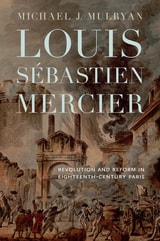
Louis Sébastien Mercier
Revolution and Reform in Eighteenth-Century ParisMichael J. Mulryan
Bucknell University Press, 2023
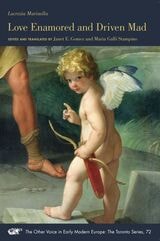
Love Enamored and Driven Mad
Lucrezia Marinella
Iter Press, 2020
The Other Voice in Early Modern Europe - The Toronto Series, volume 72
Love Known
Theology and Experience in George Herbert's PoetryRichard Strier
University of Chicago Press, 1983
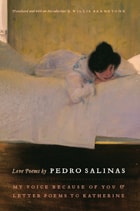
Love Poems by Pedro Salinas
My Voice Because of You and Letter Poems to KatherinePedro Salinas
University of Chicago Press, 2010
Now in paperback, a bilingual edition of one of the greatest sequences of love poems ever written.
When Pedro Salinas’s 1933 collection of love poems, La voz a ti debida, was introduced to American audiences in Willis Barnstone’s 1975 English translation, it was widely regarded as the greatest sequence of love poems written by a man or a woman, in any language, in the twentieth century. Now, seventy-five years after its publication, the reputation of the poems and its multifaceted writer remains untarnished. A portrait of their era, the poems, from a writer in exile from his native civil war-torn Spain, now reemerge in our time.
In this new, facing-page bilingual edition, Barnstone has added thirty-six poems written in the form of letters from Salinas to his great love, Katherine Whitmore. Discovered years later, these poems were written during and after the composition of La voz and, though disguised as prose, have all the rhythms and sounds of lineated lyric poetry. Taken together, the poems and letters are a history, a dramatic monologue, and a crushing and inevitable ending to the story of a man consumed by his love and his art.
Bolstered by an elegant foreword by Salinas’s contemporary, the poet Jorge Guillén, and a masterly afterword by the Salinas scholar, Enric Bou, that considers the poet and his legacy for twenty-first century world poetry, Love Poems by Pedro Salinas will be cause for celebration throughout the world of verse and beyond.
Love and Good Reasons
Postliberal Approaches to Christian Ethics and LiteratureFritz Oehlschlaeger
Duke University Press, 2003
Love and Good Reasons combines postliberal narrative theology—especially Stanley Hauerwas’s Christian ethics and Alasdair MacIntyre’s idea of traditional inquiry—with recent scholarship in literature and ethics including the work of Martha Nussbaum, J. Hillis Miller, Wayne Booth, Jeffrey Stout, and Richard Rorty. Oehlschlaeger offers detailed readings of literature by five major authors—Herman Melville, Jane Austen, Anthony Trollope, Henry James, and Stephen Crane. He examines their works in light of biblical scripture and the grand narratives of Israel, Jesus, and the Church. Discussing the role of religion in contemporary higher education, Oehlschlaeger shares his own experiences of teaching literature from a religious perspective at a state university.
Love and Logic
The Evolution of Blake's ThoughtStephen Cox
University of Michigan Press, 1992
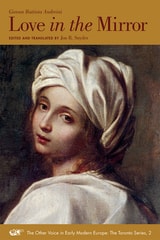
Love in the Mirror
A Bilingual EditionGiovan Battista Andreini
Iter Press, 2009
Originally published in 1622, Love in the Mirror tells the unforgettable and path-breaking story of a passionate love affair between two women in early modern Florence. Despite the risk of social sanctions, Florinda and Lidia freely consent to love each other “breast to breast and mouth to mouth,” with some surprising consequences for the institution of marriage.
This bilingual edition of the play introduces the English-speaking reader to one of the most remarkable creative artists of the Baroque age, Giovan Battista Andreini (1576–1654). Actor, playwright, and son of the first great diva of the European stage, Isabella Andreini, Giovan Battista was renowned in his lifetime as an avant-garde theatrical innovator. While drawing on the Italian commedia dell’arte, his comedies go far beyond its limits in order— like Calderón, Corneille and Shakespeare—to subvert traditional views of the relationship between art and life, representation and reality.
Love in the Mirror, which was lost from view for centuries, is here translated for the first time into a highly accessible and fully annotated English version. The volume includes a wideranging introduction to this experimental comic masterpiece, as well as to the life and works of G.B. Andreini.
Love's Labour's Lost
William Shakespeare
Arizona Center for Medieval and Renaissance Studies, 2024
Love’s Labour’s Lost is a wacky comedy of disguise and mischief, following the King of Navarre and his companions as they attempt to swear off the company of women. Focusing on bringing new life into the musicality of Shakespeare’s language, Josh Wilder’s translation of Love’s Labour’s Lost brings out the play’s romp and sass for a contemporary audience.
This translation of Love’s Labour’s Lost was written as part of the Oregon Shakespeare Festival’s Play On! project, which commissioned new translations of thirty-nine Shakespeare plays. These translations present the work of “The Bard” in language accessible to modern audiences while never losing the beauty of Shakespeare’s verse. Enlisting the talents of a diverse group of contemporary playwrights, screenwriters, and dramaturges from diverse backgrounds, this project reenvisions Shakespeare for the twenty-first century. These volumes make these works available for the first time in print—a new First Folio for a new era.
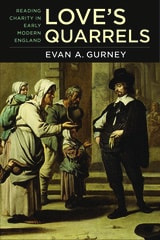
Love's Quarrels
Reading Charity in Early Modern EnglandEvan Gurney
University of Massachusetts Press, 2018
Early modern English writers often complained that “charity had grown cold,” lamenting the dissolution of society's communal bonds. But far from diminishing in scope or influence, charity generated heated debates, animated by social, political, and religious changes that prompted urgent questions about the virtue's powers and functions. Charity was as much a problem as it was a solution, a sure sign of trouble even when invoked on behalf of peace and community.
Love's Quarrels charts charity's complex history from the 1520s to the 1640s and details the ways in which it can be best understood in biblical translations of the early sixteenth century, in Elizabethan polemic and satire, and in the political and religious controversies arriving at the outset of civil war. As key works from Edmund Spenser, Ben Jonson, and John Milton reveal, “reading charity” was fraught with difficulty as early modern England reconsidered its deepest held convictions in the face of mounting social disruption and spiritual pressure.
Love, Life, and Lust in Heinrich Kaufringer's Verse Narratives
Albrecht Classen
Arizona Center for Medieval and Renaissance Studies, 2015
Lovefuries
The Contracting Sea; The Hanging Judge; Bite or SuckDavid Ian Rabey
Intellect Books, 2008
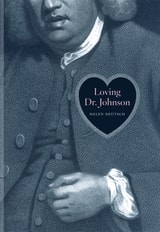
Loving Dr. Johnson
Helen Deutsch
University of Chicago Press, 2005
Loving Dr. Johnson uses the enormous popularity of Johnson to understand a singular case of author love and to reflect upon what the love of authors has to do with the love of literature. Helen Deutsch's work is driven by several impulses, among them her affection for both Johnson's work and Boswell's biography of him, and her own distance from the largely male tradition of Johnsonian criticism—a tradition to which she remains indebted and to which Loving Dr. Johnson is ultimately an homage. Limning sharply Johnson's capacious oeuvre, Deutsch's study is also the first of its kind to examine the practices and rituals of Johnsonian societies around the world, wherein Johnson's literary work is now dwarfed by the figure of the writer himself.
An absorbing look at one iconic author and his afterlives, Loving Dr. Johnson will be of enormous value to students of English literature and literary scholars keenly interested in canon formation.
Loving Faster than Light
Romance and Readers in Einstein's UniverseKaty Price
University of Chicago Press, 2012
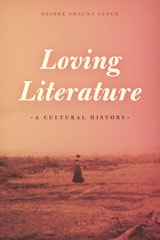
Loving Literature
A Cultural HistoryDeidre Shauna Lynch
University of Chicago Press, 2014
That question led Deidre Shauna Lynch into the historical and cultural investigation of Loving Literature. How did it come to be that professional literary scholars are expected not just to study, but to love literature, and to inculcate that love in generations of students? What Lynch discovers is that books, and the attachments we form to them, have played a vital role in the formation of private life—that the love of literature, in other words, is deeply embedded in the history of literature. Yet at the same time, our love is neither self-evident nor ahistorical: our views of books as objects of affection have clear roots in eighteenth- and nineteenth-century publishing, reading habits, and domestic history.
While never denying the very real feelings that warm our relationship to books, Loving Literature nonetheless serves as a riposte to those who use the phrase “the love of literature” as if its meaning were transparent. Lynch writes, “It is as if those on the side of love of literature had forgotten what literary texts themselves say about love’s edginess and complexities.” With this masterly volume, Lynch restores those edges and allows us to revel in those complexities.
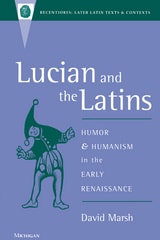
Lucian and the Latins
Humor and Humanism in the Early RenaissanceDavid Marsh
University of Michigan Press, 1998
Until now, no study has attempted to connect the Latin translators and imitators of Lucian with his wider European influence. In Lucian and the Latins, David Marsh describes how Renaissance authors rediscovered the comic writings of Lucian. He traces how Lucianic themes and structures made an essential contribution to European literature beginning with a survey of Latin translations and imitations, which gave new direction to European letters in the fifteenth and sixteenth centuries. The Lucianic dialogues of the dead and dialogues of the gods were immensely popular, despite the religious backlash of the sixteenth century. The paradoxical encomium, represented by Lucian's "The Fly" and "The Parasite," inspired so-called serious humanists like Leonardo Bruni and Guarino of Verona. Lucian's "True Story" initiated the genre of the fantastic journey, which enjoyed considerable popularity during the Renaissance age of discovery. Humanist descendants of this work include Thomas More's Utopia and much of Rabelais' Pantagruel.
Lucian and the Latins will attract readers interested in a wide variety of subjects: the classical tradition, the early Italian Renaissance, the origins of modern European literature, and the uses of humor and satire as instruments of cultural critique.
David Marsh is Professor of Italian, Rutgers University.
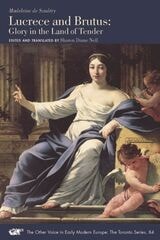
Lucrece and Brutus
Glory in the Land of TenderMadeleine de Scudéry
Iter Press, 2021
Comprising texts by Madeleine de Scudéry, including many from her novel Clélie, this volume focuses on the story of Lucretia, the Roman matron whose rape and suicide led to the downfall of the Roman monarchy. Through her work, Scudéry seeks to contrast the enormous cultural contributions of women with their physical vulnerability and to propose an alternative to sexual violation, as envisioned on the Map of the Land of Tender that charts an imaginary land in the novel and outlines a path toward love. In Scudéry’s version of this tale, Lucrece and her beloved, Brutus, follow the path of tender friendship. Scudéry contradicts history’s characterization of Lucrece as craving glory in the form of fame. Indeed, contrary to ancient sources, Lucrece’s glory will be her decision to sacrifice herself secretly for her tender friend.
Lunar Voices
Of Tragedy, Poetry, Fiction, and ThoughtDavid Farrell Krell
University of Chicago Press, 1995
Krell pursues important philosophical motifs such as time, rhythm, and desire, through texts by Nietzsche, Trakl, Empedocles, Kafka, and Garcia Marquez. He surveys instances in which poets or novelists explicitly address philosophical questions, and philosophers confront literary texts—Heidegger's and Derrida's appropriations of Georg Trakl's poetry, Blanchot's obsession with Kafka's tortuous love affairs, and Garcia Marquez's use of Nietzsche's idea of the Eternal Return—all linked by the tragic hero Empedocles.
In his search to understand the insatiable desire for completeness that patterns so much art and philosophy, Krell investigates the identification of the lunar voice with woman in various roles—lover, friend, sister, shadow, and narrative voice.
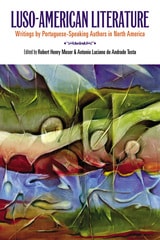
Luso-American Literature
Writings by Portuguese-Speaking Authors in North AmericaMoser, Robert H
Rutgers University Press, 2011
Lyric Novella
Annemarie Schwarzenbach
Seagull Books, 2011
Schwarzenbach’s clear, psychologically acute prose makes this novella an evocative narrative, with many intriguing parallels to her own life.
Annemarie Schwarzenbach—journalist, novelist, antifascist, archaeologist, and traveler—has become a European cult figure for bohemian free spirits since the rediscovery of her works in the late 1980s. Lyric Novella is her story of a young man’s obsession with a Berlin variété actress. Despite having his future career mapped out for him in the diplomatic service, the young man begins to question all his family values under Sibylle’s spell. His family, future, and social standing become irrelevant when set against his overriding compulsion to pick her up every night from the theater so they can go for a drive. Bringing the story back to her own life, Schwarzenbach admitted after publication that her hero was in fact a young woman, not a man, leaving little doubt that Lyric Novella is a literary tale of lesbian love during socially and politically turbulent times.
Lyrical Strategies
The Poetics of the Twentieth-Century American NovelKatie Owens-Murphy
Northwestern University Press, 2018
Owens-Murphy surveys a broad array of writers: poets from the lyrical transatlantic tradition, as well as American novelists including Gertrude Stein, Jean Toomer, William Faulkner, Toni Morrison, Louise Erdrich, and Cormac McCarthy. Through a masterful reexamination of canonical works of twentieth-century American fiction through the lens of lyric poetry, she reveals how many elements in these novels can be better understood as poetic and rhetorical figures (metaphysical conceit, polysyndeton, dramatic monologue, apostrophe, and so on) than as narrative ones.
Making fresh contributions to literary theory and American fiction, Lyrical Strategies will fascinate readers and scholars of the American novel, fiction, poetry, and poetics alike.
Lyrics of the French Renaissance
Marot, Du Bellay, RonsardEdited by Norman R. Shapiro
University of Chicago Press, 2006
Hope Glidden’s accessible introduction, along with the notes she and Shapiro provide on specific poems, will increase readers’ enjoyment and illuminate the historical and linguistic issues relating to this wealth of more than 150 lyric poems.
“A marvelous micro-anthology of sixteenth-century French letters. Representing the pinnacle of French Renaissance verse, the poems singled out here are sensitively interpreted in rhymed English versions. . . . There is a pleasant and inspiring craftsmanship in these interpretations.”—Virginia Quarterly Review
L’Honnête Femme
The Respectable Woman in Society and the New Collection of Letters and Responses by Contemporary WomenJacques Du Bosc
Iter Press, 2014
—Reverend John J. Conley, SJ
Knott Professor of Philosophy, Loyola University Maryland
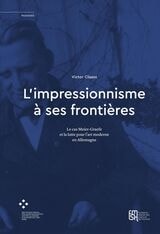
L’impressionnisme à ses frontières
Le cas Meier-Graefe et la lutte pour l’art moderne en AllemagneVictor Claass
Diaphanes, 2023
Par ses écrits pionniers sur l’histoire du développement de l’art moderne, le critique d’art allemand Julius Meier-Graefe (1867-1935) joua un rôle décisif pour la canonisation de l’impressionnisme dans l’Europe de 1900. En défendant avec subversion et énergie la peinture de Manet, Renoir ou Cézanne outre-Rhin, il se mit à dos les élites conservatrices de l’Empire, qui observaient avec méfiance la propagation des valeurs de la modernité artistique. Tout au long de sa trajectoire franco-allemande, ponctuée de virulentes polémiques et cisaillée par le surgissement de la Première Guerre mondiale, Meier-Graefe lutta contre l’emprise d’un nationalisme obtus sur les récits artistiques. Son projet de régénération de la culture allemande fut ainsi indissociable de ses efforts pour la fédération d’une Europe pacifiée des images.
Si le progressisme francophile tout comme le vitalisme de son approche de la peinture ont parfois été soulignés, l’étude de son implication dans les débats politico-culturels de son temps révèle une personnalité plus nuancée. Ce livre analyse ainsi les surprenants à-coups et paradoxes ayant émaillé la carrière transnationale de Meier-Graefe, où alternèrent phases d’enthousiasme débridé et d’intense désillusion. Le personnage s’y dévoile comme un penseur du déclin et le chantre d’une modernité idéalisée, dont l’impressionnisme représentait à la fois la quintessence et le chant du cygne.