Results by title
5448 books match the query 'History and criticism' and 182 start with l
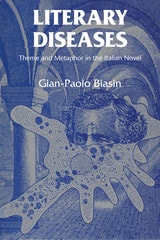
Literary Diseases
Theme and Metaphor in the Italian NovelBy Gian-Paolo Biasin
University of Texas Press, 1975
Disease—real or imagined, physical or mental—is a common theme in Western literature and is often a symbol of modern alienation. In Literary Diseases, a comprehensive analysis of the metaphorical and symbolic force of disease in modern Italian literature, Gian-Paolo Biasin expands the geography of the discussion of this important theme. Using as a backdrop the perspective of European experiences of the previous hundred years, Biasin analyzes the theme of disease as a reflection of certain sociological and historical phenomena in modern European novels, as a metaphor for the world visions of selected Italian novelists, and especially as a vehicle for understanding the nature and function of fiction itself.
The core of Biasin’s study is found in his discussion of the works of four major Italian writers. In his criticism of the novels of Giovanni Verga, who stood at the center of many complex developments in the nineteenth century, he examines the antecedents of modern Italian prose. He then scrutinizes the works of Italo Svevo and Luigi Pirandello, who together inaugurated the modern novel in Italy. Of particular interest is his exploration of their critical use of psychoanalysis and madness climaxed by apocalyptic visions. He then discusses the prose of Carlo Emilio Gadda, which epitomizes the problems of the avant-garde in its experimentalism and expressionism.
Biasin utilizes a broad spectrum of critical approaches—from sociology, psychoanalysis, and different trends in modern French, American, and Italian literary criticism—in shaping his own methodology, which is a thematic and structural symbolism. He concludes that disease in literature should be considered as a metaphor for writing (écriture) and as a cognitive instrument that calls into question the anthropocentric values of Western culture. The book, with its textual comparisons and unusual supporting examples, constitutes a significant methodological contribution as well as a major survey of modern Italian prose, and will allow the reader to see traditional landmarks in European fiction in a new light.
Literary Gestures
The Aesthetic in Asian American Writingedited by Rocío G. Davis and Sue-Im Lee
Temple University Press, 2005
Literary Identification from Charlotte Brontë to Tsitsi Dangarembga
Laura Green
The Ohio State University Press, 2012
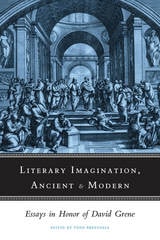
Literary Imagination, Ancient and Modern
Essays in Honor of David GreneEdited by Todd Breyfogle
University of Chicago Press, 1999
Ranging as widely as Grene's own interests in Greek and Roman antiquity, in drama, poetry, and the novel, in the art of translation, and in English history, these essays include discussions of the Odyssey and Ulysses, the Metamorphoses of Ovid and Apuleius, Mallarmé's English and T. S. Eliot's religion, and the mutually antipathetic minds of Edmund Burke and Thomas Jefferson. The introduction by Todd Breyfogle sketches for the first time the contours of Grene's own thought.
Classicists, political theorists, intellectual historians, philosophers, and students of literature will all find much of value in the individual essays here and in the juxtaposition of their themes.
Contributors: Saul Bellow, Seth Benardete, Todd Breyfogle, Amirthanayagam P. David, Wendy Doniger, Mary Douglas, Joseph N. Frank, Victor Gourevitch, Nicholas Grene, W. R. Johnson, Brendan Kennelly, Edwin McClellan, Françoise Meltzer, Stephanie Nelson, Conor Cruise O'Brien, Martin Ostwald, Robert B. Pippin, James Redfield, Sandra F. Siegel, Norma Thompson, and David Tracy
Literary Journalism across the Globe
Journalistic Traditions and Transnational InfluencesJohn S. Bak
University of Massachusetts Press, 2011
At the end of the nineteenth century, several countries were developing journalistic traditions similar to what we identify today as literary reportage or literary journalism. Yet throughout most of the twentieth century, in particular after World War I, that tradition was overshadowed and even marginalized by the general perception among democratic states that journalism ought to be either “objective,” as in the American tradition, or “polemical,” as in the European. Nonetheless, literary journalism would survive and, at times, even thrive. How and why is a story that is unique to each nation.
Though largely considered an Anglo-American phenomenon today, literary journalism has had a long and complex international history, one built on a combination of traditions and influences that are sometimes quite specific to a nation and at other times come from the blending of cultures across borders. These essays examine this phenomenon from various international perspectives, documenting literary journalism's rich and diverse heritage and describing its development within a global context.
In addition to the editors, contributors include David Abrahamson, Peiqin Chen, Clazina Dingemanse, William Dow, Rutger de Graaf, John Hartsock, Nikki Hessell, Maria Lassila-Merisalo, Edvaldo Pereira Lima, Willa McDonald, Jenny McKay, Sonja Merljak Zdovc, Sonia Parratt, Norman Sims, Isabel Soares,and Soenke Zehle.
Literary Journalism and the Aesthetics of Experience
John C. Hartsock
University of Massachusetts Press, 2016
Proponents and practitioners of narrative literary journalism have sought to assert its distinctiveness as both a literary form and a type of journalism. In Literary Journalism and the Aesthetics of Experience, John C. Hartsock argues that this often neglected kind of journalism—exemplified by such renowned works as John Hersey's Hiroshima, James Agee's Let Us Now Praise Famous Men, and Joan Didion's Slouching Towards Bethlehem—has emerged as an important genre of its own, not just a hybrid of the techniques of fiction and the conventions of traditional journalism.
Hartsock situates narrative literary journalism within the broader histories of the American tradition of “objective” journalism and the standard novel. While all embrace the value of narrative, or storytelling, literary journalism offers a particular “aesthetics of experience” lacking in both the others. Not only does literary journalism disrupt the myths sustained by conventional journalism and the novel, but its rich details and attention to everyday life question readers' cultural assumptions. Drawing on the critical theories of Nietzsche, Bakhtin, Benjamin, and others, Hartsock argues that the aesthetics of experience challenge the shibboleths that often obscure the realities the other two forms seek to convey.
At a time when print media appear in decline, Hartsock offers a thoughtful response to those who ask, “What place if any is there for a narrative literary journalism in a rapidly changing media world?”
Literary Journalism in the Twentieth Century
Norman Sims
Northwestern University Press, 2008
This wide-ranging collection of critical essays on literary journalism addresses the shifting border between fiction and non-fiction, literature and journalism.
Literary Journalism in the Twentieth Century addresses general and historical issues, explores questions of authorial intent and the status of the territory between literature and journalism, and offers a case study of Mary McCarthy’s 1953 piece, "Artists in Uniform," a classic of literary journalism.
Sims offers a thought-provoking study of the nature of perception and the truth, as well as issues facing journalism today.
Literary Luxuries
American Writing at the End of the MillenniumJoe David Bellamy
University of Missouri Press, 1995
From the Iowa Writers Workshop to the halls of Congress and the National Endowment for the Arts, from the world of literary magazines and writers' conferences to the bizarre realm of the late-twentieth-century American English department, Literary Luxuries takes the reader on a guided tour of American literary life in our time--and the forces threatening its existence.
Joe David Bellamy has been a significant figure on the literary scene during the last three decades; as a "literary Everyman," he offers in Literary Luxuries a distinctive and valuable perspective on the culture wars, on education and the imagination, on particular writers and major literary and aesthetic movements, on the role of government in fostering cultural development, and on the day-to-day strife of the writer's life in the United States.
As director of the literature program of the National Endowment for the Arts, Bellamy had the unenviable task of trying to persuade Congress and ordinary citizens that American literature is worthy of support, and in Literary Luxuries he continues that debate and helps us to understand its implications: "Literature is our national treasury of language and style and our best reckoning about human life, as it is lived in this time and place."
Part memoir, part critique, part impassioned defense of American literary culture and the values it espouses and struggles to uphold, Literary Luxuries offers unforgettable commentary on the literary life in the United States during the last decades of the twentieth century as described from the perspective of one of its key participants.

Literary Politics in the Soviet Ukraine, 1917-1934
George S. N. Luckyj
Duke University Press, 1990
The new edition reissues Luckyj’s critical work in light of current political developments and reflects the revision of previous findings. Luckyj originally drew on published Soviet sources and the important unpublished papers of a Soviet Ukrainian writer who defected to the West to describe how the brief literary revival in the Soviet Ukraine in the 1920s was abruptly halted by Communist Party controls. The present volume features a new preface, an additional chapter covering recent Soviet attitudes toward the literature of the 1920s and 1930s, and an updated bibliography.
Literary Publishing in America, 1790-1850
William Charvat
University of Massachusetts Press, 1993
Available for the first time in paperback, this book is a succinct distillation of the work and thought of William Charvat, a pioneer in the study of the history of the American book. This burgeoning field of inquiry investigates the social and cultural context of the act of literary creation by relating it to the modes of its production and distribution. This new edition of Literary Publishing in America contains an afterword by Michael Winship that discusses scholarship in the field since publication of Charvat's groundbreaking work.
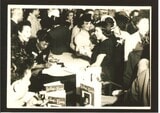
Literary Sisters
Dorothy West and Her Circle, A Biography of the Harlem RenaissanceMitchell, Verner D
Rutgers University Press, 2012
Harlem Renaissance writer Dorothy West led a charmed life in many respects. Born into a distinguished Boston family, she appeared in Gershwin’s Porgy and Bess, then lived in the Soviet Union with a group that included Langston Hughes, to whom she proposed marriage. She later became friends with Jacqueline Kennedy Onassis, who encouraged her to finish her second novel, The Wedding, which became the octogenarian author’s first bestseller.
Literary Sisters reveals a different side of West’s personal and professional lives—her struggles for recognition outside of the traditional literary establishment, and her collaborations with talented African American women writers, artists, and performers who faced these same problems. West and her “literary sisters”—women like Zora Neale Hurston and West’s cousin, poet Helene Johnson—created an emotional support network that also aided in promoting, publishing, and performing their respective works. Integrating rare photos, letters, and archival materials from West’s life, Literary Sisters is not only a groundbreaking biography of an increasingly important author but also a vivid portrait of a pivotal moment for African American women in the arts.
Literary Theory
An IntroductionTerry Eagleton
University of Minnesota Press, 1996

Literature Among Discourses
The Spanish Golden AgeWlad Godzich and Nicholas Spadaccini, EditorsIntroduction by Wlad Godzich and Nicholas Spadaccini
University of Minnesota Press, 1986
Literature Among Discourses was first published in 1986. Minnesota Archive Editions uses digital technology to make long-unavailable books once again accessible, and are published unaltered from the original University of Minnesota Press editions.
Literature in the High Middle Ages referred to anything written. Those who institutionalized the study of literature in the eighteenth and nineteenth centuries ignored this medieval meaning, and literary history, especially in the hands of teachers, became what Wlad Godzich and Nicholas Spadaccini call a peregrination from one masterpiece to another. In Spanish literature, a cluster of such masterpieces came to be identified quite early, constituting a siglo de oro,a Golden Age. These outstanding works of the sixteenth and seventeenth centuries became a paradigm of achievement for the German romantics who formulated the project of literary history; for this reason, the authors of Literature among Discourses have chosen to begin their own exploratory voyage with the Spanish Golden Age.
Their intent is not simply to complete the historical record by studying "popular" texts alongside the canonical works, nor is it to establish these texts as a treasure trove of raw materials awaiting entry into and transformation by the masterpiece. They ask, rather, why the masterpiece came to occupy its place—how specific texts (or classes of texts) came to be differentiated from other discursive entities and labeled "literature." Taken together, their essays reveal an era in which literature is never a given, but is instead constantly being forged in a manner as complex as the social dynamic itself.
Contributors include: the editors, José Antonio Maravall, Michael Nerlich, Ronald Sousa, Constance Sullivan, Jenaro Talens, José Luís Canet, and Javier Herrero. Wlad Godzich is director of the Center for Humanistic Studies, and Nicholas Spadaccini, professor of Spanish and Portuguese, at the University of Minnesota.
Literature Incorporated
The Cultural Unconscious of the Business Corporation, 1650-1850John O'Brien
University of Chicago Press, 2015
Examining British and American essays, poems, novels, and stories from the seventeenth through the nineteenth centuries, O’Brien pursues the idea of incorporation as a trope discernible in a wide range of texts. Key authors include John Locke, Eliza Haywood, Harriet Martineau, and Edgar Allan Poe, and each chapter is oriented around a type of corporation reflected in their works, such as insurance companies or banks. In exploring issues such as whether sentimental interest is the same as economic interest, these works bear witness to capitalism’s effect on history and human labor, desire, and memory. This period’s imaginative writing, O’Brien argues, is where the unconscious of that process left its mark. By revealing the intricate ties between literary models and economic concepts, Literature Incorporated shows us how the business corporation has shaped our understanding of our social world and ourselves.
Literature and Criminal Justice in Antebellum America
Carl Ostrowski
University of Massachusetts Press, 2016
Drawing on an eclectic range of sources including newspaper arrest reports, prison reform periodicals, popular literary magazines, transatlantic travel narratives, popular crime novels, anthologies of prison poetry, and the memoirs of prison chaplains, Ostrowski analyzes how authors as canonical as Nathaniel Hawthorne and as obscure as counterfeiter/poet/prison inmate Christian Meadows adapted, manipulated, or rejected prevailing narratives about criminality to serve their artistic and rhetorical ends. These narratives led to the creation of new literary subgenres while also ushering in psychological interiority as an important criterion by which serious fiction was judged. Ostrowski joins and extends recent scholarly conversations on subjects including African American civic agency, literary sentimentalism, outsider authorship, and the racial politics of antebellum prison reform.

Literature and Human Equality
Stewart Justman
Northwestern University Press, 2006
Only when influenced by the principle of equality does a narrative deliberately deny readers knowledge beyond those they are reading about--privileged knowledge. This book argues that such a turn, in the hands of masters of the novel, changed narrative itself into an exploration of the limits of knowledge; that the portrayal of persons unknown to history transformed the novel into an investigation of the unknown. If the novel is the literary form of limited knowledge, the fullest expression of that form is found in the great fictional experiments of the nineteenth century, the age when the social question--the question of human equality--broke upon the world. Justman looks into some of those experiments for their own sake, but also for the light they cast on the nature and history of the novel. Focusing on Great Expectations, War and Peace, The Death of Ivan Ilych, and The Brothers Karamazov, Justman explores what happens when we, as readers, are denied knowledge not only for the sake of suspense, but because ignorance belongs to what we have in common, the human condition.
Literature and Identity in The Golden Ass of Apuleius
Luca Graverini
The Ohio State University Press, 2012
Literature and Liminality
Festive Readings in the Hispanic TraditionGustavo Pérez Firmat
Duke University Press, 1986
Gustavo Perez Firmat examines three of these marginal or liminal phenomena—paying particular attention to the distinction between "center" and "periphery"—as they appear in Hispanic literature. Carnival (the traditional festival in which normal behavior is overturned), choteo (an insulting form of humor), and disease are three liminal entities discussed. Less an attempt to frame a general theory of such "liminalities" than an effort to demonstrate the interpretive power of the liminality concept, this work challenges conventional boundaries of critical sense and offers new insights into a variety of questions, among them the notion of convertability in psychoanalysis and the relation of New World culture to its European forebears.
Literature and Politics in the Central American Revolutions
By John Beverley and Marc Zimmerman
University of Texas Press, 1990
“This book began in what seemed like a counterfactual intuition . . . that what had been happening in Nicaraguan poetry was essential to the victory of the Nicaraguan Revolution,” write John Beverley and Marc Zimmerman. “In our own postmodern North American culture, we are long past thinking of literature as mattering much at all in the ‘real’ world, so how could this be?” This study sets out to answer that question by showing how literature has been an agent of the revolutionary process in Nicaragua, El Salvador, and Guatemala.
The book begins by discussing theory about the relationship between literature, ideology, and politics, and charts the development of a regional system of political poetry beginning in the late nineteenth century and culminating in late twentieth-century writers. In this context, Ernesto Cardenal of Nicaragua, Roque Dalton of El Salvador, and Otto René Castillo of Guatemala are among the poets who receive detailed attention.
Literature and Resistance in Guatemala
Textual Modes and Cultural Politics from El Señor Presidente to Rigoberta MenchúMarc Zimmerman
Ohio University Press, 1994
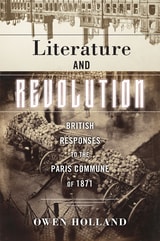
Literature and Revolution
British Responses to the Paris Commune of 1871Owen Holland
Rutgers University Press, 2022
This book examines how a heterogeneous group of authors in Britain responded to the Commune. In doing so, it provides the first full-length critical study of the reception and representation of the Commune in Britain during the closing decades of the nineteenth century, showing how discussions of the Commune functioned as a screen to project hope and fear, serving as a warning for some and an example to others. Writers considered in the book include John Ruskin, Edward Bulwer-Lytton, Eliza Lynn Linton, Mary Elizabeth Braddon, Anne Thackeray Ritchie, Margaret Oliphant, George Gissing, Henry James, William Morris, Alfred Austin and H.G. Wells. As the book shows, many, but not all, of these writers responded to the Commune with literary strategies that sought to stabilize bourgeois subjectivity in the wake of the traumatic shock of a revolutionary event. The book extends critical understanding of the Commune’s cultural afterlives and explores the relationship between literature and revolution.
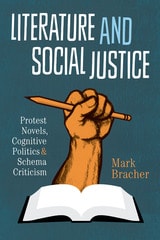
Literature and Social Justice
Protest Novels, Cognitive Politics, and Schema CriticismBy Mark Bracher
University of Texas Press, 2013
Can reading social protest novels actually produce a more just world? Literature and Social Justice offers a scientifically informed, evidence-based affirmative answer to that crucial question, arguing that literature has the potential—albeit largely unrealized—to produce lasting, socially transformative psychological changes in readers. Moving beyond traditional social criticism in its various forms, including feminist, gender, queer, and postcolonialist approaches, Mark Bracher uses new knowledge concerning the cognitive structures and processes that constitute the psychological roots of social injustice to develop a detailed, systematic critical strategy that he calls “schema criticism,” which can be applied to literature and other discourses to maximize and extend their potential for promoting social justice.
Bracher draws on studies in social cognition, social neuroscience, evolutionary psychology, political psychology, and psychoanalysis to uncover the root cognitive structures that cause misunderstandings among people and give rise to social injustice. Using the novels The Jungle, The Grapes of Wrath, and Native Son, he then demonstrates how schema criticism can correct these faulty cognitive structures and enable readers to develop more accurate and empathetic views of those they deem “Other,” as well as become more aware of their own cognitive processes. Calling the book “insightful, erudite, and humane,” Cognitive Approaches to Literature and Culture Series coeditor Patrick Colm Hogan says, “This inspiring book should be welcomed by literary critics, political activists, and anyone who cares about social justice.”
Literature and the Child
Romantic Continuations, Postmodern ContestationsJames Holt Mcgavran
University of Iowa Press, 1999
Literature at the Barricades
The American Writer in the 1930sEdited by Ralph F. Bogardus and Fred Hobson
University of Alabama Press, 1982
This collection captures the sense—at times the ordeal—of the 1930s literary experience in America. Fourteen essayists deal with the experience of being a writer in a time of overwhelming economic depression and political ferment, and thereby illuminate the social, political, intellectual, and aesthetic problems and pressures that characterized the experience of American writers and influenced their works.
The essays, as a group, constitute a reevaluation of the American literature of the 1930s. At the same time they support and reinforce certain assumptions about the decade of the Great Depression—that it was grim, desperate, a time when dreams died and poverty became something other than genteel—they challenge other assumptions, chief among them in the notion that 1930s literature was uniform in content, drab in style, anti-formalist, and always political or sociological in nature. They leave us with an impression that there was variety in American writing of the 1930s and a convincing argument that the decade was not a retreat from the modernism of the 1920s. Rather it was a transitional period in which literary modernism was very much an issue and a force that bore imaginative fruit.
Literature in Exile
John Glad, ed.
Duke University Press, 1990
The volume includes writers whose origins lie in Central Europe, South Africa, Israel, Cuba, Chile, Somalia, and Turkey. Through their testimony of the creative process in exile, we gain insight into the forces which affect the creative process as a whole.
Contributors. William Gass, Yury Miloslavsky, Jan Vladislav, Jiri Grusa, Guillermo Cabrera Infante, Horst Bienek, Edward Limonov, Nedim Gursel, Nuruddin Farah, Jaroslav Vejvoda, Anton Shammas, Joseph Brodsky, Wojciech Karpinski, Thomas Venclova, Yuri Druzhnikov
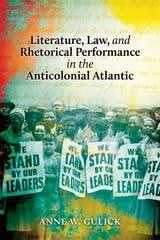
Literature, Law, and Rhetorical Performance in the Anticolonial Atlantic
Anne W. Gulick
The Ohio State University Press, 2016
Responses to this question take shape across the black Atlantic from Haiti to South Africa, in texts ranging from Haiti’s Declaration of Independence and work by C. L. R. James to South Africa’s Freedom Charter, Aimé Césaire’s poem Notebook of a Return to the Native Land, and Ngugi wa Thiong’o’s A Grain of Wheat. These texts constitute a robust transatlantic tradition of challenging colonial and imperial authority through rhetorical performance. Drawing on the cosmopolitan aspirations and emancipatory energies of the political declaration, this tradition aims to radically reinvent the possibilities for law and political belonging in the postcolonial future.
Liturgical Hermeneutics of Sacred Scripture
Marco Benini
Catholic University of America Press, 2023
Live Dead
The Grateful Dead, Live Recordings, and the Ideology of LivenessJohn Brackett
Duke University Press, 2023
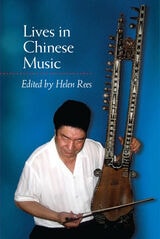
Lives in Chinese Music
Edited by Helen Rees
University of Illinois Press, 2008
Using biography to deepen understanding of Chinese music, contributors present richly contextualized portraits of rural folk singers, urban opera singers, literati, and musicians on both geographic and cultural frontiers. The topics investigated by these authors provide fresh insights into issues such as the urban-rural divide, the position of ethnic minorities within the People's Republic of China, the adaptation of performing arts to modernizing trends of the twentieth century, and the use of the arts for propaganda and commercial purposes.
The social and political history of China serves as a backdrop to these discussions of music and culture, as the lives chronicled here illuminate experiences from the pre-Communist period through the Cultural Revolution to the present. Showcasing multiple facets of Chinese musical life, this collection is especially effective in taking advantage of the liberalization of mainland China that has permitted researchers to work closely with artists and to discuss the interactions of life and local and national histories in musicians' experiences.
Contributors are Nimrod Baranovitch, Rachel Harris, Frank Kouwenhoven, Tong Soon Lee, Peter Micic, Helen Rees, Antoinet Schimmelpenninck, Shao Binsun, Jonathan P. J. Stock, and Bell Yung.
Lives in Play
Autobiography and Biography on the Feminist StageRyan Claycomb
University of Michigan Press, 2014
Lives in Play explores the centrality of life narratives to women's drama and performance from the 1970s to the present moment. In the early days of second-wave feminism, the slogan was "The personal is the political." These autobiographical and biographical "true stories" have the political impact of the real and have also helped a range of feminists tease out the more complicated aspects of gender, sex, and sexuality in a Western culture that now imagines itself to be "postfeminist."
The book covers a broad range of texts and performances, from performance artists like Karen Finley, Holly Hughes, and Bobby Baker to playwrights like Suzan-Lori Parks, Maria Irene Fornes, and Sarah Kane. The book examines biography and autobiography together to link their narrative tactics and theatrical approaches and show the persistent and important uses of life writing strategies for theater artists committed to advancing women's rights and remaking women's representations.
Lives in Play argues that these writers and artists have not only responded to the vibrant conversations in feminist theory but also have anticipated and advanced these ideas, theorizing gender onstage for specific ends. Ryan Claycomb demonstrates how these performances work through tensions between performative identity and the essentialized body, between the truth value of life stories and the constructed nature of gender and narrative alike, and between writing and performing as modes of feminist representation.
The book will appeal to scholars in performance studies, women's studies, and literature, including those in the growing field of auto/biography studies.
Living Cargo
How Black Britain Performs Its PastSteven Blevins
University of Minnesota Press, 2016
Offering a wide-ranging study of contemporary literature, film, visual art, and performance by writers and artists who live and work in the United Kingdom but also maintain strong ties to postcolonial Africa and the Caribbean, Living Cargo explores how contemporary black British culture makers have engaged with the institutional archives of colonialism and the Atlantic slave trade in order to reimagine blackness in British history and to make claims for social and political redress.
Steven Blevins calls this reimagining “unhousing history”—an aesthetic and political practice that animates and improvises on the institutional archive, repurposing it toward different ends and new possibilities. He discusses the work of novelists, including Caryl Phillips, Fred D’Aguiar, David Dabydeen, and Bernardine Evaristo; filmmakers Isaac Julien and Inge Blackman; performance poet Dorothea Smartt; fashion designer Ozwald Boateng; artists Hew Locke and Yinka Shonibare; and the urban redevelopment of Bristol, England, which unfolded alongside the public demand to remember the city’s slave-trading past.
Living Cargo argues that the colonial archive is neither static nor residual but emergent. By reassembling historical fragments and traces consolidated in the archive, these artists not only perform a kind of counter-historiography, they also imagine future worlds that might offer amends for the atrocities of the past.
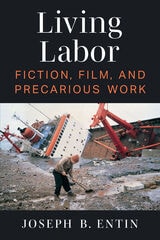
Living Labor
Fiction, Film, and Precarious WorkJoseph B. Entin
University of Michigan Press, 2023
Cover attribution: Allan Sekula, Shipwreck and worker, Istanbul, from TITANIC’s wake, 1998/2000. Courtesy of the Allan Sekula Studio.
Living in the Future
Sovereignty and Internationalism in the Canterbury TalesSusan Nakley
University of Michigan Press, 2017
Chaucer uses two extant national ideals, sovereignty and domesticity, to introduce the concept of an English nation into the contemporary popular imagination and reinvent an idealized England as a hallowed homeland. For nationalist thinkers, sovereignty governs communities with linguistic, historical, cultural, and religious affinities. Chaucerian sovereignty appears primarily in romantic and household contexts that function as microcosms of the nation, reflecting a pseudo-familial love between sovereign and subjects and relying on a sense of shared ownership and judgment. This notion also has deep affinities with popular and political theories flourishing throughout Europe. Chaucer’s internationalism, matched with his artistic use of the vernacular and skillful distortions of both time and space, frames a discrete sovereign English nation within its diverse interconnected world.
As it opens up significant new points of resonance between postcolonial theories and medieval ideas of nationhood, Living in the Future marks an important contribution to medieval literary studies. It will be essential for scholars of Middle English literature, literary history, literary political and postcolonial theory, and literary transnationalism.
Living the Hiplife
Celebrity and Entrepreneurship in Ghanaian Popular MusicJesse Weaver Shipley
Duke University Press, 2013
Shipley shows how young hiplife musicians produce and transform different kinds of value—aesthetic, moral, linguistic, economic—using music to gain social status and wealth, and to become respectable public figures. In this entrepreneurial age, youth use celebrity as a form of currency, aligning music-making with self-making and aesthetic pleasure with business success. Registering both the globalization of electronic, digital media and the changing nature of African diasporic relations to Africa, hiplife links collective Pan-Africanist visions with individualist aspiration, highlighting the potential and limits of social mobility for African youth.
The author has also directed a film entitled Living the Hiplife and with two DJs produced mixtapes that feature the music in the book available for free download.
Living with Lynching
African American Lynching Plays, Performance, and Citizenship, 1890-1930Koritha Mitchell
University of Illinois Press, 2012
In closely analyzing the political and spiritual uses of black theatre during the Progressive Era, Mitchell demonstrates that audiences were shown affective ties in black families, a subject often erased in mainstream images of African Americans. Examining lynching plays as archival texts that embody and reflect broad networks of sociocultural activism and exchange in the lives of black Americans, Mitchell finds that audiences were rehearsing and improvising new ways of enduring in the face of widespread racial terrorism. Images of the black soldier, lawyer, mother, and wife helped readers assure each other that they were upstanding individuals who deserved the right to participate in national culture and politics. These powerful community coping efforts helped African Americans band together and withstand the nation's rejection of them as viable citizens.
The Left of Black interview with author Koritha Mitchell begins at 14:00.
An interview with Koritha Mitchell at The Ohio Channel.
London Voices, 1820–1840
Vocal Performers, Practices, HistoriesEdited by Roger Parker and Susan Rutherford
University of Chicago Press, 2019
It is the London of this period that editors Roger Parker and Susan Rutherford pinpoint in this book, which chooses one broad musical category—voice—and engages with it through essays on music of the streets, theaters, opera houses, and concert halls; on the raising of voices in religious and sociopolitical contexts; and on the perception of voice in literary works and scientific experiments with acoustics. Emphasizing human subjects, this focus on voice allows the authors to explore the multifaceted issues that shaped London, from the anxiety surrounding the city’s importance in the musical world at large to the changing vocal imaginations that permeated the epoch. Capturing the breadth of sonic stimulations and cultures available—and sometimes unavoidable—to residents at the time, London Voices, 1820–1840 sheds new light on music in Britain and the richness of London culture during this period.
London, Radical Culture, and the Making of the Dickensian Aesthetic
Sambudha Sen
The Ohio State University Press, 2012
Lonesome Cowgirls and Honky-Tonk Angels
The Women of Barn Dance RadioKristine M. McCusker
University of Illinois Press, 2007
Drawing on personal interviews and rich archival material from the Grand Ole Opry, Kristine M. McCusker examines the gendered politics of the images through the lives and careers of six women performers: Linda Parker, the Girls of the Golden West (Milly and Dolly Good), Lily May Ledford, Minnie Pearl, and Rose Lee Maphis.
Long Lost Blues
Popular Blues in America, 1850-1920Peter C. Muir
University of Illinois Press, 2010
Long Lost Blues exposes for the first time the full scope and importance of early popular blues to mainstream American culture in the early twentieth century. Closely analyzing sheet music and other print sources that have previously gone unexamined, Muir revises our understanding of the evolution and sociology of blues at its inception.
Long Shadows
The Second World War in British Fiction and FilmEdited by Petra Rau
Northwestern University Press, 2016

Long Steel Rail
Norm Cohen
University of Illinois Press, 2000
Loose Ends
Closure and Crisis in the American Social TextRussell Reising
Duke University Press, 1996
Reising suggests that these "non-endings" entirely refocus the narrative structures they appear to conclude, accentuate the narrative stresses and ideological fissures that the texts seem to suppress, and reveal "shadow narratives" that trail alongside the dominant story line. He argues that unless the reader notices the ruptures in the closing moments of these works, the social and historical moments in which the narrative and the reader are embedded will be missed. This reading not only offers new interpretive possibilities, but also uncovers startling affinities between the poetry of Phillis Wheatley and the fiction of Henry James, between Charles Brockden Brown’s Wieland and Melville’s least-studied novel, and between Emily Dickinson’s poem "I Started Early—Took My Dog" and Disney’s animated classic.
Pursuing the implications of these failed moments of closure, Reising elaborates on topics ranging from the roots of domestic violence and mass murder in early American religious texts to the pornographic imperative of mid-century nature writing, and from James’s "descent" into naturalist and feminist fiction to Dumbo’s explosive projection of commercial, racial, and political agendas for postwar U. S. culture.
Losing the Plot
Film and Feeling in the Modern NovelPardis Dabashi
University of Chicago Press, 2023
The modernist novel sought to escape what Virginia Woolf called the “tyranny” of plot. Yet even as twentieth-century writers pushed against the constraints of plot-driven Victorian novels, plot kept its hold on them through the influence of another medium: the cinema. Focusing on the novels of Nella Larsen, Djuna Barnes, and William Faulkner—writers known for their affinities and connections to classical Hollywood—Pardis Dabashi links the moviegoing practices of these writers to the tensions between the formal properties of their novels and the characters in them. Even when they did not feature outright happy endings, classical Hollywood films often provided satisfying formal resolutions and promoted normative social and political values. Watching these films, modernist authors were reminded of what they were leaving behind—both formally and in the name of aesthetic experimentalism—by losing the plot.

Lost Property
The Woman Writer and English Literary History, 1380-1589Jennifer Summit
University of Chicago Press, 2000
Lost Property traces the representation of women writers from Margery Kempe and Christine de Pizan to Elizabeth I and Mary Queen of Scots, exploring how the woman writer became a focal point for emerging theories of literature and authorship in English precisely because of her perceived alienation from tradition. Through original archival research and readings of key literary texts, Summit writes a new history of the woman writer that reflects the impact of such developments as the introduction of printing, the Reformation, and the rise of the English court as a literary center.
A major rethinking of the place of women writers in the histories of books, authorship, and canon-formation, Lost Property demonstrates that, rather than being an unimaginable anomaly, the idea of the woman writer played a key role in the invention of English literature.
Lost Sounds
Blacks and the Birth of the Recording Industry, 1890-1919Tim Brooks
University of Illinois Press, 2004
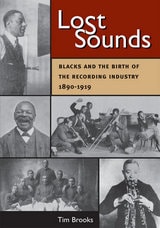
Drawing on more than thirty years of scholarship, Tim Brooks identifies key black recording artists and profiles forty audio pioneers. Brooks assesses the careers and recordings of George W. Johnson, Bert Williams, George Walker, Noble Sissle, Eubie Blake, the Fisk Jubilee Singers, W. C. Handy, James Reese Europe, Wilbur Sweatman, Harry T. Burleigh, Roland Hayes, Booker T. Washington, and boxing champion Jack Johnson, plus a host of lesser-known voices. Many of these pioneers struggled to be heard in an era of rampant discrimination. Their stories detail the forces––black and white––that gradually allowed African Americans to enter the mainstream entertainment industry.
Lost Sounds includes Brooks's selected discography of CD reissues and an appendix by Dick Spottswood describing early recordings by black artists in the Caribbean and South America.
Lost in Time
Locating the Stranger in German ModernityJune J. Hwang
Northwestern University Press, 2014
Lost in the Customhouse
Authorship in the American RenaissanceJerome Loving
University of Iowa Press, 1993

Lost in the Rentharpian Hills
Spanning the Decades with Carl JacobiR. Dixon Smith
University of Wisconsin Press, 1985
R. Dixon Smith has captured the enchanting story of the well known pulp writer Carl Jacobi. Jacobi wrote many fantasy and weird tales, while leading a somewhat bizarre yet magical life.
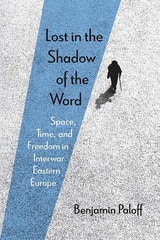
Lost in the Shadow of the Word
Space, Time, and Freedom in Interwar Eastern EuropeBenjamin Paloff
Northwestern University Press, 2016
Scholars of modernism have long addressed how literature, painting, and music reflected the radical reconceptualization of space and time in the early twentieth century—a veritable revolution in both physics and philosophy that has been characterized as precipitating an “epistemic trauma” around the world. In this wide-ranging study, Benjamin Paloff contends that writers in Central and Eastern Europe felt this impact quite distinctly from their counterparts in Western Europe. For the latter, the destabilization of traditional notions of space and time inspired works that saw in it a new kind of freedom. However, for many Central and Eastern European authors, who were writing from within public discourses about how to construct new social realities, the need for escape met the realization that there was both nowhere to escape to and no stable delineation of what to escape from. In reading the prose and poetry of Czech, Polish, and Russian writers, Paloff imbues the term “Kafkaesque” with a complexity so far missing from our understanding of this moment in literary history.
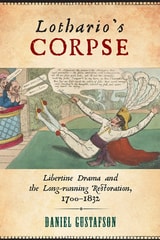
Lothario's Corpse
Libertine Drama and the Long-Running Restoration, 1700-1832Daniel Gustafson
Bucknell University Press, 2020
Published by Bucknell University Press. Distributed worldwide by Rutgers University Press.