Results by title
718 books match the query 'Civil rights' and 35 start with m
Mad River, Marjorie Rowland, and the Quest for LGBTQ Teachers’ Rights
Margaret A. Nash
Rutgers University Press, 2022
In the first in-depth treatment of this foundational legal case, authors Margaret A. Nash and Karen L. Graves tell the story of that case and of Marjorie Rowland, the pioneer who fought for employment rights for LGBTQ educators and who paid a heavy price for that fight. It brings the story of LGBTQ educators’ rights to the present, including commentary on Bostock v Clayton County, the 2020 Supreme Court case that struck down employment discrimination against LGBT workers.
Making Gay History
Memoir of a Scholar-ActivistJohn D'Emilio
Duke University Press, 2026
Making Gay History continues John D’Emilio’s story, following his memoir of his early years, Memories of a Gay Catholic Boyhood. Here, D’Emilio recounts his career as a public historian, activist, and academic, relating his own queer history alongside the development of the LGBTQ movement in the United States. D’Emilio was part of the first burgeoning period of LGBTQ studies while still a graduate student in New York City. From there, he takes readers through his experiences as an out professor at UNC Greensboro, his activism in Washington, DC, and finally, his employment at the University of Illinois as an LGBTQ historian, a position that was unimaginable at the start of his career. At the same time, he narrates his own coming out, his successes and struggles with LGBTQ advocacy, and the loves and losses faced throughout his adult life, telling an intertwined personal and national history of queer hearts and minds.
Making Minnesota Liberal
Civil Rights And The Transformation Of The Democratic PartyJennifer A. Delton
University of Minnesota Press, 2002
Making Minnesota Liberal
Civil Rights and the Transformation of the Democratic PartyJennifer A. Delton
University of Minnesota Press, 2002
The surprising story of how Minnesota politicians in the 1950s helped redirect American politics—now in paperback
How did a largely white state like Minnesota become a springboard for leadership in civil rights? Why did it produce a generation of liberals—Hubert Humphrey, Walter Mondale, Donald Fraser, Orville Freeman, and Eugene McCarthy—whose ideals transformed the Democratic party?
In Making Minnesota Liberal, Jennifer A. Delton delves into the roots of Minnesota politics for the answer, tracing the change from the regional, third-party, class-oriented politics of the Farmer-Labor party to the national, two-party, pluralistic liberalism of the Democratic-Farmer-Labor party (DFL). While others have examined how anticommunism and the Cold War shaped this transformation, Delton takes a new approach, showing the key roles played by antiracism and the civil rights movement. In telling this story, Delton contributes to our understanding not only of Minnesota’s political history but also of the relationship between antiracism and American politics in the twentieth century.
Making Minnesota Liberal combines political history with a discussion of the symbolic role played by race in political battles between whites. Delton recounts the creation of Minnesota’s Farmer-Labor party, its merger with the Democrats, and the acrimonious battle for control of the DFL just after World War II. She argues that the Humphrey liberals won this battle in part because antiracism activities enabled previously antagonistic groups, divided by ethnicity, religion, and class, to unify around a common cause.
Delton contends that although liberal Minnesotans’s concern for racial justice was genuine, it also provided them with national political relevance and imbued their bid for power with a sense of morality. Ultimately the language of tolerance and diversity that emerged from antiracism prepared Minnesotans for Humphrey’s vision of a pluralistic and state-centered liberalism, which eventually became the model for Democratic politics nationwide. Making Minnesota Liberal is an absorbing and trenchant account of a key moment in American history, one that continues to resonate in our time.
Making Rights Real
Activists, Bureaucrats, and the Creation of the Legalistic StateCharles R. Epp
University of Chicago Press, 2009
It’s a common complaint: the United States is overrun by rules and procedures that shackle professional judgment, have no valid purpose, and serve only to appease courts and lawyers. Charles R. Epp argues, however, that few Americans would want to return to an era without these legalistic policies, which in the 1970s helped bring recalcitrant bureaucracies into line with a growing national commitment to civil rights and individual dignity.
Focusing on three disparate policy areas—workplace sexual harassment, playground safety, and police brutality in both the United States and the United Kingdom—Epp explains how activists and professionals used legal liability, lawsuit-generated publicity, and innovative managerial ideas to pursue the implementation of new rights. Together, these strategies resulted in frameworks designed to make institutions accountable through intricate rules, employee training, and managerial oversight. Explaining how these practices became ubiquitous across bureaucratic organizations, Epp casts today’s legalistic state in an entirely new light.
Making Whole What Has Been Smashed
On Reparations PoliticsTorpey, John
Rutgers University Press, 2017
Viewing the search for “coming to terms with the past” as a form of politics, John Torpey argues that there are major differences between reparations for the living victims of past wrongdoing and reparations for the descendants of such victims. More fundamentally, he argues that claims for reparations comprise a relatively novel kind of politics that involves a quest for symbolic recognition and material compensation for those seeking them—through the idiom of the past rather than the present. This reissue is the first paperback edition and contains a new preface by the author.
Malcolm X's Michigan Worldview
An Exemplar for Contemporary Black StudiesRita Kiki Edozie
Michigan State University Press, 2024
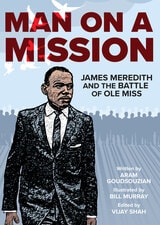
Man on a Mission
James Meredith and the Battle of Ole MissAram Goudsouzian
University of Arkansas Press, 2022
In 1962, James Meredith famously desegregated the University of Mississippi (a.k.a. Ole Miss). As the first Black American admitted to the school, he demonstrated great courage amidst the subsequent political clashes and tragic violence. After President Kennedy summoned federal troops to help maintain order, the South—and America at large—would never be the same.
Man on a Mission depicts Meredith’s relentless pursuit of justice, beginning with his childhood in rural Mississippi and culminating with the confrontation at Ole Miss. A blend of historical research and creative inspiration, this graphic history tells Meredith’s dramatic story in his own singular voice.
From the dawn of the modern civil rights movement, Meredith has offered a unique perspective on democracy, racial equality, and the meaning of America. Man on a Mission presents his captivating saga for a new generation in the era of Black Lives Matter.
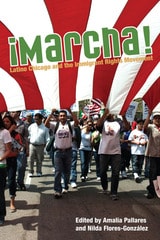
Marcha
Latino Chicago and the Immigrant Rights MovementEdited by Amalia Pallares and Nilda Flores-Gonzalez
University of Illinois Press, 2010
Marcha is a multidisciplinary survey of the individuals, organizations, and institutions that have given shape and power to the contemporary immigrant rights movement in Chicago. A city with longstanding historic ties to immigrant activism, Chicago has been the scene of a precedent-setting immigrant rights mobilization in 2006 and subsequent mobilizations in 2007 and 2008.
Positing Chicago as a microcosm of the immigrant rights movement on national level, these essays plumb an extraordinarily rich set of data regarding recent immigrant rights activities, defining the cause as not just a local quest for citizenship rights, but a panethnic, transnational movement. The result is a timely volume likely to provoke debate and advance the national conversation about immigration in innovative ways.
Marching Together
Women of the Brotherhood of Sleeping Car PortersMelinda Chateauvert
University of Illinois Press, 1998
The Brotherhood of Sleeping Car Porters (BSCP) was the first national trade union for African Americans. Standard BSCP histories focus on the men who built the union. Yet the union's Ladies' Auxiliary played an essential role in shaping public debates over black manhood and unionization, setting political agendas for the black community, and crafting effective strategies to win racial and economic justice.
Melinda Chateauvert explores the history of the Ladies' Auxiliary and the wives, daughters, and sisters of Pullman porters who made up its membership and used the union to claim respectability and citizenship. As she shows, the Auxiliary actively educated other women and children about the labor movement, staged consumer protests, and organized local and national civil rights campaigns ranging from the 1941 March on Washington to school integration to the Montgomery Bus Boycott. Chateauvert also sheds light on the plight of Pullman maids, who—relegated to the Auxiliary—found their problems as working women neglected in favor of the rhetoric of racial solidarity.
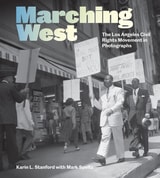
Marching West
The Los Angeles Civil Rights Movement in PhotographsKarin L. Stanford
J. Paul Getty Trust, The, 2026
This volume presents the first visual history of the people and organizations that led the fight for change during the civil rights era in Los Angeles.
During a 1963 speech to a crowd of nearly forty thousand at Wrigley Field in Los Angeles, Dr. Martin Luther King Jr. addressed the question of how Angelenos could contribute to the civil rights movement: “The most important thing that you can do is to set Los Angeles free, because you have segregation and discrimination here, and police brutality.”
Marching West illuminates the dynamic history of civil rights activism in Los Angeles and explores how the medium of photography both witnessed and advanced the fight for Black equality. Over one hundred images, some of which have never been previously published, reveal connections between the local and national movements and document the actions of Western coalitions, religious leaders, Hollywood stars, and concerned citizens. Drawn from the Tom & Ethel Bradley Center at California State University, Northridge (CSUN), the Getty Research Institute, and other Southern California collections—including prints by Harry Adams, Howard Bingham, Charles Brittin, Joe Flowers, Vera Jackson, and Charles Williams—this unprecedented volume presents less familiar but essential stories about American progress toward social justice.
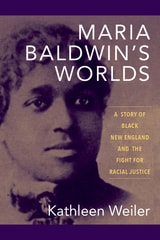
Maria Baldwin's Worlds
A Story of Black New England and the Fight for Racial JusticeKathleen Weiler
University of Massachusetts Press, 2019
Maria Baldwin (1856–1922) held a special place in the racially divided society of her time, as a highly respected educator at a largely white New England school and an activist who carried on the radical spirit of the Boston area's internationally renowned abolitionists from a generation earlier.
African American sociologist Adelaide Cromwell called Baldwin “the lone symbol of Negro progress in education in the greater Boston area” during her lifetime. Baldwin used her respectable position to fight alongside more radical activists like William Monroe Trotter for full citizenship for fellow members of the black community. And, in her professional and personal life, she negotiated and challenged dominant white ideas about black womanhood. In Maria Baldwin's Worlds, Kathleen Weiler reveals both Baldwin's victories and what fellow activist W. E. B. Du Bois called her “quiet courage” in everyday life, in the context of the wider black freedom struggle in New England.
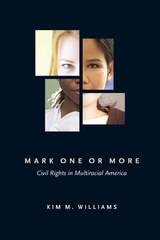
Mark One or More
Civil Rights in Multiracial AmericaKim M. Williams
University of Michigan Press, 2010
The movement to add a multiracial category to the 2000 U.S. Census provoked unprecedented debates about race. The effort made for strange bedfellows. Republicans like House Speaker Newt Gingrich and affirmative action opponent Ward Connerly took up the multiracial cause. Civil rights leaders opposed the movement on the premise that it had the potential to dilute the census count of traditional minority groups. The activists themselves—a loose confederation of organizations, many led by the white mothers of interracial children—wanted recognition. What they got was the transformation of racial politics in America.
Mark One or More is the compelling account of how this small movement sparked a big change, and a moving call to reassess the meaning of racial identity in American life.
Kim M. Williams is Associate Professor of Public Policy in Harvard's Kennedy School of Government, and an expert in racial and ethnic politics and political movements.
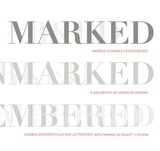
Marked, Unmarked, Remembered
A Geography of American MemoryAndrew Lichtenstein
West Virginia University Press, 2017
These powerful photographs by award-winning photojournalist Andrew Lichtenstein are interspersed with short essays by some of the leading historians of the United States. The book is introduced with substantive meditations on meaning and landscape by Alex Lichtenstein, editor of the American Historical Review, and Edward T. Linenthal, former editor of the Journal of American History. Individually, these images convey American history in new and sometimes startling ways. Taken as a whole, the volume amounts to a starkly visual reckoning with the challenges of commemorating a violent and conflictual history of subjugation and resistance that we forget at our peril.
Marketing the Wilderness
Outdoor Recreation, Indigenous Activism, and the Battle over Public LandsJoseph Whitson
University of Minnesota Press, 2025
How outdoor industry marketing promotes an image of “the wilderness” as an unpeopled haven
Marketing the Wilderness analyzes the relationship between the outdoor recreation industry, public lands in the United States, and Indigenous sovereignty and representation in recreational spaces. Combining social media analysis, digital ethnography, and historical research, Joseph Whitson offers nuanced insights into more than a century of the outdoor recreation industry’s marketing strategies, unraveling its complicity in settler colonialism.
Complicating the narrative of outdoor recreation as a universal good, Whitson introduces the concept of “wildernessing” to describe the physical, legal, and rhetorical production of pristine, empty lands that undergirds the outdoor recreation industry, a process that further disenfranchises Indigenous people from whom these lands were stolen. He demonstrates how companies such as Patagonia and REI align with the mining and drilling industries in their need to remove Indigenous peoples and histories from valuable lands. And he describes the ways Indigenous and decolonial activists are subverting and resisting corporate marketing strategies to introduce new narratives of place.
Through the lens of environmental justice activism, Marketing the Wilderness reconsiders the ethics of recreational land use, advocating for engagement with issues of cultural representation and appropriation informed by Indigenous perspectives. As he discusses contemporary public land advocacy around places such as Bears Ears National Monument, Whitson focuses on the deeply fraught relationship between the outdoor recreation industry and Indigenous communities. Emphasizing the power of the corporate system and its treatment of land as a commodity under capitalism, he shows how these tensions shape the American idea of “wilderness” and what it means to fight for its preservation.
Retail e-book files for this title are screen-reader friendly with images accompanied by short alt text and/or extended descriptions.
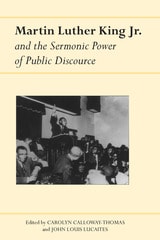
Martin Luther King Jr. and the Sermonic Power of Public Discourse
Carolyn Calloway-Thomas
University of Alabama Press, 1993
Critical studies of the prophetic voice that reshaped a nation.
Martin Luther King Jr. and the Sermonic Power of Public Discourse presents a rich and illuminating examination of Dr. King’s rhetorical mastery, revealing how his most iconic speeches and writings drew deeply from African American sermonic traditions to articulate a moral vision capable of transforming public consciousness. Through nine incisive essays, the volume explores how King’s oratory fused theology, ethics, metaphor, and call‑and‑response patterns to mobilize audiences and frame the civil rights movement as a universal moral struggle.
The collection focuses on five pivotal works—“Death of Evil on the Seashore,” “Letter from Birmingham Jail,” “I Have a Dream,” “A Time to Break Silence,” and “I’ve Been to the Mountaintop”—each analyzed for its rhetorical structure, historical context, and thematic force. These pieces span the full arc of King’s public career, illustrating not only his evolving political and theological commitments but also his sustained effort to envision and communicate a “beloved community” rooted in justice, equality, and human dignity.
In addition to unpacking King’s metaphoric language, ethical appeals, and theological grounding, several essays highlight the ways his rhetoric bridged diverse audiences and invited collective participation in social change. Scholars examine how King re‑constructed the rhetorical situation in “Letter from Birmingham Jail,” framed equality as a universal ideal, and used orality and performance to elevate “I Have a Dream” into one of the most resonant speeches in American history.
Far more than an anthology of commentary, this volume provides a nuanced, interdisciplinary understanding of King as a rhetorician whose discourse transcended political advocacy to become a powerful form of moral persuasion. It is an essential resource for readers interested in rhetoric, communication, civil rights history, and the enduring power of prophetic speech.
Martin Luther King Jr., Heroism, and African American Literature
Trudier Harris
University of Alabama Press, 2023
Examines how representations of Martin Luther King Jr.’s character and persona in works of African American literature have evolved and reflect the changing values and mores of African American culture
African American writers have incorporated Martin Luther King Jr. into their work since he rose to prominence in the mid-1950s. Martin Luther King Jr., Heroism, and African American Literature is a study by award-winning author Trudier Harris of King’s character and persona as captured and reflected in works of African American literature continue to evolve.
One of the most revered figures in American history, King stands above most as a hero. His heroism, argues Harris, is informed by African American folk cultural perceptions of heroes. Brer Rabbit, John the Slave, Stackolee, and Railroad Bill—folk heroes all—provide a folk lens through which to view King in contemporary literature. Ambiguities and issues of morality that surround trickster figures also surround King. Nonconformist traits that define Stackolee and Railroad Bill also inform King’s life and literary portraits. Defiance of the law, uses of indirection, moral lapses, and bad habits are as much a part of the folk-transmitted biography of King as they are a part of writers’ depictions of him in literary texts.
Harris first demonstrates that during the Black Arts Movement of the 1960s, when writers such as Nikki Giovanni, Sonia Sanchez, and LeRoi Jones (Amiri Baraka) were rising stars in African American poetry, King’s philosophy of nonviolence was out of step with prevailing notions of militancy (Black Power), and their literature reflected that division.
In the quieter times of the 1970s and 1980s and into the twenty-first century, however, treatments of King and his philosophy in African American literature changed. Writers who initially rejected him and nonviolence became ardent admirers and boosters, particularly in the years following his assassination. By the 1980s, many writers skeptical about King had reevaluated him and began to address him as a fallen hero. To the most recent generation of writers, such as Katori Hall, King is fair game for literary creation, no matter what those portrayals may reveal, to a point where King has become simply another source of reference for creativity.
Collectively these writers, among many others, illustrate that Martin Luther King Jr. provides one of the strongest influences upon the creative worlds of multiple generations of African American writers of varying political and social persuasions.
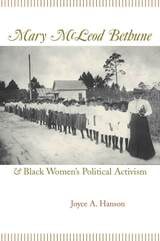
Mary McLeod Bethune and Black Women's Political Activism
Joyce A. Hanson
University of Missouri Press, 2003
Mary McLeod Bethune was a significant figure in American political history. She devoted her life to advancing equal social, economic, and political rights for blacks. She distinguished herself by creating lasting institutions that trained black women for visible and expanding public leadership roles. Few have been as effective in the development of women’s leadership for group advancement. Despite her accomplishments, the means, techniques, and actions Bethune employed in fighting for equality have been widely misinterpreted.
Examining the historical evolution of African American women’s activism in the critical period between 1920 and 1950, a time previously characterized as “doldrums” for both feminist and civil rights activity, Mary McLeod Bethune and Black Women’s Political Activism is important for understanding the centrality of black women to the political fight for social, economic, and racial justice.
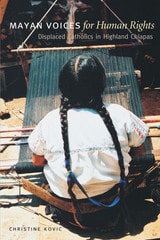
Mayan Voices for Human Rights
Displaced Catholics in Highland ChiapasBy Christine Kovic
University of Texas Press, 2005
In the last decades of the twentieth century, thousands of Mayas were expelled, often violently, from their homes in San Juan Chamula and other highland communities in Chiapas, Mexico, by fellow Mayas allied with the ruling Institutional Revolutionary Party (PRI). State and federal authorities generally turned a blind eye to these human rights abuses, downplaying them as local conflicts over religious conversion and defense of cultural traditions. The expelled have organized themselves to fight not only for religious rights, but also for political and economic justice based on a broad understanding of human rights.
This pioneering ethnography tells the intertwined stories of the new communities formed by the Mayan exiles and their ongoing efforts to define and defend their human rights. Focusing on a community of Mayan Catholics, the book describes the process by which the progressive Diocese of San Cristóbal and Bishop Samuel Ruiz García became powerful allies for indigenous people in the promotion and defense of human rights. Drawing on the words and insights of displaced Mayas she interviewed throughout the 1990s, Christine Kovic reveals how the exiles have created new communities and lifeways based on a shared sense of faith (even between Catholics and Protestants) and their own concept of human rights and dignity. She also uncovers the underlying political and economic factors that drove the expulsions and shows how the Mayas who were expelled for not being "traditional" enough are in fact basing their new communities on traditional values of duty and reciprocity.
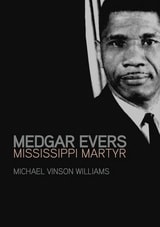
Medgar Evers
Mississippi MartyrMichael Vinson Williams
University of Arkansas Press, 2011
Memphis Tennessee Garrison
The Remarkable Story of a Black Appalachian WomanAncella R. Bickley
Ohio University Press, 2001
As a black Appalachian woman, Memphis Tennessee Garrison belonged to a demographic category triply ignored by historians.
The daughter of former slaves, she moved to McDowell County, West Virginia, at an early age and died at ninety-eight in Huntington. The coalfields of McDowell County were among the richest seams in the nation. As Garrison makes clear, the backbone of the early mining work force—those who laid the railroad tracks, manned the coke ovens, and dug the coal—were black miners. These miners and their families created communities that became the centers of the struggle for unions, better education, and expanded civil rights. Memphis Tennessee Garrison, an innovative teacher, administrative worker at U.S. Steel, and vice president of the National Board of the NAACP at the height of the civil rights struggle (1963-66), was involved with all of these struggles.
In many ways, this oral history, based on interview transcripts, is the untold and multidimensional story of African American life in West Virginia, as seen through the eyes of a remarkable woman. She portrays a courageous people who organize to improve their working conditions, send their children to school and then to college, own land, and support a wide range of cultural and political activities.
Methodists and the Crucible of Race, 1930-1975
Peter C. Murray
University of Missouri Press, 2004
During the Civil Rights movement, American churches confronted issues of racism that they had previously ignored. No church experienced this confrontation more sharply than the Methodist Church. When Methodists reunited their northern and southern halves in 1939, their new church constitution created a segregated church structure that posed significant issues for Methodists during the Civil Rights movement.
Of the six jurisdictional conferences that made up the Methodist Church, only one was not based on a geographic region: the Central Jurisdiction, a separate conference for “all Negro annual conferences.” This Jim Crow arrangement humiliated African American Methodists and embarrassed their liberal white allies within the church. The Supreme Court’s Brown v. Board of Education decision awakened many white Methodists from their complacent belief that the church could conform to the norms of the South without consequences among its national membership.
Murray places the struggle of the Methodist Church within the broader context of the history of race relations in the United States. He shows how the effort to destroy the barriers in the church were mirrored in the work being done by society to end segregation. Immensely readable and free of jargon, Methodists and the Crucible of Race, 1930–1975, will be of interest to a broad audience, including those interested in the Civil Rights movement and American church history.
Mexican American Civil Rights in Texas
Robert Brischetto
Michigan State University Press, 2022
Mining, the Environment, and Indigenous Development Conflicts
Saleem H. Ali
University of Arizona Press, 2003
This book gets to the heart of resource conflicts and environmental impact assessment by asking why indigenous communities support environmental causes in some cases of mining development but not in others. Saleem Ali examines environmental conflicts between mining companies and indigenous communities and with rare objectivity offers a comparative study of the factors leading to those conflicts.
Mining, the Environment, and Indigenous Development Conflicts presents four cases from the United States and Canada: the Navajos and Hopis with Peabody Coal in Arizona; the Chippewas with the Crandon Mine proposal in Wisconsin; the Chipewyan Inuits, Déné and Cree with Cameco in Saskatchewan; and the Innu and Inuits with Inco in Labrador. These cases exemplify different historical relationships with government and industry and provide an instance of high and low levels of Native resistance in each country. Through these cases, Ali analyzes why and under what circumstances tribes agree to negotiated mining agreements on their lands, and why some negotiations are successful and others not.
Ali challenges conventional theories of conflict based on economic or environmental cost-benefit analysis, which do not fully capture the dynamics of resistance. He proposes that the underlying issue has less to do with environmental concerns than with sovereignty, which often complicates relationships between tribes and environmental organizations. Activist groups, he observes, fail to understand such tribal concerns and often have problems working with tribes on issues where they may presume a common environmental interest.
This book goes beyond popular perceptions of environmentalism to provide a detailed picture of how and when the concerns of industry, society, and tribal governments may converge and when they conflict. As demands for domestic energy exploration increase, it offers clear guidance for such endeavors when native lands are involved.
Minority Report
Evaluating Political Equality in AmericaJohn D. Griffin and Brian Newman
University of Chicago Press, 2008
Miranda's Waning Protections
Police Interrogation Practices after DickersonWelsh S. White
University of Michigan Press, 2003
Welsh S. White looks at both sides of the issue, emphasizing that Miranda represents just one stage in the Court's ongoing struggle to accommodate a fundamental conflict between law enforcement and civil liberties, and assessing whether the Court's present decisions (including Miranda) strike an appropriate balance between promoting law enforcement's interest in obtaining reliable evidence and the individual's interest in being protected from overreaching police practices.
Welsh S. White is Professor of Law, University of Pittsburgh School of Law. He is best known for his work on capital punishment and has published and lectured on the death penalty for the past twenty years.
Missing
Youth, Citizenship, and Empire after 9/11Sunaina Marr Maira
Duke University Press, 2009
Bringing grounded ethnographic analysis to the critique of U.S. empire, Maira teases out the ways that imperial power affects the everyday lives of young immigrants in the United States. She illuminates the paradoxes of national belonging, exclusion, alienation, and political expression facing a generation of Muslim youth coming of age at this particular moment. She also sheds new light on larger questions about civil rights, globalization, and U.S. foreign policy. Maira demonstrates that a particular subjectivity, the “imperial feeling” of the present historical moment, is linked not just to issues of war and terrorism but also to migration and work, popular culture and global media, family and belonging.
Missouri’s War
The Civil War in DocumentsSilvana R. Siddali
Ohio University Press, 2009
Winner of a 2011 “Distinguished Achievement in Literature” award, Missouri Humanities Council
Civil War Missouri stood at the crossroads of America. As the most Southern-leaning state in the Middle West, Missouri faced a unique dilemma. The state formed the gateway between east and west, as well as one of the borders between the two contending armies. Moreover, because Missouri was the only slave state in the Great Interior, the conflicts that were tearing the nation apart were also starkly evident within the state. Deep divisions between Southern and Union supporters, as well as guerrilla violence on the western border, created a terrible situation for civilians who lived through the attacks of bushwhackers and Jayhawkers.
The documents collected in Missouri's War reveal what factors motivated Missourians to remain loyal to the Union or to fight for the Confederacy, how they coped with their internal divisions and conflicts, and how they experienced the end of slavery in the state. Private letters, diary entries, song lyrics, official Union and Confederate army reports, newspaper editorials, and sermons illuminate the war within and across Missouri's borders.
Missouri's War also highlights the experience of free and enslaved African Americans before the war, as enlisted Union soldiers, and in their effort to gain rights after the end of the war. Although the collection focuses primarily on the war years, several documents highlight both the national sectional conflict that led to the outbreak of violence and the effort to reunite the conflicting forces in Missouri after the war.
Mobilizing Gay Singapore
Rights and Resistance in an Authoritarian StateLynette J Chua
Temple University Press, 2015
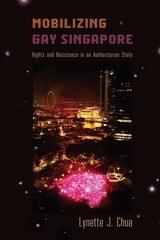
For decades, Singapore's gay activists have sought equality and justice in a state where law is used to stifle basic civil and political liberties. In her groundbreaking book, Mobilizing Gay Singapore, Lynette Chua asks, what does a social movement look like in an authoritarian state? She takes an expansive view of the gay movement to examine its emergence, development, strategies, and tactics, as well as the roles of law and rights in social processes.
Chua tells this important story using in-depth interviews with gay activists, observations of the movement's activities-including "Pink Dot" events, where thousands of Singaporeans gather in annual celebrations of gay pride-movement documents, government statements, and media reports. She shows how activists deploy "pragmatic resistance" to gain visibility and support, tackle political norms that suppress dissent, and deal with police harassment, while avoiding direct confrontations with the law.
Mobilizing Gay Singapore also addresses how these brave, locally engaged citizens come out into the open as gay activists and expand and diversify their efforts in the global queer political movement.
Mobilizing Public Opinion
Black Insurgency and Racial Attitudes in the Civil Rights EraTaeku Lee
University of Chicago Press, 2002
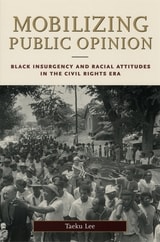
Ultimately, Mobilizing Public Opinion is a timely, cautionary tale about how we view public opinion and a compelling testament to the potential power of ordinary citizens.
Modern Isonomy
Democratic Participation and Human Rights Protection as a System of Equal RightsGerald Stourzh
University of Chicago Press, 2021
The ideal, Stourzh argues, is a state, and indeed a world, in which individual rights, including the right to participate in politics equally, are clearly defined and possessed by all. Stourzh begins with ancient Greek thought contrasting isonomy—which is associated with the rule of the many—with “gradated societies,” oligarchies, and monarchies. He then discusses the American experiment with the development of representative democracy as well as the French Revolution, which proclaimed that all people are born and remain free and with equal rights. But progress on the creation and protection of rights for all has been uneven. Stourzh discusses specifically the equalization of slaves, peasants, women, Jews, and indigenous people. He demonstrates how deeply intertwined the protection of equal rights is with the development of democracy and gives particular attention to the development of constitutional adjudication, notably the constitutional complaint of individuals. He also discusses the international protection human rights. Timely and thought-provoking, Modern Isonomy is an erudite exploration of political and human rights.
Moisture of the Earth
Mary Robinson, Civil Rights and Textile Union ActivistAn Oral History, Compiled and Edited by Fran Leeper Buss
University of Michigan Press, 2009
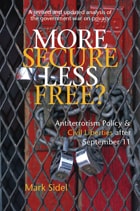
More Secure, Less Free?
Antiterrorism Policy & Civil Liberties after September 11Mark Sidel
University of Michigan Press, 2010
Unlike earlier books published shortly after the September 11 attacks that focus on the Patriot Act, More Secure, Less Free? covers the Patriot Act but goes well beyond, analyzing Total Information Awareness, Terrorist Information and Prevention System (TIPS), Computer Assisted Passenger Prescreening System II (CAPPS II), and a number of other "second wave" antiterror initiatives.
It's also the first book of its kind to go beyond federal measures to explain the devolution of antiterror policies to the states, and now to the military as well. Author Mark Sidel discusses the continuing debates on antiterror law at the state level, with a focus on the important states of New York, California, and Michigan, and explains how the military-through an informant program known as "Eagle Eyes"-is now taking a direct hand in domestic antiterror efforts.
The volume also discusses and analyzes crucially important aspects of American antiterror policy that have been largely ignored in other volumes and discusses the effects of antiterror policy on the American academic world and the American nonprofit sector, for example. And it provides the first comparative perspectives on U.S. antiterror policy yet published in an American volume, discussing antiterror initiatives in Great Britain, Australia, and India and contrasting those to the American experience.
More Secure, Less Free? is important and essential reading for anyone interested in an analytical perspective on American antiterror policy since September 11 that goes well beyond the Patriot Act.
Mark Sidel is Associate Professor of Law at the University of Iowa and a research scholar at the University's Obermann Center for Advanced Studies.

Mrs. Shipley's Ghost
The Right to Travel and Terrorist WatchlistsJeffrey Kahn
University of Michigan Press, 2014
Today, when a single person can turn an airplane into a guided missile, no one objects to rigorous security before flying. But can the state simply declare some people too dangerous to travel, ever and anywhere? Does the Constitution protect a fundamental right to travel? Should the mode of travel (car, plane, or boat) or itinerary (domestic or international) make a constitutional difference? This book explores the legal and policy questions raised by government travel restrictions, from passports and rubber stamps to computerized terrorist watchlists.
In tracing the history and scope of U.S. travel regulations, Jeffrey Kahn begins with the fascinating story of Mrs. Ruth Shipley, a federal employee who almost single-handedly controlled access to passports during the Cold War. Kahn questions how far national security policies should go and whether the government should be able to declare some individuals simply too dangerous to travel. An expert on constitutional law, Kahn argues that U.S. citizens’ freedom to leave the country and return is a fundamental right, protected by the Constitution.

My Father Said Yes
A White Pastor in Little Rock School IntegrationDunbar H. Ogden
Vanderbilt University Press, 2008
My Father Said Yes is the untold story of the Reverend Dunbar Ogden, who became the pro-integration leader in Little Rock's white community. He responded to a call for support from Daisy Bates, co-owner of the town's black newspaper. Both faced fierce opposition from within as well as from outside. Reverend Ogden lost his church and Daisy Bates lost her newspaper.
This memoir is also a moving father-son story. In this frank account, the author discusses the depression his father battled for most of his life, as well as the family tragedy of his brother's suicide.