Results by title
219 books match the query 'Holocaust, Jewish (1939-1945)' and 7 start with m
MAKING STORIES, MAKING SELVES
FEMINIST REFLECTIONS ON THE HOLOCAUSTR. Ruth Linden
The Ohio State University Press, 1995
Urged forward by these silences, Linden, a feminist and sociologist, began to interview Jewish Holocaust survivors in 1983. As Linden interprets survivors' accounts of the death camps and the resistance, she reveals complex ways in which selves are constructed through storytelling. The stories that unfold are continuously fashioned and refashioned—never stripped of context or frozen in time. What emerges is an unexpectedly elegant montage in which interviewee, interviewer, and author are intertwined.
Linden's meetings with survivors and her encounters with their stories transformed her as a feminist, a Jew, and a social scientist. Her analysis reveals the intimate connections between an ethnographer's lived experience and her interpretations of others'. Linden's reflections on the process of ethnography belie the rhetoric of positivism in the social sciences. They will inspire other scholars to break free of research and writing practices in their own disciplines that efface the ineluctable bond between knower and known. All readers will be challenged to reexamine the Holocaust in an intensely personal light and to reconsider the meanings of survival in our own time.
Cutting across the boundaries of ethnography and autobiography to create a new kind of text, Making Stories, Making Selves offers a significant contribution to interpretive social science and the literature of the Holocaust. Linden's original and courageous work is vital reading for Holocaust scholars, students of modern Jewish life, sociologists, feminist theorists, and all readers seeking to understand their own relationship to the Holocaust.
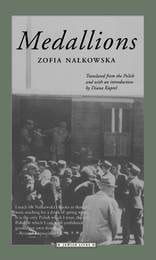
Medallions
Zofia Nalkowska
Northwestern University Press, 2000
Considered a masterpiece of antifascist world literature, Medallions stands as the culmination of Nalkowska's literary style, a style the Polish writer Witold Gombrowicz once described as "the iron capital of her art and one of the very few exportables in our national literature." More than mere historical record, Medallions offers the reader startling immediacy, the repetition of an event as it persists in the testimonial present, in the scars on the consciousness and conscience of individuals.
Mendelssohn Is on the Roof
Jiri Weil
Northwestern University Press, 1998
Thus begins a story of disarming simplicity that traces the transformation of ordinary lives in Nazi-occupied Prague. Death abetted by the petty malevolence of Nazi functionaries wins all the battles but ultimately loses the war, defeated by the fragile flowering of courage and defiance.
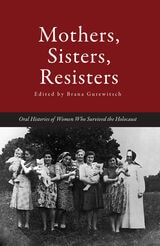
Mothers, Sisters, Resisters
Oral Histories of Women Who Survived the HolocaustBrana Gurewitsch
University of Alabama Press, 1999
Powerful oral histories revealing the unique experiences of women during the Holocaust.
In Mothers, Sisters, Resisters, 25 survivors of the Holocaust furnish compelling and historically vital testimony that illuminates and explores Jewish women's experiences during that terrible period. In entries that preserve each voice, personality, and style, survivors describe their efforts to evade Nazi laws and subsequent dehumanization, protect their children and siblings, and maintain their Jewish identity.
Throughout each narrative, from Brandla Small's description of having her child dragged from her arms at Auschwitz, to Eva Schonbrun's remembrances of her sister who refused to leave her siblings and save herself, to Emilie Schindler's account of rescuing Jews left abandoned on a cattle car, we become intimately involved with each woman's struggle and eventual survival. We also gain a new appreciation and understanding of the Holocaust experiences unique to women.
Music of Another World
Szymon Laks
Northwestern University Press, 2000
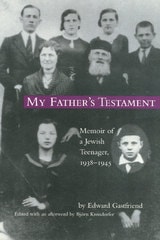
My Fathers Testament
Edward Gastfriend
Temple University Press, 1999
The accelerating Nazi assault on the Jews abruptly shattered Lolek's life. Jews were randomly beaten and arrested, forced out of their homes, deported to slave labor camps, and shot on the streets. During this time, Lolek lost his family, friends, and neighbors, the whole while struggling to hold onto a promise he made to his father before his father was deported. Lolek pledged never to denounce God and to maintain his faith. This covenant proved to be the key to his remarkable survival in several slave labor camps including Auschwitz and several satellite camps of Auschwitz-Birkenau.
My Father's Testament is an intimate portrayal of a teenage boy trying to stay alive without losing his humanity - in hiding, in the camps, and during the death marches at the end of the war.
Embedded in this unique memoir are two other stories of fathers and sons. One lies in the moving Foreword by David R. Gastfriend, Ed's son, now a psychiatrist at Harvard Medical School. The other lies in Bjorn Krondorfer's Afterword. Years after he met Edward Gastfriend, Krondorfer was startled to hear his father mention Blechhammer as one of the places where he was stationed as a young German soldier. Blechhammer was where Lolek was held in a slave labor camp. The coincidence led this German father and son to travel back to the site to confront the Holocaust.
My Father's Testament will engage readers interested in history, the Holocaust, and religion.
My Version of the Facts
Carla Pekelis, translated from the Italian by George Hochfield
Northwestern University Press, 2005