Results by title
120 books match the query 'Marketing' and 15 start with m
MUSE IN THE MACHINE
AMERICAN FICTION AND MASS PUBLICITYMARK CONROY
The Ohio State University Press, 2004
Making the News Popular
Mobilizing U.S. News AudiencesAnthony Nadler
University of Illinois Press, 2016
Anthony Nadler charts a paradigm shift, from market research's reach into the editorial suite in the 1970s through contemporary experiments in collaborative filtering and social news sites like Reddit and Digg. As Nadler shows, the transition was and is a rocky one. It also goes back much further than many experts suppose. Idealized visions of demand-driven news face obstacles with each iteration. Furthermore, the post-professional philosophy fails to recognize how organizations mobilize interest in news and public life. Nadler argues that this civic function of news organizations has been neglected in debates on the future of journalism. Only with a critical grasp of news outlets' role in stirring broad interest in democratic life, he says, might journalism's digital crisis push us toward building a more robust and democratic news media.
Wide-ranging and original, Making the News Popular offers a critical examination of an important, and still evolving, media phenomenon.
Marketable Values
Inventing the Property Market in Modern BritainDesmond Fitz-Gibbon
University of Chicago Press, 2018
In Marketable Values, Desmond Fitz-Gibbon seeks to answer that question. He tells the story of how Britons imagined, organized, and debated the buying and selling of land from the mid-eighteenth to the early twentieth century. In a society organized around the prestige of property, the desire to commodify land required making it newly visible through such spectacles as public auctions, novel professions like auctioneering, and real estate journalism. As Fitz-Gibbon shows, these innovations sparked impassioned debates on where, when, and how to demarcate the limits of a market society. As a result of these collective efforts, the real estate business became legible to an increasingly attentive public and a lynchpin of modern economic life.
Drawing on an eclectic range of sources—from personal archives and estate correspondence to building designs, auction handbills, and newspapers—Marketable Values explores the development of the British property market and the seminal role it played in shaping the relationship we have to property around the world today.
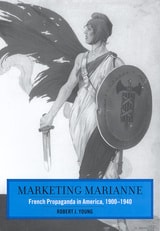
Marketing Marianne
French Propaganda in America, 1900-1940Robert J. Young
Rutgers University Press, 2003
Although historians have written extensively on propaganda during Napoleon III’s regime and Vichy, they have virtually ignored the Third Republic. Focusing on Third Republic policies, Marketing Marianne suggests that Americans’ long-lasting love affair with French culture is no accident. Robert J. Young argues that the French used subtle but effective means to influence U.S. policy in Europe. He examines French propaganda efforts and the methods of the French Foreign Ministry, always highlighting the wider cultural and social context of Franco-American relations. French propagandists believed that the steady promotion of their nation as the cultural capital of the world was the best way to foster goodwill among Americans. They slowly recognized the important role the United States played in maintaining the balance of power in Europe. Young argues that the French deliberately exploited America’s sense of cultural inferiority when faced with Europe’s rich heritage, and the rise of new technologies and modern forms of government in France encouraged the development of more sophisticated forms of propaganda.
Marketing Modernisms
Self-Promotion, Canonization, RereadingKevin J.H. Dettmar and Stephen Watt, Editors
University of Michigan Press, 1996

Marketing Nutrition
Soy, Functional Foods, Biotechnology, and ObesityBrian Wansink
University of Illinois Press, 2007

Marketing Today's Academic Library
A Bold New Approach to Communicating with StudentsBrian Mathews
American Library Association, 2009
Marketing Your Library's Electronic Resources
Marie R. Kennedy
American Library Association, 2018
Marketing the Bard
Shakespeare in Performance and Print, 1660-1740Don-John Dugas
University of Missouri Press, 2006
To posterity, William Shakespeare may be the Bard of Avon, but to mid-seventeenth-century theatergoers he was just another dramatist. Yet barely a century later, he was England’s most popular playwright and a household name. In this intriguing study, Don-John Dugas explains how these changes came about and sealed Shakespeare’s reputation even before David Garrick performed his work on the London stage.

Marketing the Wilderness
Outdoor Recreation, Indigenous Activism, and the Battle over Public LandsJoseph Whitson
University of Minnesota Press, 2025
How outdoor industry marketing promotes an image of “the wilderness” as an unpeopled haven
Marketing the Wilderness analyzes the relationship between the outdoor recreation industry, public lands in the United States, and Indigenous sovereignty and representation in recreational spaces. Combining social media analysis, digital ethnography, and historical research, Joseph Whitson offers nuanced insights into more than a century of the outdoor recreation industry’s marketing strategies, unraveling its complicity in settler colonialism.
Complicating the narrative of outdoor recreation as a universal good, Whitson introduces the concept of “wildernessing” to describe the physical, legal, and rhetorical production of pristine, empty lands that undergirds the outdoor recreation industry, a process that further disenfranchises Indigenous people from whom these lands were stolen. He demonstrates how companies such as Patagonia and REI align with the mining and drilling industries in their need to remove Indigenous peoples and histories from valuable lands. And he describes the ways Indigenous and decolonial activists are subverting and resisting corporate marketing strategies to introduce new narratives of place.
Through the lens of environmental justice activism, Marketing the Wilderness reconsiders the ethics of recreational land use, advocating for engagement with issues of cultural representation and appropriation informed by Indigenous perspectives. As he discusses contemporary public land advocacy around places such as Bears Ears National Monument, Whitson focuses on the deeply fraught relationship between the outdoor recreation industry and Indigenous communities. Emphasizing the power of the corporate system and its treatment of land as a commodity under capitalism, he shows how these tensions shape the American idea of “wilderness” and what it means to fight for its preservation.
Retail e-book files for this title are screen-reader friendly with images accompanied by short alt text and/or extended descriptions.
Marketing to Moviegoers
A Handbook of Strategies and Tactics, Second EditionRobert Marich
Southern Illinois University Press, 2009
While Hollywood executives spend millions of dollars making movies, even more money is poured into selling those films to the public. In the second edition of his comprehensive guidebook, Marketing to Moviegoers, veteran film and TV journalist Robert Marich plumbs the depths of the strategies and tactics used by studios to market their films to consumers. Packed with real life examples and useful data, this new edition blends practical, up-to-date information with theory to clearly explain all aspects of promoting motion pictures.
Marketing to Moviegoers: A Handbook of Strategies and Tactics takes readers carefully through all of the key components of film marketing. From creative strategy, market research, and advertising to publicity, product placement, and distribution to theaters, Marich's book covers everything film professionals need to know to mount a successful marketing campaign. Each chapter contains a wealth of useful information—including the historical background of the business, sample market research documents and advertising budgets, comments from successful industry insiders, and over thirty-five tables—and offers intriguing insight into the strategies of modern promotion.
Most other film marketing books focus mainly on marketing by independent distributors, but Marich specifically outlines the marketing methods of the six major Hollywood studios, which are notoriously secretive about these methods, while also detailing the marketing plans of the independent and foreign film sectors. In addition, he examines in depth the effectiveness of both new and old media, especially the ways in which the advent of the Internet has both helped and hindered the movie marketing process.
While many books have been written on the business-to-business aspect of film promotion, Marich's volume is one of the few that focuses on the methods used to sell motion pictures to those who truly make or break a film's success—the public.
This essential reference contains detailed examples, more than twenty illustrations, and a comprehensive glossary of marketing terms. A highly navigable handbook that breaks down a complicated process into manageable strategies in an easy-to-read style, Marketing to Moviegoers is a must for all film professionals and filmmaking students.
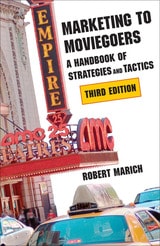
Marketing to Moviegoers
A Handbook of Strategies and Tactics, Third EditionRobert Marich
Southern Illinois University Press, 2013
While Hollywood executives spend millions of dollars making movies, even more money is poured into selling those films to the public. In the third edition of his comprehensive guidebook, Marketing to Moviegoers: A Handbook of Strategies and Tactics, veteran film and TV journalist Robert Marich plumbs the depths of the methods used by studios to market their films to consumers. Updates to the third edition include a chapter on marketing movies using digital media; an insightful discussion of the use of music in film trailers; new and expanded materials on marketing targeted toward affinity groups and awards; fresh analysis of booking contracts between theaters and distributors; a brief history of indie film marketing; and explorations of the overlooked potential of the drive-in theater and the revival of third-party-financed movie campaigns.
While many books have been written on the business-to-business aspect of film promotion, Marich’s volume is one of the few that focuses on the techniques used to sell motion pictures to those in a position to truly make or break a film—the public. A highly navigable handbook that breaks down a complicated process into manageable strategies in an easy-to-read style, Marketing to Moviegoers is a must for all professionals and students in today’s rapidly evolving film industry.
Marketing with Social Media
A LITA GuideBeth Thomsett-Scott
American Library Association, 2020
This all-new edition gathers a range of contributors to explore real-world uses of library marketing technology, perfect for novices ready to dive in as well as practitioners on the lookout for ways to improve existing efforts. Inside, librarians share insights on how they use their favorite social media tools to promote their library and build community. Applicable to all types of institutions, this guide
- covers popular tools such as Snapchat, Tumblr, Instagram, Facebook, and Twitter;
- shares four easy-to-use tools for creating memes, tips for creating short videos, and ways to integrate blogs into social media;
- demonstrates how to use reaction GIFs and tagging to boost your Tumblr posts;
- shows how to tailor messages to communicate effectively with different generations and audiences; and
- includes screen shots, illustrations, sample social media policies to help you navigate controversies, and free online training resources.

Markets
Armin Beverungen
University of Minnesota Press, 2018
A media theory of markets
Markets abound in media—but a media theory of markets is still emerging. Anthropology offers media archaeologies of markets, and the sociology of markets and finance unravels how contemporary financial markets have witnessed a media technological arms race. Building on such work, this volume brings together key thinkers of economic studies with German media theory, describes the central role of the media specificity of markets in new detail and inflects them in three distinct ways. Nik-Khah and Mirowski show how the denigration of human cognition and the concomitant faith in computation prevalent in contemporary market-design practices rely on neoliberal conceptions of information in markets. Schröter confronts the asymmetries and abstractions that characterize money as a medium and explores the absence of money in media. Beverungen situates these inflections and gathers further elements for a politically and historically attuned media theory of markets concerned with contemporary phenomena such as high-frequency trading and cryptocurrencies.

Mezcal in Oaxaca
A Craft Spirit for the Global MarketplaceRonda L. Brulotte
University of Texas Press, 2025
An ethnography of mezcal and how it has become a global, "artisanal" good.
Mezcal is booming. Once considered a peasant drink—the rough, lowbrow cousin of the more refined tequila—the smoky spirit is now prized by connoisseurs the world over. It is also hailed as a savior of Oaxaca, powering a craft industry that can uphold rural economies and Indigenous traditions.
Ronda L. Brulotte traces mezcal’s swift rise and its effects on communities that have distilled and enjoyed the beverage for generations. Only in the late 1990s did mezcal begin to escape its longstanding associations with Indigenous and working-class life, even as these very qualities supply the “authenticity” that elite consumers crave. Through a detailed ethnography of the spirits industry in Oaxaca, Brulotte compares the ideal of the artisanal economy with the reality of participation in global markets. Her findings—focused on tourism-led development and gentrification, the exploitation of women and smallholders, and swelling regional migration pressures—raise troubling questions about the ecological and social sustainability of a new craft imaginary that rebrands rustic products as luxury goods.