914 books match the query 'Medieval' and 163 start with m
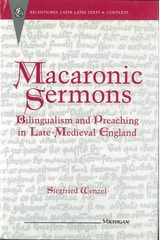
cover of Macaronic Sermons: Bilingualism and Preaching in Late-Medieval England

Macaronic Sermons

Bilingualism and Preaching in Late-Medieval England

Siegfried Wenzel

University of Michigan Press, 2010
Siegfried Wenzel's groundbreaking study seeks to describe and analyze the linguistically mixed, or macaronic, sermons in late fourteenth-century England.  Not only are these works of considerable religious interest, they provide extensive information on their literary, linguistic, and cultural milieux.
 
Macaronic Sermons begins by offering a typology of such works: those in which English words offer glosses, or offer structural functions, or offer neither of the two but yet are syntactically integrated.  This last group is then examined in detail: reasons are given for this usage and for its origins, based on the realities of fourteenth-century England.
 
Siefriend Wenzel draws valuable conclusions about the linguistic status quo of the era, together with the extent of education, the audiences' expectations, and the ways in which the authors' minds worked.
 
Obviously of interest to scholars and students of early English literature, Macaronic Sermons also contains much valuable information for specialists in language development or oral theory, and for those interested in multicultural societies.
[more]
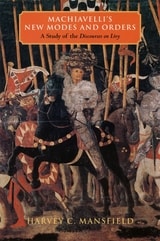
cover of Machiavelli's New Modes and Orders: A Study of the Discourses on Livy

Machiavelli's New Modes and Orders

A Study of the Discourses on Livy

Harvey C. Mansfield

University of Chicago Press, 2001

Machiavelli's New Modes and Orders is the only full-length interpretive study on Machiavelli's controversial and ambiguous work, Discourses on Livy. These discourses, considered by some to be Machiavelli's most important work, are thoroughly explained in a chapter-by-chapter commentary by Harvey C. Mansfield, one of the world's foremost interpreters of this remarkable philosopher.

Mansfield's aim is to discern Machiavelli's intention in writing the book: he argues that Machiavelli wanted to introduce new modes and orders in political philosophy in order to make himself the founder of modern politics. Mansfield maintains that Machiavelli deliberately concealed part of his intentions so that only the most perceptive reader could see beneath the surface of the text and understand the whole of his book. Previously out of print, Mansfield's penetrating study brings to light the hidden thoughts lurking in the details of the Discourses on Livy to inform and challenge its readers at every step along the way.
[more]
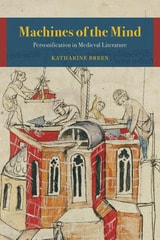
cover of Machines of the Mind: Personification in Medieval Literature

Machines of the Mind

Personification in Medieval Literature

Katharine Breen

University of Chicago Press, 2021


In Machines of the Mind, Katharine Breen proposes that medieval personifications should be understood neither as failed novelistic characters nor as instruments of heavy-handed didacticism. She argues that personifications are instead powerful tools for thought that help us to remember and manipulate complex ideas, testing them against existing moral and political paradigms. Specifically, different types of medieval personification should be seen as corresponding to positions in the rich and nuanced medieval debate over universals. Breen identifies three different types of personification—Platonic, Aristotelian, and Prudentian—that gave medieval writers a surprisingly varied spectrum with which to paint their characters.

Through a series of new readings of major authors and works, from Plato to Piers Plowman, Breen illuminates how medieval personifications embody the full range of positions between philosophical realism and nominalism, varying according to the convictions of individual authors and the purposes of individual works. Recalling Gregory the Great’s reference to machinae mentis (machines of the mind), Breen demonstrates that medieval writers applied personification with utility and subtlety, employing methods of personification as tools that serve different functions. Machines of the Mind offers insight for medievalists working at the crossroads of religion, philosophy, and literature, as well as for scholars interested in literary character-building and gendered relationships among characters, readers, and texts beyond the Middle Ages.
[more]
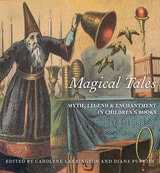
cover of Magical Tales: Myth, Legend, and Enchantment in Children's Books

Magical Tales

Myth, Legend, and Enchantment in Children's Books

Edited by Carolyne Larrington and Diane Purkiss

Bodleian Library Publishing, 2013

A faun carrying an umbrella. A hobbit who makes his home in a hole in the ground. An ill-treated schoolboy with a secret and a scar. Fantasy is among the most beloved genres in children’s literature— and its offerings are often just as eagerly anticipated by adults. But how is it that writers like J. K. Rowling and Philip Pullman are able to create such remarkable images?

Magical Tales
traces the origin of the genre back through Norse mythology, Arthurian legend, and medieval literature. Drawing on manuscripts and rare books in the renowned collection of the Bodleian Library, the essays turn the spotlight on spell books; grimoires, or magical textbooks; and books of legend and myth whose themes writers like J. R. R. Tolkien and C. S. Lewis incorporated into their work, inspiring generations of writers that extend to the present day. In serving as a source of inspiration for later literary works, the contributors show, myths and legends have themselves been altered in interesting ways.

Richly illustrated, Magical Tales offers an enchanting take on the development of this wildly popular genre.
[more]
cover of Magna Carta: Its Role in the Making of the English Constitution, 1300-1629

Magna Carta

Its Role in the Making of the English Constitution, 1300-1629

Faith Thompson

University of Minnesota Press, 1948
Magna Carta was first published in 1948. Minnesota Archive Editions uses digital technology to make long-unavailable books once again accessible, and are published unaltered from the original University of Minnesota Press editions.This important study in English constitutional history is the story of the Magna Carta from the end of the reign of Edward I to the dissolution of parliament and the completion of Sir Edward Coke’s Commentary (1300-1629).Miss Thompson surveys the various ways, practical and theoretical, in which the Charter was used by groups and individuals in English society. She examines the pertinent sources and finds that the Charter was never eclipsed in the later Middle Ages or even in the Tudor period and that its reinterpretation in the early Stuart period was not an abrupt and novel phenomenon. The statesmen who transformed a charter of feudal “liberties” into a charter of “liberty of the subject” were using a document with a long history and a reputation already made in plea rolls and Year Books, parliament and statute rolls, law treatises, and even chronicles.Miss Thompson provides considerable background material to support her emphasis on this process of interpretation, and she clearly interprets the character and motives of successive sponsors of the Charter.The value of Miss Thompson’s study is in the unusual thoroughness of her treatment of Magna Carta and in her corrections of misconceptions about the role the Magna Carta has played in the making of the English constitution.
[more]
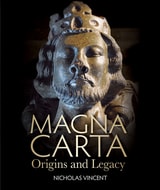
cover of Magna Carta: Origins and Legacy

Magna Carta

Origins and Legacy

Nicholas Vincent

Bodleian Library Publishing, 2015

Magna Carta is the most famous document in English history. And yet its survival is purely accidental. King John, who negotiated the document with his rebellious barons, had no intention of honouring its contents. Annulled by the pope within weeks of being issued, it was destined to oblivion. But with the sudden death of John, all of this changed. Magna Carta was reissued by the regents of the boy King Henry III as an apology for past misrule and as a promise of future good government. It was reissued on successive occasions and repeatedly cited in legal cases in the following centuries. Later, it played a part in conflicts such as the English Civil War and the American Revolutionary War. Echoes of Magna Carta are to be found in the Declaration of Independence and the Constitution. It continues to be cited today as a touchstone of fundamental universal freedoms. 

This book tells the story of the birth and development of Magna Carta from its origins to the modern day. It also reproduces and describes, for the very first time, every surviving copy of the Great Charter, as well as related charters of the period, including various new discoveries. It addresses the previously unanswered question of how the charter was published and disseminated to the shires of England and includes a chapter on the charter's scribes and sealing, supplying a truly unique insight into both the creation and afterlife of the most fundamental legal document in British history.
[more]
cover of Magnus Felix Ennodius: A Gentleman of the Church

Magnus Felix Ennodius

A Gentleman of the Church

S. A. H. Kennell

University of Michigan Press, 2000

Magnus Felix Ennodius (474-521), deacon of Milan and bishop of Pavia in the turbulent years after the fall of the Roman Empire in the West, was a prolific writer of letters, poetry, speeches, and pamphlets on the controversies that beset the church in his day. In the Middle Ages, he was read as a model of style and source of canon law. More recently, however, Ennodius' writings have been denigrated as the vapid product of a frivolous mind more concerned with form than content. Magnus Felix Ennodius: A Gentleman of the Church sets the record straight by restoring Ennodius to his social and literary context. Ennodius stands revealed as a man on the cusp of the ancient and medieval worlds, his thought still shaped according to classical norms, but his writings informed with a sensibility that prefigures that of the Christian Middle Ages. As the only book-length study of Ennodius, here the author explores all aspects of Ennodius' life and literary production to augment the collective understanding of him on two major fronts, rhetoric and meaning, so that he can take his place as an important author and historical figure. Deeply insightful, and refreshingly original, the author breaks new ground in studying this period of history, so often overshadowed by the classical and middle ages that immediately precede and succeed it.
S. A. H. Kennell is Adjunct Professor of Classics, Memorial University of Newfoundland.
[more]
cover of Making a Great Ruler: Grand Duke Vytautas of Lithuania

Making a Great Ruler

Grand Duke Vytautas of Lithuania

Giedre Mickunaite

Central European University Press, 2006

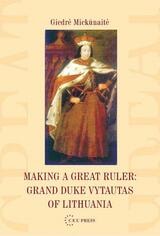
Investigating the propaganda surrounding the grand duke, this study reveals that, in fact, there were two opposite images: that of a good ruler and that of a tyrant. The paradox is that frequently these opposites were based on the same features of the grand duke's character or episodes from his biography. The research is based on a wide array of written and visual sources as well as on records of oral tradition. Rich and diverse primary materials are analysed from the perspectives of political and social history, memorial culture, as well as iconography and rhetoric.
[more]
cover of Marriage on Trial

Marriage on Trial

Ludwig Schmugge

Catholic University of America Press, 2012
This work vividly describes many of the individual cases and offers new insight into the social and legal pressures on marriage in the Middle Ages.
[more]
cover of Mary Magdalene and Her Sister Martha: An Edition and Translation of the Medieval Welsh Lives

Mary Magdalene and Her Sister Martha

An Edition and Translation of the Medieval Welsh Lives

Jane Cartwright

Catholic University of America Press, 2013
Mary Magdalene and Her Sister Martha: An Edition and Translation of the Medieval Welsh Lives provides scholarly editions and English translations of the medieval Welsh versions of the legends of Mary Magdalene and Martha. Described by Victor Saxer as medieval best sellers, these hagiographical tales, which described how Mary Magdalene and her sister Martha survived a perilous sea voyage from the holy land and evangelized Provence, were available in many different Latin and vernacular versions and circulated widely in the medieval West. The texts were translated or adapted into Middle Welsh some time before the mid-fourteenth century: the Middle Welsh Life of Mary Magdalene is extant in thirteen manuscripts and the Middle Welsh Life of Martha is preserved in eight of the same manuscripts. Jane Cartwright makes the Middle Welsh versions available to an international audience for the first time and provides a detailed study of the Welsh manuscripts that contain the texts, a comparison between the different manuscripts versions and a discussion of the wider hagiographical context of the texts in Wales. The volume includes transcriptions, editions and translations of the two Lives based on the oldest most complete extant versions found in the Red Book of Talgarth c. 1400, as well as an additional section of text describing Mary Magdalene’s life before Christ’s crucifixion from the fifteenth-century Aberystwyth, National Library of Wales, Peniarth MS 27ii. The edition is accompanied by a comprehensive glossary which provides translations of all medieval Welsh words that occur in the texts, an analysis of the development and transmission of the legends, as well as a discussion of the relevance and popularity of these two female saints in late medieval Wales: medieval Welsh poetry, church dedications, and holy wells are also considered.
[more]
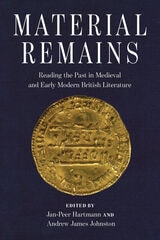
cover of Material Remains: Reading the Past in Medieval and Early Modern British Literature

Material Remains

Reading the Past in Medieval and Early Modern British Literature

Edited by Jan-Peer Hartmann and Andrew James Johnston

The Ohio State University Press, 2021
Medieval and early modern literature was fascinated with the material remains of the past. Scenes involving the discovery, description, circulation, or contemplation of archaeological objects can be found in texts ranging from hagiography to elegiac poetry, from historiography to romance—across regions and periods. This volume gathers voices to explore the ways in which these texts employ descriptions of objects from the past to produce aesthetic and literary responses to questions of historicity and the epistemological conditions of historical knowledge. The contributions to Material Remains: Reading the Past in Medieval and Early Modern British Literature examine the understanding and experience of temporality as registered through the representation of found objects. From Beowulf and King Arthur to Richard III, Roger de Norton, and more, these essays reproduce the thrill of the archaeological find and generate new forms of historical understanding beyond the established narratives that reinforce modern forms of periodizing the Middle Ages. List of Contributors Neil Cartlidge, Roberta Frank, Lori Ann Garner, Jonathan Gil Harris, Jan-Peer Hartmann, John Hines, Naomi Howell, Andrew Hui, Andrew James Johnston, Sarah Salih, Philip Schwyzer
[more]
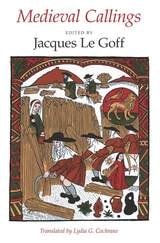
cover of Medieval Callings

Medieval Callings

Edited by Jacques Le Goff

University of Chicago Press, 1990

These essays by eleven internationally renowned historians present nuanced profiles of the major social and professional groups—the callings-of the Middle Ages.

The contributors focus on attitudes of medieval men and women toward their own society. Through a variety of techniques, from a reading of the Song of Roland to a reading of administrative records, they identify characteristic viewpoints of members of the fighting class, the clergy, and the peasantry. Along with vivid descriptions of what life was like for warrior knights, monks, high churchmen, criminals, lepers, shepherds, and prostitutes, this innovative approach offers a valuable new perspective on the complex social dynamics of feudal Europe.

"Very useful discussions of texts, both learned and literary."—Christopher Dyer, Times Literary Supplement

Contributors: Mariateresa Fumagalli Beonio Brocchieri, Franco Cardini, Enrico Castelnuovo, Giovanni Cherubini, Bronislaw Geremek, Aron Ja. Gurevich, Christiane Klapisch-Zuber, Jacques Le Goff, Giovanni Miccoli, Jacques Rossiaud, and André Vauchez.
[more]
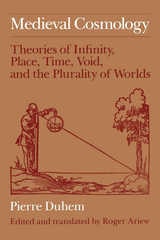
cover of Medieval Cosmology: Theories of Infinity, Place, Time, Void, and the Plurality of Worlds

Medieval Cosmology

Theories of Infinity, Place, Time, Void, and the Plurality of Worlds

Pierre Duhem

University of Chicago Press, 1987
These selections from Le système du monde, the classic ten-volume history of the physical sciences written by the great French physicist Pierre Duhem (1861-1916), focus on cosmology, Duhem's greatest interest. By reconsidering the work of such Arab and Christian scholars as Averroes, Avicenna, Gregory of Rimini, Albert of Saxony, Nicole Oresme, Duns Scotus, and William of Occam, Duhem demonstrated the sophistication of medieval science and cosmology.
[more]
cover of Medieval Islam: A Study in Cultural Orientation

Medieval Islam

A Study in Cultural Orientation

Gustave E. von Grunebaum

University of Chicago Press, 1946
From the Preface:
 
"This book book has grown out of a series of public lectures delivered in the spring of 1945 in the Division of the Humanities of the University of Chicago. It proposes to outline the cultural orientation of the Muslim Middle Ages, with eastern Islam as the center of attention. It attempts to characterize the medieval Muslim's view of himself and his peculiarly defined universe, the fundamental intellectual and emotional attitudes that governed his works, and the mood in which he lived his life. It strives to explain the structure of his universe in terms of inherited, borrowed, and original elements, the institutional framework within which it functioned, and its place in relation to the contemporary Christian world.
 
"A consideration of the various fields of cultural activity requires an analysis of the dominant interest, the intentions, and, to some extent, the methods of reasoning with which the Muslim approached his special subjects and to which achievement and limitations of achievement are due. Achievements referred to or personalities discussed will never be introduced for their own sake, let alone for the sake of listing the sum total of this civilization's major contributions. They are dealt with rather to evidence the peculiar ways in which the Muslim essayed to understand and to organize his world.
 
"The plan of the book thus rules out the narration of political history beyond the barest skeleton, but it requires the ascertaining of the exact position of Islam in the medieval world and its significance. This plan also excludes a study of Muslim economy, but it leads to an interpretation of the social structure as molded by the prime loyalties cherished by the Muslim."
[more]
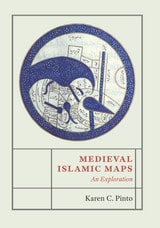
cover of Medieval Islamic Maps: An Exploration

Medieval Islamic Maps

An Exploration

Karen C. Pinto

University of Chicago Press, 2016

Hundreds of exceptional cartographic images are scattered throughout medieval and early modern Arabic, Persian, and Turkish manuscript collections. The plethora of copies created around the Islamic world over the course of eight centuries testifies to the enduring importance of these medieval visions for the Muslim cartographic imagination. With Medieval Islamic Maps, historian Karen C. Pinto brings us the first in-depth exploration of medieval Islamic cartography from the mid-tenth to the nineteenth century.
 
Pinto focuses on the distinct tradition of maps known collectively as the Book of Roads and Kingdoms (Kitab al-Masalik wa al-Mamalik, or KMMS), examining them from three distinct angles—iconography, context, and patronage. She untangles the history of the KMMS maps, traces their inception and evolution, and analyzes them to reveal the identities of their creators, painters, and patrons, as well as the vivid realities of the social and physical world they depicted.  In doing so, Pinto develops innovative techniques for approaching the visual record of Islamic history, explores how medieval Muslims perceived themselves and their world, and brings Middle Eastern maps into the forefront of the study of the history of cartography. 
[more]
cover of Medieval Jerusalem: Forging an Islamic City in Spaces Sacred to Christians and Jews

Medieval Jerusalem

Forging an Islamic City in Spaces Sacred to Christians and Jews

Jacob Lassner

University of Michigan Press, 2017

Medieval Jerusalem examines an old question that has recently surfaced and given rise to spirited discussion among Islamic historians and archeologists: what role did a city revered for its holiness play in the unfolding politics of the early Islamic period? Was there an historic moment when the city, holy to Jews, Christians, and Muslims, may have been considered as the administrative center of a vast Islamic world, as some scholars on early Islam have recently claimed? Medieval Jerusalem also emphasizes the city’s evolution as a revered Islamic religious site comparable to the holy cities Mecca and Medina.

Examining Muslim historiography and religious lore in light of Jewish traditions about the city, Jacob Lassner points out how these reworked Jewish traditions and the imposing monumental Islamic architecture of the city were meant to demonstrate that Islam had superseded Judaism and Christianity as the religion for all monotheists. He interrogates the literary sources of medieval Islamic historiography and their modern interpreters as if they were witnesses in a court of law, and applies the same method for the arguments about the monuments of the city’s material culture, including the great archaeological discoveries along the south wall of the ancient Temple Mount.

This book will be of interest to a broad range of readers given the significance of the city in the current politics of the Near East. It will in part serve as a corrective to narratives of Jerusalem’s past that are currently popular for scholarly and political reasons. 
 
 
[more]
cover of Medieval Manuscripts from Würzburg in the Bodleian Library: A Descriptive Catalogue

Medieval Manuscripts from Würzburg in the Bodleian Library

A Descriptive Catalogue

Daniela Mairhofer

Bodleian Library Publishing, 2015

The Bodleian Library holds a significant collection of Latin medieval manuscripts from Germany—more specifically from Würzburg, Eberbach, and Mainz. The medieval manuscripts from Würzburg, most of which were acquired by William Laud, Archbishop of Canterbury, during the period of the Thirty Years’ War, constitute an invaluable collection. Most of these codices originally belonged to the cathedral chapter of Würzburg, the Domstift St. Kilian, and date back to the ninth century.
           
Presenting detailed descriptions of more than fifty of manuscripts, Medieval Manuscripts from Würzburg in the Bodleian Library, Oxford provides an authoritative catalog, including many important early copies of the manuscripts of church fathers during the Carolingian period. Daniela Mairhofer examines each from both a textual and paleographic point of view, paying careful attention to the provenance of the manuscript, as well as to physical characteristics like decoration and binding. Entries are accompanied by copious color plates.
[more]
cover of Medieval Manuscripts from the Mainz Charterhouse in the Bodleian Library, Oxford: A Descriptive Catalogue

Medieval Manuscripts from the Mainz Charterhouse in the Bodleian Library, Oxford

A Descriptive Catalogue

Daniela Mairhofer

Bodleian Library Publishing, 2017

The Bodleian Library is one of the few libraries outside Germany with a substantial number of medieval manuscripts from the German-speaking lands. These manuscripts, most of which were acquired by Archbishop Laud in the 1630s, during the Thirty Years War, mainly consist of major groups of codices from ecclesiastical houses in the Rhine-Main area, that is Würzburg, Mainz, and Eberbach. Their potential contribution to the religious and intellectual history of these foundations and to the study of German medieval culture as a whole is immeasurable.

These volumes contain descriptions of more than one hundred medieval manuscripts, mostly Latin, from the Charterhouse St. Michael at Mainz. Dating from the tenth to the fifteenth centuries, they reflect the spirituality and literary interest of the Carthusian order. The first major publication on the Mainz Charterhouse manuscript collection, this two-volume edition provides authoritative and superbly detailed descriptions, including information about the physical characteristics, decoration, binding, and provenance of the manuscripts.
 
[more]
cover of Medieval Marvels and Fictions in the Latin West and Islamic World

Medieval Marvels and Fictions in the Latin West and Islamic World

Michelle Karnes

University of Chicago Press, 2022

A cross-cultural study of magical phenomena in the Middle Ages.
 
Marvels like enchanted rings and sorcerers’ stones were topics of fascination in the Middle Ages, not only in romance and travel literature but also in the period’s philosophical writing. Rather than constructions of belief accepted only by simple-minded people, Michelle Karnes shows that these spectacular wonders were near impossibilities that demanded scrutiny and investigation.
 
This is the first book to analyze a diverse set of writings on such wonders, comparing texts from the Latin West—including those written in English, French, Italian, and Castilian Spanish —with those written in Arabic as it works toward a unifying theory of marvels across different disciplines and cultures. Karnes tells a story about the parallels between Arabic and Latin thought, reminding us that experiences of the strange and the unfamiliar travel across a range of genres, spanning geographical and conceptual space and offering an ideal vantage point from which to understand intercultural exchange. Karnes traverses this diverse archive, showing how imagination imbues marvels with their character and power, making them at once enigmatic, creative, and resonant. Skirting the distinction between the real and unreal, these marvels challenge readers to discover the highest capabilities of both nature and the human intellect. Karnes offers a rare comparative perspective and a new methodology to study a topic long recognized as central to medieval culture.

 
[more]
cover of Medieval Merchants and Money: Essays in Honour of James L. Bolton

Medieval Merchants and Money

Essays in Honour of James L. Bolton

Edited by Matthew Davies

University of London Press, 2016
This volume contains selected essays in celebration of the scholarship of the medieval historian Professor James L. Bolton. The essays address a number of different questions in medieval economic and social history, as the volume looks at the activities of merchants, their trade, legal interactions and identities, and on the importance of money and credit in the rural and urban economies. Other essays look more widely at patterns of immigration to London, trade and royal policy, and the role that merchants played in the Hundred Years War.
[more]
cover of Medieval Misogyny and the Invention of Western Romantic Love

Medieval Misogyny and the Invention of Western Romantic Love

R. Howard Bloch

University of Chicago Press, 1991

Until now the advent of Western romantic love has been seen as a liberation from—or antidote to—ten centuries of misogyny. In this major contribution to gender studies, R. Howard Bloch demonstrates how similar the ubiquitous antifeminism of medieval times and the romantic idealization of woman actually are.

Through analyses of a broad range of patristic and medieval texts, Bloch explores the Christian construction of gender in which the flesh is feminized, the feminine is aestheticized, and aesthetics are condemned in theological terms. Tracing the underlying theme of virginity from the Church Fathers to the courtly poets, Bloch establishes the continuity between early Christian antifeminism and the idealization of woman that emerged in the twelfth and thirteenth centuries. In conclusion he explains the likely social, economic, and legal causes for the seeming inversion of the terms of misogyny into those of an idealizing tradition of love that exists alongside its earlier avatar until the current era.

This startling study will be of great value to students of medieval literature as well as to historians of culture and gender.
[more]
cover of Medieval Philosophy Redefined as the Latin Age

Medieval Philosophy Redefined as the Latin Age

John Deely

St. Augustine's Press, 2016

In a statement published for Paul Cobley’s edition of Realism for the 21st Century. A John Deely Reader, Umberto Eco wrote that “John Deely has not only paid attention to the Second Scholasticism but also to the first one”. In the present book, Deely goes one step further, by establishing the continuity of the Latin Age as a whole. He shows how the Latin thinkers demonstrated the presuppositions and created the framework of critical thought that made possible and inevitable the turn to science in the modern sense. The book thus shows how and why criticalachievements of the Latins remain requisite, even today, for the proper understanding of science and technology as offshot of the “Way of Signs” upon which all of thought, as also evikytuib as a whole, perforce travels.

“With the sophistic modern and Enlightenment misconceptions about philosophy’s nature and history daily crashing and burning around us, Deely’s unconventional way of understanding medieval philosophy is like a breath of fresh air amid intellectual smog. This is a great book, the single most important study of medieval thought in half a century or more. It deserves an unbiased hearing by anyone today claiming to be a serious philosopher.” — Peter A. Redpath

Founding Chairman, Universities of Western Civilization Chairman of the Board, The International Etienne Gilson Society

“Drawing upon the thought of John Poinsot and Charles Pierce, John Deely has opened a distinctively postmodern path to the metaphysics of being, at once illuminating much of this ancient tradition while casting new light upon it in the context of contemporary thought. His treatment notably of St. Thomas is not merely a return to an earlier thinker, but an opening to a different path, at once in profound agreement with St. Thomas and yet heretofore unexplored. This book, thus, not only constitutes a return to a past era, but shows this era in a new light that illuminates as well the contemporary scene.” — Kenneth L. Schmitz

Professor Emeritus, University of Toronto, Canada Pontifical John Paul II Institute for Studies on Marriage and Family, Washington, D.C.
[more]
cover of Medieval Sovereignty: Marsilius of Padua and Bartolous of Saxoferrato

Medieval Sovereignty

Marsilius of Padua and Bartolous of Saxoferrato

Francesco Maiolo

Eburon Academic Publishers, 2007
Medieval Sovereignty examines the idea of sovereignty in the Middle Ages and asks if it can be considered a fundamental element of medieval constitutional order. Francesco Maiolo analyzes the writings of Marsilius of Padua (1275/80–1342/43) and Bartolous of Saxoferrato (1314–57) and assesses their relative contributions as early proponents of popular sovereignty. Both are credited with having provided the legal justification for medieval popular government. Maiolo’s cogent reconsideration of this primacy is an important addition to current medieval studies.
[more]
cover of Medieval Things: Agency, Materiality, and Narratives of Objects in Medieval German Literature and Beyond

Medieval Things

Agency, Materiality, and Narratives of Objects in Medieval German Literature and Beyond

Bettina Bildhauer

The Ohio State University Press, 2020
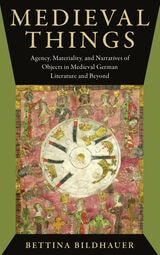
What does medieval literature look like from the point of view not of knights and ladies, but of treasure, and rings, nets and the grail? How does medieval literature imagine the agency of material things, and what exactly distinguishes human subjects from inanimate objects? Medieval Things: Agency, Materiality, and Narratives of Objects in Medieval German Literature and Beyond brings together a theoretically informed and politically engaged new materialist approach with a study of how everyday objects are understood in medieval literature. Bettina Bildhauer argues that medieval narratives can inspire current critical theory on agency and materiality. She focuses on famous and forgotten German narratives from the twelfth to the sixteenth centuries, including Wolfram of Eschenbach’s Parzival and the epic Song of the Nibelungs, and sets them in their global context. Many such tales can be reconceptualized as “thing biographies”—stories that follow the trajectory not of a human hero but of a coin, a gown, a treasure, or a ring. Many also use nets and networks to conceptualize dangerous structures of knowledge. Shine, glamour, and charisma emerge as particularly powerful ways in which material things exert a kind of agency that is neither pseudo-human nor fetishistic. In analyzing details like these from medieval literature, Bildhauer thus contributes in new ways to current theory on agency and materiality.
[more]
cover of Medieval Views of the Cosmos

Medieval Views of the Cosmos

E. Edson and E. Savage-Smith

Bodleian Library Publishing, 2004

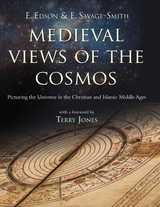
Once upon a time, the universe was much simpler: before our modern understanding of an infinite formless space scattered with pulsating stars, revolving planets, and mysterious black holes, the universe was seen as a rigid hierarchical system with the earth and the human race at its center. Medieval Views of the Cosmos investigates this worldview shared by medieval societies, revealing how their modes of thought affect us even today.

In the medieval world system—inherited by Christians and Muslims from the Greeks and Romans, and modified by their own religious tenets—spheres bearing the planets and stars wheeled around the earth, and at every level there was a moral lesson for humanity and a satisfying metaphor for the nature of God. The authors of this volume explain how the medieval view of the universe was harmonious on theological and practical levels, providing answers to the most puzzling of questions.

Medieval Views of the Cosmos is an engaging and beautifully illustrated introduction to a world where every moment was a theater of human drama directed by the hand of God.
[more]
cover of Medieval Wellness: From Beauty to Bloodletting

Medieval Wellness

From Beauty to Bloodletting

Larisa Grollemond

J. Paul Getty Trust, The, 0

Dispelling myths of a dirty, superstitious Middle Ages, this entertaining volume explores medieval approaches to health and wellness.

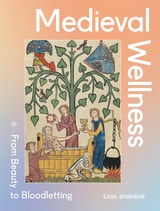
Often maligned as an era of darkness and superstition, the Middle Ages in Europe have been stereotyped as lacking standards for basic hygiene, or, at the very least, for having a laughably simplistic approach to self-care and medicine. With wit and expert analysis, medievalist Larisa Grollemond explores everyday practices and beliefs of medieval life. She uncovers a world as nuanced and self-aware as our own while playfully connecting traditions from the Middle Ages to modern wellness culture.

  • Challenges misconceptions of medieval Europe with engaging, evidence-based insights into hygiene and healthcare practices.
  • Answers popular questions about daily life, including bathing, cosmetics, contraception, and the realities of medieval medical treatments.
  • Features over 130 illustrations of illuminated manuscripts, medieval artifacts, and other art works that bring the past vividly to life.
  • Connects medieval wellness practices to contemporary self-care trends, offering surprising parallels and fresh perspective.

If you think the Middle Ages were primitive and unsophisticated, this book will change your mind. With Medieval Wellness, you’ll discover a world of care, curiosity, and complexity that will feel familiar to your own.
[more]
cover of Medieval Women and Their Objects

Medieval Women and Their Objects

Jenny Adams and Nancy Mason Bradbury, editors

University of Michigan Press, 2016

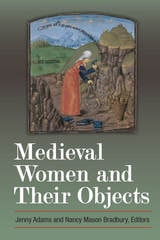
The essays gathered in this volume present multifaceted considerations of the intersection of objects and gender within the cultural contexts of late medieval France and England. Some take a material view of objects, showing buildings, books, and pictures as sites of gender negotiation and resistance and as extensions of women’s bodies. Others reconsider the concept of objectification in the lives of fictional and historical medieval women by looking closely at their relation to gendered material objects, taken literally as women’s possessions and as figurative manifestations of their desires.

The opening section looks at how medieval authors imagined fictional and legendary women using particular objects in ways that reinforce or challenge gender roles. These women bring objects into the orbit of gender identity, employing and relating to them in a literal sense, while also taking advantage of their symbolic meanings. The second section focuses on the use of texts both as objects in their own right and as mechanisms by which other objects are defined. The possessors of objects in these essays lived in the world, their lives documented by historical records, yet like their fictional and legendary counterparts, they too used objects for instrumental ends and with symbolic resonances. The final section considers the objectification of medieval women’s bodies as well as its limits. While this at times seems to allow for a trade in women, authorial attempts to give definitive shapes and boundaries to women’s bodies either complicate the gender boundaries they try to contain or reduce gender to an ideological abstraction. This volume contributes to the ongoing effort to calibrate female agency in the late Middle Ages, honoring the groundbreaking work of Carolyn P. Collette.
 

[more]
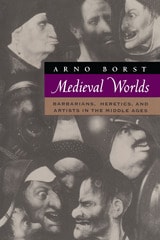
cover of Medieval Worlds: Barbarians, Heretics and Artists in the Middle Ages

Medieval Worlds

Barbarians, Heretics and Artists in the Middle Ages

Arno Borst

University of Chicago Press, 1992

In Medieval Worlds: Barbarians, Heretics, and Artists, medieval historian Arno Borst offers at once an imaginatively narrated tour of medieval society. Issues of language, power, and cultural change come to life as he examines how knights, witches and heretics, monks and kings, women poets, and disputatious university professors existed in the medieval world.

Clearly interested in the forms of medieval behavior which gave rise to the seeds of modern society, Borst focuses on three in particular that gave momentum to medieval religious, social, and intellectual movements: the barbaric, heretical, and artistic. Borst concludes by reflecting on his own life as a scholar and draws out lessons for us from the turbulence of the Middle Ages.
[more]
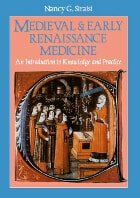
cover of Medieval and Early Renaissance Medicine: An Introduction to Knowledge and Practice

Medieval and Early Renaissance Medicine

An Introduction to Knowledge and Practice

Nancy G. Siraisi

University of Chicago Press, 1990
Western Europe supported a highly developed and diverse medical community in the late medieval and early Renaissance periods. In her absorbing history of this complex era in medicine, Siraisi explores the inner workings of the medical community and illustrates the connections of medicine to both natural philosophy and technical skills.
[more]
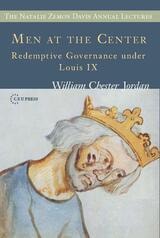
cover of Men at the Center: Redemptive Governance under Louis IX

Men at the Center

Redemptive Governance under Louis IX

William Chester Jordan

Central European University Press, 2012

Taking Professor Natalie Zemon Davis’ fascinating biographical studies of three Women on the Margins in the seventeenth century as an inspiration, the author of this book offers three portraits of men who were at the very center of governance in thirteenth-century France, men who strove in the shadow of King Louis IX (Saint Louis) to impose a redemptive regime on the realm. Professor Jordan treats them as individuals, but in a sense they are also types: Robert of Sorbon, a churchman; Etienne Boileau, a bourgeois; and Simon de Nesle, an aristocrat. Robert was the founder of the Sorbonne; Boileau was the prévôt or royal administrator of Paris; and Simon was twice co-regent of the kingdom. Thinking about them and their relations with Louis IX opens up a new and altogether sobering vista for exploring the nature of the king’s rule and the impact of his rule on his subjects.
[more]
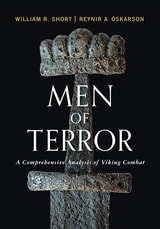
cover of Men of Terror: A Comprehensive Analysis of Viking Combat

Men of Terror

A Comprehensive Analysis of Viking Combat

William R. Short and Reynir A. Óskarson

Westholme Publishing, 2027

An Interdisciplinary Study of Viking Martial Culture that Dispels Myths and Expands Our Understanding of the Medieval Norse World
Sometime near the end of the tenth century, a man named Fraði died in Sweden. His kinsmen raised a granite runestone to his memory in Denmark. The carved message appears to tell us that Fraði was “first among all Vikings” and that he was the “terror of men.” Known sources about the Vikings revolve around the constant threat of violence: literary and artistic sources from both inside and outside Viking lands, including poetry, myths, stories, and artwork; law codes; burial practices; weapons; even their ship and house architecture. 
    Based on nearly two decades of research, Men of Terror: A Comprehensive Analysis of Viking Combat is a richly illustrated interdisciplinary study of the heart of Viking society: weapons and combat. Relying on a vast array of sources from a wide range of fields, research scientist William R. Short and independent scholar and martial arts instructor Reynir A. Óskarson dig deep into the culture of men like Fraði to better understand the mindset and performance of Viking warriors that led them to venerate and praise acts of violence and aggression. In the process they have painstakingly reverse-engineered Viking combat to account for the archaeology we have. Along the way, they answer questions such as: Were there women warriors? Why were acts such as raiding held in such high esteem? What mundane object was the king of Viking weapons and how was it used? Could bowstrings of human hair really work? Through their comprehensive research, the authors present a holistic picture of this society from what previously had only been disparate and intriguing parts. By the end of the book, the reader will understand the importance of combat to Viking society, the nature of that combat, and the code of these “men of terror.”
[more]
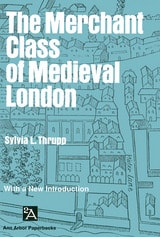
cover of Merchant Class of Medieval London: 1300-1500

Merchant Class of Medieval London

1300-1500

Sylvia L. Thrupp

University of Michigan Press, 1948
The Merchant Class of Medieval London by Sylvia L. Thrupp explores the social context in which London merchants operated, focusing on their economic, political, and social roles. This book delves into the merchants' dominant position in the city, their control over municipal government, and their national impact. It examines their wealth, standards of living, family life, education, and religious attitudes, providing a comprehensive view of their lifestyle and values. The text also addresses the social mobility within the merchant class, noting the constant movement in and out of the class and the factors influencing this dynamic. Thrupp utilizes a wide variety of sources, including deeds, wills, court records, and personal documents, to create a detailed portrait of medieval London's merchant culture. This work is essential for understanding the intricacies of medieval urban life and the significant role merchants played in shaping the economy and society of the time.
[more]
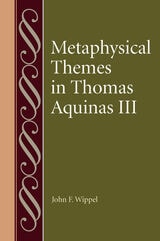
cover of Metaphysical Themes in Thomas Aquinas III

Metaphysical Themes in Thomas Aquinas III

John F. Wippel

Catholic University of America Press, 2020
Metaphysical Themes in Thomas Aquinas III is Msgr. John Wippel’s third volume dedicated to the metaphysical thought of Thomas Aquinas. After an introduction, this volume of collected essays begins with Wippel’s interpretation of the discovery of the subject of metaphysics by a special kind of judgment (“separation”). In subsequent chapters, Wippel turns to the relationship between faith and reason, exploring what are known as the preambles of faith. This is followed by two chapters on the important contributions by Cornelio Fabro on Aquinas’s distinction between essence and esse and on participation. The volume continues with articles on Aquinas’s view of creation as a preamble of faith, Aquinas’s much-disputed defense of unicity of substantial form in creatures, his account of the separated soul’s natural knowledge, and Aquinas’s understanding of evil in his De Malo 1. The volume concludes with an article comparing Bonaventure, Aquinas, and Godfrey of Fontaines on the metaphysical composition of angelic beings. Most of these issues were disputed during Aquinas’s time by some of his contemporaries, and the proper understanding of each continues to be debated by various students of his thought today. Wippel’s purpose, therefore, is to help clarify our understanding of Aquinas’s thought on each of these topics, a task that requires the careful analysis of primary sources and of secondary literature and attention to the relative chronology of his writing.
[more]
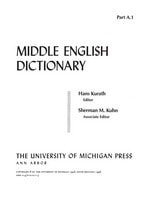
cover of Middle English Dictionary: A.1

Middle English Dictionary

A.1

Robert E. Lewis, Editor-in-Chief

University of Michigan Press, 1956
The most important modern reference work for Middle English studies
[more]
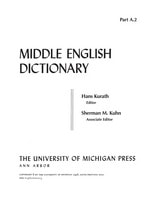
cover of Middle English Dictionary: A.2

Middle English Dictionary

A.2

Robert E. Lewis, Editor-in-Chief

University of Michigan Press, 1956
The most important modern reference work for Middle English studies
[more]
cover of Middle English Dictionary: A.3

Middle English Dictionary

A.3

Robert E. Lewis, Editor-in-Chief

University of Michigan Press, 1956
The most important modern reference work for Middle English studies
[more]
cover of Middle English Dictionary: A.4

Middle English Dictionary

A.4

Robert E. Lewis, Editor-in-Chief

University of Michigan Press, 1957
The most important modern reference work for Middle English studies
[more]
cover of Middle English Dictionary: B.1

Middle English Dictionary

B.1

Robert E. Lewis, Editor-in-Chief

University of Michigan Press, 1957
The most important modern reference work for Middle English studies
[more]
cover of Middle English Dictionary: B.2

Middle English Dictionary

B.2

Robert E. Lewis, Editor-in-Chief

University of Michigan Press, 1957
The most important modern reference work for Middle English studies
[more]
cover of Middle English Dictionary: B.3

Middle English Dictionary

B.3

Robert E. Lewis, Editor-in-Chief

University of Michigan Press, 1957
The most important modern reference work for Middle English studies
[more]
cover of Middle English Dictionary: B.4

Middle English Dictionary

B.4

Robert E. Lewis, Editor-in-Chief

University of Michigan Press, 1958
The most important modern reference work for Middle English studies
[more]
cover of Middle English Dictionary: B.5

Middle English Dictionary

B.5

Robert E. Lewis, Editor-in-Chief

University of Michigan Press, 1958
The most important modern reference work for Middle English studies
[more]
cover of Middle English Dictionary: C.1

Middle English Dictionary

C.1

Robert E. Lewis, Editor-in-Chief

University of Michigan Press, 1959
The most important modern reference work for Middle English studies
[more]
cover of Middle English Dictionary: C.2

Middle English Dictionary

C.2

Robert E. Lewis, Editor-in-Chief

University of Michigan Press, 1959
The most important modern reference work for Middle English studies
[more]
cover of Middle English Dictionary: C.3

Middle English Dictionary

C.3

Robert E. Lewis, Editor-in-Chief

University of Michigan Press, 1959
The most important modern reference work for Middle English studies
[more]
cover of Middle English Dictionary: C.4

Middle English Dictionary

C.4

Robert E. Lewis, Editor-in-Chief

University of Michigan Press, 1960
The most important modern reference work for Middle English studies
[more]
cover of Middle English Dictionary: C.5

Middle English Dictionary

C.5

Robert E. Lewis, Editor-in-Chief

University of Michigan Press, 1960
The most important modern reference work for Middle English studies
[more]
cover of Middle English Dictionary: C.6

Middle English Dictionary

C.6

Robert E. Lewis, Editor-in-Chief

University of Michigan Press, 1960
The most important modern reference work for Middle English studies
[more]
cover of Middle English Dictionary: D.1

Middle English Dictionary

D.1

Robert E. Lewis, Editor-in-Chief

University of Michigan Press, 1961
The most important modern reference work for Middle English studies
[more]
cover of Middle English Dictionary: D.2

Middle English Dictionary

D.2

Robert E. Lewis, Editor-in-Chief

University of Michigan Press, 1961

The most important modern reference work for Middle English studies
[more]