Results by title
210 books match the query 'Missouri' and 17 start with m
M. Jeff Thompson
Missouri's Swamp Fox of the ConfederacyDoris Land Mueller
University of Missouri Press, 2007
In the treacherous swamps of southeast Missouri, a different kind of Civil War was waged.
Meriwether Jeff Thompson was one of the most intriguing but least-known Missouri participants in the Civil War. He and his troops traveled fast and light to harass Union forces, materializing out of the countryside to surprise the enemy and evading the traps set for them by Northern commanders. Early in the war, Union General Ulysses S. Grant gave Thompson the name “Swamp Fox” for his exploits in the Bootheel region. This book now tells his story—an adventure that will be appreciated by readers of all ages. Doris Mueller has produced a meticulously researched account of Thompson’s life, from his Virginia boyhood and early successes to his wartime exploits and postwar life. When the war began, Thompson left his adopted city of St. Joseph—where he had served as mayor—to fight for the Confederacy. He was elected brigadier general in the First Military District of Southeast Missouri and led poorly equipped and loosely trained men in skirmishes and raids, often using guerrilla tactics. He was captured in August 1863. After being released twelve months later in a prisoner exchange, he joined Sterling Price’s ill-fated raid into Missouri. After the war, he was one of the first Southern leaders to seek reinstatement as a U.S. citizen and worked to allay hostilities among fellow Southerners.
Thompson was also known as the “Poet Laureate of the Marshes,” and Mueller includes numerous excerpts from his writings about his experiences. Her account not only provides a wealth of little-known biographical details about this important Missourian but also offers insight into the state’s unique experiences during that bloody era, personalizing events through the life of this brave soldier.
Scorned by the Northern press for impudence, but beloved as a leader by his men, Thompson was courageous in battle, often to the point of recklessness, making him a constant thorn in the side of Union forces; after the war he was an oft-maligned model for reconciliation. Doris Mueller’s recounting of his life is an action-adventure story that will delight readers as it attests to his important role in Missouri’s heritage.

Mark Twain's Homes and Literary Tourism
Hilary Iris Lowe
University of Missouri Press, 2025
A century after Samuel Clemens’s death, Mark Twain thrives. One way fans still celebrate the first true American writer and his work is by visiting any number of Mark Twain destinations. They believe they can learn something unique by visiting the places where he lived. Mark Twain’s Homes and Literary Tourism untangles the complicated ways that Clemens’s houses, now museums, have come to tell the stories that they do about Twain and, in the process, reminds us that the sites themselves are the products of multiple agendas and, in some cases, unpleasant histories.
Hilary Iris Lowe leads us through four Twain homes, beginning at the beginning—Florida, Missouri, where Clemens was born. Today the site is simply a concrete pedestal missing its bust, a plaque, and an otherwise-empty field. Though the original cabin where he was born likely no longer exists, Lowe treats us to an overview of the history of the area and the state park challenged with somehow marking this site. Next, we travel with Lowe to Hannibal, Missouri, Clemens’s childhood home, which he saw become a tourist destination in his own lifetime. Today mannequins remind visitors of the man that the boy who lived there became and the literature that grew out of his experiences in the house and little town on the Mississippi.
Literary historic sites pin their authority on the promise of exclusive insight into authors and texts through firsthand experience. As tempting as it is to accept the authenticity of Clemens’s homes, Mark Twain’s Homes and Literary Tourism argues that house museums are not reliable critical texts but are instead carefully constructed spaces designed to satisfy visitors. This volume shows us how these houses’ portrayals of Clemens change frequently to accommodate and shape our own expectations of the author and his work.

Meet Me in St. Louis
Sally Benson
University of Chicago Press, 2026
Sally Benson’s charming slice-of-life story is back in print for a new generation of readers.
Originally published as World War II raged overseas, Meet Me in St. Louis is Sally Benson’s semi-autobiographical account of the intergenerational Smith family during the twelve months leading up to the 1904 World’s Fair in St. Louis, Missouri. With warmth and tenderness, Benson chronicles the Smiths’ lives as they navigate sibling rivalries, first loves, financial hardship, jealousy, and heartaches in a poignant ode to the bonds of family.
Benson's novel is infused with wit as she details the lighthearted, pleasant existence of the Smith family’s five children—one rife with chaste crushes, victimless pranks, and other childhood escapades. Yet, the novel’s episodic, squeaky-clean veneer belies a dark comedic brilliance that transcends the ages and speaks, even today, to the universal experience of growing up.
Long out of print, this new edition of Benson’s timeless work includes a foreword by bestselling author Benjamin Dreyer, who comments both on the book's origins and its afterlife in popular culture as the source material for Judy Garland’s beloved musical of the same name. An effervescent midcentury novel waiting to be rediscovered, Meet Me in St. Louis is ready to meet its new generation of readers.
Men of No Reputation
Robert Boatright, the Buckfoot Gang, and the Fleecing of Middle AmericaKimberly Harper
University of Arkansas Press, 2024
Winner, 2025 Missouri Conference on History Book Award
Swindler. Murderer. Scoundrel.
Robert Boatright was one of Middle America’s greatest confidence men. Although little remembered today, his story provides a rare glimpse into America’s criminal past. Working in concert with a local bank and an influential Democratic boss, “this dean of modern confidence men” and his colorful confederacy of con men known as the Buckfoot Gang seemed untouchable. A series of missteps, however, led to a string of court cases across the country that brought Boatright’s own criminal enterprise to an end. And yet, the con continued: Boatright’s successor, John C. Mabray, and his cronies, many of whom had been in the Buckfoot Gang, preyed upon victims across North America in one of the largest midwestern criminal syndicates in history before they were brought to heel.
Like the works of Sinclair Lewis, Boatright’s story exposes a rift in the wholesome midwestern stereotype and furthers our understanding of nineteenth- and twentieth-century American society.
Missouri Caves in History and Legend
H. Dwight Weaver
University of Missouri Press, 2007
Missouri has been likened to a “cave factory” because its limestone bedrock can be slowly dissolved by groundwater to form caverns, and the state boasts more than six thousand caves in an unbelievable variety of sizes, lengths, and shapes. Dwight Weaver has been fascinated by Missouri’s caves since boyhood and now distills a lifetime of exploration and research in a book that will equally fascinate readers of all ages.
Missouri Caves in History and Legend records a cultural heritage stretching from the end of the ice age to the twenty-first century. In a grand tour of the state’s darkest places, Weaver takes readers deep underground to shed light on the historical significance of caves, correct misinformation about them, and describe the ways in which people have used and abused these resources.
Weaver tells how these underground places have enriched our knowledge of extinct animals and early Native Americans. He explores the early uses of caves: for the mining of saltpeter, onyx, and guano; as sources of water; for cold storage; and as livestock shelters. And he tells how caves were used for burial sites and moonshine stills, as hideouts for Civil War soldiers and outlaws—revealing how Jesse James became associated with Missouri caves—and even as venues for underground dance parties in the late nineteenth century.
Bringing caves into the modern era, Weaver relates the history of Missouri’s “show caves” over a hundred years—from the opening of Mark Twain Cave in 1886 to that of Onyx Mountain Caverns in 1990—and tells of the men and women who played a major role in expanding the state’s tourism industry. He also tracks the hunt for the buried treasure and uranium ore that have captivated cave explorers, documents the emergence of organized caving, and explains how caves now play a role in wildlife management by providing a sanctuary for endangered bats and other creatures.
Included in the book is an overview of cave resources in twelve regions, covering all the counties that currently have recorded caves, as well as a superb selection of photos from the author’s extensive collection, depicting the history and natural features of these underground wonders. Missouri Caves in History and Legend is a riveting account that marks an important contribution to the state’s heritage and brings this world of darkness into the light of day.

Missouri Geology
Three Billion Years of Volcanoes, Seas, Sediments, and ErosionA. G. Unklesbay & Jerry D. Vineyard
University of Missouri Press, 1992
Intended for the general reader, Missouri Geology is a well-illustrated introduction to the fascinating geology of Missouri.

Missouri Government and Politics
Revised and Enlarged EditionEdited by Richard J. Hardy, Richard R. Dohm, & David A. Leuthold
University of Missouri Press, 1995
Since the publication of the first edition in 1985, Missouri Government and Politics has been widely acclaimed as an outstanding text. This revised and enlarged edition updates all of the chapters to reflect the changes that have occurred in the state's government during the last decade. Five new chapters have been added on topics previously unaddressed: economic development, energy, and the environment; state policy making in higher education; funding for education in the 1990s; the statewide elected executive officials; and the types of law in Missouri.
The twenty-six chapters are grouped into four main categories: "The Context of Missouri Politics," "State Governmental Framework," "Policies and Policy Making in Missouri," and "Local Government and Politics in Missouri." Helpful additions to the basic text include more than fifty tables and figures, a glossary giving clear definitions of many governmental terms, and a bibliography on Missouri politics and government.
The authors have become experts about Missouri by serving as teachers and researchers in Missouri colleges and universities, as candidates and workers in Missouri political campaigns, and as officeholders and public administrators in Missouri state government. Their collective experience in Missouri politics ensures that this new edition provides the most thorough and comprehensive overview of the structure and inner workings of Missouri's political system.
Missouri Law and the American Conscience
Historical Rights and WrongsEdited by Kenneth H. Winn
University of Missouri Press, 2016

Missouri at Sea
Warships with Show-Me State NamesRichard E. Schroeder
University of Missouri Press, 2004
For each vessel, a brief history is supplied, and the book is illustrated with many extraordinary images and photographs taken from official U.S. government records and archives. Schroeder begins his volume with the first St. Louis and other small early ships that were symbolic of America’s modest nineteenth-century commercial and political ambitions. The first Missouri, one of the earliest American steamships, depicts the United States’ move into the industrial and technological revolution of the nineteenth century.
Another Federal St. Louis and a Confederate Missouri highlight the Mississippi River Civil War campaign. Schroeder then turns to America’s rise as a global military power at the beginning of the twentieth century with stories of the St. Louis in the Spanish-American War and the first battleship Missouri of Teddy Roosevelt’s Great White Fleet. The dominance of the U.S. Navy during World War II in the Pacific theater is illustrated by the fourth and most famous of all the ships to bear the name Missouri, whose deck was the site for the Japanese surrender.
The advanced technological achievements of the mid-twentieth century are represented by the nuclear submarines named for one of Missouri’s favorite sons and for its capital: Daniel Boone and Jefferson City. Also highlighted in the volume is the 5,000-crew nuclear aircraft carrier Harry S. Truman, along with smaller ships named for Missouri war heroes. Missouri at Sea will appeal to those readers interested in naval history and technology or Missouri history.
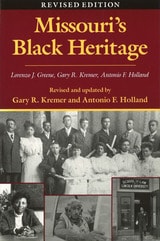
Missouri's Black Heritage, Revised Edition
Gary R. Kremer & Antonio F. Holland & With a Personal Reminiscence by Lorenzo J. Greene
University of Missouri Press, 1993
Originally written in 1980 by the late Lorenzo J. Greene, Gary R. Kremer, and Antonio F. Holland, Missouri's Black Heritage remains the only book-length account of the rich and inspiring history of the state's African American population. It has now been revised and updated by Kremer and Holland, incorporating the latest scholarship into its pages. This edition describes in detail the struggles faced by many courageous African Americans in their efforts to achieve full civil and political rights against the greatest of odds.
Documenting the African American experience from the horrors of slavery through present-day victories, the book touches on the lives of people such as John Berry Meachum, a St. Louis slave who purchased his own freedom and then helped countless other slaves gain emancipation; Hiram Young, a Jackson County free black whose manufacturing of wagons for Sante Fe Trail travelers made him a legendary figure; James Milton Turner, who, after rising from slavery to become one of the best-educated blacks in Missouri, worked with the Freedmen's Bureau and the State Department of Education to establish schools for blacks all over the state after the Civil War; and Annie Turnbo Malone, a St. Louis entrepreneur whose business skills made her one of the state's wealthiest African Americans in the early twentieth century.
A personal reminiscence by the late Lorenzo J. Greene, a distinguished African American historian whom many regard as one of the fathers of black history, offers a unique view of Missouri's racial history and heritage.
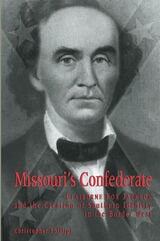
Missouri's Confederate
Claiborne Fox Jackson and the Creation of Southern Identity in the Border WestChristopher Phillips
University of Missouri Press, 2000
Claiborne Fox Jackson (1806-1862) remains one of Missouri's most controversial historical figures. Elected Missouri's governor in 1860 after serving as a state legislator and Democratic party chief, Jackson was the force behind a movement for the neutral state's secession before a federal sortie exiled him from office. Although Jackson's administration was replaced by a temporary government that maintained allegiance to the Union, he led a rump assembly that drafted an ordinance of secession in October 1861 and spearheaded its acceptance by the Confederate Congress. Despite the fact that the majority of the state's populace refused to recognize the act, the Confederacy named Missouri its twelfth state the following month. A year later Jackson died in exile in Arkansas, an apparent footnote to the war that engulfed his region and that consumed him.
In this first full-length study of Claiborne Fox Jackson, Christopher Phillips offers much more than a traditional biography. His extensive analysis of Jackson's rise to power through the tangle that was Missouri's antebellum politics and of Jackson's complex actions in pursuit of his state's secession complete the deeper and broader story of regional identity--one that began with a growing defense of the institution of slavery and which crystallized during and after the bitter, internecine struggle in the neutral border state during the American Civil War. Placing slavery within the realm of western democratic expansion rather than of plantation agriculture in border slave states such as Missouri, Philips argues that southern identity in the region was not born, but created. While most rural Missourians were proslavery, their "southernization" transcended such boundaries, with southern identity becoming a means by which residents sought to reestablish local jurisdiction in defiance of federal authority during and after the war. This identification, intrinsically political and thus ideological, centered—and still centers—upon the events surrounding the Civil War, whether in Missouri or elsewhere. By positioning personal and political struggles and triumphs within Missourians' shifting identity and the redefinition of their collective memory, Phillips reveals the complex process by which these once Missouri westerners became and remain Missouri southerners.
Missouri's Confederate not only provides a fascinating depiction of Jackson and his world but also offers the most complete scholarly analysis of Missouri's maturing antebellum identity. Anyone with an interest in the Civil War, the American West, or the American South will find this important new biography a powerful contribution to our understanding of nineteenth-century America and the origins—as well as the legacy—of the Civil War.
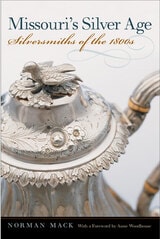
Missouri's Silver Age
Silversmiths of the 1800sNorman Mack. Foreword by Anne Woodhouse
Southern Illinois University Press, 2005
The result of nearly two decades of intensive research by Norman Mack and his late wife, Beatrice Davidow Mack, Missouri’s Silver Age: Silversmiths of the 1800s is a comprehensive directory of nineteenth-century Missouri silversmiths, their works, and their identifying makers’ marks. Illustrated with over one hundred photographs, this exceptional reference for historians and silver collectors showcases the Macks’ three-hundred-piece collection of Missouri silver, which includes a representative sample by nearly every known Missouri silversmith and is housed at the Missouri Historical Society in St. Louis.
Featuring more than a hundred detailed biographies of the artisans and apprentices who created handmade silver in St. Louis and Missouri during the nineteenth century, Missouri’s Silver Age also contains extensive photographs of makers’ touchmarks and of the pieces themselves, which include bowls, dishes, spoons, and ladles, as well as other household utensils and decorative items. Arranged alphabetically, the biographies reveal all known details of the business activities and locations of the silversmiths. Collectively, the entries and the illustrations shed light on the growth of enterprise in Missouri, show the impact of the individual on the developing frontier economies of the Midwest, and reveal how the production, acquisition, and possession of material goods reflected the culture and values of Americans during the 1800s.
Mack provides a brief but thorough history of silversmithing in America for novice collectors and historians, detailing the various methods used in making silver and the range of styles that were popular, providing insight into the methods of training apprentices, and explaining the effects of mechanization on the trade. Augmenting this volume are an appendix by Jo Ann Griffin on how to care for old silver, a map of the silversmiths’ primary locations, and a helpful alphabetical appendix of the silversmiths that includes illustrations of their touchmarks.
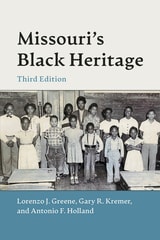
Missouri’s Black Heritage, Third Edition
Lorenzo J. Greene
University of Missouri Press, 2026
Originally written in 1980 by the Lorenzo J. Greene, Gary R. Kremer, and Antonio F. Holland and revised and updated in 1993 by Kremer and Holland, Missouri's Black Heritage, now in a greatly expanded third edition, remains the only book-length account of the rich and inspiring history of the Show-Me State's African American population. With more than one hundred photographs, most of them new to this third edition, Kremer and Holland incorporate the latest scholarship as they describe in detail the struggles many Black Missourians continue to face in the aftermath of their ancestors’ arduous and courageous struggles since Emancipation to achieve their full civil and political rights as U.S. citizens.
Documenting the African American experience from the horrors of slavery through the great victories over many generations, the book touches on the lives of people such as John Berry Meachum, a St. Louis slave who purchased his own freedom and then helped countless other slaves gain emancipation; Hiram Young, a Jackson County free black whose manufacturing of wagons for Sante Fe Trail travelers made him a legendary figure; James Milton Turner, who, after rising from slavery to become one of the best-educated blacks in Missouri worked with the Freedmen's Bureau and the State Department of Education to establish schools for blacks all over the state after the Civil War; and Annie Turnbo Malone, a St. Louis entrepreneur whose business skills made her one of the state's wealthiest African Americans in the early twentieth century.
A personal reminiscence by the late Lorenzo J. Greene, a distinguished African American historian whom many regard as one of the fathers of Black history, offers a unique view of Missouri's racial history and heritage, as do Kremer and Holland, in their new preface and introduction to the third edition.
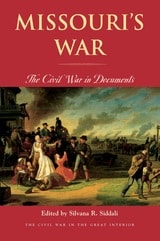
Missouri’s War
The Civil War in DocumentsSilvana R. Siddali
Ohio University Press, 2009
Winner of a 2011 “Distinguished Achievement in Literature” award, Missouri Humanities Council
Civil War Missouri stood at the crossroads of America. As the most Southern-leaning state in the Middle West, Missouri faced a unique dilemma. The state formed the gateway between east and west, as well as one of the borders between the two contending armies. Moreover, because Missouri was the only slave state in the Great Interior, the conflicts that were tearing the nation apart were also starkly evident within the state. Deep divisions between Southern and Union supporters, as well as guerrilla violence on the western border, created a terrible situation for civilians who lived through the attacks of bushwhackers and Jayhawkers.
The documents collected in Missouri's War reveal what factors motivated Missourians to remain loyal to the Union or to fight for the Confederacy, how they coped with their internal divisions and conflicts, and how they experienced the end of slavery in the state. Private letters, diary entries, song lyrics, official Union and Confederate army reports, newspaper editorials, and sermons illuminate the war within and across Missouri's borders.
Missouri's War also highlights the experience of free and enslaved African Americans before the war, as enlisted Union soldiers, and in their effort to gain rights after the end of the war. Although the collection focuses primarily on the war years, several documents highlight both the national sectional conflict that led to the outbreak of violence and the effort to reunite the conflicting forces in Missouri after the war.
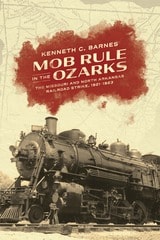
Mob Rule in the Ozarks
The Missouri and North Arkansas Railroad Strike, 1921-1923Kenneth C. Barnes
University of Arkansas Press, 2025
On January 15, 1923, a crowd of more than a thousand angry men assembled in Harrison, Arkansas, near the headquarters of the M&NA Railroad, which ran through the heart of the Ozark Mountains. The mob was prepared to use any measure necessary to end the strike of railroad employees that had dragged on for nearly two years, endangering livelihoods and businesses in an area with few other means of transportation. Supported by local officials, the mob terrorized strikers and sympathizers—many were stripped and beaten, and one man was lynched, hanged from the railroad bridge south of town. Over the next several days, similar riots broke out in other towns along the M&NA line, including Leslie and Heber Springs.
This violence effectively brought to a close one of the longest rail strikes in American history—the only one, in fact, ended by a mob uprising. In Mob Rule in the Ozarks, Kenneth C. Barnes documents how the M&NA Railroad strike reflected some of the major economic concerns that preoccupied the United States in the wake of World War I, and created a rupture within communities of the Ozarks that would take years to heal. The conflict also foreshadowed, for both the region and the country, the pendulum’s swing back to moneyed interests, away from Progressive Era gains for labor. Poignantly for Barnes, who sees parallels between this historic struggle and present-day political tensions, the strike revealed the fragile line between civil order and mob rule.
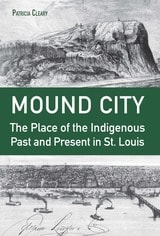
Mound City
The Place of the Indigenous Past and Present in St. LouisPatricia Cleary
University of Missouri Press, 2025
Nearly one thousand years ago, Native peoples built a satellite suburb of America's great metropolis on the site that later became St. Louis. At its height, as many as 30,000 people lived in and around present-day Cahokia, Illinois. While the mounds around Cahokia survive today (as part of a state historic site and UNESCO world heritage site), the monumental earthworks that stood on the western shore of the Mississippi were razed in the 1800s. But before and after they fell, the mounds held an important place in St. Louis history, earning it the nickname “Mound City.” For decades, the city had an Indigenous reputation. Tourists came to marvel at the mounds and to see tribal delegations in town for trade and diplomacy. As the city grew, St. Louisans repurposed the mounds—for a reservoir, a restaurant, and railroad landfill—in the process destroying cultural artifacts and sacred burial sites. Despite evidence to the contrary, some white Americans declared the mounds natural features, not built ones, and cheered their leveling. Others espoused far-fetched theories about a lost race of Mound Builders killed by the ancestors of contemporary tribes. Ignoring Indigenous people's connections to the mounds, white Americans positioned themselves as the legitimate inheritors of the land and asserted that modern Native peoples were destined to vanish. Such views underpinned coerced treaties and forced removals, and—when Indigenous peoples resisted—military action. The idea of the “Vanishing Indian” also fueled the erasure of Indigenous peoples’ histories, a practice that continued in the 1900s in civic celebrations that featured white St. Louisans “playing Indian” and heritage groups claiming the mounds as part of their own history. Yet Native peoples endured and in recent years, have successfully begun to reclaim the sole monumental mound remaining within city limits.
Drawing on a wide range of sources, Patricia Cleary explores the layers of St. Louis’s Indigenous history. Along with the first in-depth overview of the life, death, and afterlife of the mounds, Mound City offers a gripping account of how Indigenous histories have shaped the city’s growth, landscape, and civic culture.

My Grandfather's Prison
A Story of Death and Deceit in 1940s Kansas CityRichard A. Serrano
University of Missouri Press, 2009