Results by title
149 books match the query 'Modernity' and 22 start with m
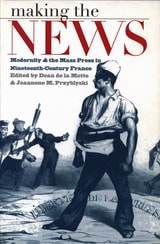
Making the News
Modernity and the Mass Press in Nineteenth-Century FranceDean de la Motte
University of Massachusetts Press, 1999
Much recent writing on print culture has focused on the social and political implications of the transition from “elite” to “mass” culture in the 1800s. The essays in this volume add significantly to our understanding of the role of the nineteenth-century French press in producing the commodities, consumers, and ideological frameworks that are the hallmarks of this shift. The book also offers an opportunity for useful comparisons with recent scholarship on the rise on the popular press in the United States, Great Britain, and Germany.
The essays address a wide range of topics, from the emergence of commercial daily newspapers during the July Monarchy to the photographic representation of women in the Paris Commune. Together they demonstrate that the French mass press was far more heterogeneous than previously supposed, tapping into an expanding readership composed of a variety of publics—from affluent bourgeois to disaffected workers to disenfranchised women. It was also relentlessly innovative, using caricature, argot, advertisements, and other attention-grabbing techniques that blurred the lines separating art, politics, and the news.

Maladies of Modernity
Scientism and the Deformation of Political OrderDavid N. Whitney
St. Augustine's Press, 2014
“Chief among the spiritually blighting tendencies of the age is materialist reductionism parading as scientific orthodoxy. David Whitney powerfully explores this movement and habit of mind as it takes its rise in the form of scientism, especially from Sir Francis Bacon’s NEW ATLANTIS in the 17th century and finds full fruition in the positivist teachings of August Comte in the 19th century—a preamble to the behavioralist dogmas of our own time. The openness to the facts of experience characteristic of all science as a search for the truth of reality in all its dimensions and diversity is thereby effectively abandoned in favor of an unrelenting insistence on a restrictive methodology ostensibly grounded in phenomenal reality that is perversely made the touchstone of all valid inquiry. The consequences are philosophically as well as politically disastrous, as Whitney brilliantly demonstrates in this path-breaking study.”
– Ellis Sandoz, Founder of the Eric Voegelin Institute for American Renaissance Studies
"David Whitney’s excellent critique of what he calls scientism, a dogmatic application of the methods of natural science to social science, provides a high-brow diagnosis of the modern maladies that result from the “rhetorical power of science.”
–– Scott Robinson, voegelinview
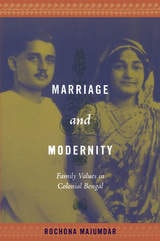
Marriage and Modernity
Family Values in Colonial BengalRochona Majumdar
Duke University Press, 2009
Majumdar examines three broad developments related to the modernity of arranged marriage: the growth of a marriage market, concomitant debates about consumption and vulgarity in the conduct of weddings, and the legal regulation of family property and marriages. Drawing on matrimonial advertisements, wedding invitations, poems, photographs, legal debates, and a vast periodical literature, she shows that the modernization of families does not necessarily imply a transition from extended kinship to nuclear family structures, or from matrimonial agreements negotiated between families to marriage contracts between individuals. Colonial Bengal tells a very different story.
Masculinist Impulses
Toomer, Hurston, Black Writing, and ModernityNathan Grant
University of Missouri Press, 2004
Grant’s book provides close readings of Jean Toomer (Cane and Natalie Mann) and Zora Neale Hurston (Moses, Man of the Mountain, Seraph of the Suwanee, and Their Eyes Were Watching God), for whom the American South was a crucial locus of the African American experience. Toomer and Hurston were virtually alone among the Harlem Renaissance writers of prose who returned to the South for their literary materials. That return, however, allowed their rediscovery of key black masculine values and charted the northern route of those values in the twentieth century to their compromise and destruction.
Grant then moves on to three more recent writers—John Edgar Wideman, Gloria Naylor, and Toni Morrison—who expanded upon and transformed the themes of Toomer and Hurston. Like Toomer and Hurston, these later authors recognized the need for the political union of black men and women in the effort to realize the goals of equity and justice.
Masculinist Impulses discusses nineteenth- and twentieth-century black masculinity as both a feature and a casualty of modernism. Scholars and students of African American literature will find Grant’s nuanced and creative readings of these key literary texts invaluable.
Masculinity Besieged?
Issues of Modernity and Male Subjectivity in Chinese Literature of the Late Twentieth CenturyXueping Zhong
Duke University Press, 2000
Before the 1990s onslaught of popular culture decentered the role of intellectuals within the nation, they had come to embody Chinese masculinity during the previous decade. The focus on masculinity in literature had become unprecedented in scale and the desire for “real men” began to permeate Chinese popular culture, making icons out of Rambo and Takakura Ken. Stories by Zhang Xianliang and Liu Heng portraying male anxiety about masculine sexuality are employed by Zhong to show how “marginal” males negotiate their sexual identities in relation to both women and the state. Looking at writers popular among not only the well-educated but also the working and middle classes, she discusses works by Han Shaogong, Yu Hua, and Wang Shuo and examines instances of self-loathing male voices, particularly as they are articulated in Mo Yan’s well-known work Red Sorghum. In her last chapter Zhong examines “roots literature,” which speaks of the desire to create strong men as a part of the effort to create a geopolitically strong Chinese nation. In an afterword, Zhong situates her study in the context of the 1990s.
This book will be welcomed by scholars of Chinese cultural studies, as well as in literary and gender studies.
Maya Ethnolinguistic Identity
Violence, Cultural Rights, and Modernity in Highland GuatemalaBrigittine M. French
University of Arizona Press, 2010
French shows, with useful examples, how constructions of language and collective identity are in fact strategies undertaken to serve the goals of institutions (including the government, the military, the educational system, and the church) and social actors (including linguists, scholars, and activists). But by incorporating in-depth fieldwork with groups that speak Kaqchikel and K’iche’ along with analyses of Spanish-language discourses, Maya Ethnolinguistic Identity also shows how some individuals in urban, bilingual Indian communities have disrupted the essentializing projects of multiculturalism. And by focusing on ideologies of language, the author is able to explicitly link linguistic forms and functions with larger issues of consciousness, gender politics, social positions, and the forging of hegemonic power relations.
Meat, Modernity, and the Rise of the Slaughterhouse
Paula Young Lee
University of New Hampshire Press, 2008
Contributors include: Dorothee Brantz, Kyri Claflin, Jared Day, Roger Horowitz, Lindgren Johnson, Ian MacLachlan, Christopher Otter, Dominic Pacyga, Richard Perren, Jeffrey Pilcher, and Sydney Watts.
Mobility and Modernity
Migration in Germany, 1820-1989Steve Hochstadt
University of Michigan Press, 1999
Mobility and Modernity
Panama in the Nineteenth-Century Anglo-American ImaginationRobert D. Aguirre
The Ohio State University Press, 2017
In this study, Robert D. Aguirre provides bold new interpretations of Anthony Trollope, John Lloyd Stephens, and Eadweard Muybridge and also recovers information about literary communities previously lost to history. Mobility and Modernity shows how Panama became defined as a site of incipient globalization and a crucial link of empire. Across this narrow strip of land people and things traveled, technology developed, and political forces erupted. The isthmus became a site of mobility that paradoxically produced varieties of immobility. Parting ways with histories that celebrate the canal as a mighty engineering feat, Mobility and Modernity reveals a more complex story of cultural conflict that began with the first gold rush news in the late 1840s and continued throughout the century.
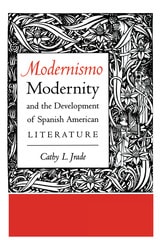
Modernismo, Modernity and the Development of Spanish American Literature
By Cathy L. Jrade
University of Texas Press, 1998
A CHOICE Outstanding Academic Book
Modernismo arose in Spanish American literature as a confrontation with and a response to modernizing forces that were transforming Spanish American society in the later nineteenth century. In this book, Cathy L. Jrade undertakes a full exploration of the modernista project and shows how it provided a foundation for trends and movements that have continued to shape literary production in Spanish America throughout the twentieth century.
Jrade opens with a systematic consideration of the development of modernismo and then proceeds with detailed analyses of works-poetry, narrative, and essays-that typified and altered the movement's course. In this way, she situates the writing of key authors, such as Rubén Darío, José Martí, and Leopoldo Lugones, within the overall modernista project and traces modernismo's influence on subsequent generations of writers.
Jrade's analysis reclaims the power of the visionary stance taken by these creative intellectuals. She firmly abolishes any lingering tendency to associate modernismo with affectation and effete elegance, revealing instead how the modernistas' new literary language expressed their profound political and epistemological concerns.

Modernity
Clarence Major
Tupelo Press, 2027
From the barbershop to the railroad track, from the museum to the waiting room, this collection invites us to see through the eyes of one of the greatest living American poets.
In Modernity, Clarence Major brings his painter's eye and poet's precision to the ordinary landscapes of contemporary life, transforming everyday encounters into moments of revelation. Moving effortlessly among museums, city streets, family memory, dreams, travel, and ritual, these quietly luminous poems discover beauty, humor, melancholy, and resilience in the fleeting textures of modern experience. Animated by keen observation and philosophical wit, Modernity reflects on art, aging, love, race, memory, and the passage of time without sacrificing the immediacy of lived perception. The result is a deeply humane collection from one of America's most distinguished literary voices, celebrating the extraordinary that persists within the ordinary.
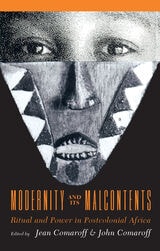
Modernity and Its Malcontents
Ritual and Power in Postcolonial AfricaEdited by Jean Comaroff and John L. Comaroff
University of Chicago Press, 1993
Some of the essays in Modernity and Its Malcontents address familiar anthropological issues—like witchcraft, myth, and the politics of reproduction—but treat them in fresh ways, situating them amidst the polyphonies of contemporary Africa. Others explore distinctly nontraditional subjects—among them the Nigerian popular press and soul-eating in Niger—in such a way as to confront the conceptual limits of Western social science. Together they demonstrate how ritual may be powerfuly mobilized in the making of history, present, and future.
Addressing challenges posed by contemporary African realities, the authors subject such concepts as modernity, ritual, power, and history to renewed critical scrutiny. Writing about a variety of phenomena, they are united by a wish to preserve the diversity and historical specificity of local signs and practices, voices and perspectives. Their work makes a substantial and original contribution toward the historical anthropology of Africa.
The contributors, all from the Africanist circle at the University of Chicago, are Adeline Masquelier, Deborah Kaspin, J. Lorand Matory, Ralph A. Austen, Andrew Apter, Misty L. Bastian, Mark Auslander, and Pamela G. Schmoll.
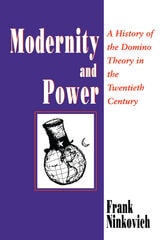
Modernity and Power
A History of the Domino Theory in the Twentieth CenturyFrank Ninkovich
University of Chicago Press, 1994
To emphasize the central role of symbolism and ideological assumptions in twentieth-century American statesmanship, Ninkovich focuses on the domino theory—a theory that departed radically from classic principles of political realism by sanctioning intervention in world regions with few financial or geographic claims on the national interest. Ninkovich insightfully traces the development of this global strategy from its first appearance early in the century through the Vietnam war.
Throughout the book, Ninkovich draws on primary sources to recover the worldview of the policy makers. He carefully assesses the coherence of their views rather than judge their actions against "objective" realities. Offering a new alternative to realpolitic and economic explanations of foreign policy, Modernity and Power will change the way we think about the history of U.S. international relations.
Modernity and Progress
Fitzgerald, Hemingway, OrwellRonald Berman
University of Alabama Press, 2007
Breaks new critical ground by exploring philosophical and aesthetic issues germane to the writings of three major modern literary figures.
In the 1920s and ‘30s, understandings of time, place, and civilization were subjected to a barrage of new conceptions. Ronald Berman probes the work of three writers who wrestled with one or more of these issues in ways of lasting significance.
Hemingway, Fitzgerald, and Orwell all grappled with fluid notions of time: Hemingway’s absolute present, Fitzgerald’s obsession with what might be and what might have been, and Orwell’s concerns with progress. For these authors, progress is also tied to competing senses of place--for Fitzgerald, the North versus the South; for Hemingway, America versus Europe. At stake for each is an understanding of what constitutes true civilization in a post-war world. Berman discusses Hemingway’s deployment of language in tackling the problems of thinking and knowing. Berman follows this notion further in examining the indisputable impact upon Hemingway’s prose of Paul Cézanne’s painting and the nature of perception.
Finally, Berman considers the influence on Orwell of Aristotle and Freud’s ideas of civilization, translated by Orwell into the fabric of 1984 and other writings.
Ronald Berman is Professor of English at the University of California at San Diego and past chairman of the National Endowment for the Humanities. He is author of six books, including “The Great Gatsby” and Fitzgerald’s World of Ideas and Fitzgerald-Wilson-Hemingway: Language and Experience.
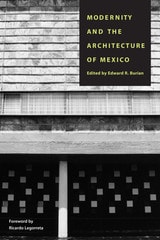
Modernity and the Architecture of Mexico
Edited by Edward R. Burian
University of Texas Press, 1997
Since the mid 1970s, there has been an extraordinary renewal of interest in early modern architecture, both as a way of gaining insight into contemporary architectural culture and as a reaction to neoconservative postmodernism. This book undertakes a critical reappraisal of the notion of modernity in Mexican architecture and its influence on a generation of Mexican architects whose works spanned the 1920s through the 1960s.
Nine essays by noted architects and architectural historians cover a range of topics from broad-based critical commentaries to discussions of individual architects and buildings. Among the latter are the architects Enrique del Moral, Juan O'Gorman, Carlos Obregón Santacilia, Juan Segura, Mario Pani, and the campus and stadium of the Ciudad Universitaria in Mexico City.
Relatively little has been published in English regarding this era in Mexican architecture. Thus, Modernity and the Architecture of Mexico will play a groundbreaking role in making the underlying assumptions, ideological and political constructs, and specific architect's agendas known to a wide audience in the humanities. Likewise, it should inspire greater appreciation for this undervalued body of works as an important contribution to the modern movement.
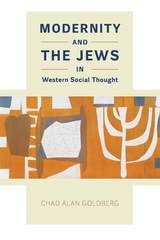
Modernity and the Jews in Western Social Thought
Chad Alan Goldberg
University of Chicago Press, 2017
In Modernity and the Jews in Western Social Thought, Chad Alan Goldberg brings us a major new study of Western social thought through the lens of Jews and Judaism. In France, where antisemites decried the French Revolution as the “Jewish Revolution,” Émile Durkheim challenged depictions of Jews as agents of revolutionary subversion or counterrevolutionary reaction. When German thinkers such as Karl Marx, Georg Simmel, Werner Sombart, and Max Weber debated the relationship of the Jews to modern industrial capitalism, they reproduced, in secularized form, cultural assumptions derived from Christian theology. In the United States, William Thomas, Robert Park, and their students conceived the modern city and its new modes of social organization in part by reference to the Jewish immigrants concentrating there. In all three countries, social thinkers invoked real or purported differences between Jews and gentiles to elucidate key dualisms of modern social thought. The Jews thus became an intermediary through which social thinkers discerned in a roundabout fashion the nature, problems, and trajectory of their own wider societies. Goldberg rounds out his fascinating study by proposing a novel explanation for why Jews were such an important cultural reference point. He suggests a rethinking of previous scholarship on Orientalism, Occidentalism, and European perceptions of America, arguing that history extends into the present, with the Jews—and now the Jewish state—continuing to serve as an intermediary for self-reflection in the twenty-first century.
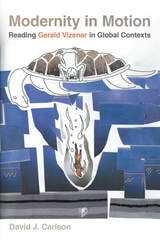
Modernity in Motion
Reading Gerald Vizenor in Global ContextsDavid J. Carlson
Michigan State University Press, 2026
Modernity in Motion offers a groundbreaking exploration of Anishinaabe writer Gerald Vizenor’s richly layered body of work spanning fiction, nonfiction, and poetry. Through the lens of transnational Indigenous studies, this compelling study reveals how Vizenor’s concept of transmotion, which he defines as the interplay between local and global identities, reconstructs modernity as a dynamic force of transformation.
Close readings illuminate Vizenor’s radical storytelling, which bridges seemingly disparate worlds: the White Earth Reservation, Nazi-occupied Paris, post-Hiroshima Japan, and beyond. By weaving these far-flung geographies into unexpected constellations, Vizenor challenges readers to rethink Indigenous history, sovereignty, and creative expression within a global framework.
Positioned at the intersection of tribal-centric and world literature paradigms, Modernity in Motion is essential reading for scholars of Indigenous studies and comparative literature.
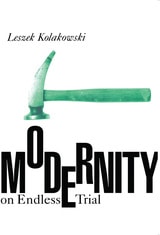
Modernity on Endless Trial
Leszek Kolakowski
University of Chicago Press, 1990
"Exemplary. . . . It should be celebrated." —Arthur C. Danto, New York Times Book Review
"This book . . . express[es] Kolakowski's thought on God, man, reason, history, moral truth and original sin, prompted by observation of the dramatic struggle among Christianity, the Enlightenment and modern totalitarianism. It is a wonderful collection of topics." —Thomas Nagel, Times Literary Supplement
"No better antidote to bumper-sticker thinking exists than this collection of 24 'appeals for moderation in consistency,' and never has such an antidote been needed more than it is now." —Joseph Coates, Chicago Tribune
"Whether learned or humorous, these essays offer gems in prose of diamond hardness, precision, and brilliance." —Thomas D'Evelyn, The Christian Science Monitor
A "Notable Books of the Year 1991" selection, New York Times Book Review—a "Noted with Pleasure" selection, New York Times Book Review—a "Summer Reading 1991" selection, New York Times Book Review—a "Books of the Year" selection, The Times.
Modernity, Islam, and Secularism in Turkey
Bodies, Places, and TimeAlev Cinar
University of Minnesota Press, 2005
Money and Modernity
Pound, Williams, and the Spirit of JeffersonAlec Marsh
University of Alabama Press, 1998
Music Hall and Modernity
The Late-Victorian Discovery of Popular CultureBarry J. Faulk
Ohio University Press, 2004
The late-Victorian discovery of the music hall by English intellectuals marks a crucial moment in the history of popular culture. Music Hall and Modernity demonstrates how such pioneering cultural critics as Arthur Symons and Elizabeth Robins Pennell used the music hall to secure and promote their professional identity as guardians of taste and national welfare. These social arbiters were, at the same time, devotees of the spontaneous culture of “the people.”
In examining fiction from Walter Besant, Hall Caine, and Henry Nevinson, performance criticism from William Archer and Max Beerbohm, and late-Victorian controversies over philanthropy and moral reform, scholar Barry Faulk argues that discourse on music-hall entertainment helped consolidate the identity and tastes of an emergent professional class. Critics and writers legitimized and cleaned up the music hall, at the same time allowing issues of class, respect, and empowerment to be negotiated.
Music Hall and Modernity offers a complex view of the new middle-class, middlebrow mass culture of late-Victorian London and contributes to a body of scholarship on nineteenth-century urbanism. The book will also interest scholars concerned with the emergence of a professional managerial class and the genealogy of cultural studies.
Myths of Modernity
Peonage and Patriarchy in NicaraguaElizabeth Dore
Duke University Press, 2006
Dore seamlessly combines archival research, oral history, and an innovative theoretical approach that unites political economy with social history. She recovers the bygone voices of peons, planters, and local officials within documents such as labor contracts, court records, and official correspondence. She juxtaposes these historical perspectives with those of contemporary peasants, landowners, activists, and politicians who share memories passed down to the present. The reconceptualization of the coffee economy that Dore elaborates has far-reaching implications. The Sandinistas mistakenly believed, she contends, that Nicaraguan capitalism was mature and ripe for socialist revolution, and after their victory in 1979 that belief led them to alienate many peasants by ignoring their demands for land. Thus, the Sandinistas’ myths of modernity contributed to their downfall.