Results by title
184 books match the query 'Murder' and 31 start with m

MURDER IN AMERICA
A HISTORYRoger Lane
The Ohio State University Press, 1997
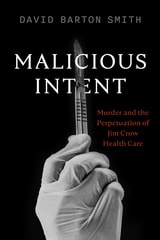
Malicious Intent
Murder and the Perpetuation of Jim Crow Health CareDavid Barton Smith
Vanderbilt University Press, 2023
Race-related disparities in American death rates, exacerbated once again by the COVID-19 pandemic, have persisted since the birth of the modern US medical system a century ago. A unique but perpetually unequal history has prevented the United States from providing the kind of health care assurances that are taken for granted in other industrialized nations. The underlying story is one of political, medical, and bureaucratic machinations, all motivated by a deliberate Jim Crow systemic design. In Malicious Intent, David Barton Smith traces the Jean Cowsert story and the cold case of her death as a through line to explain the construction and fulfillment of an unequal health care system that would rather sacrifice many than provide for Black Americans.
Cowsert’s suspicious death came at a key moment in the struggle for universal health care in the wealthiest country on earth. Malicious Intent is a history of those failed efforts and a story of selective amnesia about one doctor’s death and the movement she fought for.
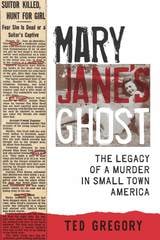
Mary Jane's Ghost
The Legacy of a Murder in Small Town AmericaTed Gregory
University of Iowa Press, 2017
Fast forward fifty years. Eccentric entrepreneur Michael Arians moves to Oregon, opens a roadhouse, gets elected mayor, and becomes obsessed with the crime. He comes up with a scandalous conspiracy theory and starts to believe that Mary Jane’s ghost is haunting his establishment. He also reaches out to the Chicago Tribune for help.
Arians’s letter falls on the desk of general assignment reporter Ted Gregory. For the next thirteen years, while he ricochets from story to story and his newspaper is deconstructed around him, Gregory remains beguiled by the case of the teenaged telephone operator Mary Jane and twenty-eight-year-old Navy vet Stanley—and equally fascinated by Arians’s seemingly hopeless pursuit of whoever murdered them. Mary Jane’s Ghost is the story of these two odysseys.
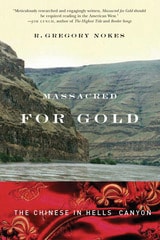
Massacred for Gold
The Chinese in Hells CanyonR. Gregory Nokes
Oregon State University Press, 2009
In 1887, more than 30 Chinese gold miners were massacred on the Oregon side of Hells Canyon, the deepest canyon in North America. Massacred for Gold, the first authoritative account of the unsolved crime—one of the worst of the many crimes committed by whites against Chinese laborers in the American West—unearths the evidence that points to an improbable gang of rustlers and schoolboys, one only 15, as the killers.
The crime was discovered weeks after it happened, but no charges were brought for nearly a year, when gang member Frank Vaughan, son of a well-known settler family, confessed and turned state’s evidence. Six men and boys, all from northeastern Oregon’s remote Wallowa country, were charged—but three fled, and the others were found innocent by a jury that a witness admitted had little interest in convicting anyone. A cover-up followed, and the crime was all but forgotten for the next 100 years, until a county clerk found hidden records in an unused safe.
In bringing this story out of the shadows, Nokes examines the once-substantial presence of Chinese laborers in the interior Pacific Northwest, describing why they came, how their efforts contributed to the region’s development, and how too often mistreatment and abuse were their only reward.
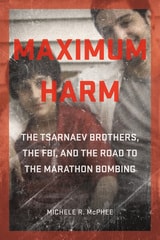
Maximum Harm
The Tsarnaev Brothers, the FBI, and the Road to the Marathon BombingMichele R. McPhee
University Press of New England, 2017
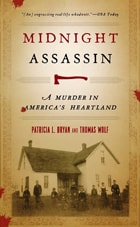
Midnight Assassin
A Murder in America's HeartlandPatricia L. Bryan
University of Iowa Press, 2007
On the night of December 1,1900, Iowa farmer John Hossack was attacked and killed while he slept at home beside his wife, Margaret. On April 11, 1901, after five days of testimony before an all-male jury, Margaret Hossack was found guilty of his murder and sentenced to life in prison. One year later, she was released on bail to await a retrial; jurors at this second trial could not reach a decision, and she was freed. She died August 25, 1916, leaving the mystery of her husband's death unsolved.
The Hossack tragedy is a compelling one and the issues surrounding their domestic problems are still relevant today, Margaret's composure and stoicism, developed during years of spousal abuse, were seen as evidence of unfeminine behavior, while John Hossack--known to be a cruel and dangerous man--was hailed as a respectable husband and father.
Midnight Assassin also introduces us to Susan Glaspell, a journalist who reported on the Hossack murder for the Des Moines Daily, who used these events as the basis for her classic short story, " A Jury of Her Peers", and the famous play Trifles.
Based on almost a decade of research, Midnight Assassin is a riveting story of loneliness, fear, and suffering in the rural Midwest.
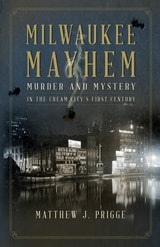
Milwaukee Mayhem
Murder and Mystery in the Cream City's First CenturyMatthew J. Prigge
Wisconsin Historical Society Press, 2015
From murder and matchstick men to all-consuming fires, painted women, and Great Lakes disasters--and the wide-eyed public who could not help but gawk at it all--"Milwaukee Mayhem" uncovers the little-remembered and rarely told history of the underbelly of a Midwestern metropolis. "Milwaukee Mayhem" offers a new perspective on Milwaukee's early years, forgoing the major historical signposts found in traditional histories and focusing instead on the strange and brutal tales of mystery, vice, murder, and disaster that were born of the city's transformation from lakeside settlement to American metropolis. Author Matthew J. Prigge presents these stories as they were recounted to the public in the newspapers of the era, using the vivid and often grim language of the times to create an engaging and occasionally chilling narrative of a forgotten Milwaukee.
Through his thoughtful introduction, Prigge gives the work context, eschewing assumptions about "simpler times" and highlighting the mayhem that the growth and rise of a city can bring about. These stories are the orphans of Milwaukee's history, too unusual to register in broad historic narratives, too strange to qualify as nostalgia, but nevertheless essential to our understanding of this American city.
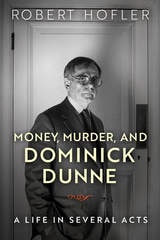
Money, Murder, and Dominick Dunne
A Life in Several ActsRobert Hofler
University of Wisconsin Press, 2019
Dunne admitted to inventing himself, and it was that public persona he wrote about in his own memoir, The Way We Lived Then. Left out of that account, but brought to light here, were his intense rivalry with his brother John Gregory, the gay affairs and relationships he had throughout his marriage and beyond, and his fights with editors at Vanity Fair. Robert Hofler also reveals the painful rift in the family after the murder of Dominick's daughter, Dominique—compounded by his coverage of her killer's trial, which launched his career as a reporter.

Murder Scenes
Normality, Deviance, and Criminal Violence in Weimar BerlinSace Elder
University of Michigan Press, 2010
---Kenneth Ledford, Case Western Reserve University
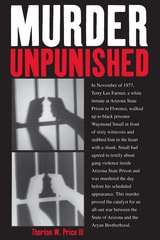
Murder Unpunished
How the Aryan Brotherhood Murdered Waymond Small and Got Away with ItThornton W. Price
University of Arizona Press, 2005
Thornton Price, one of the defense attorneys, now tells how Farmer and Small became cannon fodder in this war to reclaim Arizona’s prisons from rival gangs. These gangs—the Aryan Brotherhood, the Mau Maus, and the Mexican Mafia—were suspected of committing more than a dozen murders over the previous two years, motivating politicians to crack down after the violence could no longer be ignored or contained. To reconstruct the case, Price reviewed 16,000 pages of court records and conducted interviews with key participants to piece together an insider’s account of the crime and the politics behind its investigation. Prison murders should be easy to solve, but investigators quickly learned that the convicts’ code of silence makes these cases often impossible to win in court.
Price focuses on the special problems posed by prison crime by getting inside the skins of men like murderer Terry "Crazy" Farmer and William "Red Dog" Howard, one of the Florence Eleven and a founder of the Aryan Brotherhood. He also presents the perspectives of state investigators and reveals how they calculated to pit black witnesses against white killers until one black would break the code of silence and provoke feuding within the Brotherhood.
Murder Unpunished tells how society’s most outrageous criminals ran the prison through gang violence as outside the walls Arizona struggled to outgrow its Wild West past. Like few other books, it reveals how prisons incubate predatory criminals and gangs, and it exposes the unique difficulties of prosecuting prison crimes. It is a gripping account that cuts to the heart of our penal system and a cautionary tale for citizens who prefer to keep prisons out of sight, out of mind.
Murder and Its Consequences
Essays on Capital Punishment in AmericaLeigh B Bienen
Northwestern University Press, 2010
The essays in Murder and Its Consequences span several periods in the history of capital punishment in America and the professional career of Leigh Bienen, a leading researcher on the death penalty. “A Good Murder” describes the subtle relationship between high-profile murders and the death penalty, while “The Proportionality Review of Capital Cases” places the well-known study of proportionality in New Jersey within a nationwide context.
“Anomalies” suggests that the arcane protocols written for lethal injection have little to do with insuring humane executions, but rather are concerned with protecting the sensibilities of witnesses and the liability of corrections officials. Other essays address the groundbreaking developments surrounding the death penalty in Illinois, and take a retrospective look at the evolution of her own and the country’s thinking about this complex, divisive topic.
Murder and Masculinity
Violent Fictions of Twentieth-Century Latin AmericaRebecca E. Biron
Vanderbilt University Press, 2000
The introduction to this study deftly situates Biron's work in relation to previous theoretical arguments on the social and political dimensions of Latin American writing. The five subsequent chapters offer superb analyses of the individual texts. Like their male protagonists who experiment with the psychological and legal extremes of gender division, these narratives risk nonconformity to the laws of genre in their quest for liberation from violent social and literary conventions. In combining elements of detective stories, crime narratives, psychological case studies, and magical or grotesque realism, they offer metafictional commentary on a network of discourses that confuses images of masculinity, national identity, and political autonomy in postcolonial Latin America.
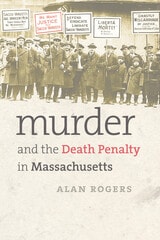
Murder and the Death Penalty in Massachusetts
Alan Rogers
University of Massachusetts Press, 2008
For more than 300 years Massachusetts executed men and women convicted of murder, but with a sharp eye on “due proceeding” and against the backdrop of popular ambivalence about the death penalty's morality, cruelty, efficacy, and constitutionality. In this authoritative book, Alan Rogers offers a comprehensive account of how the efforts of reformers and abolitionists and the Supreme Judicial Court's commitment to the rule of law ultimately converged to end the death penalty in Massachusetts.
In the seventeenth century, Governor John Winthrop and the Massachusetts General Court understood murder to be a sin and a threat to the colony's well-being, but the Puritans also drastically reduced the crimes for which death was the prescribed penalty and expanded a capital defendant's rights. Following the Revolution, Americans denounced the death penalty as “British and brutish” and the state's Supreme Judicial Court embraced its role as protector of the rights extended to all men by the Massachusetts Constitution. In the 1830s popular opposition nearly stopped the machinery of death and a vote in the Massachusetts House fell just short of abolishing capital punishment.
A post–Civil War effort extending civil rights to all men also stimulated significant changes in criminal procedure. A “monster petition” begging the governor to spare the life of a murderer convicted on slight circumstantial evidence and the grim prospect of executing nine Chinese men found guilty of murder fueled a passionate debate about the death penalty in the decade before World War I.
The trials and executions of Sacco and Vanzetti focused unwanted international and national attention on Massachusetts. This was a turning point. Sara Ehrmann took charge of the newly formed Massachusetts Council Against the Death Penalty, relentlessly lobbied the legislature, and convinced a string of governors not to sign death warrants. In the 1970s the focus shifted to the courts, and eventually, in 1980, the Supreme Judicial Court abolished the death penalty on the grounds that it violated the Massachusetts Constitution.
Murder by Sacrament
Another Toom Taggart MysteryPaul M. Edwards
Signature Books, 2014
Taggart is annoyed at having to navigate the political structure of the bureaucracy, but he cannot bring himself to leave. He is able to teach, and he likes his proximity to Church archives, local bookstores, and the woman who, according to fate, is still seeing the policeman from The Angel Acronym. All the major characters are back, and Taggart’s romantic rival is given the new murder case, meaning that he has to rely once again on Taggart for his knowledge of the Church’s secrets. This gives both men a reason to keep an eye on the other, making for entertaining situations in a funny, insider send-up of the RLDS community.
Murder in Ancient China
Two Judge Dee MysteriesRobert van Gulik
University of Chicago Press, 2013
Murder in Canton
A Judge Dee MysteryRobert van Gulik
University of Chicago Press, 1966
Murder in Canton takes place in the year 680, as Judge Dee, recently promoted to lord chief justice, is sent incognito to Canton to investigate the disappearance of a court censor. With the help of his trusted lieutenants Chiao Tai and Tao Gan, and that of a clever blind girl who collects crickets, Dee solves a complex puzzle of political intrigue and murder through the three separate subplots "the vanished censor," "the Smaragdine dancer," and "the Golden Bell."
Murder in Hollywood
Solving a Silent Screen MysteryCharles Higham
University of Wisconsin Press, 2004
When it was discovered that a famous star of the day had probably killed Taylor, a massive cover-up began—from the removal of crucial evidence to the naming of innocent people as killers—which has continued until now to protect the truth. Murder in Hollywood goes beyond the killing to unearth unknown details about the life of Taylor before his arrival in Hollywood, as well as the stories and histories buried by the crooked authorities and criminals involved the case. The author’s exclusive interviews with the culpable star, his unique possession of long-vanished police records, and the support of the present-day Los Angeles county coroner—who examined the evidence as if the murder had taken place now—have ensured a hair-raising thriller.
Charles Higham successfully presents the most plausible and convincing solution yet to the mystery. In the process he paints a vivid portrait of Hollywood in the 1920s—from its major stars to its bisexual subculture. The result is a compelling answer to a long-standing mystery and a fascinating study of a place, and an industry that, as today, let people reinvent themselves. Murder in Hollywood is more extraordinary than any crime of fiction and more exciting than any action adventure movie.
Murder in Lascaux
Betsy Draine and Michael Hinden
University of Wisconsin Press, 2014
The cave of Lascaux may be closed to the public, but five scholars a day are allowed inside, and Nora Barnes has finagled an appointment. True, she may have fudged a bit in her letter to the authorities, but she does teach art history, and she isn’t about to miss her chance to see the world’s most famous prehistoric paintings. Nora and her high-spirited husband, Toby, are visiting the Dordogne, in the southern French region of the Aquitaine. Aware that the Dordogne’s renown for cave art is matched only by its reputation for delicious cuisine, the couple has also signed up for a cooking class at a nearby château, but they soon find that more than food is on their minds.
During their tour of the cave, another visitor is murdered. When the local inspector pegs Nora and Toby as suspects, they embark on a mission to solve the crime, tracing strange links between a Cro-Magnon symbol and a thirteenth-century religious cult. As they match wits with the crusty inspector, Nora finds herself immersed in the notebooks of a forgotten artist who once lived in the château. In sifting through the artist’s papers and uncovering old secrets, she begins to piece together the motives for the murder. But has she cooked up more trouble than she can handle?
Best Books for General Audiences, selected by the Public Library Reviewers
Murder in Montauk
Judy Soloway Kay
University of Michigan Press, 2005
The MICHIGAN Reading Plus Readers are original fiction written for students who wish to improve their reading skills. The MICHIGAN Reading Plus Readers support the need for extensive reading on topics of interest to today's students. The Readers offer students books in the genres of mystery, science-fiction, and romance. Activities that practice vocabulary and reading skills are provided on the companion website.
Murder in New Orleans
The Creation of Jim Crow PolicingJeffrey S. Adler
University of Chicago Press, 2019
New Orleans in the 1920s and 1930s was a deadly place. In 1925, the city’s homicide rate was six times that of New York City and twelve times that of Boston. Jeffrey S. Adler has explored every homicide recorded in New Orleans between 1925 and 1940—over two thousand in all—scouring police and autopsy reports, old interviews, and crumbling newspapers. More than simply quantifying these cases, Adler places them in larger contexts—legal, political, cultural, and demographic—and emerges with a tale of racism, urban violence, and vicious policing that has startling relevance for today.
Murder in New Orleans shows that whites were convicted of homicide at far higher rates than blacks leading up to the mid-1920s. But by the end of the following decade, this pattern had reversed completely, despite an overall drop in municipal crime rates. The injustice of this sharp rise in arrests was compounded by increasingly brutal treatment of black subjects by the New Orleans police department. Adler explores other counterintuitive trends in violence, particularly how murder soared during the flush times of the Roaring Twenties, how it plummeted during the Great Depression, and how the vicious response to African American crime occurred even as such violence plunged in frequency—revealing that the city’s cycle of racial policing and punishment was connected less to actual patterns of wrongdoing than to the national enshrinement of Jim Crow. Rather than some hyperviolent outlier, this Louisiana city was a harbinger of the endemic racism at the center of today’s criminal justice state. Murder in New Orleans lays bare how decades-old crimes, and the racially motivated cruelty of the official response, have baleful resonance in the age of Black Lives Matter.
Murder in Their Hearts
The Fall Creek MassacreDavid Thomas Murphy
Indiana Historical Society Press, 2010
Murder on Shades Mountain
The Legal Lynching of Willie Peterson and the Struggle for Justice in Jim Crow BirminghamMelanie S. Morrison
Duke University Press, 2018
In Murder on Shades Mountain Melanie S. Morrison tells the gripping and tragic story of the attack and its aftermath—events that shook Birmingham to its core. Having first heard the story from her father—who dated Nell's youngest sister when he was a teenager—Morrison scoured the historical archives and documented the black-led campaigns that sought to overturn Peterson's unjust conviction, spearheaded by the NAACP and the Communist Party. The travesty of justice suffered by Peterson reveals how the judicial system could function as a lynch mob in the Jim Crow South. Murder on Shades Mountain also sheds new light on the struggle for justice in Depression-era Birmingham. This riveting narrative is a testament to the courageous predecessors of present-day movements that demand an end to racial profiling, police brutality, and the criminalization of black men.

Murder on the Largo
Henry Coleman and New Mexico's Last FrontierEleanor Williams
University of North Texas Press, 2024
Murder on the Mountain
Crime, Passion, and Punishment in Gilded Age New JerseyPeter J. Wosh
Rutgers University Press, 2022
Was Margaret the calculating murderess and adulteress portrayed by the press? Or was she a battered wife pushed to the edge? Or was she, as she claimed to the end, innocent? Murder on the Mountain considers all sides of this fascinating and mysterious true crime story. In turn, it examines why this murder trial became front-page news, as it resonated with public discussions about capital punishment, mental health, anti-immigrant sentiment, domestic violence, and women’s independence. This is a gripping and thought-provoking study of a murder that shocked the nation.
Murder on the Reservation
American Indian Crime FictionRay B. Browne
University of Wisconsin Press, 2004
Murder on the White Sands
The Disappearance of Albert and Henry FountainCorey Recko
University of North Texas Press, 2007

Murder, Courts, and the Press
Issues in Free Press/Fair TrialPeter E. Kane. Foreword by Franklyn S. Haiman
Southern Illinois University Press, 1992
When murder is the crime, the clash in the courts is likely to be between two constitutionally enshrined rights—freedom of speech and the right to a fair trial.
Peter E. Kane shows what happened in seven famous court cases when First Amendment rights (concerning freedom of speech) conflicted with Sixth Amendment rights (concerning fair trial). He reports the circumstances of each crime, the court proceedings, and the conduct of the press in the trials of Sam Sheppard, Charles Manson and his followers, John Paul Stevenson, Claus von Bülow, and Arthur Shawcross and the cases involving the Kellie family and the Wayne Clapp murders. Kane’s narrative and analytical approach illuminates legal principles and shows the roles of actual human beings underlying the abstractions of court opinions.
In this revised and expanded edition, Kane considers two new topics stemming from recent court cases: cameras in the courtroom and a code of ethics for crime reporting. Kane explores the issue of cameras through the famous Claus von Bülow retrial, which featured live television broadcasts; regarding a journalistic code, Kane examines the massive pretrial reporting of the serial murders of Arthur Shawcross. Kane notes that sensational crime stories serve the interests of many people: the public wants to read them; journalists want to write them because they can make a reporter’s fortune and reputation; and editors and publishers want to sell papers. The sensational crime story serves everyone’s purpose except that of the accused.
In addition to exploring journalistic ethics and the proper procedures for trial judges in guaranteeing a fair trial, these cases also provide an introduction to the operation of the courts in criminal justice. "The trial court is the arena in which the conflicts between a free press and a fair trial are played out," Kane writes. "This play is described here as are the subsequent evaluations of that play by the appellate courts. Thus the legal process is considered from its beginning with the original crime to the final resolution of the case in the United States Supreme Court."
Murder
A Tale of Modern American LifeSara L. Knox
Duke University Press, 1998
In her approach to the telling of this cultural phenomenon, Knox draws on historical analysis and original research. She discusses such subjects as the continuing existence of capital punishment, the “sensational” American murderers Martha Beck and Ray Fernandez (aka the Honeymoon Killers), the connection between true crime books and romance narratives, and pulp murder novels of the 1930s and 1940s. Analyzing widespread interest in forensic psychiatry, sexuality, mortality, and the relation of gender to society’s reactions to murder, Knox refers to the early work of David Brion Davis, Bill Ellis, and Joel Black. While demonstrating how society’s focus has shifted from the act itself to the psychology of the murderer to the broader social forces at work, she discusses the writings of Willard Motley, William March, Curtis Bok, James Baldwin, and Kate Millett, among others.
Full of anecdotes and insights, Murder is a lively meditation on American culture that includes not only close critical readings of individual texts but also everyday matters of murder’s meaning. It will interest those involved with American studies, cultural studies, and true crime accounts.
Murdered in Jersey
Expanded EditionGerald Tomlinson
Rutgers University Press, 1994
My Grandfather's Prison
A Story of Death and Deceit in 1940s Kansas CityRichard A. Serrano
University of Missouri Press, 2009

Mystery Reader's Advisory
The Librarian's Clues to Murder and MayhemAmerican Library Association, 2002