Results by title
3785 books match the query 'Poetry' and 149 start with m
M Archive
After the End of the WorldAlexis Pauline Gumbs
Duke University Press, 2018
Mad Heart Be Brave
Essays on the Poetry of Agha Shahid AliKazim Ali, Editor
University of Michigan Press, 2017

Made with Words
May Swenson
University of Michigan Press, 1998
Made with Words includes a rich assortment of Swenson's prose, including several short stories, by turns amusing, provocative, and poetic, and inextricably bound with her poetic oeuvre; a one-act play entitled The Floor, produced in New York in the mid-sixties; interviews and book reviews that shed light on Swenson's poetic development as well as her literary and artistic tastes; and finally, a collection of Swenson's letters to the poet Elizabeth Bishop that reveal the intricacies of three decades of their personal and professional relationship. The critical and biographical introduction provides an engaging glimpse into the creative life and prose work of an important contemporary American poet.
Gardner McFall is Assistant Professor of Literature, Cooper Union for the Advancement of Science and Art. She is the author of The Pilot's Daughter; Naming the Animals; and Jonathan's Cloud.
Madwomen
The "Locas mujeres" Poems of Gabriela Mistral, a Bilingual EditionGabriela Mistral
University of Chicago Press, 2008
A schoolteacher whose poetry catapulted her to early fame in her native Chile and an international diplomat whose boundary-defying sexuality still challenges scholars, Gabriela Mistral (1889–1957) is one of the most important and enigmatic figures in Latin American literature of the last century. The Locas mujeres poems collected here are among Mistral’s most complex and compelling, exploring facets of the self in extremis—poems marked by the wound of blazing catastrophe and its aftermath of mourning.
From disquieting humor to balladlike lyricism to folkloric wisdom, these pieces enact a tragic sense of life, depicting “madwomen” who are anything but mad. Strong and intensely human, Mistral’s poetic women confront impossible situations to which no sane response exists. This groundbreaking collection presents poems from Mistral’s final published volume as well as new editions of posthumous work, featuring the first English-language appearance of many essential poems. Madwomen promises to reveal a profound poet to a new generation of Anglophone readers while reacquainting Spanish readers with a stranger, more complicated “madwoman” than most have ever known.
Maestro
Love SonnetsRoger Armbrust
Parkhurst Brothers, Inc., 2021
Sense of presence leading to reverence,
not so much awaking as reverie
evolving to understanding, essence
of living within all.
Armbrust conveys this mood of reverence, reverie, and understanding throughout this collection.
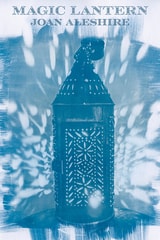
Magic Lantern
Joan Aleshire
Four Way Books, 2026
Conceived of as a memoir in poems of late-life love and its betrayal, Magic Lantern traces the borders of loss and investigates the source of our strength to traverse them, finding the roots of resilience in ordinary interactions and illuminating the undramatic power of simple connections. "At a time of our lives when the only hands / we can expect to touch us this gently / will be wearing latex gloves," Aleshire recounts a tender moment before romantic rupture. "The technician in the ER said softly, / trying to attach your heart monitors, / You’re so hairy, I’m not sure / this will stick, but I thought / it didn’t matter how intimately / they handled you; my love / had covered, would cover / you, before and after them." When the realization of the beloved’s treachery obliterates this lucidity and generosity, the speaker feels violated and estranged from herself, reducing the narrative of the affair to “what we did / in the dark, until we became / the dark.” The private destabilization of this heartache pales but compounds the shadows of a world already rent by international war and domestic political upheaval, but Aleshire orients toward another light source: the rewarding labor of building community and the noble pursuit of seeking meaning itself. The title poem executes a beautiful metacommentary on the value of art, which is to say going to the effort, trying for trying’s sake. At a local filmmaker’s screening, the speaker marvels at the powerful impression the artist has rendered with black-and-white film, astonished by how “the depths and brights, / shadows and gleams... make us watching / feel more.” In these deeply compassionate and vulnerable poems, Aleshire draws our attention to the artistry of our lives, the luminosity we stroke and orchestrate through our meticulous care and enduring bonds. This is the light we see by. A transportative seventh collection, Magic Lantern draws the disordered overwhelm of the human experience into a dazzling, seamless sequence of images, setting the ordinary into motion so that it not only coheres, but glows.
Magnifier
Brandon Krieg
University Press of Colorado, 2019
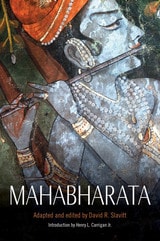
Mahabharata
Adapted and edited by David R. Slavitt
Northwestern University Press, 2015
Within its 200,000 verse lines in Sanskrit the Mahabharata takes on many roles: epic poem, foundational text of Hinduism, and, more broadly, the engaging story of a dynastic struggle and the passing of an age when man and gods intermingled. David R. Slavitt’s sparkling new edition condenses the epic for the general reader.
At its core, the Mahabharata is the story of the rivalry between the Pandavas and the Kauravas, two related noble families who are struggling for control of a kingdom in ancient northern India. Slavitt’s readable, plot-driven, single-volume account describes an arc from the conception and birth of Bhishma to that hero's death, while also introducing the four goals of life at the center of Hinduism: dharma (righteousness, morality, duty), artha (purpose), kāma (pleasure), and moksa (spiritual liberation). The Mahabharata is engaging, thrilling, funny, charming, and finally awesome, with a range in timbre from the impish naivete of fairy tales to the solemnity of our greatest epics, and this single-volume edition is the best introduction available.
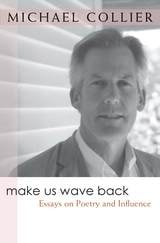
Make Us Wave Back
Essays on Poetry and InfluenceMichael Collier
University of Michigan Press, 2007
“Michael Collier’s book is refreshing in its refusal to push for one particular aesthetic. He regards his own preference for realism over abstraction as more a matter of temperament than of considered judgment, and respects poets more skeptical than he is about the ability of poetry to connect with the world. The result is an engaging record of his influences and enthusiasms, which are wide enough to include both Whitman and Larkin, both Jorge Borges and William Maxwell.”
—Carl Dennis, Pulitzer Prize–winning author of Unknown Friends and Practical Gods
“Michael Collier combines pietas and wildness in these essays on poetry as inheritance, and poetry as struggle. One feels the young man in his ‘rampage of literature,’ and the older writer reflecting on an art that is at once personal and impersonal, deeply matured in the imagination. This is a wise and well-lived book.”
—Rosanna Warren, author of Departure and Stained Glass
“The essays and remembrances in Make Us Wave Back radiate Michael Collier’s characteristic insight and sagacity on every page. Clear-minded, ardent, brightly illuminating the art of poetry, this is as lucid as writing about writing gets.”
—Campbell McGrath, author of Pax Atomica and Florida Poems
National Book Critics Circle Award finalist Michael Collier explores the influences that have made him one of the most distinguished poets of his generation. Make Us Wave Back includes essays on an expansive list of subjects, among them the literary correspondence of William Maxwell; the meaning of the author’s own role as poet laureate of the state of Maryland; the journals of Louise Bogan and how they reveal Bogan’s struggle with her own personal fears as well as the reconstruction of herself as a writer; and many more.
Michael Collier is Professor of English and Codirector of the creative writing program at the University of Maryland. He is also director of the Bread Loaf Writers’ Conference. He is the author of several books of poems, including The Clasp and Other Poems, The Folded Heart, and The Ledge.

Making Love to Roget's Wife
Poems New and SelectedRon Koertge
University of Arkansas Press, 2001
In plain, unpretentious language, with brutal honesty, Ron Koertge can meld violence, love, human ugliness, joy, and modern depravity into a short lyric that makes us laugh out loud or socks us in the gut. His images arrive in giant clown shoes—cigars the size of Florida, the plastic man’s counter-length arms—or neatly packaged in carefully observed detail, as he writes of the “black little hearts” of ants or an ape’s “dark and leathery breast.”
Through every poem, there runs a constant and sincere humanity, a voice that laughs at itself, often goads us a bit, but always stuns and enlightens us when we dis – cover something of ourselves gambling with the crowd at the racetrack, driving from the parking lot of the Mexican restaurant, or shambling with the distraught parent leaving the hospital.
In Making Love to Roget’s Wife, Ron Koertge offers his best work from twenty-three years and a dozen earlier collections. With twenty-five new poems, and over eighty from previous books, this selection reawakens us to the presence of a superbly honed comic voice.
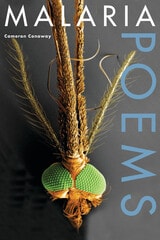
Malaria, Poems
Cameron Conaway
Michigan State University Press, 2014
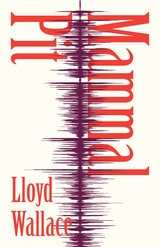
Mammal Pit
Lloyd Wallace
University of Chicago Press, 2027
A strange, cacophonous, and contemplative long poem following a posthumous narrator making meaning of life and death.
Lloyd Wallace’s book-length poem Mammal Pit uses the imaginative technologies of literature to try to say something true about being alive. Conceived as though spoken in a single, long breath by an ostensibly posthumous narrator, this soliloquy accrues fragments, images, impressions, jokes, and regrets as it progresses. The narrator recalls moments from his past life, running through the American South, crossing the long Ohio River into Pittsburgh, and zigzagging over to the oiled, silent hallways of the US Capitol, all while calling up and attempting to make sense of what it was to be alive in a human body surrounded by the heavy liquid of time. Studded with strange, exacting images—“Men dreaming of knives / In such excruciating detail / They wake up with paper cuts / Saliva wife”—Wallace’s debut collection attempts to ask the questions poetry is made to answer: What do you do with death? What do you do when it’s standing beside you? What can you do but hold its hand?
Wallace’s humorous and morbid romp across America and across the boundaries of life and death whirls language away from expected patterns and forms. Committed to the question of what it means to die, Wallace faces its inevitability and the fact that we are all doing it as we speak.
Mammal Pit is the winner of the 2027 Phoenix Emerging Poet Book Prize.
Man-Making Words
Selected Poems of Nicolas GuillenNicolas Guillen
University of Massachusetts Press, 2003
The Cuban poet Nicolás Guillén, who was born in the eastern province of Camagüey in 1902, died in 1989. This new edition of his selected poems, reissued thirty years after its original publication, includes an extensive, new introductory essay by Roberto Márquez, one of the original translators and a leading authority on Caribbean and Latin American literature and culture.
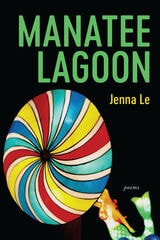
Manatee Lagoon
PoemsJenna Le
Acre Books, 2022
In Manatee Lagoon, sonnets, ghazals, pantoums, villanelles, and a “failed georgic” weave in contemporary subject matter, including social-media comment threads, Pap smears, eclipse glasses, and gun violence. A recurring motif throughout the collection, manatees become a symbol with meanings as wide-ranging as the book itself. Le aligns the genial but vulnerable sea cow with mermaids, neurologists, the month of November, harmful political speech, and even a family photo at the titular lagoon.
In these poems, Le also reflects on the experience of being the daughter of Vietnamese refugees in today’s sometimes tense and hostile America. The morning after the 2016 election, as three women of color wait for the bus, one says, “In this new world, we must protect each other.”
Manatee Lagoon is a treasury of voices, bringing together the personal and the persona, with poems dedicated to Kate Spade, John Ashbery, and Uruguayan poet Delmira Agustini. With this book, Le establishes herself as a talented transcriber of the human condition—and as one of the finest writers of formal verse today.
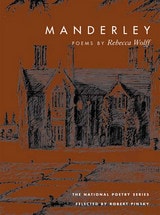
Manderley
POEMSRebecca Wolff
University of Illinois Press, 2001
In the Manderley of Rebecca, Daphne du Maurier's forbidding haven of mocking ghosts and secrets that refuse to remain buried, nothing is as it seems. So in this stunning debut collection by Rebecca Wolff, cities, partners, mothers, sisters, friends, and perfect strangers all disguise their true faces, while they who seek connection are "transported from one great gaping / hole in the fabric / of our knowledge to another."
No passage is too dark, no garden too tangled for the troubled dreamer of Manderley. Wolff turns a quicksilver gaze on a fluid world where both the real and the imaginary are transfigured. Tempering steely candor with a sophisticated delight in wordplay, these poems turn on a dime from the sensual to the eerie, the resigned to the hopeful, the comforting to the shocking. Each poem weaves together layers of dream, remembrance, and fantasy, distilling from romantic excess a gritty, spare language of truth-telling and surprise

Mandible Wishbone Solvent
Asiya Wadud
University of Chicago Press, 2024
The poetry of Mandible Wishbone Solvent is situated in the space of bridges, fragmentary overlays, spectral reach, and the desire to keep reaching. Asiya Wadud’s poems engage in this act, not to stake a claim or to fasten themselves, but to hold fragments together in order to offer possibilities for connection and extension. Throughout the collection lies an acknowledgment that any hold will drift, meander, and find new paths, with each separation making space for new entanglements. Drawing on a keen interest in tactility and ekphrasis, Wadud mines the repetition and extension that comes with any fractured state of existence and considers the nature of a residual and roving we.
Following this selection of lyrical, ekphrastic, fragmented poems, the book concludes with two prose pieces that dwell on the concepts of “isthmus” and “drift,” respectively, which offer further grounds for contemplation and provide a frame for the poems.

Manoleria
Daniel Khalastchi
Tupelo Press, 2011
Under the influence of broadcasts such as public radio’s “Marketplace” (a daily roundup of stock reports and business news), Daniel Khalastchi composed a series of character-driven poems whose recurrent narrator is physically and mentally manipulated while the world around him takes little notice. Through their chaos and horror, these poems ask a reader to question the ways in which our careening healthcare system, crumbling financial/housing/job markets, and war on multiple fronts are actually affecting us — both inside and out.

Manthology
Poems on the Male ExperienceCraig Crist-Evans
University of Iowa Press, 2006
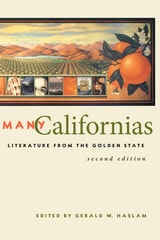
Many Californias
Literature from the Golden StateGerald W. Haslam
University of Nevada Press, 1999

Many Times, But Then
By Ann Lauterbach
University of Texas Press, 1979

Manyfaced Glass
Tennyson'S Dramatic MonologuesLinda K. Hughes
Ohio University Press, 1987
The hazy settings and amorphous auditors of Tennyson’s dramatic monologues are often contrasted—at Tennyson’s expense—with Browning’s more vivid, concrete realizations. Hughes argues that Tennyson’s achievements in the genre are, in fact, considerable, that his influence can be traced in such major figures as T. S. Eliot, and that the monologue occupies a far more central position in Tennyson’s poetic achievement than has hitherto been acknowledged.
Hughes’ study challenges the traditional view of Tennyson’s inferior achievement, and her account of the elements and operation of the dramatic monologue, especially as demonstrated by three of its most important practitioners, will be of interest to all those concerned with the monologue as a poetic mode.
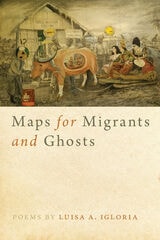
Maps for Migrants and Ghosts
Luisa A. Igloria
Southern Illinois University Press, 2020
For immigrants and migrants, the wounds of colonization, displacement, and exile remain unhealed. Crossing oceans and generations, from her childhood home in Baguio City, the Philippines, to her immigrant home in Virginia, poet Luisa A. Igloria demonstrates how even our most personal and intimate experiences are linked to the larger collective histories that came before.
In this poetry collection, Igloria brings together personal and family histories, ruminates on the waxing and waning of family fortunes, and reminds us how immigration necessitates and compels transformations. Simultaneously at home and displaced in two different worlds, the speaker lives in the past and the present, and the return to her origins is fraught with disappointment, familiarity, and alienation.
Language serves as a key and a map to the places and people that have been lost. This collection folds memories, encounters, portraits, and vignettes, familiar and alien, into both an individual history and a shared collective history—a grandfather’s ghost stubbornly refusing to come in out of the rain, an elderly mother casually dropping YOLO into conversation, and the speaker’s abandonment of her childhood home for a second time.
The poems in this collection spring out of a deep longing for place, for the past, for the selves we used to be before we traveled to where we are now, before we became who we are now. A stunning addition to the work of immigrant and migrant women poets on their diasporas, Maps for Migrants and Ghosts reveals a dream landscape at the edge of this world that is always moving, not moving, changing, and not changing.
Marianne Moore, Elizabeth Bishop, and May Swenson
The Feminist Poetics of Self-RestraintKirstin Hotelling Zona
University of Michigan Press, 2002
In recent years critical studies of Bishop and Moore have flourished, a large percentage of them devoted to explorations of sexuality and gender. A gap is growing, however, between feminist repossessions of Moore and Bishop and recent readings of their antiessentialist poetics. On the one hand, these poets are appearing more frequently in the feminist canon, but the price of this inclusion is usually the suppression of their strategies of self-restraint. While Zona questions the poetic privileging of self-expression, she establishes contiguity between feminist poetry and developments in American poetry at large. In doing so she asserts the centrality of feminist poetry within discussions of contemporary American poetry, thereby challenging the common perception of feminist poetry as an "alternative" (which often means auxiliary) genre.
Kirstin Hotelling Zona is Assistant Professor of Poetry and Poetics, Illinois State University.
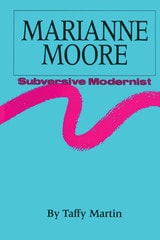
Marianne Moore, Subversive Modernist
By Taffy Martin
University of Texas Press, 1986
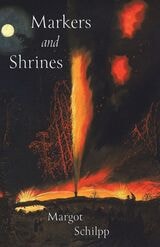
Markers and Shrines
Margot Schilpp
Carnegie Mellon University Press, 2025
In Markers and Shrines, Margot Schilpp traces the moments that define us—the losses that strip away our former selves and the resilience that emerges in their wake. These poems illuminate the way the past etches itself onto the future, displaying how experience, no matter how painful, strengthens and redefines us.
With lyrical precision and a musician’s ear for language, Schilpp crafts a world where memory lingers and meaning deepens. Her unembellished eloquence and eye for striking detail turn the everyday into something enlightening, reminding us that even in loss, there is beauty. Markers and Shrines is a reflection on survival and the unseen forces that shape who we become.
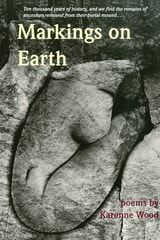
Markings on Earth
Karenne Wood
University of Arizona Press, 2001
“Ten thousand years of history, and we find the remains
of ancestors removed from their burial mound . . . “
Impressions of the past, markings on earth, are part of the world of Karenne Wood. A member of the Monacan tribe of Virginia, she writes with insight and grace on topics that both reflect and extend her Native heritage.
Markings on Earth is a cyclical work that explores the many dimensions of human experience, from our interaction with the environment to personal relationships. In these pages we relive the arrival of John Smith in America and visit the burial mounds of the Monacan people, experience the flight of the great blue heron and witness the dance of the spider. We also share the personal journey of one individual who seeks to overcome her sense of alienation from her people and her past.
Wood’s palette is not only Nature but human nature as well. She writes pointedly about shameful episodes of American history, such as the devastation of Appalachia by mining companies and the “disappearance” of Indian peoples. She also addresses forms of everyday violence known to many of us, such as alcoholism and sexual abuse. Wood conveys an acceptance of history and personal trauma, but she finds redemption in a return to tradition and a perception of the world’s natural grace.
Through these elegantly crafted words, we come to know that Native writers need not be limited to categorical roles determined by their heritage. Markings on Earth displays a fidelity to human experience, evoking that experience through poems honed to perfection. It is an affirmation of survival, a work that suggests one person’s life cannot be separated from the larger story of its community, its rootedness in history, and its timeless connections to the world.
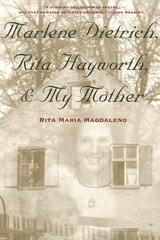
Marlene Dietrich, Rita Hayworth, & My Mother
Rita Maria Magdaleno
University of Arizona Press, 2003
Rita Magdaleno was born near Dachau shortly after World War II to a German mother and a Mexican American GI. Her family moved to Arizona in 1947, and Rita was raised with her father's traditions—but she remains at heart a child of two cultures.
This poetic memoir, recalling Magdaleno's return to the land of her birth, is an intertwining of personal and public history, bridging continents and cultures in search of family secrets. Her poems recall a mother "Marlene Dietrich pretty, / her smoky voice / & those wide Aryan / eyes that promised / never to lie," a war bride who named her child after a Hollywood movie star even before casting eyes on America. They also offer a new, intimate view of the war—and of today's reunified Germany—and show that the consequences of events played out half a century ago continue to resonate with the children of that era.
Magdaleno navigates currents of emotion that would drown less capable poets. With patience, courage, and abiding love, she draws on memories of mother and motherland to show us that healing can come in many forms.
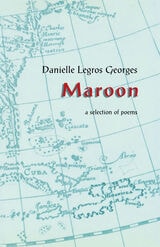
Maroon
Danielle Legros Georges
Northwestern University Press, 2001
Maroon is the debut collection of Haitian-American poet Danielle Legros Georges, who writes of the pain of exile, the beauty of nature, and the delights of love in highly rhythmic, highly original language. The range of her voice is remarkable— from the comic to the tragic to the lyric. Her poetry is electric with an overpowering zest for life and vitality of language, as she examines the traumatic experiences that brought her parents to America and searches for a more complete understanding of self.
Maroon Choreography
fahima ife
Duke University Press, 2021
Duke University Press Scholars of Color First Book Award recipient
Martial
The World of the EpigramWilliam Fitzgerald
University of Chicago Press, 2007
In this age of the sound bite, what sort of author could be more relevant than a master of the epigram? Martial, the most influential epigrammatist of classical antiquity, was just such a virtuoso of the form, but despite his pertinence to today’s culture, his work has been largely neglected in contemporary scholarship. Arguing that Martial is a major author who deserves more sustained attention, William Fitzgerald provides an insightful tour of his works, shedding new and much-needed light on the Roman poet’s world—and how it might speak to our own.
Writing in the late first century CE—when the epigram was firmly embedded in the social life of the Roman elite—Martial published his poems in a series of books that were widely read and enjoyed. Exploring what it means to read such a collection of epigrams, Fitzgerald examines the paradoxical relationship between the self-enclosed epigram and the book of poems that is more than the sum of its parts. And he goes on to show how Martial, by imagining these books being displayed in shops and shipped across the empire to admiring readers, prophetically behaved like a modern author. Chock-full of epigrams itself—in both Latin and English versions—Fitzgerald’s study will delight classicists, literary scholars, and anyone who appreciates an ingenious witticism.
Marvels of the Invisible
Poems (Tupelo Press First / Second Book Award)Jenny Molberg
Tupelo Press, 2017
Mary and the Giant Mechanism
Mary Molinary
Tupelo Press, 2013
Mashairi ya Vita vya Kuduhu
War Poetry in Kiswahili Exchanged at the Time of the Battle of KuduhuAnn Biersteker
Michigan State University Press, 1995
Mashairi Ya Vita Vya Kuduhu is a presentation and discussion of both manuscript and published versions of poems written by Lamu poets around the time of the Battle of Kuduhu. The poetic dialogue studied in this volume has played a significant role in the history of Swahili poetry, and its primary concern is to inform continued work in this area. The poems contained in this work were transmitted and preserved by speakers of Kiswahili and later collected and preserved by scholars. Chapter One contains the edited poems; Chapter Two consists of the translations. Subsequent chapters include accounts of the Battle of Kuduhu, editing and translating practices, and annotated poems and source versions. This work is presented as an example of the importance of research, fieldwork, and the consideration of available versions and alternative styles of presentation in the study of Swahili poetry.

Massacre of the Innocents
Bin Ramke
University of Iowa Press, 1995
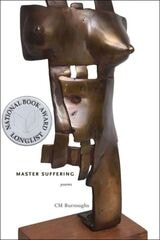
Master Suffering
CM Burroughs
Tupelo Press, 2021
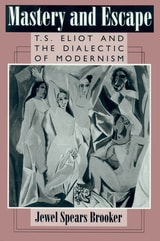
Mastery and Escape
T. S. Eliot and the Dialectic of ModernismJewel Spears Brooker
University of Massachusetts Press, 1994
This seminal scholarly work examines T. S. Eliot's literary development and philosophical outlook through the lens of modernist dialectics, exploring the tension between mastery and escape as central to understanding both his poetry and critical thought. Edited and written by acclaimed Eliot scholar Jewel Spears Brooker, this volume presents expert studies of key intellectual influences on Eliot's modernism—particularly Stéphane Mallarmé, Sir James George Frazer, F. H. Bradley, and T. E. Hulme—yielding fresh and original insights into how these thinkers shaped the poet's artistic vision.
Through careful textual analysis and intellectual history, Brooker investigates how Eliot grappled with fundamental modernist anxieties: the desire for artistic mastery and transcendence alongside the simultaneous impulse toward escape from the constraints of tradition, rationality, and conventional form. She demonstrates how Eliot's poetry and prose reflect a dialectical movement, a constant interplay between opposing forces, that defines both his modernist aesthetics and his philosophical positions.
An essential resource for scholars seeking comprehensive understanding of modernism's philosophical foundations and poetic achievements, Brooker is devoted to tracing both dialectical movements and biographical developments in Eliot's career.
Matter
Bin Ramke
University of Iowa Press, 2004
“When I was a saint,” begins the first poem, “I did not have visions but I could see and did note the color of the world.” Matter is an examination of and a report on the world’s variable colors and possibilities for, if not sanctity, then a certain sanity, a kindness, and some form of salvation.

Maxanax Chempapísi / Bloodwriting
Deborah A. Miranda
University of Arizona Press, 2027
In Maxanax Chempapísi / Bloodwriting lyric poems exploring Esselen words and concepts traverse a supporting cast of prose poems about contemporary life as a queer, Indigenous recovering academic. Deborah A. Miranda witnesses the lives of women who are lovers, mothers, daughters, sisters, and grandmothers caught in a chain of ongoing apocalypse that stretches from the colonization of North America to the current Anthropocene.
These poems are small but potent ceremonies that center relationship as medicinal. They speak of the ugliness of genocide, substance abuse, environmental destruction, and homophobia with searing fury. They linger on the sacred powers found within a river—“A web of fireflies weaving constellations in the alder’s branches”—or the wonder of “The first woman / who stole my heart / rose up / from the earth / like a creation story.” Throughout this collection, images weave connections between women’s bodies and the moon, bodies and earth, bodies and constellations that surround us. Esselen, Miranda’s Indigenous language, acts as a bridge that translates some of these ancient struggles and insights into contemporary images.
This collection resists the separation of the body, the spirit, and the sacred. It seeks a reunion of true relationship in the midst of chaos and uncertainty. Miranda balances praise for the burning—but still beautiful and holy—world and grief for the loss of beings and places that cannot be recovered.

Mayakovsky
A BiographyBengt Jangfeldt
University of Chicago Press, 2014
With Mayakovsky, Bengt Jangfeldt offers the first comprehensive biography of Mayakovsky, revealing a troubled man who was more dreamer than revolutionary, more political romantic than hardened Communist. Jangfeldt sets Mayakovsky’s life and works against the dramatic turbulence of his times, from the aesthetic innovations of the pre-revolutionary avant-garde to the rigidity of Socialist Realism and the destruction of World War I to the violence—and hope—of the Russian Revolution, through the tightening grip of Stalinist terror and the growing disillusion with Russian communism that eventually led the poet to take his life.
Through it all is threaded Mayakovsky’s celebrated love affair with Lili Brik and the moving relationship with Lili’s husband, Osip, along with a brilliant depiction of the larger circle of writers and artists around Mayakovsky, including Maxim Gorky, Viktor Shklovsky, Alexander Rodchenko, and Roman Jakobson. The result is a literary life viewed in the round, enabling us to understand the personal and historical furies that drove Mayakovsky and generated his still-startling poetry.
Illustrated throughout with rare images of key characters and locations, Mayakovsky is a major step in the revitalization of a crucial figure of the twentieth-century avant-garde.
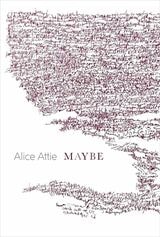
Maybe
Alice Attie
Seagull Books, 2026
The poems in Maybe form a tapestry of voices that slip from visibility to invisibility, illusion to disillusion, the conceivable to the inconceivable. Alice Attie writes of boundaries loosening, of transformations and transfigurations born of the unknown and the uncertain. Her poems suggest that this world will dissolve, and it will reappear as something other, something ineffable yet lodged in language, something fraught with an urgency that is both sublime and unbearable. Attie asks from what vantage point can the seer see, the writer write, the listener hear, learning ultimately that “for the length of my years to lengthen, I place the pebble on my tongue and rearrange the boundaries”?
Maybe It Was So
Reginald Gibbons
University of Chicago Press, 1991

Mbembe
Selected PoemsMbembe Milton Smith
BkMk Press, 1986
Finalist, Montaigne Medal, Eric Hoffer Award
The Black American Literature Forum said of his work, “Mbembe’s poems express a hunger for a fuller life, for an affirmation of existence.” The Kansas City Star commented, “Mbembe works with his own special problem of saying what he has to say and saying it in the authentic voice of a special culture.” The literary quarterly Northeast summed up his work by suggesting we “look for his light on the dark waters of the bay--red flashing four: courage; white flashing one: love--you will find your way safely to harbor.”
Mean
Colette LaBouff Atkinson
University of Chicago Press, 2008
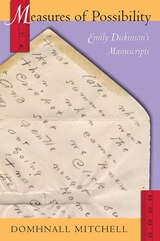
Measures of Possibility
Emily Dickinson's ManuscriptsDomhnall Mitchell
University of Massachusetts Press, 2005
In Measures of Possibility, Domhnall Mitchell sets out to test the hypothesis of Dickinson's textual radicalism, and its consequences for readers, students, and teachers, by looking closely at features such as spacing, the physical direction of the writing, and letter-shapes in handwritten lyric and epistolary texts. Through systematic contextualization and cross-referencing, Mitchell provides the reader with a critical apparatus by which to measure the extent to which contemporary approaches to Dickinson's autograph procedures can reasonably be formulated as corresponding to the poet's own purposes.
Medbh McGuckian
The Poetics of ExemplarityShane Alcobia-Murphy
Aberdeen University Press, 2012

Media Poetry
An International AnthologyEdited by Eduardo Kac
Intellect Books, 2007

Medicine Show
Tom Yuill
University of Chicago Press, 2010
In Medicine Show, inner conflict is wonderfully realized in the clash of down-home plain speech and European high culture utterances. Freely translating and adapting Catullus (Latin), Villon (Middle French), Corbiere (French), Hikmet (Turkish), and Orpheus (Greek), and placing them alongside Jagger and Richards, skinheads, and psalms, Tom Yuill’s book mirrors an old-style hawking of wares, with all the charm and absurdity that results when high culture meets pop, when city meets small town, and when provincialism confronts urbanity. Here, the poems talk to one another, one poem nudging the cusps of many others, those poems touching still others' circumferences. Yuill, by invoking the Rolling Stones as muses and as background music, offers cover versions of Shakespeare, Keats, and Dylan Thomas, ultimately giving us a new kind of verse, funneled through the languages and rhythms of his masters' voices.

Medieval English Lyrics
A Critical AnthologyR.T. Davies
Northwestern University Press, 1963
All too often, this great body of poetry is represented in anthologies by a scattering of all-too-well-known poems, or by one or two unfamiliar ones for which there are often inadequate linguistic and critical notes. R.T. Davis, Lecturer in English Literature at the University of Liverpool, has incorporated extensive linguistic and critical notes on the lyrics in this collection, and even the student without experience with Middle English will be able to read and appreciate the works. In addition to being the first critical anthology of medieval English lyrics ever published, it is a revealing portrait of a people far removed from us in time, but very much like ourselves.
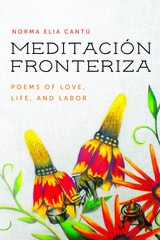
Meditación Fronteriza
Poems of Love, Life, and LaborNorma Elia Cantú
University of Arizona Press, 2019
The poems are a celebration of culture, tradition, and creativity that navigates themes of love, solidarity, and political transformation. Deeply personal yet warmly relatable, these poems flow from Spanish to English gracefully. With Gloria Anzaldúa’s foundational work as an inspiration, Meditación Fronteriza unveils unique images that provide nuance and depth to the narrative of the borderlands.
Poems addressed to talented and influential women such as Gwendolyn Brooks and Adrienne Rich, among others, pour gratitude and recognition into the collection. While many of the poems in Meditación Fronteriza are gentle and inviting, there are also moments that grieve for the state of the borderlands, calling for political resistance.
Meditations on Rising and Falling
Meditations on Rising and FallingPhilip Pardi
University of Wisconsin Press, 2008