Results by title
22279 books match the query 'Social Science' and 1258 start with m
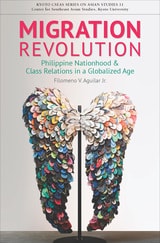
Migration Revolution
Philippine Nationhood and Class Relations in a Globalized AgeFilomeno V. Aguilar Jr.
National University of Singapore Press, 2014
The global nomadism of Filipino workers brought about some fundamental reorientations. It revolutionized Philippine society, reignited a sense of nationhood, imposed new demands on the state, reconfigured the class structure, and transnationalized class and other social relations, even as it deterritorialized the state and impacted the destinations of migrant workers.
Philippine foreign policy now takes surprising turns in consideration of migrant workers and Filipinos living abroad. Many tertiary education institutions aim deliberately at the overseas employability of local graduates. And the “Fil-foreign” offspring of unions with partners from other nationalities add a new inflection to Filipino identity.
Migration Stories
Connecting Activism, Policy, and ScholarshipEdited by Benjamin Gatling
University of Illinois Press, 2025
Ranging from oral history projects to the asylum process to calls for decolonial justice, the contributors’ analyses illuminate how migrants’ and refugees’ personal narratives influence both perceptions and policies. Their merger of perspectives provides a nuanced understanding of migration and emphasizes the importance of how storytelling can foster empathy, challenge stereotypes, and drive social change. At the same time, the essays center migrants’ and refugees’ voices within public debates and in work done to humanize the reality they face.
Original and multifaceted, Migration Stories provides a vital addition to how we study and frame immigration.
Migration and Ethnicity in Middle Range Societies
A View from the SouthwestTammy Stone
University of Utah Press, 2015
Author Tammy Stone focuses on a number of general deliberations on the archaeology of middle-range society and the prehistory of the American Southwest. This includes the complex dynamics of migration, identity, ethnic interaction, and the ability of archaeologists to identify these patterns in the archaeological record. The integration and ultimate expulsion of a group of Kayenta Anasazi at Point of Pines Pueblo in the Mogollon Highlands of east-central Arizona provides a case study and location where these themes played out. Stone uses a detailed architectural analysis of the pueblo to attain a nuanced and dynamic understanding of migration from the perspective of both the Kayenta migrants and their Mogollon hosts. By examining the choices that individuals, families, and small groups made about identity and alliance from the perspective of both the migrants and host community—the latter being an aspect often missing from analyses of migration—this volume provides never-before-published data on Point of Pines Pueblo and contributes considerably to the study of community dynamics at large.
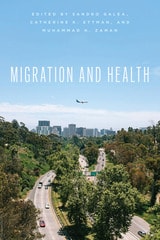
Migration and Health
Edited by Sandro Galea, Catherine K. Ettman, and Muhammad H. Zaman
University of Chicago Press, 2022
International migrants compose more than three percent of the world’s population, and internal migrants—those migrating within countries—are more than triple that number. Population migration has long been, and remains today, one of the central demographic shifts shaping the world around us. The world’s history—and its health—is shaped and colored by stories of migration patterns, the policies and political events that drive these movements, and narratives of individual migrants.
Migration and Health offers the most expansive framework to date for understanding and reckoning with human migration’s implications for public health and its determinants. It interrogates this complex relationship by considering not only the welfare of migrants, but also that of the source, destination, and ensuing-generation populations. The result is an elevated, interdisciplinary resource for understanding what is known—and the considerable territory of what is not known—at an intersection that promises to grow in importance and influence as the century unfolds.
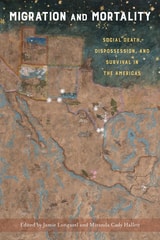
Migration and Mortality
Social Death, Dispossession, and Survival in the AmericasEdited by Jamie Longazel and Miranda Cady Hallett
Temple University Press, 2021
Death threatens migrants physically during perilous border crossings between Central and North America, but many also experience legal, social, and economic mortality. Rooted in histories of colonialism and conquest, exclusionary policies and practices deliberately take aim at racialized, dispossessed people in transit. Once in the new land, migrants endure a web of systems across every facet of their world—work, home, healthcare, culture, justice—that strips them of their personhood, denies them resources, and creates additional obstacles that deprive them of their ability to live fully.
As laws and policies create ripe conditions for the further extraction of money, resources, and labor power from the dispossessed, the contributors to this vibrant anthology, Migration and Mortality, examine restrictive immigration policies and the broader capitalist systems of exploitation and inequality while highlighting the power of migrants’ collective resistance and resilience.
The case studies in this timely collection explore border deaths, detention economies, asylum seeking, as well as the public health and mental health of migrants. Ultimately, these examples of oppression and survival contribute to understanding broader movements for life and justice in the Americas.
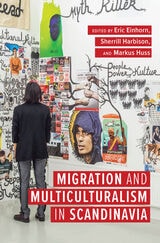
Migration and Multiculturalism in Scandinavia
Edited by Eric Einhorn, Sherrill Harbison, and Markus Huss
University of Wisconsin Press, 2022
Drawing from personal experiences and theoretical perspectives in such varied fields as sociology, political science, literature, and media studies, nineteen scholars assess recent shifts in Scandinavian societies and how they intertwine with broader transformations in Europe and beyond. Chapters explore a variety of topics, including themes of belonging and identity in Norway, the experiences and activism of the Nordic countries’ Indigenous populations, and parallels between the racist far-right resurgence in Sweden and the United States.
Contributors: Ellen A. Ahlness, Julie K. Allen, Grete Brochmann, Eric Einhorn, Sherrill Harbison, Anne Heith, Markus Huss, Peter Leonard, Barbara Mattsson, Kelly McKowen, Andreas Önnerfors, Elisabeth Oxfeldt, Tony Sandset, Carly Elizabeth Schall, Ryan Thomas Skinner, Admir Skodo, Benjamin R. Teitelbaum, Sayaka Osanami Törngren, Ethelene Whitmire
Migration and Residential Mobility in the United States
Larry Long
Russell Sage Foundation, 1988
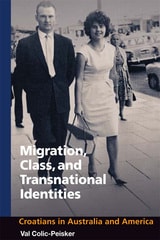
Migration, Class and Transnational Identities
Croations in Australia and AmericaVal Colic-Pelsker
University of Illinois Press, 2007
Val Colic-Peisker harnesses concepts and theories from sociology, anthropology, and political science to compare the vastly different experiences of two Croatian immigrant cohorts in the city of Perth, Western Australia. The populations explored represent an earlier group of working-class migrants arriving from communist Yugoslavia from the 1950s to 1970s and a later group of urban professionals arriving in the 1980s and 1990s as 'independent' or skills-based migrants. This latter group integrated into professional ranks but also used their Australian experience as a stepping stone in becoming part of a highly mobile global professional middle class.
Employing a refined theoretical analysis, this rich ethnography challenges the domination of the ethnic perspective in migration studies and the idea of ethnic community itself. It emphasizes the importance of class, focusing on the intersection of class, ethnicity, and gender in the process of migration, migrant incorporation, and transnationalism. In theorizing the connection of the two migrant cohorts with their native Croatia, the study introduces concepts of "ethnic" and "cosmopolitan" transnationalism as two distinctive experiences mediated by class.
Migration, Mill Work, and Portuguese Communities in New England
Edited by Cristiana Bastos, Bela Feldman-Bianco, and Miguel Moniz
Tagus Press, 2024
Migration, Transnationalization & Race
In A Changing New YorkHector Cordero-Guzman
Temple University Press, 2001
In this ambitious book, nineteen scholars from a broad range of disciplines bring our understanding of New York's immigrant communities up to date by exploring the interaction between economic globalization and transnationalization, demographic change, and the evolving racial, ethnic, gender dynamics in the City. Urban and suburban, Asian, European, Latin American, and Caribbean, men and women and children—the essays here analyze the complex forces that shape the contemporary immigrant experience in New York City and the links between immigrant communities in New York and their countries of origin.

Migration
Changing the WorldGuy Arnold
Pluto Press, 2011
Constant migration is a worldwide phenomenon that creates sharp divisions between those who accept the need for migrants and welcome the contributions they make and those who oppose them on xenophobic grounds. Guy Arnold provides a comprehensive survey of the consequences of migration.
Arnold studies both the massive internal migrations in China and India that drive economic development and the influx of cheap labour into the advanced economies of the USA and EU. He shows that migrants are essential to advanced countries, filling skills gaps and bolstering ageing and static populations. He argues that the constant flow of people in all directions should be welcomed as a positive assault upon outdated, narrow nationalism.
Packed with statistics that support the argument that migration is a force for positive change, Arnold's analysis will be an excellent resource for journalists, policy makers and students of sociology, human geography and anthropology.
Mikhail Bakhtin
The Duvakin Interviews, 1973Slav N Gratchev
Bucknell University Press, 2019
Published by Bucknell University Press. Distributed worldwide by Rutgers University Press.

Miles of Smiles, Years of Struggle
STORIES OF BLACK PULLMAN PORTERSJack Santino
University of Illinois Press, 1989
Jack Santino's interviews with retired porters provide extensive firsthand accounts of their work, the job inequities they faced, the formation of the Brotherhood of Sleeping Car Porters, and the aborted Pullman porter strike of 1928. Through the testimony of ran-and-file workers as well as key figures such as E. D. Nixon, the porter who initiated the Montgomery bus boycott and helped launch the career of Martin Luther King, Jr. and C.L. Dellums, the only surviving founding member of the BSCP, Miles of Smiles, Years of Struggle illuminates the Pullman porters' struggle for dignity.
Militant Nationalism
Between Movement and Party in Ireland and the Basque CountryCynthia Irvin
University of Minnesota Press, 1999
A comparative analysis of two militant nationalist groups.
Why do some militant nationalists turn to electoral politics while others resist-and even seek to destroy-that arena? Cynthia L. Irvin examines two cases of electoral interventions by nationalist organizations engaged in violent political competition: in Northern Ireland and in the Basque provinces of Spain. Based on her findings, she offers insights into the circumstances that lead such groups to abandon violence in favor of institutional political struggle.
Using fieldwork done in Northern Ireland and the Basque Country, Irvin develops a model linking the internal dynamics of Sinn Fein and Herri Batasuna (the electoral arm of the militant Basque separatists) to changes in their external environments. In this unusual comparative analysis, she draws on interviews with more than 100 Sinn Fein and Herri Batasuna activists and on a unique survey of 140 Herri Batasuna activists. This approach moves Irvin’s work beyond previous analyses, which have relied on either descriptive and historical accounts or formal models of insurgent violence. This detailed account has broad implications for the study of social movements and ethnic identity, providing a valuable new perspective into the strategic interactions and often conflict-ridden relationship between social movements and political parties. ISBN 0-8166-3114-X Cloth £00.00 $49.95xxISBN 0-8166-3115-8 Paper £00.00 $19.95x304 Pages 26 Tables 5 7/8 x 9 MaySocial Movements, Protest, and Contention Series, volume 9Translation inquiries: University of Minnesota Press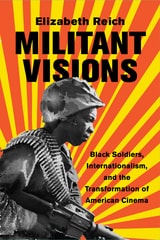
Militant Visions
Black Soldiers, Internationalism, and the Transformation of American CinemaReich, Elizabeth
Rutgers University Press, 2016
Offering a nuanced reading of a figure that was simultaneously conservative and radical, Reich considers how the cinematic black soldier lent a human face to ongoing debates about racial integration, black internationalism, and American militarism. Militant Visions thus not only presents a new history of how American cinema represented race, but also demonstrates how film images helped to make history, shaping the progress of the civil rights movement itself.
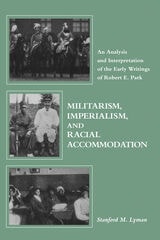
Militarism, Imperialism, and Racial Accommodation
An Analysis and Interpretation of the Early Writings of Robert E. ParkStanford Lyman
University of Arkansas Press, 1992
1993 Mid-South Sociological Association Book Award
Robert E. Park has long been recognized as one of the most influential thinkers in early American sociology, yet virtually all of his works appearing before 1913 were published in popular magazines and were dismissed as nonsociological muckraking. In Militarism, Imperialism, and Racial Accommodation: An Analysis and Interpretation of the Early Writings of Robert E. Park, Stanford M. Lyman examines and reprints many of these little-known works, including Park’s essays on German military organization, his exposés of the atrocities committed by Belgium’s Leopold II in the Congo State, his studies of the black community in Winston-Salem, North Carolina, and of Booker T. Washington’s agricultural education program at Tuskegee, Alabama.
Lyman shows clearly that Park’s essays, written outside the academy, formulated a far more complex perspective on modern modes of evil than any proposed by his contemporaries, thereby influencing sociological debates for decades to come. By writing his essays on topical subjects and by publishing them for a public audience, Park dramatized his profound belief that the struggle to achieve racial accommodation and to establish a true and lasting democracy is a concern for all.
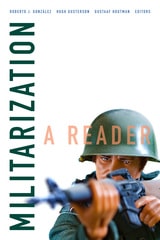
Militarization
A ReaderRoberto J. González, Hugh Gusterson, and Gustaaf Houtman, editors
Duke University Press, 2019
In collaboration with Catherine Besteman, Andrew Bickford, Catherine Lutz, Katherine T. McCaffrey, Austin Miller, David H. Price, David Vine
Militarized Global Apartheid
Catherine Besteman
Duke University Press, 2021
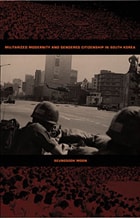
Militarized Modernity and Gendered Citizenship in South Korea
Seungsook Moon
Duke University Press, 2005
Moon situates militarized modernity in the historical context of colonialism and nationalism in the twentieth century. She follows the course of militarized modernity in South Korea from its development in the early 1960s through its peak in the 1970s and its decline after rule by military dictatorship ceased in 1987. She highlights the crucial role of the Cold War in South Korea’s militarization and the continuities in the disciplinary tactics used by the Japanese colonial rulers and the postcolonial military regimes. Moon reveals how, in the years since 1987, various social movements—particularly the women’s and labor movements—began the still-ongoing process of revitalizing South Korean civil society and forging citizenship as a new form of membership in the democratizing nation.
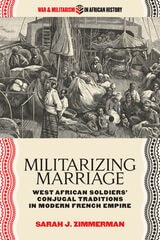
Militarizing Marriage
West African Soldiers’ Conjugal Traditions in Modern French EmpireSarah J. Zimmerman
Ohio University Press, 2020
Following tirailleurs sénégalais’ deployments in West Africa, Congo, Madagascar, North Africa, Syria-Lebanon, Vietnam, and Algeria from the 1880s to 1962, Militarizing Marriage historicizes how African servicemen advanced conjugal strategies with women at home and abroad. Sarah J. Zimmerman examines the evolution of women’s conjugal relationships with West African colonial soldiers to show how the sexuality, gender, and exploitation of women were fundamental to the violent colonial expansion and the everyday operation of colonial rule in modern French Empire.
These conjugal behaviors became military marital traditions that normalized the intimate manifestation of colonial power in social reproduction across the empire. Soldiers’ cross-colonial and interracial households formed at the intersection of race and sexuality outside the colonizer/colonized binary. Militarizing Marriage uses contemporary feminist scholarship on militarism and violence to portray how the subjugation of women was indispensable to military conquest and colonial rule.

Military Intervention after the Cold War
The Evolution of Theory and PracticeAndrea Kathryn Talentino
Ohio University Press, 2005
Military Intervention After the Cold War explores how and why this change took place, looking at how both ideas and actions changed in the post-Cold War period to make military intervention a tool of international security and a defining characteristic of the international system. Although it is often touted as a strategy to rebuild collapsed states, the examples of success are few and far between. Andrea Kathryn Talentino argues that standards of human rights and responsible governance have become part of the definition of international security. She addresses questions that are vital in the post-9/11 world, where weak and collapsed states are recognized as permissive and at times supportive environments for criminal actors.
The specter of terrorism has placed even greater emphasis on the need to understand why military intervention happens and how it could be more effective. With the news full of stories on intervention and nation-building, scholars, graduate and undergraduate students, and readers interested in understanding global interdependence will find Military Intervention After the Cold War an indispensable book.Andrea Kathryn Talentino is an assistant professor of international relations at Tulane University, New Orleans.The author of numerous articles on military intervention and post- conflict rebuilding, she is currently focusing on the link between nation-building and political violence.
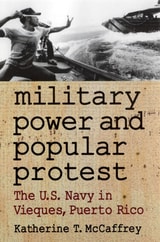
Military Power and Popular Protest
The U.S. Navy in Vieques, Puerto RicoMcCaffrey, Katherine T
Rutgers University Press, 2002
Residents of Vieques, a small island just off the east coast of Puerto Rico, live wedged between an ammunition depot and live bombing range for the U.S. Navy. Since the 1940s when the navy expropriated over two-thirds of the island, residents have struggled to make a life amid the thundering of bombs and rumbling of weaponry fire. Like the armys base in Okinawa, Japan, the facility has drawn vociferous protests from residents who challenged U.S. security interests overseas. In 1999, when a local civilian employee of the base was killed by a stray bomb, Vieques again erupted in protests that have mobilized tens of thousands individuals and transformed this tiny Caribbean Island into the setting for an international cause célèbre.
Katherine T. McCaffrey gives a complete analysis of the troubled relationship between the U.S. Navy and island residents. She explores such topics as the history of U.S. naval involvement in Vieques; a grassroots mobilizationled by fishermenthat began in the 1970s; how the navy promised to improve the lives of the island residentsand failed; and the present-day emergence of a revitalized political activism that has effectively challenged naval hegemony.
The case of Vieques brings to the fore a major concern within U.S. foreign policy that extends well beyond Puerto Rico: military bases overseas act as lightning rods for anti-American sentiment, thus threatening this countrys image and interests abroad. By analyzing this particular, conflicted relationship, the book also explores important lessons about colonialism and postcolonialism and the relationship of the United States to the countries in which it maintains military bases.

Milk Money
Cash, Cows, and the Death of the American Dairy FarmKirk Kardashian
Brandeis University Press, 2025
The dairy business is at the heart of the culture and economy of Vermont, just as it is in many other states. That fact meant little to Kirk Kardashian until he started taking his daughter to daycare at a dairy farm a few miles from his Vermont home. The farm had been owned by the same family for generations but struggled to make ends meet in a market where retail milk prices have held steady for decades while the prices paid to farmers have plummeted. Suddenly, the abstractions of economics and commodities markets were replaced by the flesh and blood of a farm family whom he greeted every day.
In the tradition of Michael Pollan and Eric Schlosser, Kardashian asks whether it is right that family farmers in America should toil so hard, produce a food so wholesome and so popular, and still lose money. His investigation uncovers the hidden forces behind dairy farm consolidation and explains why milk—a staple subject to both government oversight and industry collusion—has proven so tricky to stabilize, even as scores of small dairy farms close. This new edition brings the story up to date, as farmers grapple with an ever-changing landscape that includes shifting consumer preferences, immigration issues, climate change, and bird flu.

Milk Shake
Abundance and Loss in America’s DairylandGarbo Wedde
Wisconsin Historical Society Press, 2027
The story of how today’s dairy farmers are navigating a historic crossroads of agriculture and rural life in a rapidly changing world.
For generations, the dairy farmer has embodied the character, resilience, and values of the Midwest. Yet between 2005 and 2020, Wisconsin—known as America’s Dairyland—lost half of its dairy farms, marking one of the most profound economic and cultural transformations in its history. In Milk Shake: Abundance and Loss in America’s Dairyland, journalist Garbo Wedde delivers a thorough and emotionally resonant portrait of the farm families living through this time of change in rural life.
Drawing on extensive research and candid conversations with dozens of dairy farmers and industry stakeholders, Wedde looks beyond statistics to reveal the human stories behind the decline of the small family dairy farm. At the heart of the book are four Wisconsin farm families grappling with an uncertain future and how to respond: one leaves the industry, one embraces automation, one finds hope in a new generation willing to carry on the work, and one faces mounting financial strain that culminates in tragedy.
Interwoven among these narratives is a penetrating examination of the rise of large-scale industrial farms, their economic and environmental impacts, and the ways communities are responding. Wedde also explores the political, economic, demographic, and cultural forces reshaping dairy farming, from environmental regulation and labor shortages to gerrymandering, changing consumer preferences, and growing consolidation of small farms into agribusiness.
Richly observed scenes—from dairy breakfasts and farm auctions to public hearings on concentrated animal feeding operations (CAFOs)—bring readers inside a world that is both quintessentially American and increasingly endangered. Part social history and part elegy, Milk Shake captures a pivotal moment in America’s Dairyland while exploring questions that reach far beyond Wisconsin: What is lost when family farms disappear, and what does that loss mean for the communities, traditions, and values they sustain?
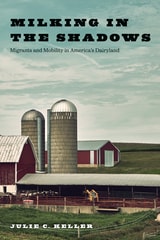
Milking in the Shadows
Migrants and Mobility in America’s DairylandKeller, Julie C
Rutgers University Press, 2019

Mill and Mansion
A Study of Architecture and Society in Lowell, Massachusetts, 1820-1865John Coolidge
University of Massachusetts Press, 1993
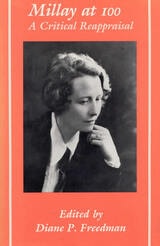
Millay At 100
A Critical ReappraisalDiane F. Freedman
Southern Illinois University Press, 1995
Though finding its occasion in the life of Millay— the centennial of the writer’ s birth— this volume refocuses attention on Millay’ s art by asking questions central to our present concerns: What in the varied body of Millay’ s work speaks to us most forcefully today? Which critical perspectives most illuminate her texts? How might those approaches be challenged, extended, or reoriented? In seeking the answers to such questions, the volume’ s contributors illuminate the means by which Millay’ s early success has been slighted and misunderstood and examine issues of personality, personae, critical stature, and formal experimentation in Millay’ s various genres: lyric poetry, the sonnet, verse drama, fiction, and the personal letter.
In 1920, following the publication of A Few Figs from Thistles, Millay was the "It girl" of American poetry. But by the late 1930s, her popularity waned as her critical reputation declined under the reign of high modernism and its critics. In fact, Millay, like others of her generation, had rejected modernist elitism in favor of public engagement, using her powerful public voice to plead for an end to the Sacco-Vanzetti trials as well as for U.S. entry into World War II. Condemned for both her politicizing and her political poetry, she was the first to admit that she and her poetry suffered in the service of public causes.
Grouped into four parts, these essays focus on Millay’ s relation to modernism, her revisionary perspectives on love, her treatment of time and of the female body, and her use of masquerade and impersonation in life and in art. Throughout, the essayists pose such questions as: Where is Millay’ s place in the literary histories of modern writing and in our hearts? How are we to value, interpret, and characterize the various forms and genres in which she wrote? What is the cultural work Millay achieves and reflects? How does she help us redefine modernism? What do Millay’ s great gifts enable us to see about genre, the social construction of gender, the definition of modernism, and the role of the poet?
Millay’ s considerable productivity, the range and virtues of her forms, and her experimentation clearly argue for a wide-ranging reappraisal of her work.

Millennial Countdown in New Guinea, Volume 47
Pamela J. Stewart and Andrew Strathern, eds.
Duke University Press, 0
The articles collected here represent a rich ethnographic record of events leading up to the new millennium, exploring "end times" versus "new world" notions among New Guinea societies. Unlike other published collections on New Guinea, this special issue of Ethnohistory focuses on the entire island, with essays on both Irian Jaya and Papua New Guinea. It makes a distinguished contribution to a classic theme in anthropology and the history of religion.
Millennial Ecuador
Critical Essays Cultural TransformationsNorman E Whitten
University of Iowa Press, 2003

Millennial Fandom
Television Audiences in the Transmedia AgeLouisa Ellen Stein
University of Iowa Press, 2015
These conflicting narratives of entrepreneurial creativity and digital immorality operate to quell the growing threat represented by millennials’ media agency. With fan activities becoming ever more visible on social media platforms including YouTube, Facebook, LiveJournal, Twitter, Polyvore, and Tumblr, the fan has become the avatar of our digital hopes and fears.
In an ambitious study encompassing a wide range of media texts, including popular television series like Kyle XY, Glee, Gossip Girl, Veronica Mars, and Pretty Little Liars and online works like The Lizzie Bennet Diaries, as well as fan texts from blog posts and tweets to remix videos, YouTube posts, and image-sharing streams, author Louisa Ellen Stein traces the circulation of the contradictory tropes of millennial hope and millennial noir. Looking at what millennials do with digital technology demonstrates the molding impact of commercial representations, and at the same time reveals how millennials are undermining, negotiating, and changing those narratives.
This generation—and the fans it represents—is actively transforming the media landscape into a dynamic, culturally transgressive space of collective authorship. Offering a rich and complex vision of the relationship between fandom and millennial culture, Millennial Fandom will interest fans, millennials, students, and scholars of contemporary media culture alike.
Millennial Landscape Change in Jordan
Geoarchaeology and Cultural EcologyCarlos E. Cordova
University of Arizona Press, 2007
Cordova focuses on geoarchaeological and cultural ecological aspects of research, presenting data from physical, chemical, and biological sources. He examines the changing influence of climate, vegetation, and hunting opportunities on cultural exploitation tactics, as well as the effects of the growing population and agriculture on the environment. Cordova argues that an interdisciplinary approach to studying the area is crucial to achieving a true understanding of Jordan’s changing landscape.
Chapter topics include approaches to the study of ancient Jordanian landscapes in the Near Eastern context; the physical scene; endowed landscapes of the woodlands; the encroaching drylands; the current and future state of the paleoecological and geoarchaeological record; patterns of millennial landscape change; and the process of interpreting millennial landscape change. The text is abundantly illustrated with photos, line illustrations, tables, and maps, providing a valuable assessment of archaeological developments over the prehistory and history of what today is the Hashemite Kingdom of Jordan. This volume will be especially welcomed by scholars interested in the archaeology, history, and geography of Jordan, the Levant, and the Near East and by field-school students working on archaeological projects in Jordan.
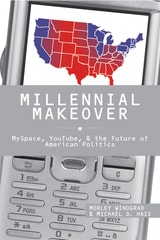
Millennial Makeover
MySpace, YouTube, and the Future of American PoliticsWinograd, Morley
Rutgers University Press, 2008
A 2008 New York Times Notable Book of the Year
It happens in America every four decades and it is about to happen again. America’s demand for change in the 2008 election will cause another of our country’s periodic political makeovers. This realignment, like all others before it, will result from the coming of age of a new generation of young Americans—the Millennial Generation—and the full emergence of the Internet-based communications technology that this generation uses so well. Beginning in 2008, almost everything about American politics and government will transform—voting patterns, the fortunes of the two political parties, the issues that engage the nation, and our government and its public policy.
Building on the seminal work of previous generational theorists,Morley Winograd and Michael D. Hais demonstrate and describe, for the first time, the two types of realignments—“idealist” and “civic”—that have alternated with one another throughout the nation’s history. Based on these patterns, Winograd and Hais predict that the next realignment will be very different from the last one that occurred in 1968. “Idealist” realignments, like the one put into motion forty years ago by the Baby Boomer Generation, produce, among other things, a political emphasis on divisive social issues and governmental gridlock. “Civic” realignments, like the one that is coming, and the one produced by the famous GI or “Greatest” Generation in the 1930s, by contrast, tend to produce societal unity, increased attention to and successful resolution of basic economic and foreign policy issues, and institution-building.
The authors detail the contours and causes of the country’s five previous political makeovers, before delving deeply into the generational and technological trends that will shape the next. The book’s final section forecasts the impact of the Millennial Makeover on the elections, issues, and public policies that will characterize America’s politics in the decades ahead.
For additional information go to:
Millennial Makeover website.
Millennial Makeover
MySpace, YouTube, and the Future of American PoliticsWinograd, Morley
Rutgers University Press, 2008
A 2008 New York Times Notable Book of the Year
It happens in America every four decades and it is about to happen again. America’s demand for change in the 2008 election will cause another of our country’s periodic political makeovers. This realignment, like all others before it, will result from the coming of age of a new generation of young Americans—the Millennial Generation—and the full emergence of the Internet-based communications technology that this generation uses so well. Beginning in 2008, almost everything about American politics and government will transform—voting patterns, the fortunes of the two political parties, the issues that engage the nation, and our government and its public policy.
Building on the seminal work of previous generational theorists,Morley Winograd and Michael D. Hais demonstrate and describe, for the first time, the two types of realignments—“idealist” and “civic”—that have alternated with one another throughout the nation’s history. Based on these patterns, Winograd and Hais predict that the next realignment will be very different from the last one that occurred in 1968. “Idealist” realignments, like the one put into motion forty years ago by the Baby Boomer Generation, produce, among other things, a political emphasis on divisive social issues and governmental gridlock. “Civic” realignments, like the one that is coming, and the one produced by the famous GI or “Greatest” Generation in the 1930s, by contrast, tend to produce societal unity, increased attention to and successful resolution of basic economic and foreign policy issues, and institution-building.
The authors detail the contours and causes of the country’s five previous political makeovers, before delving deeply into the generational and technological trends that will shape the next. The book’s final section forecasts the impact of the Millennial Makeover on the elections, issues, and public policies that will characterize America’s politics in the decades ahead.
For additional information go to:
Millennial Makeover website.
Millennial Style
The Politics of Experiment in Contemporary African Diasporic CultureAliyyah I. Abdur-Rahman
Duke University Press, 2024
Millennials Killed the Video Star
MTV's Transition to Reality ProgrammingAmanda Ann Klein
Duke University Press, 2021
Millions of Gifts for the Gods
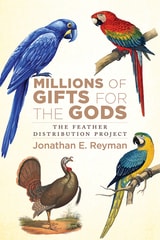
The Feather Distribution ProjectJonathan Reyman
University Press of Colorado, 2025
Grounded in Sol Tax’s concept of “action anthropology,” the project facilitated community-driven decision-making rather than imposing external solutions. This collaborative approach enabled Indigenous communities to maintain cultural practices that have persisted for over a millennium, dating back to the Ancestral Pueblo people and the Mogollon and Sinagua tribes, who viewed birds as sacred beings that helped humans emerge from the underworld. Yet the project’s impact extended far beyond cultural preservation. Over three decades, it distributed approximately 14.5 million feathers, valued at $20 million, to the Southwest Pueblos and other Indigenous Americans at no cost to them. Through partnerships with turkey hunters, zoos, bird clubs, the National Wild Turkey Federation, and dozens of volunteers, the initiative reduced illegal bird smuggling from Latin America, alleviated pressure on threatened bird populations, and eliminated harmful plucking practices.
Millions of Gifts for the Gods is an extended case study in applied anthropology, demonstrating how sustained collaboration between anthropologists and Indigenous communities can effectively address complex cultural, legal, and environmental challenges while preserving sacred traditions. This unique project is of special interest to anthropologists working in the American Southwest, as well as students and scholars of archaeology, ethnography, and ethnohistory.
Mimbres Archaeology of the Upper Gila, New Mexico
Stephen H. Lekson
University of Arizona Press, 1990
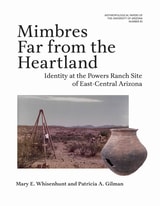
Mimbres Far from the Heartland
Identity at the Powers Ranch Site of East-Central ArizonaMary E. Whisenhunt and Patricia A. Gilman
University of Arizona Press, 2025
This work compares findings from Powers Ranch with those from neighboring sites in the Gila River Valley and further east in the Mimbres Valley, unraveling patterns of identity and affiliation that challenge previous understandings. The study is guided by three key research questions: the extent of affiliation between the community at the Powers Ranch site and Mimbres communities to the east, patterns that suggest Powers Ranch was a habitation and not a limited activity site, and whether the site was unique in comparison with Mimbres occupations situated to the south in the Gila River Valley. Contributions from scholars M. Steven Shackley, Martin H. Welker, and Arthur W. Vokes further enrich this volume, ensuring a comprehensive and authoritative exploration of the Powers Ranch site.
Mimbres Far from the Heartland is an invaluable addition to Southwest archaeology, shedding light on how people constructed unique identities in edge communities and how these identities were expressed through material culture and social networks. Whisenhunt and Gilman’s work significantly advances our understanding of Mimbres communities, offering new insights into the social resilience and cultural affiliations of people living far from their cultural heartland.
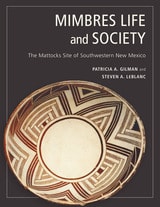
Mimbres Life and Society
The Mattocks Site of Southwestern New MexicoPatricia A. Gilman and Steven A. LeBlanc
University of Arizona Press, 2017
Mimbres pueblos, as early examples of people using surface room blocks, are ideal for investigating questions about how and why people moved from earlier subterranean pit structures to aboveground room blocks. The authors consider the number of households living at the site before and after the transition, as well as the lack of evidence for subsistence intensification and population growth as causes of this transition. These analyses suggest that each room block on the site housed a single family as opposed to multiple families, the more common interpretation. There were not necessarily more households on the site during the Classic period than earlier.
Patricia A. Gilman and Steven A. LeBlanc spent five seasons excavating at the Mattocks site and many more analyzing and writing about Mattocks site data. They note that subtle social differences among people were at play, and they emphasize that the Mattocks site may be unique among Mimbres pueblos in many aspects. Mimbres Life and Society reveals broad-ranging implications for southwestern archaeologists and anyone interested in understanding the ancient Southwest and early village societies.
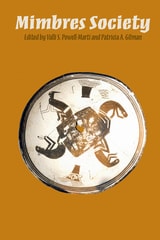
Mimbres Society
Edited by Valli S. Powell-Marti and Patricia A. Gilman
University of Arizona Press, 2006
While the attention to the extraordinary Mimbres painted pottery is well merited, the focus on its artistry alone has obscured other equally remarkable achievements and compelling questions about this unique and sophisticated society. Was the society as truly egalitarian as it has often been suggested? Was the pottery produced by specialists? How did Mimbres architecture—among the first to break living spaces into apartment-style room blocks—reflect the relationships among individuals, families, and communities? Did aggregate housing units translate into social equality, or did subtle hierarchies exist?
Tracing the way technology evolved in ceramic decoration, architecture, and mortuary practices, this collection of eight original contributions brings new insights into previously unexplored dimensions of Mimbres society. The contributors also provide vivid examples of how today’s archaeologists are linking field data to social theory.
Mimbres during the Twelfth Century
Abandonment, Continuity, and ReorganizationMargaret C. Nelson
University of Arizona Press, 1999
Mimesis and Science
Empirical Research on Imitation and the Mimetic Theory of Culture and ReligionScott R. Garrels
Michigan State University Press, 2011
This exciting compendium brings together, for the first time, some of the foremost scholars of René Girard’s mimetic theory, with leading imitation researchers from the cognitive, developmental, and neuro sciences. These chapters explore some of the major discoveries and developments concerning the foundational, yet previously overlooked, role of imitation in human life, revealing the unique theoretical links that can now be made from the neural basis of social interaction to the structure and evolution of human culture and religion. Together, mimetic scholars and imitation researchers are on the cutting edge of some of the most important breakthroughs in understanding the distinctive human capacity for both incredible acts of empathy and compassion as well as mass antipathy and violence. As a result, this interdisciplinary volume promises to help shed light on some of the most pressing and complex questions of our contemporary world.

Mimetic Theory and World Religions
Wolfgang Palaver
Michigan State University Press, 2017

Mind The Gap
The Education Of A Nature WriterJohn Hay
University of Nevada Press, 2006
Mind, Self, and Society
From the Standpoint of a Social BehavioristGeorge Herbert Mead
University of Chicago Press, 1967
"If philosophical eminence be measured by the extent to which a man's writings anticipate the focal problems of a later day and contain a point of view which suggests persuasive solutions to many of them, then George Herbert Mead has justly earned the high praise bestowed upon him by Dewey and Whitehead as a 'seminal mind of the very first order.'"—Sidney Hook, The Nation
Mind, Self, and Society
The Definitive EditionGeorge Herbert Mead
University of Chicago Press, 2015
This collection gets to the heart of Mead’s meditations on social psychology and social philosophy. Its penetrating, conversational tone transports the reader directly into Mead’s classroom as he teases out the genesis of the self and the nature of the mind. The book captures his wry humor and shrewd reasoning, showing a man comfortable quoting Aristotle alongside Alice in Wonderland.
Included in this edition are an insightful foreword from leading Mead scholar Hans Joas, a revealing set of textual notes by Dan Huebner that detail the text’s origins, and a comprehensive bibliography of Mead’s other published writings. While Mead’s lectures inspired hundreds of students, much of his brilliance has been lost to time. This new edition ensures that Mead’s ideas will carry on, inspiring a new generation of thinkers.

Mindful Movement
The Evolution of the Somatic Arts and Conscious ActionMartha Eddy
Intellect Books, 2016

Minerva and the Muse
A Life of Margaret FullerDoe Coover Agency
University of Massachusetts Press, 1996
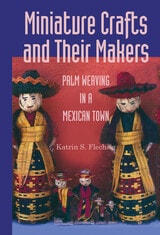
Miniature Crafts and Their Makers
Palm Weaving in a Mexican TownKatrin Flechsig
University of Arizona Press, 2004
Minima Ethnographica
Intersubjectivity and the Anthropological ProjectMichael Jackson
University of Chicago Press, 1998
Written in the style of Theodor Adorno's Minima Moralia, Jackson's work shows how general ideas are always anchored in particular social events and critical concerns. Emphasizing the intersubjective encounter over objective descriptions of the whole historical and contemporary situation of a given people, he illustrates the power and originality of existential anthropology through a series of vignettes from his fieldwork in Sierra Leone and Australia. An award-winning poet, novelist, and anthropologist, Jackson offers a timely critique of conventions that dull our sense of the links between academic study and lived experience.