Results by title
1488 books match the query 'Media Studies' and 119 start with m
Media Primitivism
Technological Art in AfricaDelinda Collier
Duke University Press, 2020
Media Reform and the Climate Emergency
Rethinking Communication in the Struggle for a Sustainable FutureDavid J. Park
University of Michigan Press, 2021
Award-winning author David J. Park argues that the battle against global warming is also a fight for media reform. With his new book Media Reform and the Climate Emergency: Rethinking Communication in the Struggle for a Sustainable Future, he critically examines how advertising, the digital infrastructure, and journalism advance the climate emergency and lays out a path of reform to help create a more sustainable world. The production and consumption of goods and services within consumer societies lead to unsustainable greenhouse gas emissions, and Park finds that much of mass communication is either dependent upon or closely tied to the success of this social organization. As a result, he suggests successful environmental movements creatively dismantle or reform institutional infrastructures that extend the planetary global warming crisis and the unsustainable consumption of nature.
Communication policies and industries are part of these infrastructures. Advertising evolved to propel a new consumer society that would encourage the over-consumption of goods and services with harmful and unsustainable production processes. Our digital infrastructure is largely premised upon the surveillance of online consumer habits and preferences, with the goal to create individualized messages to more effectively persuade people to increase their consumption habits. Much of commercial journalism resists the drastic and immediate regulatory changes necessary to address the worst aspects of this crisis. This is because so many of the needed changes challenge the media’s source of income, their libertarian philosophy, and the general status quo, which is preferred by elites. Bound to foster conversations among scholars, activists, politicians, and those who work in the communication industries, this book rethinks mass communication and highlights how immediate reform is needed in the struggle for a sustainable planet.

Media Rurality
Patrick Brodie and Darin Barney, editors
Duke University Press, 2026
Contributors. Christopher Ali, Patrick Bresnihan, Patrick Brodie, Darin Barney, Jenna Burrell, Jordan B. Kinder, Burç Köstem, Cindy Lin, Emily Ng, Lisa Parks, Anne Pasek, Esther Peeren, Nicole Starosielski, Ishita Tiwary, Hunter Vaughan, Ayesha Vemuri, Megan Wiessner, Assatu Wisseh
Media Theory in Japan
Marc Steinberg and Alexander Zahlten, editors
Duke University Press, 2017
Media Travels
Toward an Atlas of Global MediaJuan Llamas-Rodriguez
Amherst College Press, 2025
Media studies courses, particularly introductory courses, are often narrowly focused on US and Western European canons. Instructors for introductory media studies courses wishing to expand the offerings in their curricula will find in these essays new ways of approaching foundational concepts and issues in the field, including globalization, social difference, and diverse media cultures. Scholars wishing to expand their research into specific media forms or representational issues can also turn to these case studies for approaches from beyond the US. By including a variety of media and several geographical areas, the collection introduces readers to the formal, technological, and cultural diversity of global media studies.
Edited by Juan Llamas-Rodriguez with contributions from Anthony Adah and Añulika Agina, Maria Corrigan, Benjamin Han, Anna Shah Hoque, Meryem Kamil, Angelica Marie Lawson, Lilia Adriana Perez Limon, Sonia Robles, Kuhu Tanvir, David Tenorio, and Rachel van der Merwe.

Media and Dependency in South Africa
A Case Study of the Press and the Ciskei “Homeland”Les Switzer
Ohio University Press, 1985

Media and Management
Rutvica Andrijasevic
University of Minnesota Press, 2021
An essential account of how the media devices we use today inherit the management practices governing factory labor
This book argues that management is enabled by media forms, just as media gives life to management. Media technologies central to management have included the stopwatch, the punch card, the calculator, and the camera, while management theories are taught in printed and virtual textbooks and online through TED talks. In each stage of the evolving relationship between workers and employers, management innovations are learned through media, with media formats producing fresh opportunities for management.
Drawing on rich historical and ethnographic case studies, this book approaches key instances of the industrial and service economy—the legacy of Toyotism in today’s software industry, labor mediators in electronics manufacturing in Central and Eastern Europe, and app-based food-delivery platforms in China—to push media and management studies in new directions. Media and Management offers a provocative insight on the future of labor and media that inevitably cross geographical boundaries.
Media and the Affective Life of Slavery
Allison Page
University of Minnesota Press, 2022
How media shapes our actions and feelings about race
Amid fervent conversations about antiracism and police violence, Media and the Affective Life of Slavery delivers vital new ideas about how our feelings about race are governed and normalized by our media landscape. Allison Page examines U.S. media from the 1960s to today, analyzing how media culture instructs viewers to act and feel in accordance with new racial norms created for an era supposedly defined by an end to legal racism.
From the classic television miniseries Roots to the edutainment video game Mission 2: Flight to Freedom and the popular website slaveryfootprint.org, Media and the Affective Life of Slavery provides an in-depth look at the capitalist and cultural artifacts that teach the U.S. public about slavery. Page theorizes media not only as a system of representation but also as a technology of citizenship and subjectivity, wherein race is seen as a problem to be solved. Ultimately, she argues that visual culture works through emotion, a powerful lever for shaping and managing racialized subjectivity.
Media and the Affective Life of Slavery delivers compelling, provocative material and includes a wealth of archival research into such realms as news, entertainment, television, curricula, video games, and digital apps, providing new and innovative scholarship where none currently exists.

Media in Europe Today
Edited by Josef Trappel, Werner A. Meier, Leen d’Haenens, Jeanette Steemers, and Barbara Thomass for the Euromedia Research Group
Intellect Books, 2011
Media in Europe Today provides a comprehensive overview of European media in its current state of transformation. Through a focus on specific European media sectors, it assesses the impact of new technologies across industries and addresses a wide range of practices, strategies, and challenges facing European media today. The Euromedia Research Group has more than twenty years of experience in the observation of trends affecting media today, and this book marks the strong continuation of that long tradition.
Media in New Turkey
The Origins of an Authoritarian Neoliberal StateBilge Yesil
University of Illinois Press, 2016
Yesil confronts essential questions regarding: the role of the state and military in building the structures that shaped Turkey's media system; media adaptations to ever-shifting contours of political and economic power; how the far-flung economic interests of media conglomerates leave them vulnerable to state pressure; and the ways Turkey's politicized judiciary criminalizes certain speech.
Drawing on local knowledge and a wealth of Turkish sources, Yesil provides an engrossing look at the fault lines carved by authoritarianism, tradition, neoliberal reform, and globalization within Turkey's increasingly far-reaching media.
Media in the Enlarged Europe
Politics, Policy and IndustryEdited by Alec Charles
Intellect Books, 2009
Looking beyond national and cultural boundaries, Media in the Enlarged Europe focuses on the complexity and instability of the European Union and its relationship with the mass media. Contributors to this volume address the continuing growth and expansion of the European Union, relationships between old and new Europe, and social and political developments in the former communist countries. Media in the Enlarged Europe presents snapshots of media politics, policies, industries, and cultures in the European Union as a whole, while incorporating case studies of the history and current state of mass media in specific nations. This will be an essential volume for students and experts in media studies, international relations, and international studies.
Media, Culture, and Decolonization
Re-righting the Subaltern Histories of GhanaWunpini Fatimata Mohammed
Rutgers University Press, 2026
Media, Culture, and Decolonization: Re-righting the Subaltern Histories of Ghana invites us to look at media and culture from a decolonial perspective. Through Dagbaŋ epistemologies and knowledge systems, this book examines media by highlighting how African languages, cultures, and traditions can shift how we think of knowledge. It is an offering to anyone curious about the relationship between culture, language, and media. By focusing on African language media in Ghana such as film, television, and radio, the book emphasizes the importance of espousing a decolonial politic and praxis in the process of co-creating knowledge with Indigenous communities. It connects the struggles of global majority countries and demonstrates the ways in which (neo)colonialism and imperialism impede the work toward liberatory futures. This book demonstrates the potential that African language media hold as tools of cultural and epistemological decolonization.
Media, Democracy and European Culture
Edited by Ib Bondebjerg and Peter Madsen
Intellect Books, 2008
Media, Democracy and European Culture presents up-to-date and cutting-edge research on the political and cultural dimension of democracy in Europe and its representation in the media. This interdisciplinary volume brings together the work of some of the most prominent European scholars in media, political science, sociology, cultural studies and law. The contributors explore issues of globalization, the role of the media and communication policy to order to provide a comparative country-to-country look at how the media constructs European identity. This timely and forward-looking collection will be of interest to scholars of media, international and cultural studies.

Media, Erotics, and Transnational Asia
Purnima Mankekar and Louisa Schein, eds.
Duke University Press, 2012
Judith Farquhar examines how health magazines serve as sources of both medical information and erotic titillation to readers in urban China. Tom Boellstorff analyzes how queer zines produced in Indonesia construct the relationship between same-sex desire and citizenship. Purnima Mankekar examines the rearticulation of commodity affect, erotics, and nation on Indian television. Louisa Schein describes how portrayals of Hmong women in videos shot in Laos create desires for the homeland among viewers in the diaspora. Taken together, the essays offer fresh insights into research on gender, erotics, media, and Asia transnationally conceived.
Contributors. Anne Allison, Tom Boellstorff, Nicole Constable, Heather Dell, Judith Farquhar, Sarah L. Friedman, Martin F. Manalansan IV, Purnima Mankekar, Louisa Schein, Everett Yuehong Zhang
Media, Geopolitics, and Power
A View from the Global SouthHerman Wasserman
University of Illinois Press, 2018
Herman Wasserman analyzes the debates surrounding South Africa's new media presence against the backdrop of rapidly changing geopolitics. His exploration reveals how South African disputes regarding access to, and representation in, the media reflect the domination and inequality in the global communication sphere. Optimists see post-apartheid media as providing a vital space that encourages exchanges of opinion in a young democracy. Critics argue the public sphere mirrors South Africa's past divisions and privileges the viewpoints of the elite. Wasserman delves into the ways these simplistic narratives obscure the country's internal tensions, conflicts, and paradoxes even as he charts the diverse nature of South African entry into the global arena.
Media, Markets and Public Spheres
European Media at the CrossroadsEdited by Jostein Gripsrud and Lennart Weibull
Intellect Books, 2010
Using a sample of European newspapers and their TV listings as a stepping stone, Media, Markets and Public Spheres presents an overview of changes in European public spheres over the last fifty years. With in-depth analyses of structural changes in press and broadcasting, changing relations between media, and changes in media policies, this book explores how and why the media decisively influence most aspects of society. Media, Markets and Public Spheres will be useful to students in media and communication studies and European studies, as well as for those studying sociology and political science.
Media, Monarchy and Power
Neil Blain and Hugh O'Donnell
Intellect Books, 2013
Media, Nationalism and European Identities
Karol Jakubowicz
Central European University Press, 2011
Media, Technology, and Society
Theories of Media EvolutionW. Russell Neuman
University of Michigan Press, 2010
"This book is the perfect primer for understanding media in the digital age. We are in an era when newspaper, radio, and television are fast becoming archeological concepts. Herein are the reasons why."
---Nicholas Negroponte, founder and chairman of One Laptop per Child and cofounder of the MIT Media Laboratory
"Congratulations to Neuman and colleagues for a fascinating exploration of how previous new media were constructed, whether things could have been otherwise, and what can be learned for future media."
---Sonia Livingstone, Department of Media and Communications, the London School of Economics and Political Science
In Media, Technology, and Society, some of the most prominent figures in media studies explore the issue of media evolution. Focusing on a variety of compelling examples in media history, ranging from the telephone to the television, the radio to the Internet, these essays collectively address a series of notoriously vexing questions about the nature of technological change. Is it possible to make general claims about the conditions that enable or inhibit innovation? Does government regulation tend to protect or thwart incumbent interests? What kinds of concepts are needed to address the relationship between technology and society in a nonreductive and nondeterministic manner? To what extent can media history help us to understand and to influence the future of media in constructive ways? The contributors' historically grounded responses to these questions will be relevant to numerous fields, including history, media and communication studies, management, sociology, and information studies.
W. Russell Neuman is John Derby Evans Professor of Media Technology and Research Professor, Center for Political Studies, Institute for Social Research, at the University of Michigan.
DIGITALCULTUREBOOKS: a collaborative imprint of the University of Michigan Press and the University of Michigan Library
Mediating America
Black and Irish Press and the Struggle for Citizenship, 1870-1914Brian Shott
Temple University Press, 2019
Until recently, print media was the dominant force in American culture. The power of the paper was especially true in minority communities. African Americans and European immigrants vigorously embraced the print newsweekly as a forum to move public opinion, cohere group identity, and establish American belonging.
Mediating America explores the life and work of T. Thomas Fortune and J. Samuel Stemons as well as Rev. Peter C. Yorke and Patrick Ford—respectively two African American and two Irish American editor/activists in the late nineteenth and early twentieth centuries. Historian Brian Shott shows how each of these “race men” (the parlance of the time) understood and advocated for his group’s interests through their newspapers. Yet the author also explains how the newspaper medium itself—through illustrations, cartoons, and photographs; advertisements and page layout; and more—could constrain editors’ efforts to guide debates over race, religion, and citizenship during a tumultuous time of social unrest and imperial expansion.
Black and Irish journalists used newspapers to recover and reinvigorate racial identities. As Shott proves, minority print culture was a powerful force in defining American nationhood.
Mediating Vulnerability
Comparative Approaches and Questions of GenreEdited by Anneleen Masschelein, Florian Mussgnug, and Jennifer Rushworth
University College London, 2021
To experience vulnerability is to experience the tension between ruin and creativity: a vulnerable species faces extinction but also evolution, and a vulnerable person risks both irreparable harm and transformative connection. Mediating Vulnerability explores how this tension plays out across contemporary literary studies. Examining a variety of approaches to the destructive and remediating powers of genre, the authors consider how vulnerability intersects a range of representational forms including high-profile fiction by Margaret Atwood and Cormac McCarthy as well as lesser-known graphic novels, video games, television, and photography.
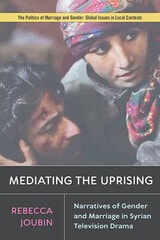
Mediating the Uprising
Narratives of Gender and Marriage in Syrian Television DramaRebecca Joubin
Rutgers University Press, 2020
While for some screenwriters a return to pre-2011 life would be welcome after so much bloodshed, others advocated profound cultural and social transformation, instead. They employed marriage and gender metaphors in the stories they wrote to engage in political critique, even at the risk of creating marketing difficulties for the shows or they created escapist stories such as transnational adaptations and Old Damascus tales. Serving as heritage preservation, Mediating the Uprising underscores that television drama creators in Syria have many ways of engaging in protest, with gender and marriage at the heart of the polemic.
Mediation and Protest Movements
Edited by Bart Cammaerts, Alice Mattoni, and Patrick McCurdy
Intellect Books, 2013
Over the past year, international and national media have been full of stories about protest movements and tumultuous social upheaval from Tunisia to California. But scholars have not yet fully addressed the connection between these movements and the media and communication channels through which their messages spread. Correcting that imbalance, Mediation and Protest Movements explores the nature of the relationship between protest movements, media representation, and communication strategies and tactics.
In a series of fascinating essays, contributors to this timely volume focus on the processes and practices in which contemporary protesters engage when acting with and through media. Covering both online and offline contexts as well as mainstream and alternative media, they consider media environments around the world in all their complexity. They also provide a broad and comparative perspective on the ways that protest movements at local and transnational levels engage in mediation processes and develop media practices. Bridging the gap between social movement theory and media and communication studies, Mediation and Protest Movements will serve as an important reference for students and scholars of the media and social change.
Mediatization(s)
Theoretical Conversations between Europe and Latin AmericaEdited by Carlos A. Scolari, José L. Fernández, and Joan R. Rodríguez-Amat
Intellect Books, 2021
This book presents the work of key authorities on mediatization from Europe and Latin America in one single volume, integrating macro-level theorization with applied observations of mediatization processes from a multidisciplinary perspective. Presented in a handbook format, with comprehensive introductory sections written by the editors and original texts signed by world-renowned researchers, this collection is a vital new resource for researchers and students alike.
Medium Cool, Volume 101
Andrew McNamara and Peter Krapp, eds.
Duke University Press, 0
Contributors. Keith Broadfoot, Rex Butler, Patrick Crogan, Wolfgang Ernst, Gary Hall, Rosemary Hawker, Peter Krapp, Catherine Liu, John MacArthur, Andrew McNamara, Toni Ross, Lisa Trahair, Georg Stanitzek, Georg Christoph Tholen, Lisa Trahair, Samuel Weber, Simon Morgan Wortham
Melodrama as Provocateur
Linda Williams. Edited by Christine Gledhill, Laura Horak, and Elisabeth R. Anker
Duke University Press, 2026
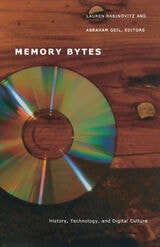
Memory Bytes
History, Technology, and Digital CultureLauren Rabinovitz and Abraham Geil, eds.
Duke University Press, 2004
These essays from scholars in the social sciences and humanities cover topics related to science and medicine, politics and war, mass communication, philosophy, film, photography, and art. Whether describing how the cultural and legal conflicts over player piano rolls prefigured controversies over the intellectual property status of digital technologies such as mp3 files; comparing the experiences of watching QuickTime movies to Joseph Cornell’s “boxed relic” sculptures of the 1930s and 1940s; or calling for a critical history of electricity from the Enlightenment to the present, Memory Bytes investigates the interplay of technology and culture. It relates the Information Age to larger and older political and cultural phenomena, analyzes how sensory effects have been technologically produced over time, considers how human subjectivity has been shaped by machines, and emphasizes the dependence of particular technologies on the material circumstances within which they were developed and used.
Contributors. Judith Babbitts, Scott Curtis, Ronald E. Day, David Depew, Abraham Geil, Sharon Ghamari-Tabrizi, Lisa Gitelman, N. Katherine Hayles, John Durham Peters, Lauren Rabinovitz, Laura Rigal, Vivian Sobchack, Thomas Swiss
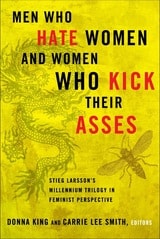
Men Who Hate Women and Women Who Kick Their Asses
Stieg Larsson's Millennium Trilogy in Feminist PerspectiveDonna King
Vanderbilt University Press, 2012
These lively and accessible essays expand the conversation in the blogosphere about the novels and films by connecting the controversies about gender roles to social trends in the real world.
Messianic Zionism in the Digital Age
Jews, Noahides, and the Third Temple ImaginaryRachel Z. Feldman
Rutgers University Press, 2024
Winner of the 2025 American Academy of Religion Award for Excellence in the Study of Religion: Analytical-Descriptive Studies
Winner of the 2023 Association for Jewish Studies Jordan Schnitzer First Book Prize
Judaism in the twenty-first century has seen the rise of the messianic Third Temple movement, as religious activists based in Israel have worked to realize biblical prophecies, including the restoration of a Jewish theocracy and the construction of the third and final Temple on Jerusalem’s Temple Mount. Through groundbreaking ethnographic research, Messianic Zionism in the Digital Age details how Third Temple visions have gained considerable momentum and political support in Israel and abroad .
The role of technology in this movement’s globalization has been critical. Feldman skillfully highlights the ways in which the internet and social media have contributed to the movement's growth beyond the streets of Jerusalem into communities of former Christians around the world who now identify as the Children of Noah (Bnei Noah). She charts a path for future research while documenting the intimate effects of political theologies in motion and the birth of a new transnational Judaic faith.
Metafilm
Materialist Rhetoric and Reflexive CinemaChristopher Carter
The Ohio State University Press, 2018
Ultimately, Metafilm reframes materialism as a multimodal composing-in-action, or reflexive materialism, focusing on movies that dramatize their entanglement in economic and historical trauma while provoking forms of resistance during and after viewing. Carter contends that even as we recognize the division of social power in the films, we must also recognize how the concept is subversive and eludes control. In looking at the interplay between the films’ content and their production, circulation, and reception, Carter explores how the films persuade us to identify with onscreen worlds before probing our expectations—validating some, rejecting others, and sometimes proposing new ways of watching altogether.
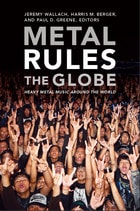
Metal Rules the Globe
Heavy Metal Music around the WorldJeremy Wallach, Harris M. Berger, and Paul D. Greene, eds.
Duke University Press, 2012
Contributors. Idelber Avelar, Albert Bell, Dan Bendrups, Harris M. Berger, Paul D. Greene, Ross Hagen, Sharon Hochhauser, Shuhei Hosokawa, Keith Kahn-Harris, Kei Kawano, Rajko Muršič,Steve Waksman, Jeremy Wallach, Robert Walser, Deena Weinstein, Cynthia P. Wong
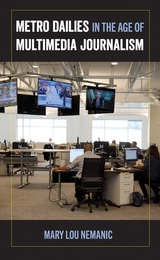
Metro Dailies in the Age of Multimedia Journalism
Mary Lou Nemanic
Temple University Press, 2020
The death of the daily newspaper in the internet age has been predicted for decades. While print newspapers are struggling from drops in advertising and circulation, their survival has been based on original reporting. Instead of a death knell, metro dailies are experiencing an identity crisis—a clash between traditional print journalism’s formality and detail and digital journalism’s informality and brevity.
In Metro Dailies in the Age of Multimedia Journalism, Mary Lou Nemanic provides in-depth case studies of five mid-size city newspapers to show how these publications are adapting to the transition from print-only to multiplatform content delivery—and how newsroom practices are evolving to address this change. She considers the successes when owners allow journalists to manage their newspapers—to ensure production of quality journalism under the protection of newspaper guilds—as well as how layoffs and resource cutbacks have jeopardized quality standards.
Arguing for an integrated approach in which print and online reporting are considered complementary and visual journalism is emphasized across platforms, Nemanic suggests that there is a future for the endangered daily metro newspaper.
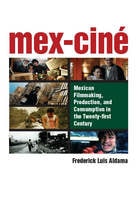
Mex-Ciné
Mexican Filmmaking, Production, and Consumption in the Twenty-first CenturyFrederick Luis Aldama
University of Michigan Press, 2013
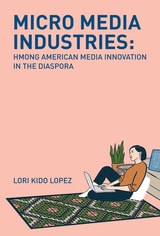
Micro Media Industries
Hmong American Media Innovation in the DiasporaLori Kido Lopez
Rutgers University Press, 2021
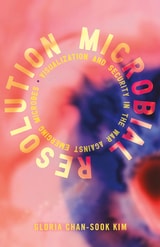
Microbial Resolution
Visualization and Security in the War against Emerging MicrobesGloria Chan-Sook Kim
University of Minnesota Press, 2024
An interdisciplinary study charting the war against microbial futures leads to a new theory of contemporary vision and visuality
In 1989, a group of U.S. government scientists met to discuss some surprising findings: new diseases were appearing around the world, and viruses that they thought long vanquished were resurfacing. Their appearance heralded a future perpetually threatened by unforeseeable biological risks, sparking a new concept of disease: the “emerging microbe.” With the Cold War nearing its end, American scientists and security experts turned to confront this new “enemy,” redirecting national security against its risky horizons. In order to be fought, emerging microbes first needed to be made perceptible; but how could something immaterial, unknowable, and ever mutating be coaxed into visibility, knowability, and operability?
Microbial Resolution charts the U.S.-led war on the emerging microbe to show how their uncertain futures were transformed into objects of global science and security. Moving beyond familiar accounts that link scientific knowledge production to optical practices of visualizing the invisible, Gloria Chan-Sook Kim develops a theory of “microbial resolution” to analyze the complex problematic that arises when dealing with these entities: what can be seen when there is nothing to see? Through a syncretic analysis of data mining, animal-tracking technologies, media networks, computer-modeled futures, and global ecologies and infrastructures, she shows how a visual impasse—the impossibility of seeing microbial futures—forms the basis for new modes of perceiving, knowing, and governing in the present.
Timely and thought provoking, Microbial Resolution opens up the rich paradoxes, irreconcilabilities, and failures inherent in this project and demonstrates how these tensions profoundly animate twenty-first-century epistemologies, aesthetics, affects, and ecologies.

Militant Visions
Black Soldiers, Internationalism, and the Transformation of American CinemaReich, Elizabeth
Rutgers University Press, 2016
Offering a nuanced reading of a figure that was simultaneously conservative and radical, Reich considers how the cinematic black soldier lent a human face to ongoing debates about racial integration, black internationalism, and American militarism. Militant Visions thus not only presents a new history of how American cinema represented race, but also demonstrates how film images helped to make history, shaping the progress of the civil rights movement itself.

Millennial Fandom
Television Audiences in the Transmedia AgeLouisa Ellen Stein
University of Iowa Press, 2015
These conflicting narratives of entrepreneurial creativity and digital immorality operate to quell the growing threat represented by millennials’ media agency. With fan activities becoming ever more visible on social media platforms including YouTube, Facebook, LiveJournal, Twitter, Polyvore, and Tumblr, the fan has become the avatar of our digital hopes and fears.
In an ambitious study encompassing a wide range of media texts, including popular television series like Kyle XY, Glee, Gossip Girl, Veronica Mars, and Pretty Little Liars and online works like The Lizzie Bennet Diaries, as well as fan texts from blog posts and tweets to remix videos, YouTube posts, and image-sharing streams, author Louisa Ellen Stein traces the circulation of the contradictory tropes of millennial hope and millennial noir. Looking at what millennials do with digital technology demonstrates the molding impact of commercial representations, and at the same time reveals how millennials are undermining, negotiating, and changing those narratives.
This generation—and the fans it represents—is actively transforming the media landscape into a dynamic, culturally transgressive space of collective authorship. Offering a rich and complex vision of the relationship between fandom and millennial culture, Millennial Fandom will interest fans, millennials, students, and scholars of contemporary media culture alike.
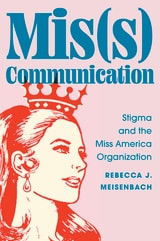
Mis(s) Communication
Stigma and the Miss America OrganizationRebecca J. Meisenbach
Rutgers University Press, 2026
Mis(s) Communication: Stigma and the Miss America Organization explores the one-hundred-year history of the Miss America Organization (MAO) as a site of stigma management. Through five years of ethnographic, archival, and interview-based research, Rebecca J. Meisenbach shows how pageant participation is both valorized and stigmatized—making MAO a key lens for studying stigma as a dynamic, power-laden communication process. The book examines stigma across individual, organizational, and societal levels, focusing on moments like Rule Seven, which once barred nonwhite participants, and the 1968 protest by the New York Radical Women alongside the first Miss Black America pageant. Meisenbach also investigates how contestants navigate stigma tied to intelligence, body image, and the sexualization of women. She analyzes MAO’s 2018 elimination of the swimsuit competition as a stigma management move and its recent shift to a for-profit model under Miss America Opportunity. The book ultimately argues for understanding stigma as communicative and deeply intersectional.
Misinformation Policy in Sub-Saharan Africa
From Laws and Regulations to Media LiteracyPeter Cunliffe-Jones, Assane Diagne, Alan Finlay, Sahite Gaye, Wallace Gichunge, Chido Onumah, Cornia Pretorius and Anya Schiffrin
University of Westminster Press, 2021
Misinformation Policy in Sub-Saharan Africa is a single volume containing two research reports by eight authors examining policy towards misinformation in Sub-Saharan Africa.
The volume first examines the teaching of ‘media literacy’ in state-run schools in seven Sub-Saharan African countries as of mid-2020, as relates to misinformation. It explains the limited elements of media and information literacy (MIL) that are included in the curricula in the seven countries studied and the elements of media literacy related to misinformation taught in schools in one province of South Africa since January 2020. The authors propose six fields of knowledge and skills specific to misinformation that are required in order to reduce students’ susceptibility to false and misleading claims. Identifying obstacles to the introduction and effective teaching of misinformation literacy, the authors make five recommendations for the promotion of misinformation literacy in schools, to reduce the harm misinformation causes.
The second report in the volume examines changes made to laws and regulations related to ‘false information’ in eleven countries across Sub-Saharan Africa 2016-2020 from Ethiopia to South Africa. By examining the terms of such laws against what is known of misinformation types, drivers and effects, it assesses the likely effects of punitive policies and those of more positive approaches that provide accountability in political debate by promoting access to accurate information and corrective speech. In contrast to the effects described for most recent regulations relating to misinformation, the report identifies ways in which legal and regulatory frameworks can be used to promote a healthier information environment.
Misinformation and Mass Audiences
Edited by Brian G. Southwell, Emily A. Thorson, and Laura Sheble
University of Texas Press, 2018
Lies and inaccurate information are as old as humanity, but never before have they been so easy to spread. Each moment of every day, the Internet and broadcast media purvey misinformation, either deliberately or accidentally, to a mass audience on subjects ranging from politics to consumer goods to science and medicine, among many others. Because misinformation now has the potential to affect behavior on a massive scale, it is urgently important to understand how it works and what can be done to mitigate its harmful effects.
Misinformation and Mass Audiences brings together evidence and ideas from communication research, public health, psychology, political science, environmental studies, and information science to investigate what constitutes misinformation, how it spreads, and how best to counter it. The expert contributors cover such topics as whether and to what extent audiences consciously notice misinformation, the possibilities for audience deception, the ethics of satire in journalism and public affairs programming, the diffusion of rumors, the role of Internet search behavior, and the evolving efforts to counteract misinformation, such as fact-checking programs. The first comprehensive social science volume exploring the prevalence and consequences of, and remedies for, misinformation as a mass communication phenomenon, Misinformation and Mass Audiences will be a crucial resource for students and faculty researching misinformation, policymakers grappling with questions of regulation and prevention, and anyone concerned about this troubling, yet perhaps unavoidable, dimension of current media systems.
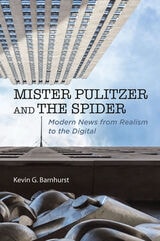
Mister Pulitzer and the Spider
Modern News from Realism to the DigitalKevin G. Barnhurst
University of Illinois Press, 2018
To solve the mystery, Kevin Barnhurst spent thirty years studying news going back to the realism of the 1800s. The usual suspects--technology, business competition, and the pursuit of scoops--are only partly to blame for the fate of news. The main culprit is modernism from the "Mister Pulitzer" era, which transformed news into an ideology called "journalism." News is no longer what audiences or experts imagine. Stories have grown much longer over the past century and now include fewer events, locations, and human beings. Background and context rule instead.
News producers adopted modernism to explain the world without recognizing how modernist ideas influence the knowledge they produce. When webs of networked connectivity sparked a resurgence in realist stories, legacy news stuck to big-picture analysis that can alienate audience members accustomed to digital briefs.
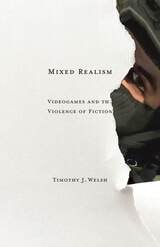
Mixed Realism
Videogames and the Violence of FictionTimothy J. Welsh
University of Minnesota Press, 2016
Mixed Realism is about how we interact with media. Timothy J. Welsh shows how videogames, like novels, both promise and trouble experiences of “immersion.” His innovative methodology offers a new understanding of the expanding role of virtuality in contemporary life.
Today’s wired culture is a mixed reality, conducted as exchanges between virtual and material contexts. We make balance transfers at an ATM, update Facebook timelines, and squeeze in sessions of Angry Birds on the subway. However, the “virtual” is still frequently figured as imaginary, as opposed to “real.” The vision of 1990s writers of a future that would pit virtual reality against actual reality has never materialized, yet it continues to haunt cultural criticism. Our ongoing anxiety about immersive media now surrounds videogames, especially “shooter games,” and manifests as a fear that gamers might not know the difference between the virtual world and the real world.
As Welsh notes, this is the paradox of real virtuality. We understand that the media-generated virtualities that fill our lives are not what they represent. But what are they if they are not real? Do they have presence, significance, or influence exceeding their material presence and the user processes that invoke them? What relationships do they establish through and beyond our interactions with them?
Mixed Realism brims with fresh analyses of literary works such as Truman Capote’s In Cold Blood and Mark Z. Danielewski’s House of Leaves, along with sustained readings of controversial videogames such as Super Columbine Massacre and Call of Duty: Modern Warfare 2. Continually connecting the dots between surprising groupings of texts and thinkers, from David Foster Wallace to the cult-classic videogame Eternal Darkness and from Cormac McCarthy to Grand Theft Auto, it offers a fresh perspective on both digital games and contemporary literature.
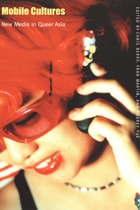
Mobile Cultures
New Media in Queer AsiaChris Berry, Fran Martin, and Audrey Yue, eds.
Duke University Press, 2003
Scholars, artists, and activists from a range of countries, the contributors chronicle the different ways new media galvanize Asian queer communities in Taiwan, South Korea, Japan, Indonesia, Thailand, Malaysia, India, and around the world. They consider phenomena such as the uses of the Internet among gay, lesbian, or queer individuals in Taiwan and South Korea; the international popularization of Japanese queer pop culture products such as Yaoi manga; and a Thai website’s reading of a scientific tract on gay genetics in light of Buddhist beliefs. Essays also explore the politically subversive possibilities opened up by the proliferation of media technologies, examining, for instance, the use of Cyberjaya—Malaysia’s government-backed online portal—to form online communities in the face of strict antigay laws.
Contributors. Chris Berry, Tom Boellstorff, Larissa Hjorth, Katrien Jacobs, Olivia Khoo, Fran Martin, Mark McLelland, David Mullaly, Baden Offord, Sandip Roy, Veruska Sabucco, Audrey Yue
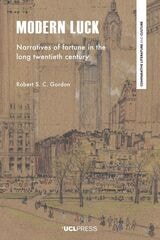
Modern Luck
Narratives of Fortune in the Long Twentieth CenturyRobert S. C. Gordon
University College London, 2023
Beliefs, superstitions, and tales about luck are present across all human cultures. Humans are perennially fascinated by luck and by its association with happiness and danger, uncertainty and aspiration. Yet it remains an elusive, ungraspable idea, one that slips and slides over time: all cultures reimagine what luck is and how to tame it at different stages in their history, and our own era is no exception to the rule.
Modern Luck sets out to explore the enigma of luck’s presence in modernity, examining the hybrid forms it has taken on in the modern imagination, and in particular in the field of modern stories. Analyzing a rich and unusually eclectic range of narratives taken from literature, film, music, television, and theatre, from Dostoevsky to Philip K. Dick, Pinocchio to Cimino, Curtiz to Kieslowski, it lays out first the usages and meanings of the language of luck, and then the key figures, patterns, and motifs that govern the stories told about it, from the late nineteenth century to the present day.

Molecular Capture
The Animation of BiologyAdam Nocek
University of Minnesota Press, 2021
How computer animation technologies became vital visualization tools in the life sciences
Who would have thought that computer animation technologies developed in the second half of the twentieth century would become essential visualization tools in today’s biosciences? This book is the first to examine this phenomenon. Molecular Capture reveals how popular media consumption and biological knowledge production have converged in molecular animations—computer simulations of molecular and cellular processes that immerse viewers in the temporal unfolding of molecular worlds—to produce new regimes of seeing and knowing.
Situating the development of this technology within an evolving field of historical, epistemological, and political negotiations, Adam Nocek argues that molecular animations not only represent a key transformation in the visual knowledge practices of life scientists but also bring into sharp focus fundamental mutations in power within neoliberal capitalism. In particular, he reveals how the convergence of the visual economies of science and entertainment in molecular animations extends neoliberal modes of governance to the perceptual practices of scientific subjects. Drawing on Alfred North Whitehead’s speculative metaphysics and Michel Foucault’s genealogy of governmentality, Nocek builds a media philosophy well equipped to examine the unique coordination of media cultures in this undertheorized form of scientific media. More specifically, he demonstrates how governmentality operates across visual practices in the biosciences and the popular mediasphere to shape a molecular animation apparatus that unites scientific knowledge and entertainment culture.
Ultimately, Molecular Capture proposes that molecular animation is an achievement of governmental design. It weaves together speculative media philosophy, science and technology studies, and design theory to investigate how scientific knowledge practices are designed through media apparatuses.

Moment of Action
Riddles of Cinematic PerformancePomerance, Murray
Rutgers University Press, 2016
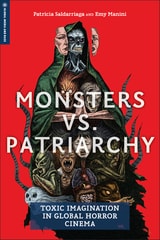
Monsters vs. Patriarchy
Toxic Imagination in Global Horror CinemaPatricia Saldarriaga
Rutgers University Press, 2025
Monsters vs. Patriarchy examines female monstrosity as it appears in horror films from around the world and considers specific political, scientific, and historical contexts to better understand how we construct and reconstruct monstrosity, using an intersectional approach to examine the imposition of gender and racial hierarchies that support national power structures. The authors contend that monstrous female cinematic subjects, including ghosts, witches, cannibals, and posthuman beings, are becoming empowered, using the tools of their monstrification to smash the colonial, white supremacist, and misogynist structures that created them.

Monstrous Nature and Representations of Environmental Harms
A Green Cultural Criminological PerspectiveAvi Brisman and Nigel South
Temple University Press, 2025
The authors use examples from popular culture, including Disney and Marvel Cinematic Universe films, to consider ideas about how the environment responds to people who cause it harm. Brisman and South identify and discuss three dominant and interrelated depictions of the relationship between humans and the environment: first, nature as monstrous or fear inducing; second, nature and the Earth (or parts of it) as abject; and third, the entanglement of nature and the apocalypse, wherein nature is contributing to the end of the world, with an end point sometimes conceptualized as one without humans.
Monstrous Nature and Representations of Environmental Harms argues that such representations have material consequences. The authors make the case for challenging them so that we neither perpetuate them nor retreat into cynicism and defeatism about the future of our planet.
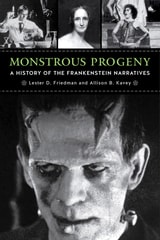
Monstrous Progeny
A History of the Frankenstein NarrativesFriedman, Lester D
Rutgers University Press, 2016

More Bad News From Israel
Greg Philo and Mike Berry
Pluto Press, 2011
Building on rigorous research by the world-renowned Glasgow University Media Group, More Bad News From Israel examines media coverage of the current conflict in the Middle East and the impact it has on public opinion.
The book brings together senior journalists and ordinary viewers to examine how audiences understand the news and how their views are shaped by media reporting. In the largest study ever undertaken in this area, the authors focus on television news. They illustrate major differences in the way Israelis and Palestinians are represented, including how casualties are shown and the presentation of the motives and rationales of both sides. They combine this with extensive audience research involving hundreds of participants from the USA, Britain and Germany. It shows extraordinary differences in levels of knowledge and understanding, especially amongst young people from these countries.
Covering recent developments, including the Israeli attacks on Lebanon and Gaza, this authoritative and up-to-date study will be an invaluable tool for journalists, activists and students and researchers of media studies.