Results by title
22279 books match the query 'Social Science' and 1258 start with m
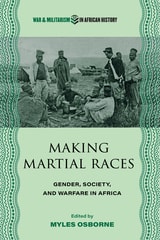
Making Martial Races
Gender, Society, and Warfare in AfricaMyles Osborne
Ohio University Press, 2024
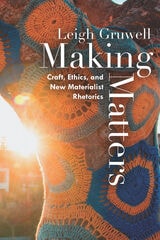
Making Matters
Craft, Ethics, and New Materialist RhetoricsLeigh Gruwell
Utah State University Press, 2022
To recast new materialist rhetorics as inherently crafty, Leigh Gruwell historicizes and locates the concept of craft both within rhetorical history as well as in the disciplinary history of writing studies. Her investigation centers on three specific case studies: craftivism, the fibercraft website Ravelry, and the 2017 Women’s March. These instances all highlight how a material, ecological understanding of rhetorical agency can enact political change.
Craft agency models how we humans might work with and alongside things—nonhuman, sometimes digital, sometimes material—to create more equitable relationships. Making Matters argues that craft is a useful starting point for addressing criticisms of new materialist rhetorics not only because doing so places rhetorical action as a product of complex relationships between a network of human and nonhuman actors, but also because it does so with an explicitly activist agenda that positions the body itself as a material interface.
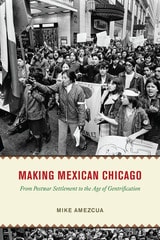
Making Mexican Chicago
From Postwar Settlement to the Age of GentrificationMike Amezcua
University of Chicago Press, 2022
Though Chicago is often popularly defined by its Polish, Black, and Irish populations, Cook County is home to the third-largest Mexican-American population in the United States. The story of Mexican immigration and integration into the city is one of complex political struggles, deeply entwined with issues of housing and neighborhood control. In Making Mexican Chicago, Mike Amezcua explores how the Windy City became a Latinx metropolis in the second half of the twentieth century.
In the decades after World War II, working-class Chicago neighborhoods like Pilsen and Little Village became sites of upheaval and renewal as Mexican Americans attempted to build new communities in the face of white resistance that cast them as perpetual aliens. Amezcua charts the diverse strategies used by Mexican Chicagoans to fight the forces of segregation, economic predation, and gentrification, focusing on how unlikely combinations of social conservatism and real estate market savvy paved new paths for Latinx assimilation. Making Mexican Chicago offers a powerful multiracial history of Chicago that sheds new light on the origins and endurance of urban inequality.
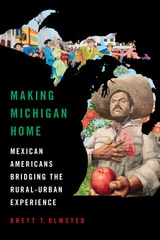
Making Michigan Home
Mexican Americans Bridging the Rural-Urban ExperienceBrett T. Olmsted
University of Illinois Press, 2025
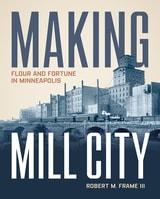
Making Mill City
Flour and Fortune in MinneapolisRobert M. Frame III
University of Minnesota Press, 2026
A richly illustrated history of the flour factories that transformed the milling industry worldwide—and forever changed the culture and architecture of Minneapolis
Among the most consequential advances of the Industrial Revolution was the invention of the modern roller mill, which sent the traditional millstone into obsolescence and fundamentally changed the production of a key ingredient to feeding the world. The culture and landscape of its hometown, Minneapolis, Minnesota, was altered as well, and Making Mill City tells the story of how revolutionary technologies originating at St. Anthony Falls on the Mississippi River put Minneapolis on the map and cemented its global status as “Mill City.”
With deep historical detail and abundant illustrations, Robert M. Frame III charts the dramatic transformation of Minneapolis milling—and urban life—between the early 1870s and 1920s. Two machines propelled this change: the middlings purifier and the modern roller mill. Enabling millers to grind hard Upper Midwestern spring wheat, these innovations gave rise to the “mammoth mills” and ever-expanding flour factories that would soon dominate the Minneapolis riverfront. Prominent entrepreneurs like those who gave their names to the Washburn and Pillsbury A Mills were significant, but Frame foregrounds the crucial roles of the millers, millwrights, and engineers who designed and equipped the massive new factories, as well as the editor of the legendary weekly trade publication Northwestern Miller, to paint a picture of the vibrant and diverse culture that grew around this industrial phenomenon.
A rich narrative describing how Minneapolis became the largest producer and exporter of wheat flour for more than fifty years, Making Mill City captures a critical chapter in the history of the city. Art and architecture inspired by mills and millers stand today as National Historic Landmarks, and the development and success of the current thriving metropolis have strong foundations in its milling history.
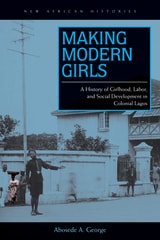
Making Modern Girls
A History of Girlhood, Labor, and Social Development in Colonial LagosAbosede A. George
Ohio University Press, 2014
Winner of the 2015 Aidoo-Snyder Book Prize for outstanding book on African women's experiences. (African Studies Association)
Honorable Mention, New York African Studies Association Book Prize
In Making Modern Girls, Abosede A. George examines the influence of African social reformers and the developmentalist colonial state on the practice and ideology of girlhood as well as its intersection with child labor in Lagos, Nigeria. It draws from gender studies, generational studies, labor history, and urban history to shed new light on the complex workings of African cities from the turn of the twentieth century through the nationalist era of the 1950s.
The two major schemes at the center of this study were the modernization project of elite Lagosian women and the salvationist project of British social workers. By approaching children and youth, specifically girl hawkers, as social actors and examining the ways in which local and colonial reformers worked upon young people, the book offers a critical new perspective on the uses of African children for the production and legitimization of national and international social development initiatives.
Making Modern Girls demonstrates how oral sources can be used to uncover the social history of informal or undocumented urban workers and to track transformations in practices of childhood over the course of decades. George revises conventional accounts of the history of development work in Africa by drawing close attention to the social welfare initiatives of late colonialism and by highlighting the roles that African women reformers played in promoting sociocultural changes within their own societies.
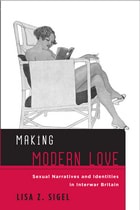
Making Modern Love
Sexual Narratives and Identities in Interwar BritainLisa Z. Sigel
Temple University Press, 2012
After the Great War, British men and women grappled with their ignorance about sexuality and desire. Seeking advice and information from doctors, magazines, and each other, they wrote tens of thousands of letters about themselves as sexual subjects. In these letters, they disclosed their uncertainties, their behaviors, and the role of sexuality in their lives. Their fascinating narratives tell how people sought to unleash their imaginations and fashion new identities.
Making Modern Love shows how readers embraced popular media—self-help books, fetish magazines, and advice columns—as a source of information about sexuality and a means for telling their own stories. From longings for transcendent marital union to fantasies of fetish-wear, cross-dressing, and whipping, men and women revealed a surprising range of desires and behaviors (queer and otherwise) that have been largely disregarded until now.
Lisa Sigel mines these provocative narratives to understand how they contributed to new subjectivities and the development of modern sexualities.
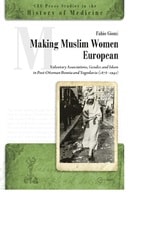
Making Muslim Women European
Voluntary Associations, Gender, and Islam in Post-Ottoman Bosnia and Yugoslavia (1878-1941)Fabio Giomi
Central European University Press, 2021
This social, cultural, and political history of Slavic Muslim women of the Yugoslav region in the first decades of the post-Ottoman era is the first to provide a comprehensive overview of the issues confronting these women. It is based on a study of voluntary associations (philanthropic, cultural, Islamic-traditionalist, and feminist) of the period.
It is broadly held that Muslim women were silent and relegated to a purely private space until 1945, when the communist state “unveiled” and “liberated” them from the top down. After systematic archival research in Bosnia, Croatia, Serbia, and Austria, Fabio Giomi challenges this view by showing: • How different sectors of the Yugoslav elite through association publications, imagined the role of Muslim women in post-Ottoman times, and how Muslim women took part in the construction or the contestation of these narratives. • How associations employed different means in order to forge a generation of “New Muslim Women” able to cope with the post-Ottoman political and social circumstances. • And how Muslim women used the tools provided by the associations in order to pursue their own projects, aims and agendas. The insights are relevant for today’s challenges facing Muslim women in Europe. The text is illustrated with exceptional photographs.T
Making National Heroes
The Exemplarist Production of Masculinities in Contemporary ChinaJacqueline Zhenru Lin
Hong Kong University Press, 2024
Making National Heroes is an ethnography on the making of national heroes in the commemoration of the Second World War in contemporary China. Foregrounding the lived experience of men and women who participate in commemorative activities, it theorizes how masculinity and nationalism entangle in recollecting war memories. Taking the line of feminist inquiry, this anthropological study aims to capture the significance of creating exemplars that are the realization of hegemonic masculinities. It adds a gendered perspective to studies on the exemplarist moral theory and theorizes exemplary men’s cross-culture significance in defining masculinities. Researchers in the fields of critical masculinity studies, anthropology, feminist methodology, China studies, and war memories will be interested in this book.

Making News at The New York Times
Nikki Usher
University of Michigan Press, 2014
This news ethnography brings to bear the overarching value clashes at play in a digital news world. The book argues that emergent news values are reordering the fundamental processes of news production. Immediacy, interactivity, and participation now play a role unlike any time before, creating clashes between old and new. These values emerge from the social practices, pressures, and norms at play inside the newsroom as journalists attempt to negotiate the new demands of their work. Immediacy forces journalists to work in a constant deadline environment, an ASAP world, but one where the vaunted traditions of yesterday's news still appear in the next day's print paper. Interactivity, inspired by the new user-computer directed capacities online and the immersive Web environment, brings new kinds of specialists into the newsroom, but exacts new demands upon the already taxed workflow of traditional journalists. And at time where social media presents the opportunity for new kinds of engagement between the audience and media, business executives hope for branding opportunities while journalists fail to truly interact with their readers.
Making Our Neighborhoods, Making Our Selves
George C. Galster
University of Chicago Press, 2019
Urban theorists have tried for decades to define exactly what a neighborhood is. But behind that daunting existential question lies a much murkier problem: never mind how you define them—how do you make neighborhoods productive and fair for their residents? In Making Our Neighborhoods, Making Our Selves, George C. Galster delves deep into the question of whether American neighborhoods are as efficient and equitable as they could be—socially, financially, and emotionally—and, if not, what we can do to change that. Galster aims to redefine the relationship between places and people, promoting specific policies that reduce inequalities in housing markets and beyond.

Making Peace With Property
Traces of Post-Conflict ColombiaMeghan L. Morris
Duke University Press, 2027

Making Peace with Nature
Ecological Encounters along the Korean DMZEleana J. Kim
Duke University Press, 2022
Making Photography Matter
A Viewer's History from the Civil War to the Great DepressionCara Finnegan
University of Illinois Press, 2017
Cara A. Finnegan analyzes a wealth of newspaper and magazine articles, letters to the editor, trial testimony, books, and speeches produced by viewers in response to specific photos they encountered in public. From the portrait of a young Lincoln to images of child laborers and Depression-era hardship, Finnegan treats the photograph as a locus for viewer engagement and constructs a history of photography's viewers that shows how Americans used words about images to participate in the politics of their day. As she shows, encounters with photography helped viewers negotiate the emergent anxieties and crises of U.S. public life through not only persuasion but action, as well.
Making Pictures in Stone
American Indian Rock Art of the NortheastEdward J. Lenik
University of Alabama Press, 2008
A full range of rock art appearances, including dendroglyphs, pictographs, and a selection of portable rock objects
The Indians of northeastern North America are known to us primarily through reports and descriptions written by European explorers, clergy, and settlers, and through archaeological evidence. An additional invaluable source of information is the interpretation of rock art images and their relationship to native peoples for recording practical matters or information, as expressions of their legends and spiritual traditions, or as simple doodling or graffiti. The images in this book connect us directly to the Indian peoples of the Northeast, mainly Algonkian tribes inhabiting eastern Pennsylvania, Maryland and the lower Potomac River Valley, New York, New Jersey, the six New EnglandStates, and Atlantic Canada. Lenik provides a full range of rock art appearances in the study area, including some dendroglyphs, pictographs, and a selection of portable rock objects. By providing a full analysis and synthesis of the data, including the types and distribution of the glyphs, and interpretations of their meaning to the native peoples, Lenik reveals a wealth of new information on the culture and lifeways of the Indians of the Northeast.
Making Precarity Work
Life on the Edge of Venice BeachLaura A. Orrico
University of Chicago Press, 2025
In Making Precarity Work, sociologist Laura A. Orrico shows how Los Angeles’s Venice Beach boardwalk, which is a magnet for tourists, is also a workplace, one that wouldn’t exist without the motley crew of people selling art, drinking, performing, using drugs, and working odd jobs who gather daily to engage in varied activities, from selling crafts to minding each other’s wares and asking for spare change.
Throughout the book, Orrico lifts up this workplace as a collective accomplishment, demonstrating how it can be a safety net to manage insecurity and inequality for those opting into its flexible and precarious structure, as well as how the LA government’s efforts to stabilize this work often disrupt the success of this collaborative and creative ecosystem. She also presents the ways this work can exacerbate those very inequalities. Sharing the personal stories of boardwalk workers, Orrico considers these juxtaposed realities and asks her audience to question how we can and should respond to a society whose best option for the disadvantaged is precarity.
Making Refuge
Somali Bantu Refugees and Lewiston, MaineCatherine Besteman
Duke University Press, 2016
Making Scenes
Reggae, Punk, and Death Metal in 1990s BaliEmma Baulch
Duke University Press, 2007
Making Scenes is an exploration of the subtle politics of identity that took place within and among these scenes throughout the course of the 1990s. Participants in the different scenes often explained their interest in death metal, punk, or reggae in relation to broader ideas about what it meant to be Balinese, which reflected views about Bali’s tourism industry and the cultural dominance of Jakarta, Indonesia’s capital and largest city. Through dance, dress, claims to public spaces, and onstage performances, participants and enthusiasts reworked “Balinese-ness” by synthesizing global media, ideas of national belonging, and local identity politics. Making Scenes chronicles the creation of subcultures at a historical moment when media globalization and the gradual demise of the authoritarian Suharto regime coincided with revitalized, essentialist formulations of the Balinese self.
Making Security Social
Disability, Insurance, and the Birth of the Social Entitlement State in GermanyGreg Eghigian
University of Michigan Press, 2000

Making Sense of Collectivity
Ethnicity, Nationalism and GlobalisationEdited by Sinisa Malesevic and Mark Haugaard
Pluto Press, 2002

Making Sense of the Census Revisited
Census Records for England and Wales,1801-1901. A Handbook for Historical ResearchersEdward Higgs
University of London Press, 2005
Making Senses of the Past
Toward a Sensory ArchaeologyEdited by Jo Day
Southern Illinois University Press, 2013
In ancient Peru, a site provides sensory surprises as voices resound beneath the ground and hidden carvings slowly reveal their secrets. In Canada and New Zealand, the flicker of reflected light from a lake dances on the faces of painted rocks and may have influenced when and why the pigment was applied. In Mesopotamia, vessels for foodstuffs build a picture of a past cuisine that encompasses taste and social activity in the building of communities. While perfume and flowers are examined in various cultures, in the chamber tombs of ancient Roman Palestine, we are reminded that not all smells are pleasant. Making Senses of the Past explores alternative ways to perceive past societies and offers a new way of wiring archaeology that incorporates the senses.
Making Sex Public and Other Cinematic Fantasies
Damon R. Young
Duke University Press, 2018
Making Space for Empire
Colonial Elites, Whiteness, and the Planning of Modern Puerto RicoJoaquin Villanueva
Duke University Press, 2027

Making Stars
Biography and Celebrity in Eighteenth-Century BritainNora Nachumi
University of Delaware Press, 2022
Making The Black Jacobins
C. L. R. James and the Drama of HistoryRachel Douglas
Duke University Press, 2019
Making Their Days Happen
Paid Personal Assistance Services Supporting People with Disability Living in Their Homes and CommunitiesLisa I. Iezzoni
Temple University Press, 2022
Most Americans—even those with significant disability—want to live in their homes and communities. Unpaid family members or friends often work as “informal” caregivers, helping those who need assistance— and many feel they have no option but to serve. In contrast, paid personal assistance services workers (PAS) provide a lifeline to those consumers with complex needs and limited social networks. However, there is a crisis looming in the increasing needs for paid PAS and the limited available PAS workforce.
Making Their Days Happen explores disability, health, and civil rights, along with relevant federal and state labor policies related to personal assistance services. Lisa Iezzoni addresses the legal context of paid PAS as well as financing mechanisms for obtaining home-based personal assistance. She also draws upon interviews she conducted with paid PAS consumers and PAS workers to explore PAS experiences and their perspectives about their work.
Offering recommendations for improving future experiences of PAS consumers and providers, Iezzoni emphasizes that people with disabilities want to be a part of society, and PAS workers who do this low-wage work find satisfaction in helping them achieve their goals.

Making Their Own Way
Southern Blacks' Migration to Pittsburgh, 1916-30Peter Gottlieb
University of Illinois Press, 1987
on that momentous movement historians know as the Great Migration. Peter
Gottlieb shatters the received portrait of southern migrants as bewildered,
premodern folk, 'utterly unprepared' for the complexities of urban life.
African Americans in his account emerge as complex, creative agents, exploiting
old solidarities and building new ones, transforming the urban landscape
even as it transformed them." -- James Campbell, Northwestern University
"Engagingly written and well organized. . . . A major addition to
the fields of Afro-American, urban, and working-class history." --
Howard N. Rabinowitz, Georgia Historical Quarterly
"Gottlieb uses oral histories, corporate records, and primary and
secondary scholarship to present a useful picture of an important part
of the Great Migration that followed World War I." -- George Lipsitz,
Choice
"Sensitive and yet also incisive. . . . clear and often compelling.
An outstanding study." -- James R. Barrett, Journal of American
Ethnic History
Publication of this work was supported in part by a grant from the
Andrew W. Mellon Foundation.
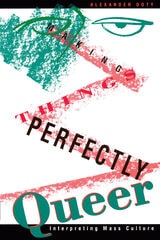
Making Things Perfectly Queer
Interpreting Mass CultureAlexander Doty
University of Minnesota Press, 1993
Doty argues that films, television, and other forms of mass culture consistently elicit a wide range of queer (sexually liminal) responses, and suggests an interpretive framework for understanding mass culture that stands as a corrective to many standard cultural approaches.
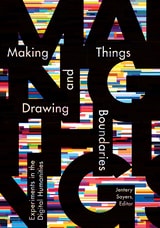
Making Things and Drawing Boundaries
Experiments in the Digital HumanitiesJentery Sayers
University of Minnesota Press, 2017
In Making Things and Drawing Boundaries, critical theory and cultural practice meet creativity, collaboration, and experimentation with physical materials as never before. Foregrounding the interdisciplinary character of experimental methods and hands-on research, this collection asks what it means to “make” things in the humanities. How is humanities research manifested in hand and on screen alongside the essay and monograph? And, importantly, how does experimentation with physical materials correspond with social justice and responsibility? Comprising almost forty chapters from ninety practitioners across twenty disciplines, Making Things and Drawing Boundaries speaks directly and extensively to how humanities research engages a growing interest in “maker” culture, however “making” may be defined.
Contributors: Erin R. Anderson; Joanne Bernardi; Yana Boeva; Jeremy Boggs; Duncan A. Buell; Amy Burek; Trisha N. Campbell; Debbie Chachra; Beth Compton; Heidi Rae Cooley; Nora Dimmock; Devon Elliott; Bill Endres; Katherine Faull; Alexander Flamenco; Emily Alden Foster; Sarah Fox; Chelsea A. M. Gardner; Susan Garfinkel; Lee Hannigan; Sara Hendren; Ryan Hunt; John Hunter; Diane Jakacki; Janelle Jenstad; Edward Jones-Imhotep; Julie Thompson Klein; Aaron D. Knochel; J. K. Purdom Lindblad; Kim Martin; Gwynaeth McIntyre; Aurelio Meza; Shezan Muhammedi; Angel David Nieves; Marcel O’Gorman; Amy Papaelias; Matt Ratto; Isaac Record; Jennifer Reed; Gabby Resch; Jennifer Roberts-Smith; Melissa Rogers; Daniela K. Rosner; Stan Ruecker; Roxanne Shirazi; James Smithies; P. P. Sneha; Lisa M. Snyder; Kaitlyn Solberg; Dan Southwick; David Staley; Elaine Sullivan; Joseph Takeda; Ezra Teboul; William J. Turkel; Lisa Tweten.

Making Uncertainty
Tuberculosis, Substance Use, and Pathways to Health in South AfricaAnna Versfeld
Rutgers University Press, 2023
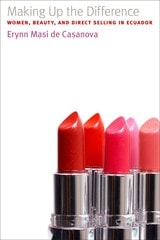
Making Up the Difference
Women, Beauty, and Direct Selling in EcuadorBy Erynn Masi de Casanova
University of Texas Press, 2011
Globalization and economic restructuring have decimated formal jobs in developing countries, pushing many women into informal employment such as direct selling of cosmetics, perfume, and other personal care products as a way to "make up the difference" between household income and expenses. In Ecuador, with its persistent economic crisis and few opportunities for financially and personally rewarding work, women increasingly choose direct selling as a way to earn income by activating their social networks. While few women earn the cars and trips that are iconic prizes in the direct selling organization, many use direct selling as part of a set of household survival strategies.
In this first in-depth study of a cosmetics direct selling organization in Latin America, Erynn Masi de Casanova explores women's identities as workers, including their juggling of paid work and domestic responsibilities, their ideas about professional appearance, and their strategies for collecting money from customers. Focusing on women who work for the country's leading direct selling organization, she offers fascinating portraits of the everyday lives of women selling personal care products in Ecuador's largest city, Guayaquil. Addressing gender relations (including a look at men's direct and indirect involvement), the importance of image, and the social and economic context of direct selling, Casanova challenges assumptions that this kind of flexible employment resolves women's work/home conflicts and offers an important new perspective on women's work in developing countries.
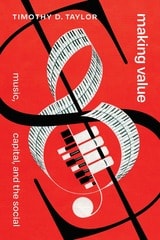
Making Value
Music, Capital, and the SocialTimothy D. Taylor
Duke University Press, 2024
Making War in Côte d'Ivoire
Mike McGovern
University of Chicago Press, 2011
After a brief period of active combat in 2002, the conflict in Côte d’Ivoire settled into a pattern of neither war nor peace until the 2010 elections led to a new phase of direct conflict. During these taut years, short bursts of intense violence alternated with long periods of standoff. When things were peaceful, the Ivorian political elite and the press produced inflammatory rhetoric while soldiers and militias used the state of emergency as an excuse to shake down civilians at roadblocks. What kept this perpetually tense, dismal, and destructive situation simmering? In this groundbreaking book, Mike McGovern suggests the answer lies in understanding war as a process, not a series of events, and that rather than focusing on the role of political institutions, we should be paying attention to the flawed and unpredictable people within them.
McGovern argues that only deep knowledge of a region—its history, languages, literature, and popular culture—can yield meaningful insights into political decision making. Putting this theory into action, he examines an array of issues from the micro to the macro, including land tenure disputes, youth boredom, organized crime, and the international cocoa trade. Drawn from McGovern’s academic research and experience working for a conflict resolution think tank and the political access that position gave him, Making War in Côte D’Ivoire will be the definitive work on the Ivorian conflict and an innovative example of how anthropology can address the complexities of politics.
Making Whole What Has Been Smashed
On Reparations PoliticsTorpey, John
Rutgers University Press, 2017
Viewing the search for “coming to terms with the past” as a form of politics, John Torpey argues that there are major differences between reparations for the living victims of past wrongdoing and reparations for the descendants of such victims. More fundamentally, he argues that claims for reparations comprise a relatively novel kind of politics that involves a quest for symbolic recognition and material compensation for those seeking them—through the idiom of the past rather than the present. This reissue is the first paperback edition and contains a new preface by the author.
Making Women Pay
Microfinance in Urban IndiaSmitha Radhakrishnan
Duke University Press, 2022
Making Work Pay
Bruce D. Meyer
Russell Sage Foundation, 2001
Making World Literature
Actors, Institutions, and Networks in the United States since 1890Anna Muenchrath
University of Massachusetts Press, 2024
From universities to governments, the Big Five publishers to Amazon, the influence of institutions abounds in US publishing. A diverse array of books from around the globe have been made into world literature in the US, selected by editors, publishers, and bureaucrats, produced by non-profits and for-profit presses of all sizes, and distributed through schools, publishing programs, and bookstores. The resulting world literary canon is the product of complex negotiations between individual preferences and institutional mandates, as well as economic, cultural, and pedagogical logics. While book publishing has fallen increasingly under the sway of global capitalism, yet the literary world remains made up of a series of individuals making choices about whom to fund, teach, translate, edit, and publish. The “world” of world literature, Anna Muenchrath argues, is a heterogeneous network of people whose circulation of literature is necessarily imbricated in the market economy, but whose selections might resist that economy and open new literary futures. Through archival research and close readings, this book considers what those participating are trying to do in circulating a text, and what communities they are helping to form or strengthen.
Making World Literature posits that network theory can effectively model the agency of actors and institutions in the literary field, making visible both the long-term accrual of power, as well as the choices of authors, translators, editors, and readers who do not simply replicate the values of a global literary marketplace, but divert, question, and undermine them. Muenchrath closely examines the paratexts and archival documents surrounding moments of global circulation in and through institutions like US world literature anthologies, the Council of Books in Wartime, the Iowa Writer’s Workshop, Oprah’s Book Club, and Amazon’s translation imprint. The granularity of these case studies reveals the increasingly limited agency of the individual in the global literary field, demonstrating how such players are important actors, and how their choices open up further options for later actors seeking to take texts down new paths toward or after publication.
Making Worlds
Gender, Metaphor, MaterialityEdited by Susan Hardy Aiken, Ann Brigham, Sallie A. Marston, and Penny Waterstone
University of Arizona Press, 1997
In recent years these questions have occasioned intensifying debates, but they have seldom extended beyond the boundaries of individual academic disciplines or crossed the divide that has traditionally separated the academy from the "outside" world. Making Worlds both questions and traverses those divisions by combining personal essays, activist political rhetoric, oral history, poetry, iconography, and performance art with interdisciplinary academic discourses.
Representing a wide range of perspectives, Making Worlds develops a provocative conversation about gender and spatiality in the interwoven symbolic and material environments we create. The contributors engage such issues as the body as site of symbolic action, fabrication, and desire; the place and play of sexualities; the cultural implications of everyday life—home, travel, work, childbirth, food, disease, and death; technology and mass media; surveillance, confinement, and the law; the dynamics of race and ethnicity; imperialism, oppression, and resistance; the politics of urban spaces; landscape and cultural memory; the experience of time; and the nature of "Nature." For students and scholars in cultural studies, geography, literary criticism, anthropology, history, and women's studies, it offers new ways of thinking about space, place, and the spatial contexts of social thought and action.
Making a Global Immigrant Neighborhood
Brooklyn's Sunset ParkTarry Hum
Temple University Press, 2014
Based on more than a decade of research, Making a Global Immigrant Neighborhood charts the evolution of Sunset Park--with a densely concentrated working-poor and racially diverse immigrant population--from the late 1960s to its current status as one of New York City's most vibrant neighborhoods.
Tarry Hum shows how processes of globalization, such as shifts in low-wage labor markets and immigration patterns, shaped the neighborhood. She explains why Sunset Park's future now depends on Asian and Latino immigrant collaborations in advancing common interests in community building, civic engagement, entrepreneurialism, and sustainability planning. She shows, too, how residents' responses to urban development policies and projects and the capital represented by local institutions and banks foster community activism.
Hum pays close attention to the complex social, political, and spatial dynamics that forge a community and create new models of leadership as well as coalitions. The evolution of Sunset Park so astutely depicted in this book suggests new avenues for studying urban change and community development.
Making a Killing
Femicide, Free Trade, and La FronteraEdited by Alicia Gaspar de Alba, with Georgina Guzmán
University of Texas Press, 2010
Since 1993, more than five hundred women and girls have been murdered in Ciudad Juárez across the border from El Paso, Texas. At least a third have been sexually violated and mutilated as well. Thousands more have been reported missing and remain unaccounted for. The crimes have been poorly investigated and have gone unpunished and unresolved by Mexican authorities, thus creating an epidemic of misogynist violence on an increasingly globalized U.S.-Mexico border.
This book, the first anthology to focus exclusively on the Juárez femicides, as the crimes have come to be known, compiles several different scholarly "interventions" from diverse perspectives, including feminism, Marxism, critical race theory, semiotics, and textual analysis. Editor Alicia Gaspar de Alba shapes a multidisciplinary analytical framework for considering the interconnections between gender, violence, and the U.S.-Mexico border. The essays examine the social and cultural conditions that have led to the heinous victimization of women on the border—from globalization, free trade agreements, exploitative maquiladora working conditions, and border politics, to the sexist attitudes that pervade the social discourse about the victims. The book also explores the evolving social movement that has been created by NGOs, mothers' organizing efforts, and other grassroots forms of activism related to the crimes. Contributors include U.S. and Mexican scholars and activists, as well as personal testimonies of two mothers of femicide victims.
Making a Promised Land
Harlem in Twentieth-Century Photography and FilmMassood, Paula J.
Rutgers University Press, 2013
Making a Promised Land examines the interconnected histories of African American representation, urban life, and citizenship as documented in still and moving images of Harlem over the last century. Paula J. Massood analyzes how photography and film have been used over time to make African American culture visible to itself and to a wider audience and charts the ways in which the “Mecca of the New Negro” became a battleground in the struggle to define American politics, aesthetics, and citizenship. Visual media were first used as tools for uplift and education. With Harlem’s downturn in fortunes through the 1930s, narratives of black urban criminality became common in sociological tracts, photojournalism, and film. These narratives were particularly embodied in the gangster film, which was adapted to include stories of achievement, economic success, and, later in the century, a nostalgic return to the past. Among the films discussed are Fights of Nations (1907), Dark Manhattan (1937), The Cool World (1963), Black Caesar (1974), Malcolm X (1992), and American Gangster (2007). Massood asserts that the history of photography and film in Harlem provides the keys to understanding the neighborhood’s symbolic resonance in African American and American life, especially in light of recent urban redevelopment that has redefined many of its physical and demographic contours.
Making a Scene
Urban Landscapes, Gentrification, and Social Movements in SwedenKimberly A. Creasap
Temple University Press, 2022
In the three largest cities in Sweden, social movement “scenes”—networks of social movement actors and the places they inhabit—challenge threats such as gentrification. The geography of the built environment influences their ability to lay claim to urban space and to local political processes. In Making a Scene, Kimberly Creasap emphasizes that it is the centrality, concentration, and visibility of these scenes that make them most effective. Whereas some scenes become embedded as part of everyday life—as in Malmö—in contrast, scenes in Göteborg and Stockholm often fail to become part of the fabric of urban neighborhoods.
Creasap investigates key spaces for scenes, from abandoned industrial areas and punk clubs to street festivals, bookstores, and social centers, to show how activists create sites and develop structures of resistance that are anti-capitalist, anti-fascist, anti-gentrification, queer, and feminist. She also charts the relationship between scenes and city spaces to show these autonomous social movements create their own cultural landscapes. Making a Scene encourages critical thinking about spatiality and place in the sociology of social movements and the role of social movements as important actors in urban development.
Making a Social Body
British Cultural Formation, 1830-1864Mary Poovey
University of Chicago Press, 1995
Poovey illuminates the ways literary genres, such as the novel, and innovations in social thought, such as statistical thinking and anatomical realism, helped separate social concerns from the political and economic domains. She then discusses the influence of the social body concept on Victorian ideas about the role of the state, examining writings by James Phillips Kay, Thomas Chalmers, and Edwin Chadwick on regulating the poor. Analyzing the conflict between Kay's idea of the social body and Babbage's image of the social machine, she considers the implications of both models for the place of Victorian women. Poovey's provocative readings of Disraeli's Coningsby, Gaskell's Mary Barton, and Dickens's Our Mutual Friend show that the novel as a genre exposed the role gender played in contemporary discussions of poverty and wealth.
Making a Social Body argues that gender, race, and class should be considered in the context of broader concerns such as how social authority is distributed, how institutions formalize knowledge, and how truth is defined.
Making a Spectacle
Feminist Essays on Contemporary Women's TheatreEdited and with an Introduction by Lynda Hart
University of Michigan Press, 1988
Making an Antislavery Nation
Lincoln, Douglas, and the Battle over FreedomGraham A. Peck
University of Illinois Press, 2020
This sweeping narrative presents an original and compelling explanation for the triumph of the antislavery movement in the United States prior to the Civil War. Abraham Lincoln's election as the first antislavery president was hardly preordained. From the country's inception, Americans had struggled to define slavery's relationship to freedom. Most Northerners supported abolition in the North but condoned slavery in the South, while most Southerners denounced abolition and asserted slavery's compatibility with whites' freedom. On this massive political fault line hinged the fate of the nation.
Graham A. Peck meticulously traces the conflict over slavery in Illinois from the Northwest Ordinance in 1787 to Lincoln's defeat of his archrival Stephen A. Douglas in the 1860 election. Douglas's attempt in 1854 to persuade Northerners that slavery and freedom had equal national standing stirred a political earthquake that brought Lincoln to the White House. Yet Lincoln's framing of the antislavery movement as a conservative return to the country's founding principles masked what was in fact a radical and unprecedented antislavery nationalism. It justified slavery's destruction but triggered the Civil War.
Presenting pathbreaking interpretations of Lincoln, Douglas, and the Civil War's origins, Making an Antislavery Nation shows how battles over slavery paved the way for freedom's triumph in America.
Making an Issue of Child Abuse
Political Agenda Setting for Social ProblemsBarbara J. Nelson
University of Chicago Press, 1986
Making and Unmaking Public Health in Africa
Ethnographic and Historical PerspectivesRuth J. Prince
Ohio University Press, 2013
This volume explores how medical professionals and patients, government officials, and ordinary citizens approach questions of public health as they navigate contemporary landscapes of NGOs and transnational projects, faltering state services, and expanding privatization. Its contributors analyze the relations between the public and the private providers of public health, from the state to new global biopolitical formations of political institutions, markets, human populations, and health. Tensions and ambiguities animate these complex relationships, suggesting that the question of what public health actually is in Africa cannot be taken for granted. Offering historical and ethnographic analyses, the volume develops an anthropology of public health in Africa.
Contributors: P. Wenzel Geissler; Murray Last; Rebecca Marsland; Lotte Meinert; Benson A. Mulemi; Ruth J. Prince; and Noemi Tousignant.
Making the American Home
Middle-Class Women and Domestic Material Culture, 1840–1940Marilyn F. Motz
University of Wisconsin Press, 1988
Making the American Team
Sport, Culture, and the Olympic ExperienceMark Dyreson
University of Illinois Press, 1998
Sport dominates television and the mass media. Politics and business are a-bustle with sports metaphors. Endorsements by athletes sell us products. "Home run," "slam dunk," and the rest of the vocabulary of sport color daily conversation. Even in times of crisis and emergency, the media reports the scores and highlights.
Marky Dyreson delves into how our obsession with sport came into being with a close look at coverage of the Olympic Games between 1896 and 1912. How people reported and consumed information on the Olympics offers insight into how sport entered the heart of American culture as part of an impetus for social reform. Political leaders came to believe in the power of sport to revitalize the "republican experiment." Sport could instill a new sense of national identity that would forge a new sense of community and a healthy political order while at the same time linking America's intellectual and power elite with the experiences of the masses.