Results by title
5448 books match the query 'History and criticism' and 307 start with m
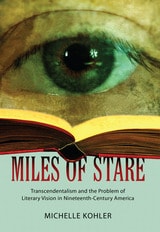
Miles of Stare
Transcendentalism and the Problem of Literary Vision in Nineteenth-Century AmericaMichelle Kohler
University of Alabama Press, 2014
The strangeness of nineteenth-century poetic vision is exemplified most famously by Emerson’s transparent eyeball. That disembodied, omniscient seer is able to shed its body and transcend sight paradoxically in order to see—not to create—poetic language “manifest” on the American landscape. In Miles of Stare, Michelle Kohler explores the question of why, given American transcendentalism’s anti-empiricism, the movement’s central trope becomes an eye purged of imagination. And why, furthermore, she asks, despite its insistent empiricism, is this notorious eye also so decidedly not an eye? What are the ethics of casting a boldly equivocal metaphor as the source of a national literature amidst a national landscape fraught with slavery, genocide, poverty, and war?
Miles of Stare explores these questions first by tracing the historical emergence of the metaphor of poetic vision as the transcendentalists assimilated European precedents and wrestled with America’s troubling rhetoric of manifest destiny and national identity. These questions are central to the work of many nineteenth-century authors writing in the wake of transcendentalism, and Kohler offers examples from the writings of Douglass, Hawthorne, Dickinson, Howells, and Jewett that form a cascade of new visual metaphors that address the irreconcilable contradictions within the transcendentalist metaphor and pursue their own efforts to produce an American literature. Douglass’s doomed witness to slavery, Hawthorne’s reluctantly omniscient narrator, and Dickinson’s empty “miles of Stare” variously skewer the authority of Emerson’s all-seeing poetic eyeball while attributing new authority to the limitations that mark their own literary gazes.
Tracing this metaphorical conflict across genres from the 1830s through the 1880s, Miles of Stare illuminates the divergent, contentious fates of American literary vision as nineteenth-century writers wrestle with the commanding conflation of vision and language that lies at the center of American transcendentalism—and at the core of American national identity.
Millennial Style
The Politics of Experiment in Contemporary African Diasporic CultureAliyyah I. Abdur-Rahman
Duke University Press, 2024
Milton Babbitt
Words About MusicStephen Dembski
University of Wisconsin Press, 1987
In 1983 at the University of Wisconsin–Madison, Babbitt presented a concise summary of his most essential musical insights in a series of lectures and seminars. These are gathered here, presenting for the first time in book form a comprehensive overview of the subjects that have formed the core of his teaching for the past forty years.
Babbitt’s central concern in these lectures is the twelve-tone tradition with which he is so closely identified. His discussion of this tradition ranges from close consideration of specific compositional problems to frank evaluation of his own position in that tradition. In his characteristically penetrating way, Babbitt discusses the most controversial issues in twentieth-century music, from serialism and atonality to the responsibility of the listener and the place of music in the university.
Until now, few have had direct exposure to Babbitt’s ideas. In Madison, he spoke to a variety of audiences and, because of the pedagogical context, his presentation was direct and explanatory. This volume preserves the dazzling constructions and spontaneous excitement of his spoken language.
At the time of publication, Milton Babbitt was William Shubael Conant Professor of Music Emeritus at Princeton University. He has been showered with awards during his long and distinguished career, including the Pulitzer Prize (1982) and a prestigious MacArthur Fellowship (1986). He was a member of the National Institute of Arts and Letters and a Fellow of the American Academy of Arts and Sciences.
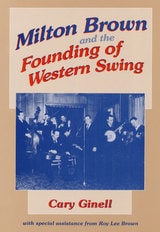
Milton Brown and the Founding of Western Swing
Cary Ginell
University of Illinois Press, 1994
Milton's Epic Voice
The Narrator in Paradise LostAnne Ferry
University of Chicago Press, 1983
Milton's Modernities
Poetry, Philosophy, and History from the Seventeenth Century to the PresentEdited by Feisal G. Mohamed and Patrick Fadely
Northwestern University Press, 2017
Bristling with insights on Milton’s major works, Milton’s Modernities offers fresh perspectives on the thinkers central to our theorizations of modernity: from Lucretius and Spinoza, Hegel and Kant, to Benjamin and Deleuze. At the volume's core is an embrace of the possibilities unleashed by current trends in philosophy, variously styled as the return to ethics, or metaphysics, or religion. These make all the more visible Milton’s dialogues with later modernity, dialogues that promise to generate much critical discussion in early modern studies and beyond.
Such approaches necessarily challenge many prevailing assumptions that have guided recent Milton criticism—assumptions about context and periodization, for instance. In this way, Milton’s Modernities powerfully broadens the historical archive beyond the materiality of events and things, incorporating as well intellectual currents, hybrids, and insights.
Mimetic Disillusion
Eugene O'Neill, Tennessee Williams, and U.S. Dramatic RealismAnne Fleche
University of Alabama Press, 1997
Reimagining American dramatic realism through the lenses of mimesis, theory, and theatrical innovation.
This volume focuses on two major writers of the 1930s and 1940s—Eugene O'Neill and Tennessee Williams—one whose writing career was just ending and the other whose career was just beginning. In new readings of their major works from this period, Long Day's Journey into Night, The Iceman Cometh, The Glass Menagerie, and A Streetcar Named Desire, Fleche develops connections to the writings of Jacques Derrida, Paul de Man, and Michel Foucault, among others, and discusses poststructuralism in the light of modern writers such as Bertolt Brecht, Antonin Artaud, and Walter Benjamin. Fleche also extends this discussion to the work of two contemporary playwrights, Adrienne Kennedy and Tony Kushner. The aim of Mimetic Disillusion is not to reject "mimetic" and "realistic" readings but to explore the rich complexities of these two ideas and the fruit of their ongoing relevance to U.S. theatre.

Mindscapes
The Geographies of Imagined WorldsEdited by George E. Slusser and Eric S. Rabkin
Southern Illinois University Press, 1989
Eighteen essays plus four examples from the ninth annual J. Lloyd Eaton Conference on Science Fiction and Fantasy Literature at the University of California, Riverside.
The concept of mindscape, Slusser and Rabkin explain, allows critics to focus on a single fundamental problem: "The constant need for a relation between mind and some being external to mind."
The essayists are Poul Anderson, Wendy Doniger O’Flaherty, Ronald J. Heckelman, David Brin, Frank McConnell, George E. Slusser, James Romm, Jack G. Voller, Peter Fitting, Michael R. Collings, Pascal J. Thomas, Reinhart Lutz, Joseph D. Miller, Gary Westfahl, Bill Lee, Max P. Belin, William Lomax, and Donald M. Hassler.
The book concludes with four authors discussing examples of mindscape. The participants are Jean-Pierre Barricelli, Gregory Benford, Gary Kern, and David N. Samuelson.
Minor Creatures
Persons, Animals, and the Victorian NovelIvan Kreilkamp
University of Chicago Press, 2018
Minor Re/Visions
Asian American Literacy Narratives as a Rhetoric of CitizenshipMorris Young
Southern Illinois University Press, 2004
Through a blend of personal narrative, cultural and literary analysis, and discussions about teaching, Minor Re/Visions: Asian American Literacy Narratives as a Rhetoric of Citizenship shows how people of color use reading and writing to develop and articulate notions of citizenship. Morris Young begins with a narration of his own literacy experiences to illustrate the complicated relationship among literacy, race, and citizenship and to reveal the tensions that exist between competing beliefs and uses of literacy among those who are part of dominant American culture and those who are positioned as minorities.
Influenced by the literacy narratives of other writers of color, Young theorizes an Asian American rhetoric by examining the rhetorical construction of American citizenship in works such as Richard Rodriguez’s Hunger of Memory, Victor Villanueva’s Bootstraps: From an American Academic of Color, Carlos Bulosan’s America Is in the Heart, and Maxine Hong Kingston’s “Song for a Barbarian Reed Pipe” from Woman Warrior. These narratives, Young shows, tell stories of transformation through education, the acquisition of literacy, and cultural assimilation and resistance. They also offer an important revision to the American story by inserting the minor and creating a tension amid dominant discourses about literacy, race, and citizenship. Through a consideration of the literacy narratives of Hawai`i, Young also provides a context for reading literacy narratives as responses to racism, linguistic discrimination, and attempts at “othering” in a particular region.
As we are faced with dominant discourses that construct race and citizenship in problematic ways and as official institutions become even more powerful and prevalent in silencing minor voices, Minor Re/Visions reveals the critical need for revising minority and dominant discourses. Young’s observations and conclusions have important implications for the ways rhetoricians and compositionists read, teach, and assign literacy narratives.
Minor Salvage
The Korean War and Korean American Life WritingsStephen Hong Sohn
University of Michigan Press, 2022
Mirabile Dictu
Representations of the Marvelous in Medieval and Renaissance EpicDouglas Biow
University of Michigan Press, 1996
Mirrors of Our Playing
Paradigms and Presences in Modern DramaThomas R. Whitaker
University of Michigan Press, 1999

Miscellaneous Verdicts
Writings on WritersAnthony Powell
University of Chicago Press, 1992
Powell begins with a section on the British, exploring his fascination both with genealogy and with figures like John Aubrey, and writing in depth about writers like Kipling, Conrad, and Hardy. The second section, on America, also opens with discussions of family trees (in this case presidential ones) and includes pieces on Henry James, James Thurber, American booksellers in Paris, Hemingway, and Dashiell Hammett. Personal encounters, and absorbing incidents from the lives of his subjects, frequently fill these pages—as they do even more in the section on Powell's contemporaries—Connolly, Orwell, Graham Greene, and others. Finally, and aptly, the book closes with a section on Proust and matters Proustian, including a marvellous essay on what is eaten and drunk, and by whom, in A la Recherche du Temps Perdu.
"An urbane book, quietly erudite, very sensible, highly civilized, remarkably useful."—Anthony Burgess, Observer
"An acute intelligence and fastidious sense of humor make [Powell] the funniest and most profound living writer of the English language."—Hugh Montgomery-Massingberd, Sunday Telegraph
Anthony Powell was born in London in 1905. He is the author of seven novels, a biography of John Aubrey, two plays, a collection of memoirs, and the twelve-volume novel sequence Dance to the Music of Time.
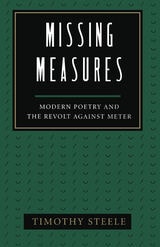
Missing Measures
Modern Poetry and the Revolt Against MeterTimothy Steele
University of Arkansas Press, 1990
By the close of the nineteenth century, many poets had abandoned rhyme and meter in favor of “free verse.” Nearly one hundred years later, a growing number of younger poets are reclaiming traditional conventions of prosody by composing rhymed and measured poetry.
Missing Measures is the first full articulation of the aesthetics of this new movement. Timothy Steele, one of the best of those poets who are sometimes called the “New Formalists,” treats his subject against a backdrop of the long history of ideas about poetry, formulated first by the ancients and re-examined and re-interpreted by subsequent writers.
Steele offers a new perspective on the wholesale departure from tradition proclaimed in modernist critical justifications. A rare marriage of clear writing, careful scholarship, and bold thinking, Missing Measures provides a vital new movement with a critical manifesto.
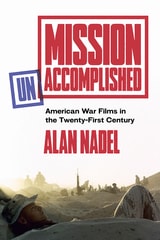
Mission Unaccomplished
American War Films in the Twenty-First CenturyAlan Nadel
University of Texas Press, 2025
An analysis of how post-9/11 war movies changed from following soldiers on specific missions to chronicling war as a day-to-day occupation.
In 2003, the United States began a war in Iraq without a mission. Instead of fighting to restore peace—the traditional objective of warfare—servicemembers faced the grim reality that there was no goal. Lacking even certainty as to who was the enemy, soldiers discovered that their task was simply to survive.
Mission Unaccomplished explores how Hollywood grasped the experience of Iraq from the perspective of US soldiers, reinventing the war film in the process. Historically, films such as Saving Private Ryan valorized the goals of war by chronicling missions that unambiguously contribute to the defeat of the enemy and the restoration of peace. But in The Hurt Locker, American Sniper, Green Zone, and other recent dramas, soldiers just try to outlast the chaos. Dramatizing the aimlessness of the war, events occur in random order, and soldiers have no sense of how their actions contribute to victory or peace. Looking to recent WWII movies such as Dunkirk and Hacksaw Ridge, which use this same cinematic vocabulary to position soldiering as merely a deadly job to be endured, Alan Nadel argues that the disillusionment of Iraq has influenced cinema broadly, inspiring a newly critical war film genre.
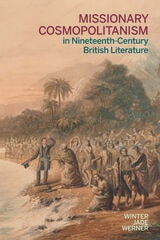
Missionary Cosmopolitanism in Nineteenth-Century British Literature
Winter Jade Werner
The Ohio State University Press, 2020
Missionary Cosmopolitanism identifies the nineteenth-century novel as thematically and formally attuned to the tension between missionaries’ cosmopolitan values and the moral impoverishment of their imperialist and expansionist practices. Werner’s chapters interact with canonical works such as Charlotte Brontë’s Jane Eyre and Charles Dickens’s Bleak House, along with lesser-known works by Robert Southey and Sydney Owenson. Ultimately, Missionary Cosmopolitanism demonstrates that nineteenth-century literature both illustrated and helped define missionary discourses regarding cosmopolitan ideas, showing how global evangelicalism continues to tap into the “new cosmopolitanisms” of today.
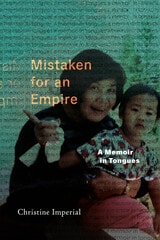
Mistaken for an Empire
A Memoir in TonguesChristine Imperial
The Ohio State University Press, 2023

Mixed Feelings
Feminism, Mass Culture, and Victorian SensationalismCvetkovich, Ann
Rutgers University Press, 1992
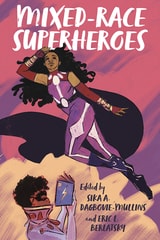
Mixed-Race Superheroes
Sika A. Dagbovie-Mullins
Rutgers University Press, 2021
The essays in this collection contend with the multitude of ways that racial mixedness has been presented in superhero comics, films, television, and literature. They explore how superhero media positions mixed-race characters within a genre that has historically privileged racial purity and propagated images of white supremacy. The book considers such iconic heroes as Superman, Spider-Man, and The Hulk, alongside such lesser-studied characters as Valkyrie, Dr. Fate, and Steven Universe. Examining both literal and symbolic representations of racial mixing, this study interrogates how we might challenge and rewrite stereotypical narratives about mixed-race identity, both in superhero media and beyond.
Mixing Race, Mixing Culture
Inter-American Literary DialoguesEdited by Monika Kaup and Debra Rosenthal
University of Texas Press, 2002
Over the last five centuries, the story of the Americas has been a story of the mixing of races and cultures. Not surprisingly, the issue of miscegenation, with its attendant fears and hopes, has been a pervasive theme in New World literature, as writers from Canada to Argentina confront the legacy of cultural hybridization and fusion.
This book takes up the challenge of transforming American literary and cultural studies into a comparative discipline by examining the dynamics of racial and cultural mixture and its opposite tendency, racial and cultural disjunction, in the literatures of the Americas. Editors Kaup and Rosenthal have brought together a distinguished set of scholars who compare the treatment of racial and cultural mixtures in literature from North America, the Caribbean, and Latin America. From various angles, they remap the Americas as a multicultural and multiracial hemisphere, with a common history of colonialism, slavery, racism, and racial and cultural hybridity.
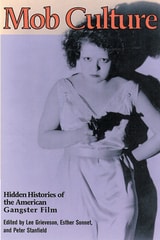
Mob Culture
Hidden Histories of the American Gangster FilmGrieveson, Lee
Rutgers University Press, 2005
Sinister, swaggering, yet often sympathetic, the figure of the gangster has stolen and murdered its way into the hearts of American cinema audiences. Despite the enduring popularity of the gangster film, however, traditional criticism has focused almost entirely on a few canonical movies such as Little Caesar, Public Enemy, and The Godfather trilogy, resulting in a limited and distorted understanding of this diverse and changing genre.
Mob Culture offers a long-awaited, fresh look at the American gangster film, exposing its hidden histories from the Black Hand gangs of the early twentieth century to The Sopranos. Departing from traditional approaches that have typically focused on the "nature" of the gangster, the editors have collected essays that engage the larger question of how the meaning of criminality has changed over time. Grouped into three thematic sections, the essays examine gangster films through the lens of social, gender, and racial/ethnic issues.
Destined to become a classroom favorite, Mob Culture is an indispensable reference for future work in the genre.
Modeling Citizenship
Jewish and Asian American WritingAuthored by Cathy Schlund-Vials
Temple University Press, 2011
Navigating deftly among historical and literary readings, Cathy Schlund-Vials examines the analogous yet divergent experiences of Asian Americans and Jewish Americans in Modeling Citizenship. She investigates how these model minority groups are shaped by the shifting terrain of naturalization law and immigration policy, using the lens of naturalization, not assimilation, to underscore questions of nation-state affiliation and sense of belonging.
Modeling Citizenship examines fiction, memoir, and drama to reflect on how the logic of naturalization has operated at discrete moments in the twentieth century. Each chapter focuses on two exemplary literary works. For example, Schlund-Vials shows how Mary Antin's Jewish-themed play The Promised Land is reworked into a more contemporary Chinese American context in Gish Jen's Mona in the Promised Land.
In her compelling analysis, Schlund-Vials amplifies the structural, cultural, and historical significance of these works and the themes they address.

Models of Value
Eighteenth-Century Political Economy and the NovelJames Thompson
Duke University Press, 1996
In this account, political economy and the novel clearly arise as solutions to a crisis in the notion of value. Exploring the ways in which these different genres responded to the crisis—political economy by reconceptualizing wealth as capital, and the novel by refiguring intrinsic or human worth in the form of courtship narratives—Thompson rereads several literary works, including Defoe’s Roxana, Fielding’s Tom Jones, and Burney’s Cecilia, along with influential contemporary economic texts. Models of Value also traces the discursive consequences of this bifurcation of value, and reveals how history and theory participate in the very novelistic and economic processes they describe. In doing so, the book bridges the opposition between the interests of Marxism and feminism, and the distinctions which, newly made in the eighteenth century, continue to inform our discourse today.
An important reformulation of the literary and cultural production of the eighteenth century, Models of Value will attract students of the novel, political economy, and of literary history and theory.
Modern American Grotesque
Literature and PhotographyJames Goodwin
The Ohio State University Press, 2009
Modern American Poetry, 1865-1950
Alan Shucard
University of Massachusetts Press, 1990
Modern Czech Theatre
Reflector and Conscience of a NationJarka M. Burian
University of Iowa Press, 2000
The story of Czech theatre in the twentieth century involves generations of mesmerizing players and memorable productions. Beyond these artistic considerations, however, lies a larger story: a theatre that has resonated with the intense concerns of its audiences acquires a significance and a force beyond anything created by striking individual talents or random stage hits. Amid the variety of performances during the past hundred years, that basic and provocative reality has been repeatedly demonstrated, as Jarka Burian reveals in his extraordinary history of the dramatic world of Czech theatre.
Following a brief historical background, Burian provides a chronological series of perspectives and observations on the evolving nature of Czech theatre productions during this century in relation to their similarly evolving social and political contexts. Once Czechoslovak independence was achieved in 1918, a repeated interplay of theatre with political realities became the norm, sometimes stifling the creative urge but often producing even greater artistry. When playwright Václav Havel became president in 1990, this was but the latest and most celebrated example of the vital engagement between stage and society that has been a repeated condition of Czech theatre for the past two hundred years. In Jarka Burian's skillful hands, Modern Czech Theatre becomes an extremely important touchstone for understanding the history of modern theatre within western culture.

Modern Japanese Literary Studies
Seth Jacobowitz and Jonathan E. Abel, Editors
University of Michigan Press, 2026
Modern Noise, Fluid Genres
Popular Music in Indonesia, 1997–2001Jeremy Wallach
University of Wisconsin Press, 2008
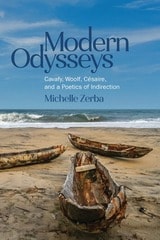
Modern Odysseys
Cavafy, Woolf, Césaire, and a Poetics of IndirectionMichelle Zerba
The Ohio State University Press, 2021
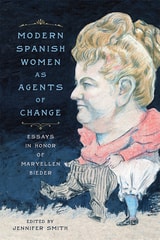
Modern Spanish Women as Agents of Change
Essays in Honor of Maryellen BiederSmith, Jennifer
Bucknell University Press, 2019
Published by Bucknell University Press. Distributed worldwide by Rutgers University Press.
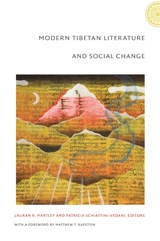
Modern Tibetan Literature and Social Change
Lauran R. Hartley and Patricia Schiaffini-Vedani, eds.
Duke University Press, 2008
The contributors explore the circumstances that led to the development of modern Tibetan literature, its continuities and breaks with classical Tibetan literary forms, and the ways that writers use forms such as magical realism, satire, and humor to negotiate literary freedom within the People’s Republic of China. They provide crucial information about Tibetan writers’ lives in China and abroad, the social and political contexts in which they write, and the literary merits of their oeuvre. Along with deep social, cultural, and political analysis, this wealth of information clarifies the complex circumstances that Tibetan writers face in the PRC and the diaspora. The contributors consider not only poetry, short stories, and novels but also other forms of cultural production—such as literary magazines, films, and Web sites—that provide a public forum in the Tibetan areas of the PRC, where censorship and restrictions on public gatherings remain the norm. Modern Tibetan Literature and Social Change includes a previously unavailable list of modern Tibetan works translated into Western languages and a comprehensive English-language index of names, subjects, and terms.
Contributors: Pema Bhum, Howard Y. F. Choy, Yangdon Dhondup, Lauran R. Hartley, Hortsang Jigme, Matthew T. Kapstein, Nancy G. Lin, Lara Maconi, Françoise Robin, Patricia Schiaffini-Vedani, Ronald D. Schwartz, Tsering Shakya, Sangye Gyatso (aka Gangzhün), Steven J. Venturino,
Riika Virtanen
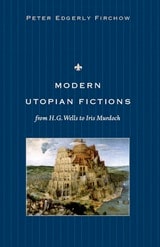
Modern Utopian Fictions from H. G. Wells to Iris Murdoch
Peter Edgerly Firchow
Catholic University of America Press, 2007
Modernism Is the Literature of Celebrity
By Jonathan Goldman
University of Texas Press, 2011
The phenomenon of celebrity burst upon the world scene about a century ago, as movies and modern media brought exceptional, larger-than-life personalities before the masses. During the same era, modernist authors were creating works that defined high culture in our society and set aesthetics apart from the middle- and low-brow culture in which celebrity supposedly resides. To challenge this ingrained dichotomy between modernism and celebrity, Jonathan Goldman offers a provocative new reading of early twentieth-century culture and the formal experiments that constitute modernist literature's unmistakable legacy. He argues that the literary innovations of the modernists are indeed best understood as a participant in the popular phenomenon of celebrity.
Presenting a persuasive argument as well as a chronicle of modernism's and celebrity's shared history, Modernism Is the Literature of Celebrity begins by unraveling the uncanny syncretism between Oscar Wilde's writings and his public life. Goldman explains that Wilde, in shaping his instantly identifiable public image, provided a model for both literary and celebrity cultures in the decades that followed. In subsequent chapters, Goldman traces this lineage through two luminaries of the modernist canon, James Joyce and Gertrude Stein, before turning to the cinema of mega-star Charlie Chaplin. He investigates how celebrity and modernism intertwine in the work of two less obvious modernist subjects, Jean Rhys and John Dos Passos. Turning previous criticism on its head, Goldman demonstrates that the authorial self-fashioning particular to modernism and generated by modernist technique helps create celebrity as we now know it.
Modernism and Colonialism
British and Irish Literature, 1899–1939Richard Begam and Michael Valdez Moses, eds.
Duke University Press, 2007
Ranging over poetry, fiction, and criticism, the essays provide fresh appraisals of Joseph Conrad, T. S. Eliot, Ezra Pound, Virginia Woolf, D. H. Lawrence, Wyndham Lewis, E. M. Forster, W. B. Yeats, James Joyce, Elizabeth Bowen, Hugh MacDiarmid, and Evelyn Waugh, as well as Robert Louis Stevenson and H. Rider Haggard. The essays that bookend the collection connect the modernists to their Victorian precursors, to postwar literary critics, and to postcolonial poets. The rest treat major works written or published between 1899 and 1939, the boom years of literary modernism and the period during which the British empire reached its greatest geographic expanse. Among the essays are explorations of how primitivism figured in the fiction of Lawrence and Lewis; how, in Ulysses, Joyce used modernist techniques toward anticolonial ends; and how British imperialism inspired Conrad, Woolf, and Eliot to seek new aesthetic forms appropriate to the sense of dislocation they associated with empire.
Contributors. Nicholas Allen, Rita Barnard, Richard Begam, Nicholas Daly, Maria DiBattista, Ian Duncan, Jed Esty, Andrzej Gąsiorek, Declan Kiberd, Brian May, Michael Valdez Moses, Jahan Ramazani, Vincent Sherry
Modernism and Music
An Anthology of SourcesEdited and with Commentary by Daniel Albright
University of Chicago Press, 2004
Modernism and the Harlem Renaissance
Houston A. Baker Jr.
University of Chicago Press, 1989
Modernism and the Nativist Resistance
Contemporary Chinese Fiction from TaiwanSung-sheng Yvonne Chang
Duke University Press, 1993
Situating her subject in its historical context, Sung-sheng Yvonne Chang traces the connection between Taiwan's Modernists and the liberal scholars of pre-Communist China. She discusses the Modernists' ambivalent relationship with contemporary Taiwan's conservative culture, and provides a detailed critical survey of the strife between the Modernists and the socialistically inclined, anti-Western Nativists. Chang's approach is comprehensive, combining Chinese and comparative perspectives. Employing the critical insights of Raymond Williams, Peter Burger, M. M. Bahktin, and Fredric Jameson, she investigates the complex issues involved in Chinese writers' appropriation of avant-gardism, aestheticism, and various other Western literary concepts and techniques. Within this framework, Chang offers original, challenging interpretations of major works by the best-known Chinese Modernists from Taiwan.
As an intensive introduction to a literature of considerable quality and impact, and as a case study of the global spread of Western literary Modernism, this book will be of great interest to students of Chinese and comparative literature, and to those who wish to understand the broad patterns of twentieth-century literary history.
Modernism and the Women’s Popular Romance in Britain, 1885–1925
Martin Hipsky
Ohio University Press, 2011
Today’s mass-market romances have their precursors in late Victorian popular novels written by and for women. In Modernism and the Women’s Popular Romance Martin Hipsky scrutinizes some of the best-selling British fiction from the period 1885 to 1925, the era when romances, especially those by British women, were sold and read more widely than ever before or since.
Recent scholarship has explored the desires and anxieties addressed by both “low modern” and “high modernist” British culture in the decades straddling the turn of the twentieth century. In keeping with these new studies, Hipsky offers a nuanced portrait of an important phenomenon in the history of modern fiction. He puts popular romances by Mrs. Humphry Ward, Marie Corelli, the Baroness Orczy, Florence Barclay, Elinor Glyn, Victoria Cross, Ethel Dell, and E. M. Hull into direct relationship with the fiction of Virginia Woolf, Katherine Mansfield, James Joyce, and D. H. Lawrence, among other modernist greats.
Modernism the Morning After
Bob Perelman
University of Alabama Press, 2017
Modernism the Morning After is a superb, lively, engaging series of essays and talks, dating from 1995 to 2016, by the eminent scholar, critic, and poet Bob Perelman. Throughout his career, Perelman has focused on the persistence of modernist ambition in poetry, with all of its admirable articulations and tragicomic short-circuits. Poetry, it turns out, is not simply “news that stays news,” as Ezra Pound postulated. Instead, as Perelman demonstrates, poetry often gropes toward whatever news can be found in the broader contexts of public speech—the cultural commons, the almost-real or much-too-real language of people and our hyperactive media.
Working in a variety of modes from the poetic to the dramatic to the conversational, and ranging across an expansive historical register from Dickinson, Whitman, and Dunbar in the nineteenth century to Kenneth Goldsmith and Stephen Colbert in the twenty-first, Perelman’s readings are unfailingly illuminating and, in many cases, his witty expositions take us strikingly close to the original intent of the text concerned.
Perelman also places intermittent, yet artful, pressure on some basic questions about the very nature of poetry. What does the transcription of poems tell us about them? How do hoaxes like the Ern Malley affair compel us to reconsider fundamental assumptions about what constitutes “authentic” poetry? How does the bathetic register relate to tones and idiom in recent poetic production? In Modernism the Morning After, Perelman writes as a poet, teacher, and critic, addressing a broad audience of readers and writers without choosing between them, inviting all to consider along with him modernism’s future through a dynamic consideration of its past.
Modernismo, Modernity and the Development of Spanish American Literature
By Cathy L. Jrade
University of Texas Press, 1998
A CHOICE Outstanding Academic Book
Modernismo arose in Spanish American literature as a confrontation with and a response to modernizing forces that were transforming Spanish American society in the later nineteenth century. In this book, Cathy L. Jrade undertakes a full exploration of the modernista project and shows how it provided a foundation for trends and movements that have continued to shape literary production in Spanish America throughout the twentieth century.
Jrade opens with a systematic consideration of the development of modernismo and then proceeds with detailed analyses of works-poetry, narrative, and essays-that typified and altered the movement's course. In this way, she situates the writing of key authors, such as Rubén Darío, José Martí, and Leopoldo Lugones, within the overall modernista project and traces modernismo's influence on subsequent generations of writers.
Jrade's analysis reclaims the power of the visionary stance taken by these creative intellectuals. She firmly abolishes any lingering tendency to associate modernismo with affectation and effete elegance, revealing instead how the modernistas' new literary language expressed their profound political and epistemological concerns.
Modernist Heresies
British Literary History, 1883–1924Damon Franke
The Ohio State University Press, 2008
Franke documents the untold history of the Cambridge Heretics Society and places the concerns of this discussion society in dialogue with contemporaneous literature by such authors as Pater, Hardy, Shaw, Joyce, Woolf, Lawrence, and Orwell. Since several highly influential figures of the modernist literati were members of the Heretics or in dialogue with the group, heresy and its relation to synthesis now become crucial to an understanding of modernist aesthetics and ethics.
From the 1880s through the 1920s, heresy commonly appears in literature as a discursive trope, and the literary mode of heresy shifts over the course of this time from one of syncretism to one based on the construction of modernist artificial or "synthetic" wholes. In Franke’s work, the discourse of heresy comes forth as a forgotten dimension of the origins of modernism, one deeply entrenched in Victorian blasphemy and the crisis in faith, and one pointing to the censorship of modernist literature and some of the first doctrines of literary criticism.
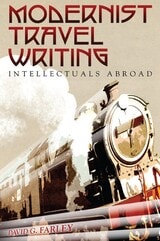
Modernist Travel Writing
Intellectuals AbroadDavid G. Farley
University of Missouri Press, 2010
Modernist Travel Writing argues that the travel book is a crucial genre for understanding the development of modernism in the years between the wars, despite the established view that travel writing during the interwar period was largely an escapist genre—one in which writers hearkened back to the realism of nineteenth-century literature in order to avoid interwar anxiety. Farley analyzes works that exist on the margins of modernism, generically and geographically, works that have yet to receive the critical attention they deserve, partly due to their classification as travel narratives and partly because of their complex modernist styles.
The book begins by examining the ways that travel and the emergent travel regulations in the wake of the First World War helped shape Ezra Pound’s Cantos. From there, it goes on to examine E. E. Cummings’s frustrated attempts to navigate the “unworld” of Soviet Russia in his book Eimi,Wyndham Lewis’s satiric journey through colonial Morocco in Filibusters in Barbary,and Rebecca West’s urgent efforts to make sense of the fractious Balkan states in Black Lamb and Grey Falcon. These modernist writers traveled to countries that experienced most directly the tumult of revolution, the effects of empire, and the upheaval of war during the years between World War I and World War II. Farley’s study focuses on the question of what constitutes “evidence” for Pound, Lewis, Cummings, and West as they establish their authority as eyewitnesses, translate what they see for an audience back home, and attempt to make sense of a transformed and transforming modern world.
Modernist Travel Writing makes an original contribution to the study of literary modernism while taking a distinctive look at a unique subset within the growing field of travel writing studies. David Farley’s work will be of interest to students and teachers in both of these fields as well as to early-twentieth-century literary historians and general enthusiasts of modernist studies.
Modernity At Sea
Melville, Marx, Conrad In CrisisCesare Casarino
University of Minnesota Press, 2002
Analyzes nineteenth-century seafaring narratives and their importance to ideas of modernity
At once a literary-philosophical meditation on the question of modernity and a manifesto for a new form of literary criticism, Modernity at Sea argues that the nineteenth-century sea narrative played a crucial role in the emergence of a theory of modernity as permanent crisis.
In a series of close readings of such works as Herman Melville’s White-Jacket and Moby Dick, Joseph Conrad’s The Nigger of the "Narcissus” and The Secret Sharer, and Karl Marx’s Grundrisse, Cesare Casarino draws upon the thought of twentieth-century figures including Giorgio Agamben, Louis Althusser, Walter Benjamin, Leo Bersani, Gilles Deleuze, Félix Guattari, and Antonio Negri to characterize the nineteenth-century ship narrative as the epitome of Michel Foucault’s "heterotopia"—a special type of space that simultaneously represents, inverts, and contests all other spaces in culture.Elaborating Foucault’s claim that the ship has been the heterotopia par excellence of Western civilization since the Renaissance, Casarino goes on to argue that the nineteenth-century sea narrative froze the world of the ship just before its disappearance—thereby capturing at once its apogee and its end, and producing the ship as the matrix of modernity.
Modernity and Progress
Fitzgerald, Hemingway, OrwellRonald Berman
University of Alabama Press, 2007
Breaks new critical ground by exploring philosophical and aesthetic issues germane to the writings of three major modern literary figures.
In the 1920s and ‘30s, understandings of time, place, and civilization were subjected to a barrage of new conceptions. Ronald Berman probes the work of three writers who wrestled with one or more of these issues in ways of lasting significance.
Hemingway, Fitzgerald, and Orwell all grappled with fluid notions of time: Hemingway’s absolute present, Fitzgerald’s obsession with what might be and what might have been, and Orwell’s concerns with progress. For these authors, progress is also tied to competing senses of place--for Fitzgerald, the North versus the South; for Hemingway, America versus Europe. At stake for each is an understanding of what constitutes true civilization in a post-war world. Berman discusses Hemingway’s deployment of language in tackling the problems of thinking and knowing. Berman follows this notion further in examining the indisputable impact upon Hemingway’s prose of Paul Cézanne’s painting and the nature of perception.
Finally, Berman considers the influence on Orwell of Aristotle and Freud’s ideas of civilization, translated by Orwell into the fabric of 1984 and other writings.
Ronald Berman is Professor of English at the University of California at San Diego and past chairman of the National Endowment for the Humanities. He is author of six books, including “The Great Gatsby” and Fitzgerald’s World of Ideas and Fitzgerald-Wilson-Hemingway: Language and Experience.
Modernizing Solitude
The Networked Individual in Nineteenth-Century American LiteratureYoshiaki Furui
University of Alabama Press, 2019
During the nineteenth century, the United States saw radical developments in media and communication that reshaped concepts of spatiality and temporality. As the telegraph, the postal system, and public transportation became commonplace, the country achieved a level of connectedness that was never possible before. At this level, physical isolation no longer equaled psychological separation from the exterior world, and as communication networks proliferated, being disconnected took on negative cultural connotations.
Though solitude, and the lack thereof, is a pressing concern in today’s culture of omnipresent digital connectivity, Yoshiaki Furui shows that solitude has been a significant preoccupation since the nineteenth century. The obsession over solitude is evidenced by many writers of the period, with consequences for many basic notions of creativity, art, and personal and spiritual fulfillment.
In Modernizing Solitude: The Networked Individual in Nineteenth-Century American Literature, Furui examines, among other works, Henry David Thoreau’s Walden, Harriet Jacobs’s Incidents in the Life of a Slave Girl, Herman Melville’s “Bartleby, the Scrivener,” Emily Dickinson’s poetry and letters, and telegraphic literature in the 1870s to identify the virtues and values these writers bestowed upon solitude in a time and place where it was being consistently threatened or devalued. Although each writer has a unique way of addressing the theme, they all aim to reclaim solitude as a positive, productive state of being that is essential to the writing process and personal identity. Employing a cross-disciplinary approach to understand modern solitude and the resulting literature, Furui seeks to historicize solitude by anchoring literary works in this revolutionary yet interim period of American communication history, while also applying theoretical insights into the literary analysis.
Modes of Faith
Secular Surrogates for Lost Religious BeliefTheodore Ziolkowski
University of Chicago Press, 2007
In the decades surrounding World War I, religious belief receded in the face of radical new ideas such as Marxism, modern science, Nietzschean philosophy, and critical theology. Modes of Faith addresses both this decline of religious belief and the new modes of secular faith that took religion’s place in the minds of many writers and poets.
Theodore Ziolkowski here examines the motives for this embrace of the secular, locating new modes of faith in art, escapist travel, socialism, politicized myth, and utopian visions. James Joyce, he reveals, turned to art as an escape while Hermann Hesse made a pilgrimage to India in search of enlightenment. Other writers, such as Roger Martin du Gard and Thomas Mann, sought temporary solace in communism or myth. And H. G. Wells, Ziolkowski argues, took refuge in utopian dreams projected in another dimension altogether.
Rooted in innovative and careful comparative reading of the work of writers from France, England, Germany, Italy, and Russia, Modes of Faith is a critical masterpiece by a distinguished literary scholar that offers an abundance of insight to anyone interested in the human compulsion to believe in forces that transcend the individual.
Modes of Play in Eighteenth-Century France
Fayçal Falaky
Bucknell University Press, 2022
Modes of Production of Victorian Novels
N. N. Feltes
University of Chicago Press, 1986
Feltes focuses on five English novels: Dickens's Pickwick Papers, Thackeray's Henry Esmond, Eliot's Middlemarch, Hardy's Tess of the d'Urbervilles, and Forster's Howards End. Published at approximately twenty year intervals between 1836 and 1920, they each represent a different first-publication format: part-issue, three-volume, bimonthly, magazine-serial, and single-volume. Drawing on publishing, economic, and literary history, Feltes offers a broad, synthetic explanation of the relationship between the production and format of each novel, and the way in which these determine, in the last instance, the ideology of the text.
Modes of Production in Victorian Novels provides a Marxist structuralist analysis of historical events and practices described elsewhere only empirically, and traces their relationship to literary texts which have been analyzed only idealistically, thus setting these familiar works firmly and perhaps permanently into a framework of historic materialism.
Modes of Viewing in Hellenistic Poetry and Art
And ArtGraham Zanker
University of Wisconsin Press, 2003
Taking a fresh look at the poetry and visual art of the Hellenistic age, from the death of Alexander the Great in 323 B.C. to the Romans’ defeat of Cleopatra in 30 B.C., Graham Zanker makes enlightening discoveries about the assumptions and conventions of Hellenistic poets and artists and their audiences.
Zanker’s exciting new interpretations closely compare poetry and art for the light each sheds on the other. He finds, for example, an exuberant expansion of subject matter in the Hellenistic periods in both literature and art, as styles and iconographic traditions reserved for grander concepts in earlier eras were applied to themes, motifs, and subjects that were emphatically less grand.