Results by title
5448 books match the query 'History and criticism' and 307 start with m
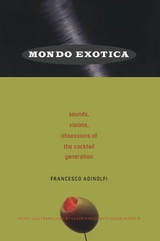
Mondo Exotica
Sounds, Visions, Obsessions of the Cocktail GenerationFrancesco Adinolfi Edited and translated by Karen Pinkus with Jason Vivrette
Duke University Press, 2008
Adinolfi interviewed a number of exotica greats, and Mondo Exotica incorporates material from his interviews with Martin Denny, Esquivel, the Italian film composers Piero Piccioni and Piero Umiliani, and others. It begins with an extended look at the postwar popularity of exotica in the United States. Adinolfi describes how American bachelors and suburbanites embraced the Polynesian god Tiki as a symbol of escape and sexual liberation; how Les Baxter’s album Ritual of the Savage (1951) ushered in the exotica music craze; and how Martin Denny’s Exotica built on that craze, hitting number one in 1957. Adinolfi chronicles the popularity of performers from Yma Sumac, “the Peruvian Nightingale,” to Esquivel, who was described by Variety as “the Mexican Duke Ellington,” to the chanteuses Eartha Kitt, Julie London, and Ann-Margret. He explores exotica’s many sub-genres, including mood music, crime jazz, and spy music. Turning to Italy, he reconstructs the postwar years of la dolce vita, explaining how budget spy films, spaghetti westerns, soft-core porn movies, and other genres demonstrated an attraction to the foreign. Mondo Exotica includes a discography of albums, compilations, and remixes.
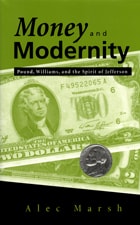
Money and Modernity
Pound, Williams, and the Spirit of JeffersonAlec Marsh
University of Alabama Press, 1998
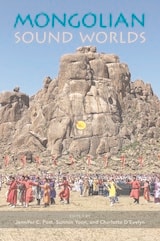
Mongolian Sound Worlds
Edited by Jennifer C. Post, Sunmin Yoon, and Charlotte D'Evelyn
University of Illinois Press, 2022
A merger of expert scholarship and eyewitness experience, Mongolian Sound Worlds illuminates a diverse and ever-changing musical culture.
Contributors: Bayarsaikhan Badamsuren, Otgonbaayar Chuulunbaatar, Andrew Colwell, Johanni Curtet, Charlotte D’Evelyn, Tamir Hargana, Peter K. Marsh, K. Oktyabr, Rebekah Plueckhahn, Jennifer C. Post, D. Tserendavaa, and Sunmin Yoon
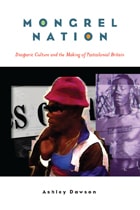
Mongrel Nation
Diasporic Culture and the Making of Postcolonial BritainAshley Dawson
University of Michigan Press, 2007
Mongrel Nation surveys the history of the United Kingdom’s African, Asian, and Caribbean populations from 1948 to the present, working at the juncture of cultural studies, literary criticism, and postcolonial theory. Ashley Dawson argues that during the past fifty years Asian and black intellectuals from Sam Selvon to Zadie Smith have continually challenged the United Kingdom’s exclusionary definitions of citizenship, using innovative forms of cultural expression to reconfigure definitions of belonging in the postcolonial age. By examining popular culture and exploring topics such as the nexus of race and gender, the growth of transnational politics, and the clash between first- and second-generation immigrants, Dawson broadens and enlivens the field of postcolonial studies.
Mongrel Nation gives readers a broad landscape from which to view the shifting currents of politics, literature, and culture in postcolonial Britain. At a time when the contradictions of expansionist braggadocio again dominate the world stage, Mongrel Nation usefully illuminates the legacy of imperialism and suggests that creative voices of resistance can never be silenced.Dawson
“Elegant, eloquent, and full of imaginative insight, Mongrel Nation is a refreshing, engaged, and informative addition to post-colonial and diasporic literary scholarship.”
—Hazel V. Carby, Yale University
“Eloquent and strong, insightful and historically precise, lively and engaging, Mongrel Nation is an expansive history of twentieth-century internationalist encounters that provides a broader landscape from which to understand currents, shifts, and historical junctures that shaped the international postcolonial imagination.”
—May Joseph, Pratt Institute
Ashley Dawson is Associate Professor of English at the City University of New York’s Graduate Center and the College of Staten Island. He is coeditor of the forthcoming Exceptional State: Contemporary U.S. Culture and the New Imperialism.
Monsters and Monstrosity in Augustan Poetry
Dunstan Lowe
University of Michigan Press, 2015
Monsters vs. Patriarchy
Toxic Imagination in Global Horror CinemaPatricia Saldarriaga
Rutgers University Press, 2025
Monsters vs. Patriarchy examines female monstrosity as it appears in horror films from around the world and considers specific political, scientific, and historical contexts to better understand how we construct and reconstruct monstrosity, using an intersectional approach to examine the imposition of gender and racial hierarchies that support national power structures. The authors contend that monstrous female cinematic subjects, including ghosts, witches, cannibals, and posthuman beings, are becoming empowered, using the tools of their monstrification to smash the colonial, white supremacist, and misogynist structures that created them.
Monstrosities
Bodies And British RomanticismPaul Youngquist
University of Minnesota Press, 2003
A surprising evaluation of the role of the physical body in the construction of British identity
Eighteenth-century medicine used the word “monstrosities” to describe physically deformed bodies—those irreducible to the “proper body” in their singular, sometimes startling difference. Considering British society in confrontation with such monstrosities, Paul Youngquist reveals the cultural politics of embodiment in Britain during the late eighteenth and early nineteenth centuries. Drawing on the histories of medicine, economics, liberalism, and nationalism, his work shows that bodies are not simply born but rather built by cultural practices directed toward particular social ends.
Among the phenomena Youngquist treats are the science of comparative anatomy, the annual festivity of Bartholomew Fair, the social status of black Britons, opium habitués, pregnant women, and wounded war veterans. The authors he engages include John Locke, William Blake, Olaudah Equiano, Samuel Taylor Coleridge, Thomas De Quincey, Mary Wollstonecraft, Lord Byron, and Mary Shelley. Uniquely interdisciplinary, formidably researched, and replete with curious illustrations, this remarkable book should be of interest to anyone concerned with the historical and cultural fate of bodies in liberal society—and with the importance of deviance in determining that fate.
Monstrous Kinds
Body, Space, and Narrative in Renaissance Representations of DisabilityElizabeth B. Bearden
University of Michigan Press, 2019
Monstrous Work and Radical Satisfaction
Black Women Writing under SegregationEve Dunbar
University of Minnesota Press, 2024
Radical Black feminist refusal through the works of mid-twentieth-century African American women writers
Monstrous Work and Radical Satisfaction offers new and insightful readings of African American women’s writings in the 1930s–1950s, illustrating how these writers centered Black women’s satisfaction as radical resistance to the false and incomplete promise of liberal racial integration. Eve Dunbar examines the writings of Ann Petry, Dorothy West, Alice Childress, and Gwendolyn Brooks to show how these women explored self-fulfillment over normative and sanctioned models of national belonging.
Paying close attention to literary moments of disruption, miscommunication, or confusion rather than ease, assimilation, or mutual understanding around race and gender, Dunbar tracks these writers’ dissatisfaction with American race relations. She shows how Petry, West, Childress, and Brooks redeploy the idea of monstrous work to offer potential modalities for registering Black women’s capacity to locate satisfaction within the domestic and interpersonal.
While racial integration may satisfy the national idea of equality and inclusion, it has not met the long-term needs of Black people’s quest for equity. Dunbar responds, demonstrating how these mid-century women offer new blueprints for Black life by creating narrative models for radical satisfaction: Black women’s completeness, joy, and happiness outside the bounds of normative racial inclusion.
Monstrous Youth
Transgressing the Boundaries of Childhood in the United StatesSara Austin
The Ohio State University Press, 2022
Montaigne in Motion
Jean Starobinski
University of Chicago Press, 1985
Educated in the humanities and trained in psychiatry, Jean Starobinski is a central figure in the Geneva School of criticism. His classic work, Montaigne in Motion, is a subtly conceived and elegantly written study of the Essais of Montaigne, whose deceptively plainspoken meditations have entranced readers and stimulated philosophers since their first publication in 1580 and 1595.
Here Starobinski offers a decidedly postmodern reading of Montaigne. In chapters dealing with the themes of public and private life, friendship, death, the body, and love, Starobinski reveals much that will remind us that Montaigne’s thought is as apropos to our time as it was to his own.
“The most important contribution to Montaigne studies since Friedrich’s work . . . . [It] will be the critical framework in which scholars will discuss Montaigne in the years to come.”—Choice
“Starobinski brings Montaigne to life by treating him as our contemporary and asking him modern questions.”—Hudson Review
Monumental Anxieties
Homoerotic Desire and Feminine Influence in 19-th Century U.S. LiteratureDerrick, Scott S
Rutgers University Press, 1997
Scott Derrick has written an original book that contributes significantly to current revisions of the nineteenth-century American literary tradition's representation of gender and sexuality. His interpretation of feminist, lesbian-feminist, and gay issues in nineteenth-century American literature as complementary enlarges our historical understanding and helps build the coalition politics needed in these areas."-John Carlos Rowe, University of California, Irvine
Recent gender-based scholarship on nineteenth-century American literature has established male authors' crucial awareness of the competition from popular women writers. And critical work in gay studies and queer theory has stressed the importance in canonical American literature of homoerotic relations between men, even before "homosexuality" became codified at the end of the century. Scott Derrick draws on these insights to explore the ways in which male authors struggle to refigure literature-historically devalued as feminine-as a masculine and heterosexual enterprise. Derrick focuses on scenes of compositional crisis that reveal how male identity itself is at risk in the perils and possibilities of being a male author in a feminized literary marketplace.
He suggests that traditionally valued texts by Hawthorne, Poe, James, Sinclair, and Crane have at their core combustible four-sided conflicts between feminine identifications and masculine distancings, homoerotic longings and homophobic dreads, conflicts which are largely determined by domestic ideals of male and female roles within the nineteenth-century family. The negotiation of such conflicts is controlled by the nature of fiction writing, which both frees the imagination to explore forbidden fantasies and harnesses the imagination to public understandings of the proper form and content of fiction. Thus Monumental Anxieties also contributes to recent debates about the social shaping of contemporary homosexuality and to the history of American masculinity.
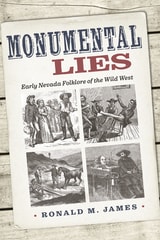
Monumental Lies
Early Nevada Folklore of the Wild WestRonald M. James
University of Nevada Press, 2023
Monumental Lies: Early Nevada Folklore of the Wild West opens the door to understanding how legends and traditions emerged during the first decades following the “Rush to Washoe,” which transformed the region beginning in 1859. During this Wild West period, there was widespread celebration of deceit, manifesting in tall tales, burlesque lies, practical jokes, and journalistic hoaxes. Humor was central to these endeavors and practitioners easily found themselves scorned if they failed to be adequately funny. This ethos became central to the way folklore emerged during the formative years of the Nevada territory and state.
The tens of thousands of people who came to the West, attracted by gold and silver mining, brought distinct cultural legacies. The interaction of diverse perspectives, even while new stories and traditions coalesced or simply appeared, was a complex process. Author Ronald M. James addresses how the fluidity of the region affected new expressions of folklore as they took root.
Mark Twain, often a go-to source for collections of early tall tales of this region, cannot be overlooked, but his interaction with local traditions was specific and narrow. More importantly, William Wright—publishing as Dan De Quille—arose as a key collector of legends, a counterpart of early European folklorists. With a bedrock understanding of what unfolded in the nineteenth century, it is possible to consider
Monuments Askew
An Elliptical History of the Factory of the Eccentric ActorMaria Corrigan
Rutgers University Press, 2025

Moorings and Metaphors
Figures of Culture and Gender in Black Women's LiteratureKarla F. Holloway
Rutgers University Press, 1991
Proceeding from a consideration of the imaginative textual languages of contemporary African-American and West African writers, Holloway asserts the intertextuality of black women's literature across two continents. She argues the subtext of culture as the source of metaphor and language, analyzes narrative structures and linguistic processes, and develops a combined theoretical/critical apparatus and vocabulary for interpreting these writers' works. The cultural sources and spiritual considerations that inhere in these textual languages are discussed within the framework Holloway employs of patterns of revision, (re)membrance, and recursion--all of which are vehicles for expressive modes inscribed at the narrative level. Her critical reading of contemporary black women's writing in the United States and West Africa is unique, radical, and sure to be controversial.
Moorings
Portuguese Expansion and the Writing of AfricaJosiah Blackmore
University of Minnesota Press, 2008
How Africa was perceived in the early modern imaginary
In this first book to study Portuguese texts about Africa, Moorings brings an important but little-known body of European writings to bear on contemporary colonial thought. Images of Africa as monstrous, dangerous, and lush were created in early Portuguese imperial writings and dominated its representation in European literature. Moorings establishes these key works in their proper place: foundational to Western imperial discourse.
Attentive to history as well as the nuances of language, Josiah Blackmore leads readers from the formation of the “Moor” in medieval Iberia to the construction of a full colonial imaginary, as found in the works of two writers: the royal chronicler Gomes Eanes de Zurara and the epic poet Luís de Camões. Blackmore’s original work helps to explain how concepts and myths—such as the “otherness” of Africa and Africans—originated, functioned, and were perpetuated.Delving into the Portuguese imperial experience, Moorings enriches our understanding of historical and literary imagination during a significant period of Western expansion.
Moral Enterprise
Literature and Education in Antebellum AmericaDerek Pacheco
The Ohio State University Press, 2013
Mormon Healer Folk Poet
Mary Susannah Fowler's Life of 'Unselfish Usefulness'Margaret Brady
Utah State University Press, 2000
Mormons, Musical Theater, and Belonging in America
Jake Johnson
University of Illinois Press, 2019

Morning Dew and Roses
Nuance, Metaphor, and Meaning in FolksongsBarre Toelken
University of Illinois Press, 1995
"Toelken's insights . . . are unique. His study broadens and deepens scholarly appreciation of how folksong metaphors carry their own semantic weight. . . . One of the best expressions of the power of music in folksong that I have seen in recent years." -- James Porter, author of The Traditional Music of Britain and Ireland
In this lively exploration of folksongs and their meanings, Barre Toelken looks closely at riddle songs and other ambiguous folksongs, as well as the various "ballad commonplaces." Ranging through metaphors such as weaving, plowing, plucking flowers, and walking in the dew, Toelken shows how each contributes to meaning in vernacular song. He includes comparisons to German folksongs, medieval poetry, Italian folk lyrics, and a wide range of Euro-American vernacular expression.
Morning Star
surrealism, marxism, anarchism, situationism, utopiaBy Michael Löwy
University of Texas Press, 2009
An expanded edition of revered theorist Michael Löwy's Morning Star: Marxism and Surrealism (previously published in French, Portuguese, Spanish, Italian, and Greek), this masterwork collects the author's essays on the ways in which surrealism intersected with a variety of revolutionary political approaches, ranging from utopian ideals to Marxism and situationism. Taking its title from André Breton's essay "Arcane 17," which casts the star as the searing firebrand of rebellion, Löwy's provocative work spans many perspectives. These include surrealist artists who were deeply interested in Marxism and anarchism (Breton among them), as well as Marxists who were deeply interested in surrealism (Walter Benjamin in particular).
Probing the dialectics of innovation, diversity, continuity, and unity throughout surrealism's international presence, Morning Star also incorporates analyses of Claude Cahun, Guy Debord, Pierre Naville, José Carlos Mariátegui and others, accompanied by numerous reproductions of surrealist art. An extraordinarily rich collection, Morning Star promises to ignite new dialogues regarding the very nature of dissent.
Mortal Forms
Affect and Temporality in Early English PoetryEvelyn Reynolds
The Ohio State University Press, 2026
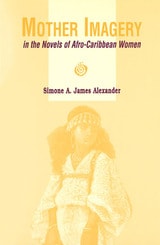
Mother Imagery in the Novels of Afro-Caribbean Women
Simone A. James Alexander
University of Missouri Press, 2000
Focusing on specific texts by Jamaica Kincaid, Maryse Condé, and Paule Marshall, this fascinating study explores the intricate trichotomous relationship between the mother (biological or surrogate), the motherlands Africa and the Caribbean, and the mothercountry represented by England, France, and/or North America. The mother-daughter relationships in the works discussed address the complex, conflicting notions of motherhood that exist within this trichotomy. Although mothering is usually socialized as a welcoming, nurturing notion, Alexander argues that alongside this nurturing notion there exists much conflict. Specifically, she argues that the mother-daughter relationship, plagued with ambivalence, is often further conflicted by colonialism or colonial intervention from the "other," the colonial mothercountry.
Mother Imagery in the Novels of Afro-Caribbean Women offers an overview of Caribbean women's writings from the 1990s, focusing on the personal relationships these three authors have had with their mothers and/or motherlands to highlight links, despite social, cultural, geographical, and political differences, among Afro-Caribbean women and their writings. Alexander traces acts of resistance, which facilitate the (re)writing/righting of the literary canon and the conception of a "newly created genre" and a "womanist" tradition through fictional narratives with autobiographical components.
Exploring the complex and ambiguous mother-daughter relationship, she examines the connection between the mother and the mother's land. In addition, Alexander addresses the ways in which the absence of a mother can send an individual on a desperate quest for selfhood and a home space. This quest forces and forges the creation of an imagined homeland and the re-validation of "old ways and cultures" preserved by the mother. Creating such an imagined homeland enables the individual to acquire "wholeness," which permits a spiritual return to the motherland, Africa via the Caribbean. This spiritual return or homecoming, through the living and practicing of the old culture, makes possible the acceptance and celebration of the mother's land.
Alexander concludes that the mothers created by these authors are the source of diasporic connections and continuities. Writing/righting black women's histories as Kincaid, Condé, and Marshall have done provides a clearing, a space, a mother's land, for black women. Mother Imagery in the Novels of Afro-Caribbean Women will be of great interest to all teachers and students of women's studies, African American studies, Caribbean literature, and diasporic literatures.

Mother of Detective Fiction
The Life and Works of Anna Katharine GreenPatricia D. Maida
University of Wisconsin Press, 1989
In examining the life and works of Anna Katharine Green, one discovers a slice of American life: in the social events of New York City, in the plight of young working women, in the moral dilemmas of upright citizens pursuing the American dream.
Mothering Across Cultures
Postcolonial RepresentationsAngelita Reyes
University of Minnesota Press, 2001
A multifaceted exploration of memory, mothering, literature, and postcoloniality.
Blending the personal and the historical, the practical and the theoretical, Angelita Reyes draws on a wide range of texts from Africa and the African diaspora to establish mothering as a paradigm of progressive feminisms. Reyes creates a comparative dialogue among the fictions of five postcolonial women writers: Toni Morrison, Paule Marshall, Simone Schwarz-Bart, Jean Rhys, and Mariama Bâ.
Reyes discusses the theme of mothering as a human reality, as a paradigm for cultural crossings, and as what she refers to as autobiographical memory-telling. Not only does her work explore the fraught relationships among memory, history, and mothering, but it also questions conventional ways of approaching the often fragmented testimony and artifacts of the lives of women of African descent. Finally, Reyes uses memory-telling to present the autobiography of her own mother, whose extended American family said she "married a Spanish Negro who don’t speak good English." Her blending of authorial, critical, historical, and autobiographical voices in this work extends our understanding of the cross-cultural ideas of mothering.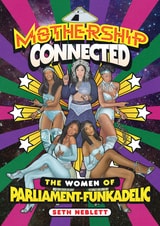
Mothership Connected
The Women of Parliament-FunkadelicSeth Neblett
University of Texas Press, 2025
An oral history with the women of Parliament-Funkadelic, from forming the band to landing the mothership.
Parliament-Funkadelic is perhaps the greatest funk band ever assembled. Yet at the time of the group’s induction into the Rock & Roll Hall of Fame, none of the women who helped create the sound and performed in P-Funk were invited to the ceremony and their contributions have been largely overlooked.
Mothership Connected tells the story of Mallia Franklin, Lynn Mabry, Dawn Silva, Debbie Wright, and Shirley Hayden, all of whom were instrumental in making Parliament-Funkadelic, as well as the spin-off groups Parlet and the Brides of Funkenstein, into the legends they are today. Assembled by Seth Neblett, son of the “Queen of Funk” Mallia Franklin, and filled with the voices of funk icons like George Clinton, Sly Stone, Bootsy Collins, and the women themselves, this oral history makes clear why these “architects” at the “core” of P-Funk were both essential—and erased. From Franklin introducing Bootsy Collins to Clinton, to the Brides’ top-10 hit “Disco to Go,” to the drugs that helped destroy the group, this book reveals the hidden lives and uncomfortable truths of life in P-Funk. More than sex, drugs, and rock and roll, Mothership Connected is about Black women navigating a tumultuous era and industry to become musical pioneers. Now, after decades in the shadows, these genre-defining women are finally telling their story.
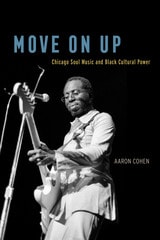
Move On Up
Chicago Soul Music and Black Cultural PowerAaron Cohen
University of Chicago Press, 2019
A Booklist Top 10 Arts Book of 2019
A No Depression Top Music Book of 2019
Curtis Mayfield. The Chi-Lites. Chaka Khan. Chicago’s place in the history of soul music is rock solid. But for Chicagoans, soul music in its heyday from the 1960s to the 1980s was more than just a series of hits: it was a marker and a source of black empowerment. In Move On Up, Aaron Cohen tells the remarkable story of the explosion of soul music in Chicago. Together, soul music and black-owned businesses thrived. Record producers and song-writers broadcast optimism for black America’s future through their sophisticated, jazz-inspired productions for the Dells and many others. Curtis Mayfield boldly sang of uplift with unmistakable grooves like “We’re a Winner” and “I Plan to Stay a Believer.” Musicians like Phil Cohran and the Pharaohs used their music to voice Afrocentric philosophies that challenged racism and segregation, while Maurice White of Earth, Wind, and Fire and Chaka Khan created music that inspired black consciousness. Soul music also accompanied the rise of African American advertisers and the campaign of Chicago’s first black mayor, Harold Washington, in 1983. This empowerment was set in stark relief by the social unrest roiling in Chicago and across the nation: as Chicago’s homegrown record labels produced rising stars singing songs of progress and freedom, Chicago’s black middle class faced limited economic opportunities and deep-seated segregation, all against a backdrop of nationwide deindustrialization.
Drawing on more than one hundred interviews and a music critic’s passion for the unmistakable Chicago soul sound, Cohen shows us how soul music became the voice of inspiration and change for a city in turmoil.
Movement and Modernism
Yeats, Eliot, Williams, and Early Twentieth-Century DanceTerri A. Mester
University of Arkansas Press, 1997
Movie Mavens
US Newspaper Women Take On the Movies, 1914-1923Edited by Richard Abel
University of Illinois Press, 2021
An invaluable collection of rare archival sources, Movie Mavens reveals women's essential contribution to the creation of American film culture.
Moving Away from Silence
Music of the Peruvian Altiplano and the Experience of Urban MigrationThomas Turino
University of Chicago Press, 1993
Turino's ethnography is the first large-scale study to concentrate on the pervasive effects of migration on Andean people and their music. Turino uses the musical traditions of Conima, Peru as a unifying thread, tracing them through the varying lives of Conimeos in different locales. He reveals how music both sustains and creates meaning for a people struggling amid the dramatic social upheavals of contemporary Peru.
Moving Away from Silence contains detailed interpretations based on comparative field research of Conimeo musical performance, rehearsals, composition, and festivals in the highlands and Lima. The volume will be of great importance to students of Latin American music and culture as well as ethnomusicological and ethnographic theory and method.
Moving Color
Early Film, Mass Culture, ModernismYumibe, Joshua
Rutgers University Press, 2012
Color was used in film well before The Wizard of Oz. Thomas Edison, for example, projected two-colored films at his first public screening in New York City on April 23, 1896. These first colors of early cinema were not photographic; they were applied manually through a variety of laborious processes—most commonly by the hand-coloring and stenciling of prints frame by frame, and the tinting and toning of films in vats of chemical dyes. The results were remarkably beautiful.
Moving Color is the first book-length study of the beginnings of color cinema. Looking backward, Joshua Yumibe traces the legacy of color history from the beginning of the nineteenth century to the cinema of the early twentieth century. Looking forward, he explores the implications of this genealogy on experimental and contemporary digital cinemas in which many colors have become, once again, vividly unhinged from photographic reality. Throughout this history, Moving Color revolves around questions pertaining to the sensuousness of color: how color moves us in the cinema—visually, emotionally, and physically.
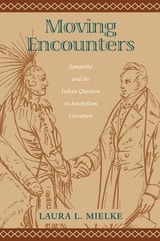
Moving Encounters
Sympathy and the Indian Question in Antebellum LiteratureLaura L. Mielke
University of Massachusetts Press, 2008
An old Indian woman comforts two young white children she finds lost in the woods and lovingly carries them back to their eager parents. A frontiersman sheds tears over the grave of a Mohican youth, holding hands with the mourning father. According to Laura L. Mielke, such emotionally charged scenes between whites and Indians paradoxically flourished in American literature from 1820 to 1850, a time when the United States government developed and applied a policy of Indian removal.
Although these “moving encounters,” as Mielke terms them, often promoted the possibility of mutual sympathy between Native Americans and Euro-Americans, they also suggested that these emotional links were inherently unstable, potentially dangerous, and ultimately doomed. At the same time, the emphasis on Indian-white sympathy provided an opportunity for Indians and non-Native activists to voice an alternative to removal and acculturation, turning the language of a sentimental U.S. culture against its own imperial impulse. Mielke details not only how such writers as James Fenimore Cooper and Henry Rowe Schoolcraft forecast the inevitable demise of Indian-white sympathy, but also how authors like Lydia Maria Child and William Apess insisted that a language of feeling could be used to create shared community or defend American Indian sovereignty. In this way, Moving Encounters sheds new light on a wide range of texts concerning the “Indian Question” by emphasizing their engagement with popular sentimental forms and by challenging the commonly held belief that all Euro-American expressions of sympathy for American Indians in this period were fundamentally insincere. While portraits of Indian-white sympathy often prompted cynical rejoinders from parodists, many never lost faith in the power of emotion to overcome the greed and prejudice fueling the dispossession of American Indians.
Moving Home
Gender, Place, and Travel Writing in the Early Black AtlanticSandra Gunning
Duke University Press, 2021
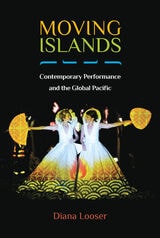
Moving Islands
Contemporary Performance and the Global PacificDiana Looser
University of Michigan Press, 2021
Moving Islands reveals the international and intercultural connections within contemporary performance from Oceania, focusing on theater, performance art, art installations, dance, film, and activist performance in sites throughout Oceania and in Australia, Asia, North America, and Europe. Diana Looser’s study moves beyond a predictable country-specific or island-specific focus to encompass an entire region defined by diversity and global exchange, showing how performance operates to frame social, artistic, and political relationships across widely dispersed locations. The study also demonstrates how Oceanian performance contributes to international debates about diaspora, indigeneity, urbanization, and environmental sustainability. The author considers the region’s unique cultural and geographic dynamics as she brings forth the paradigm of transpasifika to suggest a way of understanding these intercultural exchanges and connections, with the aim to “rework the cartographic and disciplinary priorities of transpacific studies to privilege the activities of Islander peoples.”

Moving On
The Heroines of Shirley Ann Grau, Anne Tyler, and Gail GodwinSusan S. Kissel
University of Wisconsin Press, 1996
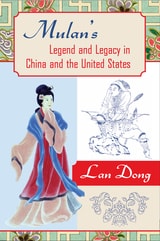
Mulan's Legend and Legacy in China and the United States
Authored by Lan Dong
Temple University Press, 2010
Mulan, the warrior maiden who performed heroic deeds in battle while dressed as a male soldier, has had many incarnations from her first appearance as a heroine in an ancient Chinese folk ballad. Mulan’s story was retold for centuries, extolling the filial virtue of the young woman who placed her father's honor and well-being above her own. With the publication of Maxine Hong Kingston’s The Woman Warrior in the late 1970s, Mulan first became familiar to American audiences who were fascinated with the extraordinary Asian American character. Mulan’s story was recast yet again in the popular 1998 animated Disney film and its sequel.
In Mulan’s Legend and Legacy in China and the United States, Lan Dong traces the development of this popular icon and asks, "Who is the real Mulan?" and "What does authenticity mean for the critic looking at this story?" Dong charts this character’s literary voyage across historical and geographical borders, discussing the narratives and images of Mulan over a long time span—from premodern China to the contemporary United States to Mulan’s counter-migration back to her homeland.
As Dong shows, Mulan has been reinvented repeatedly in both China and the United States so that her character represents different agendas in each retelling—especially after she reached the western hemisphere. The dutiful and loyal daughter, the fierce, pregnant warrior, and the feisty teenaged heroine—each is Mulan representing an idea about female virtue at a particular time and place.

Multicultural Comics
From Zap to Blue BeetleEdited by Frederick Luis Aldama
University of Texas Press, 2010
Multicultural Comics: From Zap to Blue Beetle is the first comprehensive look at comic books by and about race and ethnicity. The thirteen essays tease out for the general reader the nuances of how such multicultural comics skillfully combine visual and verbal elements to tell richly compelling stories that gravitate around issues of race, ethnicity, gender, and sexuality within and outside the U.S. comic book industry. Among the explorations of mainstream and independent comic books are discussions of the work of Adrian Tomine, Grant Morrison, and Jessica Abel as well as Marv Wolfman and Gene Colan's The Tomb of Dracula; Native American Anishinaabe-related comics; mixed-media forms such as Kerry James Marshall's comic-book/community performance; DJ Spooky's visual remix of classic film; the role of comics in India; and race in the early Underground Comix movement. The collection includes a "one-stop shop" for multicultural comic book resources, such as archives, websites, and scholarly books. Each of the essays shows in a systematic, clear, and precise way how multicultural comic books work in and of themselves and also how they are interconnected with a worldwide tradition of comic-book storytelling.

Murder Most Modern
Detective Fiction and Japanese CultureSari Kawana
University of Minnesota Press, 2008
The quintessential international genre, detective fiction often works under the guise of popular entertainment to expose its extensive readership to complex moral questions and timely ethical dilemmas. The first book-length study of interwar Japanese detective fiction, Murder Most Modern considers the important role of detective fiction in defining the country’s emergence as a modern nation-state.
Kawana explores the interactions between the popular genre and broader discourses of modernity, nation, and ethics that circulated at this pivotal moment in Japanese history. The author contrasts Japanese works by Edogawa Ranpo, Unno Juza, Oguri Mushitaro, and others with English-language works by Edgar Allan Poe, Dashiell Hammett, and Agatha Christie to show how Japanese writers of detective fiction used the genre to disseminate their ideas on some of the most startling aspects of modern life: the growth of urbanization, the protection and violation of privacy, the criminalization of abnormal sexuality, the dehumanization of scientific research, and the horrors of total war.
Kawana’s comparative approach reveals how Japanese authors of the genre emphasized the vital social issues that captured the attention of thrill-seeking readers-while eluding the eyes of government censors.
Sari Kawana is assistant professor of Japanese at the University of Massachusetts, Boston.
Murder Most Queer
The Homicidal Homosexual in the American TheaterJordan Schildcrout
University of Michigan Press, 2014
Murder She Wrote
A Study of Agatha Christie's Detective FictionPatricia D. Maida
University of Wisconsin Press, 1982
This book explores the inter-relationships between Agatha Christie and her works to seek the wholeness in the Christie experience. The authors perceive an integration in personal experience and moral and aesthetic values between the woman and her art.
Murder and Masculinity
Violent Fictions of Twentieth-Century Latin AmericaRebecca E. Biron
Vanderbilt University Press, 2000
The introduction to this study deftly situates Biron's work in relation to previous theoretical arguments on the social and political dimensions of Latin American writing. The five subsequent chapters offer superb analyses of the individual texts. Like their male protagonists who experiment with the psychological and legal extremes of gender division, these narratives risk nonconformity to the laws of genre in their quest for liberation from violent social and literary conventions. In combining elements of detective stories, crime narratives, psychological case studies, and magical or grotesque realism, they offer metafictional commentary on a network of discourses that confuses images of masculinity, national identity, and political autonomy in postcolonial Latin America.

Murder by Accident
Medieval Theater, Modern Media, Critical IntentionsJody Enders
University of Chicago Press, 2009
Over fifty years ago, it became unfashionable—even forbidden—for students of literature to talk about an author’s intentions for a given work. In Murder by Accident, Jody Enders boldly resurrects the long-disgraced concept of intentionality, especially as it relates to the theater.
Drawing on four fascinating medieval events in which a theatrical performance precipitated deadly consequences, Enders contends that the marginalization of intention in critical discourse is a mirror for the marginalization—and misunderstanding—of theater. Murder by Accident revisits the legal, moral, ethical, and aesthetic limits of the living arts of the past, pairing them with examples from the present, whether they be reality television, snuff films, the “accidental” live broadcast of a suicide on a Los Angeles freeway, or an actor who jokingly fired a stage revolver at his temple, causing his eventual death. This book will force scholars and students to rethink their assumptions about theory, intention, and performance, both past and present.
Murder on the Reservation
American Indian Crime FictionRay B. Browne
University of Wisconsin Press, 2004
Murderous Feeling
Gender and Retribution in Black and Indigenous LiteratureChad Benito Infante
University of Minnesota Press, 2026
Examining revenge narratives as a feminist response to slavery and settler colonialism
From Octavia Butler’s Kindred to The Round House by Louise Erdrich, themes of retribution resound throughout the work of renowned Black and Indigenous women and queer authors. Revealing how the Black Power Movement and the American Indian Movement influenced literature from the 1960s onward, Murderous Feeling explores how these writers have employed revenge narratives as a response to white supremacy and colonialism.
Chad Benito Infante shows how, rather than using retributive violence to cultivate a heroic, masculine ideal, Black and Native women and queer writers use revenge as a way to raise philosophical questions about justice and the reclamation of power in the face of white supremacy. Pairing canonical texts—including work by James Baldwin, Leslie Marmon Silko, Craig Womack, Toni Morrison, and others—he demonstrates how this uniquely queer and feminist literary tradition, the “grammar of interrogation,” allows for generative ambivalence and curiosity about the possibilities and failures of violence.
In highlighting these narratives’ potential to steer anticolonial efforts, Murderous Feeling reconceptualizes literary violence not as an individualized act of cleansing but as a tool for revolutionary inquiry.
Retail e-book files for this title are screen-reader friendly.
Museum of Words
The Poetics of Ekphrasis from Homer to AshberyJames A. W. Heffernan
University of Chicago Press, 1993
In the first book ever to explore this museum, James Heffernan argues that ekphrasis stages a battle for mastery between the image and the word. Moving from the epics of Homer, Virgil, and Dante to contemporary American poetry, this book treats the history of struggle between rival systems of representation. Readable and well illustrated, this study of how poets have represented painting and sculpture is a major contribution to our understanding of the relation between the arts.
Music Hall and Modernity
The Late-Victorian Discovery of Popular CultureBarry J. Faulk
Ohio University Press, 2004
The late-Victorian discovery of the music hall by English intellectuals marks a crucial moment in the history of popular culture. Music Hall and Modernity demonstrates how such pioneering cultural critics as Arthur Symons and Elizabeth Robins Pennell used the music hall to secure and promote their professional identity as guardians of taste and national welfare. These social arbiters were, at the same time, devotees of the spontaneous culture of “the people.”
In examining fiction from Walter Besant, Hall Caine, and Henry Nevinson, performance criticism from William Archer and Max Beerbohm, and late-Victorian controversies over philanthropy and moral reform, scholar Barry Faulk argues that discourse on music-hall entertainment helped consolidate the identity and tastes of an emergent professional class. Critics and writers legitimized and cleaned up the music hall, at the same time allowing issues of class, respect, and empowerment to be negotiated.
Music Hall and Modernity offers a complex view of the new middle-class, middlebrow mass culture of late-Victorian London and contributes to a body of scholarship on nineteenth-century urbanism. The book will also interest scholars concerned with the emergence of a professional managerial class and the genealogy of cultural studies.
Music In Cuba
Alejo Carpentier
University of Minnesota Press, 2002
Music Is My Life
Louis Armstrong, Autobiography, and American JazzDaniel Stein
University of Michigan Press, 2012
Music Is My Life is the first comprehensive analysis of Louis Armstrong's autobiographical writings (including his books, essays, and letters) and their relation to his musical and visual performances. Combining approaches from autobiography theory, literary criticism, intermedia studies, cultural history, and musicology, Daniel Stein reconstructs Armstrong's performances of his life story across various media and for different audiences, complicating the monolithic and hagiographic views of the musician.
The book will appeal to academic readers with an interest in African American studies, jazz studies, musicology, and popular culture, as well as general readers interested in Armstrong's life and music, jazz, and twentieth-century entertainment. While not a biography, it provides a key to understanding Armstrong's oeuvre as well as his complicated place in American history and twentieth-century media culture.
Music Scenes
Local, Translocal, and VirtualAndy Bennett
Vanderbilt University Press, 2004
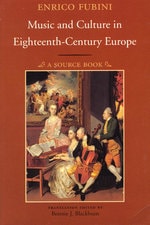
Music and Culture in Eighteenth-Century Europe
A Source BookEnrico Fubini
University of Chicago Press, 1994
Enrico Fubini offers a sampling of English, French, German, and Italian writings on topics ranging from Enlightenment rationalism and the theories of harmony to German musical culture and the polemics on J. S. Bach. Organized by topic and historical period these selections go beyond writings dealing exclusively with specific musical works to larger issues of theory and the reception of musical ideas in the culture at large. The selections are from books, journals, newspapers, pamphlets, and letters; the contributors include Diderot, Rousseau, Voltaire, Grimm, Alfieri, Rameau, Quantz, Gluck, Tartini, Leopold and W. A. Mozart, and C. P .E. Bach. Many are translated here for the first time.
With general and chapter introductions, restored footnotes, and other valuable annotations, and a biographical appendix, this anthology will interest music scholars, students, and teachers.