Results by title
22279 books match the query 'Social Science' and 1258 start with m
Mapping Gay L.A.
Intersection Of Place And PoliticsMoira Rachel Kenney
Temple University Press, 2001
By tracking the terrain of the movement since the beginnings of gay liberation in 1960s Los Angeles, Kenney shows how activists laid claim to streets, buildings, neighborhoods, and, in the example of West Hollywood, an entire city. Exploiting the area's lack of cohesion, they created a movement that maintained a remarkable flexibility and built support networks stretching from Venice Beach to East LA. Taking a different path from San Francisco and New York, gays and lesbians in Los Angeles emphasized social services, decentralized communities (usually within ethnic neighborhoods), and local as well as national politics. Kenney's grounded reading of this history celebrates the public and private forms of activism that shaped a visible and vibrant community.
Mapping Indigenous Presence
North Scandinavian and North American PerspectivesEdited by Kathryn W. Shanley and Bjørg Evjen; Foreword by S. James Anaya
University of Arizona Press, 2015
Mapping Indigenous Presence presents a set of comparative Indigenous studies essays with contemporary perspectives, attesting to the importance of the roles Indigenous people have played as overseers of their own lands and resources, as creators of their own cultural richness, and as political entities capable of governing themselves. This interdisciplinary collection explores the Indigenous experience of Sámi peoples of Norway and Native Americans of Montana in their respective contexts—yet they are in many ways distinctly different within the body politic of their respective countries. Although they share similarities as Indigenous peoples within nation-states and inhabit somewhat similar geographies, their cultures and histories differ significantly.
Sámi people speak several languages, while Indigenous Montana is made up of twelve different tribes with at least ten distinctly different languages; both peoples struggle to keep their Indigenous languages vital. The political relationship between Sámi people and the mainstream Norwegian government and culture has historically been less contentious that that of the Indigenous peoples of Montana with the United States and with the state of Montana, yet the Sámi and the Natives of Montana have struggled against both the ideology and the subsequent assimilation policy of the savagery-versus-civilization model. The authors attempt to increase understanding of how these two sets of Indigenous peoples share important ontological roots and postcolonial legacies, and how research may be used for their own self-determination and future directions.
Mapping Medical Anthropology for the Twenty-First Century
Matthew J. Wolf-Meyer
Rutgers University Press, 2026
Mapping Medical Anthropology for the Twenty-First Century provides readers with a comprehensive survey of topics, methodologies, and theories in the discipline, drawing on contributions from leading anthropologists around the world. As a discipline, medical anthropology provides situational analysis of health, disease, and disability to show how the experiences of medical experts, patients, and their broader communities are informed by their social and cultural contexts. Adopting a keywords-driven approach, Mapping Medical Anthropology for the Twenty-First Century provides readers with an introduction to the concepts and approaches that have animated medical anthropology over the course of the twentieth century. Authors put these keywords into dialogue with their ethnographic and archival research to demonstrate how these concepts can be expanded to address contemporary phenomena related to health, disease, and disability. Mapping Medical Anthropology for the Twenty-First Century provides newcomers to medical anthropology with a robust introduction to the discipline, while providing experienced readers a set of chapters that explore the discipline in novel and exciting ways.
Mapping Multiculturalism
Gordon, Avery F.
University of Minnesota Press, 1996
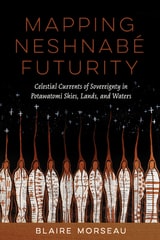
Mapping Neshnabé Futurity
Celestial Currents of Sovereignty in Potawatomi Skies, Lands, and WatersBlaire Morseau; Foreword by Grace L. Dillon
University of Arizona Press, 2025
In Mapping Neshnabé Futurity Blaire Morseau weaves together on-the-ground insights and Indigenous speculative fiction to illustrate the profound ways in which Anishinaabé/Neshnabé (Potawatomi, Odawa, and Ojibwe) communities are reclaiming their sovereignty and crafting vibrant futures. Morseau lays out how Neshnabék have marshaled dissent to hydrologic fracturing, oil pipelines, and other damaging infrastructures of capitalist settler futurity. The book positions these efforts as vital acts of nation building and visionary reclamation of space, both terrestrial and celestial.
Morseau also challenges the hegemonic narratives of settler futurism found in mainstream science fiction, which often perpetuate colonial fantasies and exclude marginalized voices. By fusing ethnography of tribal nation-building projects and analysis of Indigenous speculative fiction, Morseau provides a path to Indigenous futurisms and its role in imagining decolonization. Morseau’s analysis underscores the potency of Indigenous knowledge systems and ceremonial practices in imagining and actualizing alternative futures.
Mapping Neshnabé Futurity is an essential read for scholars and activists alike, urging a rethinking of how we conceive of futurity and sovereignty. This work shows how counter-mapping projects both on the ground and in the skies reclaim space in the Great Lakes region—Neshnabé homelands—and are part of larger constellations of Indigenous futurities and stories of survivance.
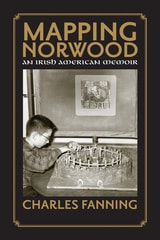
Mapping Norwood
An Irish-American MemoirCharles Fanning
University of Massachusetts Press, 2010
This memoir is an act of map making, of plotting out overlapping territories—topographical, temporal, and psychological. Centered on family life in a Massachusetts town from the 1920s to the 1960s, the author's investigation extends outward to include the Boston area from colonial times to the recent past, encounters with Boston's Museum of Fine Arts and with Harvard College, the American Civil War, and Ireland and Germany in the nineteenth century.
Charles Fanning re-creates the landscape of childhood and adolescence in a place and time both ordinary and rich with possibility. An expert on Irish immigration, he was born and raised in Norwood, Massachusetts, twelve miles outside of Boston, where Yankee and Irish cultures bumped against each other. The narrative traces his personal growth, shaped by family, school, baseball, radio drama, and art. He was the first in his family to attend college, and the book ends with his undergraduate experience at Harvard, class of 1964.
Along with this coming-of-age story, Mapping Norwood features forays back in time, including chapters on each of Fanning's parents and historical excavations and meditations on three ancestors. Guided by his own experience as a scholar, the pressure of these chapters is epistemological—the thrill of the hunt toward knowing. Fanning's great-grandfather, John Fanning, disappeared from the family in the late 1880s, and a chapter chronicles the discovery of “Walking John's” fifty years of hidden later life in East St. Louis, Illinois, where he died alone in 1946. Fanning's great-great-grandfather, Winslow Radcliffe, was a veteran of the 35th Massachusetts Infantry in the Civil War, and the author traces this regiment through the horrors of Antietam and Fredericksburg, by means of diaries and letters by four men from Winslow's company. The evidence gleaned helps explain Winslow's suicide after the war. An Irish immigrant ancestor, Phillip Fanning, came to Boston from County Monaghan just after the Great Famine of the late 1840s. Relying on historical research, Fanning imagines vividly the lives led by Phillip's family and thousands like them in the wake of Ireland's nineteenth-century catastrophe.
Mapping Racial Literacies
College Students Write about Race and SegregationSophie R. Bell
Utah State University Press, 2020
This textual ethnography embeds early college students’ writing in deep historical and theoretical contexts and looks for new ways that their writing contributes to and reshapes contemporary understandings of how US and global citizens are thinking about race. The book is a teaching narrative, tracing a teaching journey that considers student writing not only in the moments it is assigned but also in continual revisions of the course, making it a useful tool in helping college-age students see, explore, and articulate the role of race in determining their life experiences and opportunities.
Sophie Bell’s work narrates the experiences of a white teacher making mistakes in teaching about race and moving forward through those mistakes, considering that process valuable and, in fact, necessary. Providing a model for future scholars on how to carve out a pedagogically responsive identity as a teacher, Mapping Racial Literacies contributes to the scholarship on race and writing pedagogy and encourages teachers of early college classes to bring these issues front and center on the page, in the classroom, and on campus.
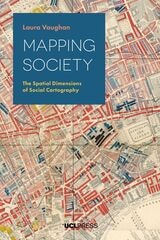
Mapping Society
The Spatial Dimensions of Social CartographyLaura Vaughan
University College London, 2018
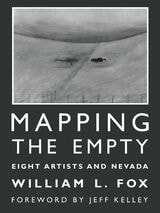
Mapping The Empty
Eight Artists And NevadaWilliam L. Fox
University of Nevada Press, 1999
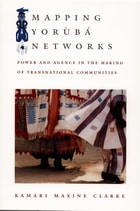
Mapping Yorùbá Networks
Power and Agency in the Making of Transnational CommunitiesKamari Maxine Clarke
Duke University Press, 2004
Examining how the development of a deterritorialized network of black cultural nationalists became aligned with a lucrative late-twentieth-century roots heritage market, Clarke explores the dynamics of Òyótúnjí Village’s religious and tourist economy. She discusses how the community generates income through the sale of prophetic divinatory consultations, African market souvenirs—such as cloth, books, candles, and carvings—and fees for community-based tours and dining services. Clarke accompanied Òyótúnjí villagers to Nigeria, and she describes how these heritage travelers often returned home feeling that despite the separation of their ancestors from Africa as a result of transatlantic slavery, they—more than the Nigerian Yorùbá—are the true claimants to the ancestral history of the Great Òyó Empire of the Yorùbá people. Mapping Yorùbá Networks is a unique look at the political economy of homeland identification and the transnational construction and legitimization of ideas such as authenticity, ancestry, blackness, and tradition.
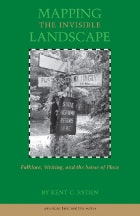
Mapping the Invisible Landscape
Folklore, Writing, and the Sense of PlaceKent C. Ryden
University of Iowa Press, 1993
Any landscape has an unseen component: a subjective component of experience, memory, and narrative which people familiar with the place understand to be an integral part of its geography but which outsiders may not suspect the existence of—unless they listen and read carefully. This invisible landscape is make visible though stories, and these stories are the focus of this engrossing book.
Traveling across the invisible landscape in which we imaginatively dwell, Kent Ryden—himself a most careful listener and reader—asks the following questions. What categories of meaning do we read into our surroundings? What forms of expression serve as the most reliable maps to understanding those meanings? Our sense of any place, he argues, consists of a deeply ingrained experiential knowledge of its physical makeup; an awareness of its communal and personal history; a sense of our identity as being inextricably bound up with its events and ways of life; and an emotional reaction, positive or negative, to its meanings and memories.
Ryden demonstrates that both folk and literary narratives about place bear a striking thematic and stylistic resemblance. Accordingly, Mapping the Invisible Landscape examines both kinds of narratives. For his oral materials, Ryden provides an in-depth analysis of narratives collected in the Coeur d'Alene mining district in the Idaho panhandle; for his consideration of written works, he explores the “essay of place,” the personal essay which takes as its subject a particular place and a writer's relationship to that place.
Drawing on methods and materials from geography, folklore, and literature, Mapping the Invisible Landscape offers a broadly interdisciplinary analysis of the way we situate ourselves imaginatively in the landscape, the way we inscribe its surface with stories. Written in an extremely engaging style, this book will lead its readers to an awareness of the vital role that a sense of place plays in the formation of local cultures, to an understanding of the many-layered ways in which place interacts with individual lives, and to renewed appreciation of the places in their own lives and landscapes.
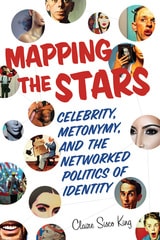
Mapping the Stars
Celebrity, Metonymy, and the Networked Politics of IdentityClaire Sisco King
The Ohio State University Press, 2023
King considers three stars with popular and controversial personas: Norman Rockwell, Will Smith, and Kim Kardashian. Working in very different contexts and with very different public images, these figures nonetheless share a consistent, if not conspicuous, interest in celebrity as a construct. Offering intertextual readings of their public images across such sites as movie posters, magazines, cinema, and social media—and deploying rhetorical theories of metonymy (a linguistic device linking signifiers by shared associations)—King argues that these stars’ self-reflexive attention to the processes by which celebrity is created and constrained creates opportunities for reframing public discourse about what it means to be famous and what it means to be a person.

Maras
Gang Violence and Security in Central AmericaEdited by Thomas C. Bruneau, Lucía Dammert, and Elizabeth Skinner
University of Texas Press, 2011
Sensational headlines have publicized the drug trafficking, brutal violence, and other organized crime elements associated with Central America's mara gangs, but there have been few clear-eyed analyses of the history, hierarchies, and future of the mara phenomenon. The first book to look specifically at the Central American gang problem by drawing on the perspectives of researchers from different disciplinary backgrounds, Maras: Gang Violence and Security in Central America provides much-needed insight.
These essays trace the development of the gangs, from Mara Salvatrucha to the 18th Street Gang, in Los Angeles and their spread to El Salvador, Honduras, Guatemala, and Nicaragua as the result of members' deportation to Central America; there, they account for high homicide rates and threaten the democratic stability of the region. With expertise in areas ranging from political science to law enforcement and human rights, the contributors also explore the spread of mara violence in the United States. Their findings comprise a complete documentation that spans sexualized violence, case studies of individual gangs, economic factors, varied responses to gang violence, the use of intelligence gathering, the limits of state power, and the role of policy makers.
Raising crucial questions for a wide readership, these essays are sure to spark productive international dialogues.

Maraña
War and Disease in the Jungles of ColombiaLina Pinto-García
University of Chicago Press, 2025
Cutaneous leishmaniasis, transmitted by female sandflies, produces skin lesions of varying size and shape. In Colombia, the insect vector of the disease is native to the same forested environments that have served as the main stage for one of the longest and most violent wars in Latin American history. As a result, the populations most affected by leishmaniasis in Colombia are members of the state army and nonstate armed groups.
Lina Pinto-García explores how leishmaniasis and the armed conflict are inextricably connected and mutually reinforcing. Maraña means “tangle” in Spanish but is also commonly used in Colombia to name the entangled greenery, braided lianas, and dense foliage that characterize the tropical forests where leishmaniasis transmission typically occurs. Pinto-García argues that leishmaniasis and the war are not merely linked but enmarañadas to each other through narratives, technologies, and practices produced by the state, medicine, biomedical research, and the armed conflict itself. All told, Maraña is a passionate study of how war has shaped the production of scientific knowledge about leishmaniasis and access to its treatments in Colombia.
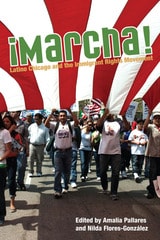
Marcha
Latino Chicago and the Immigrant Rights MovementEdited by Amalia Pallares and Nilda Flores-Gonzalez
University of Illinois Press, 2010
Marcha is a multidisciplinary survey of the individuals, organizations, and institutions that have given shape and power to the contemporary immigrant rights movement in Chicago. A city with longstanding historic ties to immigrant activism, Chicago has been the scene of a precedent-setting immigrant rights mobilization in 2006 and subsequent mobilizations in 2007 and 2008.
Positing Chicago as a microcosm of the immigrant rights movement on national level, these essays plumb an extraordinarily rich set of data regarding recent immigrant rights activities, defining the cause as not just a local quest for citizenship rights, but a panethnic, transnational movement. The result is a timely volume likely to provoke debate and advance the national conversation about immigration in innovative ways.
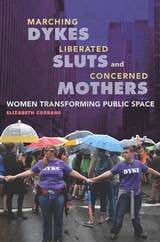
Marching Dykes, Liberated Sluts, and Concerned Mothers
Women Transforming Public SpaceElizabeth Currans
University of Illinois Press, 2017
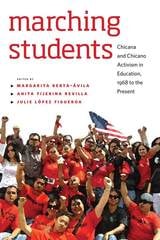
Marching Students
Chicana and Chicano Activism in Education, 1968 to the PresentMargarita Berta-Avila
University of Nevada Press, 2011
Contributors: Alejandro Covarrubias, Xico González, Eracleo Guevara, Adriana Katzew, Lilia R. De Katzew, Rita Kohli, Edward M. Olivos, Alejo Padilla, Carmen E. Quintana, Evelyn M. Rangel-Medina, Marianna Rivera, Daniel G. Solórzano, Carlos Tejeda
Marcus Aurelius in Love
Marcus Aurelius and Marcus Cornelius Fronto
University of Chicago Press, 2007
In 1815 a manuscript containing one of the long-lost treasures of antiquity was discovered—the letters of Marcus Cornelius Fronto, reputed to have been one of the greatest Roman orators. But this find disappointed many nineteenth-century readers, who had hoped for the letters to convey all of the political drama of Cicero’s. That the collection included passionate love letters between Fronto and the future emperor Marcus Aurelius was politely ignored—or concealed. And for almost two hundred years these letters have lain hidden in plain sight.
Marcus Aurelius in Love rescues these letters from obscurity and returns them to the public eye. The story of Marcus and Fronto began in 139 CE, when Fronto was selected to instruct Marcus in rhetoric. Marcus was eighteen then and by all appearances the pupil and teacher fell in love. Spanning the years in which the relationship flowered and died, these are the only love letters to survive from antiquity—homoerotic or otherwise. With a translation that reproduces the effusive, slangy style of the young prince and the rhetorical flourishes of his master, the letters between Marcus and Fronto will rightfully be reconsidered as key documents in the study of the history of sexuality and classics.
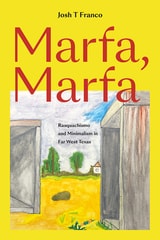
Marfa, Marfa
Rasquachismo and Minimalism in Far West TexasJosh T Franco
Duke University Press, 2026
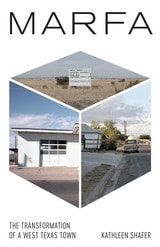
Marfa
The Transformation of a West Texas TownBy Kathleen Shafer
University of Texas Press, 2019
A small town in the vast desert of West Texas, Marfa attracts visitors from around the world to its art foundations and galleries, film and music festivals, and design and architecture symposiums. While newcomers sometimes see it as “another Santa Fe,” long-time residents often take a bemused, even disapproving attitude toward the changes that Marfa has undergone since artist Donald Judd came to town in the 1970s and began creating spaces for his own and other artists’ work. They remember when ranching and the military formed the basis of the town’s economy, even as they acknowledge that tourist dollars are now essential to Marfa’s sustainability
Marfa tells an engaging story of how this isolated place became a beacon in the art world, like the famous Marfa Lights that draw curious spectators into the West Texas night. As Kathleen Shafer delves into the town’s early history, the impact of Donald Judd, the expansion of arts programming, and the increase in tourism, she unlocks the complex interplay between the particularities of the place, the forces of commerce and growth, the textures of local culture and tradition, and the transformative role of artists and creative work. Bookending her story between two iconic artworks—the whimsical Prada Marfa and the crass Playboy Marfa—Shafer illuminates the shifting cultural landscape of Marfa, showing why this place has become a mecca for so many and how the influx of newcomers has transformed its character.

Margaret Atwood
Vision and FormsEdited by Kathryn Van Spanckeren and Jan Garden Castro. Foreword by Margaret Atwood
Southern Illinois University Press, 1988
A prolific writer and versatile social critic, Canadian novelist and poet Margaret Atwood has recently published Bluebeard’s Egg (short stories), Interlunar (poetry), and The Handmaid’s Tale a critically acclaimed best-selling novel.
This international collection of essays evaluates the complete body of her work—both the acclaimed fiction and the innovative poetry. The critics represented here—American, Australian, and Canadian—address Atwood’s handling of such themes as feminism, ecology, the gothic novel, and the political relationship between Canada and the United States.
The essays on Atwood’s novels introduce the general reader to her development as a writer, as she matures from a basically subjective, poetic vision, seen in Surfacing and The Edible Woman, to an increasingly engaged, political stance, exemplified by The Handmaid’s Tale. Other essays examine Atwood’s poetry, from her transformation of the Homeric model to her criticisms of the United States’ relationship with Canada. The last two critical essays offer a unique view of Atwood through an investigation of her use of the concept of shamanism and through a presentation of eight of her vivid watercolors.
The volume ends with Atwood presenting her own views in an interview with Jan Garden Castro and in a conversation between Atwood and students at the University of Tampa, Florida.

Margaret Fuller and Her Circles
Brigitte Bailey
University of New Hampshire Press, 2013
Margaret Fuller
Transatlantic Crossings in a Revolutionary AgeEdited by Charles Capper and Cristina Giorcelli
University of Wisconsin Press, 2007
This volume is a collaboration of international scholars who, from varied fields and approaches, assess Fuller’s genius and character. Treating the last several years of Margaret Fuller’s short life, these essays offer a truly international discussion of Fuller’s unique cultural, political, and personal achievements. From the origins and articulations of Fuller’s cosmopolitanism to her examination of “the woman question,” and from her fascination with the European “other” to her candid perception of imperial America from abroad, they ponder what such an extraordinary woman meant to America, and also to Italy and Europe, during her lifetime and continuing to the present.
Margaret Mead Made Me Gay
Personal Essays, Public IdeasEsther Newton
Duke University Press, 2000
Newton’s provocative essays detail a queer academic career while offering a behind-the-scenes view of academic homophobia. In four sections that correspond to major periods and interests in her life—”Drag and Camp,” “Lesbian-Feminism,” “Butch,” and “Queer Anthropology”—the volume reflects her successful struggle to create a body of work that uses cultural anthropology to better understand gender oppression, early feminism, theatricality and performance, and the sexual and erotic dimensions of fieldwork. Combining personal, theoretical, and ethnographic perspectives, Margaret Mead Made Me Gay also includes photographs from Newton’s personal and professional life.
With wise and revealing discussions of the complex relations between experience and philosophy, the personal and the political, and identities and practices, Margaret Mead Made Me Gay is important for anyone interested in the birth and growth of gay and lesbian studies.

Margaret Mead and Ruth Benedict
The Kinship of WomenHilary Lapsley
University of Massachusetts Press, 2001

Margaret Mead, Gregory Bateson, and Highland Bali
Fieldwork Photographs of Bayung Gede, 1936-1939Gerald Sullivan
University of Chicago Press, 1999
Margaret Mead, Gregory Bateson, and Highland Bali includes 200 photographs that the couple took between 1936 and 1939, the vast majority of which have never before been published. They vividly capture the everyday lives of the men, women, and children of Bayung Gedé, their homes and their temples, and many other fascinating details of village life not featured in Mead and Bateson's publications.
In a substantial introductory essay, Gerald Sullivan, who selected the photographs, uses excerpts from fieldnotes and correspondence to illuminate Mead and Bateson's ethnographic work. Tracing the project from its inception in their proposals to the publication of their work, Sullivan shows how they used the photographs both as fieldnotes and as elements in their theoretical argument. Finally, he explores what the photographs reveal—independently of Mead and Bateson's project—about the Balinese character to the contemporary viewer.
The result is a both a substantial contribution to visual anthropology and an invaluable supplement to the published works of Margaret Mead and Gregory Bateson.

Margaret Webster
A Life in the TheaterMilly S. Barranger
University of Michigan Press, 2004
-Marian Seldes
"Margaret Webster is a highly welcome addition to our knowledge of the first important female director in American theater. Remembered now especially for her staging of Othello with Paul Robeson, Uta Hagen, and Jose Ferrer, Margaret Webster was probably the best-known, in-demand, and admired director of Shakespeare in America in the 1940s and 1950s. Fascinating throughout, the book's discussions of working with Robeson, and of HUAC, which targeted her just as her career was reaching a peak, make for especially engrossing reading."
-Oscar Brockett
Margaret Webster: A Life in the Theater is an engrossing backstage account of the life of pioneering director Margaret Webster (1905-72).
This is the first book-length biography of Webster, a groundbreaking stage and opera director whose career challenged not only stage tradition but also mainstream attitudes toward professional women.
Often credited with first having brought Shakespeare to Broadway, and renowned for her bold casting of an African American (Paul Robeson) in the role of Othello, Webster was a creative force in modern American and British theater.
Her story reveals the independent-minded artist undeterred by stage tradition and unmindful of rules about a woman's place in the professional theater. In addition to providing fascinating glimpses into Webster's personal and family life, Margaret Webster: A Life in the Theater also offers a who's-who list of the biggest names in New York and London theater of the time, as well as Hollywood: John Gielgud, Noël Coward, George Bernard Shaw, Uta Hagen, Sybil Thorndike, Eva LeGallienne, and John Barrymore, among others, all of whom crossed paths with Webster. Capping Webster's amazing story is her investigation by Senator Joseph McCarthy and HUAC, which left her unable to work for a year, and from which she never fully recovered.
Margaret
A Tale of the Real and Ideal, Blight and BloomSylvester Judd
University of Massachusetts Press, 2009
Praised at the time as the most emphatically “American” book ever written, Margaret is a breathtaking combination of female bildungsroman, utopian novel, and historical romance. First published in 1845, Sylvester Judd's novel centers on the fictional New England village of Livingston, where the young Margaret Hart strives to escape the poverty and vice of her surroundings by learning from a mysterious teacher, the “Master,” and by entwining herself with the powers of nature. But when Margaret's brother is tried and hanged for murder, this rural community collapses, forcing Margaret to face the temptations of an urban underworld and to confront the intrigue of her family history. Margaret is the story of a young woman's attempt to create a new social order, founded on beauty and truth, in a land plagued by violence, debauchery, and political instability.
As Gavin Jones points out in his new introduction, Margaret perhaps stands alone in its creation of a female character who grows in social rather than domestic power. The novel also remains unique in its exploration of transcendental philosophy in novelistic form. Part eco-criticism, part seduction novel, part temperance tract, and part social history, Margaret is a virtual handbook for understanding the literary culture of mid-nineteenth-century America, the missing piece in puzzling out connections between writers such as Hawthorne, Melville, Whitman, and Thoreau.
Margaret was widely read and deeply influential on both British and American writers throughout the nineteenth century but controversial for its representations of alcoholism and capital punishment. Judd's novel remains resonant for today's readers as it overturns conventional views of the literary representation of women and the origins of the American Renaissance.
Marginal Conventions
Popular Culture, Mass Media, and Social DevianceClinton R. Sanders
University of Wisconsin Press, 1990
Marginal Gains
Monetary Transactions in Atlantic AfricaJane I. Guyer
University of Chicago Press, 2004
The answer is a rich diversity of economic practices responsive to both local and global circumstances. In Marginal Gains, Jane I. Guyer explores and explains these often bewildering practices, including trade with coastal capitalism and across indigenous currency zones, and within the modern popular economy. Drawing on a wide range of evidence, Guyer demonstrates that the region shares a coherent, if loosely knit, commercial culture. She shows how that culture actually works in daily practice, addressing both its differing scales of value and the many settings in which it operates, from crisis conditions to ordinary household budgets. The result is a landmark study that reveals not just how popular economic systems work in Africa, but possibly elsewhere in the Third World.
Marginal People in Deviant Places
Ethnography, Difference, and the Challenge to Scientific RacismJanice M. Irvine
University of Michigan Press, 2022
Place plays a crucial role in this work as Irvine examines its role in shaping ethnographies about outsiders and therefore understandings of social difference. Irvine has visited the sites of each of the ethnographies about which she writes, collecting photos, videos, and archival materials that will help readers understand the importance of place in the generation of particular ethnographic stories. The open-access online edition of this book is richly illustrated to help convey the deep sense of emplacement of the ethnographies discussed in this book and includes a series of interviews with sociologists about how they conduct their work and understand their forebears.

Marginalism and Discontinuity
Tools for the Crafts of Knowledge and DecisionMartin H. Krieger
Russell Sage Foundation, 1989
Marginalized in the Middle
Alan Wolfe
University of Chicago Press, 1996
"In applying a realist approach to controversies over immigration, pornography, race relations, and the apparent communications gap between the genders, Wolfe seeks to demonstrate the advantages of combining the insights of criticism and the tools of social science."—Library Journal
"A plea for a return to liberal thinking, an insistence on the value of 'social criticism beyond politics.' "—Washington Post Book World
"[Wolfe] surveys contemporary public discourse on racial and sexual relations, welfare policy, immigration, pornography, education and cultural politics . . . he manages to bring some fresh thinking to most of these stale debates."—T. J. Jackson Lears, New York Times Book Review
Marginalizing Colonialism
The Politics of Urban Growth in BolgatangaDomenico Cristofaro
Ohio University Press, 2026
Marginalizing Colonialism offers a social, political, and spatial history of Bolgatanga, a northern Ghanaian town whose colonial-era urban development has been largely overlooked in African historiography. Covering the late nineteenth century through the 1940s, the book traces how this settlement—long characterized as a remote hinterland of the British Empire—emerged as a commercial and political center in the region. Rather than depicting urbanization as an imperial project, it reveals how African actors actively shaped Bolgatanga’s growth and repeatedly marginalized, redirected, and evaded colonial authority.
The narrative follows Bolgatanga’s transformation from a dispersed settlement organized around kinship, ritual geographies, and earth shrines into a dynamic urban hub integrated into regional trade networks. Central to this shift were new land tenure systems, commercial expansion, and changing spatial practices. By the 1930s and 1940s, trade in kola, groundnuts, livestock, and other goods surged, stimulated by new roads and increased mobility. Population growth converted farmland into leased plots, permanent buildings replaced older compounds, and areas around the market became focal points of economic and social life.
These changes were driven not by the colonial state but rather by local negotiations and strategic adaptations. Chiefs, earth priests, merchants, and migrant traders mediated and reshaped colonial policies, while missionaries and settlers concluded land agreements beyond official oversight. Roads and marketplaces, planned through negotiations between colonial officials and local chiefs and built largely through African labor, became central infrastructures of local economic life. Even as colonial administrators sought to codify land tenure and regulate commerce, their influence remained largely nominal—a background presence in a story propelled by African initiative.
Drawing on archival documents, oral histories, and unpublished manuscripts by local intellectuals, Marginalizing Colonialism provides the first comprehensive urban history of Bolgatanga. It challenges dominant narratives in African colonial and urban historiography by exposing the silences of the colonial archive and highlighting the significance of medium-sized towns as arenas of negotiation and creativity. Ultimately, the book argues that Bolgatanga’s urbanization was a locally driven process that redefined power, space, and governance—leaving a legacy that continues to shape the city’s identity and regional role today.

Marianne Moore, Elizabeth Bishop, and May Swenson
The Feminist Poetics of Self-RestraintKirstin Hotelling Zona
University of Michigan Press, 2002
In recent years critical studies of Bishop and Moore have flourished, a large percentage of them devoted to explorations of sexuality and gender. A gap is growing, however, between feminist repossessions of Moore and Bishop and recent readings of their antiessentialist poetics. On the one hand, these poets are appearing more frequently in the feminist canon, but the price of this inclusion is usually the suppression of their strategies of self-restraint. While Zona questions the poetic privileging of self-expression, she establishes contiguity between feminist poetry and developments in American poetry at large. In doing so she asserts the centrality of feminist poetry within discussions of contemporary American poetry, thereby challenging the common perception of feminist poetry as an "alternative" (which often means auxiliary) genre.
Kirstin Hotelling Zona is Assistant Professor of Poetry and Poetics, Illinois State University.
Marie Syrkin
Values Beyond the SelfCarole S. Kessner
Brandeis University Press, 2008
Marie Syrkin’s life spanned ninety years of the twentieth century, 1899–1989. As a polemical journalist, socialist Zionist, poet, educator, literary critic, translator, and idiosyncratic feminist, she was an eyewitness to and reporter on most of the major events in America, Israel, and Europe. Beautiful as well as brilliant, she had a rich personal life as a lover, wife, mother, and friend. During her lifetime Syrkin’s name was widely recognized in the world of Jewish life and letters. Yet, since Syrkin’s death, recognition of her name is no longer quite so immediate. Carole S. Kessner’s biography restores Syrkin’s fascinating life and legacy for a new generation.
Mariners, Renegades and Castaways
The Story of Herman Melville and the World We Live InC. L. R. James
Dartmouth College Press, 2001
Mariners, Renegades and Castaways
The Story of Herman Melville and the World We Live InC. L. R. James
Brandeis University Press, 2025
Political theorist and cultural critic, novelist, and cricket enthusiast, C. L. R. James (1901–89) was a brilliant polymath who was described by Edward Said as “a centrally important twentieth-century figure.” Through such landmark works as The Black Jacobins, Beyond a Boundary, and American Civilization, James’s thought continues to influence and inspire scholars in a variety of fields.
In this complete edition of his seminal work of literary and cultural criticism, Mariners, Renegades, and Castaways, James anticipated many of the concerns and ideas that have shaped the contemporary fields of American and postcolonial studies. In this provocative study of Moby Dick in which he challenged the prevailing Americanist interpretation that opposed a “totalitarian” Ahab and a “democratic, American” Ishmael, James offers instead a vision of a factory-like Pequod whose “captain of industry” leads the crew to their doom. In addition to demonstrating how such an interpretation supported the United States’ emerging national security state, he also related the narrative of Moby Dick to his own persecuted position at the height of McCarthyism. It is precisely this personal, deeply original material that was excised from the first edition of this book.
With a new foreword by Professor Chanda Prescod-Weinstein—theoretical physicist, advocate for a just science, and James’s granddaughter—and an introduction by Professor Donald E. Pease at Dartmouth College that places the work in its critical and cultural context, Mariners, Renegades, and Castaways is once again available in a new edition.
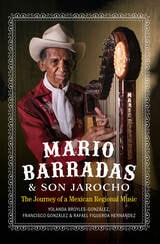
Mario Barradas and Son Jarocho
The Journey of a Mexican Regional MusicYolanda Broyles-González, Rafael Figueroa Hernández, and Francisco González
University of Texas Press, 2022
Son Jarocho was born as the regional sound of Veracruz but over time became a Mexican national genre, even transnational, genre—a touchstone of Chicano identity in the United States. Mario Barradas and Son Jarocho traces a musical journey from the Gulf Coast to interior Mexico and across the border, describing the transformations of Son Jarocho along the way.
This comprehensive cultural study pairs ethnographic and musicological insights with an oral history of the late Mario Barradas, one of Son Jarocho’s preeminent modern musicians. Chicano musician Francisco González offers an insider’s account of Barradas’s influence and Son Jarocho’s musical qualities, while Rafael Figueroa Hernández delves into Barradas’s recordings and films. Yolanda Broyles-González examines the interplay between Son Jarocho’s indigenous roots and contemporary role in Mexican and US society. The result is a nuanced portrait of a vital and evolving musical tradition.
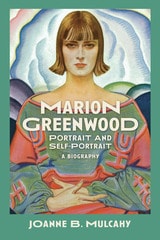
Marion Greenwood
Portrait and Self-Portrait—A BiographyJoanne B. Mulcahy
University of Alabama Press, 2025
This new biography reveals Marion Greenwood's central place in the pantheon of history’s remarkable women artists.
Marion Greenwood: Portrait and Self-Portrait—A Biography brings to life a woman who blazed through the twentieth-century art world. Born in Brooklyn in 1909, Greenwood thrived at storied institutions and arts centers such as the Art Students League, the studio of German modernist Winold Reiss, the Woodstock Colony, and Yaddo. In 1933, she catapulted to international fame as the first woman to paint a public mural in Mexico. Diego Rivera celebrated Greenwood as one of “the world’s greatest living women mural painters.” She traveled the globe to create award-winning portraits of people from diverse backgrounds, crossing racial, cultural, and class lines to reflect her vision for a more just world.
This biography, the first about Greenwood, is based on a decade of research and interviews. Author Joanne B. Mulcahy integrates the artist’s adventuresome personal life with her journey to artistic glory. Greenwood comes alive as a notable and spirited part of the heady art scenes of 1920s and 1930s Mexico, New York City, and Paris, and as one of two women artist-correspondents during World War II. After social realism and portraiture fell from favor, Greenwood doggedly stuck with what she called “the human thing” in art. Her freewheeling romantic life and independent spirit defied expectations for women, and she dismissed sexist critics who mixed acclaim for her work with commentary on her stunning beauty.
A feminist pioneer, Greenwood made a living as an artist in a time when few women could. In following Greenwood’s maverick path and artistic achievements, this book reveals her central place in the pantheon of history’s remarkable women artists.
Mariupol 2013-2022
Stories of Mobilization and ResistanceHana Josticova
Central European University Press, 2024
The chapters in this book represent successive phases of one story – that of Mariupol, formerly Ukraine’s tenth largest city, and the second largest in the Donbas region. The author, a young Slovak academic, conducted her ethnographic fieldwork in this coastal town between November 2018 and August 2021. She was one of the last academics to do research in Mariupol before its invasion and eventual occupation by Russia.
During these years, Hana Jošticová was overwhelmed by acts of mobilization and resistance that went in opposite directions: support for a Western direction of Ukraine’s future, and support for the status quo that the victory of the Euromaidan seemed to threaten.
She noted the sequence of events presented in the media and through the lens of individual frames and narratives. Her book is a collection and interpretation of memories and testimonies from both sides: those who actively resisted Russian influence; and those who sparked their own revolution, the ‘Russian Spring.’ Her focus is on self-mobilized individuals who resorted to action outside of established organizational structures spontaneously, autonomously, without resources and guarantees of safety. Her evidence indicates that popular support for the Russian Spring had less to do with Russia than with the social, economic, or cultural characteristics of the Donetsk region.
Years of immersive research convinced the author that individuals are as important as masses, ideas are as powerful as material resources, and beliefs and emotions are as critical as weapons.
Mark My Words
Native Women Mapping Our NationsMishuana Goeman
University of Minnesota Press, 2013
Dominant history would have us believe that colonialism belongs to a previous era that has long come to an end. But as Native people become mobile, reservation lands become overcrowded and the state seeks to enforce means of containment, closing its borders to incoming, often indigenous, immigrants.
In Mark My Words, Mishuana Goeman traces settler colonialism as an enduring form of gendered spatial violence, demonstrating how it persists in the contemporary context of neoliberal globalization. The book argues that it is vital to refocus the efforts of Native nations beyond replicating settler models of territory, jurisdiction, and race. Through an examination of twentieth-century Native women’s poetry and prose, Goeman illuminates how these works can serve to remap settler geographies and center Native knowledges. She positions Native women as pivotal to how our nations, both tribal and nontribal, have been imagined and mapped, and how these women play an ongoing role in decolonization.
In a strong and lucid voice, Goeman provides close readings of literary texts, including those of E. Pauline Johnson, Esther Belin, Joy Harjo, Leslie Marmon Silko, and Heid Erdrich. In addition, she places these works in the framework of U.S. and Canadian Indian law and policy. Her charting of women’s struggles to define themselves and their communities reveals the significant power in all of our stories.
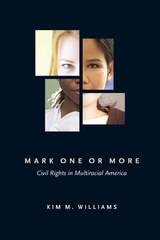
Mark One or More
Civil Rights in Multiracial AmericaKim M. Williams
University of Michigan Press, 2010
The movement to add a multiracial category to the 2000 U.S. Census provoked unprecedented debates about race. The effort made for strange bedfellows. Republicans like House Speaker Newt Gingrich and affirmative action opponent Ward Connerly took up the multiracial cause. Civil rights leaders opposed the movement on the premise that it had the potential to dilute the census count of traditional minority groups. The activists themselves—a loose confederation of organizations, many led by the white mothers of interracial children—wanted recognition. What they got was the transformation of racial politics in America.
Mark One or More is the compelling account of how this small movement sparked a big change, and a moving call to reassess the meaning of racial identity in American life.
Kim M. Williams is Associate Professor of Public Policy in Harvard's Kennedy School of Government, and an expert in racial and ethnic politics and political movements.
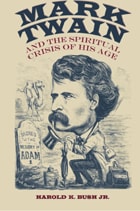
Mark Twain and the Spiritual Crisis of His Age
Harold K. Bush
University of Alabama Press, 2007
Discover the spiritual depths behind America’s greatest humorist.
Mark Twain is often pictured as a severe critic of religious piety, shaking his fist at God and mocking the devout. Such a view, however, is only partly correct. It ignores the social realities of Twain’s major period as a writer and his own spiritual interests: his participation in church activities, his socially progressive agenda, his reliance on religious themes in his major works, and his friendships with clergymen, especially his pastor and best friend, Joe Twichell. It also betrays a conception of religion that is more contemporary than that of the period in which he lived.
Harold K. Bush Jr. highlights Twain’s attractions to and engagements with the wide variety of religious phenomena of America in his lifetime, and how these matters affected his writings. Though Twain lived in an era of tremendous religious vigor, it was also a time of spiritual upheaval and crisis. The rise of biological and psychological sciences, the criticism of biblical texts as literary documents, the influx of world religions and immigrant communities, and the trauma of the Civil War all had dramatic effects on America’s religious life. At the same time mass urban revivalism, the ecumenical movement, Social Christianity, and occultic phenomena, like spiritualism and mind sciences, all rushed in to fill the voids. The rapid growth of agnosticism in the 1870s and 1880s is also clearly reflected in Twain’s life and writings. Thus Twain’s career reflects in an unusually resonant way the vast changes in American belief during his lifetime.
Bush’s study offers both a new and more complicated understanding of Twain and his literary output and serves as the cultural biography of an era.
Mark Twain on the Loose
A Comic Writer and the American SelfBruce Michelson
University of Massachusetts Press, 1995
Can we rediscover the wildness in Mark Twain’s humor? Can we understand how that wildness helped make him a national legend and a key figure in the expression of an American self? In Mark Twain on the Loose, Bruce Michelson writes about Twain as a body of literature, as a public personality, and as a myth. Michelson shows that many of Twain’s most ambitious and memorable works, from the very beginning to the end of his career, express a drive for absolute liberation from every social, psychological, and artistic limit.
The outrageous and anarchic sides of Twain play a vital role in his art. But these traits are undervalued even by his admirers, who often favor clean shapes and steady affirmations in Twain’s writing —not the dangerous comic outbreak, or the deep yearning to free the self from every definition and confinement.
Reviewing works from a wide range of Twain’s writings, Michelson brings to light those wild dimensions, their literary consequences, and their cultural importance. He reveals this great author as “the best escape artist in the American canon,” a reflexive, paradoxical, rule-shattering comic genius.
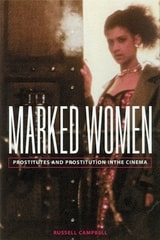
Marked Women
Prostitutes and Prostitution in the CinemaRussell Campbell
University of Wisconsin Press, 2006
Julia Roberts played a prostitute, famously, in Pretty Woman. So did Jodie Foster in Taxi Driver, Jane Fonda in Klute, Anna Karina in Vivre sa vie, Greta Garbo in Anna Christie, and Charlize Theron, who won an Academy Award for Monster. This engaging and generously illustrated study explores the depiction of female prostitute characters and prostitution in world cinema, from the silent era to the present-day industry. From the woman with control over her own destiny to the woman who cannot get away from her pimp, Russell Campbell shows the diverse representations of prostitutes in film.
Marked Women classifies fifteen recurrent character types and three common narratives, many of them with their roots in male fantasy. The “Happy Hooker,” for example, is the liberated woman whose only goal is to give as much pleasure as she receives, while the “Avenger,” a nightmare of the male imagination, represents the threat of women taking retribution for all the oppression they have suffered at the hands of men. The “Love Story,” a common narrative, represents the prostitute as both heroine and anti-heroine, while “Condemned to Death” allows men to manifest, in imagination only, their hostility toward women by killing off the troubled prostitute in an act of cathartic violence.
The figure of the woman whose body is available at a price has fascinated and intrigued filmmakers and filmgoers since the very beginning of cinema, but the manner of representation has also been highly conflicted and fiercely contested. Campbell explores the cinematic prostitute as a figure shaped by both reactionary thought and feminist challenges to the norm, demonstrating how the film industry itself is split by fascinating contradictions.
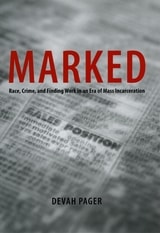
Marked
Race, Crime, and Finding Work in an Era of Mass IncarcerationDevah Pager
University of Chicago Press, 2007
Nearly every job application asks it: have you ever been convicted of a crime? For the hundreds of thousands of young men leaving American prisons each year, their answer to that question may determine whether they can find work and begin rebuilding their lives.
The product of an innovative field experiment, Marked gives us our first real glimpse into the tremendous difficulties facing ex-offenders in the job market. Devah Pager matched up pairs of young men, randomly assigned them criminal records, then sent them on hundreds of real job searches throughout the city of Milwaukee. Her applicants were attractive, articulate, and capable—yet ex-offenders received less than half the callbacks of the equally qualified applicants without criminal backgrounds. Young black men, meanwhile, paid a particularly high price: those with clean records fared no better in their job searches than white men just out of prison. Such shocking barriers to legitimate work, Pager contends, are an important reason that many ex-prisoners soon find themselves back in the realm of poverty, underground employment, and crime that led them to prison in the first place.
“Using scholarly research, field research in Milwaukee, and graphics, [Pager] shows that ex-offenders, white or black, stand a very poor chance of getting a legitimate job. . . . Both informative and convincing.”—Library Journal
“Marked is that rare book: a penetrating text that rings with moral concern couched in vivid prose—and one of the most useful sociological studies in years.”—Michael Eric Dyson
Market Day in Provence
Michèle de La Pradelle
University of Chicago Press, 2006
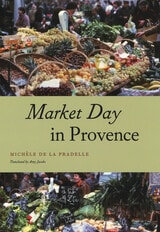
The renewal and celebration of the outdoor market culture in recent years, argues de La Pradelle, artfully masks a fierce commitment to modern-day free-market economics. Responding to consumer desire for an experience that recalls a time before impersonal supermarket chains and mass-produced products, buyers and sellers alike create an atmosphere built on various fictions. Vendors at the market at Carpentras, for example, oblige patrons by acting like lifelong acquaintances of those whom they’ve only just met as they dispense free samples and lively, witty banter. Likewise, going to the market to look for “freshness” becomes a way for the consumer to signify the product’s relation to nature—a denial of the workaday reality of growing melons under plastic sheets, then machine-sorting, crating, and transporting them.
Offering captivating descriptions of goods and the friendly and occasionally piquant exchanges between buyers and sellers, Market Day in Provence will be devoured by any reader with an interest in areas as diverse as food, ethnography, globalization, modernity, and French culture.
Market Dreams
Gender, Class, and Capitalism in the Czech RepublicElaine Weiner
University of Michigan Press, 2010
Drawing on a rich trove of focus group data, interviews, and textual sources, Elaine Weiner's Market Dreams powerfully captures the varied responses of female managers and factory workers in the Czech Republic to their country's transition from socialism to capitalism. Her work, rooted in sociology and comparative feminism, is an important advance for the literature on women in Eastern Europe.
"Market Dreams is a conceptually-sophisticated and empirically-rich account of how the discourses and practices of the free market penetrated the hearts and minds of everyday Czech citizens. Weiner's provocative analysis takes readers inside the worlds of female factory workers to expose the discontinuities between their radiant market dreams and their everyday realities--and juxtaposes them to the continuities experienced by female managers. In the process, it challenges many of our ideas about post/socialism, marketization, and gender and reveals the enduring power of stories in shaping social identities and actions."
---Lynne Haney, Associate Professor of Sociology, New York University
"Through interviews and a careful analysis of newspaper articles written in the first decade after the collapse of state socialism, Weiner explores the complicated interconnections between personal stories and the emerging neoliberal metanarrative of the free market in the Czech Republic after 1989. Her book transcends many of the dichotomies with which researchers of post-state socialism have been struggling: 'East' vs. 'West,' losers and winners, emancipation vs. oppression, etc., and thus makes a truly novel contribution to our understanding of women's lives after state socialism."
---Éva Fodor, Assistant Professor of Gender Studies, Central European University
"Weiner's rich and innovative study of female Czech managers and workers exemplifies the importance of narrative analysis for understanding why gender and class have not (yet) reconfigured the sense of postcommunism's alternatives. This is critical reading for feminists, class analysts, and students of postcommunist social change."
---Michael Kennedy, Director, Center for European Studies, University of Michigan
Elaine Weiner is Assistant Professor of Sociology at McGill University. Visit the author's website at: www.mcgill.ca/sociology/faculty/weiner/.
Cover Credit: Frank Scherschel/Time & Life Pictures/Getty Images
Market Encounters
Consumer Cultures in Twentieth-Century GhanaBianca Murillo
Ohio University Press, 2017
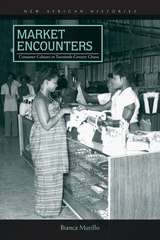
In Market Encounters, Bianca Murillo explores the shifting social terrains that made the buying and selling of goods in modern Ghana possible. Fusing economic and business history with social and cultural history, she traces the evolution of consumerism in the colonial Gold Coast and independent Ghana from the late nineteenth century through to the political turmoil of the 1970s.
Murillo brings sales clerks, market women, and everyday consumers in Ghana to the center of a story that is all too often told in sweeping metanarratives about what happens when African businesses are incorporated into global markets. By emphasizing the centrality of human relationships to Ghana’s economic past, Murillo introduces a radical rethinking of consumption studies from an Africa-centered perspective. The result is a keen look at colonial capitalism in all of its intricacies, legacies, and contradictions, including its entanglement with gender and race.