Results by title
18284 books match the query 'United States' and 949 start with m
Marching Together
Women of the Brotherhood of Sleeping Car PortersMelinda Chateauvert
University of Illinois Press, 1998
The Brotherhood of Sleeping Car Porters (BSCP) was the first national trade union for African Americans. Standard BSCP histories focus on the men who built the union. Yet the union's Ladies' Auxiliary played an essential role in shaping public debates over black manhood and unionization, setting political agendas for the black community, and crafting effective strategies to win racial and economic justice.
Melinda Chateauvert explores the history of the Ladies' Auxiliary and the wives, daughters, and sisters of Pullman porters who made up its membership and used the union to claim respectability and citizenship. As she shows, the Auxiliary actively educated other women and children about the labor movement, staged consumer protests, and organized local and national civil rights campaigns ranging from the 1941 March on Washington to school integration to the Montgomery Bus Boycott. Chateauvert also sheds light on the plight of Pullman maids, who—relegated to the Auxiliary—found their problems as working women neglected in favor of the rhetoric of racial solidarity.
Marfa, Marfa
Rasquachismo and Minimalism in Far West TexasJosh T Franco
Duke University Press, 2026

Marfa
The Transformation of a West Texas TownBy Kathleen Shafer
University of Texas Press, 2019
A small town in the vast desert of West Texas, Marfa attracts visitors from around the world to its art foundations and galleries, film and music festivals, and design and architecture symposiums. While newcomers sometimes see it as “another Santa Fe,” long-time residents often take a bemused, even disapproving attitude toward the changes that Marfa has undergone since artist Donald Judd came to town in the 1970s and began creating spaces for his own and other artists’ work. They remember when ranching and the military formed the basis of the town’s economy, even as they acknowledge that tourist dollars are now essential to Marfa’s sustainability
Marfa tells an engaging story of how this isolated place became a beacon in the art world, like the famous Marfa Lights that draw curious spectators into the West Texas night. As Kathleen Shafer delves into the town’s early history, the impact of Donald Judd, the expansion of arts programming, and the increase in tourism, she unlocks the complex interplay between the particularities of the place, the forces of commerce and growth, the textures of local culture and tradition, and the transformative role of artists and creative work. Bookending her story between two iconic artworks—the whimsical Prada Marfa and the crass Playboy Marfa—Shafer illuminates the shifting cultural landscape of Marfa, showing why this place has become a mecca for so many and how the influx of newcomers has transformed its character.
Marga Richter
Sharon Mirchandani
University of Illinois Press, 2012
This is the first full-length introduction to the life and works of significant American composer Marga Richter (born 1926), who has written more than one hundred works for orchestra, chamber ensemble, dance, opera, voice, chorus, piano, organ, and harpsichord. Still actively composing in her eighties, Richter is particularly known for her large-scale works performed by ensembles such as the London Philharmonic Orchestra and the Civic Orchestra of Chicago and for other pieces performed by prominent artists including pianist Menahem Pressler, conductor Izler Solomon, and violinist Daniel Heifetz.
Interspersing consideration of Richter's musical works with discussion of her life, her musical style, and the origins and performances of her works, Sharon Mirchandani documents a successful composer's professional and private life throughout the twentieth century. Covering Richter's formative years, her influences, and the phases of her career from the 1950s to the present, Mirchandani closely examines Richter's many interesting, attractive musical works that draw inspiration from distinctly American, Irish/English, and Asian sources. Drawing extensively on interviews with the composer, Mirchandani also provides detailed descriptions of Richter's scores and uses reviews and other secondary sources to provide contexts for her work, including their relationship to modern dance, to other musical styles, and to 1970s feminism.

Margaret Fuller and Her Circles
Brigitte Bailey
University of New Hampshire Press, 2013
Margaret Fuller
Transatlantic Crossings in a Revolutionary AgeEdited by Charles Capper and Cristina Giorcelli
University of Wisconsin Press, 2007
This volume is a collaboration of international scholars who, from varied fields and approaches, assess Fuller’s genius and character. Treating the last several years of Margaret Fuller’s short life, these essays offer a truly international discussion of Fuller’s unique cultural, political, and personal achievements. From the origins and articulations of Fuller’s cosmopolitanism to her examination of “the woman question,” and from her fascination with the European “other” to her candid perception of imperial America from abroad, they ponder what such an extraordinary woman meant to America, and also to Italy and Europe, during her lifetime and continuing to the present.
Margaret Mead Made Me Gay
Personal Essays, Public IdeasEsther Newton
Duke University Press, 2000
Newton’s provocative essays detail a queer academic career while offering a behind-the-scenes view of academic homophobia. In four sections that correspond to major periods and interests in her life—”Drag and Camp,” “Lesbian-Feminism,” “Butch,” and “Queer Anthropology”—the volume reflects her successful struggle to create a body of work that uses cultural anthropology to better understand gender oppression, early feminism, theatricality and performance, and the sexual and erotic dimensions of fieldwork. Combining personal, theoretical, and ethnographic perspectives, Margaret Mead Made Me Gay also includes photographs from Newton’s personal and professional life.
With wise and revealing discussions of the complex relations between experience and philosophy, the personal and the political, and identities and practices, Margaret Mead Made Me Gay is important for anyone interested in the birth and growth of gay and lesbian studies.
Margaret Webster
A Life in the TheaterMilly S. Barranger
University of Michigan Press, 2004
-Marian Seldes
"Margaret Webster is a highly welcome addition to our knowledge of the first important female director in American theater. Remembered now especially for her staging of Othello with Paul Robeson, Uta Hagen, and Jose Ferrer, Margaret Webster was probably the best-known, in-demand, and admired director of Shakespeare in America in the 1940s and 1950s. Fascinating throughout, the book's discussions of working with Robeson, and of HUAC, which targeted her just as her career was reaching a peak, make for especially engrossing reading."
-Oscar Brockett
Margaret Webster: A Life in the Theater is an engrossing backstage account of the life of pioneering director Margaret Webster (1905-72).
This is the first book-length biography of Webster, a groundbreaking stage and opera director whose career challenged not only stage tradition but also mainstream attitudes toward professional women.
Often credited with first having brought Shakespeare to Broadway, and renowned for her bold casting of an African American (Paul Robeson) in the role of Othello, Webster was a creative force in modern American and British theater.
Her story reveals the independent-minded artist undeterred by stage tradition and unmindful of rules about a woman's place in the professional theater. In addition to providing fascinating glimpses into Webster's personal and family life, Margaret Webster: A Life in the Theater also offers a who's-who list of the biggest names in New York and London theater of the time, as well as Hollywood: John Gielgud, Noël Coward, George Bernard Shaw, Uta Hagen, Sybil Thorndike, Eva LeGallienne, and John Barrymore, among others, all of whom crossed paths with Webster. Capping Webster's amazing story is her investigation by Senator Joseph McCarthy and HUAC, which left her unable to work for a year, and from which she never fully recovered.
Marginal People in Deviant Places
Ethnography, Difference, and the Challenge to Scientific RacismJanice M. Irvine
University of Michigan Press, 2022
Place plays a crucial role in this work as Irvine examines its role in shaping ethnographies about outsiders and therefore understandings of social difference. Irvine has visited the sites of each of the ethnographies about which she writes, collecting photos, videos, and archival materials that will help readers understand the importance of place in the generation of particular ethnographic stories. The open-access online edition of this book is richly illustrated to help convey the deep sense of emplacement of the ethnographies discussed in this book and includes a series of interviews with sociologists about how they conduct their work and understand their forebears.

Marginal Sights
Staging the Chinese in AmericaJames S. Moy
University of Iowa Press, 1994
Marginal Workers, Marginal Jobs
The Underutilization of American WorkersBy Teresa A. Sullivan
University of Texas Press, 1978
Unemployment levels have received a great deal of attention and discussion in recent years. However, another labor category—underemployment—has virtually been ignored. Underutilized or underemployed workers are those who are experiencing inadequate hours of work, insufficient levels of income, and mismatch of occupation and skills. Marginal Workers, Marginal Jobs addresses two principal issues: how can we measure underemployment, and how can we explain its prevalence?
To answer the first question, Teresa Sullivan examines yardsticks in use, demonstrates their inadequacy, and develops a different measure that is easy to interpret and is usable by both demographers and economists. In answering the second, she analyzes 1960 and 1970 census data to determine the relative effects of population composition and job structure on levels of employment.
One of the important contributions of Sullivan's study is to distinguish between marginal workers and marginal jobs in explaining underutilization. Previous explanations, including the widely used dual market theory, have not stressed this analytic distinction. In addition, her work accounts separately for the various types of marginality and seeks to show the condition of workers who are marginal on more than one count—for example, those who are both young and black, or old and female.
A provocative study based on large samples of the U.S. population, this book raises important questions about a critical subject and makes a significant contribution to the theory of underutilization.

Margins in the Classroom
Teaching LiteratureKostas Myrsiades and Linda S. Myrsiades, Editors
University of Minnesota Press, 1994
Margins in the Classroom was first published in 1994. Minnesota Archive Editions uses digital technology to make long-unavailable books once again accessible, and are published unaltered from the original University of Minnesota Press editions.
For today's teacher of literature, facing a minefield of politics and theory, this book arrives as a much needed guide through the multiplying cultural anxieties of the college classroom. Margins in the Classroom brings together established scholars and emerging voices from diverse backgrounds to show how politics and theory can and do affect the most pressing problems confronting the contemporary teacher of literature. The essays in this volume go beyond questioning and examining existing practices to suggest fresh approaches to teaching the expanding literary canon within the context of the politics of the educational institution.
Grounded in literary criticism, psychoanalysis, feminist theory, political economy, sociology, and philosophy, these essays apply new theoretical models to the traditional canon, identify new bodies of literature, and show how theory can be used to analyze these new literatures. Focusing on the politics of teaching and theory in the classroom, the authors explore the present practice and future implications of changing textual analysis, literary theory, and pedagogy. Their essays address the politics of literature as it affects the classroom, the design of courses, and the creation of new courses. They mold theory to the variety of classroom populations and materials the teacher of literature encounters today. The resulting volume bridges the differences between the languages of the classroom instructor and the contemporary theorist. Margins in the Classroom is unique in both the breadth and the depth of its concern over the disturbing, if electric, impact of changes in criticism, theory, and pedagogy in college literature classes as we approach the next century of academic instruction.Kostas Myrsiades is professor of comparative literature, and Linda S. Myrsiades is professor of English, both at West Chester University. Kostas Myrsiades is editor of College Literature, where Linda S. Myrsiades is an associate editor.
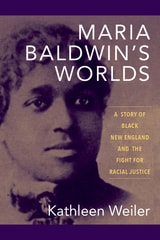
Maria Baldwin's Worlds
A Story of Black New England and the Fight for Racial JusticeKathleen Weiler
University of Massachusetts Press, 2019
Maria Baldwin (1856–1922) held a special place in the racially divided society of her time, as a highly respected educator at a largely white New England school and an activist who carried on the radical spirit of the Boston area's internationally renowned abolitionists from a generation earlier.
African American sociologist Adelaide Cromwell called Baldwin “the lone symbol of Negro progress in education in the greater Boston area” during her lifetime. Baldwin used her respectable position to fight alongside more radical activists like William Monroe Trotter for full citizenship for fellow members of the black community. And, in her professional and personal life, she negotiated and challenged dominant white ideas about black womanhood. In Maria Baldwin's Worlds, Kathleen Weiler reveals both Baldwin's victories and what fellow activist W. E. B. Du Bois called her “quiet courage” in everyday life, in the context of the wider black freedom struggle in New England.
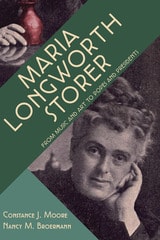
Maria Longworth Storer
From Music and Art to Popes and PresidentsConstance J. Moore; Nancy M. Broermann
Ohio University Press, 2019
Published by the University of Cincinnati Press
While the adage may go, “Behind every great man is a great woman,” the story of Maria Longworth Storer necessitates a new adage—at the front of every great city is a great woman. After being shunted into the biographies and history books of other people, Longworth Storer is now finally given center stage on the one hundred and seventieth anniversary of her birth.
Maria Longworth Storer: From Music and Art to Popes and Presidents is the most comprehensive biography of this one of a kind Cincinnatian. Known as the founder of the first female-run manufacturing company in the United States, Rookwood Pottery, Longworth Storer was passionate about women’s rights, her city, and issues of poverty and the arts. She owned Rookwood pottery for nine years, and then transferred ownership after earning recognition at the Exhibition of American Art Industry in Philadelphia and receiving a gold medal at the Exposition Universelle in Paris. Aside from her success with Rookwood, Longworth Storer was central to making the Queen City the major cultural landmark it is today. Although the rest of her life was no less remarkable as the wife of notorious diplomat Bellamy Storer, later embroiled in the famous Roosevelt-Storer scandal, little has been written about her contributions and exploits in diplomatic relations and her powerful influence on turn-of-the-twentieth-century political leaders.
Featuring new archival research, and never before seen photos of the Storer family, authors Constance J. Moore and Nancy M. Broermann have compiled a portrait of Maria Longworth Storer that is rich in detail, fitting to both the wide, often eclectic, breadth of Longworth Storer’s projects, and to the depth of her impact on leaders from Washington D.C. to Europe.
Moving through major moments in both American and Cincinnati history, and intersecting with significant historical figures including Teddy Roosevelt and William Howard Taft, Moore and Broermann expose the broader historical narrative of Longworth Storer’s life without letting her unique spirit and individual accomplishments become overshadowed by them.
Through thoughtful, balanced narrative, readers get to know a remarkable woman whose fascinating and dramatic life as a political figure, women’s rights advocate, and patron of the arts has had a long lasting legacy on the Queen City and the Shaping of our nation’s diplomatic policies.
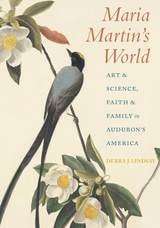
Maria Martin's World
Art and Science, Faith and Family in Audubon’s AmericaDebra J. Lindsay
University of Alabama Press, 2018
Maria Martin (1796–1863) was an evangelical Lutheran from Charleston, South Carolina, who became an accomplished painter within months of meeting John James Audubon. Martin met Audubon through her brother-in-law, Reverend John Bachman, who befriended Audubon while passing through Charleston on route to Florida where he expected to find new avian species. Martin was an amateur artist, but by the time Audubon left, she had familiarized herself with his style of drawing. Six months after their initial meeting, her background botanicals were deemed good enough to embellish Audubon’s exquisite bird paintings.
Martin’s botanicals and insects appeared in volumes two and four of The Birds of America (1830–1838). She painted snakes for John Edwards Holbrook’s North American Herpetology (1842) and assisted in drafting the descriptive taxonomies prepared by John Bachman—who later became her husband in 1848 following the death of her older sister—for The Viviparous Quadrupeds of North America (1846–1854). Until now, her contributions have been unknown to all but the most astute students of natural history and art history and a close circle of family and friends.
Maria Martin’s World is a heavily illustrated volume examining how Maria Martin learned to paint aesthetically beautiful botanicals with exacting accuracy. Drawing on deep research into archival documents and family-held artifacts, Debra Lindsay brings Maria Martin out from behind the curtain of obscurity and disinformation that has previously shrouded her and places her centrally in her own time and milieu. In the telling of Maria Martin’s story, Lindsay also uncovers many nuances of the behavior and actions of the two prominent men in her life that readers interested in Audubon and Bachman will find noteworthy.
Martin was a gifted artist recognized for having contributed beautiful paintings to a natural history. But beyond the natural world this is a biography of an evangelical Lutheran steeped in the faith of her German ancestors and raised to respect the patriarchal norms of her time. Maria Martin pursued her scientific and artistic interests only when they did not conflict with her religious and familial responsibilities.
Maria's Journey
Ramon Arredondo and Trisha (Hull) Arredondo
Indiana Historical Society Press, 2010

Marianne Moore, Elizabeth Bishop, and May Swenson
The Feminist Poetics of Self-RestraintKirstin Hotelling Zona
University of Michigan Press, 2002
In recent years critical studies of Bishop and Moore have flourished, a large percentage of them devoted to explorations of sexuality and gender. A gap is growing, however, between feminist repossessions of Moore and Bishop and recent readings of their antiessentialist poetics. On the one hand, these poets are appearing more frequently in the feminist canon, but the price of this inclusion is usually the suppression of their strategies of self-restraint. While Zona questions the poetic privileging of self-expression, she establishes contiguity between feminist poetry and developments in American poetry at large. In doing so she asserts the centrality of feminist poetry within discussions of contemporary American poetry, thereby challenging the common perception of feminist poetry as an "alternative" (which often means auxiliary) genre.
Kirstin Hotelling Zona is Assistant Professor of Poetry and Poetics, Illinois State University.
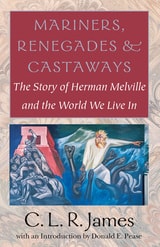
Mariners, Renegades and Castaways
The Story of Herman Melville and the World We Live InC. L. R. James
Dartmouth College Press, 2001
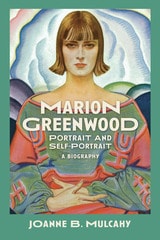
Marion Greenwood
Portrait and Self-Portrait—A BiographyJoanne B. Mulcahy
University of Alabama Press, 2025
This new biography reveals Marion Greenwood's central place in the pantheon of history’s remarkable women artists.
Marion Greenwood: Portrait and Self-Portrait—A Biography brings to life a woman who blazed through the twentieth-century art world. Born in Brooklyn in 1909, Greenwood thrived at storied institutions and arts centers such as the Art Students League, the studio of German modernist Winold Reiss, the Woodstock Colony, and Yaddo. In 1933, she catapulted to international fame as the first woman to paint a public mural in Mexico. Diego Rivera celebrated Greenwood as one of “the world’s greatest living women mural painters.” She traveled the globe to create award-winning portraits of people from diverse backgrounds, crossing racial, cultural, and class lines to reflect her vision for a more just world.
This biography, the first about Greenwood, is based on a decade of research and interviews. Author Joanne B. Mulcahy integrates the artist’s adventuresome personal life with her journey to artistic glory. Greenwood comes alive as a notable and spirited part of the heady art scenes of 1920s and 1930s Mexico, New York City, and Paris, and as one of two women artist-correspondents during World War II. After social realism and portraiture fell from favor, Greenwood doggedly stuck with what she called “the human thing” in art. Her freewheeling romantic life and independent spirit defied expectations for women, and she dismissed sexist critics who mixed acclaim for her work with commentary on her stunning beauty.
A feminist pioneer, Greenwood made a living as an artist in a time when few women could. In following Greenwood’s maverick path and artistic achievements, this book reveals her central place in the pantheon of history’s remarkable women artists.
Mark My Words
Native Women Mapping Our NationsMishuana Goeman
University of Minnesota Press, 2013
Dominant history would have us believe that colonialism belongs to a previous era that has long come to an end. But as Native people become mobile, reservation lands become overcrowded and the state seeks to enforce means of containment, closing its borders to incoming, often indigenous, immigrants.
In Mark My Words, Mishuana Goeman traces settler colonialism as an enduring form of gendered spatial violence, demonstrating how it persists in the contemporary context of neoliberal globalization. The book argues that it is vital to refocus the efforts of Native nations beyond replicating settler models of territory, jurisdiction, and race. Through an examination of twentieth-century Native women’s poetry and prose, Goeman illuminates how these works can serve to remap settler geographies and center Native knowledges. She positions Native women as pivotal to how our nations, both tribal and nontribal, have been imagined and mapped, and how these women play an ongoing role in decolonization.
In a strong and lucid voice, Goeman provides close readings of literary texts, including those of E. Pauline Johnson, Esther Belin, Joy Harjo, Leslie Marmon Silko, and Heid Erdrich. In addition, she places these works in the framework of U.S. and Canadian Indian law and policy. Her charting of women’s struggles to define themselves and their communities reveals the significant power in all of our stories.
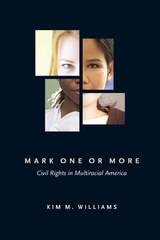
Mark One or More
Civil Rights in Multiracial AmericaKim M. Williams
University of Michigan Press, 2010
The movement to add a multiracial category to the 2000 U.S. Census provoked unprecedented debates about race. The effort made for strange bedfellows. Republicans like House Speaker Newt Gingrich and affirmative action opponent Ward Connerly took up the multiracial cause. Civil rights leaders opposed the movement on the premise that it had the potential to dilute the census count of traditional minority groups. The activists themselves—a loose confederation of organizations, many led by the white mothers of interracial children—wanted recognition. What they got was the transformation of racial politics in America.
Mark One or More is the compelling account of how this small movement sparked a big change, and a moving call to reassess the meaning of racial identity in American life.
Kim M. Williams is Associate Professor of Public Policy in Harvard's Kennedy School of Government, and an expert in racial and ethnic politics and political movements.
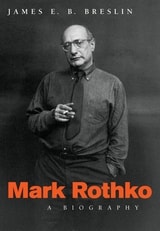
Mark Rothko
A BiographyJames E. B. Breslin
University of Chicago Press, 2012
The definitive biography of one of the most-loved artists of the twentieth century, a book the New York Times called "the best life of an American painter yet written"
A book of heroic dimensions, this is the first full-length biography of one of the greatest artists of the twentieth century—a man as fascinating, difficult, and compelling as the paintings he produced. Drawing on exclusive access to Mark Rothko's personal papers and over one hundred interviews with artists, patrons, and dealers, James Breslin tells the story of a life in art—the personal costs and professional triumphs, the convergence of genius and ego, the clash of culture and commerce. Breslin offers us not only an enticing look at Rothko as a person, but delivers a lush, in-depth portrait of the New York art scene of the 1930s, ’40s, and ’50s—the world of Abstract Expressionism, of Pollock, Rothko, de Kooning, and Klein, which would influence artists for generations to come.
Mark Twain & France
The Making of a New American IdentityPaula Harrington and Ronald Jenn
University of Missouri Press, 2017
While critics have generally dismissed Mark Twain’s relationship with France as hostile, Harrington and Jenn see Twain’s use of the French as a foil to help construct his identity as “the representative American.” Examining new materials that detail his Montmatre study, the carte de visite album, and a chronology of his visits to France, the book offers close readings of writings that have been largely ignored, such as The Innocents Adrift manuscript and the unpublished chapters of A Tramp Abroad, combining literary analysis, socio-historical context and biographical research.
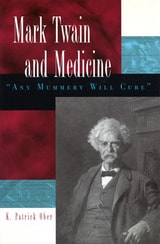
Mark Twain and Medicine
"Any Mummery Will Cure"K. Patrick Ober
University of Missouri Press, 2003
Mark Twain has always been America’s spokesman, and his comments on a wide range of topics continue to be accurate, valid, and frequently amusing. His opinions on the medical field are no exception. While Twain’s works, including his popular novels about Tom Sawyer and Huckleberry Finn, are rich in medical imagery and medical themes derived from his personal experiences, his interactions with the medical profession and his comments about health, illness, and physicians have largely been overlooked.
In Mark Twain and Medicine, K. Patrick Ober remedies this omission. The nineteenth century was a critical time in the development of American medicine, with much competition among the different systems of health care, both traditional and alternative. Not surprisingly, Mark Twain was right in the middle of it all. He experimented with many of the alternative care systems that were available in his day—in part because of his frustration with traditional medicine and in part because he hoped to find the “perfect” system that would bring health to his family.
Twain’s commentary provides a unique perspective on American medicine and the revolution in medical systems that he experienced firsthand. Ober explores Twain’s personal perspective in this area, as he expressed it in fiction, speeches, and letters. As a medical educator, Ober explains in sufficient detail and with clarity all medical and scientific terms, making this volume accessible to the general reader.
Ober demonstrates that many of Twain’s observations are still relevant to today’s health care issues, including the use of alternative or complementary medicine in dealing with illness, the utility of placebo therapies, and the role of hope in the healing process.
Twain’s evaluation of the medical practices of his era provides a fresh, humanistic, and personalized view of the dramatic changes that occurred in medicine through the nineteenth century and into the first decade of the twentieth. Twain scholars, general readers, and medical professionals will all find this unique look at his work appealing.

Mark Twain and Orion Clemens
Brothers, Partners, StrangersPhilip Ashley Fanning
University of Alabama Press, 2003
One became America’s greatest writer. The other died in obscurity and failure. As brothers, they shaped each other's lives and work.
In a compelling way, Philip Fanning traces the fraternal relationship of Orion and Samuel Clemens from its beginning in Hannibal, Missouri, in the 1830s to Orion's death in Iowa in 1897. He demonstrates that Orion’s influence on the writer known as Mark Twain was profound, pervasive, and prolonged.
In some respects, Samuel defined himself against Orion’s formidable background. It was Orion who became the chief financial and spiritual support of the Clemens family following the father's controversial death in 1847. It was Orion who led the way for his brother into printing, journalism, and mine speculation. And it was Orion who served as Sam’s first real editor and literary mentor, recognizing and encouraging his younger brother’s talents as a writer.
The two siblings had much in common, and they often appeared to be codependent, so much so that their attitudes veered sharply from mutual admiration to mutual disdain and rivalry. Whereas Orion was self-effacing, easygoing, humble, and adventurous in his politics and progressive in his views, Twain was often ill-tempered and antagonistic toward those around him and conservative in his outlook. He frequently portrayed his older brother in autobiographical writings and letters as a buffoon and a laughingstock.
Fanning—who drew upon extensive archival sources, unpublished letters between the two brothers, and the Mark Twain Papers at the University of California, Berkeley—charts these divergences in their characters and in their fortunes. As Twain rose to become a national celebrity and a financial success, Orion's finances and self-esteem disintegrated, and Twain’s treatment of his brother became evermore harsh and mocking. Fanning’s study stands as both a biography of a fractious fraternal relationship and a work of scholarship that highlights for the first time how significantly Orion Clemens influenced Twain’s psychic and artistic economy.
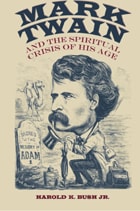
Mark Twain and the Spiritual Crisis of His Age
Harold K. Bush
University of Alabama Press, 2007
Discover the spiritual depths behind America’s greatest humorist.
Mark Twain is often pictured as a severe critic of religious piety, shaking his fist at God and mocking the devout. Such a view, however, is only partly correct. It ignores the social realities of Twain’s major period as a writer and his own spiritual interests: his participation in church activities, his socially progressive agenda, his reliance on religious themes in his major works, and his friendships with clergymen, especially his pastor and best friend, Joe Twichell. It also betrays a conception of religion that is more contemporary than that of the period in which he lived.
Harold K. Bush Jr. highlights Twain’s attractions to and engagements with the wide variety of religious phenomena of America in his lifetime, and how these matters affected his writings. Though Twain lived in an era of tremendous religious vigor, it was also a time of spiritual upheaval and crisis. The rise of biological and psychological sciences, the criticism of biblical texts as literary documents, the influx of world religions and immigrant communities, and the trauma of the Civil War all had dramatic effects on America’s religious life. At the same time mass urban revivalism, the ecumenical movement, Social Christianity, and occultic phenomena, like spiritualism and mind sciences, all rushed in to fill the voids. The rapid growth of agnosticism in the 1870s and 1880s is also clearly reflected in Twain’s life and writings. Thus Twain’s career reflects in an unusually resonant way the vast changes in American belief during his lifetime.
Bush’s study offers both a new and more complicated understanding of Twain and his literary output and serves as the cultural biography of an era.
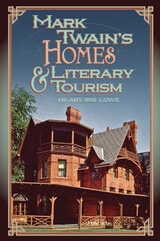
Mark Twain's Homes and Literary Tourism
Hilary Iris Lowe
University of Missouri Press, 2025
A century after Samuel Clemens’s death, Mark Twain thrives. One way fans still celebrate the first true American writer and his work is by visiting any number of Mark Twain destinations. They believe they can learn something unique by visiting the places where he lived. Mark Twain’s Homes and Literary Tourism untangles the complicated ways that Clemens’s houses, now museums, have come to tell the stories that they do about Twain and, in the process, reminds us that the sites themselves are the products of multiple agendas and, in some cases, unpleasant histories.
Hilary Iris Lowe leads us through four Twain homes, beginning at the beginning—Florida, Missouri, where Clemens was born. Today the site is simply a concrete pedestal missing its bust, a plaque, and an otherwise-empty field. Though the original cabin where he was born likely no longer exists, Lowe treats us to an overview of the history of the area and the state park challenged with somehow marking this site. Next, we travel with Lowe to Hannibal, Missouri, Clemens’s childhood home, which he saw become a tourist destination in his own lifetime. Today mannequins remind visitors of the man that the boy who lived there became and the literature that grew out of his experiences in the house and little town on the Mississippi.
Literary historic sites pin their authority on the promise of exclusive insight into authors and texts through firsthand experience. As tempting as it is to accept the authenticity of Clemens’s homes, Mark Twain’s Homes and Literary Tourism argues that house museums are not reliable critical texts but are instead carefully constructed spaces designed to satisfy visitors. This volume shows us how these houses’ portrayals of Clemens change frequently to accommodate and shape our own expectations of the author and his work.
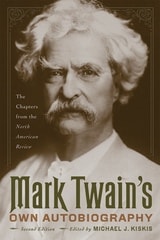
Mark Twain's Own Autobiography
The Chapters from the North American ReviewMark Twain; Edited by Michael J. Kiskis; Foreword by Sheila Leary
University of Wisconsin Press, 2010
More than the story of a literary career, this memoir is anchored in the writer’s relation to his family—what they meant to him as a husband, father, and artist. It also brims with many of Twain’s best comic anecdotes about his rambunctious boyhood in Hannibal, his misadventures in the Nevada territory, his notorious Whittier birthday speech, his travels abroad, and more.
Twain published twenty-five “Chapters from My Autobiography” in the North American Review in 1906 and 1907. “I intend that this autobiography . . . shall be read and admired a good many centuries because of its form and method—form and method whereby the past and the present are constantly brought face to face, resulting in contrasts which newly fire up the interest all along, like contact of flint with steel.”
For this second edition, Michael Kiskis’s introduction references a wealth of critical work done on Twain since 1990. He also adds a discussion of literary domesticity, locating the autobiography within the history of Twain’s literary work and within Twain’s own understanding and experience of domestic concerns.
Mark Twain's Pudd'nhead Wilson
Race, Conflict and CultureSusan Gillman and Forrest Robinson, eds.
Duke University Press, 1990
In a variety of ways the essays build arguments out of, not in spite of, the anomalies, inconsistencies, and dead ends in the text itself. Such wrinkles and gaps, the authors find, are the symptoms of an inconclusive, even evasive, but culturally illuminating struggle to confront and resolve difficult questions bearing on race and sex. Such fresh, intellectually enriching perspectives on the novel arise directly from the broad-based interdisciplinary foundations provided by the participating scholars. Drawing on a wide variety of critical methodologies, the essays place the novel in ways that illuminate the world in which it was produced and that further promise to stimulate further study.
Contributors. Michael Cowan, James M. Cox, Susan Gillman, Myra Jehlen, Wilson Carey McWilliams, George E. Marcus, Carolyn Porter, Forrest Robinson, Michael Rogin, John Carlos Rowe, John Schaar, Eric Sundquist
Mark Twain, Travel Books, and Tourism
The Tide of a Great Popular MovementJeffrey Alan Melton
University of Alabama Press, 2008
With the publication of The Innocents Abroad (1869), Mark Twain embarked on a long and successful career as the 19th century's best-selling travel writer. Jeffrey Melton treats Twain's travel narratives in depth, and in the context of his contemporary travel writers and a burgeoning tourism culture. As Melton shows, Twain's five major travel narratives--The Innocents Abroad, Roughing It, Life on the Mississippi, A Tramp Abroad, and Following the Equator--demonstrate Twain's mastery and reinvention of the genre.
Mark Twain, Unsanctified Newspaper Reporter
James E. Caron
University of Missouri Press, 2008
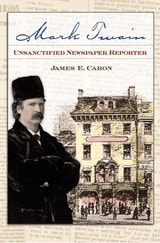
Before Mark Twain became a national celebrity with his best-selling The Innocents Abroad, he was just another struggling writer perfecting his craft—but already “playin’ hell” with the world. In the first book in more than fifty years to examine the initial phase of Samuel Clemens’s writing career, James Caron draws on contemporary scholarship and his own careful readings to offer a fresh and comprehensive perspective on those early years—and to challenge many long-standing views of Mark Twain’s place in the tradition of American humor.
Tracing the arc of Clemens’s career from self-described “unsanctified newspaper reporter” to national author between 1862 and 1867, Caron reexamines the early and largely neglected writings—especially the travel letters from Hawaii and the letters chronicling Clemens’s trip from California to New York City. Caron connects those sets of letters with comic materials Clemens had already published, drawing on all known items from this first phase of his career—even the virtually forgotten pieces from the San Francisco Morning Call in 1864—to reveal how Mark Twain’s humor was shaped by the sociocultural context and how it catered to his audience’s sensibilities while unpredictably transgressing its standards.
Caron reveals how Sam Clemens’s contemporaries, notably Charles Webb, provided important comic models, and he shows how Clemens not only adjusted to but also challenged the guidelines of the newspapers and magazines for which he wrote, evolving as a comic writer who transmuted personal circumstances into literary art. Plumbing Mark Twain’s cultural significance, Caron draws on anthropological insights from Victor Turner and others to compare the performative aspects of Clemens’s early work to the role of ritual clowns in traditional societies
Brimming with fresh insights into such benchmarks as “Our Fellow Savages of the Sandwich Islands” and “Jim Smiley and His Jumping Frog,” this book is a gracefully written work that reflects both patient research and considered judgment to chart the development of an iconic American talent. Mark Twain, Unsanctified Newspaper Reporter should be required reading for all serious scholars of his work, as well as for anyone interested in the interplay between artistic creativity and the literary marketplace.
Marked, Unmarked, Remembered
A Geography of American MemoryAndrew Lichtenstein
West Virginia University Press, 2017
These powerful photographs by award-winning photojournalist Andrew Lichtenstein are interspersed with short essays by some of the leading historians of the United States. The book is introduced with substantive meditations on meaning and landscape by Alex Lichtenstein, editor of the American Historical Review, and Edward T. Linenthal, former editor of the Journal of American History. Individually, these images convey American history in new and sometimes startling ways. Taken as a whole, the volume amounts to a starkly visual reckoning with the challenges of commemorating a violent and conflictual history of subjugation and resistance that we forget at our peril.
Market Friendly or Family Friendly?
The State and Gender Inequality in Old AgeMadonna Harrington Meyer
Russell Sage Foundation, 2007
Marketing Marianne
French Propaganda in America, 1900-1940Robert J. Young
Rutgers University Press, 2003
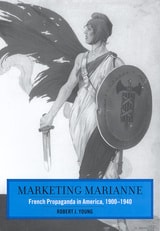
Although historians have written extensively on propaganda during Napoleon III’s regime and Vichy, they have virtually ignored the Third Republic. Focusing on Third Republic policies, Marketing Marianne suggests that Americans’ long-lasting love affair with French culture is no accident. Robert J. Young argues that the French used subtle but effective means to influence U.S. policy in Europe. He examines French propaganda efforts and the methods of the French Foreign Ministry, always highlighting the wider cultural and social context of Franco-American relations. French propagandists believed that the steady promotion of their nation as the cultural capital of the world was the best way to foster goodwill among Americans. They slowly recognized the important role the United States played in maintaining the balance of power in Europe. Young argues that the French deliberately exploited America’s sense of cultural inferiority when faced with Europe’s rich heritage, and the rise of new technologies and modern forms of government in France encouraged the development of more sophisticated forms of propaganda.

Marketing the Wilderness
Outdoor Recreation, Indigenous Activism, and the Battle over Public LandsJoseph Whitson
University of Minnesota Press, 2025
How outdoor industry marketing promotes an image of “the wilderness” as an unpeopled haven
Marketing the Wilderness analyzes the relationship between the outdoor recreation industry, public lands in the United States, and Indigenous sovereignty and representation in recreational spaces. Combining social media analysis, digital ethnography, and historical research, Joseph Whitson offers nuanced insights into more than a century of the outdoor recreation industry’s marketing strategies, unraveling its complicity in settler colonialism.
Complicating the narrative of outdoor recreation as a universal good, Whitson introduces the concept of “wildernessing” to describe the physical, legal, and rhetorical production of pristine, empty lands that undergirds the outdoor recreation industry, a process that further disenfranchises Indigenous people from whom these lands were stolen. He demonstrates how companies such as Patagonia and REI align with the mining and drilling industries in their need to remove Indigenous peoples and histories from valuable lands. And he describes the ways Indigenous and decolonial activists are subverting and resisting corporate marketing strategies to introduce new narratives of place.
Through the lens of environmental justice activism, Marketing the Wilderness reconsiders the ethics of recreational land use, advocating for engagement with issues of cultural representation and appropriation informed by Indigenous perspectives. As he discusses contemporary public land advocacy around places such as Bears Ears National Monument, Whitson focuses on the deeply fraught relationship between the outdoor recreation industry and Indigenous communities. Emphasizing the power of the corporate system and its treatment of land as a commodity under capitalism, he shows how these tensions shape the American idea of “wilderness” and what it means to fight for its preservation.
Retail e-book files for this title are screen-reader friendly with images accompanied by short alt text and/or extended descriptions.
Markets and Medicine
The Politics of Health Care Reform in Britain, Germany, and the United StatesSusan Giaimo
University of Michigan Press, 2002
Markets of Sorrow, Labors of Faith
New Orleans in the Wake of KatrinaVincanne Adams
Duke University Press, 2013
Filled with the often desperate voices of residents who returned to New Orleans, Markets of Sorrow, Labors of Faith describes the human toll of disaster capitalism and the affect economy it has produced. While for-profit companies delayed delivery of federal resources to returning residents, faith-based and nonprofit groups stepped in to rebuild, compelled by the moral pull of charity and the emotional rewards of volunteer labor. Adams traces the success of charity efforts, even while noting an irony of neoliberalism, which encourages the very same for-profit companies to exploit these charities as another market opportunity. In so doing, the companies profit not once but twice on disaster.
Marking Modern Times
A History of Clocks, Watches, and Other Timekeepers in American LifeAlexis McCrossen
University of Chicago Press, 2013
In Marking Modern Times, Alexis McCrossen relates how the American preoccupation with time led people from across social classes to acquire watches and clocks. While noting the difficulties in regulating and synchronizing so many timepieces, McCrossen expands our understanding of the development of modern time discipline, delving into the ways we have standardized time and describing how timekeepers have served as political, social, and cultural tools in a society that doesn’t merely value time but regards access to time as a natural-born right, a privilege of being an American.
Marriage In A Culture Of Divorce
Karla B. Hackstaff
Temple University Press, 1999
Marriage in a Culture of Divorce examines the shifting meanings of divorce and gender for two generations of middle-class, married couples. Hackstaff finds that new social and economic conditions both support and undermine the efforts of spouses to redefine the meaning of marriage in a culture of divorce. The definitions of marriage, divorce, and gender have changed for all, but more for the young than the old, and more for women than for men. While some spouses in both generations believe that marriage is for life and that men should dominate in marriage, the younger generation of spouses increasingly construct marriage as contingent rather than forever.
Hackstaff presents this evidence in archival case studies of couples married in the 1950s, which she then contrasts with her own case studies of people married during the 1970s, finding evidence of a significant shift in who does the emotional work of maintaining the relationship. It is primarily the woman in the '50s couples who "monitors" the marriage, whereas in the '70s couples both husband and wife support a "marital work ethic," including couples therapy in some cases.
The words and actions of the couples Hackstaff follows in depth - the '50s Stones, Dominicks, Hamptons, and McIntyres, and the '70s Turners, Clement-Leonettis, Greens, Kason-Morrises, and Nakatos -- reveal the changes and contradictory tendencies of married life in the U.S. There are traditional relationships characterized by male dominance, there are couples striving for gender equality, there are partners pulling together, and partners pulling apart.
Those debating "family values" should not forget, Hackstaff contends, that there are costs associated with marriage culture as well as divorce culture, and they should view divorce as a transitional means for defining marriage in an egalitarian direction. She convincingly illustrates her controversial position, that although divorce has its cost to society, the divorce culture empowers wives and challenges the legacy of male dominance that previously set the conditions for marriage endurance.
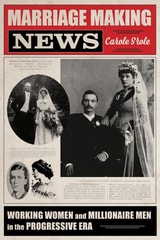
Marriage Making News
Working Women and Millionaire Men in the Progressive EraCarole Srole
University of Illinois Press, 2026
Women’s desire for autonomy, a rising divorce rate, the declining power of the upper class, new ideas of beauty and sexuality—newspaper tales of cross-class nuptials brought a host of anxieties about gender and class to the front page. Srole focuses particular attention on the economic changes faced by working-class women while also surveying newspaper attacks on their morality and womanhood, and their complicity in their own poverty. As she shows, working women and their advocates persevered by asserting an independence they pursued through union activism, professionalism, land ownership, and filling traditionally male jobs.
An engaging merger of media and women’s history, Marriage Making News looks at a rags-to-riches genre and illuminates the forces of change at work behind the stories.
Marriage Material
How an Enduring Institution Is Changing Same-Sex RelationshipsAbigail Ocobock
University of Chicago Press, 2024
It is no secret that marriage rates in the United States are at an all-time low. Despite this significant decline, the institution of marriage endures in our society amid historic changes to its meaning and practice. How does the continuing strength of marriage impact the relationships of same-sex couples after the legalization of same-sex marriage?
Drawing on over one hundred interviews with LGBTQ+ people, Marriage Material reveals the transformative impact marriage equality has had on same-sex relationships. Sociologist Abigail Ocobock looks to same-sex couples across a wide age range to illuminate the complex ways institutional mechanisms work in tandem to govern the choices and behaviors of individuals with different marriage experiences. Ocobock examines both the influence of marriage on the dynamics of same-sex relationships and how LGBTQ+ people challenge heteronormative assumptions about marriage, highlighting the complex interplay between institutional constraint and individual agency.
Marriage Material presents a bold challenge to dominant scholarly and popular ideas about the decline of marriage, making clear that gaining access to legal marriage has transformed same-sex relationships, both for better and for worse.
Marriage Vows and Racial Choices
Jessica Vasquez-Tokos
Russell Sage Foundation, 2017
Vasquez-Tokos finds that their experiences in childhood, adolescence, and young adulthood shape their perceptions of race, which in turn influence their romantic expectations. Most Latinos marry other Latinos, but those who intermarry tend to marry whites. She finds that some Latina women who had domineering fathers assumed that most Latino men shared this trait and gravitated toward white men who differed from their fathers. Other Latina respondents who married white men fused ideas of race and class and perceived whites as higher status and considered themselves to be “marrying up.” Latinos who married non-Latino minorities—African Americans, Asian Americans, and Native Americans—often sought out non-white partners because they shared similar experiences of racial marginalization. Latinos who married Latinos of a different national origin expressed a desire for shared cultural commonalities with their partners, but—like those who married whites—often associated their own national-origin groups with oppressive gender roles.
Vasquez-Tokos also investigates how racial and cultural identities are maintained or altered for the respondents’ children. Within Latino-white marriages, biculturalism—in contrast with Latinos adopting a white “American” identity—is likely to emerge. For instance, white women who married Latino men often embraced aspects of Latino culture and passed it along to their children. Yet, for these children, upholding Latino cultural ties depended on their proximity to other Latinos, particularly extended family members. Both location and family relationships shape how parents and children from interracial families understand themselves culturally.
As interracial marriages become more common, Marriage Vows and Racial Choices shows how race, gender, and class influence our marital choices and personal lives.
Marriage and Cohabitation
Arland Thornton, William G. Axinn, and Yu Xie
University of Chicago Press, 2007
In an era when half of marriages end in divorce, cohabitation has become more commonplace and those who do get married are doing so at an older age. So why do people marry when they do? And why do some couples choose to cohabit? A team of expert family sociologists examines these timely questions in Marriage and Cohabitation, the result of their research over the last decade on the issue of union formation.
Situating their argument in the context of the Western world’s 500-year history of marriage, the authors reveal what factors encourage marriage and cohabitation in a contemporary society where the end of adolescence is no longer signaled by entry into the marital home. While some people still choose to marry young, others elect to cohabit with varying degrees of commitment or intentions of eventual marriage. The authors’ controversial findings suggest that family history, religious affiliation, values, projected education, lifetime earnings, and career aspirations all tip the scales in favor of either cohabitation or marriage. This book lends new insight into young adult relationship patterns and will be of interest to sociologists, historians, and demographers alike.
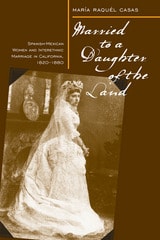
Married To A Daughter Of The Land
Spanish-Mexican Women And Interethnic Marriage In California, 1820-80Maria Raquel Casas
University of Nevada Press, 2009

Marsden Hartley
Race, Region, and NationDonna M. Cassidy
University of New Hampshire Press, 2005
Cassidy, sensitive to the psychological and gender analysis traditionally central to interpretations of Hartley, becomes the first scholar to reassess his late work in light of contemporary American perceptions of race, ethnicity, place, and history. This remarkable new book resonates not only as a seminal Hartley study and a complex art and cultural period history, but as a superb example of applied early twentieth-century American intellectual history informed by an impressive command of primary and secondary interdisciplinary literature. Numerous and rich illustrations, as well as transcriptions of several key essays by Hartley, some never before published, including "This Country of Maine" (1937–38), round out this insightful, nuanced, and revolutionary treatment. Donna M. Cassidy's Marsden Hartley will engage general readers as well as scholars and students.
Martha Tolton and Her Son Augustus
A Black Catholic Family's Experience of Slavery and FreedomEmilie Leumas
Catholic University of America Press, 2026

Martin Faber
The Story of a Criminal with "Confessions of a Murder"William Gilmore Simms
University of Arkansas Press, 2006
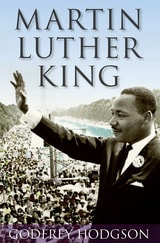
Martin Luther King
Godfrey Hodgson
University of Michigan Press, 2010
Dr. Martin Luther King Jr. is as relevant today as he was when he led civil rights campaigns in the 1950s and 1960s. He was an agent and a prophet of political change in this country, and the election of President Barack Obama is his direct legacy.
Now from one of Britain's most experienced political observers comes a new, accessible biography of the man and his works. The story of King is dramatic, and Godfrey Hodgson presents it with verve, clarity, and acute insight based in part on his own reporting on-scene at the time. He interviewed King half a dozen times or more; heard his speech at the March on Washington; was in Birmingham, Selma and Chicago; and met many of the characters in King's life story. Martin Luther King combines the best of his own reporting, plus the work of other biographers and researchers, to trace the iconic civil rights leader's career from his birth in Atlanta in 1929, through the campaigns that made possible the Civil Rights Act of 1964 and the Voting Rights Act of 1965, to his assassination in Memphis in 1968. Hodgson sheds light on every aspect of an extraordinary life: the Black Baptist culture in which King grew up, his theology and political philosophy, his physical and moral courage, his insistence on the injustice of inequality, his campaigning energy, his repeated sexual infidelities.
Hodgson describes the political minefield in which King operated; follows how he gradually persuaded President Kennedy that he could not stand by and allow the civil rights movement to be frustrated; and describes how, on the verge of success, his career was threatened by President Johnson's anger at King's principled decision to come out against the Vietnam War. He also puts King's career into the context of American history in the crisis of the 1960s. In his life, King was frustrated; but in death, he has been triumphant.
Martin Luther King allows the charisma and power of King's personality to shine through, showing in gripping narrative style exactly how one man helped America to progress toward its truest ideals. Hodgson's extensive research and detail help paint an accurate, complex portrait of one of America's most important leaders.
Godfrey Hodgson has worked in Britain and America as a newspaper and magazine journalist; as a television reporter, documentary maker and anchor; as a university teacher and lecturer; and as the author of a dozen well-received books about U.S. politics and recent history, including America in Our Time, a history of the United States in the 1960s; More Equal than Others, on politics and society in twentieth-century America; and most recently, a biography of Senator Daniel Patrick Moynihan, The Gentleman from New York. Hodgson met King on a number of occasions between 1956 and 1967. He recently retired as director of the Reuters Foundation Programme at Oxford University and is a visiting journalism professor at City University in London.
PRAISE FOR America in Our Time
"A critique so stimulating and compelling that I can only say read it."
---Richard Lingeman, The New York Times
"It simply gets right, without great fuss, the detail and proportion of things like the civil rights movement, student unrest, the stages of our Vietnam engagement."
---Garry Wills, The New York Review of Books
PRAISE FOR More Equal than Others
"The most thoughtful, thorough and sorrowful book imaginable on what has happened in these years."
---Bernard Crick, The Independent
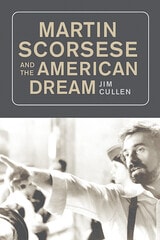
Martin Scorsese and the American Dream
Jim Cullen
Rutgers University Press, 2021
This book is the first study of Scorsese’s profound ambivalence toward the American Dream, the ways it drives some men and women to aspire to greatness, but leaves others seduced and abandoned. Showing that Scorsese understands the American dream in terms of a tension between provincialism and cosmopolitanism, Jim Cullen offers a new lens through which to view such seemingly atypical Scorsese films as The Age of Innocence, Hugo, and Kundun. Fast-paced, instructive, and resonant, Martin Scorsese and the American Dream illuminates an important dimension of our national life and how a great artist has brought it into focus.
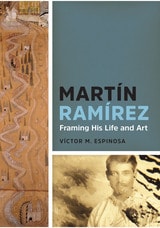
Martín Ramírez
Framing His Life and ArtBy Víctor M. Espinosa
University of Texas Press, 2015
Martín Ramírez, a Mexican migrant worker and psychiatric patient without formal artistic training, has been hailed by leading New York art critics as one of the twentieth century’s greatest artists. His work has been exhibited alongside masters such as José Clemente Orozco, Diego Rivera, Rufino Tamayo, Salvador Dalí, Marc Chagall, Paul Klee, and Joan Miró. A landmark exhibition of Ramírez’s work at the American Folk Art Museum in 2007 broke attendance records and garnered praise from major media, including the New York Times, New Yorker, and Village Voice.
Martín Ramírez offers the first sustained look at the life and critical reception of this acclaimed artist. Víctor Espinosa challenges the stereotype of outsider art as an indecipherable enigma by delving into Ramírez’s biography and showing how he transformed memories of his life in Mexico, as well as his experiences of displacement and seclusion in the United States, into powerful works of art. Espinosa then traces the reception of Ramírez’s work, from its first anonymous showings in the 1950s to contemporary exhibitions and individual works that have sold for as much as a half-million dollars. This eloquently told story reveals how Ramírez’s three-decades-long incarceration in California psychiatric institutions and his classification as “chronic paranoid schizophrenic” stigmatized yet also protected what his hands produced. Stripping off the labels “psychotic artist” and “outsider master,” Martín Ramírez demonstrates that his drawings are not passive manifestations of mental illness. Although he drew while confined as a psychiatric patient, the formal elements and content of Ramírez’s artwork are shaped by his experiences of cultural and physical displacement.