Results by title
5550 books match the query 'Biography & Autobiography' and 112 start with n
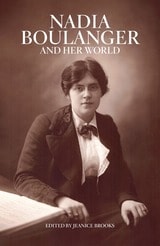
Nadia Boulanger and Her World
Edited by Jeanice Brooks
University of Chicago Press, 2020
Composer, performer, conductor, impresario, and charismatic and inspirational teacher, Boulanger engaged in a vast array of activities in a variety of media, from private composition lessons and lecture-recitals to radio broadcasts, recordings, and public performances. But how to define and account for Boulanger’s impact on the music world is still unclear. Nadia Boulanger and Her World takes us from a time in the late nineteenth century, when many careers in music were almost entirely closed to women, to the moment in the late twentieth century when those careers were becoming a reality. Contributors consider Boulanger’s work in the worlds of composition, musical analysis, and pedagogy and explore the geographies of transatlantic and international exchange and disruption within which her career unfolded. Ultimately, this volume takes its title as a topic for exploration—asking what worlds Boulanger belonged to, and in what sense we can consider any of them to be “hers.”
Nahum Goldman
His Missions to the GentileRaphael Patai
University of Alabama Press, 1980
Nahum Goldmann (1895-1982) was a major Zionist figure for the last half-century and the chief architect of the pact pledging West Germany to pay reparations to Israel and to individual Jews for acts committed during the Nazi regime. He was co-founder of the Eschkol Publishing House in Berlin and was co-publisher of the Encyclopedia Judaica, the only major Jewish encyclopedia published in Germany.
Patai’s study is the first to explore this brilliant, often irritating, and enormously successful Jewish politician and diplomat. Goldmann represented no government, yet he effected important international change. The book discusses Goldmann’s involvement with the partition controversy which led to the establishment of Israel, West German reparation payments amounting to over $36 billion, and a series of attempts to meet with Egyptian President Nasser in hopes of bringing peace to the Middle East.
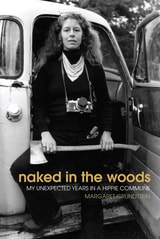
Naked in the Woods
My Unexpected Years in a Hippie CommuneMargaret Grundstein
Oregon State University Press, 2015
Naked in the Woods chronicles Grundstein’s shift from reluctant hippie to committed utopian—sacrificing phones, electricity, and running water to live on 160 acres of remote forest with nothing but a drafty cabin and each other. Grundstein, (whose husband left, seduced by “freer love”) faced tough choices. Could she make it as a single woman in man’s country? Did she still want to? How committed was she to her new life? Although she reveled in the shared transcendence of communal life deep in the natural world, disillusionment slowly eroded the dream. Brotherhood frayed when food became scarce. Rifts formed over land ownership. Dogma and reality clashed.
Many people, baby boomers and millennials alike, have romantic notions about the 1960s and 70s. Grundstein’s vivid account offers an unflinching, authentic portrait of this iconic and often misreported time in American history. Accompanied by a collection of distinctive photographs she took at the time, Naked in the Woods draws readers into a period of convulsive social change and raises timeless questions: how far must we venture to find the meaning we seek, and is it ever far out enough to escape our ingrained human nature?

Nancy Hanks, An Intimate Portrait
The Creation of a National Commitment to the ArtsMichael Straight
Duke University Press, 1988
This biography captures the spirit and the flavor of Ms. Hanks's remarkable life, above all during the eight years in which she led the Endowment. Tracing her childhood in Florida and North Carolina through her achievements as a student leader at Duke University, Straight makes clear her conscious effort to find a path with more scope than the usual marriage-and-a-family when expected of Southern women. Nancy Hanks went to Washington and found a job with the Office of War Mobilization. She later worked with Nelson Rockefeller, who became governor of New York, a Republican party luminary, and vice president under Gerald Ford, in addition to being an heir to one of America's greatest fortunes. Her relationship with Rockefeller was crucial to her personal life, and his conception of government and its role and a lasting influence on her career.
Straight examines Nancy Hanks's leadership of the NEA and takes particular note of the intense debate over the role of government in fostering American artistic expression, an issue with roots running back through the New Deal to the early history of the United States. Nancy Hanks took a strong and activist role in the formulation and administration of a national arts policy, and her accomplishments have left an indelible mark on public support for arts in the United States. Straight, who worked closely with Ms. Hanks and admired her despite frequent policy disagreements, deals honestly with both the successes and failures of her efforts. His biography imparts a sense of the reasons why her many friends felt such loyalty to this complex and gifted woman.
Narratives of Justice
Legislators' Beliefs about Distributive FairnessGrant Reeher
University of Michigan Press, 1996
Narratives of Justice offers a provocative, contemporary look at the timeless questions of justice and fairness. Using face-to-face interviews, Grant Reeher plumbs the minds of legislators for their beliefs about distributive justice and attempts to discover the ways in which those beliefs influence their behavior. The book calls into question many notions of American political ideology and, in particular, the idea of an "American exceptionalism" regarding views from the political left, and the dominance in the United States of a "liberal tradition."
Political philosophers have amassed a large body of work on justice and fairness from a theoretical perspective, but there is comparatively little empirical work on the subject. The work that does exist concentrates on the beliefs of the public. We know very little concerning the beliefs about justice held by political elites. This work offers a window into the beliefs of legislators, a group for which such an inquiry is rarely undertaken.
The book is based on a set of extended, in-depth interviews with the members of the Connecticut State Senate as well as a year of close observation of the Senate in action. The interviews averaged four hours in length and covered a variety of topics related to fairness. Through this material, Reeher employs a narrative-based framework to understand the patterns in the senators' interview responses, and develops a typology of the senator's narratives. These narratives vary in both content and form, and as a whole present a surprising range of views.
Narratives of Justice will be of interest to those concerned with justice, political ideologies, and political beliefs, as well as state and local politics and, more generally, American politics. Its wide research and thorough documentation make it a useful guide to the literature within and beyond political science concerning beliefs, ideologies, legislative behavior, and qualitative research methods.
Grant Reeher is Assistant Professor, Maxwell School of Citizenship and Public Affairs, Department of Political Science, Syracuse University, and currently a Robert Wood Johnson Foundation Scholar in Health Policy Research, University of Michigan.
Nasser
Anne Alexander
Haus Publishing, 2007
Nasser
Anne Alexander
Haus Publishing, 2025
More than fifty years after his death, Gamal Abd al-Nasser remains a towering figure in the Arab world. As one of the young officers who overthrew British-backed King Farouk in Egypt in 1952, Nasser rose to prominence as a charismatic visionary who challenged foreign dominance. At just thirty-six years old, he became the undisputed leader of Egypt in a presidency that would run from 1956 to 1970.
This insightful biography, in its second edition and featuring a new introduction from the author, delves into the life of Nasser, charting his rise to power, his nationalization of the Suez Canal, and his turbulent years as president. Many in the Arab World celebrate Nasser for his defiance of colonial rule and his dream of Arab unity. However, his legacy is not without its contradictions. Critics have alluded, for instance, to his autocratic rule and unfulfilled promises. In Nasser, Anne Alexander explores this tension between Nasser’s revolutionary ideas and the reality of his governance.
Natalija
Life in the Balkan Powder Keg, 1880-1956Natalija Matic-Zrnic
Central European University Press, 2009
Nathan B. Young and the Struggle over Black Higher Education
Antonio F. Holland
University of Missouri Press, 2006
Born in slavery in Alabama, Young followed a love of learning to degrees from Talladega and Oberlin Colleges and a career in higher education. Employed by Booker T. Washington in 1892, he served at Tuskegee Institute until conflict with Washington’s vocational orientation led him to move on. During a brief tenure at Georgia State Industrial College under Richard R. Wright, Sr., he became disillusioned by efforts of whites to limit black education to agriculture and the trades. Hired as president of Florida A&M in 1901, he fought for twenty years to balance agricultural/vocational education with the liberal arts, only to meet with opposition from state officials that led to his ouster.
This principled educator finally found his place as president of Lincoln University in Missouri in 1923. Here Young made a determined effort to establish the school as a standard institution of higher learning. Holland describes how he campaigned successfully to raise academic standards and gain accreditation for Lincoln’s programs—successes made possible by the political and economic support of farsighted members of Missouri’s black community.
Holland shows that the great debate over black higher education was carried on not only in the rhetoric of Washington and Du Bois but also on the campuses, as Young and others sought to prepare African American students to become thinkers and creators. In tracing Young’s career, Holland presents a wealth of information on the nature of the education provided for former slaves and their descendents in four states—shedding new light on the educational environment at Oberlin and Tuskegee—and on the actions of racist white government officials to limit the curriculum of public education for blacks.
Although Young’s efforts to improve the schools he served were often thwarted, Holland shows that he kept his vision alive in the black community. Holland’s meticulous reconstruction of an eventful career provides an important look at the forces that shaped and confounded the development of black higher education during traumatic times.
Nathan Boone and the American Frontier
R. Douglas Hurt
University of Missouri Press, 2000
Celebrated as one of America's frontier heroes, Daniel Boone left a legacy that made the Boone name almost synonymous with frontier settlement. Nathan Boone, the youngest of Daniel's sons, played a vital role in American pioneering, following in much the same steps as his famous father. In Nathan Boone and the American Frontier, R. Douglas Hurt presents for the first time the life of this important frontiersman.
Based on primary collections, newspaper articles, government documents, and secondary sources, this well-crafted biography begins with Nathan's childhood in present-day Kentucky and Virginia and then follows his family's move to Missouri. Hurt traces Boone's early activities as a hunter, trapper, and surveyor, as well as his leadership of a company of rangers during the War of 1812. After the war, Boone returned to survey work. In 1831, he organized another company of rangers for the Black Hawk War and returned to military life, making it his career. The remainder of the book recounts Boone's activities with the army in Iowa and the Indian Territory, where he was the first Boone to gain notice outside Missouri or Kentucky. Even today his work is recognized in the form of state parks, buildings, and place-names.
Although Nathan Boone was an important figure, he lived much of his life in the shadow of his father. R. Douglas Hurt, however, makes a strong case for Nathan's contribution to the larger context of life in the American backcountry, especially the execution of military and Indian policy and the settlement of the frontier.
By recognizing the significant role that Nathan Boone played, Nathan Boone and the American Frontier also provides the recognition due the many unheralded frontiersmen who helped settle the West. Anyone with an interest in the history of Missouri, the frontier, or the Boone name will find this book informative and compelling.
Nathan Hale
The Life and Death of America's First SpyM. William Phelps
University Press of New England, 2015
Nathan Straus
From Macy's Magnate to International HumanitarianAndrew Fisher
Rutgers University Press, 2026
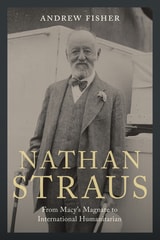
Nathan Straus (1848–1931) encompassed worlds. He rose from his Jewish German immigrant family’s ruin in Civil War Georgia to become co-owner of Macy’s and Abraham & Straus department stores. He helped build American Zionism and cofounded the American Jewish Congress movement. His public service led to a nomination for New York City mayor.
This, the first comprehensive biography of Straus, details each of these lives but argues that his most historic achievements lay elsewhere—in philanthropy. Inspired by both his Jewish values and no-nonsense pragmatism, Straus designed, funded, and oversaw four Progressive philanthropic initiatives. The greatest—his demonstration and advocacy campaigns for milk pasteurization—saved the lives of countless thousands of infants in New York City and, ultimately, across much of America and western Europe. Straus also founded America’s first TB preventorium for at-risk children: a model for the forty-five more that followed. Partnering with Hadassah, he brought American public health innovations to Mandate Palestine. He provided vast relief for New York City’s jobless in the severe 1890s depression. In all, Straus’s humanitarianism won the acclaim of American presidents and world leaders and the gratitude of millions. We can learn from him today.

Nathanael West - American Writers 21
University of Minnesota Pamphlets on American WritersStanley Edgar Hyman
University of Minnesota Press, 1962
Nathanael West - American Writers 21 was first published in 1962. Minnesota Archive Editions uses digital technology to make long-unavailable books once again accessible, and are published unaltered from the original University of Minnesota Press editions.
Nathaniel Hawthorne - American Writers 23
University of Minnesota Pamphlets on American WritersHyatt H. Waggoner
University of Minnesota Press, 1962
Nathaniel Hawthorne - American Writers 23 was first published in 1962. Minnesota Archive Editions uses digital technology to make long-unavailable books once again accessible, and are published unaltered from the original University of Minnesota Press editions.
Native American Autobiography
An AnthologyArnold Krupat
University of Wisconsin Press, 1994
Native American Autobiography is the first collection to bring together the major autobiographical narratives by Native American people from the earliest documents that exist to the present. The thirty narratives included here cover a range of tribes and cultural areas, over a span of more than 200 years.
From the earliest known written memoir—a 1768 narrative by the Reverend Samson Occom, a Mohegan, reproduced as a chapter here—to recent reminiscences by such prominent writers as N. Scott Momaday and Gerald Vizenor, the book covers a broad range of Native American experience. The sections include “Traditional Lives;” “The Christian Indians, from the Eighteenth Century to Indian Removal, 1830;” “The Resisting Indians, from Indian Removal to Wounded Knee, 1830-90;” “The Closed Frontier, 1890-;” “The Anthropologists' Indians, 1900-;” “‘Native American Renaissance,’ 1968-;” and “Traditional Lives Today.” Editor Arnold Krupat provides a general introduction, a historical introduction to each of the seven sections, extensive headnotes for each selection, and suggestions for further reading, making this an ideal resource for courses in American literature, history, anthropology, and Native American studies. General readers, too, will find a wealth of fascinating material in the life stories of these Native American men and women.
"This is the first comprehensive anthology of American Indian autobiography ever published. It will be of interest to virtually anyone teaching or studying the literatures of the native peoples of North America, as well as to a general audience, because of the informative, literate introductions and the absorbing narratives themselves."—William L. Andrews, series editor

Native Voices
Indigenous American Poetry, Craft, and ConversationsEdited by CMarie Fuhrman and Dean Rader
Tupelo Press, 2019
In this groundbreaking anthology of Indigenous poetry and prose, Native poems, stories, and essays are informed with a knowledge of both what has been lost and what is being restored. It offers a diverse collection of stories told by Indigenous writers about themselves, their histories, and their present. It is a celebration of culture and the possibilities of language.
Featuring forty-four poets, including Ishmael Hope, Bojan Louis, Ruby Murray, Simon Ortiz, Leslie Marmon Silko, Luci Tapahonso, Joy Harjo, dg okpik, Sherwin Bitsui, Heid E. Erdrich, Layli Long Soldier, and Orlando White.
Original influence essays by Diane Glancy on Lorca, Chrystos on Audre Lorde, Louise Erdrich on Elizabeth Bishop, LeAnne Howe on W. D. Snodgrass, Allison Hedge Coke on Delmore Schwartz, Suzanne Rancourt on Ai, and M. L. Smoker on Richard Hugo, among others.
And, a selection of resonant work chosen from previous generations of Native artists.
“There really is no better anthology out there that collects indigenous poets publishing from 1960 to the present.” — Dean Rader, co-editor

Natural Coincidence
The Trip from KalamazooBil Gilbert
University of Michigan Press, 2004
Natural Coincidence collects some of Bil Gilbert's finest writing, covering a diverse range of subjects that include investigations of the biology of Tasmanian devils, the lives and loves of snapping turtles, and an appreciation of the intelligence of crows. Perfectly suiting this eclectic choice of angles is Gilbert's unique writing style, a blend of unprepossessing erudition, wit, and honesty that has been compared to Aldo Leopold's Sand County Almanac.
The collection opens with a memoir of a childhood Christmas in western Michigan, before Gilbert's fascination with the natural world drew him to more exotic locales like Tasmania, Alaska, Nova Scotia, and Manhattan to write about such topics as the javelina, bigfoot, buffalo, and ringtails.
"More than 50 years ago," writes Gilbert, "without a clear notion about why or where I was going, I set off on a trip from Kalamazoo, Michigan. I am still traveling toward an unknown destination. But along the way, much more for reasons of good luck than thoughtful planning, I have met many wonderful beings and happenings. The essays appearing in Natural Coincidence represent an attempt to describe some of these wonders. I like to think, or at least pretend, that the inspiration for and theme of this book is gratitude."
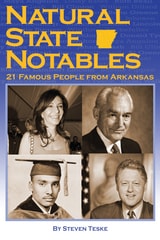
Natural State Notables
Twenty-One Famous People from ArkansasSteven Teske
Butler Center for Arkansas Studies, 2014
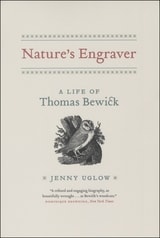
Nature's Engraver
A Life of Thomas BewickJenny Uglow
University of Chicago Press, 2009
Thomas Bewick’s (1753–1828) History of British Birds was the first field guide for ordinary people, illustrated with woodcuts of astonishing accuracy and beauty. In Nature’s Engraver, Jenny Uglow tells the story of the farmer’s son from Tyneside who became one of Britain’s greatest and most popular engravers. It is a story of violent change, radical politics, lost ways of life, and the beauty of the wild—a journey to the beginning of our lasting obsession with the natural world.
“A refined and engaging biography, as beautifully wrought, in its way, as Bewick’s woodcuts.”—New York Times
“Uglow’s clear prose sparkles like Bewick’s River Tyne.”—Los Angeles Times
“This is a lovely book, not just in the quality and sympathy of the writing but in the care of its design and illustration. [Uglow] has turned a rich but undramatic life into a vignette as full of interest and details as one of Bewick’s own woodcuts.”—Sunday Telegraph
“A splendid biography. But it becomes an endearing one by the scattered presence of so many of Bewick’s woodcuts.”—Washington Post
“Another triumph for England’s most innovative biographer, and a marvelous treat for fans of Bewick’s beguiling work.”—Kirkus Reviews
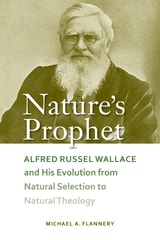
Nature's Prophet
Alfred Russel Wallace and His Evolution from Natural Selection to Natural TheologyMichael A. Flannery
University of Alabama Press, 2018
An astute study of Alfred Russel Wallace’s path to natural theology.
A spiritualist, libertarian socialist, women’s rights advocate, and critic of Victorian social convention, Alfred Russel Wallace was in every sense a rebel who challenged the emergent scientific certainties of Victorian England by arguing for a natural world imbued with purpose and spiritual significance. Nature’s Prophet: Alfred Russel Wallace and His Evolution from Natural Selection to Natural Theology is a critical reassessment of Wallace’s path to natural theology and counters the dismissive narrative that Wallace’s theistic and sociopolitical positions are not to be taken seriously in the history and philosophy of science.
Author Michael A. Flannery provides a cogent and lucid account of a crucial—and often underappreciated—element of Wallace’s evolutionary worldview. As co-discoverer, with Charles Darwin, of the theory of natural selection, Wallace willingly took a backseat to the well-bred, better known scientist. Whereas Darwin held fast to his first published scientific explanations for the development of life on earth, Wallace continued to modify his thinking, refining his argument toward a more controversial metaphysical view which placed him within the highly charged intersection of biology and religion.
Despite considerable research into the naturalist’s life and work, Wallace’s own evolution from natural selection to natural theology has been largely unexplored; yet, as Flannery persuasively shows, it is readily demonstrated in his writings from 1843 until his death in 1913. Nature’s Prophet provides a detailed investigation of Wallace’s ideas, showing how, although he independently discovered the mechanism of natural selection, he at the same time came to hold a very different view of evolution from Darwin.
Ultimately, Flannery shows, Wallace’s reconsideration of the argument for design yields a more nuanced version of creative and purposeful theistic evolution and represents one of the most innovative contributions of its kind in the Victorian and Edwardian eras, profoundly influencing a later generation of scientists and intellectuals.
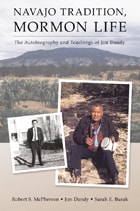
Navajo Tradition, Mormon Life
The Autobiography and Teachings of Jim DandyRobert S. McPherson
University of Utah Press, 2012
Born in the early 1940s in northern Arizona’s high country desert, Jim Dandy began life imbued with the traditions of the Navajo people. Raised by his father and grandfather—both medicine men—and a grandmother steeped in Navajo practices, he embraced their teachings and followed in their footsteps. But attending the LDS Placement program in northern Utah changed his life’s course when he became a member of the Mormon Church. Following graduation from high school, Jim served an LDS mission among his people, obtained a bachelor’s degree, and entered the work force in southeastern Utah as a career counselor, teacher, and community advocate who improved educational opportunities on the Navajo Reservation.
Jim has led a life of service and teaching. He maintains the traditional philosophy with which he was raised and the Mormon beliefs that he learned and continues to follow; his life reflects the values inherent in these two different worlds. Readers interested in Navajo philosophy will find his blend of these two distinct views fascinating, while others will better understand the effects of the controversial placement program on the life of one individual. However, this is primarily the warm story of a man’s life among his people and his love for them and their culture.
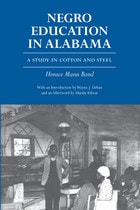
Negro Education in Alabama
A Study in Cotton and SteelHorace Mann Bond
University of Alabama Press, 1994
WINNER OF THE SUSAN COLVER ROSENBERGER AWARD
A foundational work of educational history, Horace Mann Bond’s study reveals how race, labor, and power shaped Black schooling in Alabama—and why those lessons still matter today.
Originally published in 1939, Negro Education in Alabama: A Study in Cotton and Steel by Horace Mann Bond is a pioneering work of educational and social history. Drawing on extensive data and firsthand observation, Bond explores how the economic structures of the cotton South and the industrializing North influenced the development of Black education in Alabama. He examines disparities in funding, curriculum, and access, while also highlighting the resilience and agency of African American communities in pursuing educational advancement. This reissued edition preserves Bond’s critical insights and remains a vital resource for scholars of African American history, education policy, and Southern studies.
Neil Jordan
Maria T. Pramaggiore
University of Illinois Press, 2007
Despite the striking diversity of Jordan's films, the director consistently returns to gothic themes of loss, violence, and madness. In her sophisticated examination of Mona Lisa,Michael Collins, and The Good Thief, Pramaggiore shows how Jordan presents these dark narratives with a uniquely Irish and postmodern sense of irony. This illuminating analysis of one of the cinema's most important artists will be of keen interest to movie enthusiasts as well as students and scholars of contemporary film.
Neither God nor Master
Robert Bresson and Radical PoliticsBrian Price
University of Minnesota Press, 2010
Situating Bresson in radical and aesthetic political contexts, from surrealism to situationism, Neither God nor Master shows how his early style was a model for social resistance. We then see how, after May 1968, his films were in fact a series of reflections on the failure of revolution in France—especially as “failure” is understood in relation to Bresson’s chosen literary precursors, Dostoyevsky and Tolstoy, and Russian revolutionary culture of the nineteenth century.
Restoring Bresson to the radical political culture from which he emerged—and to which he remained faithful—Price offers a major revision of the reputation of one of the most celebrated figures in the history of French film. In doing so, he raises larger philosophical questions about the efficacy of revolutionary practices and questions about interpretation and metaphysical tendencies of film historical research that have, until now, gone largely untested.
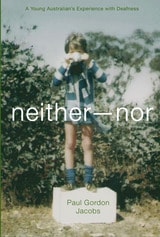
Neither–Nor
A Young Australian's Experience with DeafnessPaul Jacobs
Gallaudet University Press, 2007
The Fifth Volume in the Deaf Lives Series
Born in Melbourne, Australia, in 1974, Paul Jacobs lost his mother when he was three months old. When he was five, he lost most of his hearing. These two defining events formed the core of his being. He spent the first two decades of his life “coming to terms with being neither Deaf nor hearing — a neither/nor, an in-between — and a person with a social identity that had yet to be invented.” His memoir, Neither—Nor: A Young Australian’s Experience with Deafness, recounts this journey.
Jacobs excelled in sports and the classroom, but he never lost awareness of how he was seen as different, often in cruel or patronizing ways. His father, a child psychologist, headed a long list of supportive people in his life, including his Uncle Brian, his itinerant teacher of the deaf Mrs. Carey, a gifted art teacher Mrs. Klein, who demanded and received from him first-rate work, a notetaker Rita, and Bella, his first girlfriend. Jacobs eventually attended university, where he graduated with honors. He also entered the Deaf world when he starred on the Deaf Australian World Cup cricket team. However, he never learned sign language, and frequently noted the lack of an adult role model for “neither—nors” such as himself.
Still emotionally adrift in 1998, Jacobs toured Europe, then volunteered to tutor deaf residents at Court Grange College in Devon, England. There, he discovered a darker reality for some deaf individuals — hearing loss complicated by schizophrenia, Bonnevie-Ullrich Syndrome, and other conditions. After returning to Australia, Jacobs recognized what he had gleaned from his long journey: “Power comes from within, not without. Sure, deafness makes one prone to be stigmatized. Yet having a disability can act as a stimulus for greater personal growth, richer experiences, and more genuine relationships.”
Nell's Story
A Woman from Eagle RiverNell Peters, with Robert Peters
University of Wisconsin Press, 1995
Nels Anderson’s World War I Diary
Allan Kent Powell
University of Utah Press, 2013
Nels Anderson’s World War I Diary provides a rare glimpse into the wartime experiences of one of the most well-respected sociologists of the twentieth century, the renowned author of The Hobo (1920) and Desert Saints: The Mormon Frontier in Utah (1942). Anderson, a keen observer of people, places, and events his entire life, joined the U.S. Army in 1918 at the age of 29 and was sent to Europe to fight as part of the Allied Expeditionary Force (AEF) under General Pershing. Because keeping a journal was strongly discouraged among American forces during WWI, particularly among the rank-and-file soldiers, Anderson’s diary stands as a rare gem. Furthermore, it is the only known account of war service during WWI by a member of the LDS Church. Anderson joined the Mormon faith after accepting the hospitality of an extended Mormon ranching family during his travels throughout the American West as a working hobo.
Anderson’s accounts of the St. Mihiel and Meuse-Argonne offensives are particularly remarkable given the challenges of keeping a detailed journal amidst the chaos and suffering of the war’s Western Front. His insights into the depravity and callousness of war are buttressed with intimate human portraits of those to whom he was closest. The war years provided many formative experiences that would prove to have a lasting influence on Anderson’s views regarding the working poor, authority, and human values; this would come to bear heavily on his later work as a pioneering sociologist at the University of Chicago, where he helped establish participant observation as a research method. The many introspective entries contained in this volume will be of reat interest to military historians and history buffs as well as to those in the social sciences looking to find the intellectual origins of Anderson’s later work in the burgeoning field of sociology.
Winner of the Army Historical Foundation Distinguished Writing Award for Journals, Memoirs, and Letters.
Nemerov's Door
EssaysRobert Wrigley
Tupelo Press, 2021
Neruda
An Intimate BiographyBy Volodia Teitelboim
University of Texas Press, 1992
Like a rain-swollen river sweeping everything into its current, Pablo Neruda channeled all his life experiences into impassioned poetry that ultimately brought him the 1971 Nobel Prize for literature. His close friend and fellow writer-activist Volodia Teitelboim shared that exciting process for forty years, uniquely qualifying him to offer this intimate portrait of the poet. Originally published in Spain in 1984, Neruda is a biography that reads like a novel.
Teitelboim captures the whole sweep of Neruda's eventful life (1904-1973), from his motherless childhood in Chile's rainy southern forest to his unquiet death just twelve days after the violent overthrow of the Allende government he had served. He follows him through his bohemian youth as an impoverished university student in Santiago, his lonely existence in Southeast Asia consular outposts, his joyous discovery of Spain, and his lifelong devotion to poetry, love, Chile, and politics.
Nestor Makhno and Rural Anarchism in Ukraine, 1917-1921
Colin Darch
Pluto Press, 2020
Between 1917 and 1921, the Makhnovists fought German and Austrian invaders, reactionary monarchist forces, Ukrainian nationalists and sometimes the Bolsheviks themselves. Drawing upon anarchist ideology, the Makhnovists gathered widespread support amongst the Ukrainian peasantry, taking up arms when under attack and playing a significant role - in temporary alliance with the Red Army - in the defeats of the White Generals Denikin and Wrangel. Often dismissed as a kulak revolt, or a manifestation of Ukrainian nationalism, Colin Darch analyses the successes and failures of the Makhnovist movement, emphasising its revolutionary character.
Over 100 years after the revolutions, this book reveals a lesser known side of 1917, contributing both to histories of the period and broadening the narrative of 1917, whilst enriching the lineage of anarchist history.

Nestor Makhno and Rural Anarchism in Ukraine, 1917-1921
Colin Darch
Pluto Press, 2020
Between 1917 and 1921, the Makhnovists fought German and Austrian invaders, reactionary monarchist forces, Ukrainian nationalists and sometimes the Bolsheviks themselves. Drawing upon anarchist ideology, the Makhnovists gathered widespread support amongst the Ukrainian peasantry, taking up arms when under attack and playing a significant role - in temporary alliance with the Red Army - in the defeats of the White Generals Denikin and Wrangel. Often dismissed as a kulak revolt, or a manifestation of Ukrainian nationalism, Colin Darch analyzes the successes and failures of the Makhnovist movement, emphasizing its revolutionary character.
Over 100 years after the revolutions, this book reveals a lesser known side of 1917, contributing both to histories of the period and broadening the narrative of 1917, whilst enriching the lineage of anarchist history.
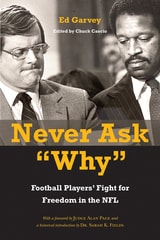
Never Ask "Why"
Football Players' Fight for Freedom in the NFLBy Ed Garvey; Edited by Chuck Cascio
Temple University Press, 2023
When pro football players formed a union to stand up against the NFL for their own interests, they chose lawyer Ed Garvey as their Executive Director. The NFL Players Association (NFLPA), would take on the NFL over player contracts, collective bargaining agreements, and antitrust suits. It lobbied for players’ free agency, contract rights, and impartial arbitration of disciplinary disputes. Garvey navigated strikes, lockouts, scabs, stooges, lies, as well as the sports media complex—to maintain players’ dignity. According to the league, the players were to take what they were given and “never ask why.”
In Never Ask “Why,” journalist Chuck Cascio presents the late Garvey’s rich account of the early years of the NFLPA, taking readers among the players as they held the league accountable to play fair. Learning from their mistakes, the NFLPA would succeed in curbing commissioner Pete Rozelle’s disciplinary power and striking down the Rozelle Rule’s absolute control over free agency.
Garvey tells the intimate stories of how pro football players, rivals on the field, rallied together to stand up for themselves. He worked tirelessly to change a system that exploited players and even controlled the media. In the end, Garvey shows how the NFLPA transformed the state of pro sports leagues today and how, even still, they work to keep down the players on whose backs they profit.
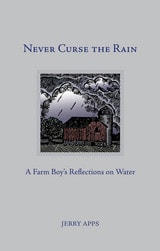
Never Curse the Rain
A Farm Boy’s Reflections on WaterJerry Apps
Wisconsin Historical Society Press, 2017
In Never Curse the Rain, Jerry shares his memories of water, from its importance to his family’s crops and cattle to its many recreational uses—fishing trips, canoe journeys, and the simple pleasures of an afternoon spent dreaming in the haymow as rain patters on the barn roof. Water is still a touchstone in Jerry’s life, and he explores the ways he’s found it helpful in soothing a troubled mind or releasing creativity. He also discusses his concerns about the future of water and ensuring we always have enough. For, as Jerry writes, "Water is one of the most precious things on this planet, necessary for all life, and we must do everything we can to protect it."
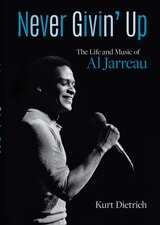
Never Givin' Up
The Life and Music of Al JarreauKurt Dietrich
Wisconsin Historical Society Press, 2023
This is the first biography to chronicle the life and career of one of the most distinguished and beloved musical artists to come out of Wisconsin: Al Jarreau. From his earliest days singing in the 1940s until his death in 2017, Jarreau defied categorization. While his biggest hit, “We’re In This Love Together,” is pure pop, he smashed music industry stereotypes as the first artist to win Grammy Awards in three genres: jazz, pop, and R&B.
Never Givin’ Up traces Jarreau’s singing career from humble beginnings in his hometown of Milwaukee to international fame. The narrative includes his formative student days at Ripon College and the University of Iowa, as well as the years spent honing his craft at nightspots in Milwaukee, San Francisco, and the Twin Cities. After he was signed by Warner Bros. Records in 1975 at the age of 35, Jarreau achieved stardom with his innovative vocal stylings and electric live performances.
This book includes more than 20 sidebars with bonus information about every Jarreau album and behind-the-scenes stories about the making of the records. Author Kurt Dietrich conducted interviews with dozens of Al's friends, fellow musicians, professional associates, and family members—most notably Al’s sister, Rose Marie Freeman, who was a major contributor to the project. Featuring 54 images spanning Jarreau’s life, from never-before-seen family snapshots to stills from his legendary stage performances, Never Givin’ Up celebrates a Milwaukee hometown hero and global sensation.
Silver Medal Winner for the 2023 Foreword INDIES Book of the Year Award for Performing Arts and Music
Finalist for the Association for Recorded Sound Collections’ Award for Best Historical Research in Recorded Jazz
“Kurt Dietrich has created a masterful book, revealing and depicting a detailed version of my brother, Al Jarreau, through his music and career. In these pages, I see Al’s determination and his admirable goal of ‘Never Givin’ Up’ on his joy of singing. It was my distinct pleasure to work with Kurt Dietrich in the process, establishing what has become a bond of family-like friendship that will endure for a lifetime and beyond.”
—Rose Marie (Jarreau) Freeman
“Dietrich captures Jarreau’s simultaneously gregarious and shy charm while revealing his own affection for this gifted and gracious performer. It’s his love letter to a Milwaukee legend.”
—Bill Milkowski, author of Jaco: The Extraordinary and Tragic Life of Jaco Pastorius and Ode to a Tenor Titan: The Life and Times and Music of Michael Brecker
"Written in an approachable style and carefully documented, this book will be valuable for fans and researchers of Jarreau’s music. Summing Up: Highly recommended."
—Choice Reviews
Never Givin' Up
The Life and Music of Al JarreauKurt Dietrich
Wisconsin Historical Society Press, 2025
This is the first biography to chronicle the life and career of one of the most distinguished and beloved musical artists to come out of Wisconsin: Al Jarreau. From his earliest days singing in the 1940s until his death in 2017, Jarreau defied categorization. While his biggest hit, “We’re In This Love Together,” is pure pop, he smashed music industry stereotypes as the first artist to win Grammy Awards in three genres: jazz, pop, and R&B.
Never Givin’ Up traces Jarreau’s singing career from humble beginnings in his hometown of Milwaukee to international fame. The narrative includes his formative student days at Ripon College and the University of Iowa, as well as the years spent honing his craft at nightspots in Milwaukee, San Francisco, and the Twin Cities. After he was signed by Warner Bros. Records in 1975 at the age of 35, Jarreau achieved stardom with his innovative vocal stylings and electric live performances.
This book includes more than 20 sidebars with bonus information about every Jarreau album and behind-the-scenes stories about the making of the records. Author Kurt Dietrich conducted interviews with dozens of Al's friends, fellow musicians, professional associates, and family members—most notably Al’s sister, Rose Marie Freeman, who was a major contributor to the project. Never Givin’ Up celebrates a Milwaukee hometown hero and global sensation.
Silver Medal Winner for the 2023 Foreword INDIES Book of the Year Award for Performing Arts and Music
Finalist for the Association for Recorded Sound Collections’ Award for Best Historical Research in Recorded Jazz
“Kurt Dietrich has created a masterful book, revealing and depicting a detailed version of my brother, Al Jarreau, through his music and career. In these pages, I see Al’s determination and his admirable goal of ‘Never Givin’ Up’ on his joy of singing. It was my distinct pleasure to work with Kurt Dietrich in the process, establishing what has become a bond of family-like friendship that will endure for a lifetime and beyond.”
—Rose Marie (Jarreau) Freeman
“Dietrich captures Jarreau’s simultaneously gregarious and shy charm while revealing his own affection for this gifted and gracious performer. It’s his love letter to a Milwaukee legend.”
—Bill Milkowski, author of Jaco: The Extraordinary and Tragic Life of Jaco Pastorius and Ode to a Tenor Titan: The Life and Times and Music of Michael Brecker
"Written in an approachable style and carefully documented, this book will be valuable for fans and researchers of Jarreau’s music. Summing Up: Highly recommended."
—Choice Reviews
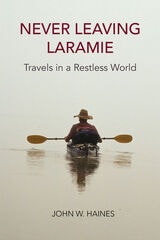
Never Leaving Laramie
Travels in a Restless WorldJohn W. Haines
Oregon State University Press, 2020
In the years since, Haines has added writer to a resume that already included baker and banker. In Never Leaving Laramie, he pulls stories about traveling into an exploration of home: How a rural home fueled and sustained a worldview. How beauty and danger blend together with humility and ego. How itchy feet combine with the comfort of home in Laramie, a tough railroad town turned college town and a launchpad for wanderers. Throughout, Haines returns to ideas of rivers and movement. He ends with a chapter on a different kind of travel, reflecting on how his accident did and did not change him and the varied ways that people can move through the world.

Never Make a Spy Out of Me
An Epistolary Story from the Romanian Secret Police Archives (1947-1962)Valentina Glajar
Central European University Press, 2027
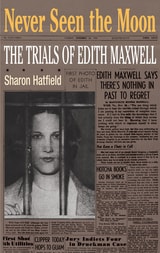
Never Seen the Moon
THE TRIALS OF EDITH MAXWELLSharon Hatfield
University of Illinois Press, 2004
Immediately granted celebrity status by the powerful Hearst press, Maxwell was also championed as a martyr by advocates of women's causes. National news magazines and even detective magazines picked up her story, Warner Brothers created a screen version, and Eleanor Roosevelt helped secure her early release from prison. Sharon Hatfield's brilliant telling of this true-crime story transforms a dusty piece of history into a vibrant thriller. Throughout the narrative, she discusses yellow journalism, the inequities of the jury system, class and gender tensions in a developing region, and a woman's right to defend herself from family violence.
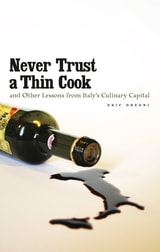
Never Trust a Thin Cook and Other Lessons from Italy’s Culinary Capital
Eric Dregni
University of Minnesota Press, 2024
The food-obsessed chronicle of an American’s three years in Italy—now available in paperback
I simply want to live in the place with the best food in the world. This dream led Eric Dregni to Italy, first to Milan and eventually to a small, fog-covered town to the north: Modena, the birthplace of balsamic vinegar, Ferrari, and Luciano Pavarotti. Never Trust a Thin Cook is a classic American abroad tale, brimming with adventures both expected and unexpected, awkward social moments, and most important, very good food.
Parmesan thieves. Tortellini based on the shape of Venus’s navel. Infiltrating the secret world of the balsamic vinegar elite. Life in Modena is a long way from the Leaning Tower of Pizza (the south Minneapolis pizzeria where Eric and his girlfriend and fellow traveler Katy first met), and while some Italians are impressed that “Minnesota” sounds like “minestrone,” they are soon learning what it means to live in a country where the word “safe” doesn’t actually exist—only “less dangerous.” Thankfully, another meal is always waiting, and Dregni revels in uncorking the secrets of Italian cuisine, such as how to guzzle espresso “corrected” with grappa and learning that mold really does make a good salami great.
What begins as a gastronomical quest soon becomes a revealing, authentic portrait of how Italians live and a hilarious demonstration of how American and Italian cultures differ. In Never Trust a Thin Cook, Eric Dregni dishes up the sometimes wild experiences of living abroad alongside the simple pleasures of Italian culture in perfect, complementary portions.
New Perspectives on the Life and Art of Richard Crashaw
Edited by John R. Roberts
University of Missouri Press, 1990
Richard Crashaw (1612/13-1649) has been one of the most neglected, misunderstood, misread, and unappreciated of the so-called major metaphysical poets. Critics have long labeled Crashaw’s poetry “foreign,” “grotesque,: “deficient in judgment and taste,” and even “sexually perverse.” In recent years, however, Crashaw’s role in providing an understanding and appreciation of seventeenth century poetic theory and aesthetics has become increasingly more evident to literary scholars and critics. They now generally agree that his poetry occupies a permanent and significant position in the intellectual, religious, and literary history of his time.
This collection of ten original critical and historical essays on the life and art of Crashaw will serve as a further impetus to the renewed interest in Crashaw. In the introduction, John R. Roberts and Lorraine M. Roberts survey past Crashavian criticism, giving the reader an overall view of the critical response to Crashaw and his work. The introduction also signals new directions for future scholarship. Scholars, critics, and students of metaphysical, baroque, and religious poetry will find these essays engaging and insightful.

News to Me
Adventures of an Accidental JournalistLaurie Hertzel
University of Minnesota Press, 2010
The story of a journalist’s coming of age in Duluth during the boom days of print
Laurie Hertzel wasn't yet a teenager in Duluth, Minnesota, when she started her first newspaper, which she appropriately christened Newspaper. Complete with the most sensational headlines of the day-MARGO FLUEGEL HAS ANOTHER BIRTHDAY!-and with healthy competition from her little brothers and their rival publication, Magapaper (a magazine and a newspaper), this venture would become Hertzel's first step toward realizing what her heart was already set on: journalism as her future.
News to Me is the adventurous story of Hertzel's journey into the bustling world of print journalism in the mid-1970s, a time when copy was still banged out on typewriters by chain-smoking men in fedoras and everybody read the paper. A coming-of-age tale in more ways than one, Hertzel's eighteen-year career at the Duluth News Tribune began when journalism was a predominantly male profession. And while the newspaper trade was booming, Duluth had fallen on difficult times as factories closed and more and more people moved away. Hertzel describes her climb up the ranks of the paper against the backdrop of a Midwestern city during a time of extraordinary change. She was there during major events like the Congdon murders, the establishment of the BWCA, and the rise of Indian treaty rights, and eventually follows the biggest story of her life to Soviet Russia-and completely blows her deadline.
Written with the insight and humor of someone who makes a living telling stories, News to Me is the chronicle of a small-city newspaper on the cusp of transformation, an affectionate portrait of Duluth and its people, and the account of a talented, persistent journalist who witnessed it all and was changing right along with it-whether she wanted to or not.
(Oh, Newspaper doggedly outlasted the full-color Magapaper).
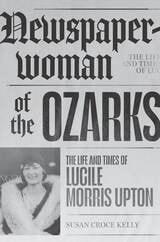
Newspaperwoman of the Ozarks
The Life and Times of Lucile Morris UptonSusan Croce Kelly
University of Arkansas Press, 2023
Lucile Morris Upton landed her first newspaper job out West in the early 1920s, then returned home to spend half a century reporting on the Ozarks world she knew best. Having come of age just as women gained the right to vote, she took advantage of opportunities that presented themselves in a changing world. During her years as a journalist, Upton rubbed shoulders with presidents, flew with aviation pioneer Wiley Post, covered the worst single killing of US police officers in the twentieth century, wrote an acclaimed book on the vigilante group known as the Bald Knobbers, charted the growth of tourism in the Ozarks, and spearheaded a movement to preserve iconic sites of regional history. Following retirement from her newspaper job, she put her experience to good use as a member of the Springfield City Council and community activist.
Told largely through Upton’s own words, this insightful biography captures the excitement of being on the front lines of newsgathering in the days when the whole world depended on newspapers to find out what was happening.
Winner, 2024 Missouri Literary Award
First Place, 2024 Missouri Professional Communicators Communications Contest
Finalist, Society of Midland Authors Book Award
Newton
Kosmos - Bios - LogosIrena Stepánová
Karolinum Press, 2014
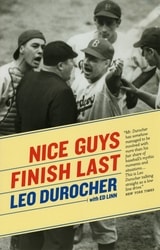
Nice Guys Finish Last
Leo Durocher with Ed Linn
University of Chicago Press, 2009
“I believe in rules. Sure I do. If there weren't any rules, how could you break them?”
The history of baseball is rife with colorful characters. But for sheer cantankerousness, fighting moxie, and will to win, very few have come close to Leo “the Lip” Durocher. Following a five-decade career as a player and manager for baseball’s most storied franchises, Durocher teamed up with veteran sportswriter Ed Linn to tell the story of his life in the game. The resulting book, Nice Guys Finish Last, is baseball at its best, brimming with personality and full of all the fights and feuds, triumphs and tricks that made Durocher such a success—and an outsized celebrity.
Durocher began his career inauspiciously, riding the bench for the powerhouse 1928 Yankees and hitting so poorly that Babe Ruth nicknamed him “the All-American Out.” But soon Durocher hit his stride: traded to St. Louis, he found his headlong play and never-say-die attitude a perfect fit with the rambunctious “Gashouse Gang” Cardinals. In 1939, he was named player-manager of the Brooklyn Dodgers—and almost instantly transformed the underachieving Bums into perennial contenders. He went on to manage the New York Giants, sharing the glory of one of the most famous moments in baseball history, Bobby Thomson’s “shot heard ’round the world,” which won the Giants the 1951 pennant. Durocher would later learn how it felt to be on the other side of such an unforgettable moment, as his 1969 Cubs, after holding first place for 105 days, blew a seemingly insurmountable 8-1/2-game lead to the Miracle Mets.
All the while, Durocher made as much noise off the field as on it. His perpetual feuds with players, owners, and league officials—not to mention his public associations with gamblers, riffraff, and Hollywood stars like George Raft and Larraine Day—kept his name in the headlines and spread his fame far beyond the confines of the diamond.
A no-holds-barred account of a singular figure, Nice Guys Finish Last brings the personalities and play-by-play of baseball’s greatest era to vivid life, earning a place on every baseball fan’s bookshelf.
Nicholas of Cusa
A Sketch for a BiographyErich Meuthen
Catholic University of America Press, 2010

Nietzsche
Lou Salomé
University of Illinois Press, 1988
Published in 1894 as its subject languished in madness, Salomé's book rode the crest of a surge of interest in Nietzsche's iconoclastic philosophy. She discusses his writings and such biographical events as his break with Wagner, attempting to ferret out the man in the midst of his works.
Salomé's provocative conclusion -- that Nietzsche's madness was the inevitable result of his philosophical views -- generated considerable controversy. Nietzsche's sister, Elisabeth Förster-Nietzsche, dismissed the book as a work of fantasy. Yet the philosopher's longtime acquaintance Erwin Rohde wrote, "Nothing better or more deeply experienced or perceived has ever been written about Nietzsche."
Siegfried Mandel's extensive introduction examines the circumstances that brought Lou Salomé and Nietzsche together and the ideological conflicts that drove them apart.
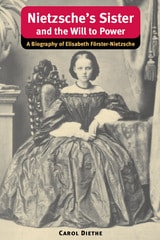
Nietzsche's Sister and the Will to Power
A Biography of Elisabeth Förster-NietzscheCarol Diethe
University of Illinois Press, 2002
In 1901, a year after her brother Friedrich's death, Elisabeth Förster-Nietzsche published The Will to Power, a hasty compilation of writings he had never intended for print. In Nietzsche's Sister and the Will to Power, Carol Diethe contends that Förster-Nietzsche's own will to power and her desire to place herself--not her brother--at the center of cultural life in Germany are centrally responsible for Nietzsche's reputation as a belligerent and proto-Fascist thinker.
Offering a new look at Nietzsche's sister from a feminist perspective, this spirited and erudite biography examines why Elisabeth Förster-Nietzsche recklessly consorted with anti-Semites, from her own husband to Hitler himself, out of convenience and a desire for revenge against a brother whose love for her waned after she caused the collapse of his friendship with Lou Salomé. The book also examines their family dynamics, Nietzsche's dismissal of his sister's early writing career, and the effects of limited education on intelligent women. Diethe concludes by detailing Förster-Nietzsche's brief marriage and her subsequent colonial venture in Paraguay, maintaining that her sporadic anti-Semitism was, like most things in her life, an expedient tool for cultivating personal success and status.
A volume in the series International Nietzsche Studies, edited by Richard Schacht
Nietzsche
Attempt at a MythologyErnst Bertram. Translated and with an Introduction by Robert E. Norton
University of Illinois Press, 2008
The only English translation of a crucial interpretation of Nietzsche
First published in 1918, Ernst Bertram's Nietzsche: Attempt at a Mythology substantially shaped the image of Nietzsche for the generation between the wars. It won the Nietzsche Society's first prize and was admired by luminous contemporaries including André Gide, Hermann Hesse, Gottfried Benn, and Thomas Mann. Although translated into French in 1932, the book was never translated into English following the decline of Nietzsche's and Bertram's reputations after 1945. Now, with Nietzsche's importance for twentieth-century thought undisputed, the work by one of his most influential interpreters can at last be read in English.Employing a perspectival technique inspired by Nietzsche himself, Bertram constructs a densely layered portrait of the thinker that shows him riven by deep and ultimately irresolvable cultural, historical, and psychological conflicts. At once lyrical and intensely probing, richly complex yet thematically coherent, Bertram's book is a masterpiece in a forgotten tradition of intellectual biography.
Night Mother
A Personal and Cultural History of The ExorcistMarlena Williams
The Ohio State University Press, 2023

Night Moves
By Jessica Hopper
University of Texas Press, 2018
Written in taut, mesmerizing, often hilarious scenes, Night Moves captures the fierce friendships and small moments that form us all. Drawing on her personal journals from the aughts, Jessica Hopper chronicles her time as a DJ, living in decrepit punk houses, biking to bad loft parties with her friends, exploring Chicago deep into the night. And, along the way, she creates an homage to vibrant corners of the city that have been muted by sleek development. A book birthed in the amber glow of Chicago streetlamps, Night Moves is about a transformative moment of cultural history—and how a raw, rebellious writer found her voice.