4531 books match the query 'Cultural & Ethnic Studies' and 99 start with n
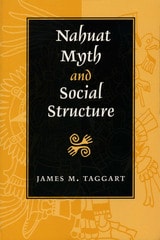
cover of Nahuat Myth and Social Structure

Nahuat Myth and Social Structure

By James M. Taggart

University of Texas Press, 1997

First published in 1983, Nahuat Myth and Social Structure brings together an important collection of modern-day Aztec Indian folktales and vividly demonstrates how these tales have been shaped by the social structure of the communities in which they are told.
[more]
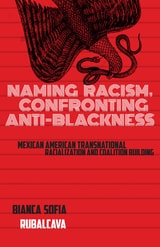
cover of Naming Racism, Confronting Anti-Blackness: Mexican American Transnational Racialization and Coalition Building

Naming Racism, Confronting Anti-Blackness

Mexican American Transnational Racialization and Coalition Building

Bianca Sofia Rubalcava

Rutgers University Press, 2026

What happens when we move beyond a Black-and-white understanding of racism? This provocative book challenges conventional narratives by exploring how Mexican Americans navigate the US racial hierarchy—not simply as victims of white supremacy but as complex participants in systems of racial oppression. Tracing the construction of race from colonial regimes to the present, author Bianca Sofia Rubalcava argues that non-Black people of color, particularly Mexican Americans, often negotiate their racial position by distancing themselves from Blackness. Through legal history, social movement archives, and survey data, this work reveals how anti-Blackness has persisted across borders and generations, from the pursuit of legal whiteness to enduring family biases around interracial relationships. Ultimately, the book offers a powerful critique of how anti-Black ideologies hinder cross-racial solidarity and perpetuate marginalization. A bold and necessary intervention, this study pushes the Latinx community—and all readers—to confront complicity and reimagine racial justice in more inclusive and transformative ways.
[more]
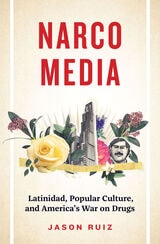
cover of Narcomedia: Latinidad, Popular Culture, and America's War on Drugs

Narcomedia

Latinidad, Popular Culture, and America's War on Drugs

Jason Ruiz

University of Texas Press, 2023

2024 Honorable Mention — The Victor Villaseñor Best Latino Focused Nonfiction Book Award – English, Empowering Latino Futures’ International Latino Book Awards

Exploring representations of Latinx people from Scarface to Narcos, this book examines how pop culture has framed Latin America as the villain in America’s long and ineffectual War on Drugs.

If there is an enemy in the War on Drugs, it is people of color. That is the lesson of forty years of cultural production in the United States. Popular culture, from Scarface and Miami Vice to Narcos and Better Call Saul, has continually positioned Latinos as an alien people who threaten the US body politic with drugs. Jason Ruiz explores the creation and endurance of this trope, its effects on Latin Americans and Latinx people, and its role in the cultural politics of the War on Drugs.

Even as the focus of drug anxiety has shifted over the years from cocaine to crack and from methamphetamines to opioids, and even as significant strides have been made in representational politics in many areas of pop culture, Latinx people remain an unshakeable fixture in stories narrating the production, distribution, and sale of narcotics. Narcomedia argues that such representations of Latinx people, regardless of the intentions of their creators, are best understood as a cultural front in the War on Drugs. Latinos and Latin Americans are not actually America’s drug problem, yet many Americans think otherwise—and that is in no small part because popular culture has largely refused to imagine the drug trade any other way.
[more]
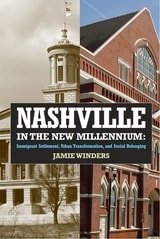
cover of Nashville in the New Millennium: Immigrant Settlement, Urban Transformation, and Social Belonging

Nashville in the New Millennium

Immigrant Settlement, Urban Transformation, and Social Belonging

Jamie Winders

Russell Sage Foundation, 2013
Beginning in the 1990s, the geography of Latino migration to and within the United States started to shift. Immigrants from Central and South America increasingly bypassed the traditional gateway cities to settle in small cities, towns, and rural areas throughout the nation, particularly in the South. One popular new destination—Nashville, Tennessee—saw its Hispanic population increase by over 400 percent between 1990 and 2000. Nashville, like many other such new immigrant destinations, had little to no history of incorporating immigrants into local life. How did Nashville, as a city and society, respond to immigrant settlement? How did Latino immigrants come to understand their place in Nashville in the midst of this remarkable demographic change? In Nashville in the New Millennium, geographer Jamie Winders offers one of the first extended studies of the cultural, racial, and institutional politics of immigrant incorporation in a new urban destination. Moving from schools to neighborhoods to Nashville’s wider civic institutions, Nashville in the New Millennium details how Nashville’s long-term residents and its new immigrants experienced daily life as it transformed into a multicultural city with a new cosmopolitanism. Using an impressive array of methods, including archival work, interviews, and participant observation, Winders offers a fine-grained analysis of the importance of historical context, collective memories and shared social spaces in the process of immigrant incorporation. Lacking a shared memory of immigrant settlement, Nashville’s long-term residents turned to local history to explain and interpret a new Latino presence. A site where Latino day laborers gathered, for example, became a flashpoint in Nashville’s politics of immigration in part because the area had once been a popular gathering place for area teenagers in the 1960s and 1970s. Teachers also drew from local historical memories, particularly the busing era, to make sense of their newly multicultural student body. They struggled, however, to help immigrant students relate to the region’s complicated racial past, especially during history lessons on the Jim Crow era and the Civil Rights movement. When Winders turns to life in Nashville’s neighborhoods, she finds that many Latino immigrants opted to be quiet in public, partly in response to negative stereotypes of Hispanics across Nashville. Long-term residents, however, viewed this silence as evidence of a failure to adapt to local norms of being neighborly. Filled with voices from both long-term residents and Latino immigrants, Nashville in the New Millennium offers an intimate portrait of the changing geography of immigrant settlement in America. It provides a comprehensive picture of Latino migration’s impact on race relations in the country and is an especially valuable contribution to the study of race and ethnicity in the South.
[more]
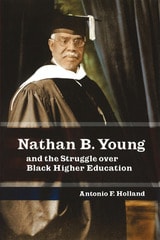
cover of Nathan B. Young and the Struggle over Black Higher Education

Nathan B. Young and the Struggle over Black Higher Education

Antonio F. Holland

University of Missouri Press, 2006

At the turn of the twentieth century, African Americans eager to improve their lives through higher education were confronted with the divergent points of view of two great leaders: Booker T. Washington advocated vocational training, while W. E. B. Du Bois stressed the importance of the liberal arts. Into the fray stepped Nathan B. Young, who, as Antonio Holland now tells, left a lasting mark on that debate.

Born in slavery in Alabama, Young followed a love of learning to degrees from Talladega and Oberlin Colleges and a career in higher education. Employed by Booker T. Washington in 1892, he served at Tuskegee Institute until conflict with Washington’s vocational orientation led him to move on. During a brief tenure at Georgia State Industrial College under Richard R. Wright, Sr., he became disillusioned by efforts of whites to limit black education to agriculture and the trades. Hired as president of Florida A&M in 1901, he fought for twenty years to balance agricultural/vocational education with the liberal arts, only to meet with opposition from state officials that led to his ouster.

This principled educator finally found his place as president of Lincoln University in Missouri in 1923. Here Young made a determined effort to establish the school as a standard institution of higher learning. Holland describes how he campaigned successfully to raise academic standards and gain accreditation for Lincoln’s programs—successes made possible by the political and economic support of farsighted members of Missouri’s black community.

Holland shows that the great debate over black higher education was carried on not only in the rhetoric of Washington and Du Bois but also on the campuses, as Young and others sought to prepare African American students to become thinkers and creators. In tracing Young’s career, Holland presents a wealth of information on the nature of the education provided for former slaves and their descendents in four states—shedding new light on the educational environment at Oberlin and Tuskegee—and on the actions of racist white government officials to limit the curriculum of public education for blacks.

Although Young’s efforts to improve the schools he served were often thwarted, Holland shows that he kept his vision alive in the black community. Holland’s meticulous reconstruction of an eventful career provides an important look at the forces that shaped and confounded the development of black higher education during traumatic times.
[more]
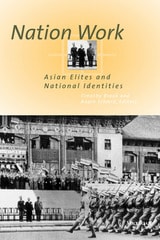
cover of Nation Work: Asian Elites and National Identities

Nation Work

Asian Elites and National Identities

Timothy Brook and Andre Schmid, Editors

University of Michigan Press, 2000

As increasing attention is drawn to globalization, questions arise about the fate of "the nation," a political and social unit that for centuries has seemed the common-sense way to organize the world. In Nation Work, Timothy Brook and André Schmid draw together eight essays that use historical examples from Asian countries--China, India, Korea, and Japan--to enrich our understandings of the origin and growth of nations.
Asia provides fertile ground for this inquiry, the volume argues, because in Asia the history of the modern nation has been inseparable from global influences in the form of Western imperialism. Yet, while the impetus for building a modern national identity may have come from the need to fashion a favorable place in a world system dominated by Western nations, those engaged in nationalist enterprises found their particular voices more often in relation to tensions within Asia than in relation to more generic tensions between Asia and the West.
With topics ranging from public health measures in nineteenth-century Japan through textual scholarship of Tamil intellectuals, the willful division of Korea's history from China's, the development of China's cotton industry, and the meaning of "postnational-ism" for Chinese artists, the essays reveal the fascinating array of sites at which nation work can take place.
This will be essential reading for historians and social scientists interested in Asia.
Timothy Brook is Professor of History, Stanford University. André Schmid is Assistant Professor of East Asian Studies, University of Toronto.
[more]
cover of Nation and Migration: How Citizens in Europe Are Coping with Xenophobia

Nation and Migration

How Citizens in Europe Are Coping with Xenophobia

György Csepeli

Central European University Press, 2021

Nation and Migration provides a way to understand recent migration events in Europe that have attracted the world's attention. The emergence of the nations in the West promised homogenization, but instead the imagined national communities have everywhere become places of heterogeneity, and modern nation states have been haunted by the specter of minorities. This study analyses experiences relating to migration in 23 European countries. It is based on data from the International Social Survey Programme, a global cross-national collaborative exercise, with surveys made in 1995, 2003, and 2013. In the authors' view, a critical test for Europe will be its ability to find adequate responses to the challenges of globalization.

The book provides a detailed overview of how citizens in Europe are coping with a xenophobia fueled by their own sense of insecurity. The authors reconstruct the competing sociological reactions to migration in the forms of integration, assimilation and segregation. Hungary receives special attention: the data show that people living there are far less closed and xenophobic than they might seem through the prism of a media-instigated moral panic.

[more]
cover of National Abjection: The Asian American Body Onstage

National Abjection

The Asian American Body Onstage

Karen Shimakawa

Duke University Press, 2002

National Abjection explores the vexed relationship between "Asian Americanness" and "Americanness” through a focus on drama and performance art. Karen Shimakawa argues that the forms of Asian Americanness that appear in U.S. culture are a function of national abjection—a process that demands that Americanness be defined by the exclusion of Asian Americans, who are either cast as symbolic foreigners incapable of integration or Americanization or distorted into an “honorary” whiteness. She examines how Asian Americans become culturally visible on and off stage, revealing the ways Asian American theater companies and artists respond to the cultural implications of this abjection.

Shimakawa looks at the origins of Asian American theater, particularly through the memories of some of its pioneers. Her examination of the emergence of Asian American theater companies illuminates their strategies for countering the stereotypes of Asian Americans and the lack of visibility of Asian American performers within the theater world. She shows how some plays—Wakako Yamauchi’s 12-1-A, Frank Chin’s Chickencoop Chinaman, and The Year of the Dragon—have both directly and indirectly addressed the displacement of Asian Americans. She analyzes works attempting to negate the process of abjection—such as the 1988 Broadway production of M. Butterfly as well as Miss Saigon, a mainstream production that enacted the process of cultural displacement both onstage and off. Finally, Shimakawa considers Asian Americanness in the context of globalization by meditating on the work of Ping Chong, particularly his East-West Quartet.

[more]
cover of National Greens: The Natures of Korean Golf

National Greens

The Natures of Korean Golf

Rachael Miyung Joo

Duke University Press, 2027
In National Greens, Rachael Miyung Joo details the rise of golf as a global Korean cultural project in the twenty-first century. While courses began as exclusive domains of the privileged hidden from public view, the sport is now a widespread visible practice popular across communities in South Korea and the Korean diaspora. Based on fieldwork in South Korea, Aotearoa New Zealand, the Philippines, and the United States, Joo aligns this transformation of golfing with shifts in Korean cultural formations, like the rising significance of leisure culture in everyday life, the globalization of Korean media celebrity, and innovative technologies now dedicated to recreation. She also explores the environmental and political repercussions of the sport’s proliferation as an influx in courses radically alters landscapes, and activist attempts to block or slow construction have largely proven ineffective. Highlighting the growth of golf in South Korea, its functions in imperialism and migration, and the effects of golf technologies, National Greens illustrates the game’s symbolic power in shaping ideas of leisure, landscape, environment, nation, and identity.
[more]
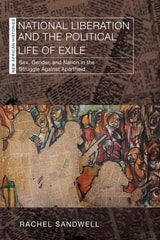
cover of National Liberation and the Political Life of Exile: Sex, Gender, and Nation in the Struggle Against Apartheid

National Liberation and the Political Life of Exile

Sex, Gender, and Nation in the Struggle Against Apartheid

Rachel Sandwell

Ohio University Press, 2025

The first book-length study to reveal how women in exile shaped South Africa’s antiapartheid movement

This groundbreaking book explores the often-overlooked role of women in South Africa’s liberation movements, particularly within the African National Congress during its years in exile from 1960 to 1990. It examines how transformations in gender roles—though contested—were central to imagining a postapartheid South Africa.

Through an analysis of women’s diplomatic work and their advocacy for policies on sexual education, birth control, family life, and childcare, Rachel Sandwell challenges traditional narratives that have ignored or minimized women’s contributions. She highlights how South African women played a crucial role in connecting exiles to left-wing international organizations like the Women’s International Democratic Federation, positioning women as key figures in global anticolonial politics.

The book also explores how gender transformation was at the heart of the exiled antiapartheid movement’s vision for a free South Africa. Women fought for recognition beyond the role of “mothers of the nation,” sparking internal debates over revolutionary morality, the compatibility of motherhood with military service, and responses to sexual and domestic violence within the movement. These struggles mirrored broader ideological conflicts over nation building, belonging, and political identity as the African National Congress sought legitimacy as a government-in-exile.

Ultimately, National Liberation and the Political Life of Exile asks how we write histories of revolutionary movements—especially those that, despite their transformative ambitions, did not fully realize their goals. A vital contribution to feminist history, anticolonial studies, and the history of global liberation struggles, this book reshapes our understanding of gender and politics in the antiapartheid movement.

[more]
cover of Natives of My Person

Natives of My Person

George Lamming

University of Michigan Press, 1992
A compelling novel of slavery and colonialism
[more]
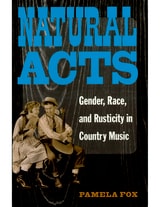
cover of Natural Acts: Gender, Race, and Rusticity in Country Music

Natural Acts

Gender, Race, and Rusticity in Country Music

Pamela Fox

University of Michigan Press, 2009
Whether found in country barn dances, the plaintive twang of Hank Williams, the glitzy glamour of Dolly Parton, or the country-pop sound of Faith Hill, country music has always maintained an allegiance to its own authenticity. Its specific sounds and images have changed over the past century, but country music has consistently been associated with rusticity, a notion connected to the working class and rooted in ideals like unspoiled rural life and values and humble origins. The music suggests not only uncomplicated musical arrangements and old-time instruments such as the banjo and fiddle, but performers who identify with their everyday fans. Natural Acts explores the ways that country musicians -- particularly women artists -- have established a "natural" country identity. Pamela Fox focuses on five revealing moments in country performance: blackface comedy during country music's "Golden Age" of pre-1945 radio and stage programming; the minstrel's "rube" or hillbilly equivalent in the same period; postwar honky-tonk music and culture; the country star memoir or autobiography of the '80s and '90s; and the recent roots phenomenon known as alt.country. "'All I gotta do is act naturally,' Buck Owens sang, and Pamela Fox knows where the acting comes in. From early hillbilly acts to alt.country, Natural Acts lays bare, with wide-ranging scholarship and incisive analysis, the ideologies of authenticity on which country music rests. As engrossing and useful as any book I know on country music." ---Eric Lott, author of Love and Theft: Blackface Minstrelsy and the American Working Class "The first completely mature book of country music historical criticism. It is a deep investigation of country music's power to articulate the displaced pleasures and anxieties of a society wracked by structural change. Historically rigorous, Fox uncovers documents that demonstrate the ongoing power of minstrelsy in barn dance programs across the country past World War II; musically and lyrically astute, she shows how the best honky-tonk music simultaneously critiques the dangers of that setting while seductively luring listeners to those sawdust and alcohol drenched environments; with her ear attuned to the formal complexities of autobiography, Fox directs our attention to the contradictory performance of identity that characterizes the life stories of Reba McEntire, Naomi Judd, Dolly Parton, and others. Natural Acts is provocative, stunning, and engagingly written. Country music studies has come of age." ---Barry Shank, The Ohio State University
[more]
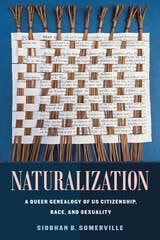
cover of Naturalization: A Queer Genealogy of US Citizenship, Race, and Sexuality

Naturalization

A Queer Genealogy of US Citizenship, Race, and Sexuality

Siobhan B. Somerville

Duke University Press, 2026

Amid contentious debates about citizenship, borders, and belonging, naturalization tends to stand apart, widely celebrated as the culmination of immigrant narratives and American ideals of liberalism. In Naturalization, Siobhan B. Somerville unsettles this story, showing how the process of citizen-making has historically been embedded in normative assumptions about race, indigeneity, and sexuality that have sustained the US settler colonial project. Tracing an alternative genealogy of naturalization from the eighteenth century through the mid-twentieth, Somerville investigates overlooked stories not only of immigrants but also of Indigenous people, formerly enslaved people of African descent, and inhabitants of US territories, many of whom became US citizens through collective naturalization, often without their consent. Somerville’s interdisciplinary approach to a wide-ranging archive—including federal law, photographs, letters, and memoirs—shows how naturalization has long functioned as both a powerful metaphor and a contradictory material practice at the core of the US settler colonial state.
[more]
cover of Naturalizing Mexican Immigrants: A Texas History

Naturalizing Mexican Immigrants

A Texas History

By Martha Menchaca

University of Texas Press, 2011

2013 — NACCS Book Award – National Association for Chicana and Chicano Studies

During the nineteenth and early twentieth centuries, a majority of the Mexican immigrant population in the United States resided in Texas, making the state a flashpoint in debates over whether to deny naturalization rights. As Texas federal courts grappled with the issue, policies pertaining to Mexican immigrants came to reflect evolving political ideologies on both sides of the border.

Drawing on unprecedented historical analysis of state archives, U.S. Congressional records, and other sources of overlooked data, Naturalizing Mexican Immigrants provides a rich understanding of the realities and rhetoric that have led to present-day immigration controversies. Martha Menchaca's groundbreaking research examines such facets as U.S.-Mexico relations following the U.S. Civil War and the schisms created by Mexican abolitionists; the anti-immigration stance that marked many suffragist appeals; the effects of the Spanish American War; distinctions made for mestizo, Afromexicano, and Native American populations; the erosion of means for U.S. citizens to legalize their relatives; and the ways in which U.S. corporations have caused the political conditions that stimulated emigration from Mexico.

The first historical study of its kind, Naturalizing Mexican Immigrants delivers a clear-eyed view of provocative issues.
[more]
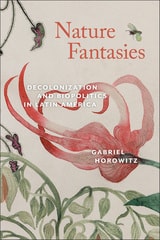
cover of Nature Fantasies: Decolonization and Biopolitics in Latin America

Nature Fantasies

Decolonization and Biopolitics in Latin America

Gabriel Horowitz

Bucknell University Press, 2024

In this original study, Gabriel Horowitz examines the work of select nineteenth- and twentieth-century Latin American writers through the lens of contemporary theoretical debates about nature, postcoloniality, and national identity. In the work of José Martí, Gertrudis Gómez de Avellaneda, Jorge Luis Borges, Augusto Roa Bastos, Cesar Aira, and others, he traces historical constructions of nature in regional intellectual traditions and texts as they inform political culture on the broader global stage. By investigating national literary discourses from Cuba, Argentina, and Paraguay, he identifies a common narrative thread that imagines the utopian wilderness of the New World as a symbolic site of independence from Spain. In these texts, Horowitz argues, an expressed desire to return to the nation’s foundational nature contributed to a movement away from political and social engagement and toward a “biopolitical state,” in which nature, traditionally seen as pre-political, conversely becomes its center.
[more]
cover of Navigating Interracial Borders: Black-White Couples and Their Social Worlds

Navigating Interracial Borders

Black-White Couples and Their Social Worlds

Childs, Erica Chito

Rutgers University Press, 2005

Is love color-blind, or at least becoming increasingly so? Today’s popular rhetoric and evidence of more interracial couples than ever might suggest that it is. But is it the idea of racially mixed relationships that we are growing to accept or is it the reality? What is the actual experience of individuals in these partnerships as they navigate their way through public spheres and intermingle in small, close-knit communities?

In Navigating Interracial Borders, Erica Chito Childs explores the social worlds of black-white interracial couples and examines the ways that collective attitudes shape private relationships. Drawing on personal accounts, in-depth interviews, focus group responses, and cultural analysis of media sources, she provides compelling evidence that sizable opposition still exists toward black-white unions. Disapproval is merely being expressed in more subtle, color-blind terms.

Childs reveals that frequently the same individuals who attest in surveys that they approve of interracial dating will also list various reasons why they and their families wouldn’t, shouldn’t, and couldn’t marry someone of another race. Even college students, who are heralded as racially tolerant and open-minded, do not view interracial couples as acceptable when those partnerships move beyond the point of casual dating. Popular films, Internet images, and pornography also continue to reinforce the idea that sexual relations between blacks and whites are deviant.

Well-researched, candidly written, and enriched with personal narratives, Navigating Interracial Borders offers important new insights into the still fraught racial hierarchies of contemporary society in the United States.
[more]
cover of Navigating White News: Asian American Journalists at Work

Navigating White News

Asian American Journalists at Work

David C Oh

Rutgers University Press, 2023

NCA Asian Pacific American Caucus & Communication Studies Division Outstanding Book Award 

Combining critical race studies with cultural production studies, Navigating White News: Asian American Journalists at Work is the only academic book to examine the ways that racial identification and activation matters in their understanding of news. This adds to the existing literature on race and the sociology of news by examining intra-racial differences in the ways they navigate and understand White newsrooms. Employing in-depth interviews with twenty Asian American journalists who are actively working in large and small newsrooms across the United States, Navigating White News: Asian American Journalists at Work argues that Asian American reporters for whom racial identities are important questioned what counted as news, questioned the implicitly White perspective of objectivity, and actively worked toward providing more complex, substantive coverage of Asian American communities. For Asian American reporters for whom racial identity was not meaningful, they were more invested in existing professional norms. Regardless, all journalists understood that news is a predominantly and culturally White institution.

 
[more]
cover of Ne me quitte pas: A Song by Jacques Brel and Interpreted by Nina Simone and Others

Ne me quitte pas

A Song by Jacques Brel and Interpreted by Nina Simone and Others

Maya Angela Smith

Duke University Press, 2025
In 1959, Belgian singer-songwriter Jacques Brel wrote and performed “Ne me quitte pas” (Don’t leave me), a visceral and haunting plea for his lover to come back. As a teenager, Maya Angela Smith was so captivated by Nina Simone’s powerful 1965 cover of the song that it inspired her to be a French professor. In Ne me quitte pas, Smith follows the classic song’s long and varied journey, from Brel’s iconic 1966 performance on French television to Simone’s cover to Shirley Bassey’s English-language version (“If You Go Away”) to its contemporary manifestations in popular culture. Throughout, Smith shows that as the song travels across languages, geographies, genres, and generations, it accumulates shifting artistic and cultural significance as each listener creates their own meaning.
[more]
cover of Necessarily Black: Cape Verdean Youth, Hip-Hop Culture, and a Critique of Identity

Necessarily Black

Cape Verdean Youth, Hip-Hop Culture, and a Critique of Identity

P. Khalil Saucier

Michigan State University Press, 2015
Necessarily Black is an ethnographic account of second-generation Cape Verdean youth identity in the United States and a theoretical attempt to broaden and complicate current discussions about race and racial identity in the twenty-first century. P. Khalil Saucier grapples with the performance, embodiment, and nuances of racialized identities (blackened bodies) in empirical contexts. He looks into the durability and (in)flexibility of race and racial discourse through an imbricated and multidimensional understanding of racial identity and racial positioning. In doing so, Saucier examines how Cape Verdean youth negotiate their identity within the popular fabrication of “multiracial America.” He also explores the ways in which racial blackness has come to be lived by Cape Verdean youth in everyday life and how racialization feeds back into the experience of these youth classified as black through a matrix of social and material settings. Saucier examines how ascriptions of blackness and forms of black popular culture inform subjectivities. The author also examines hip-hop culture to see how it is used as a site where new (and old) identities of being, becoming, and belonging are fashioned and reworked. Necessarily Black explores race and how Cape Verdean youth think and feel their identities into existence, while keeping in mind the dynamics and politics of racialization, mixed-race identities, and anti-blackness.
[more]
cover of Necro Citizenship: Death, Eroticism, and the Public Sphere in the Nineteenth-Century United States

Necro Citizenship

Death, Eroticism, and the Public Sphere in the Nineteenth-Century United States

Russ Castronovo

Duke University Press, 2001

In Necro Citizenship Russ Castronovo argues that the meaning of citizenship in the United States during the nineteenth century was bound to—and even dependent on—death. Deploying an impressive range of literary and cultural texts, Castronovo interrogates an American public sphere that fetishized death as a crucial point of political identification. This morbid politics idealized disembodiment over embodiment, spiritual conditions over material ones, amnesia over history, and passivity over engagement.

Moving from medical engravings, séances, and clairvoyant communication to Supreme Court decisions, popular literature, and physiological tracts, Necro Citizenship explores how rituals of inclusion and belonging have generated alienation and dispossession. Castronovo contends that citizenship does violence to bodies, especially those of blacks, women, and workers. “Necro ideology,” he argues, supplied citizens with the means to think about slavery, economic powerlessness, or social injustice as eternal questions, beyond the scope of politics or critique. By obsessing on sleepwalkers, drowned women, and other corpses, necro ideology fostered a collective demand for an abstract even antidemocratic sense of freedom. Examining issues involving the occult, white sexuality, ghosts, and suicide in conjunction with readings of Harriet Jacobs, Ralph Waldo Emerson, Frederick Douglass, Nathaniel Hawthorne, and Frances Harper, Necro Citizenship successfully demonstrates why Patrick Henry's “give me liberty or give me death” has resonated so strongly in the American imagination.
[more]
cover of Necropolitics

Necropolitics

Achille Mbembe

Duke University Press, 2019
In Necropolitics Achille Mbembe, a leader in the new wave of francophone critical theory, theorizes the genealogy of the contemporary world, a world plagued by ever-increasing inequality, militarization, enmity, and terror as well as by a resurgence of racist, fascist, and nationalist forces determined to exclude and kill. He outlines how democracy has begun to embrace its dark side---what he calls its “nocturnal body”---which is based on the desires, fears, affects, relations, and violence that drove colonialism. This shift has hollowed out democracy, thereby eroding the very values, rights, and freedoms liberal democracy routinely celebrates. As a result, war has become the sacrament of our times in a conception of sovereignty that operates by annihilating all those considered enemies of the state. Despite his dire diagnosis, Mbembe draws on post-Foucauldian debates on biopolitics, war, and race as well as Fanon's notion of care as a shared vulnerability to explore how new conceptions of the human that transcend humanism might come to pass. These new conceptions would allow us to encounter the Other not as a thing to exclude but as a person with whom to build a more just world.
[more]
cover of Negative Liberties: Morrison, Pynchon, and the Problem of Liberal Ideology

Negative Liberties

Morrison, Pynchon, and the Problem of Liberal Ideology

Cyrus R. K. Patell

Duke University Press, 2001

Since the nineteenth century, ideas centered on the individual, on Emersonian self-reliance, and on the right of the individual to the pursuit of happiness have had a tremendous presence in the United States—and even more so after the Reagan era. But has this presence been for the good of all? In Negative Liberties Cyrus R. K. Patell revises important ideas in the debate about individualism and the political theory of liberalism. He does so by adding two new voices to the current discussion—Toni Morrison and Thomas Pynchon—to examine the different ways in which their writings embody, engage, and critique the official narrative generated by U.S. liberal ideology.
Pynchon and Morrison reveal the official narrative of individualism as encompassing a complex structure of contradiction held in abeyance. This narrative imagines that the goals of the individual are not at odds with the goals of the family or society and in fact obscures the existence of an unholy truce between individual liberty and forms of oppression. By bringing these two fiction writers into a discourse dominated by Ralph Waldo Emerson, Isaiah Berlin, John Rawls, George Kateb, Robert Bellah, and Michael Sandel, Patell unmasks the ways in which contemporary U.S. culture has not fully shed the oppressive patterns of reasoning handed down by the slaveholding culture from which American individualism emerged.
With its interdisciplinary approach, Negative Liberties will appeal to students and scholars of American literature, culture, sociology, and politics.

[more]
cover of Negative Liberty: Public Opinion and the Terrorist Attacks on America

Negative Liberty

Public Opinion and the Terrorist Attacks on America

Darren W. Davis

Russell Sage Foundation, 2007
Did America's democratic convictions "change forever" after the terrorist attacks of September 11? In the wake of 9/11, many pundits predicted that Americans' new and profound anxiety would usher in an era of political acquiescence. Fear, it was claimed, would drive the public to rally around the president and tolerate diminished civil liberties in exchange for security. Political scientist Darren Davis challenges this conventional wisdom in Negative Liberty, revealing a surprising story of how September 11 affected Americans' views on civil liberties and security. Drawing on a unique series of original public opinion surveys conducted in the immediate aftermath of 9/11 and over the subsequent three years, Negative Liberty documents the rapid shifts in Americans' opinions regarding the tradeoff between liberty and security, at a time when the threat of terrorism made the conflict between these values particularly stark. Theories on the psychology of threat predicted that people would cope with threats by focusing on survival and reaffirming their loyalty to their communities, and indeed, Davis found that Americans were initially supportive of government efforts to prevent terrorist attacks by rolling back certain civil liberties. Democrats and independents under a heightened sense of threat became more conservative after 9/11, and trust in government reached its highest level since the Kennedy administration. But while ideological divisions were initially muted, this silence did not represent capitulation on the part of civil libertarians. Subsequent surveys in the years after the attacks revealed that, while citizens' perceptions of threat remained acute, trust in the government declined dramatically in response to the perceived failures of the administration's foreign and domestic security policies. Indeed, those Americans who reported the greatest anxiety about terrorism were the most likely to lose confidence in the government in the years after 2001. As a result, ideological unity proved short lived, and support for civil liberties revived among the public. Negative Liberty demonstrates that, in the absence of faith in government, even extreme threats to national security are not enough to persuade Americans to concede their civil liberties permanently. The September 11 attacks created an unprecedented conflict between liberty and security, testing Americans' devotion to democratic norms. Through lucid analysis of concrete survey data, Negative Liberty sheds light on how citizens of a democracy balance these competing values in a time of crisis.
[more]
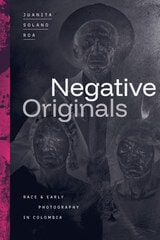
cover of Negative Originals: Race and Early Photography in Colombia

Negative Originals

Race and Early Photography in Colombia

Juanita Solano Roa

Duke University Press, 2025

In Negative Originals, Juanita Solano Roa explores race and identity through photographic practices in late nineteenth-century Medellín, Colombia. Focusing on the photographic studios of Fotografía Rodríguez and Benjamín de la Calle, Solano Roa examines the visual construction and dissemination of racial ideologies and the linkage of race to progress. She studies both positive and negative prints to highlight the juxtaposition of traditional portraiture, which reinforced prevailing racial ideologies, and subversive depictions of often excluded individuals such as cross-dressers, peasants, the poor, and Afro-Colombians. In redefining photography’s role, Solano Roa shifts the critic’s eye from traditional positive prints to negatives, exposing the form’s material, symbolic, and spatial significance. In doing so, she simultaneously uncovers new perspectives on the medium and challenges hegemonic histories. Engaging one of Latin America’s most important photographic archives, Solano Roa addresses urgent gaps in the history of Colombian and Latin American photography, particularly at the intersection of race, gender, and the construction of whiteness.
[more]
cover of Negative, Nonsensical, and Non-Conformist: The Films of Suzuki Seijun

Negative, Nonsensical, and Non-Conformist

The Films of Suzuki Seijun

Peter A. Yacavone

University of Michigan Press, 2023
In the late 1950s, Suzuki Seijun was an unknown, anxious low-ranking film director churning out so-called program pictures for Japan’s most successful movie studio, Nikkatsu. In the early 1960s, he met with modest success in  directing popular movies about yakuza gangsters and mild exploitation films featuring prostitutes and teenage rebels. In this book, Peter A. Yacavone argues that Suzuki became an unlikely cinematic rebel and, with hindsight, one of the most important voices in the global cinema of the 1960s. Working from within the studio system, Suzuki almost single-handedly rejected the restrictive filmmaking norms of the postwar period and expanded the form and language of popular cinema. This artistic rebellion proved costly when Suzuki was fired in 1967 and virtually blacklisted by the studios, but Suzuki returned triumphantly to the scene of world cinema in the 1980s and 1990s with a series of critically celebrated, avant-garde tales of the supernatural and the uncanny. This book provides a well-informed, philosophically oriented analysis of Suzuki’s 49 feature films.
[more]
cover of Negotiating Ethnicity: Second-Generation South Asians Traverse a Transnational World

Negotiating Ethnicity

Second-Generation South Asians Traverse a Transnational World

Purkayastha, Bandana

Rutgers University Press, 2005

In the continuing debates on the topic of racial and ethnic identity in the United States, there are some that argue that ethnicity is an ascribed reality. To the contrary, others claim that individuals are becoming increasingly active in choosing and constructing their ethnic identities.Focusing on second-generation South Asian Americans, Bandana Purkayastha offers fresh insights into the subjective experience of race, ethnicity, and social class in an increasingly diverse America. The young people of Indian, Pakistani, Bangladeshi, and Nepalese origin that are the subjects of the study grew up in mostly white middle class suburbs, and their linguistic skills, education, and occupation profiles are indistinguishable from their white peers. By many standards, their lifestyles mark them as members of mainstream American culture. But, as Purkayastha shows, their ethnic experiences are shaped by their racial status as neither “white” nor “wholly Asian,” their continuing ties with family members across the world, and a global consumer industry, which targets them as ethnic consumers.”

Drawing on information gathered from forty-eight in-depth interviews and years of research, this book illustrates how ethnic identity is negotiated by this group through choice—the adoption of ethnic labels, the invention of “traditions,” the consumption of ethnic products, and participation in voluntary societies. The pan-ethnic identities that result demonstrate both a resilient attachment to heritage and a celebration of reinvention.

Lucidly written and enriched with vivid personal accounts, Negotiating Ethnicity is an important contribution to the literature on ethnicity and racialization in contemporary American culture.
[more]
cover of Negotiating Latinidad: Intralatina/o Lives in Chicago

Negotiating Latinidad

Intralatina/o Lives in Chicago

Frances R. Aparicio

University of Illinois Press, 2019

Longstanding Mexican and Puerto Rican populations have helped make people of mixed nationalities—MexiGuatamalans, CubanRicans, and others—an important part of Chicago's Latina/o scene. Intermarriage between Guatemalans, Colombians, and Cubans have further diversified this community-within-a-community. Yet we seldom consider the lives and works of these Intralatino/as when we discuss Latino/as in the United States.In Negotiating Latinidad, a cross-section of Chicago's second-generation Intralatino/as offer their experiences of negotiating between and among the national communities embedded in their families. Frances R. Aparicio's rich interviews reveal Intralatino/as proud of their multiplicity and particularly skilled at understanding difference and boundaries. Their narratives explore both the ongoing complexities of family life and the challenges of fitting into our larger society, in particular the struggle to claim a space—and a sense of belonging—in a Latina/o America that remains highly segmented in scholarship. The result is an emotionally powerful, theoretically rigorous exploration of culture, hybridity, and transnationalism that points the way forward for future scholarship on Intralatino/a identity.
[more]
cover of Negotiating With ETA: Obstacles To Peace In The Basque Country, 1975-1988

Negotiating With ETA

Obstacles To Peace In The Basque Country, 1975-1988

Robert P. Clark

University of Nevada Press, 1990

Since the late 1960s, the Basque insurgent organization ETA (Euzkadi ta Askatasuna, or Basque Homeland and Freedom) has been engaged in a violent struggle against the Spanish state in an effort to gain the independence of the Basque Country. ETA violence has led to the death of hundreds of people, making the organization the most violent insurgent group in Europe. Between 1975 and 1988, nearly thirty attempts to negotiate an end to violence, with a few limited exceptions, all ended in failure. This important book examines why the efforts to negotiate have failed and makes suggestions on how to improve the chances for successful discussion in the future. Although Clark does not disprove the conventional wisdom that negotiation with terrorists is a bad idea, he does begin from the opposing point of view that there may be some positive values to be realized from such negotiation.Negotiating with ETA describes the various factions that are interested in the outcome of such negotiations and the Spanish antiterrorist policy throughout the period under examination. The book also recounts the early attempts to negotiate, the first attempt at "social reintegration," various attempts by the Basque Government to get negotiations started, negotiation efforts under the Spanish socialist government of Felipe González, and the lengthy negotiations that took place in Algeria. A wide range of scholars and specialists will find this book valuable, including those interested in contemporary Spanish politics, ethnic nationalism, Basque affairs, the problem of terrorism, and conflict resolution.
[more]
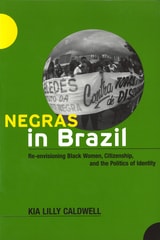
cover of Negras in Brazil: Re-envisioning Black Women, Citizenship, and the Politics of Identity

Negras in Brazil

Re-envisioning Black Women, Citizenship, and the Politics of Identity

Caldwell, Kia Lilly

Rutgers University Press, 2006

For most of the twentieth century, Brazil was widely regarded as a "racial democracy"-a country untainted by the scourge of racism and prejudice. In recent decades, however, this image has been severely critiqued, with a growing number of studies highlighting persistent and deep-seated patterns of racial discrimination and inequality. Yet, recent work on race and racism has rarely considered gender as part of its analysis.

In Negras in Brazil, Kia Lilly Caldwell examines the life experiences of Afro-Brazilian women whose stories have until now been largely untold. This pathbreaking study analyzes the links between race and gender and broader processes of social, economic, and political exclusion. Drawing on ethnographic research with social movement organizations and thirty-five life history interviews, Caldwell explores the everyday struggles Afro-Brazilian women face in their efforts to achieve equal rights and full citizenship. She also shows how the black women's movement, which has emerged in recent decades, has sought to challenge racial and gender discrimination in Brazil. While proposing a broader view of citizenship that includes domains such as popular culture and the body, Negras in Brazil highlights the continuing relevance of identity politics for members of racially marginalized communities. Providing new insights into black women's social activism and a gendered perspective on Brazilian racial dynamics, this book will be of interest to students and scholars of Latin American Studies, African diaspora studies, women's studies, politics, and cultural anthropology.

[more]
cover of Negritude Women

Negritude Women

T. Denean Sharpley-Whiting

University of Minnesota Press, 2002

Rediscovers the crucial role that women played in the influential Negritude movement.

The Negritude movement, which signaled the awakening of a pan-African consciousness among black French intellectuals, has been understood almost exclusively in terms of the contributions of its male founders: Aimé Césaire, Léopold Sédar Senghor, and Léon G. Damas. This masculine genealogy has completely overshadowed the central role played by French-speaking black women in its creation and evolution. In Negritude Women, T. Denean Sharpley-Whiting offers a long-overdue corrective, revealing the contributions made by the women who were not merely integral to the success of the movement, but often in its vanguard.

Through such disparate tactics as Lacascade’s use of Creole expressions in her French prose writings, the literary salon and journal founded by the Martinique-born Nardal sisters, and Roussy-Césaire’s revolutionary blend of surrealism and Negritude in the pages of Tropiques, the journal she founded with her husband, these four remarkable women made vital contributions. In exploring their influence on the development of themes central to Negritude-black humanism, the affirmation of black peoples and their cultures, and the rehabilitation of Africa-Sharpley-Whiting provides the movement’s first genuinely inclusive history.

[more]
cover of Negro Militia and Reconstruction

Negro Militia and Reconstruction

By Otis A. Singletary

University of Texas Press, 1957

Much of the violence that characterized Reconstruction was directly associated with the Negro militia movement organized by Radical politicians to support their precarious regimes in Southern states. This book is the story of that ill-fated movement, a story with important implication for later times.

Most Southern whites did not disguise their hostility toward the governments that were imposed on their states after Reconstruction entered its Radical phase. and Radical leaders lived in constant fear that this hostility would flare into open revolt. Organization of a loyal protective force was imperative if they were to remain in power.

Although planned originally as a defensive force, the Negro militia was quickly used by the Radicals for such purposes as controlling elections. The resentment of Southern whites resulting from this political activity was aggravated by crimes of violence, depredations, and minor social offenses committed by some of the militiamen. However, the white Southerner’s fundamental enmity toward the Negro militia stemmed from the racial implications of a policy that armed the Negroes and placed them in positions of authority over white men.

At first, opposition to the Negro militia movement took the form of legal stratagems and other measures short of force, but the final blow to the Negro militia was dealt by white volunteer rifle companies— illegal, armed counterforces that were at the very core of the White Line movement. The race riot as a political technique was born, the most notorious riot occurring at Hamburg, South Carolina, where, the author states, the policy of “disbandment through extermination” was successfully employed. Disintegration of the entire movement was inevitable.

“It is ironic,” Singletary states, “that the organization of this protective force, because of its racial implications, actually aided in the destruction of the very thing it was created to protect.”

Before its publication, Negro Militia and Reconstruction won the Moncado Prize, a cash award made biennially by the American Military Institute for “the best original book-length manuscript in any field of United States Military history.”
[more]
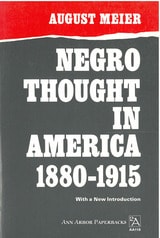
cover of Negro Thought in America, 1880-1915: Racial Ideologies in the Age of Booker T. Washington

Negro Thought in America, 1880-1915

Racial Ideologies in the Age of Booker T. Washington

August Meier

University of Michigan Press, 1963
An analysis of the ideas of Booker T. Washington, Frederick Douglass, W. E. B. DuBois, and other black leaders from the turn of the century
[more]
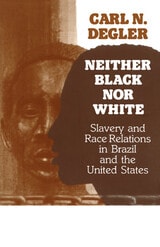
cover of Neither Black Nor White: Slavery and Race Relations in Brazil and the United States

Neither Black Nor White

Slavery and Race Relations in Brazil and the United States

Carl Degler

University of Wisconsin Press, 1986

Carl Degler’s 1971 Pulitzer-Prize-winning study of comparative slavery in Brazil and the United States is reissued in the Wisconsin paperback edition, making it accessible for all students of American and Latin American history and sociology.
    Until Degler’s groundbreaking work, scholars were puzzled by the differing courses of slavery and race relations in the two countries. Brazil never developed a system of rigid segregation, such as appeared in the United States, and blacks in Brazil were able to gain economically and retain far more of their African culture. Rejecting the theory of Giberto Freyre and Frank Tannenbaum—that Brazilian slavery was more humane—Degler instead points to a combination of demographic, economic, and cultural factors as the real reason for the differences.
   “In the early 1970s when studies in social history were beginning to blossom on the North American scene, Carl Degler’s prize-winning contribution was a thoughtful provocative essay in comparative history. Its thoughtfulness has not diminished with the years. Indeed, it is as topical today as when it was first published. The Brazilian experience with rapid industrialization and its attempt to restore democratic government indicates that the issues which Degler treated in the early 1970s are more pertinent than ever today.”—Franklin W. Knight, Department of History, Johns Hopkins University.
[more]
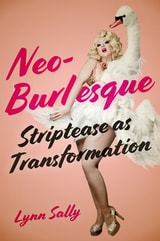
cover of Neo-Burlesque: Striptease as Transformation

Neo-Burlesque

Striptease as Transformation

Lynn Sally

Rutgers University Press, 2022

The neo-burlesque movement seeks to restore a sense of glamour, theatricality, and humor to striptease. Neo-burlesque performers strut their stuff in front of audiences that appreciate their playful brand of pro-sex, often gender-bending, feminism. 
 
Performance studies scholar and acclaimed burlesque artist Lynn Sally offers an inside look at the history, culture, and philosophy of New York’s neo-burlesque scene. Revealing how twenty-first century neo-burlesque is in constant dialogue with the classic burlesque of the nineteenth and twentieth centuries, she considers how today’s performers use camp to comment on preconceived notions of femininity. She also explores how the striptease performer directs the audience’s gaze, putting on layers of meaning while taking off layers of clothing. 
 
Through detailed profiles of iconic neo-burlesque performers such as Dita Von Teese, Dirty Martini, Julie Atlas Muz, and World Famous *BOB*, this book makes the case for understanding neo-burlesque as a new sexual revolution. Yet it also examines the broader community of “Pro-Am” performers who use neo-burlesque as a liberating vehicle for self-expression. Raising important questions about what feminism looks like, Neo-Burlesque celebrates a revolutionary performing art and participatory culture whose acts have political reverberations, both onstage and off.
[more]
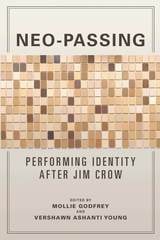
cover of Neo-Passing: Performing Identity after Jim Crow

Neo-Passing

Performing Identity after Jim Crow

Edited by Mollie Godfrey and Vershawn Ashanti Young: Foreword by Gayle Wald Afterword by Michele Elam

University of Illinois Press, 2018
African Americans once passed as whites to escape the pains of racism. Today's neo-passing has pushed the old idea of passing in extraordinary new directions. A white author uses an Asian pen name; heterosexuals live "out" as gay; and, irony of ironies, whites try to pass as black. Mollie Godfrey and Vershawn Ashanti Young present essays that explore practices, performances, and texts of neo-passing in our supposedly postracial moment. The authors move from the postracial imagery of Angry Black White Boy and the issues of sexual orientation and race in ZZ Packer's short fiction to the politics of Dave Chappelle's skits as a black President George W. Bush. Together, the works reveal that the questions raised by neo-passing—questions about performing and contesting identity in relation to social norms—remain as relevant today as in the past. Contributors: Derek Adams, Christopher M. Brown, Martha J. Cutter, Marcia Alesan Dawkins, Michele Elam, Alisha Gaines, Jennifer Glaser, Allyson Hobbs, Brandon J. Manning, Loran Marsan, Lara Narcisi, Eden Osucha, Gayle Wald, and Deborah Elizabeth Whaley
[more]
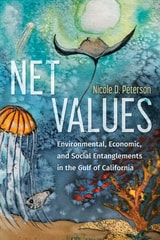
cover of Net Values: Environmental, Economic, and Social Entanglements in the Gulf of California

Net Values

Environmental, Economic, and Social Entanglements in the Gulf of California

Nicole D. Peterson

University of Arizona Press, 2025

In Loreto, Baja California Sur, Mexico, artisanal fishing families and staff of Loreto Bay National Park face an array of choices as tourism, environmental concerns, and economic precarity challenge livelihoods and natural resource availability. In Net Values, Nicole D. Peterson offers a critical examination of how the idea of “choice” is understood, and what it means for policies, planning, and programs to ignore the social, political, economic, and cultural contexts surrounding these choices.

Anchored by more than twenty years of research, Peterson provides insight into the fishing community of Loreto and reveals an important role in decision-making that diverges from previous studies. She argues that decisions about fishing, natural resource management, and other aspects of life are influenced by context, values, and expectations in ways that go beyond the typical psychological or cognitive theories of choice. Instead, Net Values highlights the ways that choices are constrained and enabled by values and expectations of cultures, histories, relationships, and experiences, both personal and shared. Peterson answers questions such as “why do the fishermen fish?” or “what is the marine park staff doing?” These decisions and choices are related to the larger implication addressed by this book: that in order to make effective policies around natural resource management and other issues, we must understand how those potential policies interact with the decision processes already underway.

Divided into five chapters, Net Values is rich in ethnographic detail, drawing from real people to inform the narratives, chapters, and theoretical elaboration. Peterson’s interactions with fishers such as Don Javier and his family and friends support the ideas offered around choice, values, and strategies, connecting ideas to real experiences.

[more]
cover of Nevada: A History

Nevada

A History

Robert Laxalt

University of Nevada Press, 1991
An evocative portrait of the state that "didn't deserve to be" but became one anyway. First published in 1977, this edition includes a new preface that reexamines Laxalt's predictions for Nevada made almost 20 years ago and reflects on the changes that have occurred in the state: the urban plight of Las Vegas and Reno, the renewed appreciation of the land by conservationists and opportunists, and the explosive growth of tourism and gaming.
[more]
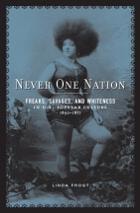
cover of Never One Nation: Freaks, Savages, and Whiteness in U.S. Popular Culture, 1850-1877

Never One Nation

Freaks, Savages, and Whiteness in U.S. Popular Culture, 1850-1877

Linda Frost

University of Minnesota Press, 2005

In Never One Nation, Linda Frost argues that during the eventful decades surrounding the Civil War, American identity was constructed not only nationally but also locally. Depictions of race, class, and sexuality seen in P. T. Barnum's museums, in the image of the Circassian Beauty, and in popular periodicals like Harper's Weekly, the Southern Illustrated News, and the San Francisco Golden Era further illustrated who was - and who was not - an American. Local coverage of Native Americans and Chinese in the West, African Americans and recent Irish immigrants in New York, and slaves and Yankees in the South played a major role in conflating Americanness with whiteness. These ideas were shaped by reactions to events such as the 1863 Draft Riots and the Dakota uprising in Minnesota in 1862, and laid bare through the demonization of Northern whites in Confederate newspapers and anxieties expressed in California newspapers about the possibility of Chinese immigrants gaining U.S. citizenship. Through close readings of specific articles published in regional periodicals, mostly unexamined by literary scholars, Frost shows how Americanness came to be defined in the mid-nineteenth century by the mainstream popular culture. The era's many social upheavals - Emancipation, Reconstruction, the start of the Indian wars in the West, immigration, and the completion of the transcontinental railroad - sharpened the desire of Americans to feel part of a national community, even as they made this search for an American identity extremely contentious and necessarily fragmented. Never One Nation provocatively reframes the discourse on racial formation and reveals how local cultures and prejudices can recast the identity of a nation.
[more]
cover of New Asian Marxisms

New Asian Marxisms

Tani E. Barlow, ed.

Duke University Press, 2002

Displaying the particular vitality of the global traditions of Marxism and neomarxism at the beginning of the twenty-first century, New AsianMarxisms collects essays by a diverse group of scholars—historians, political scientists, literary scholars, and sociologists—who offer a range of studies of the Marxist heritage focusing on Korea, Japan, India, and China.

While some of these essays take up key thinkers in Marxist history or draw attention to outstanding problematics, others focus on national literature and discourse in North and South Korea, the "Mao Zedong Fever" of the 1990s, the implications of Li Dazhao's poetry, and the Indian Naxalite movement.  Illustrating the importance of central analytical categories like exploitation, alienation, and violence to studies on the politics of knowledge, contributors confront prevailing global consumerist fantasies
with accounts of political struggle, cultural displacement, and theoretical strategies.

Contributors. Tani E. Barlow, Dai Jinhua, Michael Dutton, D. R. Howland, Marshall Johnson, Liu Kang, You-me Park, William Pietz, Claudia Pozzana, Alessandro Russo, Sanjay Seth, Gi-Wook Shin, Sugiyama Mitsunobu, Jing Wang
[more]
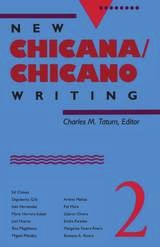
cover of New Chicana/Chicano Writing, Volume 2

New Chicana/Chicano Writing, Volume 2

Charles M. Tatum

University of Arizona Press, 1992

"This impressive collection augurs a bright future for Chicana/Chicano literature, and will be of interest to those who keep track of the wide diversity of American and world literature." —Publishers Weekly

"A sampling of typically captivating contemporary Chicano literature by established and emerging writers." —El Puente. The Quarterly Newsletter of the Hispanic Culture Foundation
[more]
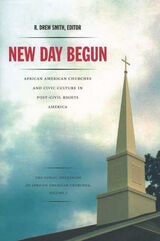
cover of New Day Begun: African American Churches and Civic Culture in Post-Civil Rights America

New Day Begun

African American Churches and Civic Culture in Post-Civil Rights America

R. Drew Smith, ed.

Duke University Press, 2003

New Day Begun presents the findings of the first major research project on black churches’ civic involvement since C. Eric Lincoln and Lawrence H. Mamiya’s landmark study The Black Church in the African American Experience. Since the passage of the 1964 Civil Rights Act and the 1965 Voting Rights Act, the scale and scope of African American churches’ civic involvement have changed significantly: the number of African American clergy serving in elective and appointive offices has noticeably increased, as have joint efforts by black churches and government agencies to implement policies and programs. Filling a vacuum in knowledge about these important developments, New Day Begun assesses the social, political, and ecclesiastical factors that have shaped black church responses to American civic and political life since the Civil Rights movement.

This collection of essays analyzes the results of an unprecedented survey of nearly 2,000 African American churches across the country conducted by The Public Influences of African-American Churches Project, which is based at Morehouse College in Atlanta. These essays—by political scientists, theologians, ethicists, and others—draw on the survey findings to analyze the social, historical, and institutional contexts of black church activism and to consider the theological and moral imperatives that have shaped black church approaches to civic life—including black civil religion and womanist and afrocentric critiques. They also look at a host of faith-based initiatives addressing economic development and the provision of social services. New Day Begun presents necessary new interpretations of how black churches have changed—and been changed by—contemporary American political culture.

Contributors.
Lewis Baldwin, Allison Calhoun-Brown, David D. Daniels III, Walter Earl Fluker, C.R.D. Halisi, David Howard-Pitney, Michael Leo Owens, Samuel Roberts, David Ryden, Corwin Smidt, R. Drew Smith
[more]
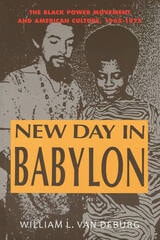
cover of New Day in Babylon: The Black Power Movement and American Culture, 1965-1975

New Day in Babylon

The Black Power Movement and American Culture, 1965-1975

William L. Van Deburg

University of Chicago Press, 1992

The most comprehensive account available of the rise and fall of the Black Power Movement and of its dramatic transformation of both African-American and larger American culture. With a gift for storytelling and an ear for street talk, William Van Deburg chronicles a decade of deep change, from the armed struggles of the Black Panther party to the cultural nationalism of artists and writers creating a new aesthetic. Van Deburg contends that although its tactical gains were sometimes short-lived, the Black Power movement did succeed in making a revolution—one in culture and consciousness—that has changed the context of race in America.

"New Day in Babylon is an extremely intelligent synthesis, a densely textured evocation of one of American history's most revolutionary transformations in ethnic group consciousness."—Bob Blauner, New York Times

Winner of the Gustavus Myers Center Outstanding Book Award, 1993
[more]
cover of New Deal Modernism: American Literature and the Invention of the Welfare State

New Deal Modernism

American Literature and the Invention of the Welfare State

Michael Szalay

Duke University Press, 2000

In New Deal Modernism Michael Szalay examines the effect that the rise of the welfare state had on American modernism during the 1930s and 1940s, and, conversely, what difference this revised modernism made to the New Deal’s famed invention of “Big Government.”
Szalay situates his study within a liberal culture bent on security, a culture galvanized by its imagined need for private and public insurance.
Taking up prominent exponents of social and economic security—such as Franklin Delano Roosevelt, John Maynard Keynes, and John Dewey—Szalay demonstrates how the New Deal’s revision of free-market culture required rethinking the political function of aesthetics. Focusing in particular on the modernist fascination with the relation between form and audience, Szalay offers innovative accounts of Busby Berkeley, Jack London, James M. Cain, Robert Frost, Ayn Rand, Betty Smith, and Gertrude Stein, as well as extended analyses of the works of Ernest Hemingway, John Steinbeck, and Richard Wright.
[more]
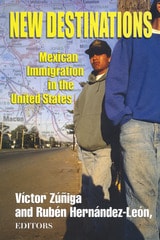
cover of New Destinations: Mexican Immigration in the United States

New Destinations

Mexican Immigration in the United States

Victor Zuniga

Russell Sage Foundation, 2005
Mexican immigration to the United States—the oldest and largest immigration movement to this country—is in the midst of a fundamental transformation. For decades, Mexican immigration was primarily a border phenomenon, confined to Southwestern states. But legal changes in the mid-1980s paved the way for Mexican migrants to settle in parts of America that had no previous exposure to people of Mexican heritage. In New Destinations, editors Víctor Zúñiga and Rubén Hernández-León bring together an inter-disciplinary team of scholars to examine demographic, social, cultural, and political changes in areas where the incorporation of Mexican migrants has deeply changed the preexisting ethnic landscape. New Destinations looks at several of the communities where Mexican migrants are beginning to settle, and documents how the latest arrivals are reshaping—and being reshaped by—these new areas of settlement. Contributors Jorge Durand, Douglas Massey, and Chiara Capoferro use census data to diagram the historical evolution of Mexican immigration to the United States, noting the demographic, economic, and legal factors that led recent immigrants to move to areas where few of their predecessors had settled. Looking at two towns in Southern Louisiana, contributors Katharine Donato, Melissa Stainback, and Carl Bankston III reach a surprising conclusion: that documented immigrant workers did a poorer job of integrating into the local culture than their undocumented peers. They attribute this counterintuitive finding to documentation policies, which helped intensify employer control over migrants and undercut the formation of a stable migrant community among documented workers. Brian Rich and Marta Miranda detail an ambivalent mixture of paternalism and xenophobia by local residents toward migrants in Lexington, Kentucky. The new arrivals were welcomed for their strong work ethic so long as they stayed in "invisible" spheres such as fieldwork, but were resented once they began to take part in more public activities like schools or town meetings. New Destinations also provides some hopeful examples of progress in community relations. Several chapters, including Mark Grey and Anne Woodrick's examination of a small Iowa town, point to the importance of dialogue and mediation in establishing amicable relations between ethnic groups in newly multi-cultural settings. New Destinations is the first scholarly assessment of Mexican migrants' experience in the Midwest, Northeast, and deep South—the latest settlement points for America's largest immigrant group. Enriched by perspectives from demographers, anthropologists, sociologists, folklorists, and political scientists, this volume is an essential starting point for scholarship on the new Mexican migration.
[more]
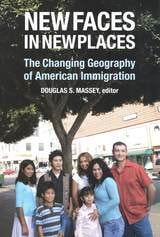
cover of New Faces in New Places: The Changing Geography of American Immigration

New Faces in New Places

The Changing Geography of American Immigration

Douglas S. Massey

Russell Sage Foundation, 2008
Beginning in the 1990s, immigrants to the United States increasingly bypassed traditional gateway cites such as Los Angeles and New York to settle in smaller towns and cities throughout the nation. With immigrant communities popping up in so many new places, questions about ethnic diversity and immigrant assimilation confront more and more Americans. New Faces in New Places, edited by distinguished sociologist Douglas Massey, explores today's geography of immigration and examines the ways in which native-born Americans are dealing with their new neighbors. Using the latest census data and other population surveys, New Faces in New Places examines the causes and consequences of the shift toward new immigrant destinations. Contributors Mark Leach and Frank Bean examine the growing demand for low-wage labor and lower housing costs that have attracted many immigrants to move beyond the larger cities. Katharine Donato, Charles Tolbert, Alfred Nucci, and Yukio Kawano report that the majority of Mexican immigrants are no longer single male workers but entire families, who are settling in small towns and creating a surge among some rural populations long in decline. Katherine Fennelly shows how opinions about the growing immigrant population in a small Minnesota town are divided along socioeconomic lines among the local inhabitants. The town's leadership and professional elites focus on immigrant contributions to the economic development and the diversification of the community, while working class residents fear new immigrants will bring crime and an increased tax burden to their communities. Helen Marrow reports that many African Americans in the rural south object to Hispanic immigrants benefiting from affirmative action even though they have just arrived in the United States and never experienced historical discrimination. As Douglas Massey argues in his conclusion, many of the towns profiled in this volume are not equipped with the social and economic institutions to help assimilate new immigrants that are available in the traditional immigrant gateways of New York, Los Angeles, and Chicago. And the continual replenishment of the flow of immigrants may adversely affect the nation's perception of how today's newcomers are assimilating relative to previous waves of immigrants. New Faces in New Places illustrates the many ways that communities across the nation are reacting to the arrival of immigrant newcomers, and suggests that patterns and processes of assimilation in the twenty-first century may be quite different from those of the past. Enriched by perspectives from sociology, anthropology, and geography New Faces in New Places is essential reading for scholars of immigration and all those interested in learning the facts about new faces in new places in America.
[more]
cover of New Growth: The Art and Texture of Black Hair

New Growth

The Art and Texture of Black Hair

Jasmine Nichole Cobb

Duke University Press, 2022

From Frederick Douglass to Angela Davis, “natural hair” has been associated with the Black freedom struggle. In New Growth Jasmine Nichole Cobb traces the history of Afro-textured coiffure, exploring it as a visual material through which to reimagine the sensual experience of Blackness. Through close readings of slave narratives, scrapbooks, travel illustrations, documentary films, and photography as well as collage, craft, and sculpture, from the nineteenth century to the present, Cobb shows how the racial distinctions ascribed to people of African descent become simultaneously visible and tactile. Whether examining Soul Train’s and Ebony’s promotion of the Afro hairstyle alongside styling products or how artists such as Alison Saar and Lorna Simpson underscore the construction of Blackness through the representation of hair, Cobb foregrounds the inseparability of Black hair’s look and feel. Demonstrating that Blackness is palpable through appearance and feeling, Cobb reveals the various ways that people of African descent forge new relationships to the body, public space, and visual culture through the embrace of Black hair.
[more]
cover of New Italian Migrations to the United States: Vol. 1: Politics and History since 1945

New Italian Migrations to the United States

Vol. 1: Politics and History since 1945

Edited by Laura E. Ruberto and Joseph Sciorra: Afterword by Donna Gabaccia

University of Illinois Press, 2017

Italian immigration from 1945 to the present is an American phenomenon too little explored in our historical studies. Until now. In this new collection, Laura E. Ruberto and Joseph Sciorra edit essays by an elite roster of scholars in Italian American studies. These interdisciplinary works focus on leading edge topics that range from politics of the McCarren-Walter Act and its effects on women to the ways Italian Americans mobilized against immigration restrictions. Other essays unwrap the inner workings of multi-ethnic power brokers in a Queens community, portray the complex transformation of identity in Boston’s North End, and trace the development of Italian American youth culture and how new arrivals fit into it. Finally, Donna Gabaccia pens an afterword on the importance of this seventy-year period in U.S. migration history.

Contributors: Ottorino Cappelli, Donna Gabaccia, Stefano Luconi, Maddalena Marinari, James S. Pasto, Rodrigo Praino, Laura E. Ruberto, Joseph Sciorra, Donald Tricarico, and Elizabeth Zanoni.
[more]
cover of New Italian Migrations to the United States: Vol. 2: Art and Culture since 1945

New Italian Migrations to the United States

Vol. 2: Art and Culture since 1945

Laura Ruberto, Joseph Sciorra

University of Illinois Press, 2017

This second volume of <i>New Italian Migrations to the United States</i> explores the evolution of art and cultural expressions created by and about Italian immigrants and their descendants since 1945. The essays range from an Italian-language radio program that broadcast intimate messages from family members in Italy to the role of immigrant cookbook writers in crafting a fashionable Italian food culture. Other works look at how exoticized actresses like Sophia Loren and Pier Angeli helped shape a glamorous Italian style out of images of desperate postwar poverty; overlooked forms of brain drain; the connections between countries old and new in the works of Michigan self-taught artist Silvio Barile; and folk revival performer Alessandra Belloni's reinterpretation of tarantella dance and music for Italian American women. In the afterword, Anthony Julian Tamburri discusses the nomenclature ascribed to Italian American creative writers living in Italy and the United States.

Contributors: John Allan Cicala, Simone Cinotto, Teresa Fiore, Incoronata (Nadia) Inserra, Laura E. Ruberto, Joseph Sciorra, and Anthony Julian Tamburri.

[more]
cover of New Orleans Sports: Playing Hard in the Big Easy

New Orleans Sports

Playing Hard in the Big Easy

Thomas Aiello

University of Arkansas Press, 2019

New Orleans has long been a city fixated on its own history and culture. Founded in 1718 by the French, transferred to the Spanish in the 1763 Treaty of Paris, and sold to the United States in 1803, the city’s culture, law, architecture, food, music, and language share the influence of all three countries. This cultural mélange also manifests in the city’s approach to sport, where each game is steeped in the city’s history.

Tracing that history from the early nineteenth century to the present, while also surveying the state of the city’s sports historiography, New Orleans Sports places sport in the context of race relations, politics, and civic and business development to expand that historiography—currently dominated by a text that stops at 1900—into the twentieth century, offering a modern examination of sports in the city.
[more]
cover of New Roots in America's Sacred Ground: Religion, Race, and Ethnicity in Indian America

New Roots in America's Sacred Ground

Religion, Race, and Ethnicity in Indian America

Joshi, Khyati Y

Rutgers University Press, 2006

In this compelling look at second-generation Indian Americans, Khyati Y. Joshi draws on case studies and interviews with forty-one second-generation Indian Americans, analyzing their experiences involving religion, race, and ethnicity from elementary school to adulthood.  As she maps the crossroads they encounter as they navigate between their homes and the wider American milieu, Joshi shows how their identities have developed differently from their parents’ and their non-Indian peers’ and how religion often exerted a dramatic effect.

The experiences of Joshi’s research participants reveal how race and religion interact, intersect, and affect each other in a society where Christianity and whiteness are the norm. Joshi shows how religion is racialized for Indian Americans and offers important insights in the wake of 9/11 and the backlash against Americans who look Middle Eastern and South Asian.

Through her candid insights into the internal conflicts contemporary Indian Americans face and the religious and racial discrimination they encounter, Joshi provides a timely window into the ways that race, religion, and ethnicity interact in day-to-day life.

[more]