Results by title
2728 books match the query 'Education' and 41 start with n
Naming How We Feel
Specific Affect and Emotional Labor In the Writing CenterDaniel Lawson
Utah State University Press, 2026
Writing centers are the locus for a wide range of emotional labor on campus, often serving students beyond the typical educational purpose. Naming How We Feel grapples with the question of how writing center administrators account for, train for, and theorize emotion and affect in the writing center to facilitate better and more ethical practices and considers how writing center administrators might ameliorate the costs of such emotional labor to faculty, tutors, and students.
Beginning with a discussion of how writing center scholars might identify and understand emotional labor, the book then expands to examine richly varied case studies and anecdotes to showcase how tutors tend to experience such labor and consider its relationship and association with emotional intelligence and burnout. Lawson considers how the field might better prepare and train tutors for affect and emotional labor, ultimately advocating for more equitable conditions for emotional labor within writing centers.
Naming How We Feel examines the critical role feelings play in writing and writing center work, offering advice on training tutors for emotional labor and literacy and suggestions for how administrators might engage institutional stakeholders to create and support more equitable conditions for emotional labor within their writing centers.
Naming What We Know
Threshold Concepts of Writing StudiesLinda Adler-Kassner
Utah State University Press, 2015
Naming What We Know examines the core principles of knowledge in the discipline of writing studies using the lens of “threshold concepts”—concepts that are critical for epistemological participation in a discipline. The first part of the book defines and describes thirty-seven threshold concepts of the discipline in entries written by some of the field’s most active researchers and teachers, all of whom participated in a collaborative wiki discussion guided by the editors. These entries are clear and accessible, written for an audience of writing scholars, students, and colleagues in other disciplines and policy makers outside the academy. Contributors describe the conceptual background of the field and the principles that run throughout practice, whether in research, teaching, assessment, or public work around writing. Chapters in the second part of the book describe the benefits and challenges of using threshold concepts in specific sites—first-year writing programs, WAC/WID programs, writing centers, writing majors—and for professional development to present this framework in action.
Naming What We Know opens a dialogue about the concepts that writing scholars and teachers agree are critical and about why those concepts should and do matter to people outside the field.
Narrating Their Lives
Examining English Language Teachers' Professional Identities within the ClassroomEdited by Lia Kamhi-Stein
University of Michigan Press, 2013
“…a groundbreaking book that will…engage, inform, and connect with present and future teachers and teacher educators.”
---Stephanie Vandrick, Foreword to Narrating Their Lives
The field of TESOL has called attention to the ways that the issues of race and ethnicity, language status and power, and cultural background affect second language learners’ identities and, to some degree, those of teachers. In Narrating Their Lives, Kamhi-Stein examines the process of identity construction of classroom teachers so as to make connections between their personal and professional identities and their instructional practices. To do that, she has selected six autobiographical narratives from teachers who were once part of her TESL 570 (Educational Sociolinguistics) class in the MA TESOL program at California State University, Los Angeles. These six narratives cover a surprisingly wide range of identity issues but also touch on broader instructional themes that are part of teacher education programs.
Because of the reflective nature of the narratives—with the teachers using their stories to better understand how their experiences shape what they do in the classroom—this volume includes provocative chapter-opening and reflective chapter-closing questions. An informative discussion of the autobiographical narrative assignment and the TESL 570 course (including supplemental course readings and assessment criteria) is also included.

Narratives of Adversity
Jesuits on the Eastern Peripheries of the Habsburg Realms (1640–1773)Paul J. Shore
Central European University Press, 2012
Narratives of Educating for Sustainability in Unsustainable Environments
Jane Haladay
Michigan State University Press, 2017
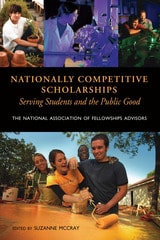
Nationally Competitive Scholarships
Serving Students and the Public GoodSuzanne McCray
University of Arkansas Press, 2007

Native People of Wisconsin
Patty Loew
Wisconsin Historical Society Press, 2003
The revised edition ofPatty Loew'sNative People of Wisconsin is now available, ISBN 9780870207488.Native People of Wisconsin, the fifth text in the New Badger History series for upper elementary and middle school students, focuses on the Indian Nations in the state: the Menominee, Ho-Chunk, Ojibwe, Oneida, Mohican Nation, Stockbridge-Munsee Band, and the Brothertown Indians. Patty Loew has followed the same structure she used in Indian Nations of Wisconsin, her book for general audiences, in which she provided chapters on Early History and European Arrivals, then devoted the remaining chapters to each of the Indian Nations in Wisconsin today.
Native People of Wisconsin, TG
Bobbie Malone and Kori Oberle
Wisconsin Historical Society Press, 2003
The revised and updated Teacher's Guide for Native People of Wisconsin is available Winter 2015, ISBN 9780870207495.This teacher's guide helps students grasp fully the rich content of Native People of Wisconsin. The guide offers more structured activities that reengage students in the text itself in a manner that diverges from teacher's guides to our earlier publications. Activities for each chapter focus on interdisciplinary standards-related reading strategies, journaling, and other multidimensional skills that both reinforce and complement the content of the text. Included with the teacher's guide is an accompanying CD-ROM, produced specifically for Native People of Wisconsin of segments from several of the video series on Wisconsin Studies produced by the Wisconsin Educational Communications Board. Such interactive learning integrates reasoning and reading skills (and state standards) beyond the social studies and promise to make Native People of Wisconsin an essential part of the classroom curriculum.
Naturalizing Philosophy of Education
John Dewey in the Postanalytic PeriodJerome A. Popp
Southern Illinois University Press, 1998
Jerome A. Popp examines the role of Dewey-based pragmatism in the past, present, and future of philosophy of education. He insists that even though Marx-ian utopian thought subjugated Dewey’s ideas during the 1970s, Dewey’s epistemological arguments are directly relevant to contemporary philosophy. He contends that not only are Dewey’s arguments related to how we think about philosophy of education; they actually improve the thinking reflected in the literature. Dewey’s arguments, he demonstrates, provide the basis for both a rejuvenated account of conceptual analysis and a criticism of the utopian relativism currently dominating the literature.
Popp notes that empiricism, manifested in the philosophy of education as analytic philosophy, holds that scientific findings, especially from psychology, have no place in philosophy. But contemporary writers in the philosophy of science contend that to justify the methods of science we must consider what is known about intelligence and cognitive processes. These arguments are relevant to the ways in which we justify claims about proper education.
Naturalizing epistemology (using the results of science in philosophic theories) leads to an enhanced account of Dewey’s instrumental approach to normative inquiry and strengthens attempts to justify educational practices. Dewey’s critique of utopian approaches to social theory is bolstered by contemporary arguments in epistemology and the philosophy of science. These arguments reject the attempt by some in philosophy of education to solve value questions through an appeal to utopian thinking. Popp agrees with Dewey’s view that the proper goals of education cannot be stated in these terms.

Nature Journal
L. J. Davenport, with a Foreword by John C. Hall
University of Alabama Press, 2010
Explore Nature. Record Wonder. Keep Your Own Journal.
Nature Journal is an innovative presentation of the best columns and photographs from L. J. Davenport’s popular column in Alabama Heritage magazine. Readers of the magazine have come to relish his artful and often witty descriptions of common species encountered in the Alabama outdoors. But Nature Journal is designed to be much more than a mere collection of entertaining essays; it is also an educational tool—a means of instructing and encouraging readers in the art of keeping a nature journal for themselves.
Each of the 25 chapters is a self-contained lesson in close observation of species morphology, behavior, and habitat; research in the literature; nondestructive capture of the subject by photography or drawing; and written description of the total observed natural phenomenon. At the end of each account, stimulating questions and gentle directives guide the reader into making his or her own observations and recordings.
This book is intended for broad nature-study use in Alabama and throughout the southeast by the general reader and nature enthusiast alike, as well as visitors to museums and outdoor centers, and students of nature and nature writing at the high school and college levels. Beautifully designed to look like a personal journal, it is a perfect gift and treasured keepsake for all lovers of the natural world.
Publication supported in part by Samford University
Navigating Academia
Writing Supporting GenresJohn M. Swales & Christine B. Feak
University of Michigan Press, 2011
Navigating Academia is a bit different from the other volumes in the series because it focuses on the supporting genres that facilitate the more public genres that form the building blocks of an academic and/or research career. Included are statements of purpose for graduate school applications, letters of recommendation, and responses to journal reviewers.
One feature that these genres have in common is that they are largely hidden from public view; it is difficult to find examples of them in university libraries. Although guidance about these genres can increasingly be found on the Internet, this guidance is often too general to be helpful in an individual particular situation. This is unfortunate because in almost all cases, the individual needs to be seen as both a serious scholar, researcher, or instructor (whether beginning or getting established) and as a collegial but objective person. As a result, many of these academic communications need to be carefully considered, particularly with regard to the likely effect this communication will have on its intended recipients, who, more often than not, are established figures in the field (as with a job application letter). Because of the roles of these genres, this volume also differs somewhat from the others in that it is as much concerned with social academic practice as it is with more formal academic texts.
This volume represents a revision and expansion of the material on academic correspondence that appeared in English in Today's Research World.

Navigating Conflict
How Youth Handle Trouble in a High-Poverty SchoolCalvin Morrill and Michael Musheno
University of Chicago Press, 2018
Grounded in sixteen years of ethnographic fieldwork, Navigating Conflict draws on archival and institutional evidence to locate urban schools in more than a century of local, state, and national change. Morrill and Musheno make the case for schools that work, where negative externalities are buffered and policies are adapted to ever-evolving student populations. They argue that these kinds of schools require meaningful, inclusive student organizations for sustaining social trust and collective peer dignity alongside responsive administrative leadership. Further, students must be given the freedom to associate and move among their peers, all while in the vicinity of watchful, but not intrusive adults. Morrill and Musheno make a compelling case for these foundational conditions, arguing that only through them can schools enable a rich climate for learning, achievement, and social advancement.
Navigating Space On and Beyond Campus
Eric Detweiler
Utah State University Press, 2026
Offering practical applications of scholarship in spatial theory and rhetorics of space and place, Navigating Space On and Beyond Campus profiles how writing and rhetoric programs across the United States have responded to the spatial challenges and possibilities facing higher education. Exploring how instructors creatively and critically navigate actual, virtual, and inaccessible spaces in the pursuit of effective, ethically informed rhetoric and writing education, this book also reveals how the use of space contributes to the creation and/or denial of equity among students, faculty, and programs.
Contributors document how they have secured and repurposed campus real estate, literally and metaphorically navigated relationships with other campus resources, and responded to austerity measures that have threatened the spaces they have historically called their own. Individual sections focus on the historical pressures that have shaped programs’ locations and resources, developments in the work and design of writing centers, the creation of new labs and centers, and the relationship between writing programs and the broader places and communities with which they are intertwined.
How spaces are allocated, structured, and regulated is a key determinant of access and equity in higher education. Navigating Space On and Beyond Campus offers timely strategies for and reflections on the place of rhetoric and writing on college and university campuses.

Navigating Tenure and Beyond
A Guide for Early Career FacultySundar A. Christopher
American Meteorological Society, 2019
Navigating the English Language Classroom
Effective Practices for Novice TeachersLía D. Kamhi-Stein, Bahiyyih Hardacre, and Jeremy Kelley
University of Michigan Press, 2024
Each chapter offers context; a case study; common concerns; and concrete, research-based practices that link theory to practice in an easy-to-access manner. Readers will learn how to face several challenges, including:
- lesson planning and delivery
- classroom assessment
- integrating technology into the classroom
- using corpora in the classroom
- establishing a professional identity
Negotiating Disability
Disclosure and Higher EducationStephanie L. Kerschbaum, Laura T. Eisenman, and James M. Jones, Editors
University of Michigan Press, 2017
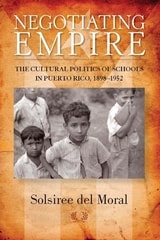
Negotiating Empire
The Cultural Politics of Schools in Puerto Rico, 1898–1952Solsiree del Moral
University of Wisconsin Press, 2013
Rather than seeing U.S. empire in Puerto Rico during this period as a contest between two sharply polarized groups, del Moral views their interaction as a process of negotiation. Although educators and families rejected some tenets of Americanization, such as English-language instruction, they also redefined and appropriated others to their benefit to increase literacy and skills required for better occupations and social mobility. Pushing their citizenship-building vision through the schools, Puerto Ricans negotiated a different school project—one that was reformist yet radical, modern yet traditional, colonial yet nationalist.

Negro Education in Alabama
A Study in Cotton and SteelHorace Mann Bond
University of Alabama Press, 1994
WINNER OF THE SUSAN COLVER ROSENBERGER AWARD
A foundational work of educational history, Horace Mann Bond’s study reveals how race, labor, and power shaped Black schooling in Alabama—and why those lessons still matter today.
Originally published in 1939, Negro Education in Alabama: A Study in Cotton and Steel by Horace Mann Bond is a pioneering work of educational and social history. Drawing on extensive data and firsthand observation, Bond explores how the economic structures of the cotton South and the industrializing North influenced the development of Black education in Alabama. He examines disparities in funding, curriculum, and access, while also highlighting the resilience and agency of African American communities in pursuing educational advancement. This reissued edition preserves Bond’s critical insights and remains a vital resource for scholars of African American history, education policy, and Southern studies.
Nettl's Elephant
Bruno Nettle
University of Illinois Press, 2010
Networks of Trust
The Social Costs of College and What We Can Do about ThemAnthony Simon Laden
University of Chicago Press, 2024
Higher education is a familiar battlefield in today’s culture wars. The right accuses colleges and universities of indoctrinating conservative students with liberal values; the left, with failing to be sufficiently inclusive. The anxieties expressed on both sides of the political spectrum have much in common, however, and they are triggered not by colleges’ failures but by their successes.
So argues philosopher Anthony Simon Laden in Networks of Trust. He highlights how a college education shapes students’ informational trust networks: the complex set of people and institutions they rely on for the information they use to think about and understand the world. While the networks that colleges build for students have great value, learning to inhabit them pulls some students away from their families and communities. If many people distrust institutions of higher education, this is one reason why. Networks of Trust offers a path forward, one that preserves the value while reducing the harms of a college education. It includes concrete suggestions for how colleges and universities can educate students in a manner that inspires and deserves trust: one that bridges rather than deepens our social divides.
Networks of Trust
The Social Costs of College and What We Can Do about ThemAnthony Simon Laden
University of Chicago Press, 2024
An eye-opening look at how parents’ mistrust of colleges has less to do with what their kids are learning than with whom they come to trust.
Higher education is a familiar battlefield in today’s culture wars. The right accuses colleges and universities of indoctrinating conservative students with liberal values; the left, with failing to be sufficiently inclusive. The anxieties expressed on both sides of the political spectrum have much in common, however, and they are triggered not by colleges’ failures but by their successes.
So argues philosopher Anthony Simon Laden in Networks of Trust. He highlights how a college education shapes students’ informational trust networks: the complex set of people and institutions they rely on for the information they use to think about and understand the world. While the networks that colleges build for students have great value, learning to inhabit them pulls some students away from their families and communities. If many people distrust institutions of higher education, this is one reason why. Networks of Trust offers a path forward, one that preserves the value while reducing the harms of a college education. It includes concrete suggestions for how colleges and universities can educate students in a manner that inspires and deserves trust: one that bridges rather than deepens our social divides.
Never the Twain Shall Meet
Bell, Gallaudet, and the Communications DebateRichard Winefield
Gallaudet University Press, 1987

New Approaches to Comparative Education
Edited by Philip G. Altbach and Gail P. Kelly
University of Chicago Press, 1986
New Approaches to Interpreter Education
Cynthia B. Roy
Gallaudet University Press, 2006
The latest addition to the Interpreter Education series expands the tools available to instructors with six new, vital chapters on new curricula and creative teaching methods. Series editor Cynthia B. Roy leads the way by calling for the use of a discourse-oriented curriculum for educating interpreters. In the following chapter, Claudia Angelelli outlines the bottom-line principles for teaching effective health-care interpreting, postulating a model that depends upon the development of skills in six critical areas: cognitive-processing, interpersonal, linguistics, professional, setting-specific, and sociocultural. Risa Shaw, Steven D. Collins, and Melanie Metzger collaborate on describing the process for establishing a bachelor of arts program in interpreting at Gallaudet University distinct from the already existent masters program.
In the fourth chapter, Doug Bowen-Bailey describes how to apply theories of discourse-based interpreter education in specific contexts by producing customized videos. Jemina Napier blends three techniques for instructing signed language interpreters in Australia: synthesizing sign and spoken language interpreting curricula; integrating various interpreting concepts into a theoretical framework; and combining online and face-to-face instruction. Finally, Helen Slatyer delineates the use of an action research methodology to establish a curriculum for teaching ad hoc interpreters of languages used by small population segments in Australia.

New Digital Worlds
Postcolonial Digital Humanities in Theory, Praxis, and PedagogyRoopika Risam
Northwestern University Press, 2019
New Digital Worlds traces the formation of postcolonial studies and digital humanities as fields, identifying how they can intervene in knowledge production in the digital age. Roopika Risam examines the role of colonial violence in the development of digital archives and the possibilities of postcolonial digital archives for resisting this violence. Offering a reading of the colonialist dimensions of global organizations for digital humanities research, she explores efforts to decenter these institutions by emphasizing the local practices that subtend global formations and pedagogical approaches that support this decentering. Last, Risam attends to human futures in new digital worlds, evaluating both how algorithms and natural language processing software used in digital humanities projects produce universalist notions of the "human" and also how to resist this phenomenon.

New Indians, Old Wars
Elizabeth Cook-Lynn
University of Illinois Press, 2006
Addressing Native American Studies' past, present, and future, the essays in New Indians, Old Wars tackle the discipline head-on, presenting a radical revision of the popular view of the American West in the process. Instead of luxuriating in its past glories or accepting the widespread historians' view of the West as a shared place, Elizabeth Cook-Lynn argues that it should be fundamentally understood as stolen.
Firmly grounded in the reality of a painful past, Cook-Lynn understands the story of the American West as teaching the political language of land theft and tyranny. She argues that to remedy this situation, Native American studies must be considered and pursued as its own discipline, rather than as a subset of history or anthropology. She makes an impassioned claim that such a shift, not merely an institutional or theoretical change, could allow Native American studies to play an important role in defending the sovereignty of indigenous nations today.
New Languages of the State
Indigenous Resurgence and the Politics of Knowledge in BoliviaBret Gustafson
Duke University Press, 2009
Gustafson shows that bilingual education is an issue that extends far beyond the classroom. Public schools are at the center of a broader battle over territory, power, and knowledge as indigenous movements across Latin America actively defend their languages and knowledge systems. In attempting to decolonize nation-states, the indigenous movements are challenging deep-rooted colonial racism and neoliberal reforms intended to mold public education to serve the market. Meanwhile, market reformers nominally embrace cultural pluralism while implementing political and economic policies that exacerbate inequality. Juxtaposing Guarani life, language, and activism with intimate portraits of reform politics among academics, bureaucrats, and others in and beyond La Paz, Gustafson illuminates the issues, strategic dilemmas, and imperfect alliances behind bilingual intercultural education.
New Perspective, Understanding, Awareness
Impacts of Arts Integration and Interdisciplinary PracticeGabriel Harp
A2RU Intervals, 2019
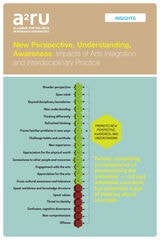
Learn more online at a2ru.org about A2RU programs, alliance partners, and how to become an A2RU partner. Discover insights and tools to support the arts and design in research universities. You can also search and browse A2RU conference abstracts, working session captures, and a wide array of supporting materials from A2RU and its alliance partnerships.
New Strategies for Wicked Problems
Science and Solutions in the 21st CenturyEdward P. Weber
Oregon State University Press, 2017
We now live in a world full of wicked problems, most of them urgent challenges calling out for creative, democratic, and effective solutions. Ed Weber, Denise Lach, and Brent Steele, of the Oregon State University School of Public Policy, solicited papers from a wide variety of accomplished scholars in the fields of science, politics, and policy with significant research experience to address this challenge. The resultant collection focuses on major contemporary environmental and natural resource policy issues, and proposes an assortment of alternative problem-solving methodologies to tackle such problems.
New Strategies for Wicked Problems will appeal to scholars, students, and decision-makers wrestling with wicked problems and “post-normal” science settings beyond simply environmental and natural resource-based issues. It will provide much needed guidance to policymakers, citizens, public managers, and various stakeholders who are struggling with wicked problems in their professional lives.
Other Contributors:
Tanya Heikkila
Helen Ingram
Ann C. Keller
Bob Lackey
Anna Pakenham Stevenson
Christopher M. Weible
Daniel R. Williams
New Work of Writing Across the Curriculum
Diversity and Inclusion, Collaborative Partnerships, and Faculty DevelopmentStaci M. Perryman-Clark
Utah State University Press, 2023
Many of these initiatives are created in isolation, reinforcing institutional silos that are not used strategically to gain the attention of senior administrators, particularly those working at state-supported public institutions who must manage shrinking institutional budgets. Yet teaching and learning centers and WAC programs gain tremendously from one another by building explicit partnerships on campus-wide diversity initiatives that emphasize cultural competence. In addition, both cultural competence and written proficiency enhance the transferable skills necessary for completing undergraduate education requirements, and this work can be leveraged to draw the attention of senior administrative leadership.
Faculty development and WAC need to make diversity and inclusion initiatives a priority for professional development. The New Work of Writing Across the Curriculum reviews initiatives that point to increased understanding of diversity and inclusion that will be of significance to administrators, WAC specialists, faculty developers, and diversity officers across the spectrum of institutions of higher learning.
New Writing Classroom
Listening, Motivation, and Habits of MindPatrick Sullivan
Utah State University Press, 2014
In A New Writing Classroom, Patrick Sullivan provides a new generation of teachers a means and a rationale to reconceive their approach to teaching writing, calling into question the discipline's dependence on argument.
Including secondary writing teachers within his purview, Sullivan advocates a more diverse, exploratory, and flexible approach to writing activities in grades six through thirteen. A New Writing Classroom encourages teachers to pay more attention to research in learning theory, transfer of learning, international models for nurturing excellence in the classroom, and recent work in listening to teach students the sort of dialogic stance that leads to higher-order thinking and more sophisticated communication.
The conventional argumentative essay is often a simplistic form of argument, widely believed to be the most appropriate type of writing in English classes, but other kinds of writing may be more valuable to students and offer more important kinds of cognitive challenges. Focusing on listening and dispositions or "habits of mind” as central elements of this new composition pedagogy, A New Writing Classroom draws not just on composition studies but also on cognitive psychology, philosophy, learning theory, literature, and history, making an exciting and significant contribution to the field.

New York University and the City
An Illustrated HistoryFrusciano, Thomas J
Rutgers University Press, 1997
In New York University and the City, Thomas J. Frusciano and Marilyn H. Pettit situate the history of a unique urban university within the context of the social, political, and economic history of New York City. The authors trace the movement northward on Manhattan Island of both university and city, from the commercial hustle and bustle around City Hall, where the first classes were held in 1832, to the rural environs of Greenwich Village, and ultimately even farther north in 1894 to the undergraduate extension on the "secluded hilltop" of University Heights in the Bronx.
Vividly illustrated with both historical and contemporary images, New York University and the City explores various themes in the history of higher education and how NYU responded to changes in urban demographics, curriculum demands, and physical space during critical periods in the city's development. The relationship between university and city is further examined through extensive biographical portraits of the many historical personalities who made contributions to the development of both city and university.
The founding of New York University in 1831 is a watershed in the history of higher education in the United States. Albert Gallatin, former secretary of the treasury, led a group that proposed the creation of an institution of higher learning in New York City that would "correspond with the spirit and wants of the age and country," a nondenominational institution that would enlarge the opportunities of education for those qualified and inclined. NYU was expected to educate not only gentlemen scholars but also the sons of the great commercial metropolis. It also reflected and symbolized the aspirations of the city. By 1931, NYU was the nation's largest private university. Frusciano and Pettit chronicle the university's growth and struggles to its ultimate position as one of the most prestigious academic research institutions in the world.
Next-Gen Perspectives on Leadership
Coalitional Strategies for Launching Careers, Renewing Curricula, and Defending DemocracyCharles McMartin
Utah State University Press, 2026
Next-gen faculty are leading now. Through coalition-building, care work, and equity-driven initiatives, they are transforming institutions from the ground up. From labor organizing and culturally responsive curriculum design to the care-work of academic parents and the leadership of writing program administrators, the contributors in this collection model the type of coalitional leadership needed in our institutions. Structured around intergenerational dialogues, the book brings together early-career scholars with mid-career leaders—Jennifer Sano-Franchini, Christina Cedillo, and Staci Perryman-Clark—who offer sharp, reflective responses to each section, and culminates in a powerful closing essay by Carmen Kynard. These voices trace a lineage of resistance and renewal, showing how the leadership strategies of today’s emerging scholars echo and evolve the activist traditions that have long shaped writing studies. Next-gen leaders are moving beyond individualistic models of success and embracing collective, justice-oriented leadership practices. This collection invites scholars to study and teach forms of leadership that help faculty and students step into the challenging opportunities they face.
For graduate students and early-career faculty, this book offers a model of leadership that creates meaningful change outside designated leadership roles or institutional metrics. For mid-career and senior faculty, it provides a framework for recognizing and supporting the ground-level leadership already happening in their contexts. This collection is for anyone committed to leading more inclusive and sustainable academic communities and encourages faculty across generations to reimagine how to mentor, collaborate, and lead in ways that reflect the values of equity, care, and coalition.
Contributors: Felicita Arzu-Carmichael, Amerdeep Bajwa, Christina Cedillo, Alexandra Chapa, Anicca Cox, Tom Do, Mena Hannakachl, Alice Hays, Charisse Iglesias, Brad Jacobson, Carmen Kynard, Adele Leon, Shaylyn Marks, Sean Moxley-Kelly, Abigail Oakley, Staci Perryman-Clark, Ana Milena Ribero, Jennifer Sano-Franchini
No Child Left Behind and the Public Schools
Scott Franklin Abernathy
University of Michigan Press, 2007
“A powerful, detailed, and exceptionally balanced critique of NCLB. It offers some hope for how we might overcome its faults. No legislator or educational expert should be allowed to get away with not reading it—whether to agree or disagree. It’s a must learning experience.”
—Deborah Meier, Senior Scholar and Adjunct Professor, Steinhardt School of Education, New York University, and author of In Schools We Trust
“A concise, highly readable, and balanced account of NCLB, with insightful and realistic suggestions for reform. Teachers, professors, policymakers, and parents—this is the one book about NCLB you ought to read.”
—James E. Ryan, William L. Matheson and Robert M. Morgenthau Distinguished Professor, University of Virginia School of Law
This far-reaching new study looks at the successes and failures of one of the most ambitious and controversial educational initiatives since desegregation—the No Child Left Behind Act of 2001.
NCLB’s opponents criticize it as underfunded and unworkable, while supporters see it as a radical but necessary educational reform that evens the score between advantaged and disadvantaged students. Yet the most basic and important question remains unasked: “Can we ever really know if a child’s education is good?”
Ultimately, Scott Franklin Abernathy argues, policymakers must begin from this question, rather than assuming that any test can accurately measure the elusive thing we call “good” education.
No Equal In The World
An Interpretation Of The Academic PresidencyJoseph N. Crowley
University of Nevada Press, 1994
No Place But Here
A Teacher’s Vocation in a Rural CommunityGarret Keizer
University Press of New England, 1996

No Sanctuary
Teachers and the School Reform That Brought Gay Rights to the MassesStephen Lane
University Press of New England, 2018

Not Alone
LGB Teachers Organizations from 1970 to 1985Jason Mayernick
Rutgers University Press, 2024
Notes on the Heart
Affective Issues in the Writing ClassroomSusan H. McLeod
Southern Illinois University Press, 1997
It has long been recognized that affect (that is, the noncognitive aspect of mental activity) plays a large role in writing and in learning to write. According to Susan H. McLeod, however, the model that has been most used for empirical research on the writing process is based on cognitive psychology and does not take into account affective phenomena. Nor does the social constructionist view of the writing process acknowledge the affective realm except in a very general way. To understand the complete picture, McLeod insists, we need to explore how cognitive, affective, and social elements interact as people write.
In this book, McLeod follows a group of students through a semester of writing assignments, tracking the students’ progress and examining the affective elements relevant to their writing. To facilitate future discussion of these phenomena, McLeod also provides suggested definitions for terms in the affective domain.
In a very real sense, this book is the result of a collaboration of three Susans: Susan McLeod, who researched and wrote the book; Sue Hallett, an instructor in Washington State University’s composition program whose classes McLeod observed and who helped provide much of the data; and Susan Parker, a graduate student who observed Hallett’s class and who ran a tutorial connected to that class. To provide a narrative structure, McLeod and her two collaborators have constructed a simulated semester, conflating the year and a half of the study into one semester and creating a class that is a composite drawn from seven classrooms over three semesters.
Although philosophers have had much to say about the affective domain, Notes on the Heart is based for the most part on research from the social sciences. Discussions of pedagogy, while meant to have practical value, are suggestive rather than prescriptive. The goal is to help teachers see their practice in new way.
Teachers will be particularly interested in McLeod’s discussion of teacher affect/effect. This section examines both the issue of the "Pygmalion effect" (students becoming better because the teacher believes they are) and perhaps the more common opposite, the "golem effect" (students becoming less capable because their teachers view them that way).
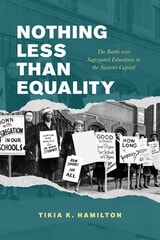
Nothing Less Than Equality
The Battle over Segregated Education in the Nation’s CapitalTikia K. Hamilton
University of Chicago Press, 2026
The landmark Brown v. Board of Education case, which barred racial segregation in American public schools, wasn’t the only path for Black parents, teachers, and activists who sought equality of educational opportunity. Some believed that the solution to inequality lay in pressing the federal government to live up to the Jim Crow doctrine of “separate but equal” by providing more resources to Black schools. And for a time, this seemed true in Washington, DC, where Black activists leveraged their status as residents of the nation’s capital to advocate on behalf of Black education. However, disappointments with the “separate but equal” strategy and a sea change in activism led to an embrace of integration.
In Nothing Less Than Equality, Tikia K. Hamilton reveals the rich and complex history of educational activism in Washington prior to Brown v. Board of Education, illuminating complex dynamics that provide a counterpoint and backdrop to the landmark Supreme Court case. Hamilton thoroughly examines the multipronged strategies employed by parents, teachers, attorneys, and activists to democratize education, demonstrating that there was no linear path to Brown.

Now Don't Try to Reason with Me
Essays and Ironies for a Credulous AgeWayne C. Booth
University of Chicago Press, 1970
“Professor Booth’s earnestness is graced by wit, irony, and generous humor.”—Louis Coxe, New Republic