Results by title
716 books match the query 'Literary Figures' and 14 start with n

Nathanael West - American Writers 21
University of Minnesota Pamphlets on American WritersStanley Edgar Hyman
University of Minnesota Press, 1962
Nathanael West - American Writers 21 was first published in 1962. Minnesota Archive Editions uses digital technology to make long-unavailable books once again accessible, and are published unaltered from the original University of Minnesota Press editions.
Nathaniel Hawthorne - American Writers 23
University of Minnesota Pamphlets on American WritersHyatt H. Waggoner
University of Minnesota Press, 1962
Nathaniel Hawthorne - American Writers 23 was first published in 1962. Minnesota Archive Editions uses digital technology to make long-unavailable books once again accessible, and are published unaltered from the original University of Minnesota Press editions.
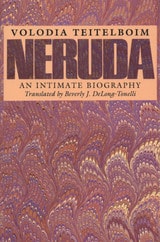
Neruda
An Intimate BiographyBy Volodia Teitelboim
University of Texas Press, 1992
Like a rain-swollen river sweeping everything into its current, Pablo Neruda channeled all his life experiences into impassioned poetry that ultimately brought him the 1971 Nobel Prize for literature. His close friend and fellow writer-activist Volodia Teitelboim shared that exciting process for forty years, uniquely qualifying him to offer this intimate portrait of the poet. Originally published in Spain in 1984, Neruda is a biography that reads like a novel.
Teitelboim captures the whole sweep of Neruda's eventful life (1904-1973), from his motherless childhood in Chile's rainy southern forest to his unquiet death just twelve days after the violent overthrow of the Allende government he had served. He follows him through his bohemian youth as an impoverished university student in Santiago, his lonely existence in Southeast Asia consular outposts, his joyous discovery of Spain, and his lifelong devotion to poetry, love, Chile, and politics.
New Perspectives on the Life and Art of Richard Crashaw
Edited by John R. Roberts
University of Missouri Press, 1990
Richard Crashaw (1612/13-1649) has been one of the most neglected, misunderstood, misread, and unappreciated of the so-called major metaphysical poets. Critics have long labeled Crashaw’s poetry “foreign,” “grotesque,: “deficient in judgment and taste,” and even “sexually perverse.” In recent years, however, Crashaw’s role in providing an understanding and appreciation of seventeenth century poetic theory and aesthetics has become increasingly more evident to literary scholars and critics. They now generally agree that his poetry occupies a permanent and significant position in the intellectual, religious, and literary history of his time.
This collection of ten original critical and historical essays on the life and art of Crashaw will serve as a further impetus to the renewed interest in Crashaw. In the introduction, John R. Roberts and Lorraine M. Roberts survey past Crashavian criticism, giving the reader an overall view of the critical response to Crashaw and his work. The introduction also signals new directions for future scholarship. Scholars, critics, and students of metaphysical, baroque, and religious poetry will find these essays engaging and insightful.
No Day without a Line
From Notebooks by Yury OleshaYury Olesha
Northwestern University Press, 1998
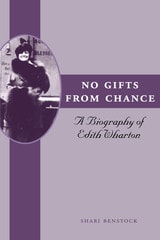
No Gifts from Chance
A Biography of Edith WhartonBy Shari Benstock
University of Texas Press, 2004
The first new biography of America's foremost woman of letters in twenty years, No Gifts from Chance presents an Edith Wharton for our times. Far from the emotionally withdrawn and neurasthenic victim of earlier portraits, she is revealed here as an ambitious, disciplined, and self-determined woman who fashioned life to her own desires. Drawing on government records, legal and medical documents, and recently opened collections of Wharton's letters, Shari Benstock's biography offers new information on what have been called the key mysteries of her life: the question of her paternity, her troubled relations with her mother and older brothers, her marriage to manic-depressive Teddy Wharton, and her extramarital affair with Morton Fullerton.
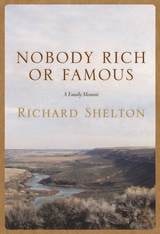
Nobody Rich or Famous
A Family MemoirRichard Shelton
University of Arizona Press, 2016
Known for his storytelling, Shelton crafts a tale of poverty and its attendant sorrows: alcoholism, neglect, and abuse. But the tenacity of the human spirit shines through. This is an epic tale of Steinbeckian proportions, but it is not fiction. This is memoir in its finest tradition, illuminating today’s cultural chasm between the haves and have-nots. In the author’s words, Nobody Rich or Famous is “the story of a family and how it got that way.”
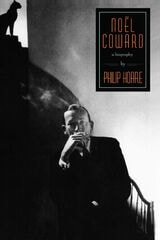
Noel Coward
A BiographyPhilip Hoare
University of Chicago Press, 1998
"Philip Hoare's careful research and lucid presentation in his Noël Coward: A Biography adds depth to the picture."-New York Times Book Review
"A fascinating, in-depth biography."—Library Journal
"Hoare has profiled vividly and in-depth a complex legend who had a talent for creating and recreating both himself and his works."—Publishers Weekly
"In the thicket of books about the life and work of Coward, Philip Hoare's stands out as the most well-documented and objective."—Los Angeles Times
"[Hoare's] book, like its subject, strives for effortless sophistication, and succeeds."—Newsday
"Hoare's retelling of Coward's story [is] the most vivid, insightful, and fascinating so far."—John Lahr, The New Yorker
Norman Mailer - American Writers 73
University of Minnesota Pamphlets on American WritersRichard Foster
University of Minnesota Press, 1968
Norman Mailer - American Writers 73 was first published in 1968. Minnesota Archive Editions uses digital technology to make long-unavailable books once again accessible, and are published unaltered from the original University of Minnesota Press editions.
This pamphlet series has been hailed by critics, teachers, and librarians as an ideals means of introducing both students and general readers to American writers of all periods. Choice has commented: "For the small library this series offers at small cost introductions by reputable critics o dozens of significant authors, and the larger the library the greater the number of undergraduate students looking for a place to start on some writer." The New York Times Book Review has called the pamphlets "extraordinarily good," pointing out that "they are just long enough (forty-eight pages) to permit a real survey of an author's work and short enough to attract the casual reader, the anxiety-ridden student, and the professor desperate for the straight word on an unfamiliar writer."

Not at All What One Is Used To
The Life and Times of Isabella GardnerMarian Janssen
University of Missouri Press, 2026
Born in 1915 to one of New England’s elite wealthy families, Isabella Gardner was expected to follow a certain path in life—one that would take her from marriageable debutante to proper society lady. But that plan was derailed when at age eighteen, Isabella caused a drunk-driving accident. Her family, to shield her from disgrace, sent her to Europe for acting studies, not foreseeing how life abroad would fan the romantic longings and artistic impulses that would define the rest of Isabella’s years. In Not at All What One Is Used To, author Marian Janssen tells the story of this passionate, troubled woman, whose career as a poet was in constant compromise with her wayward love life and her impulsive and reckless character.
Notes of a Provincial Wildfowler
Sergei Aksakov
Northwestern University Press, 2012
Notes of a Provincial Wildfowler is filled with precise descriptions of bird behavior, observations of their life cycles, and lyrical discourses on the habitats of the Russian steppe. Aksakov's nostalgic fondness for his homeland permeates his Notes, and his passion for the habits of his subjects provides a stark contrast with his enthusiasm for the shooting--and eating--of his quarry.
Notes on Fishing
Sergei Aksakov
Northwestern University Press, 1997
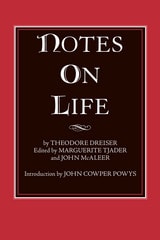
Notes on Life
Theodore Dreiser
University of Alabama Press, 1974
Exploring human nature, society, and destiny through the lens of American naturalism.
In Notes on Life, Theodore Dreiser—best known for his landmark novels Sister Carrie and An American Tragedy—reveals himself as an incisive thinker grappling with the forces that shape human existence. This compelling collection of essays brings together Dreiser’s reflections on society, ambition, morality, and the often-unseen pressures that guide individual lives. Written during a period of rapid cultural and industrial transformation in the United States, these essays offer a deeply engaged response to the uncertainties and contradictions of modern life.
At the heart of Notes on Life lies Dreiser’s enduring commitment to the principles of literary naturalism: the belief that human behavior is influenced—if not determined—by environment, heredity, and social conditions. Yet these essays go beyond literary theory. They present a searching, often personal inquiry into what it means to live meaningfully in a world shaped by inequality, chance, and desire. Dreiser examines the tension between individual aspiration and societal constraint, probing the psychological and moral dimensions of success, failure, and identity.
What distinguishes this collection is its accessibility and range. Dreiser writes with a directness that invites readers into complex philosophical questions without sacrificing intellectual depth. Whether considering the nature of happiness, the role of material success, or the ethical dilemmas of modern society, he offers insights that remain strikingly relevant. His voice—by turns analytical, reflective, and quietly provocative—bridges the gap between literature and philosophy, making these essays as engaging for general readers as they are valuable for students and scholars.
For those interested in American literature, Notes on Life provides essential context for understanding Dreiser’s fiction and the broader movement of realism and naturalism in the early twentieth century. For contemporary readers, it offers a timeless meditation on the forces that continue to shape human experience: ambition, circumstance, and the search for meaning in an ever-changing world.
Both a work of literary significance and a volume of enduring philosophical reflection, Notes on Life stands as a testament to Dreiser’s intellectual breadth and his unwavering commitment to exploring the complexities of human life.
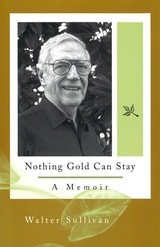
Nothing Gold Can Stay
A MemoirWalter Sullivan
University of Missouri Press, 2006