Results by title
92 books match the query 'Notes' and 30 start with n

NOTES OF A RED GUARD
Eduard M. Dune. Translated and Edited by Diane P. Koenker and S. A. Smith
University of Illinois Press, 1993
account takes the reader into Red Guard and Red Army units, Moscow factories,
workers' homes, and to the unfamiliar world of feudal Dagestan. Worker-revolutionary
Eduard Dune was seventeen when the Russian revolution began. He joined the Bolshevik
party and fought with the Moscow Red Guard during the October revolution. Notes
of a Red Guard is his candid account of what happened through 1921. This
uncensored account offers a rare glimpse of revolutionary Russia from the perspective
of an educated, skilled worker who became a rank-and-file participant.
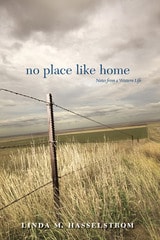
No Place Like Home
Notes from a Western LifeLinda M. Hasselstrom
University of Nevada Press, 2010
In No Place Like Home, Linda Hasselstrom ponders the changing nature of community in the modern West, where old family ranches are being turned into subdivisions and historic towns are evolving into mean, congested cities. Her scrutiny, like her life, moves back and forth between her ranch on the South Dakota prairie and her house in an old neighborhood at the edge of downtown Cheyenne, Wyoming. The vignettes that form the foundation of her consideration are drawn from the communities she has known during her life in the West, reflecting on how they have grown, thrived, failed, and changed, and highlighting the people and decisions that shaped them. Hasselstrom’s ruminations are both intensely personal and universal. She laments the disappearance of the old prairie ranches and the rural sense of community and mutual responsibility that sustained them, but she also discovers that a spirit of community can be found in unlikely places and among unlikely people. The book defines her idea of how a true community should work, and the kind of place she wants to live in. Her voice is unique and honest, both compassionate and cranky, full of love for the harsh, hauntingly beautiful short-grass prairie that is her home, and rich in understanding of the intricacies of the natural world around her and the infinite potentials of human commitment, hope, and greed. For anyone curious about the state of the contemporary West, Hasselstrom offers a report from the front, where nature and human aspirations are often at odds, and where the concepts of community and mutual responsibility are being redefined.
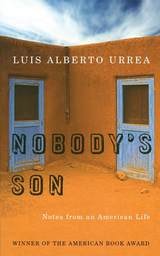
Nobody's Son
Notes from an American LifeLuis Alberto Urrea
University of Arizona Press, 1998
. . . I'm not saying it's our story. I'm not saying it isn't. It might be yours. "How do you tell a story that cannot be told?" writes Luis Alberto Urrea in this potent memoir of a childhood divided. Born in Tijuana to a Mexican father and an Anglo mother from Staten Island, Urrea moved to San Diego when he was three. His childhood was a mix of opposites, a clash of cultures and languages. In prose that seethes with energy and crackles with dark humor, Urrea tells a story that is both troubling and wildly entertaining. Urrea endured violence and fear in the black and Mexican barrio of his youth. But the true battlefield was inside his home, where his parents waged daily war over their son's ethnicity. "You are not a Mexican!" his mother once screamed at him. "Why can't you be called Louis instead of Luis?" He suffers disease and abuse and he learns brutal lessons about machismo. But there are gentler moments as well: a simple interlude with his father, sitting on the back of a bakery truck; witnessing the ultimate gesture of tenderness between the godparents who taught him the magical power of love. "I am nobody's son. I am everybody's brother," writes Urrea. His story is unique, but it is not unlike thousands of other stories being played out across the United States, stories of other Americans who have waged war—both in the political arena and in their own homes—to claim their own personal and cultural identity. It is a story of what it means to belong to a nation that is sometimes painfully multicultural, where even the language both separates and unites us. Brutally honest and deeply moving, Nobody's Son is a testament to the borders that divide us all.
Notes and Comments on Robert's Rules, 3rd Edition
Jon L. Ericson
Southern Illinois University Press, 2004
This third edition of Jon Ericson’s Notes and Comments on Robert’s Rules updates all references and page numbers to the tenth edition of Robert’s Rules of Order Newly Revised, published in 2000. Ericson’s guide to the authoritative parliamentary resource clarifies many of the concepts and rules that intimidate or confuse the members of organizations who use it, stressing that they have a choice in—and may, in fact, modify—the rules by which they are bound.
Ericson begins with the Order of Precedence, which he defines as the key concept in understanding and utilizing parliamentary procedure. He then uses a question-and-answer format in which a logical progression of essential parliamentary questions is explicitly answered, with a rationale for each rule. Throughout, he provides specific page references to Robert’s Rules. Through these three elements, he makes classic doctrine intelligible and workable, leading the reader step-by-step through the rules and their applications and, in the process, encouraging people to feel more positive about parliamentary procedure and their ability to use it.
“Far too many members, armed—or more accurately disarmed—with a misconception of parliamentary procedure, choose to spend a lifetime wondering what is going on and lamenting or blaming others when things fail to go their way,” writes Ericson in the Introduction. “Understanding parliamentary procedure also allows a person to have more fun—not just the fun of socializing outside the business meeting—but the fun of performing in the public arena.”
A popular, concise, and clear handbook, Notes and Comments on Robert’s Rules emphasizes the simple machinery of the system, relates its concepts to the procedures most commonly used in meetings and conventions, and encourages members to obtain and study, rather than shy away from Robert’s Rules of Order Newly Revised. This new edition also expands the number of question-and-answer sections and surveys the research in and commentary on the field since 1991. A laminated, removable card featuring simplified charts of parliamentary motions serves as an additional resource and is included with the volume.
Notes and Comments on Robert's Rules, Fourth Edition
Jim Slaughter, Gaut Ragsdale, Jon Ericson
Southern Illinois University Press, 2012
While Robert’s Rules of Order has long been the standard guide to parliamentary procedure, many readers find the manual too daunting and complex to utilize its full potential. In Notes and Comments on "Robert’s Rules", fourth edition, authors Jim Slaughter, Gaut Ragsdale, and Jon Ericson skillfully guide users through the intricate pathways of the latest edition of Robert’s Rules, transforming the often intimidating parliamentary guidebook into an easy-to-use tool. Notes and Comments explains in simple terms the individual motions found in Robert’s Rules, presents extensive tips and suggestions regarding possible modifications to Robert’s practices; allows readers to witness the vigorous debate about the rules within the notes section; and compares major parliamentary authorities. A reader-friendly question-and-answer format provides immediate solutions to the most common quandaries that arise during the meeting process, and a card featuring simplified charts of parliamentary motions is available for the user’s quick reference.
An essential volume for members of nonprofits, voluntary associations, unions, condo and homeowner associations, student organizations, and government bodies, Notes and Comments on “Robert’s Rules” makes parliamentary procedure accessible to meeting participants as never before. Each section of this authoritative, straightforward guide is designed to empower participants with the confidence and knowledge necessary to navigate any meeting, large or small, with the utmost efficiency.
2013 Winner of the Phifer Award from the National Communication Association
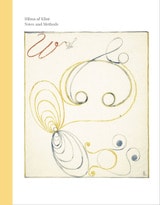
Notes and Methods
Hilma af Klint
University of Chicago Press, 2018
Hilma af Klint studied at the Royal Swedish Academy in Stockholm where she was part of the first generation of female students. Up until the beginning of the century, she painted mainly landscapes and detailed botanical studies. Her work from this period was that of a young artist of her time who meticulously observed the world around her. But, like many of her contemporaries, af Klint was also interested in the invisible relationships that shape our world, believing strongly in a spiritual dimension. She joined the Theosophical Society, and, with four fellow female members who together called themselves “The Five,” began to study mediumship. Between 1906 and 1915, purportedly guided by a higher power, af Klint created 193 individual works that, in both scale and scope of imagery, are like no other art created at that time. Botanically inspired images and mystical symbols, diagrams, words, and geometric series, all form part of af Klint’s abstract language. These abstract techniques would not be seen again until years later.
Notes and Methods presents facsimile reproductions of a wide array of af Klint’s early notebooks accompanied by the first English translation of af Klint’s extensive writings. It contains the rarely seen “Blue Notebooks,” hand-painted and annotated catalogues af Klint created of her most famous series “Paintings for the Temple,” and a dictionary compiled by af Klint of the words and letters found in her work. This extraordinary collection is edited by and copublished with Christine Burgin, and features an introduction by Iris Müller-Westermann. It will stand as an important and timely contribution to the legacy of Hilma af Klint.

Notes from a Sealed Room
An Israeli View of the Gulf WarRobert Werman. Introduction by Gerald M. Phillips
Southern Illinois University Press, 1992
In this compelling and often startling account, Robert Werman chronicles his experiences as an Israeli citizen living in Jerusalem during the Gulf War. On January 19, 1991, he began writing daily reports on his computer, sending them to friends and a few computer networks that dealt with Jewish culture and the politics of the Middle East. To Werman’s surprise, he received numerous electronic responses to his entries, sometimes as many as one hundred a day. As a result, his "war diary" was born, a diary that he continued until February 22, 1991, when, near the end of the war, he was hospitalized for a heart condition.
In the early entries, Werman notes each Iraqi Scud attack, describing in detail the sealed room in which he and his family sought shelter during the expected chemical attacks. "Sitting in the antigas room, members of the family try to put on a brave face, make jokes. . . . Only the dog, a rather stately collie, sits quietly and does not appear at all excited. We pity the dog, for he is the only one without a mask. But then we remember that—without a mask—he is our canary in the coal mine." Futilely, Werman seeks patterns to the attacks, attempting to predict when they might occur. He writes of the nation’s response to war: joggers running with their gas masks in hand, schools temporarily disbanded while children meet in small groups to continue their education, city streets emptied by six o'clock each evening as people wait in their homes for the sound of the sirens that herald an assault. He discusses the varying opinions concerning retaliation against Iraq, the fluctuating morale of the country, the damage produced by Iraqi missiles, and the widespread speculation of Israeli citizens concerning their country’s survival. Yet Werman’s daily reports, digressions, and explanations not only include his observations and impressions; they also poignantly reveal his own personal story and political, religious, and philosophical views.
Werman’s journal gives a singular view of a country under siege, recounting in detail the pressures, conflicts, and dangers existing during a war. It is a distinctive book, a fascinating personal and political account of a man, his family, their nation, and a war.

Notes from the EU’s Eastern Edge
How Migrants Were Weaponized on the Polish-Belarusian BorderJo Harper
Central European University Press, 2026
Notes from the North Country
O. B. Eustis
University of Michigan Press, 1983
Notes from the Sex Worker Left
Lumpen TheoryHeather Berg
Duke University Press, 2026
Notes in Banach Spaces
Edited by H. Elton Lacey
University of Texas Press, 1980

Notes of Debates in the Federal Convention of 1787
James Madison
Ohio University Press, 1987
James Madison’s record of the Constitutional Convention traces day by day the debates held from May to September 1787 and presents the only complete picture we have of the strategy, interests, and ideas of the Founders at the convention itself.
In this indispensable primary document, Madison not only provides detailed insights into one of the great events of US history, but clearly sets forth his own position on such issues as the balance of powers, the separation of functions, and the general role of the federal government. More than in Federalist, which shows the carefully formalized conclusions of his political thought, we see in Debates his philosophy in action, evolving in daily tension with the viewpoints of the other delegates. It is for this reason that Debates is invaluable for placing in perspective the incomplete records of such well-known figures as Rufus King and Alexander Hamilton, and the constitutional plans of such men as Edmund Randolph and Charles Pinckney.
Madison’s contemporaries regarded him as the chief statesmen at the Philadelphia convention; in addition to this, his record outranks in importance all the other writings of the founders of the American republic. He is thus identified, as no other man is, with the making of the Constitution and the correct interpretation of the intentions of its drafters.
New to this edition of Debates is a thorough, scholarly index of some two thousand entries.
Notes of Travel Through the Territory of Arizona
J. H. Marion; Edited by Donald M. Powell
University of Arizona Press, 1965
“A valuable and well written document, now made available to the general public and enhanced by the addition of an introduction and notes by Mr. Powell. . . . the publication will be of value to serious students of Arizona history.”—Journal of Arizona History

Notes of a Provincial Wildfowler
Sergei Aksakov
Northwestern University Press, 2012
Notes of a Provincial Wildfowler is filled with precise descriptions of bird behavior, observations of their life cycles, and lyrical discourses on the habitats of the Russian steppe. Aksakov's nostalgic fondness for his homeland permeates his Notes, and his passion for the habits of his subjects provides a stark contrast with his enthusiasm for the shooting--and eating--of his quarry.
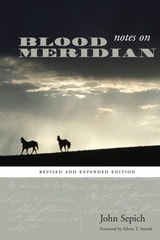
Notes on Blood Meridian
Revised and Expanded EditionBy John Sepich
University of Texas Press, 2008

Notes on Fishing
Sergei Aksakov
Northwestern University Press, 1997
Notes on Life
Theodore Dreiser
University of Alabama Press, 1974
Exploring human nature, society, and destiny through the lens of American naturalism.
In Notes on Life, Theodore Dreiser—best known for his landmark novels Sister Carrie and An American Tragedy—reveals himself as an incisive thinker grappling with the forces that shape human existence. This compelling collection of essays brings together Dreiser’s reflections on society, ambition, morality, and the often-unseen pressures that guide individual lives. Written during a period of rapid cultural and industrial transformation in the United States, these essays offer a deeply engaged response to the uncertainties and contradictions of modern life.
At the heart of Notes on Life lies Dreiser’s enduring commitment to the principles of literary naturalism: the belief that human behavior is influenced—if not determined—by environment, heredity, and social conditions. Yet these essays go beyond literary theory. They present a searching, often personal inquiry into what it means to live meaningfully in a world shaped by inequality, chance, and desire. Dreiser examines the tension between individual aspiration and societal constraint, probing the psychological and moral dimensions of success, failure, and identity.
What distinguishes this collection is its accessibility and range. Dreiser writes with a directness that invites readers into complex philosophical questions without sacrificing intellectual depth. Whether considering the nature of happiness, the role of material success, or the ethical dilemmas of modern society, he offers insights that remain strikingly relevant. His voice—by turns analytical, reflective, and quietly provocative—bridges the gap between literature and philosophy, making these essays as engaging for general readers as they are valuable for students and scholars.
For those interested in American literature, Notes on Life provides essential context for understanding Dreiser’s fiction and the broader movement of realism and naturalism in the early twentieth century. For contemporary readers, it offers a timeless meditation on the forces that continue to shape human experience: ambition, circumstance, and the search for meaning in an ever-changing world.
Both a work of literary significance and a volume of enduring philosophical reflection, Notes on Life stands as a testament to Dreiser’s intellectual breadth and his unwavering commitment to exploring the complexities of human life.
Notes on Nowhere
Feminism, Utopian Logic, and Social TransformationJennifer Burwell
University of Minnesota Press, 1997
Notes on Nowhere was first published in 1997. Minnesota Archive Editions uses digital technology to make long-unavailable books once again accessible, and are published unaltered from the original University of Minnesota Press editions.
The term utopia implies both "good place" and "nowhere." Since Sir Thomas More wrote Utopia in 1516, debates about utopian models of society have sought to understand the implications of these somewhat contradictory definitions. In Notes on Nowhere, author Jennifer Burwell uses a cross section of contemporary feminist science fiction to examine the political and literary meaning of utopian writing and utopian thought.
Burwell provides close readings of the science fiction novels of five feminist writers-Marge Piercy, Sally Gearhart, Joanna Russ, Octavia Butler, and Monique Wittig-and poses questions central to utopian writing: Do these texts promote a tradition in which narratives of the ideal society have been used to hide rather than reveal violence, oppression, and social divisions? Can a feminist critical utopia offer a departure from this tradition by using utopian narratives to expose contradiction and struggle as central aspects of the utopian impulse? What implications do these questions have for those who wish to retain the utopian impulse for emancipatory political uses?
As one way of answering these questions, Burwell compares two "figures" that inform utopian writing and social theory. The first is the traditional abstract "revolutionary" subject who contradicts existing conditions and who points us to the ideal body politic. The second, "resistant," subject is partial, concrete, and produced by conditions rather than operating outside of them. In analyzing contemporary changes in the subject's relationship to social space, Burwell draws from and revises "standpoint approaches" that tie visions of social transformation to a group's position within existing conditions.
By exploring the dilemmas, antagonisms, and resolutions within the critical literary feminist utopia, Burwell creates connections to a similar set of problems and resolutions characterizing "nonliterary" discourses of social transformation such as feminism, gay and lesbian studies, and Marxism. Notes on Nowhere makes an original, significant, and persuasive contribution to our understanding of the political and literary dimensions of the utopian impulse in literature and social theory.
Jennifer Burwell teaches in the Department of English at Wesleyan University in Connecticut.
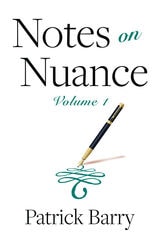
Notes on Nuance
Volume 1Patrick Barry
Michigan Publishing Services, 2020
To succeed in law, business, education, government, health care, and many other fields, it is becoming increasingly important to distinguish yourself as a savvy communicator. Social media has only accelerated the ways in which we all must learn to use our words to connect, compete, and create. There are features of the English language, however, that many of us haven’t taken full advantage of yet. Notes on Nuance is designed to help change that.
Drawing on a diverse collection of authors—from novelists to physicists, from ancient Greek historians to modern-day CEOs—it reveals the hidden mechanics that skilled writers use to add style and sophistication to their sentences and slogans. It’s the perfect resource for people who are looking to do more with their written words.
This book includes materials from a popular course called “Good with Words: Writing and Editing” that Professor Patrick Barry created at both the University of Michigan Law School and the University of Chicago Law School. An online version of that course is now available through the educational platform Coursera.
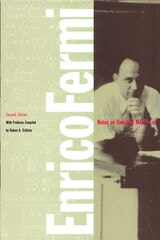
Notes on Quantum Mechanics
Enrico Fermi
University of Chicago Press, 1995
At the close of each lecture, Fermi created a single problem for his students. These challenging exercises were not included in Fermi's notes but were preserved in the notes of his students. This second edition includes a set of these assigned problems as compiled by one of his former students, Robert A. Schluter.
Enrico Fermi was awarded the Nobel Prize for Physics in 1938.
Notes on Social Measurement
Historical and CriticalOtis Dudley Duncan
Russell Sage Foundation, 1984

Notes on Vermin
Caroline Hovanec
University of Michigan Press, 2025
Notes on Vermin is an atlas of the literary vermin that appear in modern and contemporary literature, from Franz Kafka’s gigantic insect to Richard Wright’s city rats to Namwali Serpell’s storytelling mosquitoes. As parasites, trespassers, and collectives, vermin animals prove useful to writers who seek to represent life in the margins of power. Drawing on psychoanalysis, cultural studies, eco-Marxism, and biopolitics, this book explores four uses for literary vermin: as figures for the repressed thought, the uncommitted fugitive, the freeloading parasite, and the surplus life. In a series of short, accessible, interlinked essays, Notes on Vermin explores what animal pests can show us about our cultures, our environments, and ourselves.
Notes on the Greek Text of Deuteronomy
John William Wevers
SBL Press, 1995
Notes on the Greek Text of Exodus
John William Wevers
SBL Press, 1990
Notes on the Greek Text of Genesis
John William Wevers
SBL Press, 1993
Notes on the Greek Text of Leviticus
John William Wevers
SBL Press, 1997
Notes on the Greek Text of Numbers
John William Wevers
SBL Press, 1998
Notes on the Heart
Affective Issues in the Writing ClassroomSusan H. McLeod
Southern Illinois University Press, 1997
It has long been recognized that affect (that is, the noncognitive aspect of mental activity) plays a large role in writing and in learning to write. According to Susan H. McLeod, however, the model that has been most used for empirical research on the writing process is based on cognitive psychology and does not take into account affective phenomena. Nor does the social constructionist view of the writing process acknowledge the affective realm except in a very general way. To understand the complete picture, McLeod insists, we need to explore how cognitive, affective, and social elements interact as people write.
In this book, McLeod follows a group of students through a semester of writing assignments, tracking the students’ progress and examining the affective elements relevant to their writing. To facilitate future discussion of these phenomena, McLeod also provides suggested definitions for terms in the affective domain.
In a very real sense, this book is the result of a collaboration of three Susans: Susan McLeod, who researched and wrote the book; Sue Hallett, an instructor in Washington State University’s composition program whose classes McLeod observed and who helped provide much of the data; and Susan Parker, a graduate student who observed Hallett’s class and who ran a tutorial connected to that class. To provide a narrative structure, McLeod and her two collaborators have constructed a simulated semester, conflating the year and a half of the study into one semester and creating a class that is a composite drawn from seven classrooms over three semesters.
Although philosophers have had much to say about the affective domain, Notes on the Heart is based for the most part on research from the social sciences. Discussions of pedagogy, while meant to have practical value, are suggestive rather than prescriptive. The goal is to help teachers see their practice in new way.
Teachers will be particularly interested in McLeod’s discussion of teacher affect/effect. This section examines both the issue of the "Pygmalion effect" (students becoming better because the teacher believes they are) and perhaps the more common opposite, the "golem effect" (students becoming less capable because their teachers view them that way).

Notes on the Witt Classification of Hermitian Innerproduct Spaces over a Ring of Algebraic Integers
By P. E. Conner, Jr.
University of Texas Press, 1979
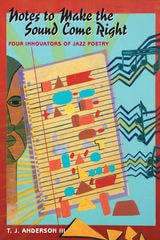
Notes to Make the Sound Come Right
Four Innovators of Jazz PoetryT.J. Anderson III
University of Arkansas Press, 2004