Results by title
939 books match the query 'Religious aspects' and 16 start with n
Naming Our Sins
How Recognizing the Seven Deadly Vices can Renew the Sacrament of ReconciliationJana Bennett
Catholic University of America Press, 2019
Narrative Landmines
Rumors, Islamist Extremism, and the Struggle for Strategic InfluenceBernardi, Daniel Leonard
Rutgers University Press, 2012
Islamic extremism is the dominant security concern of many contemporary governments, spanning the industrialized West to the developing world. Narrative Landmines explores how rumors fit into and extend narrative systems and ideologies, particularly in the context of terrorism, counter-terrorism, and extremist insurgencies. Its concern is to foster a more sophisticated understanding of how oral and digital cultures work alongside economic, diplomatic, and cultural factors that influence the struggles between states and non-state actors in the proverbial battle of hearts and minds. Beyond face-to-face communication, the authors also address the role of new and social media in the creation and spread of rumors.
As narrative forms, rumors are suitable to a wide range of political expression, from citizens, insurgents, and governments alike, and in places as distinct as Singapore, Iraq, and Indonesia—the case studies presented for analysis. The authors make a compelling argument for understanding rumors in these contexts as “narrative IEDs,” low-cost, low-tech weapons that can successfully counter such elaborate and expansive government initiatives as outreach campaigns or strategic communication efforts. While not exactly the same as the advanced technological systems or Improvised Explosive Devices to which they are metaphorically related, narrative IEDs nevertheless operate as weapons that can aid the extremist cause.
Native Americans and the Christian Right
The Gendered Politics of Unlikely AlliancesAndrea Smith
Duke University Press, 2008
Smith draws on archival research, interviews, and her own participation in Native struggles and Christian Right conferences and events. She considers American Indian activism within the Promise Keepers and new Charismatic movements. She also explores specific opportunities for building unlikely alliances. For instance, while evangelicals’ understanding of the relationship between the Bible and the state may lead to reactionary positions on issues including homosexuality, civil rights, and abortion, it also supports a relatively progressive position on prison reform. In terms of evangelical and Native American feminisms, she reveals antiviolence organizing to be a galvanizing force within both communities, discusses theories of coalition politics among both evangelical and indigenous women, and considers Native women’s visions of sovereignty and nationhood. Smith concludes with a reflection on the implications of her research for the field of Native American studies.
Natural Moral Law in Contemporary Society
Holger Zaborowski
Catholic University of America Press, 2010
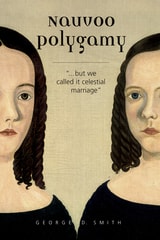
Nauvoo Polygamy
"…but we called it celestial marriage"George D. Smith
Signature Books, 2011
“Nauvoo Polygamy is s a thorough investigation of sexual politics in the City of the Saints, the 1840s Mormon headquarters in the U.S. State of Illinois. Written with precision, clarity, and ease, it is a major contribution to Mormon history, groundbreaking in identifying the other polygamists who followed the lead of their prophet, Joseph Smith, in taking multiple partners.” —Klaus J. Hansen, Professor Emeritus of History, Queen’s University, Ontario
“If for no other reason, the inclusion of chapter 6 makes this book worth its price. The chapter quotes liberally from those like Elizabeth Ann Whitney and Bathsheba Smith who accepted polygamy rather easily, those like Jane Richards who accepted it only reluctantly, and those like Patty Sessions who found plural marriage almost unbearable. A bonus is chapter 9 which provides a concise historical overview of polygamous societies in Reformation Europe, touches on similar societies in America, and offers an extended discussion of Orson Pratt’s 1852 defense of plural marriage.” —Thomas G. Alexander, Professor Emeritus of History, Brigham Young University
“George Smith shows how many of the prophet’s followers embraced plural marriage during a period when the LDS Church was emphatically denying the practice … [and he tells this in] a lucid writing style.” —Daniel Walker Howe, Pulitzer Prize winning author of What Hath God Wrought: The Transformation of America, 1815-1848.
“An extremely important contribution to the history of polygamy … that allows us to see how Joseph Smith’s marriages fit into the context of his daily life.” —Todd M. Compton, author of In Sacred loneliness: The Plural Wives of Joseph Smith
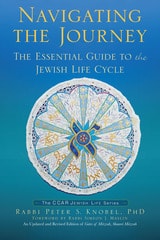
Navigating the Journey
The Essential Guide to the Jewish Life CycleRabbi Peter Knobel, PhD
Central Conference of American Rabbis, 2018
Negotiating the Disabled Body
Representations of Disability in Early Christian TextsAnna Rebecca Solevåg
SBL Press, 2018
An intersectional study of New Testament and noncanonical literature
Anna Rebecca Solevåg explores how nonnormative bodies are presented in early Christian literature through the lens of disability studies. In a number of case studies, Solevåg shows how early Christians struggled to come to terms with issues relating to body, health, and dis/ability in the gospel stories, apocryphal narratives, Pauline letters, and patristic expositions. Solevåg uses the concepts of narrative prosthesis, gaze and stare, stigma, monster theory, and crip theory to examine early Christian material to reveal the multiple, polyphonous, contradictory ways in which nonnormative bodies appear.
Features:
- Case studies that reveal a variety of understandings, attitudes, medical frameworks, and taxonomies for how disabled bodies were interpreted
- A methodology that uses disability as an analytical tool that contributes insights about cultural categories, ideas of otherness, and social groups’ access to or lack of power
- An intersectional perspective drawing on feminist, gender, queer, race, class, and postcolonial studies
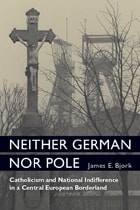
Neither German nor Pole
Catholicism and National Indifference in a Central European BorderlandJames E. Bjork
University of Michigan Press, 2009
"This is a fascinating local story with major implications for studies of nationalism and regional identities throughout Europe more generally."
---Dennis Sweeney, University of Alberta
"James Bjork has produced a finely crafted, insightful, indeed, pathbreaking study of the interplay between religious and national identity in late nineteenth-century Central Europe."
---Anthony Steinhoff, University of Tennessee at Chattanooga
Neither German nor Pole examines how the inhabitants of one of Europe's most densely populated industrial districts managed to defy clear-cut national categorization, even in the heyday of nationalizing pressures at the turn of the twentieth century. As James E. Bjork argues, the "civic national" project of turning inhabitants of Upper Silesia into Germans and the "ethnic national" project of awakening them as Poles both enjoyed successes, but these often canceled one another out, exacerbating rather than eliminating doubts about people's national allegiances. In this deadlock, it was a different kind of identification---religion---that provided both the ideological framework and the social space for Upper Silesia to navigate between German and Polish orientations. A fine-grained, microhistorical study of how confessional politics and the daily rhythms of bilingual Roman Catholic religious practice subverted national identification, Neither German nor Pole moves beyond local history to address broad questions about the relationship between nationalism, religion, and modernity.
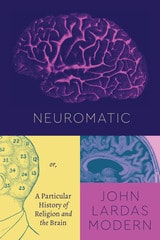
Neuromatic
Or, A Particular History of Religion and the BrainJohn Lardas Modern
University of Chicago Press, 2021
In Neuromatic, religious studies scholar John Lardas Modern offers a sprawling examination of the history of the cognitive revolution and current attempts to locate all that is human in the brain, including spirituality itself. Neuromatic is a wildly original take on the entangled histories of science and religion that lie behind our brain-laden present: from eighteenth-century revivals to the origins of neurology and mystic visions of mental piety in the nineteenth century; from cyberneticians, Scientologists, and parapsychologists in the twentieth century to contemporary claims to have discovered the neural correlates of religion.
What Modern reveals via this grand tour is that our ostensibly secular turn to the brain is bound up at every turn with the religion it discounts, ignores, or actively dismisses. In foregrounding the myths, ritual schemes, and cosmic concerns that have accompanied idealizations of neural networks and inquiries into their structure, Neuromatic takes the reader on a dazzling and disturbing ride through the history of our strange subservience to the brain.
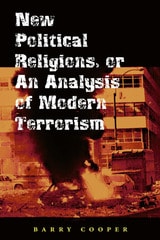
New Political Religions, or an Analysis of Modern Terrorism
Barry Cooper
University of Missouri Press, 2004
In New Political Religions, or an Analysis of Modern Terrorism, Barry Cooper applies the insights of Eric Voegelin to the phenomenon of modern terrorism. Cooper points out that the chief omission from most contemporary studies of terrorism is an analysis of the “spiritual motivation” that is central to the actions of terrorists today. When spiritual elements are discussed in conventional literature, they are grouped under the opaque term religion. A more conceptually adequate approach is provided by Voegelin’s political science and, in particular, by his Schellingian term pneumopathology—a disease of the spirit.
While terrorism has been used throughout the ages as a weapon in political struggles, there is an essential difference between groups who use these tactics for more of less rational political goals and those seeking more apocalyptic ends. Cooper argues that today's terrorists have a spiritual perversity that causes them to place greater significance on killing than on exploiting political grievances. He supports his assertion with an analysis of two groups that share the characteristics of a pneumopathological consciousness—Aum Shinrikyo, the terrorist organization that poisoned thousands of Tokyo subway riders in 1995, and Al-Qaeda, the group behind the infamous 9/11 killings.Cooper applies the Voegelinian terms first reality (a commonsense goal regarding legitimate political grievances) and second reality (a fantastic objective sought by those whose rationality has been obscured) to show the major divide between political and apocalyptic terrorist groups. Osama Bin Laden's "second reality" was the imaginary goal that the 9/11 attack was supposed to achieve, and the commonsense reality was what truly happened (the deaths of nearly 3,000 people and the United States's subsequent military response). Cooper shows how such spiritual perversity enables a human being, imagining himself empowered by God, to go on a campaign of mass destruction.
Cooper concludes with a chapter on the uniqueness of terrorist networks, their limitations, and the means by which they can be dealt with. In the ongoing conversations among specialists in terrorist studies, as well as the ordinary discourse of citizens in western democracies wishing to understand the world around them, this book will add a distinctive voice.
New Thinking in Islam
The Jihad for Democracy, Freedom and Women’s RightsKatajun Amirpur
Gingko, 2015
Next-Generation Leadership
A Toolkit for Those in Their Teens, Twenties, & Thirties, Who Want to be Successful LeadersWilliam J. Byron
University of Scranton Press, 2010
Drawing on his five decades of leadership experience, William Byron outlines in this volume the theory, practice, and purpose of leadership. Intuition, humility, empathy, simplicity of lifestyle, and sound speaking and writing skills are all essential for effective leadership, and Byron devotes separate, in-depth chapters to each. Aimed at an audience now largely overlooked by leadership literature, Next Generation Leadership will appeal to the business, government, religion, and nonprofit leaders of tomorrow.
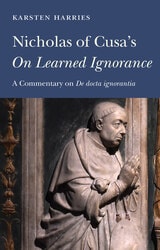
Nicholas of Cusa's <i>On Learned Ignorance</i>
A Commentary on <i>De docta ignorantia</i>Karsten Harries
Catholic University of America Press, 2024
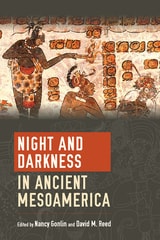
Night and Darkness in Ancient Mesoamerica
Nancy Gonlin
University Press of Colorado, 2021
The anthropological study of night and darkness enriches and strengthens the understanding of human behavior, power, economy, and the supernatural. In eleven case studies featuring the residents of Teotihuacan, the Classic period Maya, inhabitants of Rio Ulúa, and the Aztecs, the authors challenge archaeologists to consider the influence of the ignored dimension of the night and the role and expression of darkness on ancient behavior. Chapters examine the significance of eclipses, burials, tombs, and natural phenomena considered to be portals to the underworld; animals hunted at twilight; the use and ritual meaning of blindfolds; night-blooming plants; nocturnal foodways; fuel sources and lighting technology; and other connected practices.
Night and Darkness in Ancient Mesoamerica expands the scope of published research and media on the archaeology of the night. The book will be of interest to those who study the humanistic, anthropological, and archaeological aspects of the Aztec, Maya, Teotihuacanos, and southeastern Mesoamericans, as well as sensory archaeology, art history, material culture studies, anthropological archaeology, paleonutrition, socioeconomics, sociopolitics, epigraphy, mortuary studies, volcanology, and paleoethnobotany.
Contributors: Jeremy Coltman, Christine Dixon, Rachel Egan, Kirby Farah, Carolyn Freiwald, Nancy Gonlin, Julia Hendon, Cecelia Klein, Jeanne Lopiparo, Brian McKee, Jan Marie Olson, David M. Reed, Payson Sheets, Venicia Slotten, Michael Thomason, Randolph Widmer, W. Scott Zeleznik
Nonreligious Lifeworlds in Egypt
Sense-Making, Emotion, and EmbodimentKarin van Nieuwkerk
University of Texas Press, 2026
An analysis of the growing visibility of nonreligion in Egypt.
Egypt's 2011 Uprising, while often perceived as a failed revolution, nonetheless nonetheless had durable social effects. Among these has been a rise in expressing atheism and agnosticism, especially among educated and affluent youth—the country’s future leaders.
An intimate ethnography, Nonreligious Lifeworlds in Egypt explores the intellectual and emotional transformations of atheists and agnostics inspired by the aspirational freedom-seeking of the Arab Spring. Rejecting both of Egypt’s dominant religious traditions, Islam and Coptic Christianity, nonreligious people are widely viewed as agents of moral outrage. Amid media-driven panics, their sanity is often questioned by their own families as they experiment with new ways of living and relating. Drawing from in-depth fieldwork, interviews, and social media analysis, Karin van Nieuwkerk reveals her interlocutors’ changing perspectives on sex and gender, eating and drinking, and life and death. Above all, she emphasizes the affective experiences of renouncing religion, marked by anxiety and regret—but also liberation and relief. With rigor and compassion, Van Nieuwkerk opens our minds to the arduous process of exchanging established norms for self-determination.
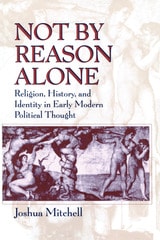
Not by Reason Alone
Religion, History, and Identity in Early Modern Political ThoughtJoshua Mitchell
University of Chicago Press, 1993
This erudite and ambitious work crosses disciplinary boundaries to expose unsuspected connections between political theory, religion, and history. In doing so, it offers a view of modern political thought undistorted by conventional distinctions between the ancient and the modern, and between the religious and the political.
"Original. . . . A delight to read a political philosopher who takes the theologies of Hobbes and Locke seriously." —J. M. Porter, Canadian Journal of History
"Mitchell's argument both illuminates and fascinates. . . . An arresting, even stunning, contribution to our study of modern political thought."—William R. Stevenson, Jr., Christian Scholar's Review