Results by title
5550 books match the query 'Biography & Autobiography' and 112 start with n
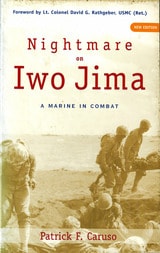
Nightmare on Iwo Jima
A Marine in CombatPatrick F. Caruso, with a foreword by David G. Rathgeber
University of Alabama Press, 2007
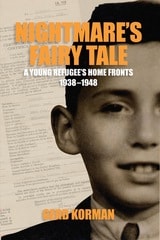
Nightmare's Fairy Tale
A Young Refugee's Home Fronts, 1938–1948Gerd Korman
University of Wisconsin Press, 2007
Fleeing the Nazis in the months before World War II, the Korman family scattered from a Polish refugee camp with the hope of reuniting in America. The father sailed to Cuba on the ill-fated St. Louis; the mother left for the United States after sending her two sons on a Kindertransport. One of the sons was Gerd Korman, whose memoir follows his own path—from the family’s deportation from Hamburg, through his time with an Anglican family in rural England, to the family’s reunited life in New York City. His memoir plumbs the depths of twentieth-century history to rescue the remarkable life story of one of its survivors.
Nimrods
a fake-punk self-hurt anti-memoirKawika Guillermo
Duke University Press, 2023

Nine Choices
Johnny Cash and American CultureJonathan Silverman
University of Massachusetts Press, 2010
For much of his career, Johnny Cash opened his shows with the tagline, “Hello, I'm Johnny Cash.” This introduction seemed unnecessary, since everyone in the audience knew who he was—the famous musical artist whose career spanned almost five decades, whose troubled life on and off the stage received wide publicity, and whose cragged face seemed to express a depth and intensity not found in any other artist, living or dead.
For Cash, as for many celebrities, renown was the product of both hard work and luck. Often a visionary and always a tireless performer, he was subject to a whirlwind of social, economic, and cultural countercurrents. Nine Choices explores the tension between Cash's desire for mainstream success, his personal struggles with alcohol and drugs, and an ever-changing cultural landscape that often circumscribed his options.
Drawing on interviews, archival research, and textual analysis, Jonathan Silverman focuses on Cash's personal and artistic choices as a way of understanding his life, his impact on American culture, and the ways in which that culture in turn shaped him. Cash made decisions about where he would live, what he would play, who would produce his albums, whether he would support the Vietnam War, and even if he would flip his famous “bird”—the iconic image of Cash giving the finger which is now plastered on posters and T-shirts everywhere—in the context of cultural forces both visible and opaque. He made other decisions in consultation with a variety of people, many of whom were chiefly concerned with the reaction of his audiences.
Less a conventional biography than a study of the making of an identity, Nine Choices explores how Johnny Cash sought to define who he was, how he was perceived, and what he signified through a series of self-conscious actions. The result, Silverman shows, was a life that was often tumultuous but never uninteresting.
Nine Months Is a Year
At Baboquívari SchoolEulalia Bourne
University of Arizona Press, 1968

Nixon and the Silver Screen
Mark Feeney
University of Chicago Press, 2004
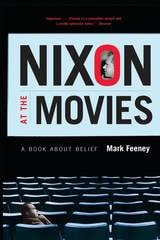
Nixon at the Movies
A Book about BeliefMark Feeney
University of Chicago Press, 2004
Nixon at the Movies takes a new and often revelatory approach to looking at Nixon's career—and Hollywood's. From the obvious (All the President's Men) to the less so (Elvis Presley movies and Nixon's relationship to '60s youth culture) to several onscreen "alternate" Nixons (Fred MacMurray in Double Indemnity, Tony Curtis in The Sweet Smell of Success, Gene Hackman in The Conversation), Feeney sees aspects of Nixon's character, and the nation's, refracted and reimagined in film. Conversely, Feeney argues that Nixon can help us see the movies in a new light, making a strong case for Nixon as the movies' tutelary deity during the early '70s, playing a role in Hollywood's Silver Age comparable to FDR's during its Golden Age.
Stylishly written and bracingly eclectic, Nixon at the Movies draws on biography, politics, cultural history, and film criticism to show just how deeply in the twentieth-century American grain lies the pair of seemingly incongruous nouns in its title. As Nixon once remarked to Garry Wills: "Isn't that a hell of a thing, that the fate of a great country can depend on camera angles?"
Nixon's First Cover-up
The Religious Life of a Quaker PresidentH. Larry Ingle
University of Missouri Press, 2015
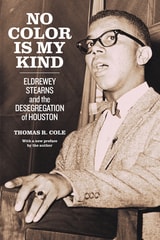
No Color Is My Kind
Eldrewey Stearns and the Desegregation of HoustonThomas R. Cole
University of Texas Press, 2021
In 1959, a Black man named Eldrewey Stearns was beaten by Houston police after being stopped for a traffic violation. He was not the first to suffer such brutality, but the incident sparked Stearns’s conscience and six months later he was leading the first sit-in west of the Mississippi River. No Color Is My Kind, first published in 1997, introduced readers to Stearns, including his work as a civil rights leader and lawyer in Houston’s desegregation movement between 1959 and 1963. This remarkable and important history, however, was nearly lost to bipolar affective disorder. Stearns was a fifty-two-year-old patient in a Galveston psychiatric hospital when Thomas Cole first met him in 1984. Over the course of a decade, Cole and Stearns slowly recovered the details of Stearns’s life before his slide into mental illness, writing a story that is more relevant today than ever.
In this new edition, Cole fills in the gaps between the late 1990s and now, providing an update on the progress of civil rights in Houston and Stearns himself. He also reflects on his tumultuous and often painful collaboration with Stearns, challenging readers to be part of his journey to understand the struggles of a Black man’s complex life. At once poignant, tragic, and emotionally charged, No Color Is My Kind is essential reading as the current movement for racial reconciliation gathers momentum.
No Color Is My Kind
The Life of Eldrewey Stearns and the Integration of HoustonBy Thomas R. Cole
University of Texas Press, 1997
No Day without a Line
From Notebooks by Yury OleshaYury Olesha
Northwestern University Press, 1998

No Gifts from Chance
A Biography of Edith WhartonBy Shari Benstock
University of Texas Press, 2004
The first new biography of America's foremost woman of letters in twenty years, No Gifts from Chance presents an Edith Wharton for our times. Far from the emotionally withdrawn and neurasthenic victim of earlier portraits, she is revealed here as an ambitious, disciplined, and self-determined woman who fashioned life to her own desires. Drawing on government records, legal and medical documents, and recently opened collections of Wharton's letters, Shari Benstock's biography offers new information on what have been called the key mysteries of her life: the question of her paternity, her troubled relations with her mother and older brothers, her marriage to manic-depressive Teddy Wharton, and her extramarital affair with Morton Fullerton.

No Horizon Is So Far
Two Women and Their Historic Journey across AntarcticaLiv Arnesen
University of Minnesota Press, 2019
The extraordinary story of the first two women to cross Antarctica
The fascinating chronicle of Liv Arnesen and Ann Bancroft’s dramatic journey as the first two women to cross Antarctica, No Horizon Is So Far follows the explorers from the planning of their expedition through their brutal trek from the Norwegian sector all the way to McMurdo Station as they walked, skied, and ice-sailed for almost three months in temperatures reaching as low as -35°F, all while towing their 250-pound supply sledges across 1,700 miles of ice full of dangerous crevasses. Through website transmissions and satellite phone calls, Ann and Liv, two former schoolteachers, were able to broadcast their expedition to more than three million students in sixty-five countries to teach geography, science, and the importance of following your dreams.

No Love Without Poetry
The Memoirs of Marina Tsvetaeva's DaughterAriadna Efron
Northwestern University Press, 2009
The memoirs of Ariadna Efron provide an intimate and indispensable perspective on the poet Marina Tsvetaeva’s life and work, told from the point of view of her daughter. This wrenching story about the difficulty of living with genius charts Efron’s relationship with her parents as they navigate art and exile.
Efron’s rapport with her mother, already intense, became strained under the hardships imposed by early twentieth century Russian political upheaval. Efron recounts the family’s travels from Moscow to Germany, to Czechoslovakia, and finally to France, where, against her mother’s advice, Efron decided to return to Russia. Diane Nemec Ignashev draws on Efron’s short stories and her mother’s notebooks to supplement the original memoirs. Haunting and poignant, No Love without Poetry completes extant historical records on Tsvetaeva—and showcases Efron as a literary force in her own right.

No Man Is An Island
Community and Commemoration on Norway's UtøyaJørgen Watne Frydnes, translated by Wendy H. Gabrielsen
University of Massachusetts Press, 2025
On July 22, 2011, a white supremacist killed eight people at Oslo’s Government Center in Norway and then terrorized the idyllic island of Utøya, where he executed sixty-nine more people, mostly teenagers. The country had never suffered such a massacre, and in the aftermath, the entire population was reeling.
Utøya, the Norwegian Labor Party’s summer camp for youth, a beloved place where many Norwegians learned about democratic values and processes, made lifelong friendships, and developed a vision for a just society, became mired in grief and discord. When Jørgen Watne Frydnes took on the daunting task of rebuilding the island and charting its future, he had to figure out a compassionate and just way forward. He made a radical decision: he set out to talk with each family of a murdered person, seeking to understand their needs and their hopes so that the future of the island could include their wishes and concerns. This emotionally grueling work, which was never considered in the scholarly literature on commemoration, led to a true renewal of Utøya, resulting in a meaningful memorial to those who were lost as well as beautiful surroundings for campers who come there to study democracy and peace.
Frydnes’s narrative, originally published in Norwegian, is structured around the seasons of the year and the landscape of the island, and tracks one person’s account of learning how to remember, commemorate, and honor the dead, and acknowledge a mass tragedy, and yet also create a nurturing, aspirational space for hope.

No One Knows Their Names
Screenwriters in HollywoodJorja Prover
University of Wisconsin Press, 1994
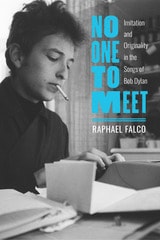
No One to Meet
Imitation and Originality in the Songs of Bob DylanRaphael Falco
University of Alabama Press, 2022
WINNER OF THE ELIZABETH AGEE PRIZE IN AMERICAN LITERATURE
A groundbreaking appreciation of Dylan as a literary practitioner.
The literary establishment tends to regard Bob Dylan as an intriguing, if baffling, outsider. That changed overnight when Dylan was awarded the 2016 Nobel Prize in Literature, challenging us to think of him as an integral part of our national and international literary heritage. No One to Meet: Imitation and Originality in the Songs of Bob Dylan places Dylan the artist within a long tradition of literary production and offers an innovative way to understand his unique and often controversial methods of composition.
Dylan expert Raphael Falco traces the similarities between the way Dylan borrows, digests, and transforms traditional songs and what Renaissance writers called imitatio. Although Dylan’s lyrical postures may suggest an avant-garde consciousness, No One to Meet shows that Dylan’s creative process creatively expands methods used by classical and Renaissance authors.
Drawing on numerous examples, including Dylan’s previously unseen manuscript excerpts and archival materials, Raphael Falco illuminates how the ancient process of poetic imitation, handed down from Greco-Roman antiquity, allows us to make sense of Dylan’s musical and lyrical technique. By placing Dylan firmly in the context of an age-old poetic practice, No One to Meet deepens our appreciation of Dylan’s songs and allows us to celebrate him as what he truly is: a great writer.
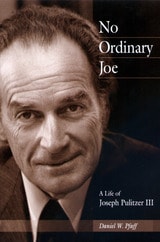
No Ordinary Joe
A Life of Joseph Pulitzer IIIDaniel W. Pfaff
University of Missouri Press, 2005
No Place But Here
A Teacher’s Vocation in a Rural CommunityGarret Keizer
University Press of New England, 1996
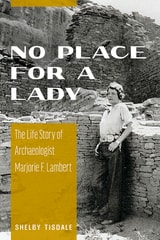
No Place for a Lady
The Life Story of Archaeologist Marjorie F. LambertShelby Tisdale
University of Arizona Press, 2023
In this delightful biography, we gain insight into a time when there were few women establishing full-time careers in anthropology, archaeology, or museums. Shelby Tisdale successfully combines Lambert’s voice from extensive interviews with her own to take us on a thought-provoking journey into how Lambert created a successful and satisfying professional career and personal life in a place she loved (the American Southwest) while doing what she loved.
Through Lambert’s life story we gain new insight into the intricacies and politics involved in the development of archaeology and museums in New Mexico and the greater Southwest. We also learn about the obstacles that young women had to maneuver around in the early years of the development of southwestern archaeology as a profession. Tisdale brings into focus one of the long-neglected voices of women in the intellectual history of anthropology and archaeology and highlights how gender roles played out in the past in determining the career paths of young women. She also highlights what has changed and what has not in the twenty-first century.
Women’s voices have long been absent throughout history, and Marjorie Lambert’s story adds to the growing literature on feminist archaeology.
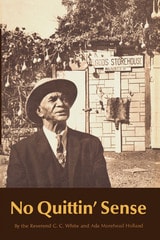
No Quittin' Sense
By the Reverend C. C. White and Ada Morehead Holland
University of Texas Press, 1994
This story, set in the Piney Woods country of East Texas, spans most of a century, from shortly after the close of the Civil War to the 1960's. It is the story of Charley White, who was born in the middle of those woods—in a decaying windowless log cabin a few years after his mother and father were freed from slavery. His childhood, lived in almost unbelievable poverty, was followed by financial stability achieved in middle age through years of struggle. And then, in order to obey God's will, he abandoned this secure life, and for forty years he waged a one-man war on poverty and intolerance.
Winner of the Carr P. Collins Award (best nonfiction book) of the Texas Institute of Letters, No Quittin' Sense presents the story of Rev. C. C. "Charley" White, whose life has inspired thousands of readers since the book was first published in 1969.
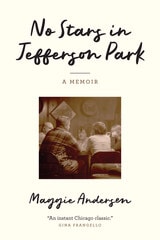
No Stars in Jefferson Park
A MemoirMaggie Andersen
Northwestern University Press, 2026
A Chicagoan’s coming-of-age memoir finds courage in the face of immense loss
In her early twenties, Maggie Andersen was a founding ensemble member of Chicago’s storied Gift Theatre with her then-boyfriend, Michael Patrick Thornton. But after a series of spinal strokes left Thornton paralyzed, Andersen made the heart-wrenching decision to leave him, along with their growing company and, later, her beloved city. No Stars in Jefferson Park alternates between two narratives: the energy and excitement of making art in Chicago’s thriving storefront theater scene and the devastating day-to-day realities of rehabilitation and rebuilding—and somewhere in the middle finding the courage to choose yourself.
Over the past twenty-plus years, the Gift—now performing in the working-class neighborhood of Portage Park—has become one of the most vital storefront theaters in Chicago, with Thornton’s career taking him to Hollywood and Broadway. But Andersen’s story has brought her back home. No Stars in Jefferson Park is a testament to lifelong friendship, a love letter to Chicago, and a profound coming-of-age story about the pain and necessity of putting yourself first.
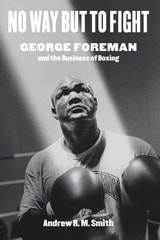
No Way but to Fight
George Foreman and the Business of BoxingBy Andrew R. M. Smith
University of Texas Press, 2020
Olympic gold medalist. Two-time world heavyweight champion. Hall of Famer. Infomercial and reality TV star. George Foreman’s fighting ability is matched only by his acumen for selling. Yet the complete story of Foreman’s rise from urban poverty to global celebrity has never been told until now.
Raised in Houston’s “Bloody Fifth” Ward, battling against scarcity in housing and food, young Foreman fought sometimes for survival and other times just for fun. But when a government program rescued him from poverty and introduced him to the sport of boxing, his life changed forever.
In No Way but to Fight, Andrew R. M. Smith traces Foreman’s life and career from the Great Migration to the Great Society, through the Cold War and culture wars, out of urban Houston and onto the world stage where he discovered that fame brought new challenges. Drawing on new interviews with George Foreman and declassified government documents, as well as more than fifty domestic and international newspapers and magazines, Smith brings to life the exhilarating story of a true American icon. No Way but to Fight is an epic worthy of a champion.
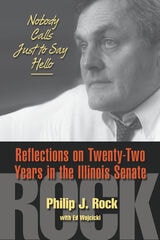
Nobody Calls Just to Say Hello
Reflections on Twenty-Two Years in the Illinois SenatePhilip J. Rock, with Ed Wojcicki
Southern Illinois University Press, 2011
A native of Chicago's West Side, Rock became one of the most influential politicians in Illinois during the 1970s and 1980s. As a senator in the 1970s and senate president from 1979 to 1993, he sponsored historic legislation to assist abused and neglected children and victims of domestic violence, ushered the state through difficult income tax increases and economic development decisions, shepherded an unruly and fragmented Democratic senate caucus, and always was fair to his Republican counterparts. Covering in great detail a critical period in Illinois political history for the first time, Rock explains how making life better for others drove his decisions in office, while also espousing the seven principles he advocates for effective leadership and providing context for how he applied those principles to the legislative battles of the era.
Unlike many Illinois politicians, Rock, a former seminarian, was known for having a greater interest in issues than in partisan politics. Considered a true statesman, he also was known as a skilled orator who could silence a busy floor of legislators with his commentary on important issues and as a devoted public servant who handled tens of thousands of bills and sponsored nearly five hundred of them himself.
Nobody Calls Just to Say Hello, which takes its title from the volume of calls and visits to elected officials from constituents in need of help, perfectly captures Rock's profound reverence for the institutions of government, his respect for other government offices, and his reputation as a problem solver who, despite his ardent Democratic beliefs, disavowed political self-preservation to cross party lines and make government work for the people. Taking readers through his legislative successes, bipartisan efforts, and political defeats-including a heartbreaking loss in the U.S. Senate primary to Paul Simon in 1984-Rock passionately articulates his belief that government's primary role is to help people, offering an antidote to the current political climate with the simple legislative advice, "Just try to be fair, give everyone a chance, and everything else comes after that."
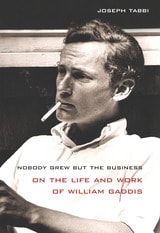
Nobody Grew but the Business
On the Life and Work of William GaddisJoseph Tabbi
Northwestern University Press, 2015
Finalist, 2016 Society for Midland Authors Award for Biography & Memoir
During his lifetime, William Gaddis (1922–1998) evaded biographical questions, never read from his work publicly, and didn’t allow his photograph to appear on his books. Before his novel J R (1975) won Gaddis the National Book Award and some measure of renown, he had given up the bohemian world of 1950s Greenwich Village for a series of corporate jobs that both paid the bills and provided an inside view of the encroachment of market values into every corner of American culture.
By illustrating the interconnectedness of Gaddis’s life and work, Tabbi, among his foremost interpreters, demystifies the “difficult author” and shows a writer who was as attuned as any to the way Americans talk, and who sensitively chronicled the gradual commodification of artistic endeavor. Illuminating, heartbreaking, and masterful, Tabbi’s book gives us the most subtly drawn portrait to date of one of the twentieth century’s seminal novelists.
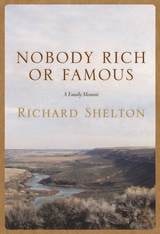
Nobody Rich or Famous
A Family MemoirRichard Shelton
University of Arizona Press, 2016
Known for his storytelling, Shelton crafts a tale of poverty and its attendant sorrows: alcoholism, neglect, and abuse. But the tenacity of the human spirit shines through. This is an epic tale of Steinbeckian proportions, but it is not fiction. This is memoir in its finest tradition, illuminating today’s cultural chasm between the haves and have-nots. In the author’s words, Nobody Rich or Famous is “the story of a family and how it got that way.”
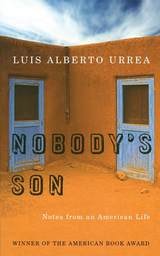
Nobody's Son
Notes from an American LifeLuis Alberto Urrea
University of Arizona Press, 1998
. . . I'm not saying it's our story. I'm not saying it isn't. It might be yours. "How do you tell a story that cannot be told?" writes Luis Alberto Urrea in this potent memoir of a childhood divided. Born in Tijuana to a Mexican father and an Anglo mother from Staten Island, Urrea moved to San Diego when he was three. His childhood was a mix of opposites, a clash of cultures and languages. In prose that seethes with energy and crackles with dark humor, Urrea tells a story that is both troubling and wildly entertaining. Urrea endured violence and fear in the black and Mexican barrio of his youth. But the true battlefield was inside his home, where his parents waged daily war over their son's ethnicity. "You are not a Mexican!" his mother once screamed at him. "Why can't you be called Louis instead of Luis?" He suffers disease and abuse and he learns brutal lessons about machismo. But there are gentler moments as well: a simple interlude with his father, sitting on the back of a bakery truck; witnessing the ultimate gesture of tenderness between the godparents who taught him the magical power of love. "I am nobody's son. I am everybody's brother," writes Urrea. His story is unique, but it is not unlike thousands of other stories being played out across the United States, stories of other Americans who have waged war—both in the political arena and in their own homes—to claim their own personal and cultural identity. It is a story of what it means to belong to a nation that is sometimes painfully multicultural, where even the language both separates and unites us. Brutally honest and deeply moving, Nobody's Son is a testament to the borders that divide us all.
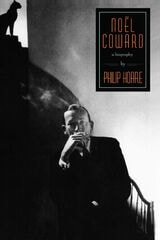
Noel Coward
A BiographyPhilip Hoare
University of Chicago Press, 1998
"Philip Hoare's careful research and lucid presentation in his Noël Coward: A Biography adds depth to the picture."-New York Times Book Review
"A fascinating, in-depth biography."—Library Journal
"Hoare has profiled vividly and in-depth a complex legend who had a talent for creating and recreating both himself and his works."—Publishers Weekly
"In the thicket of books about the life and work of Coward, Philip Hoare's stands out as the most well-documented and objective."—Los Angeles Times
"[Hoare's] book, like its subject, strives for effortless sophistication, and succeeds."—Newsday
"Hoare's retelling of Coward's story [is] the most vivid, insightful, and fascinating so far."—John Lahr, The New Yorker
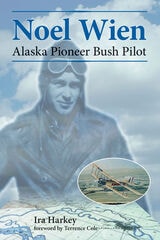
Noel Wien
Alaska Pioneer Bush PilotIra Harkey
University of Alaska Press, 1999
Nola
A Memoir of Faith, Art, and MadnessRobin Hemley
University of Iowa Press, 1998
Nordic Socialism
The Path Toward a Democratic EconomyPelle Dragsted, Translated by William Banks
University of Wisconsin Press, 2025
In Dragsted’s analysis, Denmark and the rest of the Nordic countries are already socialist, but only in part. The dangers come (and here many conservative Americans will disagree) from the unhealthy encroachment of capitalism. His provocative argument is that capitalism and socialism are not in fact mutually exclusive, and already Nordic economies are hybrids, a mix of decommodified, democratically governed sectors and undemocratic, privately controlled enterprises. The relevant question is the degree to which one dominates the other. Currently, undemocratic forces are ascendant, but it need not be so. Dragsted offers both his diagnosis and his proposed solution, a comprehensive plan for a gradual (re)democratization of the economy and a move to fully and firmly embrace, and redefine, “Nordic socialism.”

Norman Mailer - American Writers 73
University of Minnesota Pamphlets on American WritersRichard Foster
University of Minnesota Press, 1968
Norman Mailer - American Writers 73 was first published in 1968. Minnesota Archive Editions uses digital technology to make long-unavailable books once again accessible, and are published unaltered from the original University of Minnesota Press editions.
This pamphlet series has been hailed by critics, teachers, and librarians as an ideals means of introducing both students and general readers to American writers of all periods. Choice has commented: "For the small library this series offers at small cost introductions by reputable critics o dozens of significant authors, and the larger the library the greater the number of undergraduate students looking for a place to start on some writer." The New York Times Book Review has called the pamphlets "extraordinarily good," pointing out that "they are just long enough (forty-eight pages) to permit a real survey of an author's work and short enough to attract the casual reader, the anxiety-ridden student, and the professor desperate for the straight word on an unfamiliar writer."
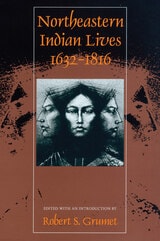
Northeastern Indian Lives, 1632-1816
Robert S. Grumet
University of Massachusetts Press, 1996
Few works have directed attention toward such lesser-known figures as Shickellamy, an Oneida diplomat; the Mohawk sachem Theyanoguin; Awashunkes, a Saconett sunksquaw; or Molly Ockett, a Pigwacket doctor. These individuals operated at the often dangerous and always uncertain interstices separating their world from that of the European settlers, as they worked for the security and survival of their peoples during the first centuries of contact. Their efforts helped shape events that determined the course of history in the colonial Northeast.
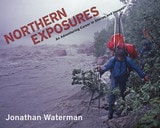
Northern Exposures
An Adventuring Career in Stories and ImagesJonathan Waterman
University of Alaska Press, 2013
North of the sixtieth parallel, the sun shines for less than six hours in the winter, and towering mountains are the only skyscrapers. Pristine waters serve caribou, moose, and bears in an unbroken landscape. At any given moment in this spectacular scenery, there’s a chance that Jonathan Waterman is present, trekking across the land. A masterful adventurer, Waterman has spent decades exploring the farthest reaches of our beautiful spaces. The essays and photographs collected in Northern Exposures are a product of this passion for exploration and offer an unparalleled view into adventuring in the north and beyond.
Picking up after In the Shadow of Denali, his first book of essays, Northern Exposures collects twenty-three stories from Waterman’s thirty-year career that show the evolution of the adventurer’s career and work, from ducking avalanches near the Gulf of Alaska, to searching for the most pristine tundra on the continent, and from writing haiku on Denali in the depth of winter to decrying oil development in the Arctic National Wildlife Refuge. Ninety-six spectacular photographs taken by Waterman during his expeditions lend a broader context and allow readers to fully understand his heartfelt argument for protecting these places. Whether active, aspiring, or just armchair adventurers, readers will be inspired by Waterman’s daring spirit.
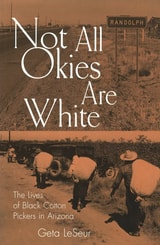
Not All Okies Are White
The Lives of Black Cotton Pickers in ArizonaGeta LeSeur
University of Missouri Press, 2000
Vividly revealing the challenges faced by a group of migrant workers who eventually formed the multiracial town of Randolph, Arizona, Not All Okies Are White is a brilliant, spellbinding celebration of the resilience and adaptability of people too often ignored by history texts.
Recognizing the black exodus to the American West as an overlooked but integral chapter in American history, Geta LeSeur fills the void by extending her research beyond the Mississippi River and the Mason-Dixon line, examining close-up the personal lives of third- and fourth-generation descendants of pre-Emancipation blacks. In this first full-length study to explore the migrant life of any nonwhite group within the United States and the first to focus specifically on a primarily black town in the Southwest, LeSeur deftly uncovers the stepping-stone pattern of black movement west of the Mississippi into Arkansas, Oklahoma, and Texas, and consequent migrations to Arizona and California imposed by economic and social conditions.
Not All Okies Are White recaptures the ways of life for black migrant workers, as well as Hispanics and Native Americans, in the first half of the century through richly detailed interviews of the families of Randolph's founders. Through the words of each narrator, these personal stories recount work experiences and survival strategies, offering new insights into the people's relationship to the land. The narratives reveal a creative tension between place and identity, movement and migration. LeSeur provides a historical, cultural, and literary context for the oral histories by incorporating news articles, information culled from historical society archives, analyses of films and novels, advertisements, and photographs.
An innovative blend of history telling and literary analysis, Not All Okies Are White describes LeSeur's acquaintance with and growing involvement in the lives of the residents of Randolph and surrounding farm communities. The result is a highly accessible cross-disciplinary study that will appeal to scholars and general readers interested in oral history, African American history, multicultural studies, and women's studies.
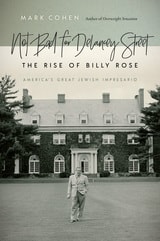
Not Bad for Delancey Street
The Rise of Billy RoseMark Cohen
Brandeis University Press, 2018
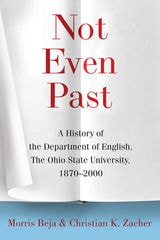
Not Even Past
A History of the Department of English, The Ohio State University, 1870–2000Morris Beja and Christian K. Zacher
Impromptu Press, 2019
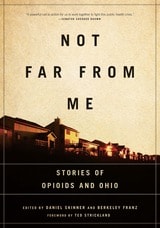
Not Far from Me
Stories of Opioids and OhioEdited by Daniel Skinner and Berkeley FranzForeword by Ted Strickland
The Ohio State University Press, 2019
More and more Americans find themselves in some way touched by the opioid epidemic. But while many have observed the effects of the crisis, Not Far from Me: Stories of Opioids and Ohio is the first book on this public health emergency composed entirely of first-person accounts. The collection unfolds across more than fifty gripping accounts by Ohioans at the center of the national epidemic. Shared through personal stories, poetry, interviews, and photos, these perspectives transcend typical one-dimensional portrayals of the crisis to offer a mosaic of how politics, religion, sports, economics, culture, race, and sexual orientation intersect in and around the epidemic.
Themes of pain and healing, despair and hope are woven throughout accounts of families who have lost loved ones to addiction, stories of survival, and experiences of working on the front lines in communities. In an attempt to give every voice the chance to be heard, Not Far from Me features contributors from across the state as they engage with the pain of opioid abuse and overdose, as well as the hope that personal- and community-level transformation brings. Ultimately, Not Far from Me humanizes the battle against addiction, challenges the stigma surrounding drug users, and unflinchingly faces the reality of the American opioid epidemic.
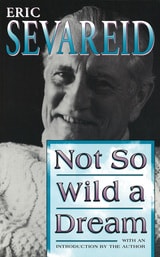
Not So Wild a Dream
Author & Intro by Eric Sevareid
University of Missouri Press, 1995
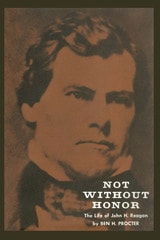
Not Without Honor
The Life of John H. ReaganBy Ben H. Procter
University of Texas Press, 1961
John H. Reagan was one of the most important figures in Texas history; this was the first biography of him to be published. Reagan, who was born in Sevier County, Tennessee, in 1818, came to Texas twenty-one years later—while Texas was still a republic—and stayed to play many major roles in its later economic and political development.
In this excellent biography, Ben H. Procter not only re-creates for us the character of the man, with his forthright integrity and his boundless desire for knowledge, but also places him against the background of the time in which he lived. In vivid language Procter portrays the violence and vigor of pioneer life, the excitement of frontier politics, the dedication, devotion, enthusiasm, and—ultimately—despair of the Civil War, and the bitterness of the struggle with the railroad tycoons and their gargantuan monopolies. Spanning as it does the Republic of Texas, early statehood, the Confederacy, Reconstruction, and the era of the "robber barons," the story of John H. Reagan encompasses a panoramic sweep of mid- to late-nineteenth-century United States history.
Throughout his long life, respect came to Reagan almost as a matter of course. The forceful strength of his personality made an impression few people could ignore. From the day when Colonel Durst hired the young Reagan as a tutor for his children, exclaiming, "This man is a scholar," until the day some fifty years later when Governor Hogg persuaded him to leave the U.S. Senate to become chairman of the new Railroad Commission because the Commission "must be above reproach," his extraordinary character and ability were recognized. In fact, the perceptive intelligence that made him examine all aspects of a situation, and the sturdy integrity and courage that made it impossible for him to abandon a position he believed to be right simply because it was for the moment unpopular, frequently gave him the appearance of a prophet. Although this "prophetic gift" occasionally led to interludes of public disfavor, Reagan was accorded honor, even in his own land—and in later years veneration—that any prophet might envy.

Not at All What One Is Used To
The Life and Times of Isabella GardnerMarian Janssen
University of Missouri Press, 2026
Born in 1915 to one of New England’s elite wealthy families, Isabella Gardner was expected to follow a certain path in life—one that would take her from marriageable debutante to proper society lady. But that plan was derailed when at age eighteen, Isabella caused a drunk-driving accident. Her family, to shield her from disgrace, sent her to Europe for acting studies, not foreseeing how life abroad would fan the romantic longings and artistic impulses that would define the rest of Isabella’s years. In Not at All What One Is Used To, author Marian Janssen tells the story of this passionate, troubled woman, whose career as a poet was in constant compromise with her wayward love life and her impulsive and reckless character.
Not for Circulation
The George E. Bogaars StoryBertha Henson
National University of Singapore Press, 2022
Do civil servants make a difference? Can they shape history? In 1985 when John Drysdale published one of the first books on the political history of independent Singapore, George E. Bogaars wrote to his daughter with typical understatement, “I feature in it a bit.” Bogaars headed the special branch at the time of Operation Cold Store. He reported directly to pioneer leaders such as Lee Kuan Yew and Goh Keng Swee before they became political icons. He started the Singapore Armed Forces from scratch when he was Permanent Secretary of the Interior and Defence. He was the head of the civil service, involved in a dozen or so government-linked companies attempting to shore up the country’s infrastructure, and expand its business portfolio. He held the country’s purse strings when he moved into the finance ministry before his retirement at the age of fifty-five. His impressive resume belies a colorful, flamboyant character with a wicked sense of humor. Veteran Singaporean journalist Bertha Henson tells his story.
Not from Here, Not from There/No Soy de Aquí ni de Allá
The Autobiography of Nelson DíazNelson A. Díaz
Temple University Press, 2018
Raised in the squalor of a New York tenement until he was 10 years old, Nelson Díaz saw his life change when his family moved to a brand-new high-rise project in West Harlem in the 1950s. That experience, along with lessons learned as the only Latino law student at Temple University, would drive him throughout his life as a lawyer and activist, fighting for the expansion of rights for all Americans.
“No soy de aquí ni de allá” is a mantra for Puerto Ricans who feel like foreigners wherever they are and who seek a place for themselves. In his inspiring autobiography, Not from Here, Not from There, Díaz tells the story of his struggles and triumphs as his perspective widened from the New York streets and law school classrooms to the halls of power in Philadelphia and Washington, DC. Whether as a leader in economic development, a pioneer in court reform, or a champion of fair housing, Díaz has never stopped advocating for others. Díaz was happy to be the first Latino to “do something,” but he never wanted to be the last. This story of an outsider who worked his way to the inside offers powerful lessons on finding a place in the world by creating spaces where everyone is welcome.
Not from Here
A MemoirAllan Johnson
Temple University Press, 2015
As a white man with Norwegian and English lineage, Johnson explores both America and the question of belonging to a place whose history holds the continuing legacy of the displacement, dispossession, and genocide of Native peoples.
More than a personal narrative, Not from Here illuminates the national silence around unresolved questions of accountability, race, and identity politics, and the dilemma of how to take responsibility for “a past we did not create.” Johnson’s story—about the past living in the present; of redemption, fate, family, tribe, and nation; of love and grief—raises profound questions about belonging, identity, and place.

Not of Pure Blood
The Free People of Color and Racial Prejudice in Nineteenth-Century Puerto RicoJay Kinsbruner
Duke University Press, 1996
Following a discussion of Puerto Rican racial prejudice in historical perspective, Kinsbruner describes residential patterns, marriages, births, deaths, occupations, and family and household matters to demonstrate that free people of color were a disadvantaged community whose political, social, and economic status was diminished by racism. He analyzes the complexities and contradictions of Puerto Rican racial prejudice and discrimination, explains the subtleties of “shade discrimination,” and examines the profoundly negative impact on race relations of the U.S. occupation of the island following the Spanish American War.
Looking behind the myth of Puerto Rican racial equity, Not of Pure Blood will be of interest to specialists in Caribbean studies, Puerto Rican history, and Latin America studies, and to scholars in a variety of fields investigating questions of racism and discrimination.
Not the Camilla We Knew
One Woman's Path from Small-town America to the Symbionese Liberation ArmyRachael Hanel
University of Minnesota Press, 2022
The mystery of how an ordinary Minnesota girl came to be, briefly, one of the most wanted domestic terrorists in the United States
Behind every act of domestic terrorism there is someone’s child, an average American whose life took a radical turn for reasons that often remain mysterious. Camilla Hall is a case in point: a pastor’s daughter from small-town Minnesota who eventually joined the ranks of radicals like Sara Jane Olson (aka Kathleen Soliah) in the notorious Symbionese Liberation Army before dying in a shootout with Los Angeles Police in May 1974. How could a “good girl” like Camilla become one of the most wanted domestic terrorists in the United States? Rachael Hanel tells her story here, revealing both the deep humanity and the extraordinary circumstances of Camilla Hall’s life.
Camilla’s childhood in a tight-knit religious family was marred by loss and grief as, one after another, her three siblings died. Her path from her Minnesota home to her final, radical SLA family featured years as an artist and activist—in welfare offices, political campaigns, union organizing, culminating in a love affair that would be her introduction to the SLA. Through in-depth research and extensive interviews, Hanel pieces together Camilla’s bewildering transformation from a “gentle, zaftig, arty, otherworldy” young woman (as one observer remarked), working for social change within the system, into a gun-wielding criminal involved in the kidnapping of Patty Hearst.
During this time of mounting unrest and violence, Camilla Hall’s story is of urgent interest for what it reveals about the forces of radicalization. But as Hanel ventures ever further into Camilla’s past, searching out the critical points where character and cause might intersect, her book becomes an intriguing, disturbing, and ultimately deeply moving journey into the dark side of America’s promise.
Not the Germans Alone
A Son's Search for the Truth of VichyIsaac Levendel
Northwestern University Press, 2000
On the eve of D-Day, Isaac Levendel's mother left her hiding place on a farm in southern France and never returned. After 40 years of silence and torment, he returned to France in 1990 determined to find out what had happened. This is the story of how, with perseverance, luck, and official help, he gained access to secret wartime documents laying bare the details of French collaboration-and the truth about his mother's fate.
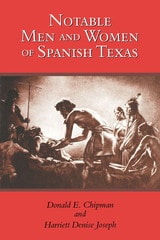
Notable Men and Women of Spanish Texas
By Donald E. Chipman and Harriett Denise Joseph
University of Texas Press, 1999
Winner, Presidio La Bahia Award, Sons of the Republic of Texas, 2000
Texas Old Missions and Forts Restoration Association Book Award, the Texas Old Missions and Fort Restoration Association and the Texas Catholic Historical Society, 2001
The Spanish colonial era in Texas (1528-1821) continues to emerge from the shadowy past with every new archaeological and historical discovery. In this book, years of archival sleuthing by Donald E. Chipman and Harriett Denise Joseph now reveal the real human beings behind the legendary figures who discovered, explored, and settled Spanish Texas.
By combining dramatic, real-life incidents, biographical sketches, and historical background, the authors bring to life these famous (and sometimes infamous) men of Spanish Texas:
- Alvar Núñez Cabeza de Vaca
- Alonso de León
- Francisco Hidalgo
- Louis Juchereau de St. Denis
- Antonio Margil
- The Marqués de Aguayo
- Pedro de Rivera
- Felipe de Rábago
- José de Escandón
- Athanase de Mézières
- The Marqués de Rubí
- Antonio Gil Ibarvo
- Domingo Cabello
- José Bernardo Gutiérrez de Lara
- Joaquín de Arredondo
The authors also devote a chapter to the women of Spanish Texas, drawing on scarce historical clues to tell the stories of both well-known and previously unknown Tejana, Indian, and African women.
Notebooks, Volume 1, 1998-99
Anselm Kiefer
Seagull Books, 2015
The first volume of Notebooks spans the years 1998-1999 and traces the origins and creative process of Kiefer’s visual works during this period. In this volume, Kiefer returns constantly to his touchstones: sixteenth-century alchemist Robert Fludd, German romantic poet Novalis, Martin Heidegger, Ingeborg Bachmann, Robert Musil, and many other writers and thinkers. The entries reveal the process by which his artworks are informed by his reading—and vice versa—and track the development of the works he created in the late 1990s. Translated into English for the first time by Tess Lewis, the diaries reveal Kiefer’s strong affinity for language and let readers witness the process of thoughts, experiences, and adventures slowly transcending the limits of art, achieving meaning in and beyond their medium.
Praise for Kiefer
“His works recall, in this sense, the grand tradition of history painting, with its notion about the elevated role of art in society, except that they do not presume moral certainty. What makes Kiefer’s work so convincing . . . is precisely its ambiguity and self-doubt, its rejection of easy solutions, historical amnesia, and transcendence.”—New York Times
“Wordiness for Kiefer is painterliness. The library and the gallery, the book and the frame inseparable, even interchangeable, in his monumental archive of human memory. Not since Picasso’s Guernica have pictures demanded so urgently that we studiously reflect and recollect in their presence.”—Simon Schama