Results by title
4917 books match the query 'Philosophy' and 125 start with n
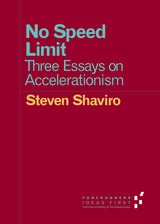
No Speed Limit
Three Essays on AccelerationismSteven Shaviro
University of Minnesota Press, 2015
Accelerationism is the bastard offspring of a furtive liaison between Marxism and science fiction. Its basic premise is that the only way out is the way through: to get beyond capitalism, we need to push its technologies to the point where they explode. This may be dubious as a political strategy, but it works as a powerful artistic program.
Other authors have debated the pros and cons of accelerationist politics; No Speed Limit makes the case for an accelerationist aesthetics. Our present moment is illuminated, both for good and for ill, in the cracked mirror of science-fictional futurity.
Forerunners: Ideas First is a thought-in-process series of breakthrough digital publications. Written between fresh ideas and finished books, Forerunners draws on scholarly work initiated in notable blogs, social media, conference plenaries, journal articles, and the synergy of academic exchange. This is gray literature publishing: where intense thinking, change, and speculation take place in scholarship.
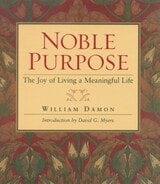
Noble Purpose
Joy Of Living A Meaningful LifeWilliam Bill Damon
Templeton Press, 2003
This book describes the personal and spiritual benefits of living life in a way that matters, with an awareness that one's life can reflect a sense of higher purpose no matter what the circumstances. The book draws upon religious, philosophical, and literary writings to show how humans in many cultures and historical epochs have pursued noble purposes by answering God's call as each hears it.
Noble purpose can be pursued both in heroic acts and in everyday behavior. The book shows how ordinary people—teachers, business professionals, parents, citizens—can ennoble what they do by being mindful of its deepest meaning. It also points out that humility is a necessary virtue for those who pursue a noble purpose. Great heroes are bold, courageous, and sometimes audacious in their determination to succeed; but they are also humble in their awareness of their own limitations. Moreover, a person must never violate basic moral laws while pursuing a noble purpose—the means must be as moral as the ends.
Purpose brings coherence and satisfaction to people's lives, producing joy in good times and resilience in hard times. It also presents a paradox: hard work in service of noble purpose that transcends personal gain is a surer path to happiness than the self-indulgent pursuit of happiness for its own sake. The closer we come to God's purpose for us, the more satisfied our lives become.
From the inspiration and examples conveyed in this book, we learn that all individuals have the capacity to discover their own God-given abilities, to learn the world's need for the services they can provide, and to experience joy in serving society and God in their special ways. As theologian Frederick Buechner writes, "The place God calls you to is the place where your deep gladness and the world's deep hunger meet."
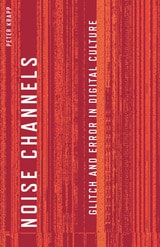
Noise Channels
Glitch and Error in Digital CulturePeter Krapp
University of Minnesota Press, 2011
To err is human; to err in digital culture is design. In the glitches, inefficiencies, and errors that ergonomics and usability engineering strive to surmount, Peter Krapp identifies creative reservoirs of computer-mediated interaction. Throughout new media cultures, he traces a resistance to the heritage of motion studies, ergonomics, and efficiency; in doing so, he shows how creativity is stirred within the networks of digital culture.
Noise Channels offers a fresh look at hypertext and tactical media, tunes into laptop music, and situates the emergent forms of computer gaming and machinima in media history. Krapp analyzes text, image, sound, virtual spaces, and gestures in noisy channels of computer-mediated communication that seek to embrace—rather than overcome—the limitations and misfires of computing. Equally at home with online literature, the visual tactics of hacktivism, the recuperation of glitches in sound art, electronica, and videogames, or machinima as an emerging media practice, he explores distinctions between noise and information, and how games pivot on errors at the human–computer interface.
Grounding the digital humanities in the conditions of possibility of computing culture, Krapp puts forth his insight on the critical role of information in the creative process.
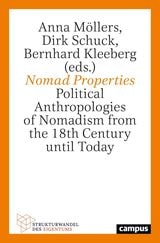
Nomad Properties
Political Anthropologies of Nomadism from the 18th Century until TodayEdited by Anna Möllers, Dirk Schuck, and Bernhard Kleeberg
Campus Verlag, 2024
What is the discourse about nomadism telling us about anthropological concepts of Western societies? This edited volume relates historical instances of nomadism to the role of “the nomad” in political discourses and recent theoretical debates. The figure of the nomad was and still is constructed as an antagonist within a (neo-)liberal frame of narratives about sedentarism, productivity, and improvement. Whereas the discourse about nomadism in the eighteenth and nineteenth centuries was entangled with colonial contexts and ideas about so-called primitive societies, it became even more multifaceted in the twentieth century, considering ideas about “nomadic thinking” of Deleuze and Guattari, and different forms of “modern nomadism” on the rise: from traveling day laborers to refugees of war, from scientists to a global managerial class.
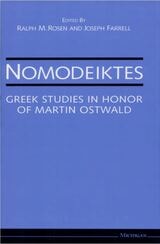
Nomodeiktes
Greek Studies in Honor of Martin OstwaldRalph M. Rosen and Joseph Farrell, Editors
University of Michigan Press, 1994
Nomodeiktes: Greek Studies in Honor of Martin Ostwald offers fascinating discussions of many of these areas, and it helps illuminate ways in which modern perceptions of this complex period are right and are wrong. Important observations are made on Greek historians and historiography, on politics and society, and on Greek philosophy and literature. The analyses of these major areas of investigation will be very useful for all interested in this centrally important period and for those who know the lure of that vivid and compelling city, Athens.
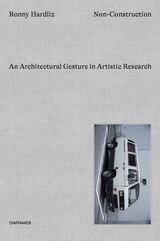
Non-Construction
An Architectural Gesture in Artistic ResearchRonny Hardliz
Diaphanes, 2021

Non-Design
Architecture, Liberalism, and the MarketAnthony Fontenot
University of Chicago Press, 2021
Nonmonotonic Reasoning
An OverviewGerhard Brewka, Jürgen Dix, and Kurt Konolige
CSLI, 1997
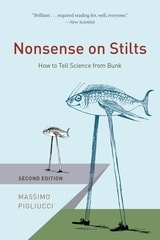
Nonsense on Stilts
Massimo Pigliucci
University of Chicago Press, 2018
In this era of fake news and alternative facts, there is more bunk than ever. But why do people believe in it? And what causes them to embrace such pseudoscientific beliefs and practices? In this fully revised second edition, noted skeptic Massimo Pigliucci sets out to separate the fact from the fantasy in an entertaining exploration of the nature of science, the borderlands of fringe science, and—borrowing a famous phrase from philosopher Jeremy Bentham—the nonsense on stilts. Presenting case studies on a number of controversial topics, Pigliucci cuts through the ambiguity surrounding science to look more closely at how science is conducted, how it is disseminated, how it is interpreted, and what it means to our society. The result is in many ways a “taxonomy of bunk” that explores the intersection of science and culture at large.
No one—neither the public intellectuals in the culture wars between defenders and detractors of science nor the believers of pseudoscience themselves—is spared Pigliucci’s incisive analysis in this timely reminder of the need to maintain a line between expertise and assumption. Broad in scope and implication, Nonsense on Stilts is a captivating guide for the intelligent citizen who wishes to make up her own mind while navigating the perilous debates that will shape the future of our planet.
Nonsense on Stilts
How to Tell Science from BunkMassimo Pigliucci
University of Chicago Press, 2010
Recent polls suggest that fewer than 40 percent of Americans believe in Darwin’s theory of evolution, despite it being one of science’s best-established findings. More and more parents are refusing to vaccinate their children for fear it causes autism, though this link can been consistently disproved. And about 40 percent of Americans believe that the threat of global warming is exaggerated, despite near consensus in the scientific community that manmade climate change is real.
Why do people believe bunk? And what causes them to embrace such pseudoscientific beliefs and practices? Noted skeptic Massimo Pigliucci sets out to separate the fact from the fantasy in this entertaining exploration of the nature of science, the borderlands of fringe science, and—borrowing a famous phrase from philosopher Jeremy Bentham—the nonsense on stilts. Presenting case studies on a number of controversial topics, Pigliucci cuts through the ambiguity surrounding science to look more closely at how science is conducted, how it is disseminated, how it is interpreted, and what it means to our society. The result is in many ways a “taxonomy of bunk” that explores the intersection of science and culture at large.
No one—not the public intellectuals in the culture wars between defenders and detractors of science nor the believers of pseudoscience themselves—is spared Pigliucci’s incisive analysis. In the end, Nonsense on Stilts is a timely reminder of the need to maintain a line between expertise and assumption. Broad in scope and implication, it is also ultimately a captivating guide for the intelligent citizen who wishes to make up her own mind while navigating the perilous debates that will affect the future of our planet.

Nostalgia
Origins and Ends of an Unenlightened DiseaseHelmut Illbruck
Northwestern University Press, 2012

Not Just Where To Click
Teaching Students (Pil #68)Heather Jagman
American Library Association, 2015

Not Just Where to Click
Teaching Students How to Think About InformationTroy A. Swanson
Assoc of College & Research Libraries, 2015
Not by Reason Alone
Religion, History, and Identity in Early Modern Political ThoughtJoshua Mitchell
University of Chicago Press, 1993
This erudite and ambitious work crosses disciplinary boundaries to expose unsuspected connections between political theory, religion, and history. In doing so, it offers a view of modern political thought undistorted by conventional distinctions between the ancient and the modern, and between the religious and the political.
"Original. . . . A delight to read a political philosopher who takes the theologies of Hobbes and Locke seriously." —J. M. Porter, Canadian Journal of History
"Mitchell's argument both illuminates and fascinates. . . . An arresting, even stunning, contribution to our study of modern political thought."—William R. Stevenson, Jr., Christian Scholar's Review
Notebooks for an Ethics
Jean-Paul Sartre
University of Chicago Press, 1992
In the famous conclusion to Being and Nothingness, Sartre announced that he would devote his next philosophical work to moral problems. Although he worked on this project in the late 1940s, Sartre never completed it to his satisfaction, and it remained unpublished until after his death in 1980. Presented here for the first time in English, the Notebooks reveal Sartre at his most productive, crafting a masterpiece of philosophical reflection that can easily stand alongside his other great works.
Sartre grapples anew here with such central issues as "authenticity" and the relation of alienation and freedom to moral values. Exploring fundamental modes of relating to the Other—among them violence, entreaty, demand, appeal, refusal, and revolt—he articulates the necessary transition from individualism to historical consciousness. This work thus forms an important bridge between the early existentialist Sartre and the later Marxist social thinker of the Critique of Dialectical Reason. The Notebooks themselves are complemented here by two additional essays, one on "the good and subjectivity," the other on the oppression of blacks in the United States.
With publication of David Pellauer's lucid translation, English-speaking readers will be able to appreciate this important contribution to moral philosophy and the history of ethics.
Jean-Paul Sartre (1906-1980) was offered, but declined, the Nobel Prize for literature in 1964. His many works of fiction, drama, and philosophy include the monumental study of Flaubert, The Family Idiot, and The Freud Scenario, both published in translation by the University of Chicago Press.
Notebooks, 1914-1916
Ludwig Wittgenstein
University of Chicago Press, 1984
"When the first edition of this collection of remarks appeared in 1961 we were provided with a glimpse of the workings of Wittgenstein's mind during the period when the seminal ideas of the Tractatus Logico-Philosophicus were being worked out. This second edition provided the occasion to be struck anew by the breadth, rigor, and above all the restlessness of that mind."—T. Michael McNulty, S. J., The Modern Schoolman
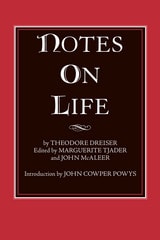
Notes on Life
Theodore Dreiser
University of Alabama Press, 1974
Exploring human nature, society, and destiny through the lens of American naturalism.
In Notes on Life, Theodore Dreiser—best known for his landmark novels Sister Carrie and An American Tragedy—reveals himself as an incisive thinker grappling with the forces that shape human existence. This compelling collection of essays brings together Dreiser’s reflections on society, ambition, morality, and the often-unseen pressures that guide individual lives. Written during a period of rapid cultural and industrial transformation in the United States, these essays offer a deeply engaged response to the uncertainties and contradictions of modern life.
At the heart of Notes on Life lies Dreiser’s enduring commitment to the principles of literary naturalism: the belief that human behavior is influenced—if not determined—by environment, heredity, and social conditions. Yet these essays go beyond literary theory. They present a searching, often personal inquiry into what it means to live meaningfully in a world shaped by inequality, chance, and desire. Dreiser examines the tension between individual aspiration and societal constraint, probing the psychological and moral dimensions of success, failure, and identity.
What distinguishes this collection is its accessibility and range. Dreiser writes with a directness that invites readers into complex philosophical questions without sacrificing intellectual depth. Whether considering the nature of happiness, the role of material success, or the ethical dilemmas of modern society, he offers insights that remain strikingly relevant. His voice—by turns analytical, reflective, and quietly provocative—bridges the gap between literature and philosophy, making these essays as engaging for general readers as they are valuable for students and scholars.
For those interested in American literature, Notes on Life provides essential context for understanding Dreiser’s fiction and the broader movement of realism and naturalism in the early twentieth century. For contemporary readers, it offers a timeless meditation on the forces that continue to shape human experience: ambition, circumstance, and the search for meaning in an ever-changing world.
Both a work of literary significance and a volume of enduring philosophical reflection, Notes on Life stands as a testament to Dreiser’s intellectual breadth and his unwavering commitment to exploring the complexities of human life.
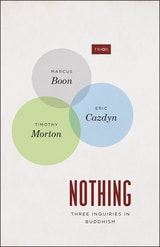
Nothing
Three Inquiries in BuddhismMarcus Boon, Eric Cazdyn, and Timothy Morton
University of Chicago Press, 2015
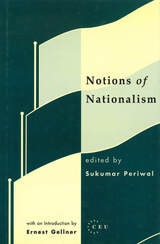
Notions of Nationalism
Sukumar Periwal
Central European University Press, 1996
In this highly topical volume, a group of distinguished scholars explore various aspects of nationalism theory and shed light on the current thinking in this area of great contemporary importance. Such topics as primordialism, institutional plurality in multi-ethnic states, historical problems of nationalism, and the importance of local-level understanding in dealing with such problems, are examined with clarity and vision.
Together the essays provide a valuable insight into an intricate debate which is of crucial relevance to the understanding of contemporary politics not only in Central Europe but in the world at large.
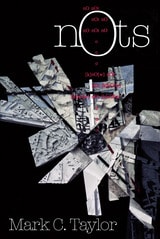
Nots
Mark C. Taylor
University of Chicago Press, 1993
In the first section of this book, Taylor discusses the question of the "not" in the religious thought of Anselm, Hegel, Derrida, and Nishitani. In the second part, he analyzes artistic efforts "to figure not" in the work of artists Arakawa and Madeline Gins, architect Daniel Libeskind, pop artist David Sallee, and pop icon Madonna. The final section consists of a deeply personal and scientifically informed chapter that discusses the workings of negativity in immunology and illness.
Taylor's essays work toward a sense of the not as unnameable as it is irrepressible—an "unthinkable third" that falls between being and nonbeing. Bringing together concerns that span Taylor's early investigations of Hegel and Kierkegaard and recent studies of art and architecture, Nots is an important contribution by one of the most original and distinctive voices now writing on the American scene.
Religion and Postmodernism series

Novalis, Spinoza, and the Limits of Romantic Materialism
Siarhei Biareishyk
Northwestern University Press, 2026
Offering an innovative and illuminating new reading of Spinoza and Novalis
This rigorously researched study reframes our understanding of the intellectual currents in Germany around 1800 through a careful reinterpretation of its key thinker, Novalis, in conversation with Spinoza’s philosophy. Siarhei Biareishyk presents an alternative to the standard narrative that resolutely links emergent modernity and secularization to philosophical “idealism” by showing how Spinozan materialism informs the scientific experiments, metaphysical inquiries, and political debates of Novalis and his contemporaries. Shifting our focus away from the historical interpretation of Novalis as a mystic and theorist of subjectivity, Biareishyk elaborates on the Spinozan materialist strain in Novalis in three key domains: ontology and the conception of nature, theories of singularity and individuation, and the concept of the political. He brings current romanticist scholarship into conversation with contemporary discussions of Spinoza in continental philosophy, in the Marxist tradition particularly, demonstrating that the Spinoza–Novalis encounter provides a viable alternative—in its articulation of causality, dialectics, and the political—to the dominant conceptual apparatuses of both Kant and Hegel.

Novel Bodies
Disability and Sexuality in Eighteenth-Century British LiteratureJason S. Farr
Bucknell University Press, 2019
Published by Bucknell University Press. Distributed worldwide by Rutgers University Press.
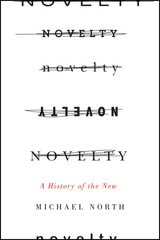
Novelty
A History of the NewMichael North
University of Chicago Press, 2013
In Novelty, Michael North takes us on a dazzling tour of more than two millennia of thinking about the problem of the new, from the puzzles of the pre-Socratics all the way up to the art world of the 1960s and ’70s. The terms of the debate, North shows, were established before Plato, and have changed very little since: novelty, philosophers argued, could only arise from either recurrence or recombination. The former, found in nature’s cycles of renewal, and the latter, seen most clearly in the workings of language, between them have accounted for nearly all the ways in which novelty has been conceived in Western history, taking in reformation, renaissance, invention, revolution, and even evolution. As he pursues this idea through centuries and across disciplines, North exhibits astonishing range, drawing on figures as diverse as Charles Darwin and Robert Smithson, Thomas Kuhn and Ezra Pound, Norbert Wiener and Andy Warhol, all of whom offer different ways of grappling with the idea of originality.
Novelty, North demonstrates, remains a central problem of contemporary science and literature—an ever-receding target that, in its complexity and evasiveness, continues to inspire and propel the modern. A heady, ambitious intellectual feast, Novelty is rich with insight, a masterpiece of perceptive synthesis.
Nursing
The Philosophy and Science of CaringJean Watson
University Press of Colorado, 1991
The concept of care is probably one of the least understood ideas used by professional and nonprofessional people, yet it is probably one of the most important concepts to be understood by human groups. It is a word with multiple social usages in the American culture, and has other meanings in other world cultures. The terms care, caring, and nursing care have both symbolic and functional meanings as they are used by caregivers and care-recipients. Nursing care also has a general, special meaning to nurses, and is often taken for granted in nurses' thoughts and action patterns. It is time that we study the implicit and explicit meanings associated with the concepts of care and caring so that we can reduce their ambiguities. Furthermore, the humanistic, scientific, and linguistic meanings related to nursing care and caring behaviors in any culture remain a most fascinating area of study for nurses.
Nursing
The Philosophy and Science of Caring, Revised EditionJean Watson
University Press of Colorado, 2008
A core concept for nurses and the professional and non-professional people they interact with, "care" is one of the field's least understood terms, enshrouded in conflicting expectations and meanings. Although its usages vary among cultures, caring is universal and timeless at the human level, transcending societies, religions, belief systems, and geographic boundaries, moving from Self to Other to community and beyond, affecting all of life.
This second edition reflects on the universal effects of caring and connects caring with love as the primordial moral basis both for the philosophy and science of caring practices and for healing itself. It introduces Caritas Processes, offers centering and mediation exercises on an included audio CD, and provides other energetic and reflective models to assist students and practitioners in cultivating a new level of Caritas Nursing in their work and world.