Results by title
28164 books match the query 'History' and 647 start with n
Near Eastern Archaeology, volume 88 number 2 (June 2025)
The University of Chicago Press
University of Chicago Press Journals, 2025
Near Eastern Archaeology, volume 88 number 3 (September 2025)
The University of Chicago Press
University of Chicago Press Journals, 2025
Near Eastern Archaeology, volume 88 number 4 (December 2025)
The University of Chicago Press
University of Chicago Press Journals, 2025
Near Eastern Archaeology, volume 89 number 1 (March 2026)
The University of Chicago Press
University of Chicago Press Journals, 2026
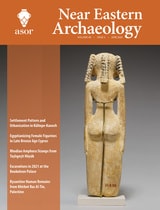
Near Eastern Archaeology, volume 89 number 2 (June 2026)
The University of Chicago Press
University of Chicago Press Journals, 2026
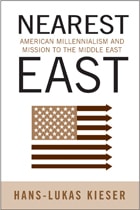
Nearest East
American Millenialism and Mission to the Middle EastAuthored by Hans-Lukas Kieser
Temple University Press, 2012
Long before oil interests shaped American interaction with the Middle East, the U.S. had a strong influence on the late Ottoman and post-Ottoman region. Covering the period from approximately 1800 to the 1970s, Hans-Lukas Kieser’s compelling Nearest East tells the story of this intimate, identity-building relationship between the U.S. and the Near East.
Kieser chronicles how American missionaries worked to implement their belief in Biblical millennialism, enlightened modernity, and a modern Zion-Israel. Millennialism was part of an American identity that constituted itself religiously in the interaction with and the representation of the “cradle of Zion.” As such, "going Near East" was—at least to American evangelical Protestants—in some ways more important than colonizing the American West. However, many Ottoman Muslims felt threatened by the American missionaries perceiving their successful institutions as an estranging challenge from the outside.
Measuring the long twisted road from the missionary Zion-builders of the early 19th century to the privileged US-Israeli partnership in the late 20th century, Nearest East looks carefully on both sides of the relationship. Kieser uses a wide range of Ottoman, Turkish, French, German and other sources, unfamiliar to most Anglophone readers, to tell this story that will appeal to historians of all stripes.
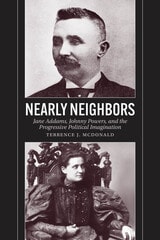
Nearly Neighbors
Jane Addams, Johnny Powers, and the Progressive Political ImaginationTerrence J. McDonald
University of Chicago Press, 2026
Jane Addams was full of courage and goodwill when she opened Hull House in Chicago’s Nineteenth Ward in 1889. However, she failed to understand that her immigrant neighbors had been well-organized around mostly Catholic churches and schools for decades before her arrival. Her ultimate political rival, Johnny Powers, grew up in this culture but was no ethnic hero or deep political thinker. Nearly Neighbors is the first book to provide a contextualized history of their encounter, embedding it in the social and political culture and structures of Chicago and the Nineteenth Ward in the 1890s.
Terrence J. McDonald provides a crucial analysis of two pivotal figures in Chicago’s political history, in part by providing the first detailed assessment of Powers’s life and practices, but also by demonstrating Addams’s misconception of him and her neighbors—and why it matters for understanding her Progressive work overall. In both her political work and writings, Addams saw her ethnic neighbors as bundles of economic need, rather than bearers of ethnic culture. At the same time, she was recruited by elite allies into causes that appeared to be opposed by her neighbors. These views and practices permitted Powers to win in their climactic political battle in 1898 simply by claiming to be the neighborhood defender against Addams and her “downtown” allies. Nearly Neighbors offers a new way of understanding Addams and the complicated legacy of her famous political work and writings.

Nearly Nuclear
A Mismanaged Energy Transitionleroy smith
Michigan State University Press, 2021
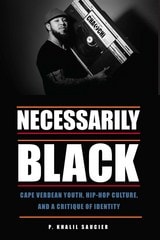
Necessarily Black
Cape Verdean Youth, Hip-Hop Culture, and a Critique of IdentityP. Khalil Saucier
Michigan State University Press, 2015
Necessary Courage
Iowa's Underground Railroad in the Struggle against SlaveryLowell J. Soike
University of Iowa Press, 2013

Necessary Evil
Settling Missouri with a Rope and a GunJoe Johnston
Missouri Historical Society Press, 2014
Necessary Evil is the first book to chronicle the implications of vigilantism in Missouri, ultimately showing that the state could never have been settled without a healthy dose of rebel justice. Packed with stories of popular gunslingers such as Wyatt Earp, Wild Bill Hickok, and Jesse James, this action-filled read will be of interest to crime enthusiasts and historians alike.
Necessity or Contingency
The Master ArgumentJules Vuillemin
CSLI, 1996

Necklace and Calabash
A Chinese Detective StoryRobert van Gulik
University of Chicago Press, 1967
Necklace and Calabash finds Judge Dee returning to his district of Poo-yang, where the peaceful town of Riverton promises a few days' fishing and relaxation. Yet a chance meeting with a Taoist recluse, a gruesome body fished out of the river, strange guests at the Kingfisher Inn, and a princess in distress thrust the judge into one of the most intricate and baffling mysteries of his career.

Necro Citizenship
Death, Eroticism, and the Public Sphere in the Nineteenth-Century United StatesRuss Castronovo
Duke University Press, 2001
Moving from medical engravings, séances, and clairvoyant communication to Supreme Court decisions, popular literature, and physiological tracts, Necro Citizenship explores how rituals of inclusion and belonging have generated alienation and dispossession. Castronovo contends that citizenship does violence to bodies, especially those of blacks, women, and workers. “Necro ideology,” he argues, supplied citizens with the means to think about slavery, economic powerlessness, or social injustice as eternal questions, beyond the scope of politics or critique. By obsessing on sleepwalkers, drowned women, and other corpses, necro ideology fostered a collective demand for an abstract even antidemocratic sense of freedom. Examining issues involving the occult, white sexuality, ghosts, and suicide in conjunction with readings of Harriet Jacobs, Ralph Waldo Emerson, Frederick Douglass, Nathaniel Hawthorne, and Frances Harper, Necro Citizenship successfully demonstrates why Patrick Henry's “give me liberty or give me death” has resonated so strongly in the American imagination.
Necropolitics
Achille Mbembe
Duke University Press, 2019
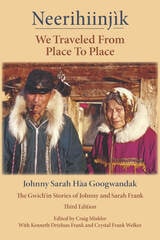
Neerihiinjìk / We Traveled from Place to Place
Johnny Sarah Hàa Googwandak/ The Gwich'in Stories of Johnny and Sarah FrankCraig Mishler
University of Alaska Press, 2026
Johnny and Sarah Frank’s lives were steeped in the old ways of survival in the upland boreal forest of northeastern Alaska. Constantly on the move in search of game and other wild resources, sharing the harvest with others around them, and passing on their skills and cultural values through a rich tradition of oral literature, the Franks are vivid examples of how the Gwich’in people survived as a nation. Neerihiinjìk: We Traveled From Place To Place is a narrative of Johnny and Sarah’s life together. Both lived well into their nineties, and, through their abundant social warmth and manifest intelligence, they had an extraordinary influence on the lives of people around them.
The stories told by Johnny and Sarah in their native language are presented here with English translations on facing pages. The finished texts were transcribed from more than thirty-five hours of tape recordings. Johnny’s tales are focused on the days of long ago, the adventures of Indian warriors, and the feats and songs of powerful medicine men. Sarah, on the other hand, shapes her stories around her own daily life and her useful knowledge of the environment and its resources. Together, they present a balanced view of the Gwich’in world – the masculine and the feminine, the spiritual as well as the practical.
Neerihiinjìk adds greatly to the Franks’ reputation as rugged individuals who were versed in the ways of their ancestors and who figured prominently in the history of twentieth century Northern Dene.

Nefertiti
The Making of a Global IconSebastian Conrad
University of Chicago Press, 2026
Charts the global resonance of the image of Nefertiti over the past century.
From the moment that the bust of Nefertiti was uncovered after over three thousand years and shown at its first exhibition in Berlin in 1924, it rapidly became an iconic image. Today, the silhouette alone of this powerful ancient Egyptian queen is recognized and admired around the world.
In Nefertiti: The Making of a Global Icon, historian Sebastian Conrad tracks the full story of the world’s embrace and appropriation of this famous visage. Starting with the discovery of the bust and Germany’s claims to its possession, Conrad shows how it became a contested object, tracing Egypt’s efforts to call for its restitution from 1924 to the present. He also canvasses the uses to which Nefertiti’s image has been put and the causes with which it has been associated: for cosmetic ads and beauty clinics; by advocates for European unity; by drag queens and the queer community; by National Socialists; by nationalists in Egypt and Bengal; by Afro-Brazilian communities; and by important Black figures from Elijah Muhammad to Beyoncé. Against a global backdrop, Conrad showcases the stunning object’s fame and the often-controversial issues and debates in which it has been embroiled. He also argues that the story of Nefertiti’s trajectory offers insights into the changing shape of globalization from the era of imperialism to the present.
This accessible, deeply researched book reveals both how much is at stake in the life of objects and how Nefertiti’s arresting likeness continues to challenge us today.

Negative Exposures
Knowing What Not to Know in Contemporary ChinaMargaret Hillenbrand
Duke University Press, 2020
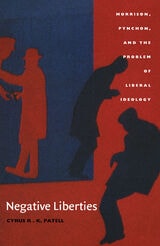
Negative Liberties
Morrison, Pynchon, and the Problem of Liberal IdeologyCyrus R. K. Patell
Duke University Press, 2001
Pynchon and Morrison reveal the official narrative of individualism as encompassing a complex structure of contradiction held in abeyance. This narrative imagines that the goals of the individual are not at odds with the goals of the family or society and in fact obscures the existence of an unholy truce between individual liberty and forms of oppression. By bringing these two fiction writers into a discourse dominated by Ralph Waldo Emerson, Isaiah Berlin, John Rawls, George Kateb, Robert Bellah, and Michael Sandel, Patell unmasks the ways in which contemporary U.S. culture has not fully shed the oppressive patterns of reasoning handed down by the slaveholding culture from which American individualism emerged.
With its interdisciplinary approach, Negative Liberties will appeal to students and scholars of American literature, culture, sociology, and politics.

Negative Life
The Cinema of ExtinctionSteven Swarbrick and Jean-Thomas Tremblay
Northwestern University Press, 2024
How films help us understand the inevitable death of Earth and humanity
Negative Life: The Cinema of Extinction brings cinema studies, queer theory, and psychoanalysis into novel configuration around the concept of negative life, a sundering of human and nonhuman relations. Engaging a philosophical and cinematic corpus that rejects the pastoralism of “entanglement” or “enmeshment,” Steven Swarbrick and Jean-Thomas Tremblay counter ecocritical pieties and cut a new path for theory. They examine films by Julian Pölsler, Kelly Reichardt, Lee Isaac Chung, Mahesh Mathai, Paul Schrader, and others that exemplify the existential contradictions currently intensifying amid the sixth mass extinction. Each case study testifies formally and thematically to negative life as a structural condition of thought and film. Together, the cases reveal the unlivable dimension of life and art, where form, desire, and nonbelonging tarry with the future-oriented promise of ecostudies—where all that lives connects. Negative Life militates against this promise, showing that faith in connection is a dead end.
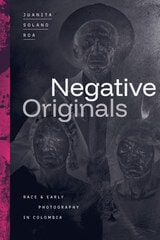
Negative Originals
Race and Early Photography in ColombiaJuanita Solano Roa
Duke University Press, 2025

Negotiated Reform
The Multilevel Governance of Financial RegulationEdited by Renate Mayntz
Campus Verlag, 2016
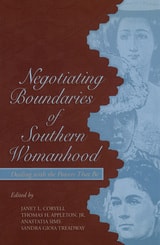
Negotiating Boundaries of Southern Womanhood
Dealing with the Powers That BeEdited & Intro by Janet L. Coryell, Thomas Appleton, Anastatia Sims, & Sandra Treadway
University of Missouri Press, 2000
In a time when most Americans never questioned the premise that women should be subordinate to men, and in a place where only white men enjoyed fully the rights and privileges of citizenship, many women learned how to negotiate societal boundaries and to claim a share of power for themselves in a male-dominated world.
Covering the early nineteenth through the early twentieth centuries, Negotiating Boundaries of Southern Womanhood describes the ways southern women found to advance their development and independence and establish their own identities in the context of a society that restricted their opportunities and personal freedom.
They confronted, cooperated with, and sometimes were co-opted by existing powers: the white and African American elite whose status was determined by wealth, family name, gender, race, skin color, or combinations thereof. Some women took action against established powers and, in so doing, strengthened their own communities; some bowed to the powers and went along to get along; some became the powers, using status to ensure their prosperity as well as their survival. All chose their actions based on the time and place in which they lived.
In these thought-provoking essays, the authors illustrate the complex intersections of race, class, and gender as they examine the ways in which southern women dealt with "the powers that be" and, in some instances, became those powers. Elitism, status, and class were always filtered through a prism of race and gender in the South, and women of both races played an important role in maintaining as well as challenging the hierarchies that existed.
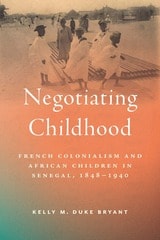
Negotiating Childhood
French Colonialism and African Children in Senegal, 1848–1940Kelly M. Duke Bryant
University of Massachusetts Press, 2026
A groundbreaking study of the meaning of childhood in French colonial Senegal
Negotiating Childhood explores how colonial child protection policies and African children’s responses to them produced new ways of defining, measuring, documenting, and experiencing childhood in the French colony of Senegal from 1848 to 1940. In this groundbreaking book, Kelly M. Duke Bryant takes the scholarship in new directions, offering to a literature dominated by studies of British colonies in the twentieth century a study of childhood in a French colony from the immediate post-emancipation period through the 1930s. This focus allows her to complicate the generally accepted timeline of child protection in colonial Africa and question other assumptions about children’s history on the continent.
This deeply researched work uses a wide range of sources to examine children’s experiences in spaces where they encountered French discipline and surveillance, such as wardship courts, public streets, schools, juvenile reformatories, and vaccine clinics. The book shows not only how these spaces re-ordered African childhood, but also how children themselves shaped and limited French efforts to impose order, especially when the state depended on African children’s cooperation to make good on rhetoric about child “protection.” It also charts the rise of documentation in children’s lives, as colonial representatives recorded names, ages, and other details about the African children with whom they interacted. Tracing the “documented” child back to the early colonial period, Negotiating Childhood historicizes the emergence of identity documentation—so crucial to our contemporary world—and questions the naturalness of the very idea of the “child.”
Negotiating Conquest
Gender and Power in California, 1770s to 1880sMiroslava Chávez-García
University of Arizona Press, 2004
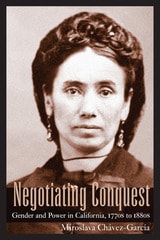
Negotiating Conquest begins with an examination of how gender and ethnicity shaped the policies and practices of the Spanish conquest, showing that Hispanic women, marriage, and the family played a central role in producing a stable society on Mexico’s northernmost frontier. It then examines how gender, law, property, and ethnicity shaped social and class relations among Mexicans and native peoples, focusing particularly on how women dealt with the gender-, class-, and ethnic-based hierarchies that gave Mexican men patriarchal authority. With the American takeover in 1846, the text’s focus shifts to how the imposition of foreign legal, economic, linguistic, and cultural norms affected the status of Mexican women, male-female relations, and the family. Addressing such issues as divorce, legitimacy, and inheritance, it describes the manner in which the conquest weakened the economic position of both Mexican women and men while at the same time increasing the leverage of Mexican women in their personal and social relationships with men.
Drawing on archival materials—including dozens of legal cases—that have been largely ignored by other scholars, Chávez-García examines federal, state, and municipal laws across many periods in order to reveal how women used changing laws, institutions, and norms governing property, marriage and sexuality, and family relations to assert and protect their rights. By showing that mexicanas contested the limits of male rule and insisted that patriarchal relationships be based on reciprocity, Negotiating Conquest expands our knowledge of how patriarchy functioned and evolved as it reveals the ways in which conquest can transform social relationships in both family and community.
Negotiating Empire
The Cultural Politics of Schools in Puerto Rico, 1898–1952Solsiree del Moral
University of Wisconsin Press, 2013
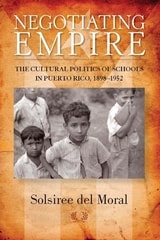
Rather than seeing U.S. empire in Puerto Rico during this period as a contest between two sharply polarized groups, del Moral views their interaction as a process of negotiation. Although educators and families rejected some tenets of Americanization, such as English-language instruction, they also redefined and appropriated others to their benefit to increase literacy and skills required for better occupations and social mobility. Pushing their citizenship-building vision through the schools, Puerto Ricans negotiated a different school project—one that was reformist yet radical, modern yet traditional, colonial yet nationalist.
Negotiating Identity and Collective Memory in Czech Silesia
Johana Wyss
Central European University Press, 2026
Negotiating Latinidad
Intralatina/o Lives in ChicagoFrances R. Aparicio
University of Illinois Press, 2019
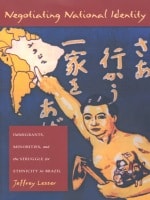
Negotiating National Identity
Immigrants, Minorities, and the Struggle for Ethnicity in BrazilJeffrey Lesser
Duke University Press, 1999
Employing a cross-cultural approach, Lesser examines a variety of acculturating responses by minority groups, from insisting on their own whiteness to becoming ultra-nationalists and even entering secret societies that insisted Japan had won World War II. He discusses how various minority groups engaged in similar, and successful, strategies of integration even as they faced immense discrimination and prejudice. Some believed that their ethnic heritage was too high a price to pay for the “privilege” of being white and created alternative categories for themselves, such as Syrian-Lebanese, Japanese-Brazilian, and so on. By giving voice to the role ethnic minorities have played in weaving a broader definition of national identity, this book challenges the notion that elite discourse is hegemonic and provides the first comprehensive look at Brazilian worlds often ignored by scholars.
Based on extensive research, Negotiating National Identity will be valuable to scholars and students in Brazilian and Latin American studies, as well as those in the fields of immigrant history, ethnic studies, and race relations.

Negotiating Performance
Gender, Sexuality, and Theatricality in Latin/o AmericaDiana Taylor and Juan Villegas, ed.
Duke University Press, 1994
The Latin/o America examined here stretches from Patagonia to New York City, bridging the political and geographical divides between U.S. Latinos and Latin Americans. Moving from Nuyorican casitas in the South Bronx, to subversive street performances in Buenos Aires, to border art from San Diego/Tijuana, this volume negotiates the borders that bring Americans together and keep them apart, while at the same time debating the use of the contested term "Latino/a." In the emerging dialogue, contributors reenvision an inclusive "América," a Latin/o America that does not pit nationality against ethnicity—in other words, a shared space, and a home to all Latin/o Americans.
Negotiating Performance opens up the field of Latin/o American theater and performance criticism by looking at performance work by Mayans, women, gays, lesbians, and other marginalized groups. In so doing, this volume will interest a wide audience of students and scholars in feminist and gender studies, theater and performance studies, and Latin American and Latino cultural studies.
Contributors. Judith Bettelheim, Sue-Ellen Case, Juan Flores, Jean Franco, Donald H. Frischmann, Guillermo Gómez-Peña, Jorge Huerta, Tiffany Ana López, Jacqueline Lazú, María Teresa Marrero, Cherríe Moraga, Kirsten F. Nigro, Patrick O’Connor, Jorge Salessi, Alberto Sandoval, Cynthia Steele, Diana Taylor, Juan Villegas, Marguerite Waller
Negotiating Power and Privilege
Career Igbo Women in Contemporary NigeriaPhilomina E. Okeke-Ihejirika
Ohio University Press, 2004
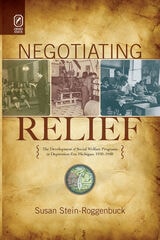
Negotiating Relief
The Development of Social Welfare Programs in Depression-Era Michigan, 1930–1940Susan Stein-Roggenbuck
The Ohio State University Press, 2008
Guided by fiscal localism and a firm belief in home rule, local officials fought to retain control of relief. Stein-Roggenbuck argues that while significant changes occurred in welfare policy as a result of the New Deal, many continuities remained. Among those was the responsibility of families to provide financial support. Often forgotten were those on general relief—individuals who did not fit the federal programs such as Aid to Dependent Children (ADC) and Old Age Assistance (OAA). General relief became a third track of welfare.
Drawing on newspaper records, county and city board minutes, social welfare agency records, federal records, and case file records, Negotiating Relief gives voice to the numerous groups involved in welfare debates, particularly the recipients of relief. This book adds to our understanding of the local implementation of welfare policy in both rural and urban areas.

Negotiating Spain and Catalonia
Competing Narratives of National IdentityFernando León-Solís
Intellect Books, 2013
The two case studies included in this book (dealing with the Football World Cups of 1994 and 2002, and the general elections of 1996 and 2000) examine competing discourses of Spain, Catalonia and their national identities, as constructed in the Spanish press. The conservative discourse offers traditional and unified images of Spain close to the stereotype, whereas more liberal visions of the country regard 'Europeanism' and 'reason' (not 'passive') as the values Spain should aspire to. From a peripheral perspective, Catalan self-definition is of a people that is hardworking, thoughtful, truly European, and different from the rest of the Spaniards.
However, these differences between the discourses are not always so clear-cut. Central to Negotiating Spain and Catalonia is the idea of the constant renegotiation of Spanish and Catalan identities in order to adapt them to the political circumstance: both case studies show how radically different narratives of Spanishness and Catalanicity offered in the turbulent political past tend to merge into the more tranquil present.
Negotiating With ETA
Obstacles To Peace In The Basque Country, 1975-1988Robert P. Clark
University of Nevada Press, 1990
Since the late 1960s, the Basque insurgent organization ETA (Euzkadi ta Askatasuna, or Basque Homeland and Freedom) has been engaged in a violent struggle against the Spanish state in an effort to gain the independence of the Basque Country. ETA violence has led to the death of hundreds of people, making the organization the most violent insurgent group in Europe. Between 1975 and 1988, nearly thirty attempts to negotiate an end to violence, with a few limited exceptions, all ended in failure. This important book examines why the efforts to negotiate have failed and makes suggestions on how to improve the chances for successful discussion in the future. Although Clark does not disprove the conventional wisdom that negotiation with terrorists is a bad idea, he does begin from the opposing point of view that there may be some positive values to be realized from such negotiation.Negotiating with ETA describes the various factions that are interested in the outcome of such negotiations and the Spanish antiterrorist policy throughout the period under examination. The book also recounts the early attempts to negotiate, the first attempt at "social reintegration," various attempts by the Basque Government to get negotiations started, negotiation efforts under the Spanish socialist government of Felipe González, and the lengthy negotiations that took place in Algeria. A wide range of scholars and specialists will find this book valuable, including those interested in contemporary Spanish politics, ethnic nationalism, Basque affairs, the problem of terrorism, and conflict resolution.
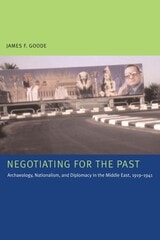
Negotiating for the Past
Archaeology, Nationalism, and Diplomacy in the Middle East, 1919-1941By James F. Goode
University of Texas Press, 2007
The discovery of the tomb of Tutankhamun in 1922 was a landmark event in Egyptology that was celebrated around the world. Had Howard Carter found his prize a few years earlier, however, the treasures of Tut might now be in the British Museum in London rather than the Egyptian Museum in Cairo. That's because the years between World War I and World War II were a transitional period in Middle Eastern archaeology, as nationalists in Egypt and elsewhere asserted their claims to antiquities discovered within their borders. These claims were motivated by politics as much as by scholarship, with nationalists seeking to unite citizens through pride in their ancient past as they challenged Western powers that still exercised considerable influence over local governments and economies. James Goode's analysis of archaeological affairs in Turkey, Egypt, Iran, and Iraq during this period offers fascinating new insight into the rise of nationalism in the Middle East, as well as archaeological and diplomatic history.
The first such work to compare archaeological-nationalistic developments in more than one country, Negotiating for the Past draws on published and archival sources in Arabic, English, French, German, Persian, and Turkish. Those sources reveal how nationalists in Iraq and Iran observed the success of their counterparts in Egypt and Turkey, and were able to hold onto discoveries at legendary sites such as Khorsabad and Persepolis. Retaining artifacts allowed nationalists to build museums and control cultural heritage. As Goode writes, "Going to the national museum became a ritual of citizenship." Western archaeologists became identified (in the eyes of many) as agents of imperialism, thus making their work more difficult, and often necessitating diplomatic intervention. The resulting "negotiations for the past" pulled patrons (such as John D. Rockefeller, Jr., and Lord Carnarvon), archaeologists (James Breasted and Howard Carter), nationalist leaders (Ataturk and Sa'd Zaghlul), and Western officials (Charles Evan Hughes and Lord Curzon) into intractable historical debates with international implications that still resonate today.
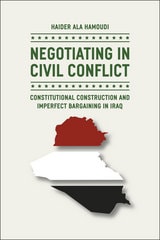
Negotiating in Civil Conflict
Constitutional Construction and Imperfect Bargaining in IraqHaider Ala Hamoudi
University of Chicago Press, 2013
Negotiating the Intersections of Writing and Writing Instruction
Proceedings from the 2019 Conference of the European Association for the Teaching of Academic Writingedited by Magnus Gustafsson and Andreas Eriksson
University Press of Colorado, 2022
Negotiating the Past in the Past
Identity, Memory, and Landscape in Archaeological ResearchNorman Yoffee
University of Arizona Press, 2008
Despite our keen eye for discerning historical spin doctors operating today, it has been only in recent years that archaeologists have begun exploring in detail how the past was used in the past itself. This volume of ten original works brings critical insight to this frequently overlooked dimension of earlier societies. Drawing on the concepts of identity, memory, and landscape, the contributors show how these points of entry can lead to substantially new accounts of how people understood their lives and why things changed as they did.
Chapters include the archaeologies of the eastern Mediterranean, including Mesopotamia, Iran, Greece, and Rome; prehistoric Greece; Achaemenid and Hellenistic Armenia; Athens in the Roman period; Nubia and Egypt; medieval South India; and northern Maya Quintana Roo. The contributors show how and why, in each society, certain versions of the past were promoted while others were aggressively forgotten for the purpose of promoting innovation, gaining political advantage, or creating a new group identity.
Commentaries by leading scholars Lynn Meskell and Jack Davis blend with newer voices to create a unique set of essays that is diverse but interrelated, exceptionally researched, and novel in its perspectives.
CONTENTS
1. Peering into the Palimpsest: An Introduction to the Volume
Norman Yoffee
2. Collecting, Defacing, Reinscribing (and Otherwise Performing) Memory in the Ancient World
Catherine Lyon Crawford
3. Unforgettable Landscapes: Attachments to the Past in Hellenistic Armenia
Lori Khatchadourian
4. Mortuary Studies, Memory, and the Mycenaean Polity
Seth Button
5. Identity under Construction in Roman Athens
Sanjaya Thakur
6. Inscribing the Napatan Landscape: Architecture and Royal Identity
Lindsay Ambridge
7. Negotiated Pasts and the Memorialized Present in Ancient India: Chalukyas of Vatapi
Hemanth Kadambi
8. Creating, Transforming, Rejecting, and Reinterpreting Ancient Maya Urban Landscapes: Insights from Lagartera and Margarita
Laura P. Villamil
9. Back to the Future: From the Past in the Present to the Past in the Past
Lynn Meskell
10. Memory Groups and the State: Erasing the Past and Inscribing the Present in the Landscapes of the Mediterranean and Near East
Jack L. Davis
About the Editor
About the Contributors
Index
Negotiation within Domination
New Spain's Indian Pueblos Confront the Spanish StateEthelia Ruiz Medrano
University Press of Colorado, 2016
Bringing together work by Mexican and North American historians, this collection is a crucially important and rare contribution to the field. Negotiation within Domination is a valuable resource for native peoples as they seek to redefine and revitalize their identities and assert their rights relating to language and religion, ownership of lands and natural resources, rights of self-determination and self-government, and protection of cultural and intellectual property. It will be of interest primarily to specialists in the field of colonial studies and historians and ethnohistorians of New Spain.
Contributors: R. Jovita Baber, José Manuel A. Chávez-Gómez, Susan Kellogg, Edward W. Osowski, María de los Ángeles Romero Frizzi, Ethelia Ruiz Medrano, Cuauhtémoc Velasco Ávila, Yanna P. Yannakakis
Negritude Women
T. Denean Sharpley-Whiting
University of Minnesota Press, 2002
Rediscovers the crucial role that women played in the influential Negritude movement.
The Negritude movement, which signaled the awakening of a pan-African consciousness among black French intellectuals, has been understood almost exclusively in terms of the contributions of its male founders: Aimé Césaire, Léopold Sédar Senghor, and Léon G. Damas. This masculine genealogy has completely overshadowed the central role played by French-speaking black women in its creation and evolution. In Negritude Women, T. Denean Sharpley-Whiting offers a long-overdue corrective, revealing the contributions made by the women who were not merely integral to the success of the movement, but often in its vanguard.
Through such disparate tactics as Lacascade’s use of Creole expressions in her French prose writings, the literary salon and journal founded by the Martinique-born Nardal sisters, and Roussy-Césaire’s revolutionary blend of surrealism and Negritude in the pages of Tropiques, the journal she founded with her husband, these four remarkable women made vital contributions. In exploring their influence on the development of themes central to Negritude-black humanism, the affirmation of black peoples and their cultures, and the rehabilitation of Africa-Sharpley-Whiting provides the movement’s first genuinely inclusive history.
Negro Education in Alabama
A Study in Cotton and SteelHorace Mann Bond
University of Alabama Press, 1994
WINNER OF THE SUSAN COLVER ROSENBERGER AWARD
A foundational work of educational history, Horace Mann Bond’s study reveals how race, labor, and power shaped Black schooling in Alabama—and why those lessons still matter today.
Originally published in 1939, Negro Education in Alabama: A Study in Cotton and Steel by Horace Mann Bond is a pioneering work of educational and social history. Drawing on extensive data and firsthand observation, Bond explores how the economic structures of the cotton South and the industrializing North influenced the development of Black education in Alabama. He examines disparities in funding, curriculum, and access, while also highlighting the resilience and agency of African American communities in pursuing educational advancement. This reissued edition preserves Bond’s critical insights and remains a vital resource for scholars of African American history, education policy, and Southern studies.
Negro Militia and Reconstruction
By Otis A. Singletary
University of Texas Press, 1957
Much of the violence that characterized Reconstruction was directly associated with the Negro militia movement organized by Radical politicians to support their precarious regimes in Southern states. This book is the story of that ill-fated movement, a story with important implication for later times.
Most Southern whites did not disguise their hostility toward the governments that were imposed on their states after Reconstruction entered its Radical phase. and Radical leaders lived in constant fear that this hostility would flare into open revolt. Organization of a loyal protective force was imperative if they were to remain in power.
Although planned originally as a defensive force, the Negro militia was quickly used by the Radicals for such purposes as controlling elections. The resentment of Southern whites resulting from this political activity was aggravated by crimes of violence, depredations, and minor social offenses committed by some of the militiamen. However, the white Southerner’s fundamental enmity toward the Negro militia stemmed from the racial implications of a policy that armed the Negroes and placed them in positions of authority over white men.
At first, opposition to the Negro militia movement took the form of legal stratagems and other measures short of force, but the final blow to the Negro militia was dealt by white volunteer rifle companies— illegal, armed counterforces that were at the very core of the White Line movement. The race riot as a political technique was born, the most notorious riot occurring at Hamburg, South Carolina, where, the author states, the policy of “disbandment through extermination” was successfully employed. Disintegration of the entire movement was inevitable.
“It is ironic,” Singletary states, “that the organization of this protective force, because of its racial implications, actually aided in the destruction of the very thing it was created to protect.”
Before its publication, Negro Militia and Reconstruction won the Moncado Prize, a cash award made biennially by the American Military Institute for “the best original book-length manuscript in any field of United States Military history.”
Negro Slavery in Arkansas
Orville Taylor
University of Arkansas Press, 2000
Long out of print and found only in rare-book stores, it is now available to a contemporary audience with this new paperback edition.
When slavery was abolished by the Emancipation Proclamation, there were slaves in every county of the state, and almost half the population was directly involved in slavery as either a slave, a slaveowner, or a member of an owner’s family. Orville Taylor traces the growth of slavery from John Law’s colony in the early eighteenth century through the French and Spanish colonial period, territorial and statehood days, to the beginning of the Civil War. He describes the various facets of the institution, including the slave trade, work and overseers, health and medical treatment, food, clothing, housing, marriage, discipline, and free blacks and manumission.
While drawing on unpublished material as appropriate, the book is, to a great extent, based on original, often previously unpublished, sources. Valuable to libraries, historians in several areas of concentration, and the general reader, it gives due recognition to the signficant place slavery occupied in the life and economy of antebellum Arkansas.

Negro Soy Yo
Hip Hop and Raced Citizenship in Neoliberal CubaMarc D. Perry
Duke University Press, 2016
Negro Thought in America, 1880-1915
Racial Ideologies in the Age of Booker T. WashingtonAugust Meier
University of Michigan Press, 1963

Neighboring Faiths
Christianity, Islam, and Judaism in the Middle Ages and TodayDavid Nirenberg
University of Chicago Press, 2014
There have been countless scripture-based studies of the three “religions of the book,” but Nirenberg goes beyond those to pay close attention to how the three religious neighbors loved, tolerated, massacred, and expelled each other—all in the name of God—in periods and places both long ago and far away. Nirenberg argues that the three religions need to be studied in terms of how each affected the development of the others over time, their proximity of religious and philosophical thought as well as their overlapping geographies, and how the three “neighbors” define—and continue to define—themselves and their place in terms of one another. From dangerous attractions leading to interfaith marriage; to interreligious conflicts leading to segregation, violence, and sometimes extermination; to strategies for bridging the interfaith gap through language, vocabulary, and poetry, Nirenberg aims to understand the intertwined past of the three faiths as a way for their heirs to produce the future—together.
Neighbors and Strangers
The Fundamentals of Foreign AffairsWilliam R. Polk
University of Chicago Press, 1997
Indeed, going deeper into the human experience, Polk documents "fear of the foreigner" as a visceral response so deep-seated and so pervasive that it transcends human memory, individual experience and even logical analysis. More generally, he shows that the tension created by having to live as neighbors with those who, in the definition of contemporaries, were irredeemably alien has been one of the major causes of the rise of civilizations.
Accessible and engaging, Neighbors and Strangers is a revelatory look at how foreign affairs are a profound reflection of human nature.
Neither Black Nor White
Slavery and Race Relations in Brazil and the United StatesCarl Degler
University of Wisconsin Press, 1986
Carl Degler’s 1971 Pulitzer-Prize-winning study of comparative slavery in Brazil and the United States is reissued in the Wisconsin paperback edition, making it accessible for all students of American and Latin American history and sociology.
Until Degler’s groundbreaking work, scholars were puzzled by the differing courses of slavery and race relations in the two countries. Brazil never developed a system of rigid segregation, such as appeared in the United States, and blacks in Brazil were able to gain economically and retain far more of their African culture. Rejecting the theory of Giberto Freyre and Frank Tannenbaum—that Brazilian slavery was more humane—Degler instead points to a combination of demographic, economic, and cultural factors as the real reason for the differences.
“In the early 1970s when studies in social history were beginning to blossom on the North American scene, Carl Degler’s prize-winning contribution was a thoughtful provocative essay in comparative history. Its thoughtfulness has not diminished with the years. Indeed, it is as topical today as when it was first published. The Brazilian experience with rapid industrialization and its attempt to restore democratic government indicates that the issues which Degler treated in the early 1970s are more pertinent than ever today.”—Franklin W. Knight, Department of History, Johns Hopkins University.
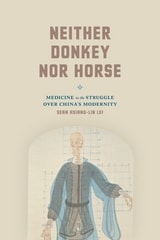
Neither Donkey nor Horse
Medicine in the Struggle over China's ModernitySean Hsiang-lin Lei
University of Chicago Press, 2014
Far from being a remnant of China’s premodern past, Chinese medicine in the twentieth century coevolved with Western medicine and the Nationalist state, undergoing a profound transformation—institutionally, epistemologically, and materially—that resulted in the creation of a modern Chinese medicine. This new medicine was derided as “neither donkey nor horse” because it necessarily betrayed both of the parental traditions and therefore was doomed to fail. Yet this hybrid medicine survived, through self-innovation and negotiation, thus challenging the conception of modernity that rejected the possibility of productive crossbreeding between the modern and the traditional.
By exploring the production of modern Chinese medicine and China’s modernity in tandem, Lei offers both a political history of medicine and a medical history of the Chinese state.

Neither German nor Pole
Catholicism and National Indifference in a Central European BorderlandJames E. Bjork
University of Michigan Press, 2009
"This is a fascinating local story with major implications for studies of nationalism and regional identities throughout Europe more generally."
---Dennis Sweeney, University of Alberta
"James Bjork has produced a finely crafted, insightful, indeed, pathbreaking study of the interplay between religious and national identity in late nineteenth-century Central Europe."
---Anthony Steinhoff, University of Tennessee at Chattanooga
Neither German nor Pole examines how the inhabitants of one of Europe's most densely populated industrial districts managed to defy clear-cut national categorization, even in the heyday of nationalizing pressures at the turn of the twentieth century. As James E. Bjork argues, the "civic national" project of turning inhabitants of Upper Silesia into Germans and the "ethnic national" project of awakening them as Poles both enjoyed successes, but these often canceled one another out, exacerbating rather than eliminating doubts about people's national allegiances. In this deadlock, it was a different kind of identification---religion---that provided both the ideological framework and the social space for Upper Silesia to navigate between German and Polish orientations. A fine-grained, microhistorical study of how confessional politics and the daily rhythms of bilingual Roman Catholic religious practice subverted national identification, Neither German nor Pole moves beyond local history to address broad questions about the relationship between nationalism, religion, and modernity.