Results by title
603 books match the query 'Discrimination (incl. Prejudice, Racism, Colorism, etc.)' and 13 start with o
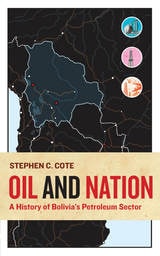
Oil and Nation
A History of Bolivia's Petroleum SectorStephen C. Cote
West Virginia University Press, 2016
The book advances chronologically from Bolivia’s earliest petroleum pioneers in the nineteenth century until the present, inserting oil into historical debates about Bolivian ethnic, racial, and environmental issues, and within development strategies by different administrations. While Bolivia is best known for its tin mining, Oil and Nation makes the case that nationalist reformers viewed hydrocarbons and the state oil company as a way to modernize the country away from the tin monoculture and its powerful backers and toward an oil-powered future.
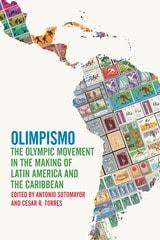
Olimpismo
The Olympic Movement in the Making of Latin America and the CaribbeanAntonio Sotomayor
University of Arkansas Press, 2020
On Anger
Race, Cognition, NarrativeBy Sue Kim
University of Texas Press, 2013
Anger is an emotion that affects everyone regardless of culture, class, race, or gender—but at the same time, being angry always results from the circumstances in which people find themselves. In On Anger, Sue J. Kim opens a stimulating dialogue between cognitive studies and cultural studies to argue that anger is always socially and historically constructed and complexly ideological, and that the predominant individualistic conceptions of anger are insufficient to explain its collective, structural, and historical nature.
On Anger examines the dynamics of racial anger in global late capitalism, bringing into conversation work on political anger in ethnic, postcolonial, and cultural studies with recent studies on emotion in cognitive studies. Kim uses a variety of literary and media texts to show how narratives serve as a means of reflecting on experiences of anger and also how we think about anger—its triggers, its deeper causes, its wrongness or rightness. The narratives she studies include the film Crash, Maxine Hong Kingston’s The Woman Warrior, Tsitsi Dangarembga’s Nervous Conditions and The Book of Not, Ngugi wa Thiong’o’s Devil on the Cross and Wizard of the Crow, and the HBO series The Wire. Kim concludes by distinguishing frustration and outrage from anger through a consideration of Stéphane Hessel’s call to arms, Indignez-vous! One of the few works that focuses on both anger and race, On Anger demonstrates that race—including whiteness—is central to our conceptions and experiences of anger.

One Hundred Years of The Souls of Black Folk
A Celebration of W. E. B. Du Bois, Volume 17Robert Gooding-Williams and Dwight A. McBride, eds.
Duke University Press, 0
This collection relies on the language of literary aesthetics to examine Du Bois’s political agenda and, conversely, on varying accounts of that political agenda to assess his aesthetic choices. It also helps us understand why Souls became a literary and political classic and has played such a decisive role in the formation of twentieth-century African American literature and political thought. The essays explore a variety of topics, including the possibility that Souls was modeled on Richard Wagner’s idea of a total artwork, Du Bois’s thinking about the political significance of homosociality, and the interplay of racialism, nationalism, and globalism in Souls.
Contributors. Anne E. Carroll, Vilashini Cooppan, Robert Gooding-Williams, Sheila Lloyd, Dwight A. McBride, Charles I. Nero, Cheryl A. Wall, Alexander G. Weheliye
Operation Mind
A Brief Documentary Account of the House Committee on Un-American Activities. And Why It Matters Now.Natalie Zemon Davis and Elizabeth Douvan
Disobedience Press, 2025
The 2025 reprint of Operation Mind offers a foreword by comparatist Silke-Maria Weineck, an essay by historian Alan Wald connecting Operation Mind’s history of McCarthyism with present-day attacks on academic freedom, and a new (2023) introduction to the text by Natalie Zemon Davis.
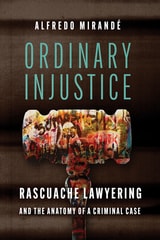
Ordinary Injustice
Rascuache Lawyering and the Anatomy of a Criminal CaseAlfredo Mirandé
University of Arizona Press, 2023
Building from author Alfredo Mirandé’s earlier work Rascuache Lawyer, the account is told by “The Professor,” who led a pro bono rascuache legal defense team comprising the professor, a retired prosecutor, and student interns, working without a budget, office, paralegals, investigators, or support staff. The book is a must-read for anyone interested in race, gender, and criminal injustice and will appeal not only to law scholars and social scientists but to lay readers interested in ethnographic field research, Latinx communities, and racial disparities in the legal system.
The case is presented as a series of letters to the author’s fictional alter-ego, Fermina Gabriel, an accomplished lawyer and singer. This narrative device allows the author to present the case as it happens, relaying the challenges and complexities as they occur and drawing the reader in.
While Ordinary Injustice deals with important, complicated legal issues and questions that arise in criminal defense work and looks at the case from the time of Juan’s arrest to the preliminary hearing, indictment, pretrial motions, and attempts to obtain a negotiated plea, it is written in nontechnical and engaging language that makes law accessible to the lay reader.
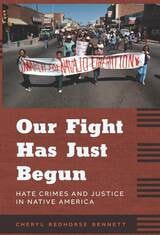
Our Fight Has Just Begun
Hate Crimes and Justice in Native AmericaCheryl Redhorse Bennett
University of Arizona Press, 2022
Illuminating largely untold stories of hate crimes committed against Native Americans in the Four Corners region of the United States, this work places these stories within a larger history, connecting historical violence in the United States to present-day hate crimes. Bennett contends that hate crimes committed against Native Americans have persisted as an extension of an “Indian hating” ideology that has existed since colonization, exposing how the justice system has failed Native American victims and families.
While this book looks deeply at multiple generations of unnecessary and ongoing pain and violence, it also recognizes that this is a time of uncertainty and hope. The movement to abolish racial injustice and racially motivated violence has gained fierce momentum. Our Fight Has Just Begun shows that racism, hate speech, and hate crimes are ever present and offers recommendations for racial justice.
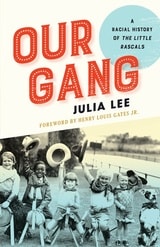
Our Gang
A Racial History of The Little RascalsJulia Lee
University of Minnesota Press, 2015
It was the age of Jim Crow, riddled with racial violence and unrest. But in the world of Our Gang, black and white children happily played and made mischief together. They even had their own black and white version of the KKK, the Cluck Cluck Klams—and the public loved it.
The story of race and Our Gang, or The Little Rascals, is rife with the contradictions and aspirations of the sharply conflicted, changing American society that was its theater. Exposing these connections for the first time, Julia Lee shows us how much this series, from the first silent shorts in 1922 to its television revival in the 1950s, reveals about black and white American culture—on either side of the silver screen. Behind the scenes, we find unconventional men like Hal Roach and his gag writers, whose Rascals tapped into powerful American myths about race and childhood. We meet the four black stars of the series—Ernie “Sunshine Sammy” Morrison, Allen “Farina” Hoskins, Matthew “Stymie” Beard, and Billie “Buckwheat” Thomas—the gang within the Gang, whose personal histories Lee pursues through the passing years and shifting political landscape.
In their checkered lives, and in the tumultuous life of the series, we discover an unexplored story of America, the messy, multiracial nation that found in Our Gang a comic avatar, a slapstick version of democracy itself.
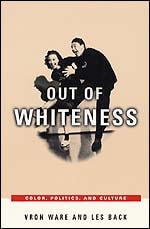
Out of Whiteness
Color, Politics, and CultureVron Ware and Les Back
University of Chicago Press, 2002
Vron Ware and Les Back look at key points in recent American and British culture where the "color line" has been blurred. Through probing accounts of racial masquerades in popular literature, the growth of the white power music scene on the Internet, the meteoric rise of big band jazz during the Second World War, and the pivotal role of white session players in crafting rhythm and blues classics by black artists, Ware and Back upset the idea of race as a symbol of inherent human attributes. Their book gives us a timely reckoning of the forces that continue to make people "white," and reveals to us the polyglot potential of identities and cultures.
Out of the Red
My Life of Gangs, Prison, and RedemptionChristian L. Bolden
Rutgers University Press, 2020
Faculty Senate Award for Research from Loyola University New Orleans
Out of the Red is one man’s pathbreaking story of how social forces and personal choices combined to deliver an unfortunate fate. After a childhood of poverty, institutional discrimination, violence, and being thrown away by the public education system, Bolden's life took him through the treacherous landscape of street gangs at the age of fourteen. The Bloods offered a sense of family, protection, excitement, and power. Incarcerated during the Texas prison boom, the teenage former gangster was thrust into a fight for survival as he navigated the perils of adult prison. As mass incarceration and prison gangs swallowed up youth like him, survival meant finding hope in a hopeless situation and carving a path to his own rehabilitation. Despite all odds, he forged a new path through education, ultimately achieving the seemingly impossible for a formerly incarcerated ex-gangbanger.
Outcasts from Evolution
Scientific Attitudes of Racial Inferiority, 1859 - 1900John S. Haller, Jr.
Southern Illinois University Press, 1996
In the only book to date to explore the period between the 1859 publication of Darwin’s Origin of Species and the discovery in 1900 of Gregor Mendel’s experiments in genetics, John S. Haller, Jr., shows the relationship between scientific "conviction" and public policy. He focuses on the numerous liberally educated American scientists who were caught up in the triumph of evolutionary ideas and who sought to apply those ideas to comparative morality, health, and the physiognomy of nonwhite races.
During this period, the natural and social scientists of the day not only accepted without question the genetic and cultural superiority of the Caucasian; they also asserted that the Caucasian race held a monopoly on evolutionary progress, arguing that "inferior races" were no more than evolutionary survivors doomed by their genetic legacy to remain outcasts from evolution.
Hereditarians and evolutionists believed that "less fit" human races were perishing from the rigors of civilization’s struggle and competition. Indeed, racial inferiority lay at the very foundation of the evolutionary framework and, remaining there, rose to the pinnacle of "truth" with the myth of scientific certainty.
Outside Agitator
Jon Daniels and the Civil Rights Movement in AlabamaCharles Eagles
University of Alabama Press, 2000
WINNER OF THE LILLIAN SMITH BOOK AWARD
The story of faith, sacrifice, and moral courage in Alabama's fight for civil rights.
Outside Agitator tells the powerful, largely forgotten story of Jonathan Daniels—a white Episcopal seminarian from New England who answered the call of the civil rights movement and paid for that commitment with his life. In 1965, Daniels left the safety of Harvard and Cambridge for Selma and Alabama’s Black Belt, where he worked alongside Black activists to challenge segregation, register voters, and confront the moral failures of church and state. His murder by a white segregationist shocked the nation and exposed the deadly cost of racial injustice—and of moral courage.
More than a biography, this book asks urgent questions that still resonate: What does it mean to act on conscience in a society structured by inequality? What responsibilities do faith, citizenship, and privilege impose? Historian Charles W. Eagles places Daniels’s life within the turbulent final phase of the southern civil rights movement, revealing the everyday fears, ethical dilemmas, and racial tensions behind the iconic events of Selma and Lowndes County.
Outside Agitator will appeal to readers interested in civil rights history, religious activism, Southern history, and the moral dimensions of political struggle. It is essential reading for students, scholars, clergy, and general readers seeking to understand how individual lives can illuminate—and challenge—the ongoing fight for justice and equality.
Overcoming Apartheid
Can Truth Reconcile a Divided Nation?James L. Gibson
Russell Sage Foundation, 2004