Results by title
4917 books match the query 'Philosophy' and 131 start with o
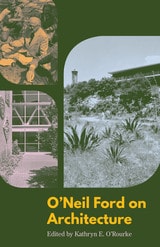
O'Neil Ford on Architecture
Edited by Kathryn E. O'Rourke
University of Texas Press, 2019
Winner, Publication Award, Southeastern Chapter of the Society of Architectural Historians (SESAH), 2019
Acclaimed for his designs of the Trinity University campus, the Little Chapel in the Woods, the Texas Instruments Semiconductor Components Division Building, and numerous private houses, O’Neil Ford (1905–1982) was an important twentieth-century architect and a pioneer of modernism in Texas. Collaborating with artists, landscape architects, and engineers, Ford created diverse and enduringly rich works that embodied and informed international developments in modern architecture. His buildings, lectures, and teaching influenced a generation of Texas architects.
O’Neil Ford on Architecture brings together Ford’s major professional writings and speeches for the first time. Revealing the intellectual and theoretical underpinnings of his distinctive modernism, they illuminate his fascination with architectural history, his pioneering uses of new technologies and construction systems, his deep concerns for the landscape and environment, and his passionate commitments to education and civil rights. An interlocutor with titans of the twentieth century, including Louis Kahn and J. Robert Oppenheimer, Ford understood architecture as inseparable from the social, political, and scientific developments of his day. An introductory essay by Kathryn E. O’Rourke provides a critical assessment of Ford’s essays and lectures and repositions him in the history of US architectural modernism. As some of his most important buildings turn sixty, O’Neil Ford on Architecture demonstrates that this Texas modernist deserves to be ranked among the leading midcentury American architects.
Object Lessons
The Novel as a Theory of ReferenceJami Bartlett
University of Chicago Press, 2016
Object-Oriented Feminism
Katherine Behar
University of Minnesota Press, 2016
The essays in Object-Oriented Feminism explore OOF: a feminist intervention into recent philosophical discourses—like speculative realism, object-oriented ontology (OOO), and new materialism—that take objects, things, stuff, and matter as primary. Object-oriented feminism approaches all objects from the inside-out position of being an object too, with all of its accompanying political and ethical potentials.
This volume places OOF thought in a long history of ongoing feminist work in multiple disciplines. In particular, object-oriented feminism foregrounds three significant aspects of feminist thinking in the philosophy of things: politics, engaging with histories of treating certain humans (women, people of color, and the poor) as objects; erotics, employing humor to foment unseemly entanglements between things; and ethics, refusing to make grand philosophical truth claims, instead staking a modest ethical position that arrives at being “in the right” by being “wrong.”
Seeking not to define object-oriented feminism but rather to enact it, the volume is interdisciplinary in approach, with contributors from a variety of fields, including sociology, anthropology, English, art, and philosophy. Topics are frequently provocative, engaging a wide range of theorists from Heidegger and Levinas to Irigaray and Haraway, and an intriguing diverse array of objects, including the female body as fetish object in Lolita subculture; birds made queer by endocrine disruptors; and truth claims arising in material relations in indigenous fiction and film. Intentionally, each essay can be seen as an “object” in relation to others in this collection.
Contributors: Irina Aristarkhova, University of Michigan; Karen Gregory, University of Edinburgh; Marina Gržinić, Slovenian Academy of Science and Arts; Frenchy Lunning, Minneapolis College of Art and Design; Timothy Morton, Rice University; Anne Pollock, Georgia Tech; Elizabeth A. Povinelli, Columbia University; R. Joshua Scannell, CUNY Graduate Center; Adam Zaretsky, VASTAL.

Objectivity and Diversity
Another Logic of Scientific ResearchSandra Harding
University of Chicago Press, 2015
Sandra Harding is not ready to throw out objectivity quite yet. For all of its problems, she contends that objectivity is too powerful a concept simply to abandon. In Objectivity and Diversity, Harding calls for a science that is both more epistemically adequate and socially just, a science that would ask: How are the lives of the most economically and politically vulnerable groups affected by a particular piece of research? Do they have a say in whether and how the research is done? Should empirically reliable systems of indigenous knowledge count as "real science"? Ultimately, Harding argues for a shift from the ideal of a neutral, disinterested science to one that prizes fairness and responsibility.
Object—Event— Performance
Art, Materiality, and Continuity Since the 1960sEdited by Hanna B. Hölling
Bard Graduate Center, 2021
Much of the artwork that rose to prominence in the second half of the twentieth century took on novel forms—such as installation, performance, event, video, film, earthwork, and intermedia works with interactive and networked components—that pose a new set of questions about what art actually is, both physically and conceptually. For conservators, this raises an existential challenge when considering what elements of these artworks can and should be preserved.
This provocative volume revisits the traditional notions of conservation and museum collecting that developed over the centuries to suit a conception of art as static, fixed, and permanent objects. Conservators and museums increasingly struggle with issues of conservation for works created from the mid-twentieth to the twenty-first century that are unstable over time. The contributors ask what it means to conserve artworks that fundamentally address and embody the notion of change and, through this questioning, guide us to reevaluate the meaning of art, of objects, and of materiality itself. Object—Event—Performance considers a selection of post-1960s artworks that have all been chosen for their instability, changeability, performance elements, and processes that pose questions about their relationship to conservation practices. This volume will be a welcome resource on contemporary conservation for art historians, scholars of dance and theater studies, curators, and conservators.
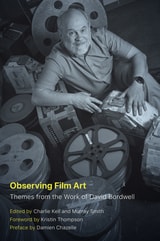
Observing Film Art
Themes from the Work of David BordwellCharlie Keil
Rutgers University Press, 2027
When David Bordwell died in 2024, he left behind a legacy of film scholarship and criticism whose influence is unmatched. Coauthor of a pair of textbooks adopted across the globe and the main force behind a blog read by thousands, Bordwell has influenced generations of film students, filmmakers, and film critics. Observing Film Art examines the breadth of Bordwell’s work through the perspectives of those who knew him best, collaborators, former students, and critics among them. This is the first collection devoted to the work of Bordwell, and it gives equal attention to each facet of his prodigious scholarship, structured to highlight his interest in theory, history, and analysis and criticism. The cornerstones of his approach to film study, including formalism, cognitivism, and historical poetics, are all examined in detail, as are key works, including The Classical Hollywood Cinema (coauthored with Kristin Thompson and Janet Staiger) and Narration in the Fiction Film.
Occasional Philosophical Writings
Jean-Paul Sartre
Seagull Books, 2021
Iconic French novelist, playwright, and essayist Jean-Paul Sartre is widely recognized as one of the most important philosophers of the twentieth century, and his work has remained relevant and thought-provoking through the decades. The Seagull Sartre Library now presents some of his most incisive philosophical, cultural, and literary critical essays in twelve newly designed and affordable editions.
The four essays of varying length assembled in this volume bear witness to Sartre’s preoccupation with philosophers and their work. In these pages he examines Descartes’s concept of freedom; comments on a fundamental idea in Husserl’s phenomenology: intentionality; writes a mixed review of Denis de Rougemont’s monumental Love in the Western World; and provides an extensive critical analysis of the work of Brice Parain, one of France’s leading philosophers of language.
Ocean, as Much as Rain
Stories, Lyrical Prose, and Poems from TibetTsering Woeser. Edited and Translated by Fiona Sze-Lorrain with Dechen Pemba.
Duke University Press, 2026
Odysseys of Recognition
Performing Intersubjectivity in Homer, Aristotle, Shakespeare, Goethe, and KleistWiggins, Ellwood
Bucknell University Press, 2019
Published by Bucknell University Press. Distributed worldwide by Rutgers University Press.

Of Bridges
A Poetic and Philosophical AccountThomas Harrison
University of Chicago Press, 2021
Offers a philosophical history of bridges—both literal bridges and their symbolic counterparts—and the acts of cultural connection they embody.
“Always,” wrote Philip Larkin, “it is by bridges that we live.” Bridges represent our aspirations to connect, to soar across divides. And it is the unfinished business of these aspirations that makes bridges such stirring sights, especially when they are marvels of ingenuity.
A rich compendium of myths, superstitions, and literary and ideological figurations, Of Bridges organizes a poetic and philosophical history of bridges into nine thematic clusters. Leaping in lucid prose between distant times and places, Thomas Harrison questions why bridges are built and where they lead. He probes links forged by religion between life’s transience and eternity as well as the consolidating ties of music, illustrated by the case of the blues. He investigates bridges in poetry, as flash points in war, and the megabridges of our globalized world. He illuminates real and symbolic crossings facing migrants each day and the affective connections that make persons and societies cohere. In readings of literature, film, philosophy, and art, Harrison engages in a profound reflection on how bridges form and transform cultural communities. Of Bridges is a mesmerizing, vertiginous tale of bridges both visible and invisible, both lived and imagined.
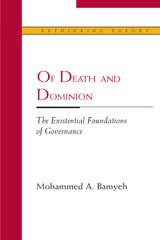
Of Death and Dominion
The Existential Foundations of GovernanceMohammed Bamyeh
Northwestern University Press, 2007
Death is the opposite not of life, but of power. And as such, Mohammed Bamyeh argues in this original work, death has had a great and largely unexplored impact on the thinking of governance throughout history, right down to our day. In Of Death and Dominion Bamyeh pursues the idea that a deep concern with death is, in fact, the basis of the ideological foundations of all political systems.
Concentrating on four types of political systems—polis, empire, theocracy, and modern mass society systems—Bamyeh shows how each follows a specific strategy designed to pit power against the equalizing specter of death. Each of these strategies—consolation, expansion, preparation, and repression—produces a certain style of political behavior, as well as particular psychic traumas. In making his argument, Bamyeh revisits a wide range of empirical and theoretical discussions in existentialist philosophy, psychoanalysis, comparative historical sociology, literary studies, and anthropology. By demonstrating how schemes of power are by definition also schemes for defying death—despite their claims to the contrary—his book encourages us to think of a new style of politics, one oriented toward life.
Of Derrida Heidegger and Spirit
David Wood
Northwestern University Press, 1993
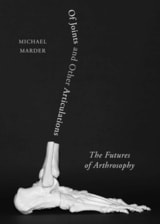
Of Joints and Other Articulations
The Futures of ArthrosophyMichael Marder
Northwestern University Press, 2026
What if we were to reimagine bodies of all kinds—biological and ecosystemic, political and textual, cosmic and artistic—from the perspective of their joints? This is the wager of Michael Marder’s philosophical treatise, which skirts the extremes of totalization and fragmentation by following the model of the joints, the structures that both articulate and disarticulate complex living unities.
Of Joints and Other Articulations: The Futures of Arthrosophy proposes that, as embodied figures of relations, joints shed new light on the question of time and the meaning of art, the activity of language and the fluctuations of good and ill health, political violence and humility, conversions and perversions. Arthrosophy, the wisdom of joints, supplements and substantiates philosophy itself, teaching us how to think through and with our knees and elbows, hips and shoulders, sutures and pivot joints.
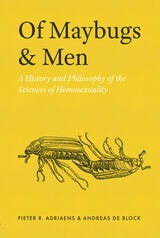
Of Maybugs and Men
A History and Philosophy of the Sciences of HomosexualityPieter R. Adriaens and Andreas De Block
University of Chicago Press, 2022
Questions about the naturalness or unnaturalness of homosexuality are as old as the hills, and the answers have often been used to condemn homosexuals, their behaviors, and their relationships. In the past two centuries, a number of sciences have involved themselves in this debate, introducing new vocabularies, theories, arguments, and data, many of which have gradually helped tip the balance toward tolerance and even acceptance. In this book, philosophers Pieter R. Adriaens and Andreas De Block explore the history and philosophy of the gay sciences, revealing how individual and societal values have colored how we think about homosexuality.
The authors unpack the entanglement of facts and values in studies of male homosexuality across the natural and human sciences and consider the extent to which science has mitigated or reinforced homonegative mores. The focus of the book is on homosexuality’s assumed naturalness. Geneticists rephrased naturalness as innateness, claiming that homosexuality is innate—colloquially, that homosexuals are born gay. Zoologists thought it a natural affair, documenting its existence in myriad animal species, from maybugs to men. Evolutionists presented homosexuality as the product of natural selection and speculated about its adaptive value. Finally, psychiatrists, who initially pathologized homosexuality, eventually appealed to its naturalness or innateness to normalize it.
Discussing findings from an array of sciences—comparative zoology, psychiatry, anthropology, evolutionary biology, social psychology, developmental biology, and machine learning—this book is essential reading for anyone interested in what science has to say about homosexuality.

Of Morsels and Marvels
Maryse Condé
Seagull Books, 2019
In Of Morsels and Marvels, Condé takes us on a literary journey around places she has travelled to in India, Indonesia, and South Africa. She highlights the tastes and culinary traditions that are fascinating examples of a living museum. Such places, Condé explains, provide important insights into lesser-known aspects of contemporary life. One anecdote illustrates what becomes of the standard Antillean dishes of fish stew and goat curry by two Antilleans who own a restaurant in Sydney, Australia. Cuisine changes not only according to the individual cook but also adapts to foreign skies under which it is created. The author also recounts personal memories of her lifelong relationship with cooking, such as when Adélia, her family’s servant, wrongly blames little Maryse for mixing raisins with fish and using her imagination in the kitchen.
Blending travel with gastronomy, this enchanting volume from the winner of the 2018 Alternative Nobel Prize will delight all who marvel at the wonders of the kitchen or seek to taste the world.
Of Problematology
Philosophy, Science, and LanguageMichel Meyer
University of Chicago Press, 1995
For Meyer, philosophy does not solve problems or give answers but instead shows how propositions are related to a whole field of questions that give them meaning. Reason is identified not with answers but with the question-answer process. Meyer pursues this new theory of reason and meaning in a critique of Western philosophy from Socrates, Plato, and Aristotle through Heidegger, Wittgenstein, and Foucault. He provides a detailed analysis of Descartes' notion of radical doubt and demonstrates its implications for the subsequent philosophical tradition that ignored the questioning process while pursuing an unshakable foundation for knowledge. Meyer argues that recent work in rhetoric points toward a theory of radical questioning and claims that the methods of rhetoric and argumentation must be turned back on philosophy itself in order to recover the original significance of metaphysics as the science of ultimate questions.
Of Spirit
Heidegger and the QuestionJacques Derrida
University of Chicago Press, 1989
"Derrida's ruminations should intrigue anyone interested in Post-Structuralism. . . . . This study of Heidegger is a fine example of how Derrida can make readers of philosophical texts notice difficult problems in almost imperceptible details of those texts."—David Hoy, London Review of Books
"Will a more important book on Heidegger appear in our time? No, not unless Derrida continues to think and write in his spirit. . . . Let there be no mistake: this is not merely a brilliant book on Heidegger, it is thinking in the grand style."—David Farrell Krell, Research in Phenomenology
"The analysis of Heidegger is brilliant, provocative, elusive."—Peter C. Hodgson, Religious Studies Review
Of Spirit
Heidegger and the QuestionJacques Derrida
University of Chicago Press, 1990
"Derrida's ruminations should intrigue anyone interested in Post-Structuralism. . . . . This study of Heidegger is a fine example of how Derrida can make readers of philosophical texts notice difficult problems in almost imperceptible details of those texts."—David Hoy, London Review of Books
"Will a more important book on Heidegger appear in our time? No, not unless Derrida continues to think and write in his spirit. . . . Let there be no mistake: this is not merely a brilliant book on Heidegger, it is thinking in the grand style."—David Farrell Krell, Research in Phenomenology
"The analysis of Heidegger is brilliant, provocative, elusive."—Peter C. Hodgson, Religious Studies Review
Oikonomia
Ancient Greek Philosophers on the Meaning of Economic LifeÉtienne Helmer
University of Chicago Press, 2024
In this book, Étienne Helmer offers a comprehensive analysis of oikonomia in ancient Greek philosophy. Despite its similarity to the word “economy,” for the ancients, oikonomia named a branch of knowledge—the science of management—that was aimed at studying the practices we engage in to satisfy our needs. This began with the domestic sphere, but it radiated outward from the oikos (house) to encompass broader issues in the polis (city) as well. Helmer explores topics such as gender roles and marriage, property and the household, the acquisition and preservation of material goods, and how Greek philosophers addressed the issue of slavery in the ancient world. Even if we are not likely to share many of ancient thinkers’ beliefs today, Helmer shows that there was once a way of thinking of “economic life” that went beyond the mere accumulation of wealth, representing a key point of departure for understanding how to inhabit the world with others.
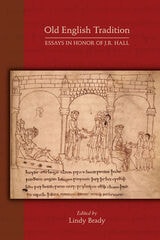
Old English Tradition
Essays in Honor of J. R. HallEdited by Lindy Brady
Arizona Center for Medieval and Renaissance Studies, 2021
Old English Tradition contains eighteen new essays by leading scholars in the field of Old English literary studies. The collection is centered around five key areas of research—Old English poetics, Anglo-Saxon Christianity, Beowulf, codicology, and early Anglo-Saxon studies—on which the work of scholar J. R. Hall, the volume’s honorand, has been influential over the course of his career.
The volume’s contents range from fresh insights on individual Old English poems such as The Wife’s Lament and Beowulf; new studies in Old English metrics and linguistics; codicological examinations of individual manuscripts; fresh editions of understudied texts; and innovative examinations of the role of early antiquarians in shaping the field of Old English literary studies as we know it today.
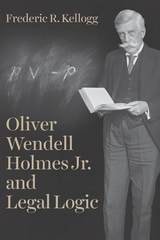
Oliver Wendell Holmes Jr. and Legal Logic
Frederic R. Kellogg
University of Chicago Press, 2018
Conventional legal logic tends to focus on the role of judges in deciding cases. Holmes recognized input from outside the law—the importance of the social dimension of legal and logical induction: how opposing views of “many minds” may converge. Drawing on analogies from the natural sciences, Holmes came to understand law as an extended process of inquiry into recurring problems.
Rather than vagueness or contradiction in the meaning or application of rules, Holmes focused on the relation of novel or unanticipated facts to an underlying and emergent social problem. Where the meaning and extension of legal terms are disputed by opposing views and practices, it is not strictly a legal uncertainty, and it is a mistake to expect that judges alone can immediately resolve the larger issue.
On Addiction
Insights from History, Ethnography, and Critical TheoryDarin Weinberg
Duke University Press, 2024
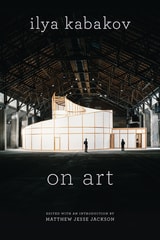
On Art
Ilya Kabakov
University of Chicago Press, 2018
Devoted to themes that range from the “cosmism” of pre-Revolutionary Russian modernism to the philosophical implications of Moscow’s garbage, Kabakov’s handmade booklets were typed out on paper, then stapled or sewn together using rough butcher paper for their covers. Among these writings are faux Socialist Realist verses, theoretical explorations, art historical analyses, accompaniments to installation projects, and transcripts of dialogues between the artist and literary theorists, critics, journalists, and other artists.
This volume offers for the first time in English the most significant texts written by Kabakov. The writings have been expressly selected for this English-language volume and there exists no equivalent work in any language.
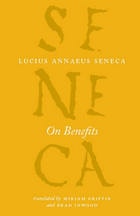
On Benefits
Lucius Annaeus Seneca
University of Chicago Press, 2011
Lucius Annaeus Seneca (4 BCE–65 CE) was a Roman Stoic philosopher, dramatist, statesman, and advisor to the emperor Nero, all during the Silver Age of Latin literature. The Complete Works of Lucius Annaeus Seneca is a fresh and compelling series of new English-language translations of his works in seven accessible volumes. Edited by world-renowned classicists Elizabeth Asmis, Shadi Bartsch, and Martha C. Nussbaum, this engaging collection restores Seneca—whose works have been highly praised by modern authors from Desiderius Erasmus to Ralph Waldo Emerson—to his rightful place among the classical writers most widely studied in the humanities.
On Benefits, written between 56 and 64 CE, is a treatise addressed to Seneca’s close friend Aebutius Liberalis. The longest of Seneca’s works dealing with a single subject—how to give and receive benefits and how to express gratitude appropriately—On Benefits is the only complete work on what we now call “gift exchange” to survive from antiquity. Benefits were of great personal significance to Seneca, who remarked in one of his later letters that philosophy teaches, above all else, to owe and repay benefits well.
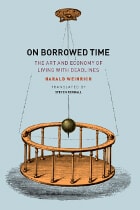
On Borrowed Time
The Art and Economy of Living with DeadlinesHarald Weinrich
University of Chicago Press, 2008
Weinrich’s analysis of the roots of the word time connects it to the temples of the skull, demonstrating that humans first experienced time in the beating of their pulses. Tracing this corporeal perception of time across literary, religious, and philosophical works, Weinrich concludes that time functions as a kind of sixth sense—the crucial sense that enables the other five.
Written with Weinrich’s customary narrative elegance, On Borrowed Time is an absorbing—and, fittingly, succinct—meditation on life’s inexorable brevity.
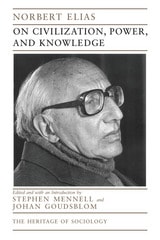
On Civilization, Power, and Knowledge
Selected WritingsNorbert Elias
University of Chicago Press, 1997
This volume is a carefully chosen collection of Elias's most important writings and includes many of his most brilliant ideas. The development of Elias's thinking during the course of his long career is traced along with a discussion of how his work relates to other major sociologists and how the various selections are interconnected. The result is a consistent and stimulating look at one of sociology's founding thinkers.
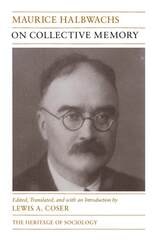
On Collective Memory
Maurice Halbwachs
University of Chicago Press, 1992
How do we use our mental images of the present to reconstruct our past? Maurice Halbwachs (1877-1945) addressed this question for the first time in his work on collective memory, which established him as a major figure in the history of sociology. This volume, the first comprehensive English-language translation of Halbwach's writings on the social construction of memory, fills a major gap in the literature on the sociology of knowledge.
Halbwachs' primary thesis is that human memory can only function within a collective context. Collective memory, Halbwachs asserts, is always selective; various groups of people have different collective memories, which in turn give rise to different modes of behavior. Halbwachs shows, for example, how pilgrims to the Holy Land over the centuries evoked very different images of the events of Jesus' life; how wealthy old families in France have a memory of the past that diverges sharply from that of the nouveaux riches; and how working class construction of reality differ from those of their middle-class counterparts.
With a detailed introduction by Lewis A. Coser, this translation will be an indispensable source for new research in historical sociology and cultural memory.
Lewis A. Coser is Distinguished Professor of Sociology Emeritus at the State University of New York and Adjunct Professor of Sociology at Boston College.
On Collective Memory
Maurice Halbwachs
University of Chicago Press, 1992
This is an auto-narrated audiobook version of this book.
How do we use our mental images of the present to reconstruct our past? Maurice Halbwachs (1877-1945) addressed this question for the first time in his work on collective memory, which established him as a major figure in the history of sociology. This volume, the first comprehensive English-language translation of Halbwach's writings on the social construction of memory, fills a major gap in the literature on the sociology of knowledge.
Halbwachs' primary thesis is that human memory can only function within a collective context. Collective memory, Halbwachs asserts, is always selective; various groups of people have different collective memories, which in turn give rise to different modes of behavior. Halbwachs shows, for example, how pilgrims to the Holy Land over the centuries evoked very different images of the events of Jesus' life; how wealthy old families in France have a memory of the past that diverges sharply from that of the nouveaux riches; and how working class construction of reality differ from those of their middle-class counterparts.
With a detailed introduction by Lewis A. Coser, this translation will be an indispensable source for new research in historical sociology and cultural memory.
Lewis A. Coser is Distinguished Professor of Sociology Emeritus at the State University of New York and Adjunct Professor of Sociology at Boston College.
On Creation [Quaestiones Disputatae de Potentia Dei, Q. 3]
Catholic University of America Press, 2011
On Creaturely Life
Rilke, Benjamin, SebaldEric L. Santner
University of Chicago Press, 2006
Santner traces this theme of creaturely life from its poetic and philosophical beginnings in the first half of the twentieth century to the writings of the enigmatic German novelist W. G. Sebald. Sebald’s entire oeuvre, Santner argues, can be seen as an archive of creaturely life. For Sebald, the work on such an archive was inseparable from his understanding of what it means to engage ethically with another person’s history and pain, an engagement that transforms us from indifferent individuals into neighbors.
An indispensable book for students of Sebald, On Creaturely Life is also a significant contribution to critical theory.
On Decoloniality
Concepts, Analytics, PraxisWalter D. Mignolo and Catherine E. Walsh
Duke University Press, 2018
On Descartes' Metaphysical Prism
The Constitution and the Limits of Onto-theo-logy in Cartesian ThoughtJean-Luc Marion
University of Chicago Press, 1999
Expertly translated by Jeffrey Kosky, this work will appeal to historians of philosophy, students of religion, and anyone interested in the genealogy of contemporary thought and its contradictions.
On Descartes’ Passive Thought
The Myth of Cartesian DualismJean-Luc Marion
University of Chicago Press, 2018
Descartes has long been associated with mind-body dualism, but Marion argues here that this is a historical misattribution, popularized by Malebranche and popular ever since both within the academy and with the general public. Actually, Marion shows, Descartes held a holistic conception of body and mind. He called it the meum corpus, a passive mode of thinking, which implies far more than just pure mind—rather, it signifies a mind directly connected to the body: the human being that I am. Understood in this new light, the Descartes Marion uncovers through close readings of works such as Passions of the Soul resists prominent criticisms leveled at him by twentieth-century figures like Husserl and Heidegger, and even anticipates the non-dualistic, phenomenological concepts of human being discussed today. This is a momentous book that no serious historian of philosophy will be able to ignore.

On Doubt
Vilém Flusser
University of Minnesota Press, 2014
In On Doubt, Vilém Flusser refines Martin Heidegger’s famous declaration that “language is the dwelling of Being.” For Flusser, “the word is the dwelling of being,” because in fact, in the beginning, there was the word.
On Doubt is a treatise on the human intellect, its relation to language, and the reality-forming discourses that subsequently emerge. For Flusser, the faith that the modern age places in Cartesian doubt plays a role similar to the one that faith in God played in previous eras—a faith that needs to be challenged. Descartes doubts the world through his proposition cogito ergo sum, but leaves doubt itself untouched as indubitable and imperious. His cogito ergo sum may have proved to the Western intellect that thoughts exist, but it did not prove the existence of that which thinks: one can eliminate thinking and yet continue being.
Therefore, should we not doubt doubt itself? Should we not try to go beyond this last step of Cartesian doubt and look for a new faith? The twentieth century has seen many attempts to defeat Cartesian doubt, however, this doubt of doubt has instead generated a complete loss of faith, which the West experiences as existential nihilism. Hence, the emergent emptying of values that results from such extreme doubt. Everything loses its meaning. Can this climate be overcome? Will the West survive the modern age?
On Emotional Presentation
Alexius Meinong, translated from the German by Marie-Luise Schubert Kalsi and with a new foreword by John J. Drummond
Northwestern University Press, 1972
Available again in English, with a new foreword by John J. Drummond that situates Meinong’s account within contemporary discussions of the emotions, this translation will be welcome to those interested in Meinong and his theory of objects as well as those interested in the philosophy of the emotions and values.
On Faith
Nathan Rotenstreich
University of Chicago Press, 1998
Rotenstreich's phenomenological study will be of great importance for religious scholars as well as for philosophers.
Nathan Rotenstreich (1913-93) was professor of philosophy at the Hebrew University of Jerusalem. He was elected to the Israel Academy of Sciences and Humanities, and his works include Jews and German Philosophy and Reason and Its Manifestations: A Study of Kant and Hegel.
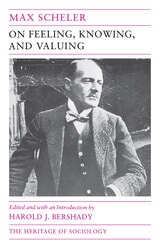
On Feeling, Knowing, and Valuing
Selected WritingsMax Scheler
University of Chicago Press, 1992
1928) ranks with Max Weber, Edmund Husserl, and Ernst
Troeltsch as being among the most brilliant minds of his
generation. Yet Scheler is now known chiefly for his
philosophy of religion, despite his groundbreaking work in
the sociology of knowledge, the sociology of emotions, and
phenomenological sociology. This volume comprises some of
Scheler's most interesting work—including an analysis of the
role of sentiments in social interaction, a sociology of
knowledge rooted in global social and cultural comparisons,
and a cross-cultural theory of values—and identifies some of
his important contributions to the discussion of issues at
the forefront of the social sciences today.
Editor Harold J. Bershady provides a richly detailed
biographical portrait of Scheler, as well as an incisive
analysis of how his work extends and integrates problems of
theory and method addressed by Durkheim, Weber, and Parsons,
among others.
Harold J. Bershady, professor of sociology at the University
of Pennsylvania, is the author of Ideology and Social
Knowledge and the editor of Social Class and
Democratic Leadership.
Heritage of Sociology series

On Future Of Educational Institutions
Friedrich Nietzsche
St. Augustine's Press, 2004
On the Future of Our Educational Institutions, the work that was to have been Nietzsche's second book until he canceled the contract and used portions in his Untimely Meditations, is a substantial call for radical educational reform presented in the form of a prolonged narrative dialogue. It is presented here in the first English translation ever from the standard critical edition (a little-known translation was made for the Complete Works of 1909, long out of print). Here Nietzsche, through the characters of this prolonged narrative dialogue, starts from a consideration of German educational institutions and rises to a consideration of what is needed for true, or classical, education. Though Nietzsche engages his contemporary world more in this work than in perhaps any other, this engagement is neither arbitrary nor limiting. Starting where one is and has grown up happens to be the necessary grounding of the organic unity that belongs to true culture: "Every so-called classical education has only one healthy and natural starting point, the artistic, serious, and rigorous habituation in the use of the mother tongue. . . . Here where gradually the distinguishing feeling for form and for barbarism awakes, the wing bestirs itself for the first time that carries to the right and sole home of education, to Greek antiquity. Of course we would not come very far with the help of that wing all alone in the attempt to bring ourselves close to that castle of the Hellenic, infinitely distant and enclosed within diamond ramparts: rather anew we need the same leaders, the same teachers, our German classics, in order ourselves to become swept away under the wingbeat of their ancient endeavors to the land of longing, to Greece."
In this dialogue, Nietzsche considers what it would mean to put education, culture, first in priority above all else, above religion, above economics, even above the state. The dialogue's call for educational reform goes so far as to require that the state be completely subordinated to the demands and needs of culture. The state must not be "a border guard, regulator, or overseer for his culture; rather the robust, muscular comrade, ready for battle, and companion on the way, who gives the admired, nobler, and, as it were, unearthly friend safe conduct through the harsh realities and for that earns his thankfulness."
Not only does the dialogue demand that the state subordinate itself to education, but it goes on to suggest that widespread educational institutions are for the sake of only a small number of beneficiaries. This radical and uncompromising devotion to the education of a very few sketches Nietzsche's thoughts on education perhaps more completely than any other work.
In addition, this dialogue offers numerous other objects of interest. The dialogue form shows off Nietzsche's literary art and offers an occasion to think carefully about the special tasks involved in reading philosophic texts well. The circumstances of this text's writing and its nearly being published offer insights both into Nietzsche's development and into the production of his works, especially regarding the Untimely Meditations. The letters and notes in the appendices help to flesh out the thinking that surrounds this text as well as to suggest the form of the never-written sixth lecture. Also Nietzsche's engagement with the immediate tradition of his contemporary milieu, not only with Goethe, Schiller, and Lessing but also with lesser figures such as Koetzebue, Grillparzer, and Gutzkow, should be of interest to intellectual historians and students of European culture.
Nietzsche read On the Future of Our Educational Institutions publicly in the form of five lectures. He then tried to rush it into publication, and it very nearly became Nietzsche's second book. Only at the last moment did he withdraw the book from the public. Now it is available in English.
On Heidegger and Language
Edited and Translated by Joseph J. Kockelmans
Northwestern University Press, 1980
On Humanism, Volume 14
Elizabeth Weed and Ellen Rooney, eds.
Duke University Press, 0
Contributors. Athena Athanasiou, Etienne Balibar, Mara de Gennaro, Carolyn J. Dean, Brady Thomas Heiner, Lynne Joyrich, Jacques Lezra
On Humanity's Intensive Introspection
Joseph Cropsey
St. Augustine's Press, 2012
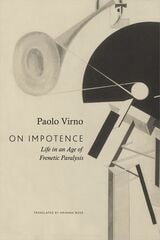
On Impotence
Life in an Age of Frenetic ParalysisPaolo Virno
Seagull Books, 2026
Contemporary life is marked by a paradoxical form of impotence. Whether in love, labor, or political struggle, we often find ourselves locked in a state of frenetic paralysis—unable to act as we wish or to endure what confronts us. This impotence is not born of lack, but of excess: an abundance of skills, capacities, and opportunities that, instead of taking form as coherent actions or speech, stagnate and turn in on themselves. In this thought-provoking meditation, philosopher Paolo Virno examines this strange impotence through the lens of classical thought, drawing especially on Aristotle and Marx.
To overcome this troubling state, Virno calls for a collective search for a shared spiritual and practical exercise aimed at reclaiming agency. He argues that only by learning to renounce renunciation can we cultivate deliberate words and timely decisions.
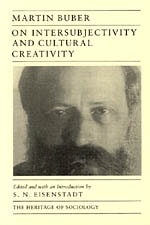
On Intersubjectivity and Cultural Creativity
Martin Buber
University of Chicago Press, 1992
Buber's central focus in his sociological work is the relation between social interaction, or intersubjectivity, and the process of human creativity. Specifically, Buber seeks to define the nature and conditions of creativity, the conditions of authentic intersubjective social relations that nurture creativity in society and culture. He attempts to identify situations favorable to creativity that he believes exist to some extent in all cultures, though their fullest development occurs only rarely.
Buber considers the combination of open dialogue between human and human and a dialogue between man and God to be necessary for the crystallization of the common discourse that is essential for holding a free, just, and open society together.
Important for an understanding of Buber's thought, these writings—touching on education, religion, the state, and charismatic leadership—will be of profound value to students of sociology, philosophy, and religion.

On Jewish Learning
Franz Rosenzweig; Edited by N. N. Glatzer
University of Wisconsin Press, 2002
On Knowing--The Natural Sciences
Richard P. McKeon
University of Chicago Press, 1994
In his lectures, McKeon outlines the entire history of Western thinking on the sciences. Treating the central concepts of motion, space, time, and cause, he traces modern intellectual debates back to the ancient Greeks, notably Plato, Aristotle, Democritus, and the Sophists. As he brings the story of Western science up to the twentieth century, he uses his fabled semantic schema (reproduced here for the first time) to uncover new ideas and observations about cosmology, mechanics, dynamics, and other aspects of physical science.
Illustrating the broad historical sweep of the lectures are a series of discussions which give detail to the course's intellectual framework. These discussions of Plato, Aristotle, Galileo, Newton, and Maxwell are perhaps the first published rendition of a philosopher in literal dialogue with his students. Led by McKeon's pointed questioning, the discussions reveal the difficulties and possibilities of learning to engage in serious intellectual communication.
On Knowing--The Social Sciences
Richard P. McKeon
University of Chicago Press, 2017
This volume—the second in a series—leaves behind natural science themes to embrace freedom, power, and history, which, McKeon argues, lay out the whole field of human action. The authors McKeon considers—Hobbes, Machiavelli, Spinoza, Kant, and J. S. Mill—show brilliantly how philosophic methods work in action, via analyses that do not merely reduce or deconstruct meaning, but enhance those texts by reconnecting them to the active history of philosophy and to problems of ethics, politics, and history. The waves of modernism and post-modernism are receding. Philosophic pluralism is now available, fully formulated, in McKeon’s work, spreading from the humanities to the social sciences.
On Learning to Heal
or, What Medicine Doesn't KnowEd Cohen
Duke University Press, 2023
On Learning, Volume 2
Philosophies, Concepts and PracticesEdited by David Scott
University College London, 2024
The contributors to this volume focus on two meta-concepts: knowledge and learning, on the relationship between the two, and the way these can be framed in epistemic, social, political, and economic terms. Knowledge and learning, as meta-concepts, are positioned in various networks or constellations of meaning, principally: their antecedents, their relations to other relevant concepts, and the way the concepts are used in the lifeworld.
The various authors in this book explore several important concepts that are relevant to the idea of learning: Meta-concepts such as epistemology, inferential role semantics, phenomenology, rationality, thinking, hermeneutics, critical realism, and pragmatism. Meso-concepts such as probability, woman, training, assessment, education, system, race, friendship, Bildung, curriculum, ecology and pedagogy. Like David Scott’s first volume of On Learning, this collection also focuses on philosophy, concepts, and practices as a response to empiricist and positivist conceptions of knowledge. It challenges reductionist ideas of learning that have filtered through to the management of our schools, colleges, and universities; confronts over-simplified messages about learning, knowledge, curriculum, and assessment; and fosters the denial that values are central to understanding how we live and how we should live, the normative dimension to social policy and social theory.
On Learning, Volume 3
Knowledge, Curriculum and EthicsDavid Scott
University College London, 2025
What does it mean to learn? In On Learning, Volume 3: Knowledge, Curriculum and Ethics, David Scott probes the intricate relationship between knowledge and learning, questioning reductionist and empiricist perspectives that dominate contemporary education. This volume, like the first two in the series, critically analyzes the philosophical and ethical dimensions of learning, pushing beyond simplified notions of curriculum and assessment. Scott ties in a range of key concepts, including epistemology and critical realism, to offer a profound rethinking of what it means to know and engage with the world.
At the heart of this book is a call to recognize that learning is not merely a mechanical process or a set of measurable outcomes but a deeply human and ethical endeavor. On Learning, Volume 3 urges readers to reconsider the structures that shape education today and invites us to rethink how we understand knowledge and learning, and the values that underpin them.
On Learning
A General Theory of Objects and Object-RelationsDavid Scott
University College London, 2021
What is learning? This book is a philosophical work that develops a general theory of ontological objects and object-relations, examining concepts as acquired dispositions. David Scott answers a series of questions about concepts in general and the concept of learning in particular. This volume offers a counterargument to empiricist conceptions of learning, rejecting the propagation of simple messages about learning, knowledge, curriculum, and assessment. Instead, Scott argues that values are central to understanding how we live, permeating our descriptions of the world, the attempts we make at creating better futures, and our relations with other people.