Results by title
141 books match the query 'Turkey' and 6 start with o
On the Semicivilized
Coloniality, Finance, and Embodied Sovereignty in CairoJulia Elyachar
Duke University Press, 2025
Orpheus
By Nazli Eray
University of Texas Press, 2006
Robert Finn's translation of Turkish author Nazli Eray's Orphée makes available to the English-language reader a rewriting of the myth from the perspective of Eurydice, the wife of Orpheus. Eray's surrealistic version takes place in a hot resort town in contemporary Turkey. The setting of an archaeological dig gives a connection to the past and literally to the underworld. Found in the dig is a statue of the Roman emperor Hadrian, who proceeds to offer an unusual perspective on modern life and values through mysterious letters carried by a messenger pigeon. Eray also comments on modernity, as the city of Ankara emerges as a character in the novel's fantasy. Set in junta-ruled Turkey of the 1980s, the novel takes its place as a crucial slice of Turkish literary history.
Resonating with haunting references to the film Last Tango in Paris, the novel evolves as a mystery story with a humorous bent. Thus Eray illuminates her insatiable curiosity about other cultures, particularly those of the West. Finally, the style of the translation is simple and clear, with crisp dialogue. Sibel Erol, professor of Turkish literature at New York University, has written an introduction that places this fantastic plot in a literary context, as well as in understandable terms that relate to the reality of today's Turkey.
Ottoman Empire and Islamic Tradition
Norman Itzkowitz
University of Chicago Press, 1972
Ottoman Eurasia in Early Modern German Literature
Cultural Translations (Francisci, Happel, Speer)Gerhild Scholz Williams
University of Michigan Press, 2021
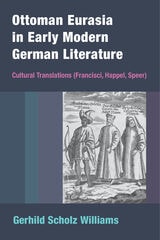
Even a casual perusal of seventeenth-century European print production makes clear that the Turk was on everyone’s mind. Europe’s confrontation of and interaction with the Ottoman Empire in the face of what appeared to be a relentless Ottoman expansion spurred news delivery and literary production in multiple genres, from novels and sermons to calendars and artistic representations. The trans-European conversation stimulated by these media, most importantly the regularly delivered news reports, not only kept the public informed but provided the basis for literary conversations among many seventeenth-century writers, three of whom form the center of this inquiry: Daniel Speer (1636-1707), Eberhard Werner Happel (1647-1690), and Erasmus Francisci (1626-1694). The expansion of the Ottoman Empire during the sixteenth and seventeenth centuries offers the opportunity to view these writers' texts in the context of Europe and from a more narrowly defined Ottoman Eurasian perspective.
Ottoman Eurasia in Early Modern German Literature: Cultural Translations (Francisci, Happel, Speer) explores the variety of cultural and commercial conversations between Europe and Ottoman Eurasia as they negotiated their competing economic and hegemonic interests. Brought about by travel, trade, diplomacy, and wars, these conversations were, by definition, “cross-cultural” and diverse. They eroded the antagonism of “us and them,” the notion of the European center and the Ottoman periphery that has historically shaped the view of European-Ottoman interactions.
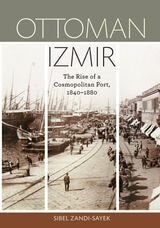
Ottoman Izmir
The Rise of a Cosmopolitan Port, 1840-1880Sibel Zandi-Sayek
University of Minnesota Press, 2011
Between 1840 and 1880, the Eastern Mediterranean port of Izmir (Smyrna) underwent unprecedented change. A modern harbor that welcomed international steamships and new railway lines that transported a cornucopia of products transformed the physical city. Migrants, seasonal workers, and transient sailors thronged into an already diverse metropolis, helping to double the population to 200,000. Simultaneously, Ottoman officials and enterprising citizens vied to control and reform the city’s administrative and legal institutions.
Ottoman Izmir examines how urban space, institutional structures, and everyday practices shaped one another in the thriving seaport of Izmir during a volatile period of growth. Sibel Zandi-Sayek investigates a variety of urban actors—Muslims and non-Muslims, Ottomans and Europeans, newcomers and native residents, merchants, investors, civil servants, and press reporters—who were actively engaged in restructuring the city. Concentrating on the workings of urban committees and on laws and policies that were written, rewritten, but never fully implemented, Zandi-Sayek exposes how modern interventions sought to impose clear-cut concepts of public and private, safety and danger, and hygiene on a city that previously had a wide range of customary regulations.
Ottoman Izmir shows how Izmir’s various stakeholders contested its built environment. In so doing, it offers a new view of the dynamics of urban modernization.
Ottoman Warfare 1500-1700
Murphey, Rhoads
Rutgers University Press, 1999