Results by title
28164 books match the query 'History' and 581 start with o

Opening Zion
A Scrapbook of the National Park's First Official TouristsJohn Clark
University of Utah Press, 2010
When Melissa Clark purchased a box of old scrapbooks online, she knew only that she had bought something relating to the University of Utah and Zion Park. What came in the mail was much more than she had expected. Instead of random mementos, two albums arrived full of photographs and newspaper clippings dating to 1920 that document a trip made by six young women from the University of Utah into the newly formed Zion National Park. Part of a promotional campaign developed by the Los Angeles and Salt Lake Railroad to advertise its national park shuttle service, the women entered Zion Canyon as its first offical tourists. When Melissa bought those timeworn scrapbooks she found a forgotten treasure: the opening of Zion.
With text by John Clark, the scrapbooks are now the basis of a one-of-a-kind publication. Part fashion spread, part adventure guide, and all Utah cultural treasure, Opening Zion is a stunning visual record of the park. Remarkably detailed black-and-white photographs show the young adventurers scrambling over rocky outcrops, pondering the dizzying height of Zion's sheer walls, and singing camp songs by the campfire. We are introduced anew to the "gigantic grandeur" of Zion National Park. As one of the women wrote, "One can think only beautiful thoughts amid such splendor."

Opening the Books
Essays on the Cultural and Social History of the British Communist PartyGeoff Andrews
Pluto Press, 1995
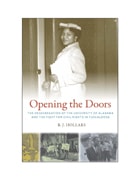
Opening the Doors
The Desegregation of the University of Alabama and the Fight for Civil Rights in TuscaloosaB. J. Hollars
University of Alabama Press, 2013
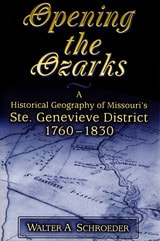
Opening the Ozarks
A Historical Geography of Missouri's Ste. Genevieve District, 1760-1830Walter A. Schroeder
University of Missouri Press, 2002
The study begins with the French Creole settlement at Old Ste. Genevieve in the middle of the eighteenth century. It describes the movement of the French into the Ozark hills during the rest of that century and continues with that of the American immigrants into Upper Louisiana after 1796, ending with the Americanization of the district after the Louisiana Purchase. Walter Schroeder examines the cultural transition from a French society, operating under a Spanish administration, to an American society in which French, Indians, and Africans formed minorities.
Schroeder used thousands of French- and Spanish-language documents, including the Archives of the Indies in Seville, Spain, as well as documents from Ste. Genevieve and St. Louis to gather his information. He also utilized thousands of land records from the American period, including deeds of land sales and sales from the public domain, and plats from both the Spanish and American periods. In addition, Schroeder performed years of fieldwork and perused aerial photography of the area, interviewing residents and searching for vestiges of the past in the landscape.
As the only study to deal with the cradle of Missouri and the first trans-Mississippi expansion of the Anglo-American frontier, Opening the Ozarks will be invaluable to anyone interested in America’s geographical history, particularly that of Missouri.
Opera and Sovereignty
Transforming Myths in Eighteenth-Century ItalyMartha Feldman
University of Chicago Press, 2007
Taking an anthropological approach to European music that’s as bold as it is unusual, Martha Feldman traces Italian opera’s shift from a mythical assertion of sovereignty, with its festive forms and rituals, to a dramatic vehicle that increasingly questioned absolute ideals. She situates these transformations against the backdrop of eighteenth-century Italian culture to show how opera seria both reflected and affected the struggles of rulers to maintain sovereignty in the face of a growing public sphere. In so doing, Feldman explains why the form had such great international success and how audience experiences of the period differed from ours today. Ambitiously interdisciplinary, Opera and Sovereignty will appeal not only to scholars of music and anthropology, but also to those interested in theater, dance, and the history of the Enlightenment.
Opera and its Voices in Utah
Walter Rudolph
Utah State University Press, 2018
The Arrington Lecture series, established by one of the twentieth-century West's most distinguished historians, Leonard Arrington, has become a leading forum for prominent historians to address topics related to Mormon history. Utah State University hosts the Leonard J. Arrington Mormon History Lecture Series through the Merrill-Cazier Library Special Collections and Archives department.
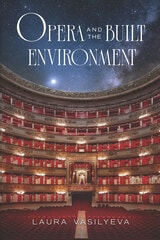
Opera and the Built Environment
Laura Vasilyeva
University of Chicago Press, 2025
In Opera and the Built Environment, music scholar Laura Vasilyeva considers the remarkable mass construction of opera houses around the world since the 1800s and the no-less-remarkable bids to standardize the architectural features of their interiors across this vast theatrical infrastructure. Now known as the teatro all’italiana, this style of architecture—made most famous by Milan’s Teatro alla Scala—is characterized by auditoria with tiers of stacked boxes and a dominant red hue.
With attention to the sensuous dimensions of their auditoria, from their surfaces to their atmospheres to their acoustics and thresholds, Vasilyeva reveals the calculated reasons these theaters took on the form they did. The result is a book that reveals unknown associations between the Italian opera house and matters of environmental destruction, empire, and belonging, showing us new and unexpected patterns in how opera connects to the world we know.

Opera and the Political Imaginary in Old Regime France
Olivia Bloechl
University of Chicago Press, 2018
In Opera and the Political Imaginary in Old Regime France, however, Olivia Bloechl reveals another layer of French opera’s political theater. The make-believe worlds on stage, she shows, involved not just fantasies of sovereign rule but also aspects of government. Plot conflicts over public conduct, morality, security, and law thus appear side-by-side with tableaus hailing glorious majesty. What’s more, opera’s creators dispersed sovereign-like dignity and powers well beyond the genre’s larger-than-life rulers and gods, to its lovers, magicians, and artists. This speaks to the genre’s distinctive combination of a theological political vocabulary with a concern for mundane human capacities, which is explored here for the first time.
By looking at the political relations among opera characters and choruses in recurring scenes of mourning, confession, punishment, and pardoning, we can glimpse a collective political experience underlying, and sometimes working against, ancienrégime absolutism. Through this lens, French opera of the period emerges as a deeply conservative, yet also more politically nuanced, genre than previously thought.

Opera for Everyone
The Industry's Experiments with American Opera in the Digital AgeMegan Steigerwald Ille
University of Michigan Press, 2024
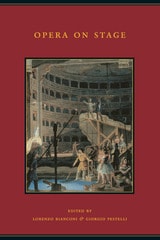
Opera on Stage
Edited by Lorenzo Bianconi and Giorgio Pestelli
University of Chicago Press, 2002
Opera on Stage, the second book of this multi-volume work to be published in English-in an expanded and updated version-focuses on staging and viewing Italian opera, from the court spectacles of the late sixteenth century to modern-day commercial productions. Mercedes Viale Ferrero describes the history of theater and stage design, detailing the evolution of the art well into the twentieth century. Gerardo Guccini does the same for stage and opera direction and the development of the director's role as an autonomous creative force. Kathleen Kuzmick Hansell discusses the interrelationships between theatrical ballet and Italian opera, from the age of Venetian opera to the early twentieth century. The visual emphasis of all three contributions is supplemented by over one hundred illustrations, and because much of this material-on the more "spectacular" visual aspects of Italian opera-has never before appeared in English, Opera on Stage will be welcomed by scholars and opera enthusiasts alike.
Operatic Geographies
The Place of Opera and the Opera HouseEdited by Suzanne Aspden
University of Chicago Press, 2019
Operatic Geographies invites us to reconsider the opera house’s spatial production. Looking at opera through the lens of cultural geography, this anthology rethinks the opera house’s landscape, not as a static backdrop, but as an expression of territoriality. The essays in this anthology consider moments across the history of the genre, and across a range of geographical contexts—from the urban to the suburban to the rural, and from the “Old” world to the “New.” One of the book’s most novel approaches is to consider interactions between opera and its environments—that is, both in the domain of the traditional opera house and in less visible, more peripheral spaces, from girls’ schools in late seventeenth-century England, to the temporary arrangements of touring operatic troupes in nineteenth-century Calcutta, to rural, open-air theaters in early twentieth-century France. The essays throughout Operatic Geographies powerfully illustrate how opera’s spatial production informs the historical development of its social, cultural, and political functions.
Operatic Infrastructures
Materiality and Meaning in 1890s London, Paris, and New YorkFlora Willson
University of Chicago Press, 2026
An exploration of the fundamental relationship between opera and urban modernity in three iconic cities: London, Paris, and New York.
At the end of the nineteenth century, London, Paris, and New York were quintessential modern metropolises and vital centers for opera. In Operatic Infrastructures, Flora Willson examines opera’s roots in the material worlds of these cities. Reaching beyond histories of opera as spectacle, she investigates the physical underpinnings of opera at the century’s end as an inter-urban, multimedia network.
Operatic Infrastructures considers emergent technologies such as the telephone and the subway, but it also retrieves the hidden, forgotten, and otherwise effaced traces of systems such as storage facilities and colonial trade routes. It takes seriously the mundane aspects of materiality, from the blandest clichés of newspaper columns to the fine print of insurance certificates. In doing so, the book reveals just how far these interfaces with modern urban life reached into opera’s own systems of meaning-making and performance in the 1890s—making it impossible to demarcate neatly between “opera” and its “context.” Without such operatic infrastructures, Willson shows, there would be no opera at all.
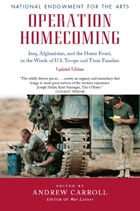
Operation Homecoming
Iraq, Afghanistan, and the Home Front, in the Words of U.S. Troops and Their Families, Updated Editionedited by Andrew Carroll
University of Chicago Press, 2008
“One of the chanted mantras of our time is, ‘But I support the troops.’ Terrific. Now read Operation Homecoming to find out who they are, what they think, feel, want, have learned, won and lost in Iraq and Afghanistan.”—Daniel Henninger, Wall Street Journal
“This anthology is the honest voice of war. . . . In the end, they are all one voice, a voice we must hear, and must not forget.”—Jeff Shaara
“These voices are stirring, chilling, and unforgettable.”—Bobbie Ann Mason
“[Captures] what journalists cannot, no matter how close they get—firsthand accounts from the warriors and the families they leave behind.”—Chicago Tribune
Operation Whisper
The Capture of Soviet Spies Morris and Lona CohenBarnes Carr
University Press of New England, 2016
Operationism in Psychology
An Epistemology of ExplorationUljana Feest
University of Chicago Press, 2025
Psychology has seen an intense debate about the lack of replicability of results in recent years. Uljana Feest uses history and philosophy of science to shed light on the nature of experiment in psychology in general, but her aim reaches beyond debates about replication to provide a novel and comprehensive analysis of the investigative process in experimental psychology. She shows that the central unit of analysis for our epistemological considerations of psychological research should be not theories but, rather, concepts. Her guiding question is: How do psychological concepts figure in the experimental exploration of the objects of psychological research? For Feest, this question has two intertwined aspects: What role do concepts play in the design of experiments and the production of data, and how can concepts be revised or adapted in response to experimental results. Following the historical trajectory of debates about operationism in psychology, she argues that this debate was not concerned with philosophical theories of meaning but, instead, closely connected to the investigative practices of experimental psychologists. The book offers a broad analytical framework for thinking philosophically about the investigative process in psychology, including analyses of the relationship between data and phenomena in psychology, the relationship between folk- and scientific psychological concepts, the relationship between genuine results and experimental artifacts, and the nature and exploration of psychological kinds.
Opium in the Balkans
Cultivation, Processing, and Trade during the Interwar PeriodVladan Jovanović
Central European University Press, 2025
Macedonian raw opium was a highly sought-after pharmaceutical raw material. This book focuses on its cultivation and production, and the trafficking of opium-based narcotics. Vladan Jovanović offers fresh insight into a neglected and marginalized subject, tracing and contextualizing both the licit and the illicit processing and trade of opium alkaloids from the Western Balkans through Turkey, and on to the rest of the world between the two World Wars.
His approach is to explore the subject both from the top down, involving the League of Nations and politicians and diplomats, as well as from the bottom up, through the analysis of the activities of smugglers, police, and ordinary people who participated in the production and distribution of opium. The author describes the process of relocating the illegal processing industry from Turkey and Bulgaria to Yugoslavia. He insightfully shows the implicit continuity of relations between the former Ottoman Empire and the newly constituted Yugoslav state in the form of bilateral political agreements.
He pays special attention to the illegal activities within the legal pharmaceutical industry and also exposes the role of criminal networks, which he situates in the appropriate political and social context. The exploration of this sensitive historical subject extends to other Balkan countries, along with Turkey, Western Europe, and the United States.

Oppenheimer Is Watching Me
A MemoirJeff Porter
University of Iowa Press, 2007
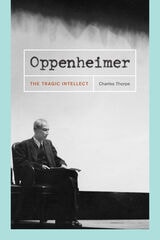
Oppenheimer
The Tragic IntellectCharles Thorpe
University of Chicago Press, 2007
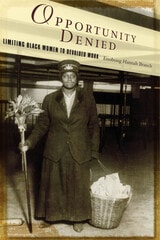
Opportunity Denied
Limiting Black Women to Devalued WorkBranch, Enobong
Rutgers University Press, 2011
Blacks and Whites. Men and Women. Historically, each group has held very different types of jobs. The divide between these jobs was stark—clean or dirty, steady or inconsistent, skilled or unskilled. In such a rigidly segregated occupational landscape, race and gender radically limited labor opportunities, relegating Black women to the least desirable jobs. Opportunity Denied is the first comprehensive look at changes in race, gender, and women’s work across time, comparing the labor force experiences of Black women to White women, Black men and White men. Enobong Hannah Branch merges empirical data with rich historical detail, offering an original overview of the evolution of Black women’s work.
From free Black women in 1860 to Black women in 2008, the experience of discrimination in seeking and keeping a job has been determinedly constant. Branch focuses on occupational segregation before 1970 and situates the findings of contemporary studies in a broad historical context, illustrating how inequality can grow and become entrenched over time through the institution of work.

Opposing Democracy in the Digital Age
The Yellow Shirts in ThailandAim Sinpeng
University of Michigan Press, 2021
Opposing Democracy in the Digital Age is about why ordinary people in a democratizing state oppose democracy and how they leverage both traditional and social media to do so. Aim Sinpeng focuses on the people behind popular, large-scale antidemocratic movements that helped bring down democracy in 2006 and 2014 in Thailand. The yellow shirts (PAD—People’s Alliance for Democracy) that are the focus of the book are antidemocratic movements grown out of democratic periods in Thailand, but became the catalyst for the country’s democratic breakdown. Why, when, and how supporters of these movements mobilize offline and online to bring down democracy are some of the key questions that Sinpeng answers. While the book primarily uses a qualitative methodological approach, it also uses several quantitative tools to analyze social media data in the later chapters. This is one of few studies in the field of regime transition that focuses on antidemocratic mobilization and takes the role of social media seriously.

Opposing Patriarchy
Women and the Law in Action in Pre-Unification Italy (1815–1865)Sara Delmedico
University of London Press, 2021
In Italy and beyond, the nineteenth century was a time of great political change. Shifts in state boundaries and socio-economic structures deeply affected the Italian political landscape, including the nation’s legal system. Many Italian women, who had lived within a strict patriarchal and hierarchical society, began to redefine their identities beyond the traditional domestic roles of daughter, wife, and mother. This volume charts that process by focusing on women’s attitudes towards the law and their interaction with the legal system. Sara Delmedico seeks to recover the forgotten voices and lives of those ordinary women who, in their everyday lives, reacted against the limitations and constraints imposed upon them by society and who refused to accept their status passively. As this volume shows, the women of the period understood the law, questioned obedience, challenged authority, and stood up for themselves. Even though they did not always achieve their goals, their actions contributed to shaping our present.

Opposing the Second Corps at Antietam
The Fight for the Confederate Left and Center on America's Bloodiest DayMarion V. Armstrong, Jr.
University of Alabama Press, 2016
A definitive guide to the Confederate army’s primary engagements at the epic Battle of Antietam
With a tally of more than five thousand killed, twenty thousand wounded, and three thousand missing, the Battle of Antietam made September 17, 1862, the deadliest day of combat in American history. In Opposing the Second Corps at Antietam, Antietam scholar Marion V. Armstrong Jr. completes his magisterial study of Antietam begun in Unfurl Those Colors! by examining Robert E. Lee’s leadership at the climactic battle in the Confederate invasion of Union territory.
Eminent Civil War historians consider Antietam the turning point of the war. Hoping to maintain the initiative they had gained at the Second Battle of Bull Run, Confederate leaders looked to a stunning victory on Northern soil to sour Northern sentiment on the war as well as to coax European powers to recognize the fledgling Confederacy. Having examined McClellan’s command and role at Antietam in Unfurl Those Colors!, Armstrong now recounts in riveting detail Lee’s command decisions and their execution in the field, drawing on a superlative collection of first-person accounts by Confederate veterans to narrate the cataclysmic struggle between Lee and McClellan.
Armstrong sets the stage with a lively recap of the political and military events leading up to the early fall of 1862 and foreshadowing the conflagration to come on September 17. Each chapter then traces a critical section of the battle, the fight for the West Woods and the bloody engagement of the Sunken Road. Armstrong augments this collection with an exceptional set of maps, which will be valued by scholars, readers, and visitors to the battlefield. These unique maps delineate troop movements in intervals as brief as fifteen minutes, bringing to life the fluid, mutable lines that characterize the glory and horror of Antietam.
Either together with Unfurl Those Colors! or as a stand-alone account of the Confederate side of the battle, Opposing the Second Corps at Antietam provides the fullest possible understanding of the experience of Confederate soldiers at Antietam.
Oppression and Liberty
Simone Weil
University of Massachusetts Press, 1973
Simone Weil was an extraordinary woman whose brief life was intensely devoted to searching for answers to some of the gravest questions inherent in the human condition: the nature of justice, the reasons for human exploitation, the problem of faith. Although debate still lingers about the interpretation of her life and her writings, many contemporary scholars consider her one of the most brilliant, original minds of the twentieth century. This collection of essays by Simone Weil deals with the controversial sociopolitical issues which have confronted us since the time of the French Revolution. The first essay was written in 1932 or 1933 when she was still in her twenties. The last remained unfinished when she died in England at the age of 34, a French-Jewish refugee from Nazi-occupied France.
The essays take a long, close look at Marx and Marxism, and at socialism versus capitalism vis-à-vis labor and the working class. Weil evaluates individuals, ideologies, and institutions with reference to two kinds and uses of power: oppression, which leads ultimately to enslavement or death; and liberty, which leads to humaneness, justice, and charity.

Optical Play
Glass, Vision, and Spectacle in Russian CultureJulia Bekman Chadaga
Northwestern University Press, 2014
Longlist finalist, 2015 Historia Nova Prize for Best Book on Russian Intellectual and Cultural History
Julia Bekman Chadaga’s ambitious study posits that glass—in its uses as a material and as captured in culture—is a key to understanding the evolution of Russian identity from the eighteenth century onward. From the contemporary perspective, it is easy to overlook how glass has profoundly transformed vision. Chadaga shows the far-reaching effects of this phenomenon.
Her book examines the similarities between glass and language, the ideological uses of glass, and the material’s associations with modernity, while illuminating the work of Lomonosov, Dostoevsky, Zamyatin, and Eisenstein, among others. In particular, Chadaga explores the prominent role of glass in the discourse around Russia’s contentious relationship with the West—by turns admiring and antagonistic—as the nation crafted a vision for its own future. Chadaga returns throughout to the spectacular aspect of glass and shows how both the tendentious capacity and the playfulness of this material have shaped Russian culture.
Optimism at All Costs
Black Attitudes, Activism, and Advancement in Obama's AmericaLessie B. Branch
University of Massachusetts Press, 2018
Lessie B. Branch confronts the tension between black Americans' economic realities and the hope many felt for the future, looking at survey data alongside the rhetoric of leading black figures, including President Obama. This disparity has caused a dangerous resistance to social activism, as discourses of optimism privilege individual success over the need for collective action. Branch sees the emergence of the Black Lives Matter movement as a constructive change in this dynamic. As Americans continue to grapple with complicated questions of race and progress in classrooms, in the media, and in legislatures, this short, provocative book will inform and enrich these important discussions.

Opting for Elsewhere
Lifestyle Migration in the American Middle ClassBrian A. Hoey
Vanderbilt University Press, 2014

Oral History and Public Memories
Paula Hamilton
Temple University Press, 2008
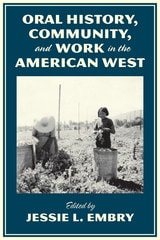
Oral History, Community, and Work in the American West
Edited by Jessie L. Embry
University of Arizona Press, 2013
In many cases occupations brought people together in myriad ways. The Latino workers who picked lemons together in Southern California report that it was baseball and Cinco de Mayo Queen contests that united them. Mormons in Fort Collins, Colorado, say that building a church together bonded them together. In separate essays, African Americans and women describe how they fostered a sense of community in Las Vegas. Native Americans detail the “Indian economy” in Northern California.
As these essays demonstrate, the history of the American West is the story of small towns and big cities, places both isolated and heavily populated. It includes groups whose history has often been neglected. Sometimes, western history has mirrored the history of the nation; at other times, it has diverged in unique ways. Oral history adds a dimension that has often been missing in writing a comprehensive history of the West. Here an array of oral historians—including folklorists, librarians, and public historians—record what they have learned from people who have, in their own ways, made history.
Oral History
A Guide for Teachers (and Others)By Thad Sitton, George L. Mehaffy, and O.L. Davis, Jr.
University of Texas Press, 1983
More than a mode of gathering information about the past, oral history has become an international movement. Historians, folklorists, and other educational and religious groups now recognize the importance of preserving the recollections of people about the past. The recorded memories of famous and common folk alike provide a vital complement to textbook history, bringing the past to life through the stories of those who lived it.
Oral History is designed to introduce teachers, students, and interested individuals to the techniques, problems, and pleasures of collecting oral history. The authors, themselves experienced educators, examine the uses of oral history in the classroom, looking at a wide range of projects that have been attempted and focusing on those that have succeeded best.
Besides suggesting many possible projects, they discuss the necessary hardware and its use: recording equipment and procedures, interview outlines and preliminary research, photography and note-taking in the field, transcription and storage of information, legal forms, and more. For the teacher, the authors offer helpful advice on training students to be sensitive interviewers in both formal and informal situations.
How can oral histories collected in the classroom be put to use? The authors discuss their uses within the curriculum; in projects such as oral history archives, publications such as the popular Foxfire books, and other media productions; and in researching current community problems. Useful appendixes survey a variety of reference tools for the oral historian and describe in detail how a Foxfire-concept magazine may be developed.
Oral Tradition as History
Jan M. Vansina
University of Wisconsin Press, 1985
Jan Vansina’s 1961 book, Oral Tradition, was hailed internationally as a pioneering work in the field of ethno-history. Originally published in French, it was translated into English, Spanish, Italian, Arabic, and Hungarian. Reviewers were unanimous in their praise of Vansina’s success in subjecting oral traditions to intense functional analysis.
Now, Vansina—with the benefit of two decades of additional thought and research—has revised his original work substantially, completely rewriting some sections and adding much new material. The result is an essentially new work, indispensable to all students and scholars of history, anthropology, folklore, and ethno-history who are concerned with the transmission and potential uses of oral material.
“Those embarking on the challenging adventure of historical fieldwork with an oral community will find the book a valuable companion, filled with good practical advice. Those who already have collected bodies of oral material, or who strive to interpret and analyze that collected by others, will be forced to subject their own methodological approaches to a critical reexamination in the light of Vansina’s thoughtful and provocative insights. . . . For the second time in a quarter of a century, we are profoundly in the debt of Jan Vansina.”—Research in African Literatures
“Oral Traditions as History is an essential addition to the basic literature of African history.”—American Historical Review
Orange Parades
The Politics of Ritual, Tradition and ControlDominic Bryan
Pluto Press, 2000
Oratorical Culture in Nineteenth-Century America
Transformations in the Theory and Practice of RhetoricGregory Clark and S. Michael Halloran
Southern Illinois University Press, 1993
Gregory Clark and S. Michael Halloran bring together nine essays that explore change in both the theory and the practice of rhetoric in the nineteenth-century United States.
In their introductory essay, Clark and Halloran argue that at the beginning of the nineteenth century, rhetoric encompassed a neoclassical oratorical culture in which speakers articulated common values to establish consensual moral authority that directed community thought and action. As the century progressed, however, moral authority shifted from the civic realm to the professional, thus expanding participation in the community as it fragmented the community itself. Clark and Halloran argue that this shift was a transformation in which rhetoric was reconceived to meet changing cultural needs.
Part I examines the theories and practices of rhetoric that dominated at the beginning of the century. The essays in this section include "Edward Everett and Neoclassical Oratory in Genteel America" by Ronald F. Reid, "The Oratorical Poetic of Timothy Dwight" by Gregory Clark, "The Sermon as Public Discourse: Austin Phelps and the Conservative Homiletic Tradition in Nineteenth-Century America" by Russel Hirst, and "A Rhetoric of Citizenship in Nineteenth-Century America" by P. Joy Rouse.
Part 2 examines rhetorical changes in the culture that developed during that century. The essays include "The Popularization of Nineteenth-Century Rhetoric: Elocution and the Private Learner" by Nan Johnson, "Rhetorical Power in the Victorian Parlor: Godey’s Lady’s Book and the Gendering of Nineteenth-Century Rhetoric" by Nicole Tonkovich, "Jane Addams and the Social Rhetoric of Democracy" by Catherine Peaden, "The Divergence of Purpose and Practice on the Chatauqua: Keith Vawter’s Self-Defense" by Frederick J.Antczak and Edith Siemers, and "The Rhetoric of Picturesque Scenery: A Nineteenth-Century Epideictic" by S. Michael Halloran.
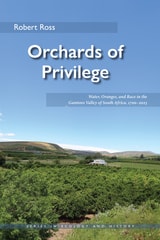
Orchards of Privilege
Water, Oranges, and Race in the Gamtoos Valley of South Africa, 1700–2023Robert Ross
Ohio University Press, 2025
This study of the Gamtoos River floodplain in South Africa’s Eastern Cape Province traces its transformation from an eighteenth-century natural landscape of thick bush into an agricultural zone now threatened by climate change. The first half of the book explains how missionaries from the London Missionary Society and residents of the Hankey Mission Station introduced irrigation, turning the area into a community of small-scale farmers. Despite early failures, by 1849 they had constructed South Africa’s first major irrigation tunnel and aqueduct. However, conflicts between the missionaries and residents led to the loss of communal lands to privatization, which ultimately impoverished the local farmers. The second half explores efforts to develop the valley for large-scale agriculture, addressing challenges like drought, flash floods, and saline water. By the mid-twentieth century, Afrikaners dominated the area, benefiting from the construction in 1970 of the Kouga Dam, which provided fresh water for the floodplain. This led to the rise of a wealthy white farming community, sustained by apartheid policies and labor from the “Coloured” and African populations. In the early twenty-first century, however, this prosperity has become threatened by severe droughts linked to global climate change. In view of these historical transformations, the Gamtoos River floodplain exemplifies the complex interplay between human ambition, environmental challenges, and sociopolitical forces.
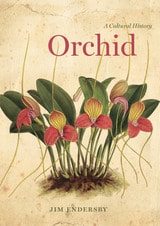
Orchid
A Cultural HistoryJim Endersby
University of Chicago Press, 2016
Following the stories of orchids throughout history, Jim Endersby divides our attraction to them into four key themes: science, empire, sex, and death. When it comes to empire, for instance, orchids are a prime example of the exotic riches sought by Europeans as they shaped their plans for colonization. He also reveals how Charles Darwin’s theory of evolution became intimately entangled with the story of the orchid as he investigated their methods of cross-pollination. As he shows, orchids—perhaps because of their extraordinarily diverse colors, shapes, and sizes—have also bloomed repeatedly in films, novels, plays, and poems, from Shakespeare to science fiction, from thrillers to elaborate modernist novels.
Featuring many gorgeous illustrations from the collection of the Royal Botanic Gardens, Kew, Orchid: A Cultural History tells, for the first time, the extraordinary story of orchids and our prolific interest in them. It is an enchanting tale not only for gardeners and plant collectors, but anyone curious about the flower’s obsessive hold on the imagination in history, cinema, literature, and more.
Order and History, Volume 1 (CW14)
Israel and RevelationEric Voegelin, Edited & Intro by Maurice P. Hogan
University of Missouri Press, 2001
Eric Voegelin's Israel and Revelation is the opening volume of his monumental Order and History, which traces the history of order in human society. This volume examines the ancient near eastern civilizations as a backdrop to a discussion of the historical locus of order in Israel. The drama of Israel mirrors the problems associated with the tension of existence as Israel attempted to reconcile the claims of transcendent order with those of pragmatic existence and so becomes paradigmatic.
According to Voegelin, what happened in Israel was a decisive step, not only in the history of Israel, but also in the human attempt to achieve order in society. The uniqueness of Israel is the fact that it was the first to create history as a form of existence, that is, the recognition by human beings of their existence under a world-transcendent God, and the evaluation of their actions as conforming to or defecting from the divine will. In the course of its history, Israel learned that redemption comes from a source beyond itself.
Voegelin develops rich insights into the Old Testament by reading the text as part of the universal drama of being. His philosophy of symbolic forms has immense implications for the treatment of the biblical narrative as a symbolism that articulates the experiences of a people's order. The author initiates us into attunement with all the partners in the community of being: God and humans, world and society. This may well be his most significant contribution to political thought: "the experience of divine being as world transcendent is inseparable from an understanding of man as human."
Order and History, Volume 2 (CW15)
The World of the PolisEric Voegelin. Edited & Intro by Athanasios Moulakis
University of Missouri Press, 2000
This second volume of Voegelin's magisterial Order and History, The World of the Polis, explores the ancient Greek symbolization of human reality. Taking us from the origins of Greek culture in the Pre-Homeric Cretan civilizations, through the Iliad and Odyssey, Hesiod, and the rise of philosophy with the Pre-Socratics Parmenides and Heraclitus, this masterful work concludes with the historians of the classical period.
In The World of the Polis, Voegelin traces the emergence of the forms of the city-state and of philosophy from the ancient symbolism of myth. He maintains that the limits and ultimate goals of human nature are constant and that the central problem of every society is the same—"to create an order that will endow the fact of its existence with meaning in terms of ends divine and human." Thus, Voegelin shows how "the meaning of existence" achieved concrete expression in the typical political, social, and religious institutions of Greece and in the productions of its poets and thinkers. He deals with more than fifty Greek writers in the course of his analysis of the rise of myth and its representation of the divine order of the cosmos as the first great symbolic form of order, one later supplanted by the leap in being reflected in the emergence of philosophy.
The book is a tour de force, a virtuoso performance by a scholar and philosopher of great power, learning, and imagination that places its subject matter in a new light. The editor's critical introduction places The World of the Polis in the broader context of Voegelin's philosophy of history. Scholars and students of political science, philosophy, and the history of ideas will find this work invaluable.
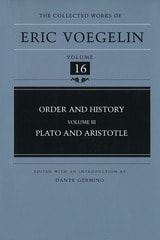
Order and History, Volume 3 (CW16)
Plato and AristotleEric Voegelin. Edited & Intro by Dante Germino
University of Missouri Press, 2000
This third volume of Order and History completes Voegelin's study of Greek culture from its earliest pre- Hellenic origins to its full maturity with the dominance of Athens. As the title suggests, Plato and Aristotle is principally devoted to the work of the two great thinkers who represent the high point of philosophic inquiry among the Greeks.
Through an absorbing analysis of the Platonic and Aristotelian vision of soul, polis, and cosmos, Voegelin demonstrates how the symbolic framework of the older myth was superseded by the more precisely differentiated symbols of philosophy. Although this outmoding and rejection of past symbols of truth might seem to lead to a chaotic and despairing relativism, Voegelin makes it the basis of a profound conception of the historical process: "the attempts to find the symbolic forms that will adequately express the meaning [of a society], while imperfect, do not form a senseless series of failures. For the great societies have created a sequence of orders, intelligibly connected with one another as advances toward, or recessions from, an adequate symbolization of the truth concerning the order of being of which the order of society is a part."
In this view, history has no obvious "meaning," yet each society makes a similar venture after truth. Although every society works out its destiny under different conditions, each nonetheless creates symbols"in its deeds and institutions"which bear the meaning of its own existence. History, then, acquires a unity in the common endeavor toward meaning and order. The rationality and nobility of this view of history has much to say to the present age.
Dante Germino's powerful introduction to this edition of Plato and Aristotle eloquently directs the reader into Voegelin's search through the thought of Plato foremost and Aristotle secondarily and toward a full understanding of their relevance to the "modern" world. This masterpiece, Germino argues, provides a welcome antidote to the spirit of an era Voegelin once called the Gnostic age.
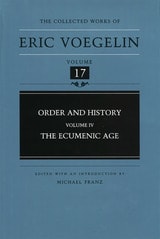
Order and History, Volume 4 (CW17)
The Ecumenic AgeEric Voegelin. Edited & Intro by Michael Franz
University of Missouri Press, 2000
Order and History, Eric Voegelin's five-volume study of how human and divine order are intertwined and manifested in history, has been widely acclaimed as one of the great intellectual achievements of our age.
In the fourth volume, The Ecumenic Age, Voegelin breaks with the course he originally charted for the series, in which human existence in society and the corresponding symbolism of order were to be presented in historical succession. The analyses in the three previous volumes remain valid as far as they go, Voegelin explains, but the original conception proved "untenable because it had not taken proper account of the important lines of meaning in history that did not run along lines of time."
The Ecumenic Age treats history not as a stream of human beings and their actions in time, but as the process of man's participation in a flux of divine presence that has eschatological direction. "The process of history, and such order as can be discerned in it," Voegelin writes, "is not a story to be told from the beginning to its happy, or unhappy, end; it is a mystery in process of revelation."
In the present volume, Voegelin applies his revised conception of historical analysis to the "Ecumenic Age," a pivotal period that extends roughly from the rise of the Persian Empire to the fall of the Roman. The age is marked by the advent of a new type of political unit—the ecumenic empire—achieved at the cost of unprecedented destruction. Yet the pragmatic destructiveness of the age is paralleled by equally unprecedented spiritual creativity, born from the need to make sense of existence in the wake of imperial conquest. These spiritual outbursts gave rise to the great ecumenic religions and raised fundamental questions for human self- understanding that extend into our historical present.
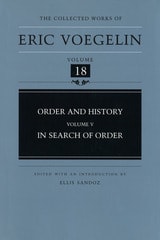
Order and History, Volume 5 (CW18)
In Search of OrderEric Voegelin, Edited & Intro by Ellis Sandoz
University of Missouri Press, 2000
In Search of Order brings to a conclusion Eric Voegelin's masterwork, Order and History. Voegelin conceived Order and History as "a philosophical inquiry concerning the principal types of order of human existence in society and history as well as the corresponding symbolic forms." In previous volumes, Voegelin discussed the imperial organizations of the ancient Near East and their existence in the form of the cosmological myth; the revelatory form of existence in history, developed by Moses and the prophets of the Chosen People; the polis, the Hellenic myth, and the development of philosophy as the symbolism of order; and the evolution of the great religions, especially Christianity.
This final volume of Order and History is devoted to the elucidation of the experience of transcendence that Voegelin discussed in earlier volumes. He aspires to show in a theoretically acute manner the exact nature of transcendental experiences. Voegelin's philosophical inquiry unfolds in the historical context of the great symbolic enterprise of restating man's humanity under the horizon of the modern sciences and in resistance to the manifold forces of our age that deform human existence. His stature as one of the major philosophical forces of the twentieth century clearly emerges from these concluding pages. In Search of Order deepens and clarifies the meditative movement that Voegelin, now in reflective distance to his own work, sees as having been operative throughout his search.
Because of Voegelin's death, on January 19, 1985, In Search of Order is briefer than it otherwise might have been; however, the theoretical presentation that he had set for himself is essentially completed here. Just as this volume serves Voegelin well in his striking analyses of Hegel, Hesiod, and Plato, it will serve as a model for the reader's own efforts in search of order.

Ordered West
The Civil War Exploits of Charles A. CurtisAlan D. Gaff
University of North Texas Press, 2017
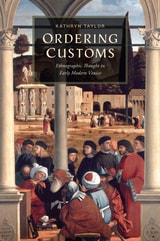
Ordering Customs
Ethnographic Thought in Early Modern VeniceKathryn Taylor
University of Delaware Press, 2023
Ordering Tang China
Cultural Memory, Emperor Taizong, and the EssentialsKelly Ngo
Lever Press, 2024
By connecting the textual discourse with an analysis of its use and reception across the region, Ngo demonstrates that the Essentials was a key source of Confucian political thought and practice during the early Tang dynasty. In accounting for the place of the Essentials in political advice literature, Ngo illustrates how it drew from the ancient Confucian heritage and was still responsive to contemporaneous political concerns, suggesting that the Essentials played a part in the success of Zhenguan political practice.
Ordering Tang China also includes the first English-language translations of portions of the seventh-century anthology, with reference to partial translations published in nine languages. Utilizing the theory of cultural memory to study the Essentials not only opens a fresh approach to learning about the imperial consumption of literature, as well as the theory and practice of emperorship, but also offers a case study for how to study Chinese governance literature, including its “mirror for princes” genre.
Ordinary Language Criticism
Literary Thinking after Cavell after WittgensteinKenneth Dauber and Walter Jost
Northwestern University Press, 2003
Resisting master formulations and overarching theories, Ordinary Language Criticism does not so much dismiss the excitement of the last two decades of literary theorizing as it reminds us of the excitement of the shared common enterprises to which theory may still contribute. In this, the volume and the model it offers have wide implications for the academy, in which a widespread ersatz-sophistication has shorted the circuit between literary works and the real lives of those reading and teaching them.
With a definitive introduction by editors Kenneth Dauber and Walter Jost, and elaborations and practical examples by major figures such as Cavell himself, Martha Nussbaum, Marjorie Perloff, Anthony Cascardi, and Charles Altieri, among others, this volume clearly shows and explains how ordinary language criticism differs from current trends and what it exactly it can accomplish in theory and practice. These essays prove that by attending more faithfully to what we actually do when we read, we can make reading more productive--can reveal how extraordinary and rich, how really sophisticated, the ordinary actually is.
Ordinary Lives
Platoon 1005 and the Vietnam WarW. Ehrhart
Temple University Press, 1999
Twenty-seven years after basic training. Ehrhart began what became a five-year search for the men of his platoon. Who were these men alongside whom he trained? Why had they joined the Marines at a time when being sent to war and of the country that sent them to fight it? What does the Corps mean to them? What Ehrhart learned offers an extraordinary window into the complexities of the Vietnam Generation and the United States of America then and now.
Based on supporting materials from military records and family members as well as interviews -- some of which Ehrhart held in such active secondary roles as dairy farmhand, fishing companion, and impromptu guest at a family wedding -- this book records the more-than-30-year journey that each man took after his boot-camp graduation on August 12, 1966. Photos of the men, both then and now, accompany the profiles. Their stories are diverse, but as Ehrhart says, "It was, in short, history, and each of these men was and is a part of that history....There are, no doubt, scoundrels and liars and losers among these men, but as a group they have mostly impressed me with their decency and their loyalty and their hard work and their perseverance in the face of hardships and hurdles, the everyday obstacles that make ordinary lives extraordinary."
Ordinary Lives
Recovering Deaf Social History through the American CensusEric C. Nystrom and R. A. R. Edwards
University of Massachusetts Press, 2024
The collective social history of deaf people in America has yet to be written. While scholars have focused their attention on residential schools for the deaf, leaders in the deaf community, and prominent graduates of these institutions, the lives of “ordinary” deaf individuals have been largely overlooked.
Employing the methods of social history, such as the use of digital history techniques and often-ignored sources like census records, Eric C. Nystrom and R. A. R. Edwards recover the lived experiences of everyday deaf people in late nineteenth century America. Ordinary Lives captures the stories of deaf women and men, both Black and white, describing their family lives, networks of support, educational experiences, and successes and hardships. In this pioneering “deaf social history,” Edwards and Nystrom reconstruct the biographies of a wider range of deaf individuals to tell a richer, more nuanced, and more inclusive history of the larger American deaf community.
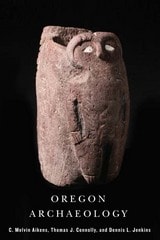
Oregon Archaeology
Melvin C. Aikens
Oregon State University Press, 2011
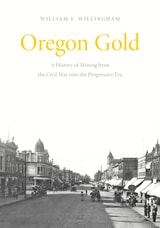
Oregon Gold
A History of Mining from the Civil War into the Progressive EraWilliam F. Willingham
Oregon State University Press, 2025
Following the discovery of gold in 1862 at Auburn and Canyon City, new communities and prospects were established in eastern Oregon. Just as the lure of free land attracted homesteaders and livestock raisers in search of new opportunities, so did the possibility of finding wealth in gold and silver throughout the region. Based on exhaustive research and a wealth of sources—federal census and mining records, newspapers, mining periodicals, county land records, maps, and federal government reports—Oregon Gold offers a comprehensive study of mining in Oregon between 1862 and 1910. From carefully examining the eastern portion of the state to exploring the economic expansion and political development of Portland, William Willingham highlights what is unique about the Oregon gold mining experience and places Oregon’s precious metal mining in the context of mining throughout the American West.
Willingham shows how mining was an important aspect of the state’s history, far greater than has been traditionally understood. He provides special attention and analysis to the role Chinese miners played in the story of eastern Oregon mining and to the demographic makeups of two major mining communities, Susanville and Granite, that thrived during the period. The attention to detail and thorough reporting in Oregon Gold will captivate both scholars and general readers interested in western mining and Oregon history during the nineteenth century.
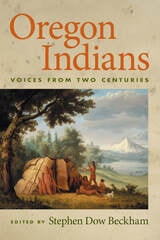
Oregon Indians
Voices from Two CenturiesStephen Dow Beckham
Oregon State University Press, 2006
In this deeply researched volume, Stephen Dow Beckham brings together commentary by Native Americans about the events affecting their lives in Oregon. Now available in paperback for the first time, this volume presents first-person accounts of events threatening, changing, and shaping the lives of Oregon Indians, from “first encounters” in the late eighteenth century to modern tribal economies.
The book's seven thematic sections are arranged chronologically and prefaced with introductory essays that provide the context of Indian relations with Euro-Americans and tightening federal policy. Each of the nearly seventy documents has a brief introduction that identifies the event and the speakers involved. Most of the book's selections are little known. Few have been previously published, including treaty council minutes, court and congressional testimonies, letters, and passages from travelers’ journals.
Oregon Indians opens with the arrival of Euro-Americans and their introduction of new technology, weapons, and diseases. The role of treaties, machinations of the Oregon volunteers, efforts of the US Army to protect the Indians but also subdue and confine them, and the emergence of reservation programs to “civilize” them are recorded in a variety of documents that illuminate nineteenth-century Indian experiences.
Twentieth-century documents include Tommy Thompson on the flooding of the Celilo Falls fishing grounds in 1942, as well as Indian voices challenging the "disastrous policy of termination," the state's prohibition on inter-racial marriage, and the final resting ground of Kennewick Man. Selections in the book's final section speak to the changing political atmosphere of the late twentieth century, and suggest that hope, rather than despair, became a possibility for Oregon tribes.

Ores to Metals
The Rocky Mountain Smelting IndustryJames E. Fell
University Press of Colorado, 2009
Although mining holds more of the glamour for those in and interested in the minerals industry, smelters have continuously played a critical role in the industry’s evolution since their introduction in Colorado in the 1860s. At that time, miners desperately needed new technology to recover gold and silver from ores resistant to milling. Beginning as small independent enterprises, progressing to larger integrated firms working in urban centers, and finally following a trend toward mergers, the entire industry was absorbed into one large holding company—the American Smelting and Refining Company. Over time, fortunes were won and lost, business success was converted to political success, and advances were made in science and metallurgy. Drawing on archival material, Fell expertly presents the triumphs and troubles of the entrepreneurs who built one of the great industries of the West.

Organic Coffee
Sustainable Development by Mayan FarmersMaria Elena Martinez-Torres
Ohio University Press, 2006
Maria Elena Martinez-Torres explains how Mayan farmers have built upon their ethnic networks to make a crucial change in their approach to agriculture. Taking us inside Chiapas, Mexico's poorest state and scene of the 1994 Zapatista uprising, she examines the anatomy of the ongoing organic coffee boom and the fair-trade movement. The organic coffee boom arose as very poor farmers formed cooperatives, revalued their ethnic identity, and improved their land through organic farming. The result has been significant economic benefits for their families and ecological benefits for the future sustainability of agriculture in the region.
Organic Coffee refutes the myth that organic farming is less productive than chemical-based agriculture and gives us reasons to be hopeful for indigenous peoples and peasant farmers