1566 books match the query 'Christianity' and 75 start with p
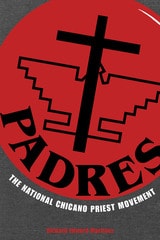
cover of PADRES: The National Chicano Priest Movement

PADRES

The National Chicano Priest Movement

By Richard Edward Martínez

University of Texas Press, 2005

From the 1848 Treaty of Guadalupe Hidalgo to the 1960s, Mexican American Catholics experienced racism and discrimination within the U.S. Catholic church, as white priests and bishops maintained a racial divide in all areas of the church's ministry. To oppose this religious apartheid and challenge the church to minister fairly to all of its faithful, a group of Chicano priests formed PADRES (Padres Asociados para Derechos Religiosos, Educativos y Sociales, or Priests Associated for Religious, Educational, and Social Rights) in 1969. Over the next twenty years of its existence, PADRES became a powerful force for change within the Catholic church and for social justice within American society.

This book offers the first history of the founding, activism, victories, and defeats of PADRES. At the heart of the book are oral history interviews with the founders of PADRES, who describe how their ministries in poor Mexican American parishes, as well as their own experiences of racism and discrimination within and outside the church, galvanized them into starting and sustaining the movement. Richard Martínez traces the ways in which PADRES was inspired by the Chicano movement and other civil rights struggles of the 1960s and also probes its linkages with liberation theology in Latin America. He uses a combination of social movement theory and organizational theory to explain why the group emerged, flourished, and eventually disbanded in 1989.
[more]
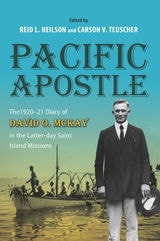
cover of Pacific Apostle: The 1920-21 Diary of David O. McKay in the Latter-day Saint Island Missions

Pacific Apostle

The 1920-21 Diary of David O. McKay in the Latter-day Saint Island Missions

David O. McKay, Edited by Reid L. Neilson and Carson V. Teuscher

University of Illinois Press, 2020
In 1920, David O. McKay embarked on a journey that forever changed the Church of Jesus Christ of Latter-day Saints. His visits to the Latter-day Saint missions, schools, and branches in the Pacific solidified the Church leadership's commitment to global outreach. As importantly, the trip inspired McKay's own initiatives when he later became Church president. McKay's account of his odyssey brings to life the story of the Church of Jesus Christ’s transformation into a global faith. Throughout his diary, McKay expressed his humanity, curiosity, and fascination with cultures and places--the Maori hongi, East Asian customs, Australian wildlife, and more. At the same time, he and his travel companion, Hugh J. Cannon, detailed the Latter-day Saint missionary life of the era, closely observing logistical challenges and cultural differences, guiding various church efforts, and listening to followers' impressions and concerns. Reid L. Neilson and Carson V. Teuscher's meticulous notes provide historical, religious, and general context for the reader.Blending travelogue with history, Pacific Apostle illuminates the thought and work of an essential figure in the twentieth-century Church of Jesus Christ.
[more]
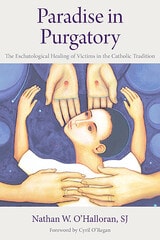
cover of Paradise in Purgatory: The Eschatological Healing of Victims in the Catholic Tradition

Paradise in Purgatory

The Eschatological Healing of Victims in the Catholic Tradition

Nathan W. O'Halloran

Catholic University of America Press, 2024
The claim of this book is that it is a precondition for Heaven that victims experience an eschatological healing of their other-inflicted wounds. Nathan O’Halloran, SJ, argues that the best theological space in which to locate this eschatological healing is in what he terms Paradise-in-Purgatory. The doctrine of Purgatory developed as a postmortem theological category for addressing sins committed after baptism and for which adequate penance has not been completed before death. In its full doctrinal articulations at Lyons II, Florence, and Trent, Purgatory is a doctrine concerned with personal, self-inflicted sin. Victims, on the other hand, require healing from other-inflicted sin rather than self-inflicted sin. For this reason, a certain expansion of this Catholic doctrine is required to make theological space for victims. O’Halloran argues that he has found that theological space within the Church’s ample tradition. The wellspring from which the doctrine of Purgatory emerged contains a richer content than has been represented thus far by conciliar definitions. Paradise in Purgatory maintains that the soteriological logic out of which Purgatory developed can be extended also to the postmortem healing of victims, and the soteriological logic of the New Testament supports this conclusion. Using as fundamental touchstones the wiping away of victims’ tears in the Book of Revelation, and the healing of Dinocrates through the prayers of his sister Perpetua in the Passion of Perpetua and Felicity, O’Halloran argues that victims must have an opportunity to experience full postmortem salvation from other-inflicted sin. The volume concludes that Purgatory can be theologically expanded to include a Paradise-in-Purgatory, i.e., a process that heals the other-inflicted wounds of sin which victims carry with them through death. The wounds of victims cannot be eschatologically discarded but must be subjected to the healing salvation which Christ came to offer.
[more]
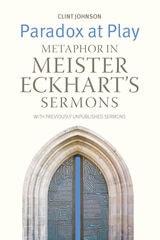
cover of Paradox at Play: Metaphor in Meister Eckhart's Sermons: with previously unpublished sermons

Paradox at Play

Metaphor in Meister Eckhart's Sermons: with previously unpublished sermons

Clint Johnson

Catholic University of America Press, 2022
Fresh translations of Meister Eckhart’s sermons are made available in this volume: three for the first time in English and sixteen others for the first time since C. de B. Evans translated them in 1924 and 1931, long before the critical editions of the manuscripts were published in 2003. Other important sermons are included in the translations as well. They improve upon previous translations which were not as sensitive to Eckhart’s metaphorical repertoire and his subtle word choice and phrasing. The extended introductory essay describes Eckhart’s metaphors and how they work together to form a cohesive whole. By looking at what his metaphors tell us about what an individual person is and how the view of the individual changed in the late medieval world, his ostensibly shocking rhetoric (in places where it is actually novel) is shown to be indicative of a larger cultural tide that culminated in the modern worldview. Finally, all of his homiletic choices are shown to be in service of the greater goal: catalyzing transformative change in his audience by stubbornly insisting on his paradoxes and jarring people out of their customary way of relating to God and themselves.
[more]
cover of Parish Boundaries: The Catholic Encounter with Race in the Twentieth-Century Urban North

Parish Boundaries

The Catholic Encounter with Race in the Twentieth-Century Urban North

John T. McGreevy

University of Chicago Press, 1996

Parish Boundaries chronicles the history of Catholic parishes in major cities such as Boston, Chicago, Detroit, New York, and Philadelphia, melding their unique place in the urban landscape to the course of twentieth century American race relations. In vivid portraits of parish life, John McGreevy examines the contacts and conflicts between Euro-American Catholics and their African-American neighbors. By tracing the transformation of a church, its people, and the nation, McGreevy illuminates the enormous impact of religious culture on modern American society.

"Parish Boundaries can take its place in the front ranks of the literature of urban race relations."—Jonathan Dorfman, Washington Post Book Review

"A prodigiously researched, gracefully written book distinguished especially by its seamless treatment of social and intellectual history."—Robert Orsi, American Historical Review

"Parish Boundaries will fascinate historians and anyone interested in the historic connection between parish and race."—Ed Marciniak, Chicago Tribune

"The history that remains to be written will rest on the firm foundation of Mr. McGreevy's remarkable book."—Richard Wightman Fox, New York Times Book Review
[more]
cover of Parish Nursing - 2011 Edition: Stories of Service and Care

Parish Nursing - 2011 Edition

Stories of Service and Care

Verna Benner Carson

Templeton Press, 2011

The engaging stories in Parish Nursing provide accessible and enjoyable accounts of real parish nurses, both paid and volunteer, who attend to the needs of their congregations in a variety of ways—from home, hospice, and hospital visits to community outreach. This revised edition gathers their stories of hearing and heeding God’s call, of their faith that they are doing the “right thing,” of their joys, sorrows, and challenges, and of their quiet dedication as they offer their time and talents to meet the needs of others.

By offering inspiration and encouragement, along with a healthy dose of updated practical advice, this collection will make parish nursing theory come to life. These stories will honor practicing parish nurses, will guide the way for anyone contemplating parish nursing as a career, and will challenge church members and leaders to examine the role that their congregations play in health ministry—especially in meeting the long-term care needs of an aging population.



[more]
cover of Passion of Israel: Jacques Maritain, Catholic Conscience, and the Holocaust

Passion of Israel

Jacques Maritain, Catholic Conscience, and the Holocaust

Richard Francis Crane

University of Scranton Press, 2010

In his lifetime, French philosopher Jacques Maritain (1882–1973) achieved a reputation as both a leading Catholic intellectual and as an outspoken critic of antisemitism. Here historian Richard Francis Crane traces the development of Maritain’s opposition toward antisemitism and analyzes the Catholic appreciation of Judaism that animated his stance. Crane probes the writings and teachings of Maritain—from before, during, and after the Holocaust—and illuminates how his ideas altered Christian perceptions of Jews and Judaism during his lifetime and continue to do so today.
[more]
cover of Passionate and Pious: Religious Media and Black Women's Sexuality

Passionate and Pious

Religious Media and Black Women's Sexuality

Monique Moultrie

Duke University Press, 2018
In Passionate and Pious Monique Moultrie explores the impact of faith-based sexual ministries on black women's sexual agency to trace how these women navigate sexuality, religious authority, and their spiritual walk with God. Providing churchwomen a space to candidly discuss these issues, these popular ministries exist largely beyond the traditional church, with dialogues about sex taking place in chat rooms and through text messages, social media, email, and other media. Moultrie foregrounds televangelist Juanita Bynum's construction of the black Christian sexual identity these ministries promote while emphasizing how churchwomen reconcile these prescriptive identities with their individual experiences. What does it mean for senior women to exercise sexual agency when their church standing could be questioned? What does celibacy mean for women who experience same-sex desire while believing that such desire goes against God's will? Advancing a womanist sexual ethics, Moultrie reframes biblical interpretations and conceptions of what constitutes a healthy relationship to provide a basis for sexual decision making that does not privilege monogamy or deny female pleasure, thereby calling on black churchwomen to experience responsible and life-enhancing sex.
[more]
cover of Passions and Virtue

Passions and Virtue

Servais Pinckaers

Catholic University of America Press, 2015
This book, the last that noted moral theologian Servais Pinckaers, OP, wrote before his death, was conceived as a follow-up to his previous work Plaidoyer pour la vertu (An Appeal for Virtue) (2007) Pinckaers' aim in Passions and Virtue was to show the positive and essential role that our emotions play in the life of virtue. His purpose is part of a larger project of renewing moral theology, a theology too often experienced as an ethics of obligation rather than as a practical guide to living virtuously. To this end, Pinckaers sketches a positive psychology of the passions as found in the biblical tradition, in the writings of the Fathers of the Church, in pagan authors and, especially, in the writings of Saint Thomas Aquinas.
[more]
cover of Patience and Salvation in Third Century North Africa: A Christian Latin Reader

Patience and Salvation in Third Century North Africa

A Christian Latin Reader

Sarah Wear

Catholic University of America Press, 2022
Patience and Salvation in Third Century North Africa: A Christian Latin Reader features the entirety of Tertullian’s To Martyrs and The Passion of Perpetua and Felicity, with selections from Cyprian’s On the Good of Patience and a short appendix on Augustine’s Commentary on Psalm 121.6. The Latin text has facing vocabulary and theological, historical, philosophical, and grammatical notes. In the first three centuries, Roman Carthage produced some of the earliest literature composed originally in Latin by Christians. Tertullian’s Ad Martyras (197); Passio Perpetuae et Felicitatis (203), and Cyprian’s De Bono Patientiae (256) all embody the force of this new genre of Latin literature. With this literature, we see a variant of Latin often denoted “Christian Latin.” Christian Latin featured linguistic elements marked by characteristics of biblical Latin, later Latin, as well as vulgarisms. In addition to converging philologically, Tertullian, the author of the Passio, and Cyprian align themselves in topos: they all ask the question of how one can endure torment and anxiety in this world. Patience (patientia), derived from the verb for “to suffer” (patior), is a virtue that allows one to endure troubles, anxieties, and physical pains with the hope of eternal happiness and salvation in heaven. In this Reader, the student will find three different literary perspectives on this theme. The book also draws parallels to the works of Seneca and Cicero on patience and suffering.
[more]
cover of Patriotism is a Catholic Virtue: Irish-American Catholics, The American Church and the Coming of the Great War

Patriotism is a Catholic Virtue

Irish-American Catholics, The American Church and the Coming of the Great War

Thomas J. Rowland

Catholic University of America Press, 2023
Most of the literature concerning the momentous challenges facing Irish American Catholics in the first two decades of the twentieth century pay but scant attention to the role played in addressing them by the American Church. Among the myriad political, social, cultural and economic issues confronting Irish American Catholics none stand out as prominently as the unabated burden of combatting scurrilous attacks upon them by nativist forces, the task of proving themselves as loyal American citizens, and navigating the perilous waves in advancing the course of directing Irish American nationalism and the cause of Ireland’s freedom. Patriotism is a Catholic Virtue ferrets out the impact the institutional Church played in affecting the course of action Irish American Catholics took regarding these three crucial missions. Whereas the task of confronting the assaults of nativism, seemingly the natural task for the institutional Church, this study provides extensive evidence of the relentless defense of Catholic virtue conducted by diocesan newspapers. Similarly, the mission of promoting Catholics as loyal American citizens was largely left in the hands of the American hierarchy, its clergy, newspapers and Catholic societies and affiliates. Lastly, this book provides evidence that the Church may well have played the decisive role in guiding its Irish American faithful along paths that, while conservatively promoting Irish nationalism, did not jeopardize an “American First” policy for Catholics. All of this was accomplished in the crucible of an emerging worldwide war.
[more]
cover of Paul in the Summa Theologiae

Paul in the Summa Theologiae

Matthew Levering

Catholic University of America Press, 2014
Aquinas's commentaries on St. Paul are well known and have received significant attention in the past few years. It is widely known, too, that Aquinas quotes Paul often in the Summa theologiae. This aspect of the Summa, however, has not been studied in detail. This book seeks to fill that lacuna in scholarship.
[more]
cover of Peace in the Thought of Thomas Aquinas: Philosophy, Theology, and Ethics

Peace in the Thought of Thomas Aquinas

Philosophy, Theology, and Ethics

John M. Meinert

Catholic University of America Press, 2024
What does Aquinas have to teach us on the topic of peace? Looking over the scholarly literature, one would think very little. Most Thomists ignore Aquinas’s thought on peace. Most peace researchers summarily dismiss Aquinas. Peace in the Thought of Thomas Aquinas challenges both these trends and offers the first book length study of peace in Aquinas’s thought. John Meinert outlines Aquinas's historical predecessors, then provides an exposition and interpretation of the full scope of Aquinas's thought on peace: metaphysics, Trinitarian theology, Christology, Pneumatology, ecclesiology, natural theology, ethics, and sacramental theology. What emerges from this extended study is a new vision of Aquinas’s work. Peace in the Thought of Thomas Aquinas establishes Aquinas as an indispensable dialogue partner for anyone thinking rigorously about the theology, philosophy, and ethics of peace. As Aquinas himself says, “observe peace and you will come to salvation.”
[more]
cover of Peculiar Portrayals: Mormons on the Page, the Stage and the Screen

Peculiar Portrayals

Mormons on the Page, the Stage and the Screen

Mark T Decker

Utah State University Press, 2010

In a time when Mormons appear to have larger roles in everything from political conflict to television shows and when Mormon-related topics seem to show up more frequently in the news, eight scholars take a close look at Mormonism in popular media: film, television, theater, and books.

Some contributors examine specific works, including the Tony-winning play Angels in America, the hit TV series Big Love, and the bestselling books Under the Banner of Heaven: A Story of Violent Faith and The Miracle Life of Edgar Mint. Others consider the phenomena of Mormon cinema and Mormon fiction; the use of the Mormon missionary as a stock character in films; and the noticeably prominent presence of Mormons in reality television shows.
[more]
cover of Pentecostalism in Urban Oaxaca: Healing Patriarchy, Marriage, and Mexico

Pentecostalism in Urban Oaxaca

Healing Patriarchy, Marriage, and Mexico

Michelle Ramirez

University of Alabama Press, 2024

An ethnography focusing on a Pentecostal church community and their pursuit of healing marriages and prosperity

Pentecostalism in Urban Oaxaca is a timely feminist ethnography set in a Pentecostal church community in Oaxaca de Juarez. Based on extensive fieldwork, Michelle Ramirez skillfully melds medical anthropology with cultural analysis to reveal the Pentecostal movement’s dynamics in the contexts of faith healing, marital relations, and economic prosperity.

Ramirez takes stock of the problematic ways that Pentecostalism has played out for Mexican women today but also reminds readers of some of its successes. Within the context of Mexican patriarchy, some women parishioners in abusive relationships see the church as a way to improve their lot. Pentecostalism seeks to rupture with Mexico’s colonial heritage, and Ramirez provides novel ways for the reader to consider how Pentecostalism can provide healing for even the “endlessness of addiction.” One case study portrays a former abusive alcoholic womanizer who underwent a spiritual transformation as a result of his conversion. Through this example and more, Ramirez examines the complex relationship between gender, modernity, and Indigeneity in the context of marriage. The book also addresses the #MeToo movement as encountered in the Pentecostal church.

Finally, Ramirez investigates how Pentecostalism addresses the “curses” of illness and poverty, highlighting the paradoxical relationship between faith healing and curanderismo. The gospel of economic prosperity holds promise for a better life, breaking free from the “disease” of poverty. To this end, Ramirez profiles some parishioners’ involvement with Omnilife, a multilevel marketing company selling vitamins and natural health products that propounds ideals similar to those of Pentecostal Christianity.


[more]
cover of People of Faith: Slavery and African Catholics in Eighteenth-Century Rio de Janeiro

People of Faith

Slavery and African Catholics in Eighteenth-Century Rio de Janeiro

Mariza de Carvalho Soares

Duke University Press, 2011
In People of Faith, Mariza de Carvalho Soares reconstructs the everyday lives of Mina slaves transported in the eighteenth century to Rio de Janeiro from the western coast of Africa, particularly from modern-day Benin. She describes a Catholic lay brotherhood formed by the enslaved Mina congregants of a Rio church, and she situates the brotherhood in a panoramic setting encompassing the historical development of the Atlantic slave trade in West Africa and the ethnic composition of Mina slaves in eighteenth-century Rio. Although Africans from the Mina Coast constituted no more than ten percent of the slave population of Rio, they were a strong presence in urban life at the time. Soares analyzes the role that Catholicism, and particularly lay brotherhoods, played in Africans’ construction of identities under slavery in colonial Brazil. As in the rest of the Portuguese empire, black lay brotherhoods in Rio engaged in expressions of imperial pomp through elaborate festivals, processions, and funerals; the election of kings and queens; and the organization of royal courts. Drawing mainly on ecclesiastical documents, Soares reveals the value of church records for historical research.
[more]
cover of Perfecting Human Actions: St. Thomas Aquinas on Human Participation in Eternal Law

Perfecting Human Actions

St. Thomas Aquinas on Human Participation in Eternal Law

John Rziha

Catholic University of America Press, 2009
During the last few centuries, a practical dichotomy between God and humans has developed within moral theory. As a result, moral theory tends to focus only on humans where human autonomy is foundational or only on God where divine commands capriciously rule. However, the moral theology of Thomas Aquinas overcomes this dichotomy. For Thomas, humans reach their perfection by participating in God's wisdom and love. Perfecting Human Actions explores the ways humans participate in eternal law--God's wisdom that guides and moves all things to their proper action. The book begins with a thoughtful examination of the philosophic recovery of the notion of participation in Thomistic metaphysics. It then explains Thomas's theological understanding of the notion of participation to show how humans are related to God. It is discovered that when performing human actions, humans participate in the eternal law in two ways: as moved and governed by it, and cognitively. In reference to participation as moved and governed, humans are directed by God to their proper end of eternal happiness. This mode of participation can be increased by perfecting the natural inclinations through virtue, grace, and the gifts of the Holy Spirit. In reference to cognitive participation, humans as rational creatures can know their proper end and how to attain it. Through this knowledge of moral truths, the intellect participates in the eternal law. Cognitive participation is perfected by the intellectual virtues (especially faith) and the gifts of the Holy Spirit (especially wisdom). The book concludes by showing how the notion of human participation in the eternal law is a much better foundation for moral theory than the contemporary notion of autonomy.
[more]
cover of Personalist Papers

Personalist Papers

John F. Crosby

Catholic University of America Press, 2004
In Personalist Papers, John F. Crosby continues the discussion of Christian personalism begun in his highly acclaimed book, The Selfhood of the Human Person.
[more]
cover of Persons of the Market: Conservatism, Corporate Personhood, and Economic Theology

Persons of the Market

Conservatism, Corporate Personhood, and Economic Theology

Kevin Musgrave

Michigan State University Press, 2022

Taking corporate personhood as a starting point, Persons of the Market observes the complex historical entanglement of Christian theology and liberal capitalism to shed new
light on their seemingly odd marriage in contemporary American politics. Author Kevin Musgrave highlights the ways that theories of corporate and human personhood have long been and remain bound together by examining four case studies: the U.S. Supreme Court’s 1886 Santa Clara decision, the role of early twentieth-century advertisers in endowing corporations with souls, Justice Lewis Powell Jr.’s eponymous memo of 1971, and the arc of the conservative movement from Ronald Reagan to Donald Trump. Tracing this rhetorical history of the extension and attribution of personhood to the corporate form illustrates how the corporation has for many increasingly become a normative model or ideal to which human persons should aspire. In closing, the book offers preliminary ideas about how we might fashion a more democratic and humane understanding of what it means to be a person.
[more]
cover of Peter Comestor's Lectures on the Glossed Gospel of John: A Study with a Critical Edition and Translation

Peter Comestor's Lectures on the Glossed Gospel of John

A Study with a Critical Edition and Translation

Peter Comestor

Catholic University of America Press, 2023

This monograph encompasses the first critical edition, translation, and historical study of a series of lectures from the cathedral school of Notre-Dame, Peter Comestor’s Glosses on the Glossed Gospel of John. Delivered in Paris in the mid-1150s, Comestor’s expansive lecture course on the Glossa ordinaria on the Gospel of John has survived in no fewer than seventeen manuscript witnesses, being preserved in the form of continuous transcripts taken in shorthand by a student-reporter (reportationes). The editor has selected the fifteen best witnesses to produce a critical edition and translation of the first chapter of Comestor’s lectures on the Gospel of John. In addition to the text of the original lectures, the edition includes appendices containing accretions to the lecture materials added by Comestor and his students, as well as the corresponding text of the Glossa ordinaria from which Comestor lectured. The Latin text and translation of Peter Comestor’s lectures are preceded by a wide-ranging critical study of the historical and intellectual context of Peter Comestor’s biblical teaching. This study begins with an outline of Comestor’s scholastic career and known works, with a detailed introduction to his Gospel lectures and the relevant historiography. Subsequently, a survey is made of the intellectual landscape of Comestor’s lectures: namely, the tradition of biblical teaching originating at the School of Laon, preserved in the Glossa ordinaria, and developed in the classroom by Peter Lombard and a succession of Parisian masters, notably Comestor himself. The following section examines the portion of the lectures presented in this book, encompassing an overview of its contents and structure, a description of Comestor’s teaching method and scholastic setting, a study of the text’s sources, and a consideration of Comestor’s participation and reception in the scholastic tradition. The final chapters contain a careful description of the manuscripts and editorial principles adopted in the Latin edition and translation.
[more]
cover of Peter Comestor's Lectures on the Gospel of Luke and its Glosses

Peter Comestor's Lectures on the Gospel of Luke and its Glosses

Peter Comestor

Catholic University of America Press, 0

Through a partial critical edition and study of Peter Comestor’s lectures, this volume recontextualizes the biblical exegesis of the twelfth-century Latin cathedral schools within the frameworks of the study of ars grammatica, underscoring the importance of the master-disciple relationship in forming medieval exegetical schools of thought. This study critically examines the Latin biblical lectures of Peter Comestor, a twelfth-century scholar based in Paris, focusing on his commentary on the Gospel of Luke and its glossing tradition. The study positions Comestor’s lectures among Latin biblical commentaries produced in the cathedral schools of Laon and Paris, a vital intellectual movement shaped by well-known figures such as Anselm of Laon and Peter Lombard, and which provided the foundations for the University of Paris. Recent scholarship has sought to bridge the gap between biblical commentaries and systematic theological treatises by highlighting the shared didactic methodologies between the medieval study of the liberal arts and sacred scripture. This study of Comestor’s Luke lectures expands these efforts, underscoring the role of classical philology and liberal arts pedagogy in shaping medieval theological thought. The volume highlights how the cathedral school scholars of northern France approached Christian theology as a work of textual criticism, exploring a wide range of subjects—from geometry to canon law—through biblical interpretation. By tracing these intellectual traditions, the study uncovers the pedagogical practices that informed the understanding of Christian biblical exegesis in the Latin Middle Ages, particularly in the period leading up to the establishment of Europe’s first universities and theology faculties.
[more]
cover of Peter Lombard and the Biblical Gloss: Textual Fluidity in Mid-Twelfth-Century Paris

Peter Lombard and the Biblical Gloss

Textual Fluidity in Mid-Twelfth-Century Paris

Mark Clark

Catholic University of America Press, 2026
This monograph presents altogether new and substantial evidence showing that the view of the development of Scholasticism and Scholastic thought going back three centuries at least is mistaken. Peter Lombard's Sentences and his career did not mark and mirror a transition from the traditional biblical theology to the newer systematic theology, as so long supposed. Rather, the traditional genres of medieval theology served as the indispensable foundation for the development of new forms for teaching Christian doctrine to clerics, forms organized systematically. The Bible was not displaced or abandoned in favor of various summas but was rather integrated into a medieval theology that looks surprisingly like the ideal of the Second Vatican Council. Dei Verbum, the dogmatic constitution that deals with the place of Sacred Scripture, doesn't mention the Schoolmen, because longstanding historiography on Scholastic thought in the High Middle Ages misled popes and prelates into supposing the medieval theology had abandoned the Bible in favor of cold, logical, systematic treatises. In fact, however, Peter Lombard, Bonaventure, Thomas Aquinas and many others could themselves have authored Dei Verbum, which reads like the prologues and primers that the masters teaching theology to clerics in the High Middle Ages wrote themselves.
[more]
cover of Philo's Influence on Valentinian Tradition

Philo's Influence on Valentinian Tradition

Risto Auvinen

SBL Press, 2024
In this book Risto Auvinen reevalutes the relationship between the exegetical and philosophical traditions found in the works of Philo and those of the Valentinian gnostic tradition, with a particular focus on the latter half of the second century, Valentinianism’s formative years. Texts examined include fragments of Valentinus, Heracleon, and Ptolemy’s Letter to Flora, in addition to the Valentinian source included in the Excerpta ex Theodoto by Clement of Alexandria and related sections in Irenaeus’s Adversus haereses. Auvinen asserts that the number of parallels with Philo in the Valentinian sources increases the likelihood that there was a historical relationship between Philo’s writings and Valentinian teachers. These connections expand our knowledge not only of the preservation and circulation of Philo’s texts in the latter part of the second century but also of the importance of the allegorical traditions of Hellenistic Judaism on Valentinus’s school of thought and on Gnosticism more broadly.
[more]
cover of Philology of the Flesh

Philology of the Flesh

John T. Hamilton

University of Chicago Press, 2018

As the Christian doctrine of Incarnation asserts, “the Word became Flesh.” Yet, while this metaphor is grounded in Christian tradition, its varied functions far exceed any purely theological import. It speaks to the nature of God just as much as to the nature of language.

In Philology of the Flesh, John T. Hamilton explores writing and reading practices that engage this notion in a range of poetic enterprises and theoretical reflections. By pressing the notion of philology as “love” (philia) for the “word” (logos), Hamilton’s readings investigate the breadth, depth, and limits of verbal styles that are irreducible to mere information. While a philologist of the body might understand words as corporeal vessels of core meaning, the philologist of the flesh, by focusing on the carnal qualities of language, resists taking words as mere containers.

By examining a series of intellectual episodes—from the fifteenth-century Humanism of Lorenzo Valla to the poetry of Emily Dickinson, from Immanuel Kant and Johann Georg Hamann to Friedrich Nietzsche, Franz Kafka, and Paul Celan—Philology of the Flesh considers the far-reaching ramifications of the incarnational metaphor, insisting on the inseparability of form and content, an insistence that allows us to rethink our relation to the concrete languages in which we think and live.
 
[more]
cover of Pickin’ Cotton on the Way to Church: The Life and Work of Father Boniface Hardin, OSB

Pickin’ Cotton on the Way to Church

The Life and Work of Father Boniface Hardin, OSB

Nancy Van Note Chism

Indiana Historical Society Press, 2019
Pickin’ Cotton on the Way to Church highlights the life of Father Boniface Hardin, a Benedictine monk. James Dwight Randolph (Randy) Hardin was born on November 18, 1933, in Bardstown, Kentucky, educated in Catholic schools in Kentucky, and thirteen years old when he asked to become a priest. Excluded from the seminaries in Kentucky because of his race, he enrolled in Saint Meinrad Seminary in Spencer County, Indiana, which had just started accepting black students. After six years of study he took his vows as monk and was given the name Boniface. He was ordained a priest in 1959 and attained a graduate degree in 1963. In 1965 Father Hardin accepted the position of associate pastor at Holy Angels Catholic Church, a predominately black parish in Indianapolis. Father Hardin was a social activist who spoke out against poverty, segregation, police brutality, and fought against the construction of an interstate highway that would adversely affect the black community. Such actions were considered inappropriate for a priest and the Archbishop of Indianapolis removed him from his position at Holy Angels. Although reinstated due to public outcries, Father Hardin soon left Holy Angels, and, along with Sister Jane Shilling, opened the Martin Center, where they could advocate full time for the poor and disenfranchised through a series of programs and services. Realizing the correlation between education and career advancement, Father Boniface and Sister Jane founded Martin University, the only predominately African American institution of higher learning in Indiana. The university continues to play a unique role in the community, with a special focus on educational opportunities to those who have been too often discounted, discouraged, and disregarded by society. Although Father Hardin was widely known in Indiana during his lifetime, accumulating many awards and honors, it is important to document his life and work for posterity. It is hoped that this volume will provide an overview of his story and lay the foundation for other scholarly efforts.
[more]
cover of Pictures, Quotations, and Distinctions: Fourteen Essays in Phenomenology

Pictures, Quotations, and Distinctions

Fourteen Essays in Phenomenology

Robert Sokolowski

Catholic University of America Press, 2022
One of the major contributions of Husserl’s phenomenology has been to show that things present themselves to us in strikingly different ways. There are various kinds of presentations and something like logical structures in them that allow the truth of things to appear. Being pictured is different from being named, and also different from being distinguished from something else. The fourteen essays in this volume provide concrete and colorful examples of strategic forms of presentation, and they also shed light on us as persons who exercise our intelligence when we let things appear in these various ways. Even our moral conduct takes place because something appears to us as to be done or to be avoided in a situation that calls for action. When we quote what someone has said, for example, we express things as they have been expressed by someone else, and we invoke the authority of that other speaker. In measurement, we either bring external units, such as inches or yards, to determine the “how much” of things; or we engage in “internal measurement” and use one part of the object to determine the size of the whole. In moral action, the deep core of what we do involves either benevolence or malevolence, and in such conduct we shape or confirm ourselves as good or bad. Even the timing of things, the measurement of their motions and the determination of their before and after, in both clock and calendar time, cannot take place without the involvement of the person’s own interwoven perceptions, remembrances, and anticipations, all held together by the underlying flow of personal as well as worldly temporality. The essays in this book are an attempt to blend the philosophical approaches of Aristotle and Husserl, the classical and the modern, to help us appreciate what Aristotle called “being as the true,” and to show how the human person is involved in this enterprise.
[more]
cover of Picturing Religious Experience: George Herbert, Calvin, and the Scriptures

Picturing Religious Experience

George Herbert, Calvin, and the Scriptures

Daniel Doerksen

University of Delaware Press, 2012

Little has been said about the relationship of Herbert’s writings to those of John Calvin, yet the latter were abundant and influential in Herbert’s Church of England. Accordingly Picturing Religious Experience studies Herbert’s poetry in relation to those writings, particularly regarding “spiritual conflicts,” which the poet himself said would be found depicted in his book of poems. Much more than is generally realized, Calvin wrote about the experience of living the Christian life—which is also Herbert’s subject in many of his poems. Altogether, this study maintains that Herbert owes to his religious orientation not just themes or details, but an impulse to observe and depict the inner life, and scriptural patterns which significantly contribute to the substance and literary excellence of The Temple.

Published by University of Delaware Press. Distributed worldwide by Rutgers University Press.
 
[more]
cover of Piercing the Clouds: Lectio Divina and the Preparation for Ministry

Piercing the Clouds

Lectio Divina and the Preparation for Ministry

Kevin Zilverberg

Saint Paul Seminary Press, 2021
This book’s six essays pertain to the “piercing of the clouds,” or the experience of heavenly mysteries, which characterizes lectio divina practiced well. Moreover, these peer-reviewed essays give special attention to the practice of lectio divina during preparation for ministry, especially the ministry of Catholic priests. That being said, any current or prospective Bible-reader may profit from this book; most of its content applies to Catholic seminarians and literate Christians alike. Here follow brief descriptions of each chapter. Laurence Kriegshauser, OSB, begins the book with a chapter on the Western monastic tradition of lectio divina and seminary formation, including an historical survey of lectio divina, a description of its characteristics, and reflections on its practice in seminaries. Michael Magee reflects upon the implications of exegetical method for lectio divina, with a comparison and critique of three commentaries’ treatments of John 6. Konrad Schaefer, OSB, advocates for fostering growth and formation through lectio divina, beginning his chapter with a description of its theological underpinnings and then taking up some practical considerations for students. Marcin Kowalski focuses on meditatio of lectio divina following upon exegesis-informed lectio, with an examination of Romans 7:7–25 as a test case. Daniel Keating examines oratio and contemplatio (and actio) of lectio divina, giving attention to theologians from twelfth-century Carthusian Prior Guigo II to Pope Benedict XVI. Anthony Giambrone, OP, contributes the final essay, on searching the Scriptures and the mystery of preaching. For him, exquisitio (intellectual engagement) leads to supplicatio (prayerful supplication), which culminates in praedicatio (preaching).
[more]
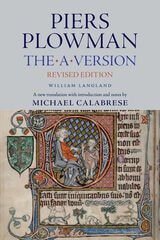
cover of Piers Plowan: The A Version, Revised Edition

Piers Plowan

The A Version, Revised Edition

William Langland

Catholic University of America Press, 2023
Passionate about trying to create social justice in a time of crisis after the Black Plague, William Langland spent his entire life working on Piers Plowman, an epic study of the human quest for truth, justice, and community. The "A Version," the first and shortest of the three versions he crafted, is wonderfully relatable and completely teachable to a modern student audience. Piers Plowman is becoming ever more relevant to students and scholars in English studies. Perhaps because the poem involves culture, religion, community, and work and engages explicitly with the histories of government and popular revolt, this allegorical tale of a wandering Christian named "Will," searching for truth with the aid of a humble plowman named Piers, has found new critical and pedagogic life in the last 20 years. Currently there are no translations of the A-version of Piers Plowman in print, so readers, scholars and teachers have been longing for an affordable, student-centered translation. The apparatus includes a 30-page historical and critical introduction, footnotes, a bibliography, a note on translation theory and practice, and samplings of the original text in Middle English, with a guide to pronunciation of that language. Piers Plowman is an extraordinary important document about the issues dramatically relevant to this day. It confronts poverty and inequity in 14th-century England and explores the need for virtue and social justice, encouraging its readers to create equality with open access for people of all classes and abilities. Though a Christian poem, Piers addresses issues of inclusivity, social responsibility and communal duty, as the poem’s protagonist wanders about the world, facing injustice and persecution as he looks for truth and salvation. Michael Calabrese, author of An Introduction to Piers Plowman and director of the Chaucer Studio’s Middle English recording of the poem, brings Piers Plowman to life for 21st-century students and for all readers interested in the history of society, virtue, faith and salvation.
[more]
cover of Piety and Charity in Late Medieval Florence

Piety and Charity in Late Medieval Florence

John Henderson

University of Chicago Press, 1997

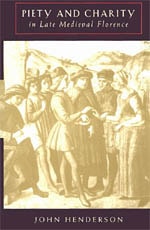
John Henderson examines the relationship between religion and society in late medieval Florence through the vehicle of the religious confraternity, one of the most ubiquitous and popular forms of lay association throughout Europe. This book provides a fascinating account of the development of confraternities in relation to other communal and ecclesiastical institutions in Florence. It is one of the most detailed analyses of charity in late medieval Europe.

"[A] long-awaited book. . . . [It is] the most complete survey of confraternities and charity, not only for Florence, but for any Italian city state to date. . . . This book recovers more vividly than other recent works what it meant to be a member of a confraternity in the late middle ages."—Samuel K. Cohn, Jr., Economic History Review

"Henderson offers new and fascinating information. . . . A stimulating and suggestive book that deserves a wide readership." —Gervase Rosser, Times Higher Education Supplement
[more]
cover of Piety and Dissent: Race, Gender, and Biblical Rhetoric in Early American Autobiography

Piety and Dissent

Race, Gender, and Biblical Rhetoric in Early American Autobiography

Eileen R. Elrod

University of Massachusetts Press, 2008

For pious converts to Christianity in late eighteenth- and early nineteenth-century New England, all reality was shaped by religious devotion and biblical text. It is therefore not surprising that earnest believers who found themselves marginalized by their race or sex relied on their faith to reconcile the tension between the spiritual experience of rebirth and the social ordeal of exclusion and injustice.

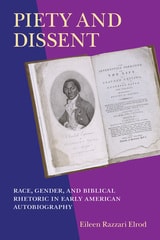
In Piety and Dissent, Eileen Razzari Elrod examines the religious autobiographies of six early Americans who represented various sorts of marginality: John Marrant, Olaudah Equiano, and Jarena Lee, all of African or African American heritage; Samson Occom (Mohegan) and William Apess (Pequot); and Abigail Abbott Bailey, a white woman who was subjected to extreme domestic violence. Through close readings of these personal narratives, Elrod uncovers the complex rhetorical strategies employed by pious outsiders to challenge the particular kinds of oppression each experienced. She identifies recurrent ideals and images drawn from Scripture and Protestant tradition—parables of liberation, rage, justice, and opposition to authority—that allowed them to see resistance as a religious act and, more than that, imbued them with a sense of agency. 

What the life stories of these six individuals reveal, according to Elrod, is that conventional Christianity in early America was not the hegemonic force that church leaders at the time imagined, and that many people since have believed it to be. Nor was there a clear distinction between personal piety and religious, social, and political resistance. To understand fully the role of religion in the early period of American letters, we must rethink some of our most fundamental assumptions about the function of Christian faith in the context of individual lives.
[more]
cover of Pilgrimage and Pogrom: Violence, Memory, and Visual Culture at the Host-Miracle Shrines of Germany and Austria

Pilgrimage and Pogrom

Violence, Memory, and Visual Culture at the Host-Miracle Shrines of Germany and Austria

Mitchell B. Merback

University of Chicago Press, 2013
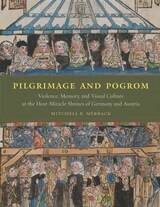
In the late Middle Ages, Europe saw the rise of one of its most virulent myths: that Jews abused the eucharistic bread as a form of anti-Christian blasphemy, causing it to bleed miraculously. The allegation fostered tensions between Christians and Jews that would explode into violence across Germany and Austria. And pilgrimage shrines were built on the sites where supposed desecrations had led to miracles or to anti-Semitic persecutions. Exploring the legends, cult forms, imagery, and architecture of these host-miracle shrines, Pilgrimage and Pogrom reveals how they not only reflected but also actively shaped Christian anti-Judaism in the two centuries before the Reformation.
 
Mitchell B. Merback studies surviving relics and eucharistic cult statues, painted miracle cycles and altarpieces, propaganda broadsheets, and more in an effort to explore how accusation and legend were transformed into propaganda and memory. Merback shows how persecution and violence became interdependent with normative aspects of Christian piety, from pilgrimage to prayers for the dead, infusing them with the ideals of crusade. Valiantly reconstructing the cult environments created for these sacred places, Pilgrimage and Pogrom is an illuminating look at Christian-Jewish relations in premodern Europe.
[more]
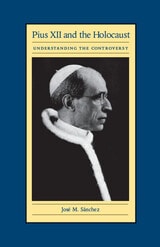
cover of Pius XII and the Holocaust: Understanding the Controversy

Pius XII and the Holocaust

Understanding the Controversy

José M. Sánchez

Catholic University of America Press, 2002
In this highly accessible work, José M. Sánchez offers a new approach to the controversy.
[more]
cover of Plain: A Memoir of Mennonite Girlhood

Plain

A Memoir of Mennonite Girlhood

Mary Alice Hostetter

University of Wisconsin Press, 2022

Plain tells the story of Mary Alice Hostetter’s journey to define an authentic self amid a rigid religious upbringing in a Mennonite farm family. Although endowed with a personality “prone toward questioning and challenging,” the young Mary Alice at first wants nothing more than to be a good girl, to do her share, and—alongside her eleven siblings—to work her family’s Lancaster County, Pennsylvania, farm. She feels fortunate to have been born into a religion where, as the familiar hymn states, she is “safe in the arms of Jesus.” As an adolescent, that keen desire for belonging becomes focused on her worldly peers, even though she knows that Mennonites consider themselves a people apart. Eventually she leaves behind the fields and fences of her youth, thinking she will finally be able to grow beyond the prohibitions of her church. Discovering and accepting her sexuality, she once again finds herself apart, on the outside of family, community, and societal norms.

This quietly powerful memoir of longing and acceptance casts a humanizing eye on a little-understood American religious tradition and a woman’s striving to grow within and beyond it.
 
[more]
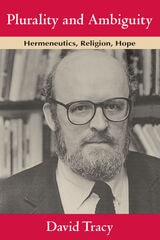
cover of Plurality and Ambiguity: Hermeneutics, Religion, Hope

Plurality and Ambiguity

Hermeneutics, Religion, Hope

David Tracy

University of Chicago Press, 1994
In Plurality and Ambiguity, David Tracy lays the philosophical groundwork for a practical application of hermeneutics, while constructing an innovative model of theological interpretation developed out of the notions of conversation and argument. He concludes with an appraisal of the religious significance of hope in an age of radically different voices and constantly shifting meanings.
[more]
cover of Poetic Relations: Intimacy and Faith in the English Reformation

Poetic Relations

Intimacy and Faith in the English Reformation

Constance M. Furey

University of Chicago Press, 2017

What is the relationship between our isolated and our social selves, between aloneness and interconnection? Constance M. Furey probes this question through a suggestive literary tradition: early Protestant poems in which a single speaker describes a solitary search for God.

As Furey demonstrates, John Donne, George Herbert, Anne Bradstreet, and others describe inner lives that are surprisingly crowded, teeming with human as well as divine companions. The same early modern writers who bequeathed to us the modern distinction between self and society reveal here a different way of thinking about selfhood altogether. For them, she argues, the self is neither alone nor universally connected, but is forever interactive and dynamically constituted by specific relationships. By means of an analysis equally attentive to theological ideas, social conventions, and poetic form, Furey reveals how poets who understand introspection as a relational act, and poetry itself as a form ideally suited to crafting a relational self, offer us new ways of thinking about selfhood today—and a resource for reimagining both secular and religious ways of being in the world.
[more]
cover of Poetics of the Flesh

Poetics of the Flesh

Mayra Rivera

Duke University Press, 2015
In Poetics of the Flesh Mayra Rivera offers poetic reflections on how we understand our carnal relationship to the world, at once spiritual, organic, and social. She connects conversations about corporeality in theology, political theory, and continental philosophy to show the relationship between the ways ancient Christian thinkers and modern Western philosophers conceive of the "body" and "flesh.” Her readings of the biblical writings of John and Paul as well as the work of Tertullian illustrate how Christian ideas of flesh influenced the works of Maurice Merleau-Ponty and Michel Foucault, and inform her readings of Judith Butler, Frantz Fanon, and others. Rivera also furthers developments in new materialism by exploring the intersections among bodies, material elements, social arrangements, and discourses through body and flesh. By painting a complex picture of bodies, and by developing an account of how the social materializes in flesh, Rivera provides a new way to understand gender and race.
 
[more]
cover of Poetry and Politics in the Play Sir Thomas More

Poetry and Politics in the Play Sir Thomas More

L. Joseph Hebert

Catholic University of America Press, 2026
If ever a play had something to say about the art of statesmanship, that play is Sir Thomas More. Its origins and authorship shrouded in mystery, the manuscript was likely written and revised between 1593 and 1604. This carefully crafted and dramatically compelling work pays tribute to a man eminent in philosophy and literature as well as politics, whose brilliant career and violent death revolved around controversies relevant to the turbulent transformations of the Tudor age, and to the subsequent development of modern government and society. Known then and now as "a man for all seasons," More was an accomplished poet, rhetorician, lawyer, diplomat, member of parliament and speaker of the House of Commons, a legal and political advisor to the city of London and King Henry VIII, and finally Chancellor of England. Having established a reputation for moral integrity, fervent piety, and vigorous opposition to both corruption and misguided attempts at reform, More saw his public career come to an abrupt end when he refused to recognize Henry as head of the English Church. In the generations that followed his trial and execution for "high treason," More was hailed by many as a man of wisdom, courage, and good faith-indeed, as "a blessed and happy martyr,"-even as the regime whose foundations he opposed continued to insist upon his error, guilt, and folly. Under the watchful eye of an Elizabethan censor, Sir Thomas More explores questions of profound philosophic and historic significance-questions that remained politically explosive at the time, and that continue to divide authors and audiences today. This book is the first to offer a comprehensive reading of the political and philosophical currents informing the play, including scene by scene summaries of the drama and clarifying synopses of sources referenced in the commentary.
[more]
cover of Political Spiritualities: The Pentecostal Revolution in Nigeria

Political Spiritualities

The Pentecostal Revolution in Nigeria

Ruth Marshall

University of Chicago Press, 2009

After an explosion of conversions to Pentecostalism over the past three decades, tens of millions of Nigerians now claim that “Jesus is the answer.” But if Jesus is the answer, what is the question? What led to the movement’s dramatic rise and how can we make sense of its social and political significance? In this ambitiously interdisciplinary study, Ruth Marshall draws on years of fieldwork and grapples with a host of important thinkers—including Foucault, Agamben, Arendt, and Benjamin—to answer these questions.

To account for the movement’s success, Marshall explores how Pentecostalism presents the experience of being born again as a chance for Nigerians to realize the promises of political and religious salvation made during the colonial and postcolonial eras. Her astute analysis of this religious trend sheds light on Nigeria’s contemporary politics, postcolonial statecraft, and the everyday struggles of ordinary citizens coping with poverty, corruption, and inequality.

Pentecostalism’s rise is truly global, and Political Spiritualities persuasively argues that Nigeria is a key case in this phenomenon while calling for new ways of thinking about the place of religion in contemporary politics.
[more]
cover of Politics and the Order of Love: An Augustinian Ethic of Democratic Citizenship

Politics and the Order of Love

An Augustinian Ethic of Democratic Citizenship

Eric Gregory

University of Chicago Press, 2008

Augustine—for all of his influence on Western culture and politics—was hardly a liberal. Drawing from theology, feminist theory, and political philosophy, Eric Gregory offers here a liberal ethics of citizenship, one less susceptible to anti-liberal critics because it is informed by the Augustinian tradition. The result is a book that expands Augustinian imaginations for liberalism and liberal imaginations for Augustinianism. 
Gregory examines a broad range of Augustine’s texts and their reception in different disciplines and identifies two classical themes which have analogues in secular political theory: love—and related notions of care, solidarity, and sympathy—and sin—as well as related notions of cruelty, evil, and narrow self-interest. From an Augustinian point of view, Gregory argues, love and sin constrain each other in ways that yield a distinctive vision of the limits and possibilities of politics.
In providing a constructive argument for Christian participation in liberal democratic societies, Gregory advances efforts to revive a political theology in which love’s relation to justice is prominent.  Politics and the Order of Love will provoke new conversations for those interested in Christian ethics, moral psychology, and the role of religion in a liberal society.
[more]
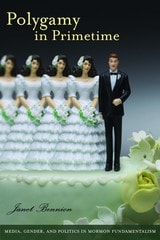
cover of Polygamy in Primetime: Media, Gender, and Politics in Mormon Fundamentalism

Polygamy in Primetime

Media, Gender, and Politics in Mormon Fundamentalism

Janet Bennion

Brandeis University Press, 2011
Recently, polygamy has become a “primetime” phenomenon. Television shows like Big Love and Sister Wives demonstrate the “progressive” side of polygamy, while horror stories from victims of abusive marriages offer less upbeat experiences among the adherents of the fundamentalist Church of Jesus Christ of Latter Day Saints (FLDS Church). Bennion, herself a product of Mormon polygamy, seeks to dispel the myths and misinformation that surround this topic. This study, based on seventeen years of ethnographic research among the Allred Group (Apostolic United Brethren) and on an analysis of recent blog journal entries written by a range of polygamous women, examines the variety and complexity of contemporary Mormon fundamentalist life in the Intermountain West. Although Bennion highlights problems associated with polygamy, including evidence that some forms are at high risk for father-child incest, she challenges the media-driven depiction of plural marriage as uniformly abusive and harmful to women. She shows how polygamist families can provide both economic security and social sustenance for some women, and how the authority of the husband can be undermined by the stresses of providing for multiple wives and children. Going beyond the media’s obsession with the sexual aspects of polygamous marriage, Bennion offers a rich description of familial, social, and legal contexts. Throughout, she makes the case for legalizing polygamy in order to allow greater visibility and regulation of the practice.
[more]
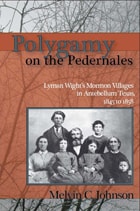
cover of Polygamy on the Pedernales: Lyman Wight's Mormon Village in Antebellum Texas

Polygamy on the Pedernales

Lyman Wight's Mormon Village in Antebellum Texas

Melvin C. Johnson

Utah State University Press, 2006

In the wake of Joseph Smith Jr.’s murder in 1844, his following splintered, and some allied themselves with a maverick Mormon apostle, Lyman Wight. Sometimes called the "Wild Ram of Texas," Wight took his splinter group to frontier Texas, a destination to which Smith, before his murder, had considered moving his followers, who were increasingly unwelcome in the Midwest. He had instructed Wight to take a small band of church members from Wisconsin to establish a Texas colony that would prepare the ground for a mass migration of the membership. Having received these orders directly from Smith, Wight did not believe the former’s death changed their significance. If anything, he felt all the more responsible for fulfilling what he believed was a prophet’s intention.

Antagonism with Brigham Young and the other LDS apostles grew, and Wight refused to join with them or move to their new gathering place in Utah. He and his small congregation pursued their own destiny, becoming an interesting component of the Texas frontier, where they had a significant economic role as early millers and cowboys and a political one as a buffer with the Comanches. Their social and religious practices shared many of the idiosyncracies of the larger Mormon sect, including polygamous marriages, temple rites, and economic cooperatives. Wight was a charismatic but authoritarian and increasingly odd figure, in part because of chemical addictions. His death in 1858 while leading his shrinking number of followers on yet one more migration brought an effective end to his independent church.
[more]
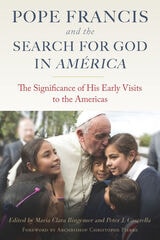
cover of Pope Francis and the Search for God in America: The Significance of His Early Visits to the Americas

Pope Francis and the Search for God in America

The Significance of His Early Visits to the Americas

Maria Clara Bingemer

Catholic University of America Press, 2021
In Tutti Fratelli, Pope Francis has called again for a “culture of encounter,” But how should his theology, pastoral practice, and social message be understood and applied in the Church of the Americas, a single but complex reality that extends from South to North? This volume offers analyses from experts looking back to the Argentine pontiff’s first fateful encuentros in the Americas as a help for understanding the present reality of the Church in the Western Hemisphere. The group includes theologians, historians, and political scientists, and the unique contribution of the volume lies in the panoramic perspective offered by the book as a whole. The initial essays set the stage for the volume as a whole, offering rich insight into Argentine and Latin American history, the world from which the Pope came and to which he returned in 2015, as well as surveying the impact of the Latin American “theology of the people” on the Pope’s visit to the U.S. Additional essays address theological, historical, and pastoral engagements that cut across several of the visits. The final group of essays is dedicated to the visits themselves and is arranged in the order that they occurred. Pope Francis and the Search for God in América is offered to all the members of the Church in América, South and North, old and young, with the hope that it will spur even more thought, reflection, prayer, and service.
[more]
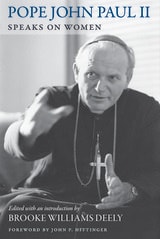
cover of Pope John Paul II Speaks on Women

Pope John Paul II Speaks on Women

Brooke Williams Deely

Catholic University of America Press, 2014
In Pope John Paul II Speaks on Women, Brooke Williams Deely presents a comprehensive record of John Paul II's reflections. This collection brings to the forefront the full context and content of his original contributions. Since John Paul II encouraged women and men to expand what he has adumbrated, this book facilitates ongoing dialogue. The principle of the organization of the volume is chronological, compiling John Paul II's teachings on the subject of women arranged by date over the entire term of his Papacy. Since this influential Pope addressed the situation of women from the beginning of his pontificate, this overview of his writings and his spoken addresses best showcases the development and historical context of his thought.
[more]
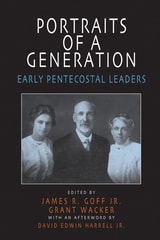
cover of Portraits of a Generation: Early Pentecostal Leaders

Portraits of a Generation

Early Pentecostal Leaders

James Goff

University of Arkansas Press, 2002

A spirit of religious revival blazed across the United States just after 1900. With a focus on Holy Spirit power, early adherents stirred an enthusiastic response, first at a Bible school in Topeka and then in a small mission on Asuza Street in Los Angeles. Almost immediately, the movement spread to Houston, Chicago, and then northeastern urban centers. By the early 1910s the fervor had reached most parts of the United States, Canada, and northern Mexico, and eventually the converts called themselves pentecostals. Today there are pentecostals all over the world. From the beginning the movement was unusually diverse: women and African Americans were active in many of the early fellowships, and although some groups were segregated, some were interracial. Everytwhere, ordinary people passionately devoted themselves to salvation, Holy Ghost baptism evidenced by speaking in tongues, divine healing, and anticipation of the Lord’s imminent return.

This movement saw itself as leaderless, depending on individual conversion and a radical equality of souls — or, as early devotees would say, on the Holy Spirit. But a closer look reveals a host of forceful, clear-eyed leaders. This volume offers twenty biographical portraits of the first-generation pioneers who wove the different strands of Holy Spirit revivalism into a coherent and dramatically successful movement.
[more]
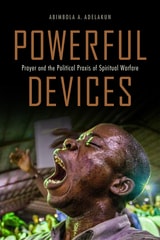
cover of Powerful Devices: Prayer and the Political Praxis of Spiritual Warfare

Powerful Devices

Prayer and the Political Praxis of Spiritual Warfare

Abimbola Adunni Adelakun

Rutgers University Press, 2023
Powerful Devices studies spiritual warfare performances as an apparatus for disestablishing structures of power and knowledge, and establishing righteousness in their stead. Drawing on performance studies’ emphasis on radicality and breaking of social norms as devices of social transformation, the book demonstrates how Christian groups with dominant cultural power but who perceive themselves as embattled wield the ideas of performance activism. Combining religious studies with ethnography, Powerful Devices explores Nigerian Pentecostals and US Evangelicals’ praxis of transnational spiritual warfare. By closely studying spiritual warfare prayers as a “device,” Powerful Devices shows how the rituals of prayer enable an apprehension of time, paradigms of self-enhancement, and the subversion of politics and authority. A critical intervention, Powerful Devices explores charismatic Christianity’s relationship to science and secular authority, technology and temporality, neoliberalism, and reactionary ideology.
[more]
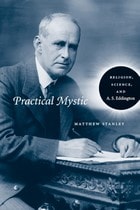
cover of Practical Mystic: Religion, Science, and A. S. Eddington

Practical Mystic

Religion, Science, and A. S. Eddington

Matthew Stanley

University of Chicago Press, 2007

Science and religion have long been thought incompatible. But nowhere has this apparent contradiction been more fully resolved than in the figure of A. S. Eddington (1882–1944), a pioneer in astrophysics, relativity, and the popularization of science, and a devout Quaker. Practical Mystic uses the figure of Eddington to shows how religious and scientific values can interact and overlap without compromising the integrity of either.

Eddington was a world-class scientist who not only maintained his religious belief throughout his scientific career but also defended the interrelation of science and religion while drawing inspiration from both for his practices. For instance, at a time when a strict adherence to deductive principles of physics had proved fruitless for understanding the nature of stars, insights from Quaker mysticism led Eddington to argue that an outlook less concerned with certainty and more concerned with further exploration was necessary to overcome the obstacles of incomplete and uncertain knowledge.

By examining this intersection between liberal religion and astrophysics, Practical Mystic questions many common assumptions about the relationship between science and spirituality. Matthew Stanley’s analysis of Eddington’s personal convictions also reveals much about the practice, production, and dissemination of scientific knowledge at the beginning of the twentieth century.
[more]
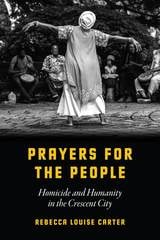
cover of Prayers for the People: Homicide and Humanity in the Crescent City

Prayers for the People

Homicide and Humanity in the Crescent City

Rebecca Louise Carter

University of Chicago Press, 2019

“Grieve well and you grow stronger.” Anthropologist Rebecca Louise Carter heard this wisdom over and over while living in post-Katrina New Orleans, where everyday violence disproportionately affects Black communities. What does it mean to grieve well? How does mourning strengthen survivors in the face of ongoing threats to Black life?
 
Inspired by ministers and guided by grieving mothers who hold birthday parties for their deceased sons, Prayers for the People traces the emergence of a powerful new African American religious ideal at the intersection of urban life, death, and social and spiritual change. Carter frames this sensitive ethnography within the complex history of structural violence in America—from the legacies of slavery to free but unequal citizenship, from mass incarceration and overpolicing to social abandonment and the unequal distribution of goods and services. And yet Carter offers a vision of restorative kinship by which communities of faith work against the denial of Black personhood as well as the violent severing of social and familial bonds. A timely directive for human relations during a contentious time in America’s history, Prayers for the People is also a hopeful vision of what an inclusive, nonviolent, and just urban society could be.
 
[more]
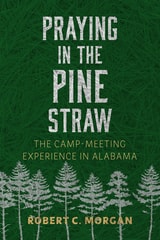
cover of Praying in the Pine Straw: The Camp-Meeting Experience in Alabama

Praying in the Pine Straw

The Camp-Meeting Experience in Alabama

Robert C. Morgan

University of Alabama Press, 2025

Step into the South’s brush arbors and piney woods where faith runs deep, stories run wild, and the old-time camp meeting was anything but quiet.

Praying in Pine Straw immerses readers in the raw, rollicking, and deeply human world of Alabama’s camp meetings—a Southern tradition where fire-and-brimstone preaching echoed through pine forests and where faith was often accompanied by contradiction. From “treeing the Devil” to “holy laughter,” these revivals blended heartfelt worship with all the complications of human nature. Mule-drawn wagons brought the faithful to rustic camps, where gospel fervor mingled with whiskey traders, local politicians, and opportunists of every kind. Preachers thundered against sin—even as they sometimes flirted with it themselves.

Robert C. Morgan offers a textured portrait of camp meetings as both spiritual experience and cultural spectacle, reviving a Southern tradition that flourished from the late nineteenth to mid-twentieth centuries. With a blend of humor and keen insight, Praying in the Pine Straw unveils the enduring contradictions of “old-time religion” and its significant influence on Southern culture and faith—a legacy that is both treasured and complex.

[more]
cover of Preaching and the Rise of the American Novel

Preaching and the Rise of the American Novel

Dawn Coleman

The Ohio State University Press, 2013

Preaching and the Rise of the American Novel by Dawn Coleman recovers a crucial moment in the history of the intimate yet often contentious relationship between religion and literature. Coleman’s book highlights the intersection of two cultural trajectories in America around 1850, both often downplayed in literary histories: a boom in preaching, associated with the growth of evangelicalism and the country’s oratorical traditions, and the long struggle of the novel, still facing considerable disdain at mid-century, to achieve moral legitimacy and aesthetic autonomy.
 
Before the Civil War, the preacher in the pulpit was the culture’s paradigmatic voice of moral authority, and novelists who wished to establish the moral value of their own storytelling needed to incorporate sermons. This book explores how antebellum ministers sought to preach effective, authoritative sermons and how novelists sought to claim a similar authority through canny representations of preachers, often veiled critiques of actual ministers, and sermonic voice, or a creative reworking of the sound of preaching. Such intense engagement with sermons shaped some of the period’s most interesting and important novels, including The Scarlet Letter, The Quaker City, Moby-Dick, Uncle Tom’s Cabin, and Clotel.
 
In illuminating how novelists sought to displace traditional religious institutions, Preaching and the Rise of the American Novel reminds readers of the deep connections between Americans’ religious practices and their literature and speaks to how the processes of secularization are often less concerned with rejecting the elements of religion than reimagining them.
[more]