Results by title
193 books match the query 'Modernism (Literature)' and 11 start with p
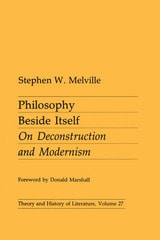
Philosophy Beside Itself
On Deconstruction and ModernismStephen W. MelvilleForeword by Donald Marshall
University of Minnesota Press, 1986
Philosophy Beside Itself was first published in 1986. Minnesota Archive Editions uses digital technology to make long-unavailable books once again accessible, and are published unaltered from the original University of Minnesota Press editions.
The writings of French philosopher Jacques Derrida have been the single most powerful influence on critical theory and practice in the United States over the past decade. But with few exceptions American philosophers have taken little or no interest in Derrida's work, and the task of reception, translation, and commentary has been left to literary critics. As a result, Derrida has appeared as a figure already defined by essentially literary critical activities and interests.
Stephen Melville's aim in Philosophy Beside Itself is to insist upon and clarify the distinctions between philosophy and criticism. He argues that until we grasp Derrida's philosophical project as such, we remain fundamentally unable to see his significance for criticism. In terms derived from Stanley Cavell's writings on modernism, Melville develops a case for Derrida as a modernist philosopher, working at once within and against that tradition and discipline.
Melville first places Derrida in a Hegelian context, the structure of which he explores by examining the work of Heidegger, Lacan, and Bataille. With this foundation, he is able to reappraise the project of deconstructive criticism as developed in Paul de Man's Blindness and Insight and further articulated by other Yale critics. Central to this critique is the ambivalent relationship between deconstructive criticism and Lacanian psychoanalysis. Criticism—radical self-criticism—is a central means through which the difficult facts of human community come to recognition, and Melville argues for criticism as an activity intimately bound to the ways in which we do and do not belong in time and in community. Derrida's achievement has been to find a new and necessary way to assert that the task of philosophy is criticism; the task of literary criticism is to assume the burden of that achievement.
Stephen Melville is an assistant professor of English at Syracuse University, and Donald Marshall is a professor of English at the University of Iowa.
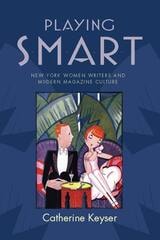
Playing Smart
New York Women Writers and Modern Magazine CultureKeyser, Catherine
Rutgers University Press, 2010
Through humor writing, this "smart set" expressed both sides of the story-promoting their urbanity and wit while using irony and caricature to challenge feminine stereotypes. Their fiction raised questions about what it meant to be a woman in the public eye, how gender roles would change because men and women were working together, and how the growth of the magazine industry would affect women's relationships to their bodies and minds. Keyser provides a refreshing and informative chronicle, saluting the value of being "smart" as incisive and innovative humor showed off the wit and talent of women writers and satirized the fantasy world created by magazines.
Poetic Investigations
Singing the Holes in HistoryPaul Naylor
Northwestern University Press, 1999

Poetic License
Essays on Modernist and Postmodernist LyricMarjorie Perloff
Northwestern University Press, 1990
Poetry On and Off the Page
Essays for Emergent OccasionsMarjorie Perloff
Northwestern University Press, 1998
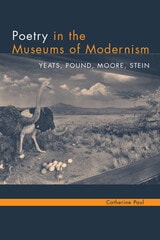
Poetry in the Museums of Modernism
Yeats, Pound, Moore, SteinCatherine Paul
University of Michigan Press, 2002
Although critics have attested to the importance of the visual arts to literary modernists and have begun to explore the relationships between literary production and social institutions, before now no one has examined the particular institutions in which modernist poets found the artworks, specimens, and other artifacts that inspired their literary innovations. Catherine Paul's book offers the reader a fresh encounter with modernism that will interest literary and art historians, literary theorists, critics, and scholars in cultural studies and museum studies.
Catherine Paul is Associate Professor of English, Clemson University.
Poetry of the Possible
Spontaneity, Modernism, and the MultitudeJoel Nickels
University of Minnesota Press, 2012
The Poetry of the Possible challenges the conventional image of modernism as a socially phobic formation, arguing that modernism’s abstractions and difficulties are ways of imagining unrealized powers of collective self-organization. Establishing a conceptual continuum between modernism and contemporary theorists such as Paulo Virno, Michael Hardt, Antonio Negri, and Alain Badiou, Joel Nickels rediscovers modernism’s attempts to document the creative potenza of the multitude.
By examining scenes of collective life in works by William Carlos Williams, Wyndham Lewis, Laura Riding, and Wallace Stevens, Nickels resurrects modernism’s obsession with constituent power: the raw, indeterminate capacity for reciprocal counsel that continually constitutes and reconstitutes established political regimes. In doing so, he reminds us that our own attempts to imagine leaderless networks of collective initiative are not so much breaks with modernist forms of knowledge as restagings of some of modernism’s most radical moments of political speculation.
Setting modernism’s individual and collective models of spontaneity in dialogue with theorists of political spontaneity such as Antonio Gramsci, Herbert Marcuse, and Theodor Adorno, Nickels retells the story of modernism as the struggle to represent powers of collective self-organization that lie outside established regimes of political representation.

Politics, Writing, Mutilation
The Cases of Bataille, Blanchot, Roussel, Leiris, and PongeAllan Stoekl
University of Minnesota Press, 1985
Politics, Writing, Mutilation was first published in 1985. Minnesota Archive Editions uses digital technology to make long-unavailable books once again accessible, and are published unaltered from the original University of Minnesota Press editions.
Five twentieth-century French writers played, and continue to play, a pivotal role in the development of literary-philosophical thinking that has come to be known in the United States as post-structuralism. The work of Georges Bataille, Maurice Blanchot, Raymond Roussel, Michel Leiris, and Francis Ponge in the 1930s and 1940s amounts to a prehistory of today's theoretical debates; the writings of Foucault and Derrida in particular would have been unthinkable outside the context provided by these writers. In Politics, Writing, Mutilation,Allan Stoekl emphasizes their role as precursors, but he also makes clear that they created a distinctive body of work that must be read and evaluated on its own terms.
Stoekl's critical readings of their work—selected novels, poems, and autobiographical fragments—reveal them to be battlegrounds not only of disruptive language practices, but of conflicting political drives as well. These irreconcilable tendencies can be defined as progressive political revolution, on the one hand with its emphasis on utility, conservation, and labor; and, on the other hand, a notion of dangerous and sinister production that stresses orgiastic sexuality and delirious expenditure. Caught between these forces is the intellectual of Bataille's time (and indeed of ours), locked in impotence, self-betrayal, and automutilation.
Stoekl develops his critique through dual readings of each writer's central work—the first reading deconstructive, the second a search for the political meaning excluded by a deconstructive approach. Repeating this process on a larger scale, he shows how Derrida and Foucault are indebted to their precursors even while they have betrayed them by stripping their work of political conflict and historical specificity. And he acknowledges that one of the most painful questions faced in prewar and Occupied France—that of the unthinkable guilt and duplicity of the intellectual—may not be as remote from contemporary theoretical concerns as some would have us believe.

Pop Modernism
Noise and the Reinvention of the EverydayJuan A. Suarez
University of Illinois Press, 2007
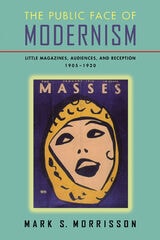
Public Face Of Modernism
Little Magazines, Audiences, And Reception, 1905-1920Mark S. Morrisson
University of Wisconsin Press, 2000
The phenomenal successes of new advertising agencies and mass market publishers did elicit what Morrisson calls a "crisis of publicity" for some modernists and for many concerned citizens in both countries. But, as Morrisson demonstrates, the vast influence of these industries on consumers also had a profound and largely overlooked effect upon many modernist authors, artists, and others. By exploring the publicity and audience reception of several of the most important modernist magazines of the period, The Public Face of Modernism shows how modernists, far from lamenting the destruction of meaningful art and public culture by the new mass market, actually displayed optimism about the power of mass-market technologies and strategies to transform and rejuvenate contemporary culture—and, above all, to restore a public function to art.
This reconstruction of the "public face of modernism" offers surprising new perceptions about the class, gender, racial, and even generational tensions within the public culture of the early part of the century, and provides a rare insight into the actual audiences for modernist magazines of the period. Moreover, in new readings of works by James Joyce, George Bernard Shaw, Wyndham Lewis, Ford Madox Ford, T. S. Eliot, William Carlos Williams, and many others, Morrisson shows that these contexts also had an impact on the techniques and concerns of the literature itself.
Puritanism and Modernist Novels
From Moral Character to the Ethical SelfLynne W. Hinojosa
The Ohio State University Press, 2015
Puritanism and Modernist Novels offers new formal and contextual readings of early modernist novels by Oscar Wilde, E. M. Forster, James Joyce, and Ford Madox Ford. Hinojosa demonstrates that, while they long for escape, these authors still question the value of the novelistic narrative of confinement and escape. Bridging modernist and novel studies, Puritanism and Modernist Novels contributes to conversations about secularization and religion in both fields, highlighting the limitations created by the secularization narrative of modernity.