Results by title
546 books match the query 'Semiotics & Theory' and 27 start with p
Palimpsest
Editorial Theory in the HumanitiesGeorge Bornstein and Ralph G. Williams, Editors
University of Michigan Press, 1993
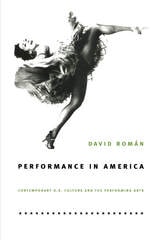
Performance in America
Contemporary U.S. Culture and the Performing ArtsDavid Román
Duke University Press, 2005
The performances that Román analyzes range from localized community-based arts events to full-scale Broadway productions and from the controversial works of established artists such as Tony Kushner to those of emerging artists. Román considers dances produced by the choreographers Bill T. Jones and Neil Greenberg in the mid-1990s as new aids treatments became available and the aids crisis was reconfigured; a production of the Asian American playwright Chay Yew’s A Beautiful Country in a high-school auditorium in Los Angeles’s Chinatown; and Latino performer John Leguizamo’s one-man Broadway show Freak. He examines the revival of theatrical legacies by female impersonators and the resurgence of cabaret in New York City. Román also looks at how the performing arts have responded to 9/11, the U.S. invasion of Afghanistan, and the second war in Iraq. Including more than eighty illustrations, Performance in America highlights the dynamic relationships among performance, history, and contemporary culture through which the past is revisited and the future reimagined.

Periodization
Cutting Up the Past, Volume 62Marshall Brown, ed.
Duke University Press, 0
This special issue of MLQ covers examples of periodization from the early modern to the present, including a range from the individual year to the longue durée and incorporates a variety of methods from close empirical study to global concern. In the lead essay, Russell A. Berman argues that periodization saves us from the dangers of both anachronism and presentism. Srinivas Aravamudan, updating Vico, reminds usthat we lose the past if we simply leave it unexamined. In “Perioddity” Timothy J. Reiss reflects on the crossings of chronology with geology in long-range and global perspectives.
This collection strives to turn discomfort with periodization into a constructive discourse.
Contributors. Srinivas Aravamudan, Russell Berman, Marshall Brown, Margreta de Grazia, Robert J. Griffin, Anne K. Mellor, Michael North, Timothy J. Reiss
Periodizing Jameson
Dialectics, the University, and the Desire for NarrativePhillip E. Wegner
Northwestern University Press, 2014
For a half century, the American intellectual Fredric Jameson has been a driving force in literary and cultural theory. In Periodizing Jameson, Phillip E. Wegner builds upon Jameson’s unique dialectical method to demonstrate the value of Jameson’s tools—periodization, the fourfold hermeneutic, and the Greimasian semiotic square, among others—and to develop virtuoso readings of Jameson’s own work and the history of the contemporary American university in which it unfolds.
Wegner shows how Jameson’s work intervenes in particular social, cultural, and political situations, using his scholarship both to develop original explorations of nineteenth-century fiction, popular films, and other promiment theorists, and to examine the changing fortunes of theory itself. In this way, Periodizing Jameson casts new light on the potential of and challenges to humanist intellectual work in the present.
Permissible Narratives
The Promise of Latino/a LiteratureChristopher González
The Ohio State University Press, 2017
Bringing together cultural critique, memory, narratology, cognition, and comprehension, González examines Latina/o authors—such as Oscar “Zeta” Acosta, Gloria Anzaldúa, Piri Thomas, Giannina Braschi, Gilbert Hernandez, Sandra Cisneros, and Junot Díaz—investigating how they successfully, and sometimes unsuccessfully, use the expansive canvas of narrative form to capture the imaginations of an open-minded readership. Permissible Narratives highlights both the inequitable accessibility of narrative devices and, crucially, the daring of Latina/o authors to nurture a readership to afford the same literary deference to them that is so often afforded to white, male, straight authors.
Perpetual War
Cosmopolitanism from the Viewpoint of ViolenceBruce Robbins
Duke University Press, 2012
Under these conditions, cosmopolitanism in the traditional sense—primary loyalty to the good of humanity as a whole, even if it conflicts with loyalty to the interests of one's own nation—becomes a necessary resource in the struggle against military aggression. To what extent does the "new" cosmopolitanism also include or support this "old" cosmopolitanism? In an attempt to answer this question, Robbins engages with such thinkers as Noam Chomsky, Edward Said, Anthony Appiah, Immanuel Wallerstein, Louis Menand, W. G. Sebald, and Slavoj Zizek. The paradoxes of detachment and belonging they embody, he argues, can help define the tasks of American intellectuals in an era when the first duty of the cosmopolitan is to resist the military aggression perpetrated by his or her own country.
Phantasmatic Indochina
French Colonial Ideology in Architecture, Film, and LiteraturePanivong Norindr
Duke University Press, 1996
Analyzing the first Exposition Coloniale Internationale, held in Paris in 1931, Norindr shows how the exhibition’s display of architecture gave a vision to the colonies that justified France’s cultural prejudices, while stimulating the desire for further expansionism. He critiques the Surrealist counter-exposition mounted to oppose the imperialist aims of the Exposition Coloniale, and the Surrealist incorporation and appropriation of native artifacts in avant-garde works. According to Norindr, all serious attempts at interrogating French colonial involvement in Southeast Asia are threatened by discourse, images, representations, and myths that perpetuate the luminous aura of Indochina as a place of erotic fantasies and exotic adventures. Exploring the resilience of French nostalgia for Indochina in books and movies, the author examines work by Malraux, Duras, and Claudel, and the films Indochine, The Lover, and Dien Bien Phu.
Certain to impact across a range of disciplines, Phantasmatic Indochina will be of interest to those engaged in the study of the culture and history of Vietnam, Cambodia, Thailand, and Laos, as well as specialists in the fields of French modernism, postcolonial studies, cultural studies, and comparative literature.
Plantation Goods
A Material History of American SlaverySeth Rockman
University of Chicago Press, 2024
The industrializing North and the agricultural South—that’s how we have been taught to think about the United States in the early nineteenth century. But in doing so, we overlook the economic ties that held the nation together before the Civil War. We miss slavery’s long reach into small New England communities, just as we fail to see the role of Northern manufacturing in shaping the terrain of human bondage in the South. Using plantation goods—the shirts, hats, hoes, shovels, shoes, axes, and whips made in the North for use in the South—historian Seth Rockman locates the biggest stories in American history in the everyday objects that stitched together the lives and livelihoods of Americans—white and Black, male and female, enslaved and free—across an expanding nation.
By following the stories of material objects, such as shoes made by Massachusetts farm women that found their way to the feet of a Mississippi slave, Rockman reveals a national economy organized by slavery—a slavery that outsourced the production of its supplies to the North, and a North that outsourced its slavery to the South. Melding business and labor history through powerful storytelling, Plantation Goods brings northern industrialists, southern slaveholders, enslaved field hands, and paid factory laborers into the same picture. In one part of the country, entrepreneurs envisioned fortunes to be made from “planter’s hoes” and rural women spent their days weaving “negro cloth” and assembling “slave brogans.” In another, enslaved people actively consumed textiles and tools imported from the North to contest their bondage. In between, merchants, marketers, storekeepers, and debt collectors laid claim to the profits of a thriving interregional trade.
Examining producers and consumers linked in economic and moral relationships across great geographic and political distances, Plantation Goods explores how people in the nineteenth century thought about complicity with slavery while showing how slavery structured life nationwide and established a modern world of entrepreneurship and exploitation. Rockman brings together lines of American history that have for too long been told separately, as slavery and capitalism converge in something as deceptively ordinary as a humble pair of shoes.
Playing at Narratology
Digital Media as Narrative TheoryDaniel Punday
The Ohio State University Press, 2019
Returning to terms such as narrator, setting, event, character, and world, Playing at Narratology reveals new ways of thinking about these basic narrative concepts—concepts that are not so basic when applied to games and web-based narratives. What are thought of as narrative innovations in these digital forms are a product of technological ability and tied to how we physically interact with a medium, creating new and complicated questions: Is the game designer the implied author or the narrator? Is the space on the screen simply the story’s setting? Playing at Narratology guides us through the evolution of narrative in new media without abandoning the field’s theoretical foundations.
Poem Containing History
Textual Studies in The CantosLawrence S. Rainey, Editor
University of Michigan Press, 1997
Poetic Maneuvers
Hans Magnus Enzensberger and the Lyric GenreCharlotte Melin
Northwestern University Press, 2004
From the first, Enzensberger resisted the marginalization of literature–particularly poetry—by connecting it with ethical imperatives of the post-Holocaust era. Charlotte Ann Melin shows how Enzensberger has accomplished this by challenging prevailing aesthetic and social values. Departing from existing studies that focus on Enzensberger's political views or controversial texts, her book situates his full poetic program within contemporary discussions staged by various German writers, translators, and theorists, including Jürgen Habermas and Theodor Adorno. Melin proposes a framework for reading poetry by Enzensberger and his contemporaries—one that connects the radical evolution of poetic style with how questions about representation, identity, and ethical values developed under historical conditions unique to the second half of the twentieth century. Her account of postwar literary trends explores the fluidity of national literary boundaries and tastes after 1945, and reveals the relationship of such American poets as William Carlos Williams and Carolyn Forché to German verse. Essential to an understanding Enzensberger as an important literary figure, Poetic Maneuvers also offers invaluable insight into the status of recent postwar German literature and American-European literary relations.
Poetry as Re-Reading
American Avant-Garde Poetry and the Poetics of Counter-MethodMing-Qian Ma
Northwestern University Press, 2008
Rereading and rewriting our understanding of the poetics of modernism and postmodernism, this truly revisionary work identifies a significant counter-tradition in twentieth-century poetry. Postmodernism, Ming-Qian Ma argues, does not so much follow from modernism as coexist with it, with postmodernists employing the anarchic poetics introduced by Gertrude Stein in countering the rationalist method of high modernists such as T. S. Eliot and Ezra Pound.
Grounded in a detailed and compelling account of the philosophy guiding such a project, Ma’s book traces a continuity of thought and practice through the very different poetic work of objectivists Louis Zukofsky, George Oppen, Carl Rakosi, and John Cage and language poets Susan Howe, Lyn Hejinian, Bruce Andrews, and Charles Bernstein. His deft individual readings provide an opening into this notoriously difficult work, even as his larger critique reveals a new and clarifying perspective on American modernist and post-modernist avant-garde poetics. Ma shows how we cannot understand these poets according to the usual way of reading but must see how they deliberately use redundancy, unpredictability, and irrationality to undermine the meaning-oriented foundations of American modernism--and to force a new and different kind of reading.
With its unusually clear explanation of the philosophy informing postmodern practice, and its unique insights into some of the more interesting and vexing poets of our time, this book points to a reading of an important strain of postmodern American poetry that is likely to develop well into the twenty-first century.
Poetry as a Way of Life
Aesthetics and Askesis in the German Eighteenth CenturyGabriel Trop
Northwestern University Press, 2014
What would it mean to make a work of art the focal point of one’s life practice? Poetry as a Way of Life goes back to the origins of aesthetics as a philosophical discipline in the early eighteenth century in order to uncover an understanding of the work of art as an exercise of the self. Engaging in close readings of works by both canonical and less well-known eighteenth-century German poets such as Friedrich Holderlin, Novalis, Friedrich von Hagedorn, and Johann Wilhelm Ludwig Gleim, Gabriel Trop illustrates the ways in which these authors tap into the potential of poetic form to redefine the limits of human perception and generate alternative ways of being in the world.
Poetry of the Possible
Spontaneity, Modernism, and the MultitudeJoel Nickels
University of Minnesota Press, 2012
The Poetry of the Possible challenges the conventional image of modernism as a socially phobic formation, arguing that modernism’s abstractions and difficulties are ways of imagining unrealized powers of collective self-organization. Establishing a conceptual continuum between modernism and contemporary theorists such as Paulo Virno, Michael Hardt, Antonio Negri, and Alain Badiou, Joel Nickels rediscovers modernism’s attempts to document the creative potenza of the multitude.
By examining scenes of collective life in works by William Carlos Williams, Wyndham Lewis, Laura Riding, and Wallace Stevens, Nickels resurrects modernism’s obsession with constituent power: the raw, indeterminate capacity for reciprocal counsel that continually constitutes and reconstitutes established political regimes. In doing so, he reminds us that our own attempts to imagine leaderless networks of collective initiative are not so much breaks with modernist forms of knowledge as restagings of some of modernism’s most radical moments of political speculation.
Setting modernism’s individual and collective models of spontaneity in dialogue with theorists of political spontaneity such as Antonio Gramsci, Herbert Marcuse, and Theodor Adorno, Nickels retells the story of modernism as the struggle to represent powers of collective self-organization that lie outside established regimes of political representation.
Post-Personal Romanticism
Democratic Terror, Prosthetic Poetics, and the Comedy of Modern Ethical LifeBo Earle
The Ohio State University Press, 2017
Tracing this insight to Hegel’s suggestion that modern subjectivity is in some sense post-individual or even posthumous, Earle argues that signature Romantic lyrics offer a way forward that avoids postmodernism’s wholesale rejection of autonomous selfhood. With chapters on Wordsworth, Blake, Byron, Shelley, and Keats, Earle traces how Romantic lyrics mine this interminability to recover figurative emblems or masks of selfhood from experiences of its inevitable normative failure. This model is of particularly urgent value today when the costs of modern narcissism, economic exploitation, and political imperialism have come to include the normalization of torture, signature drone strikes, and climate change.
Post-Postmodernist Fiction and the Rise of Digital Epitexts
Virginia Pignagnoli
The Ohio State University Press, 2023
Postmodernism and Politics
Jonathon Arac
University of Minnesota Press, 1986
In eight essays, the contributors reach out to explore cinema and photography, psychology and ethics, social theory and economic reform. Taken together, the essays provide fresh perspectives on the problem of representation in many areas, from the constitution of the individual subject, through the status of the image, to the formation and transmission of social and moral knowledge.
The contributors: Paul A. Bove, Mary Louise Pratt, Dana Polan, Andrew Parker, Rainer Nagele, John Higgins, Cornel West, and Bruce Robbins.
Postmodernism, or, The Cultural Logic of Late Capitalism
Fredric Jameson
Duke University Press, 1992
Postmodernity in Latin America
The Argentine ParadigmSantiago Colás
Duke University Press, 1994
Focusing on literature, Colás uses Julio Cortázar’s Hopscotch to characterize modernity for Latin America as a whole, Manuel Puig’s Kiss of the Spider Woman to identify the transition to a more localized postmodernity, and Ricardo Piglia’s Artificial Respiration to exemplify the cultural coordinates of postmodernity in Argentina. Informed by the cycle of political transformation beginning with the Cuban Revolution, including its effects on Peronism, to the period of dictatorship, and finally to redemocratization, Colás’s examination of this literary progression leads to the reconstruction of three significant moments in the history of Argentina. His analysis provokes both a revised understanding of that history and the recognition that multiple meanings of postmodernity must be understood in ways that incorporate the complexity of regional differences.
Offering a new voice in the debate over postmodernity, one that challenges that debate’s leading thinkers, Postmodernity in Latin America will be of particular interest to students of Latin American literature and to scholars in all disciplines concerned with theories of the postmodern.
Postsocialism and Cultural Politics
China in the Last Decade of the Twentieth CenturyXudong Zhang
Duke University Press, 2008
Zhang examines the reactions of intellectuals, authors, and filmmakers to the cultural and political conflicts in China during the 1990s. He offers a nuanced assessment of the changing divisions and allegiances within the intellectual landscape, and he analyzes the postsocialist realism of the era through readings of Mo Yan’s fiction and the films of Zhang Yimou. With Postsocialism and Cultural Politics, Zhang applies the same keen insight to China’s long 1990s that he brought to bear on the 1980s in Chinese Modernism in the Era of Reforms.

Pregnant on Arrival
Making the Illegal ImmigrantEithne Luibhéid
University of Minnesota Press, 2013
“State alert as pregnant asylum seekers aim for Ireland.” “Country Being Held Hostage by Con Men, Spongers, and Those Taking Advantage of the Maternity Residency Policy.” From 1997 to 2004, headlines such as these dominated Ireland’s mainstream media as pregnant immigrants were recast as “illegals” entering the country to gain legal residency through childbirth. As immigration soared, Irish media and politicians began to equate this phenomenon with illegal immigration that threatened to destroy the country’s social, cultural, and economic fabric.
Pregnant on Arrival explores how pregnant immigrants were made into paradigmatic figures of illegal immigration, as well as the measures this characterization set into motion and the consequences for immigrants and citizens. While focusing on Ireland, Eithne Luibhéid’s analysis illuminates global struggles over the citizenship status of children born to immigrant parents in countries as diverse as the United States, Hong Kong, and elsewhere. Scholarship on the social construction of the illegal immigrant calls on histories of colonialism, global capitalism, racism, and exclusionary nation building but has been largely silent on the role of nationalist sexual regimes in determining legal status. Eithne Luibhéid turns to queer theory to understand how pregnancy, sexuality, and immigrants’ relationships to prevailing sexual norms affect their chances of being designated as legal or illegal.
Pregnant on Arrival offers unvarnished insight into how categories of immigrant legal status emerge and change, how sexual regimes figure prominently in these processes, and how efforts to prevent illegal immigration ultimately redefine nationalist sexual norms and associated racial, gender, economic, and geopolitical hierarchies.
Primacies
Experience, Expression, and the Jewish ImaginationMichael Fishbane
University of Chicago Press, 2025
Primacies begins with the assertion that our earliest preverbal experiences are accompanied by a primary language—a universal expression of tears, cries, and laughter offered long before we learn our distinctive, ordinary languages. For Michael Fishbane, these “primacies” release the raw feelings of our existential condition and catalyze our most powerful literary expressions of sorrow, joy, and fulfillment.
In this book, Fishbane explores how ancient, medieval, and modern literature and poetry express and transform these primal sensations. Building on his theological project begun in Sacred Attunement and Fragile Finitude, Fishbane offers here a radically new lived hermeneutics that seeks to do nothing less than redefine the relationship between experience and language.
Professing Criticism
Essays on the Organization of Literary StudyJohn Guillory
University of Chicago Press, 2022
As the humanities in higher education struggle with a labor crisis and with declining enrollments, the travails of literary study are especially profound. No scholar has analyzed the discipline’s contradictions as authoritatively as John Guillory. In this much-anticipated new book, Guillory shows how the study of literature has been organized, both historically and in the modern era, both before and after its professionalization. The traces of this volatile history, he reveals, have solidified into permanent features of the university. Literary study continues to be troubled by the relation between discipline and profession, both in its ambivalence about the literary object and in its anxious embrace of a professionalism that betrays the discipline’s relation to its amateur precursor: criticism.
In a series of timely essays, Professing Criticism offers an incisive explanation for the perennial churn in literary study, the constant revolutionizing of its methods and objects, and the permanent crisis of its professional identification. It closes with a robust outline of five key rationales for literary study, offering a credible account of the aims of the discipline and a reminder to the professoriate of what they already do, and often do well.
Promissory Notes
On the Literary Conditions of DebtRobin Truth Goodman
Lever Press, 2018
Proofs of Genius
Collected Editions from the American Revolution to the Digital AgeAmanda Gailey
University of Michigan Press, 2015

Public and Private
Gender, Class, and the British Novel (1764-1878)Patricia McKee
University of Minnesota Press, 1997
Public and Private was first published in 1997. Minnesota Archive Editions uses digital technology to make long-unavailable books once again accessible, and are published unaltered from the original University of Minnesota Press editions.
This groundbreaking work examines the emergent and fluctuating relationship between the public and private social spheres of the late eighteenth and nineteenth centuries. By assessing novels such as Mary Shelley's Frankenstein and Jane Austen's Emma through the lens of the social theories of Jürgen Habermas and Michel Foucault, Patricia McKee presents a fresh and highly original contribution to literary studies.
McKee explores the themes of production and consumption as they relate to gender and class throughout the works of many of the most influential novels of the age including Tobias Smollett's Humphry Clinker, Horace Walpole's The Castle of Otranto, Emma, Frankenstein, Anthony Trollope's Barchester Towers, Charles Dickens's Little Dorrit and The Old Curiosity Shop, Mrs. Henry Wood's East Lynne, and Thomas Hardy's The Return of the Native.
McKee analyzes portrayals of a society in which abstract idealism belonged to knowledgeable, productive men and the realm of ignorance was left to emotional, consuming women and the uneducated. She traces the various ways British literature of the eighteenth and nineteenth centuries worked to reform this social experience. Topics include Dickens's attack on the bureaucratic use of knowledge to maintain the status quo; the function of antiprogressive depictions of knowledge in Trollope, Shelley, and Hardy; and Austen's characterization of the protagonist Emma as an exception in a society that denied women's productive use of knowledge.
Offering a sharp challenge to theorists who have charted a linear division of public and private experience, McKee highlights the unexpected configurations of the emergence of the public and private spheres and the effect of knowledge distribution across class and gender lines.
Patricia McKee is professor of English at Dartmouth College. She is the author of Heroic Commitment in Richardson, Eliot, and James (1986).
Punctuation
Art, Politics, and PlayJennifer DeVere Brody
Duke University Press, 2008
Brody provides a playful, erudite meditation on punctuation’s power to direct discourse and, consequently, to shape human subjectivity. Her analysis ranges from a consideration of typography as a mode for representing black subjectivity in Ralph Ellison’s Invisible Man to a reflection on hyphenation and identity politics in light of Strunk and White’s prediction that the hyphen would disappear from written English. Ultimately, Brody takes punctuation off the “stage of the page” to examine visual and performance artists’ experimentation with non-grammatical punctuation. She looks at different ways that punctuation performs as gesture in dances choreographed by Bill T. Jones, in the hybrid sculpture of Richard Artschwager, in the multimedia works of the Japanese artist Yayoi Kusama, and in Miranda July’s film Me and You and Everyone We Know. Brody concludes with a reflection on the future of punctuation in the digital era.