Results by title
967 books match the query 'Theater' and 67 start with p
PERFORMING THE VICTORIAN
JOHN RUSKIN AND IDENTITY IN THEATER, SCIENCE, AND EDUCATIONSHARON ARONOFSKY WELTMAN
The Ohio State University Press, 2007
Page to Stage
The Craft of AdaptationVincent Murphy
University of Michigan Press, 2013
At last, for those who adapt literature into scripts, a how-to book that illuminates the process of creating a stageworthy play. Page to Stage describes the essential steps for constructing adaptations for any theatrical venue, from the college classroom to a professionally produced production. Acclaimed director Vincent Murphy offers students in theater, literary studies, and creative writing a clear and easy-to-use guidebook on adaptation. Its step-by-step process will be valuable to professional theater artists as well, and for script writers in any medium. Murphy defines six essential building blocks and strategies for a successful adaptation, including theme, dialogue, character, imagery, storyline, and action. Exercises at the end of each chapter lead readers through the transformation process, from choosing their material to creating their own adaptations. The book provides case studies of successful adaptations, including The Grapes of Wrath (adaptation by Frank Galati) and the author's own adaptations of stories by Samuel Beckett and John Barth. Also included is practical information on building collaborative relationships, acquiring rights, and getting your adaptation produced.
Painting the City Red
Chinese Cinema and the Urban ContractYomi Braester
Duke University Press, 2010
Drawing on extensive archival research, interviews with leading filmmakers and urban planners, and close readings of scripts and images, Braester describes how films and stage plays have promoted and opposed official urban plans and policies as they have addressed issues such as demolition-and-relocation plans, the preservation of vernacular architecture, and the global real estate market. He shows how the cinematic rewriting of historical narratives has accompanied the spatial reorganization of specific urban sites, including Nanjing Road in Shanghai; veterans’ villages in Taipei; and Tiananmen Square, centuries-old courtyards, and postmodern architectural landmarks in Beijing. In Painting the City Red, Braester reveals the role that film and theater have played in mediating state power, cultural norms, and the struggle for civil society in Chinese cities.
Passionate Amateurs
Theatre, Communism, and LoveNicholas Ridout
University of Michigan Press, 2015
Passionate Amateurs tells a new story about modern theater: the story of a romantic attachment to theater’s potential to produce surprising experiences of human community. It begins with one of the first great plays of modern European theater—Chekhov’s Uncle Vanya in Moscow—and then crosses the 20th and 21st centuries to look at how its story plays out in Weimar Republic Berlin, in the Paris of the 1960s, and in a spectrum of contemporary performance in Europe and the United States. This is a work of historical materialist theater scholarship, which combines a materialism grounded in a socialist tradition of cultural studies with some of the insights developed in recent years by theorists of affect, and addresses some fundamental questions about the social function and political potential of theater within modern capitalism. Passionate Amateurs argues that theater in modern capitalism can help us think afresh about notions of work, time, and freedom. Its title concept is a theoretical and historical figure, someone whose work in theater is undertaken within capitalism, but motivated by a love that desires something different. In addition to its theoretical originality, it offers a significant new reading of a major Chekhov play, the most sustained scholarly engagement to date with Benjamin’s “Program for a Proletarian Children’s Theatre,” the first major consideration of Godard’s La chinoise as a “theatrical” work, and the first chapter-length discussion of the work of The Nature Theatre of Oklahoma, an American company rapidly gaining a profile in the European theater scene.
Passionate Amateurs contributes to the development of theater and performance studies in a way that moves beyond debates over the differences between theater and performance in order to tell a powerful, historically grounded story about what theater and performance are for in the modern world.
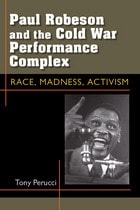
Paul Robeson and the Cold War Performance Complex
Race, Madness, ActivismTony Perucci
University of Michigan Press, 2012
Actor and singer Paul Robeson's performances in Othello, Show Boat, and The Emperor Jones made him famous, but his midcentury appearances in support of causes ranging from labor and civil rights to antilynching and American warmongering made him notorious. When Robeson announced at the 1949 Paris Peace Conference that it was "unthinkable" for blacks to go to war against the Soviet Union, the mainstream American press declared him insane.
Notions of Communism, blackness, and insanity were interchangeably deployed during the Cold War to discount activism such as Robeson's, just a part of an array of social and cultural practices that author Tony Perucci calls the Cold War performance complex. Focusing on two key Robeson performances---the concerts in Peekskill, New York, in 1949 and his appearance before the House Committee on Un-American Activities in 1956---Perucci demonstrates how these performances and the government's response to them are central to understanding the history of Cold War culture in the United States. His book provides a transformative new perspective on how the struggle over the politics of performance in the 1950s was also a domestic struggle over freedom and equality. The book closely examines both of these performance events as well as artifacts from Cold War culture---including congressional documents, FBI files, foreign policy papers, the popular literature on mental illness, and government propaganda films---to study the operation of power and activism in American Cold War culture.
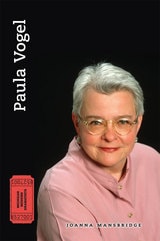
Paula Vogel
Joanna Mansbridge
University of Michigan Press, 2014
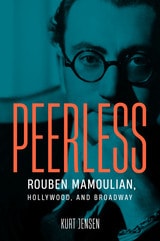
Peerless
Rouben Mamoulian, Hollywood, and BroadwayKurt Jensen
University of Wisconsin Press, 2024
Kurt Jensen’s magisterial volume, extensively researched and filled with trenchant observations, brings to life this charming, flawed, and fascinating man—and demonstrates how the wellspring of his art contained the seeds of his own destruction. Drawing upon Mamoulian’s unfinished memoir and voluminous diaries, as well as interviews with the director’s surviving collaborators, Jensen delivers fresh and informative insider stories from seminal productions. Meanwhile, he explores Mamoulian’s aesthetic principles and strategies as manifested in lighting, choreography, and sound design. A tour de force, Peerless offers readers a multifaceted, in-depth look at an idiosyncratic genius.

Penumbra
The Premier Stage for African American DramaMacelle Mahala
University of Minnesota Press, 2013
Penumbra Theatre Company was founded in 1976 by Lou Bellamy as a venue for African American voices within the Twin Cities theatre scene and has stood for more than thirty-five years at the intersection of art, culture, politics, and local community engagement. It has helped launch the careers of many internationally respected theatre artists and has been repeatedly recognized for its artistic excellence as the nation’s foremost African American theatre.
Penumbra is the first-ever history of this barrier-breaking institution. Based on extensive interviews with actors, directors, playwrights, producers, funders, and critics, Macelle Mahala’s book offers a multifaceted view of the theatre and its evolution. Penumbra follows the company’s emergence from the influential Black Arts and settlement house movements; the pivotal role Penumbra played in the development of August Wilson’s career and, in turn, how Wilson became an avid supporter and advocate throughout his life; the annual production of Black Nativity as a community-building performance; and the difficult economics of African American theatre production and how Penumbra has faced these challenges for nearly four decades.
Penumbra is a testament to how a theatre can respond to and thrive within changing political and cultural realities while contributing on a national scale to the African American presence on the American stage. It is a celebration of theatre as a means of social and cultural involvement—both local and national—and ultimately, of Penumbra’s continuing legacy of theatre that is vibrant, diverse, and vital.
Performance
Diana Taylor
Duke University Press, 2016
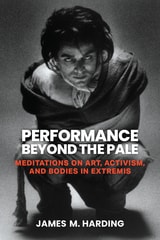
Performance Beyond the Pale
Meditations on Art, Activism, and Bodies in ExtremisJames M. Harding
University of Michigan Press, 2026
The metaphor “beyond the pale” refers to something that’s unacceptable and, as James M. Harding argues in this book, “almost always refers to something—an activity, an action, or an act—that is performed.” In this book, Harding recalls that historically the pale marked contested political boundaries and that what lay beyond the pale was considered to be a dangerous frontier. Siding with seemingly excessive and unreasonable acts and with the artists and activists who produce them, Harding brings together a series of ideas and performances that operate beyond the pale and asks readers to examine them on their own terms.
Drawing on political science, critical theory, and philosophy, Harding investigates instances of self-immolation, life-threatening journeys across deserts and seas, radical political hoaxes, extreme speech acts, and anti-police activism. The book’s five chapters consist of a series of meditations, each with an easily identifiable scholarly logic and clear argument, though the connections between the meditations are left up to the reader. Together these meditations urge readers to understand that “beyond the pale” acts are frequently the product of a sense of urgency that preempts the dictates of accepted reason, conventional logic, and safety.
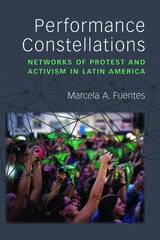
Performance Constellations
Networks of Protest and Activism in Latin AmericaMarcela A. Fuentes
University of Michigan Press, 2019
Performance and Media
Taxonomies for a Changing FieldSarah Bay-Cheng, Jennifer Parker-Starbuck, and David Saltz
University of Michigan Press, 2015
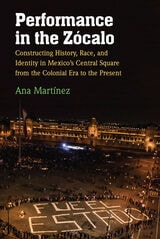
Performance in the Zócalo
Constructing History, Race, and Identity in Mexico's Central Square from the Colonial Era to the PresentAna Martínez
University of Michigan Press, 2020
A saying in Mexico City is “quien domina el centro, domina el país” (whoever dominates the center, dominates the country) as the Zócalo continues to act as the performative embodiment of Mexican society. This book highlights how particular performances build upon each other by recycling past architectures and performative practices for new purposes. Ana Martínez discusses the singular role of collective memory in creating meaning through space and landmarks, providing a new perspective and further insight into the problem of Mexico’s relationship with its own past. Rather than merely describe the commemorations, she traces the relationship between space and the invention of a Mexican imaginary. She also explores how indigenous communities, Mexico’s alienated subalterns, performed as exploited objects, exotic characters, and subjects with agency. The book’s dual purposes are to examine the Zócalo as Mexico’s central site of performance and to unmask, without homogenizing, the official discourse regarding Mexico’s natives. This book will be of interest for students and scholars in theater studies, Mexican Studies, Cultural Geography, Latinx and Latin American Studies.
Performance, Transparency, and the Cultures of Surveillance
James M. Harding
University of Michigan Press, 2018

Performing #MeToo
How Not to Look AwayEdited by Judith Rudakoff
Intellect Books, 2021
In October 2017, a wave of sexual assault allegations against Hollywood producer Harvey Weinstein prompted an outpouring of similar stories on Twitter and beyond, all bound by the same hashtag: #MeToo. The phrase, initially coined by activist Tarana Burke in 2006, reverberated across the internet and invigorated a movement. The essays in this volume engage with many of the performative interpretations of and responses to the #MeToo movement and invite reflection, discussion, and action.
Written by an international group of scholars and artists, the essays bring a global perspective to discussions on topics at the intersection of the #MeToo movement and the performing arts, including celebrity feminism, the practice of protest as a coping mechanism, misogynistic speech, the politics of performance, rehearsing and performing intimacy, and more. Contributors highlight works they have performed, witnessed, or studied, offering analysis and nuance while creating an archive of a powerful cultural moment.
Performing Brazil
Essays on Culture, Identity, and the Performing ArtsEdited by Severino J. Albuquerque and Kathryn Bishop-Sanchez
University of Wisconsin Press, 2015
The contributors to the volume are Maria José Somerlate Barbosa, Eric A. Galm, Annie McNeill Gibson, Ana Paula Höfling, Benjamin Legg, Bryan McCann, Simone Osthoff, Fernando de Sousa Rocha, Cristina F. Rosa, Alessandra Santos, and Lidia Santos.
Performing Citizenship in Postdictatorship Chile
Cultural Policy and the Making of Political DramaturgiesJennifer Joan Thompson
Northwestern University Press, 2025
Offering a nuanced understanding of the performing arts’ relationship to politics
Through careful readings of key political performances in Chile's transition from military dictatorship to neoliberal democracy, Jennifer Joan Thompson examines how the production and aesthetics of theater are intertwined in processes of democratization, enactments of citizenship, and the development of cultural policy. Performing Citizenship in Postdictatorship Chile: Cultural Policy and the Making of Political Dramaturgies reveals how artists performed changing models of democratic citizenship. Thompson traces the ways artists confronted and resisted the military dictatorship of Augusto Pinochet, how they then reimagined the body politic during the early transitional period and challenged official constructions of history and memory as the transition to democracy progressed, how they critiqued Chile’s neoliberal economic model and its violence, and, finally, how they have made claims for feminist and Indigenous citizen subjectivities throughout Chile’s current social crisis. Incorporating archival and ethnographic research alongside readings of theatrical and political performances, this study offers a nuanced understanding of the performing arts’ relationship to politics, one that accounts for the ways artists and the state collaborate in the production of the political imagination.
Performing Democracy
International Perspectives on Urban Community-Based PerformanceSusan C. Haedicke and Tobin Nellhaus, Editors
University of Michigan Press, 2001
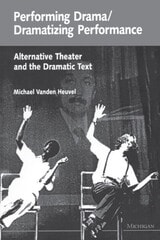
Performing Drama/Dramatizing Performance
Alternative Theater and the Dramatic TextMichael Vanden Heuvel
University of Michigan Press, 1993

Performing Flight
From the Barnstormers to Space TourismScott Magelssen
University of Michigan Press, 2020
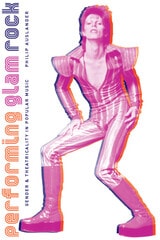
Performing Glam Rock
Gender and Theatricality in Popular MusicPhilip Auslander
University of Michigan Press, 2006
Yet glam was as much about substance as style, and Performing Glam Rock delves into the many ways glam paved the way for new explorations of identity in terms of gender, sexuality, and performance. Philip Auslander positions glam historically and examines it as a set of performance strategies, exploring the ways in which glam rock-while celebrating the showmanship of 1950s rock and roll-began to undermine rock's adherence to the ideology of authenticity in the late 1960s.
In this important study of a too-often-overlooked phenomenon, Auslander takes a fresh look at the genius of the glam movement and introduces glam to a new generation of performance enthusiasts and scholars alike.
Philip Auslander is Professor in the School of Literature, Communication, and Culture at the Georgia Institute of Technology and author of numerous books, including Liveness: Performance in a Mediatized Culture and Presence and Resistance: Postmodernism and Cultural Politics in Contemporary American Performance. He is editor of the major reference work Performance: Critical Concepts and coeditor, with Carrie Sandahl, of Bodies in Commotion: Disability and Performance.
Performing History
Theatrical Representations of the Past in Conetmporary TheatreFreddie Rokem
University of Iowa Press, 2000
Performing Identities on the Restoration Stage
Cynthia Lowenthal
Southern Illinois University Press, 2002
In Performing Identities on the Restoration Stage, Cynthia Lowenthal explores identity—especially masculinity and femininity, English and “foreign,” middle-class and aristocratic—as it is enacted, idealized, deployed, and redefined on the late-seventeenth-century British stage. Particular emphasis is placed on the ways the theatre contributed to new and often shifting early modern definitions of the boundaries of nation, status, and gender.
The first portion of the book focuses on the playwrights’ presentations of idealized men and the comic ridicule of male bodies and behaviors that fall short of the ideal. Of special interest are those moments when playwrights use stereotypes of national character, particularly the Spaniards and Turks, as examples of the worst in male behavior, judgments that are always inflected with elements of class or status inconsistency.
The second portion of Lowenthal’s discussion focuses on playwrights’ attempts to redefine the idealized woman. Lowenthal investigates the ways that an extratheatrical discourse surrounding the actresses, one that essentialized them as sexual bodies demanding scrutiny and requiring containment, also serves to secure for them an equally essential aristocratic status. Anchored by Manley’s Royal Mischief, Lowenthal’s reading reveals that even a woman playwright’s attempts to represent female subjectivity or interiority at odds with the surfaces of the body are doomed to return to those same surfaces.
By focusing on a new, early modern lability of identity and by reading less canonical women playwrights, such as Manley and Pix, alongside established male playwrights such as Dryden and Wycherley, Performing Identities on the Restoration Stage yields both a more accurate and a more compelling picture of the cultural dynamics at work on the early modern stage.
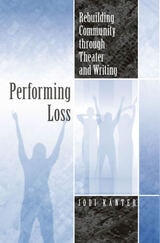
Performing Loss
Rebuilding Community through Theater and WritingJodi Kanter
Southern Illinois University Press, 2007
In Performing Loss: Rebuilding Community through Theater and Writing, author Jodi Kanter explores opportunities for creativity and growth within our collective responses to grief. Performing Loss provides teachers, students, and others interested in performance with strategies for reading, writing, and performing loss as communities—in the classroom, the theater, and the wider public sphere.
From an adaptation of Jose Saramago’s novel Blindness to a reading of Suzan-Lori Parks’s The America Play, from Kanter’s own experience creating theater with terminally ill patients and federal prisoners to a visual artist’s response to September 11th, Kanter shows in practical, replicable detail how performing loss with community members can transform experiences of isolation and paralysis into experiences of solidarity and action.
Drawing on academic work in performance, cultural studies, literature, sociology, and anthropology, Kanter considers a range of responses to grief in historical context and goes on to imagine newer, more collaborative, and more civically engaged responses. Performing Loss describes Kanter’s pedagogical and artistic processes in lively and vivid detail, enabling the reader to use her projects as models or to adapt the techniques to new communities, venues, and purposes. Kanter demonstrates through each example the ways in which writing and performing can create new possibilities for mourning and living together.
Performing Maternities
Political, Social and Feminist EnquiryEdited by Kate Aughterson and Jess Moriarty
Intellect Books, 2027
This volume brings together research and artistic practices that challenge dominant narratives around motherhood.
Performing Maternities is a collection of essays, creative work, images, and scripts that emerged out of an online international symposium held at Brighton University in November 2020. Together, the contributors challenge, celebrate, and share the normative, the queer, the transgressive, the joy, and the pain of performing maternity. The book asks key questions about the construction of maternal identities and mythologies in the contemporary world; the ways these affect individuals in different social, economic, and sexual identities; and how—as mothers, writers, artists, parents, and grandparents—we can address and challenge those identities.
Performing Palimpsest Bodies
Postmemory Theatre Experiments in MexicoRuth Hellier-Tinoco
Intellect Books, 2019
Focusing on four projects from one of Mexico’s most significant contemporary theatre companies, La Máquina de Teatro, directed by renowned artists Juliana Faesler and Clarissa Malheiros, this study documents the rigorous performances of layered, plural, and trans identities as collaborative, feminist, and queer re-visions of official histories and collective memories, using ideas of scenarios, archives, and remains. Illustrated with over 100 color photos, Performing Palimpsest Bodies will appeal to artists and scholars interested in contemporary theatre and performance studies, critical dance studies, and collective creation.
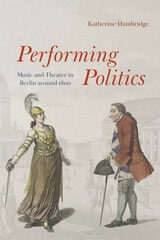
Performing Politics
Music and Theater in Berlin Around 1800Katherine Hambridge
University of Chicago Press, 2027
A new account of the emergence of modern cultural politics through a study of music and theater in Berlin around 1800.
Berlin around 1800 has been seen—at the time and since—as somewhat behind other major European cities in terms of its musical culture, peripheral to the momentous developments attributed to the period. By contrast, early nineteenth-century Berlin has been exhaustively studied as the site of a nascent German-national movement and the Prussian Reforms. In Performing Politics, Katherine Hambridge examines the confluence of music and politics in Berlin around 1800, engaging directly with the themes of being behind/ahead, central/peripheral, in order to tell new stories about nineteenth-century German history, musical and otherwise.
Performing Politics emphasizes events as much as repertoires, and non-canonical repertoires over the more familiar music of this period: dynastic birthday celebrations, the music of historical dramas, political song and communal singing, popular music theater. By focusing our attention on the unfamiliar specificity of Berlin Nationaltheater, Hambridge reenergizes our understanding of 1800–1815 as a key period in the development of musical and political modernity. Using sources largely unexploited by musicologists, and phenomena neglected by historians, she reveals the quotidian aesthetics, values, and practices that shaped both the sociopolitical narratives and musical developments of the time. Performing Politics is thus not only a history of music and theater in Berlin at a critical moment, but a music history of modern cultural politics.
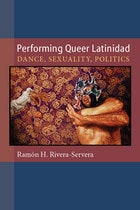
Performing Queer Latinidad
Dance, Sexuality, PoliticsRamón H. Rivera-Servera
University of Michigan Press, 2012
Performing Queer Latinidad highlights the critical role that performance played in the development of Latina/o queer public culture in the United States during the 1990s and early 2000s, a period when the size and influence of the Latina/o population was increasing alongside a growing scrutiny of the public spaces where latinidad could circulate. Performances---from concert dance and street protest to the choreographic strategies deployed by dancers at nightclubs---served as critical meeting points and practices through which LGBT and other nonnormative sex practitioners of Latin American descent (individuals with greatly differing cultures, histories of migration or annexation to the United States, and contemporary living conditions) encountered each other and forged social, cultural, and political bonds. At a time when latinidad ascended to the national public sphere in mainstream commercial and political venues and Latina/o public space was increasingly threatened by the redevelopment of urban centers and a revived anti-immigrant campaign, queer Latinas/os in places such as the Bronx, San Antonio, Austin, Phoenix, and Rochester, NY, returned to performance to claim spaces and ways of being that allowed their queerness and latinidad to coexist. These social events of performance and their attendant aesthetic communication strategies served as critical sites and tactics for creating and sustaining queer latinidad.

Performing Refuge and Risk
Precarious Theatre in East Central EuropeRachel Merrill Moss
University of Iowa Press, 2027
Performing Spanishness
History, Cultural Identity & Censorship in the Theatre of José María Rodríguez MéndezMichael Thompson
Intellect Books, 1995
José María Rodríguez Méndez is a noted playwright, an acerbic cultural critic, and a political dissident under Franco. In Performing Spanishness, the first English-language examination of Méndez’s life and work, Michael Thompson sets the playwright’s lifelong struggle against censorship in the context of Spain’s shifting national identity. Méndez’s work presents “Spanishness” not as a static trait, but as an ongoing performance; Performing Spanishness is an indispensable resource to those interested in theater, Spain, and the relationship between art and activism.
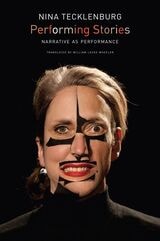
Performing Stories
Narrative as PerformanceNina Tecklenburg
Seagull Books, 2020
Nina Tecklenburg’s focus lies on narration less as literary composition than as sensate, embodied cultural practice—a participatory and open process that fosters social relationships. She gives central importance to the forces of narration that create and undo culture and politics. A foundational new book, Performing Stories presents a groundbreaking transdisciplinary perspective through new approaches that are stimulating to performance studies, narrative and cultural theory, literary criticism, and game and video studies.
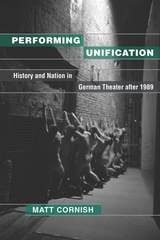
Performing Unification
History and Nation in German Theater after 1989Matt Cornish
University of Michigan Press, 2017
Performing Violence
Literary and Theatrical Experiments of New Russian DramaBirgit Beumers and Mark Lipovetsky
Intellect Books, 2009
The so-called “New Russian Drama” emerged at the end of the twentieth century, following a long period of decline in dramatic writing in the late Soviet and post-Soviet era. In Performing Violence, Birgit Beumers and Mark Lipovetsky examine the representation of violence in these new dramatic works by young Russian playwrights. Reflecting the disappointment in Yeltsin’s democratic reforms and Putin’s neoconservative politics, the plays focus on political and social representations of violence, its performances, and its justifications.
As the first English-language study of Russian drama and theatre in the twenty-first century, Performing Violence seeks a vantage point for the analysis of brutality in post-Soviet culture. While previous generations had preferred poetry and prose, this new breed of authors—the Presnyakov brothers, Evgeni Grishkovets, and Vasili Sigarev among them—have garnered international recognition for their fierce plays. This book investigates the violent portrayal of the identity crisis of a generation as represented in their theatrical works, and will be a key text for students and scholars of drama, Russian studies, and literature.
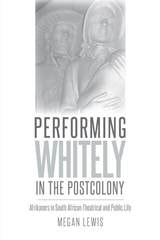
Performing Whitely in the Postcolony
Afrikaners in South African Theatrical and Public LifeMegan Lewis
University of Iowa Press, 2016
Performing Whitely examines the multiple speech acts, political acts, and theatrical acts of the Afrikaner volk or nation in theatrical and public life, including pageants, museum sites, film, and popular music as well as theatrical productions. Lewis explores the diverse ways in which Afrikaners perform whitely, and the tactics they use, including nostalgia, melodrama, queering, abjection, and kitsch. She first investigates the way that apartheid’s architects leveraged whiteness in support of their nation-building efforts in the early twentieth century. In addition to re-enacting national pilgrimages of colonial-era migrations and building massive monuments at home, Afrikaner nationalists took their show to the United States, staging critical events of the Boer War at the 1904 St. Louis Exposition. A case study of the South African experience, Performing Whitely also offers parables for global whitenesses in the postcolonial era.
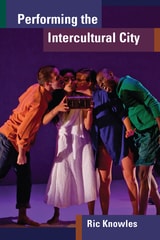
Performing the Intercultural City
Ric Knowles
University of Michigan Press, 2017
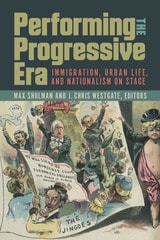
Performing the Progressive Era
Immigration, Urban Life, and Nationalism on StageMax Shulman and J. Chris Westgate
University of Iowa Press, 2019
Performing with the Dead
Trances and TracesChristopher "Kit" Danowski
Intellect Books, 2024
In this book, Kit Danowski constructs a methodology called kanga (from the Bantu for tying and untying), using three methods based on aspects of the Afrolatinx ritual and modified for performance contexts: spell, charm, and trance. This methodology enacts and complicates distinctions between performance and ritual, serving as a contribution to respectful and responsible intercultural performance practices. The methodology is bricoleur, drawing from ethnography, psychoanalytic theory, and phenomenology. Kanga in practice leads to a state of consciousness that Danowski calls hauntological. This borrows from Derrida but is redefined to refer to the study of haunted states of consciousness, where reality is coconstituted by the living and the dead and ancestral spirits are invoked to do the work once reserved for characters.
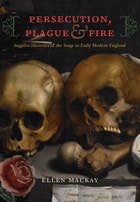
Persecution, Plague, and Fire
Fugitive Histories of the Stage in Early Modern EnglandEllen MacKay
University of Chicago Press, 2011
The theater of early modern England was a disastrous affair. The scant record of its performance demonstrates as much, for what we tend to remember today of the Shakespearean stage and its history are landmark moments of dissolution: the burning down of the Globe, the forced closure of playhouses during outbreaks of the plague, and the abolition of the theater by its Cromwellian opponents.
Persecution, Plague, and Fire is a study of these catastrophes and the theory of performance they convey. Ellen MacKay argues that the various disasters that afflicted the English theater during its golden age were no accident but the promised end of a practice built on disappearance and erasure—a kind of fatal performance that left nothing behind but its self-effacing poetics. Bringing together dramatic theory, performance studies, and theatrical, religious, and cultural history, MacKay reveals the period’s radical take on the history and the future of the stage to show just how critical the relation was between early modern English theater and its public.
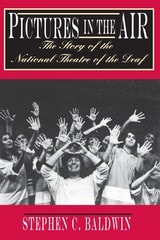
Pictures in the Air
The Story of the National Theatre of the DeafStephen C. Baldwin
Gallaudet University Press, 1994
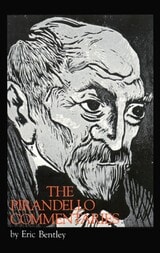
Pirandello Commentaries
Eric Bentley
Northwestern University Press, 1986
"Everybody" is still caught in the mazes of Pirandellism. But since the 1940s Eric Bentley has threaded his way through those mazes. The Pirandello Commentaries is the result.
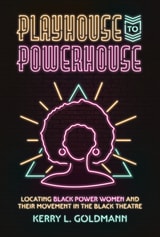
Playhouse to Powerhouse
Locating Black Power Women and their Movement in the Black TheatreKerry Goldmann
University of Arkansas Press, 2025
In Playhouse to Powerhouse, Kerry L. Goldmann explores the Black theatre movement through the lens of three significant women-led theatres that are still in operation today: Nora Vaughn’s Black Repertory Group in Berkeley, Barbara Ann Teer’s National Black Theatre in Harlem, and George Hawkins and Eileen Morris’s Ensemble Theatre in Houston. Goldmann concludes with a discussion of the current moment, examining contemporary obstacles such as gentrification, the co-opting of Black theatres, and the impact of COVID-19.
This remarkable work sheds light on the foundational role that Vaughn, Teer, and Morris played in the Black cultural revolution of the mid- to late twentieth century, securing theatre houses that thrived in multiple capacities as sites for revolution organizing, revenue generation for communal uplift, and unapologetic Black cultural representation.
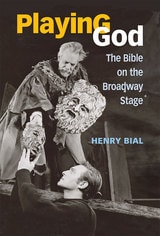
Playing God
The Bible on the Broadway StageHenry Bial
University of Michigan Press, 2015
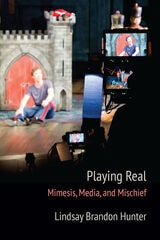
Playing Real
Mimesis, Media, and MischiefLindsay Brandon Hunter
Northwestern University Press, 2021
Playing Real: Mimesis, Media, and Mischief explores the integration and interaction of mimetic theatricality and representational media in twentieth- and twenty‑first-century performance. It brings together carefully chosen sites of performance—including live broadcasts of theatrical productions, reality television, and alternate-reality gaming—in which mediatization and mimesis compete and collude to represent the real to audiences. Lindsay Brandon Hunter reads such performances as forcing confrontation between notions of authenticity, sincerity, and spontaneity and their various others: the fake, the feigned, the staged, or the rehearsed.
Each site examined in Playing Real purports to show audiences something real—real theater, real housewives, real alternative scenarios—which is simultaneously visible as overtly constructed, adulterated by artifice and artificiality. The integration of mediatization and theatricality in these performances, Hunter argues, exploits the proclivities of both to conjure the real even as they risk corrupting the perception of authenticity by imbricating it with artifice and overt manipulation.
Although the performances analyzed obscure boundaries separating actual from virtual, genuine from artificial, and truth from fiction, Hunter rejects the notion that these productions imperil the “real.” She insists on uncertainty as a fertile site for productive and pleasurable mischief—including relationships to realness and authenticity among both audience and participants.
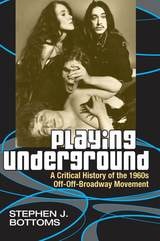
Playing Underground
A Critical History of the 1960s Off-Off-Broadway MovementStephen J. Bottoms
University of Michigan Press, 2004
-William Coco
"At last---a book documenting the beginnings of Off-Off Broadway theater. Playing Underground is an insightful, illuminating, and honest appraisal of this important period in American theater."
-Rosalyn Drexler, author of Art Does (Not!) Exist and Occupational Hazard
"An epic movie of an epic movement, Playing Underground is a book the world has waited for without knowing it. How precisely it captures the evolution of our revolution! I am amazed by the book's scope and scale, and I bless its author especially for giving two greats, Paul Foster and H. M. Koutoukas, their proper, polar places, and for memorializing such unjustly forgotten masterpieces as Irene Fornes's Molly's Dream and Jeff Weiss's A Funny Walk Home. Stephen Bottoms's vivid evocation of the grand adventure of Off-Off Broadway has woken and broken my heart. It is difficult to believe that he was not there alongside me to breathe the caffeine-nicotine-alkaloid-steeped air."
-Robert Patrick, author of Kennedy's Children and Temple Slave
Few books address the legendary age of 1960s off-off Broadway theater. Fortunately, Stephen Bottoms fills that gap with Playing Underground---the first comprehensive history of the roots of off-off Broadway.
This is a theater whose legacy is still felt today: it was the launching pad for many leading contemporary theater artists, including Sam Shepard, Maria Irene Fornes, and others, and it was a pivotal influence on improv comedy and shows like Saturday Night Live.
Off-off Broadway groups such as the Living Theatre, La Mama, and Caffe Cino captured the spirit of nontraditional theater with their edgy, unscripted, boundary-crossing subjects. Yet, as Bottoms discovers, there is no one set of truths about off-off Broadway to uncover; the entire scene was always more a matter of competing perceptions than a singular, concrete reality.
No other author has managed to illuminate this shifting tableau as Bottoms does. Through interviews with dozens of the era's leading playwrights, performers, directors, and critics, he unearths a countercultural theater movement that was both influential and transforming-yet ephemeral and quintessentially of its moment.
Playing Underground will be a definitive work on the subject, offering a complete picture of an important but little-studied period in American theater.
Plays, Movies, and Critics
Jody McAuliffe, ed.
Duke University Press, 1993
DeLillo's interview play is accompanied in this collection by interviews with theater director Roberta Levitow, Martin Scorsese, and film/theater critic Stanley Kauffmann. Other contributions include a critical look at the current American theater scene, analyses of the place of politics in the careers of G. B. Shaw and Luigi Pirandello, a compelling reading of Chekhov's "The Seagull", a detailed inquiry into the obsessions that energize the works of Sam Shepard, provocative reinterpretations of the films Mean Streets and The Sheltering Sky, and a translation of André Bazin's important piece on theology and film.
Contributors. André Bazin, Robert Brustein, Bert Cardullo, Anthony DeCurtis, Don DeLillo, Jesse Ward Engdhal, Richard Gilman, Jim Hosney, Mame Hunt, Jonathan Kalb, Stanley Kauffmann, Jody McAuliffe, Mary Ann Frese Witt, Jacquelyn Wollman, David Wyatt
Point Blank
'Nothing to Declare', 'Operation Wonderland', and 'Roses and Morphine'Edited by Liz Tomlin
Intellect Books, 2007
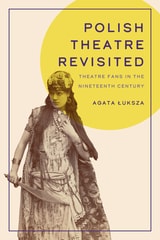
Polish Theatre Revisited
Theatre Fans in the Nineteenth CenturyAgata Luksza
University of Iowa Press, 2023
ASTR Barnard Hewitt Award, Finalist
Polish Theatre Revisited explores nineteenth-century Polish theatre through the lens of theatre audiences. Agata Łuksza places special emphasis on the most engaged spectators, known as “theatremaniacs”—from what they wore, to what they bought, to what they ate. Her source material is elusive ephemera from fans’ lives, such as notes scribbled on a weekly list of shows in the Warsaw theatres, collections of theatre postcards, and recipes for sweets named after famous actors.
The fannish behavior of theatremaniacs was usually deemed excessive or in poor taste by people in positions of power, as it clashed with the ongoing embourgeoisement of the theatre and the disciplining of audiences. Nevertheless, the theatre was one of the key areas where early fan cultures emerged, and theatremaniacs indulged in diverse fan practices in opposition to the forces reforming the theatre and its spectatorship.
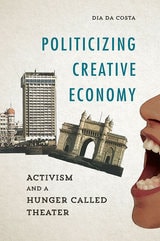
Politicizing Creative Economy
Activism and a Hunger Called TheaterDia Da Costa
University of Illinois Press, 2016
As Da Costa shows, commodification, heritage, and management discussions inevitably creep into performance. Yet the ability of performance to undermine such subtle invasions make activist theater a crucial site for considering what counts as creativity in the cultural politics of creative economy. Da Costa explores the precarious lives, livelihoods, and ideologies at the intersection of heritage projects, planning discourse, and activist performance. By analyzing the creators, performers, and activists involved--individuals at the margins of creative economy as well as society--Da Costa builds a provocative argument. Their creative economy practices may survive, challenge, and even reinforce the economies of death, displacement, and divisiveness used by the urban poor to survive.
Popular Theatre in Political Culture
Britain and Canada in focusEdited by Tim Prentki and Jan Selman
Intellect Books, 1995
Attention is drawn to several key issues including: distinctions between popular and mainstream theatre; the Theatre in Education movement; influence of Theatre for Development from Africa and Asia; popular theatre as an art form, a process of self-empowerment and an instrument of cultural intervention. The book follows an innovative structure, integrating a comparative history of popular theatre with the contributions of current, active popular theatre makers. The co-authors, one British, one Canadian, shape their discourses around these contributions so that the the authentic voices are neither mediated nor distorted. The book is thus designed to appeal both to the theatrical practitioner and to the academic.
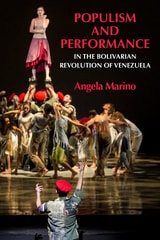
Populism and Performance in the Bolivarian Revolution of Venezuela
Angela Marino
Northwestern University Press, 2018
Based on ethnographic and archival research, Marino focuses on performances of the devil figure, tracing this beloved trickster through religious fiestas, mid-century theater and film, and other media as it both antagonizes and unifies a movement against dictatorship and neoliberalism. She then demonstrates that performance became a vehicle through which cultural producers negotiated boundaries of inclusion and exclusion in ways that overcame the simplistic logic of good versus evil, us versus them. The result is a nuanced insight into the process of building political mobilization out of crisis and through monumental times of change.
The book will interest readers of Latin American politics, cultural studies, political science, and performance studies by providing a vital record of the revolution, with valuable insights into its internal dynamics and lessons towards building a populist movement of the left in contentious times.