60 books match the query 'Way' and 4 start with p
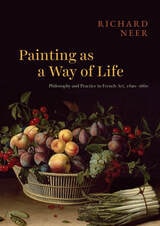
cover of Painting as a Way of Life: Philosophy and Practice in French Art, 1620–1660

Painting as a Way of Life

Philosophy and Practice in French Art, 1620–1660

Richard Neer

University of Chicago Press, 2025

Neer uncovers a key moment in the history of early modern art, when painting was understood to be a tool for self-transformation and for living a philosophical life. 
 
In this wide-ranging study, Richard Neer shows how French painters of the seventeenth century developed radically new ways to connect art, perception, and ethics. Cutting across traditional boundaries of classicism and realism, Neer addresses four case studies: Nicolas Poussin, renowned for marrying ancient philosophy and narrative painting; Louise Moillon, who pioneered French still life in the 1630s; Georges de La Tour, a painter of intense and introspective nocturnes; and the Brothers Le Nain, specialists in genre and portraiture who inspired Courbet, Manet, and other painters of modern life. Setting these artists in dialogue with Montaigne, Descartes, Pascal, and others, ranging from the studios of Rome to the streets of Paris, this book provides fresh accounts of essential artworks—some well-known, others neglected—and new ways to approach the relation of art, theory, and daily life. 
 
[more]
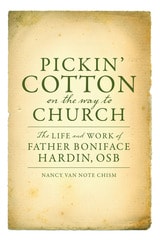
cover of Pickin’ Cotton on the Way to Church: The Life and Work of Father Boniface Hardin, OSB

Pickin’ Cotton on the Way to Church

The Life and Work of Father Boniface Hardin, OSB

Nancy Van Note Chism

Indiana Historical Society Press, 2019
Pickin’ Cotton on the Way to Church highlights the life of Father Boniface Hardin, a Benedictine monk. James Dwight Randolph (Randy) Hardin was born on November 18, 1933, in Bardstown, Kentucky, educated in Catholic schools in Kentucky, and thirteen years old when he asked to become a priest. Excluded from the seminaries in Kentucky because of his race, he enrolled in Saint Meinrad Seminary in Spencer County, Indiana, which had just started accepting black students. After six years of study he took his vows as monk and was given the name Boniface. He was ordained a priest in 1959 and attained a graduate degree in 1963. In 1965 Father Hardin accepted the position of associate pastor at Holy Angels Catholic Church, a predominately black parish in Indianapolis. Father Hardin was a social activist who spoke out against poverty, segregation, police brutality, and fought against the construction of an interstate highway that would adversely affect the black community. Such actions were considered inappropriate for a priest and the Archbishop of Indianapolis removed him from his position at Holy Angels. Although reinstated due to public outcries, Father Hardin soon left Holy Angels, and, along with Sister Jane Shilling, opened the Martin Center, where they could advocate full time for the poor and disenfranchised through a series of programs and services. Realizing the correlation between education and career advancement, Father Boniface and Sister Jane founded Martin University, the only predominately African American institution of higher learning in Indiana. The university continues to play a unique role in the community, with a special focus on educational opportunities to those who have been too often discounted, discouraged, and disregarded by society. Although Father Hardin was widely known in Indiana during his lifetime, accumulating many awards and honors, it is important to document his life and work for posterity. It is hoped that this volume will provide an overview of his story and lay the foundation for other scholarly efforts.
[more]
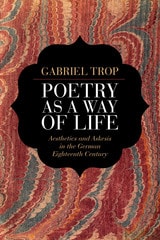
cover of Poetry as a Way of Life: Aesthetics and Askesis in the German Eighteenth Century

Poetry as a Way of Life

Aesthetics and Askesis in the German Eighteenth Century

Gabriel Trop

Northwestern University Press, 2014

What would it mean to make a work of art the focal point of one’s life practice? Poetry as a Way of Life goes back to the origins of aesthetics as a philosophical discipline in the early eighteenth century in order to uncover an understanding of the work of art as an exercise of the self. Engaging in close readings of works by both canonical and less well-known eighteenth-century German poets such as Friedrich Holderlin, Novalis, Friedrich von Hagedorn, and Johann Wilhelm Ludwig Gleim, Gabriel Trop illustrates the ways in which these authors tap into the potential of poetic form to redefine the limits of human perception and generate alternative ways of being in the world.
[more]
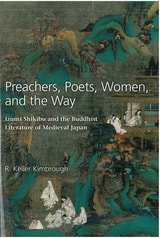
cover of Preachers, Poets, Women, and the Way: Izumi Shikibu and the Buddhist Literature of Medieval Japan

Preachers, Poets, Women, and the Way

Izumi Shikibu and the Buddhist Literature of Medieval Japan

R. Keller Kimbrough

University of Michigan Press, 2008

According to a sixteenth-century Japanese commentary on the Lotus Sutra, the venerable Chinsō Kashō was once preaching on the “ten wickednesses of women” when an angry old nun stepped out from the audience and shouted, “It’s not just women who are so evil—you’ve got plenty of wickedness in you, too!” Women were reviled in much of the popular Buddhist rhetoric of medieval Japan, castigated for their “filthy femininity,” but their low spiritual status was in fact frequently contested. This dispute over the place of women in Buddhism was often played out in the realm of medieval preachers’ and storytellers’ apocryphal tales of the lives, deaths, and inevitable religious awakenings of prominent female literary figures of an earlier age. Inspired by the folklorist Yanagita Kunio’s groundbreaking work of the early 1930s, Preachers, Poets, Women, and the Way explores the ways in which such fictional and usually scandalous stories of the Heian women authors Izumi Shikibu, Ono no Komachi, Murasaki Shikibu, and Sei Shōnagon were employed in the competitive preaching and fund-raising of late-Heian and medieval Japan.
The book draws upon a broad range of medieval textual and pictorial sources to describe the diverse and heretofore little-studied roles of itinerant and temple-based preacher-entertainers in the formation and dissemination of medieval literary culture. By plumbing the medieval roots of Heian women poets’ contemporary fame, Preachers, Poets, Women, and the Way illuminates a forgotten world of doctrinal and institutional rivalry, sectarian struggle, and passionately articulated belief, revealing the processes by which Izumi Shikibu and her peers came to be celebrated as the national cultural icons that they are today.
[more]