Results by title
8812 books match the query 'Political Science' and 592 start with p

Psychology and Society
Radical Theory and PracticeEdited by Ian Parker and Russell Spears
Pluto Press, 1996
Public Administration and the State
A Postmodern PerspectiveMichael W. Spicer
University of Alabama Press, 2005
A critical examination of public administration's pervasive vision of a powerful state
Woodrow Wilson argued for a state led by a powerful government, guided by science and enlightened experts, for the accomplishment of a set of collective purposes—in other words, a purposive state. Michael Spicer contends that though Wilson and those who followed him have not typically explored questions of political and constitutional theory in their writing, a clear and strong vision of the state has emerged in their work nonetheless.
Building upon the work of Dwight Waldo and others who have sought to explore and reveal the political theory behind the seemingly neutral language of administration, Spicer explores the roots—both historical and philosophical—of the purposive state. He considers the administrative experience of 18th-century Prussia and its relationship to the vision of the purposive state, and examines the ways this idea has been expressed in the 20th century. He then looks at the practical problems such a vision creates for public policy in a fragmented postmodern political culture. Finally, Spicer explores an alternative view of public administration—one based on a civil association model appropriate to our constitutional traditions and contemporary culture.
Public Administration's Final Exam
A Pragmatist Restructuring of the Profession and the DisciplineMichael M. Harmon
University of Alabama Press, 2006
A bold rethinking of public administration through the lens of pragmatism, governance, and democratic practice.
Michael Harmon employs the literary conceit of a Final Exam, first “written” in the early 1930s, in a critique of the field’s answers to the legitimacy question. Because the assumptions that underwrite the question preclude the possibility of a coherent answer, the exam should be canceled and its question rewritten. Envisaging a public administration no longer hostage to the legitimacy question, Harmon explains how the study and practice of public administration might proceed from adolescence to maturity.
Drawing chiefly from pragmatist philosophy, he argues that despite the universal rejection of the “politics/administration” dichotomy on factual grounds, the pseudo-problem of legitimacy nonetheless persists in the guise of four related conceptual dualisms: 1) values and facts, 2) thinking and doing, 3) ends and means, and 4) theory and practice. Collectively, these dualisms demand an impossible answer to the practical question of how we might live, and govern, together in a world of radical uncertainty and interdependence. Only by dissolving them can the legitimacy question (Woodrow Wilson’s ghost) finally be banished, clearing away the theoretical debris that obscures a more vital and useful conception of governance.
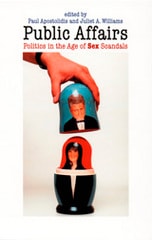
Public Affairs
Politics in the Age of Sex ScandalsPaul Apostolidis and Juliet A. Williams, eds.
Duke University Press, 2004
The essays in Public Affairs reflect on a number of sex scandals while emphasizing the Clinton/Lewinsky affair, certainly the most avidly followed and momentous sex scandal in American political history. Leading scholars situate contemporary public affairs in the context not only of earlier sex scandals in American politics (such as Thomas Jefferson’s and Sally Hemings’s affair), but also of more purely political scandals (including Teapot Dome and Watergate) and sex scandals centered around public figures other than politicians (such as the actor Hugh Grant and the minister Jimmy Swaggart). Some essays consider the Clinton affair in light of feminist and anti-racist politics, while others discuss the dynamics of scandals as major media events. By charting a critical path through the muck of scandal rather than around it, Public Affairs illuminates why sex scandals have become such a prominent feature of American public life.
Contributors. Paul Apostolidis, Jodi Dean, Joshua Gamson, Theodore J. Lowi, Joshua D. Rothman, George Shulman, Anna Marie Smith, Jeremy Varon, Juliet A. Williams

Public Catastrophes, Private Losses
Sarah Tobias
Rutgers University Press, 2025
This essay collection explores how the definition of catastrophe might be expanded to include many forms of large-scale structural violence on communities, species, and ecosystems. Using feminist methodologies, the contributors to Public Catastrophes, Private Losses trace the connections between seemingly unrelated forms of violence such as structural racism, environmental degradation, and public health crises. In contrast to a news media that focuses on mass fatalities and immediate consequences, these essays call our attention to how catastrophes can also involve slow violence with long-term effects.
The authors also consider how these catastrophes are profoundly shaped by government action or inaction, offering a powerful critique of how government neglect has cost lives and demonstrating how vulnerable populations can be better protected. The essays in this collection examine how public catastrophes imprint themselves on lives, as individuals and communities narrate, process, and grapple with legacies of loss. The book is thus a feminist intervention that challenges the binary between public and private, personal and political.
Public Financing in American Elections
Edited by Costas Panagopoulos
Temple University Press, 2011
Reformers argue that public financing of campaigns will help rescue American democracy from the corruptive influence of money in elections. Public Financing in American Elections evaluates this claim and aims to remove much of the guesswork from the discussion about public finance.
Featuring some of the most senior scholars in political science and electoral studies, this book provides an up-to-date treatment of campaign finance research and thinking about public campaign financing reforms. Exploring proposals at the local, state, and federal levels, the contributors provide a comprehensive overview of public financing initiatives in the United States and discuss their impact. Focused analyses of several current public programs are also presented.
Public Interests
Media Advocacy and Struggles over U.S. TelevisionPerlman, Allison
Rutgers University Press, 2016
Nearly as soon as television began to enter American homes in the late 1940s, social activists recognized that it was a powerful tool for shaping the nation’s views. By targeting broadcast regulations and laws, both liberal and conservative activist groups have sought to influence what America sees on the small screen. Public Interests describes the impressive battles that these media activists fought and charts how they tried to change the face of American television.
Public Lands, Public Debates
A Century of ControversyChar Miller, editor
Oregon State University Press, 2012
—Char Miller, from the introduction
Public Management Reform and Innovation
Research, Theory, and ApplicationH. George Frederickson
University of Alabama Press, 1999
A foundational examination of how research, theory, and innovation shape effective public management and democratic governance.
The subject of reform in the public sector is not new; indeed, its latest rubric, reinventing government, has become good politics. Still, as the contributors ask in this volume, is good politics necessarily good government?
Given the growing desire to reinvent government, there are hard questions to be asked: Is the private sector market model suitable and effective when applied to reforming public and governmental organizations? What are the major political forces affecting reform efforts in public management? How is public management reform accomplished in a constitutional democratic government? How do the values of responsiveness, professionalism, and managerial excellence shape current public management reforms? In this volume, editors H. George Frederickson and Jocelyn M. Johnston bring together scholars with a shared interest in empirical research to confront head-on the toughest questions public managers face in their efforts to meet the demands of reform and innovation.
Throughout the book, the authors consider the bureaucratic resistance that results when downsizing and reinvention are undertaken simultaneously, the dilemma public managers face when elected executives set a reform agenda that runs counter to the law, and the mistaken belief that improved management can remedy flawed policy.
Public Modalities
Edited by Daniel C. Brouwer and Robert Asen
University of Alabama Press, 2010
A bold rethinking of public discourse, Public Modalities explores how people shape civic life through protest, media, and identity in an ever-evolving public sphere.
This book explores the ways that scholars, journalists, politicians, and citizens conceive of “the public” or “public life,” and how those entities are defined and invented. For decades, scholars have used the metaphors of spheres, systems, webs, or networks to talk about, describe, and map various practices. This volume proposes a new metaphor—modalities—to suggest that publics are forever in flux, and much more fluid and dynamic than the static models of systems or spheres would indicate—especially in the digital age, where various publics rapidly evolve and dissipate.
Contributors to the volume—employing approaches from the fields of communication studies, English, sociology, psychology, and history—explore a broad range of texts and artifacts that give rise to publics, and discuss what they reveal about conceptualizations of social space. By focusing on process in public engagement, these scholars highlight questions of how people advance their interests and identities, and how they adapt to situational constraints.
Bringing together scholars in rhetorical, cultural, and media studies, this collection of new case studies illustrates a modalities approach to the study of publics. These case studies explore the implications of different ways of forming publics, including alternative means of expression (protests, culture jamming); the intersection of politics and consumerism (how people express their identities and interests through their consumer behavior); and online engagement (blogs as increasingly important public fora). In doing so, they raise important questions of access, community, and political efficacy
Public Office in Early Rome
Ritual Procedure and Political PracticeRoberta Stewart
University of Michigan Press, 2010
---Bryn Mawr Classical Review
Public Opinion and American Foreign Policy
Ole R. Holsti
University of Michigan Press, 1996
Public Opinion and American Foreign Policy, Revised Edition
Ole R. Holsti
University of Michigan Press, 2004
Thoroughly revised edition of an essential text, incorporating a wealth of new material on American foreign policy since 9/11.
The second edition of this concise masterwork includes vast amounts of new material on American foreign policy in the post-9/11 era, including the war in Iraq. Holsti explores the poorly understood role of public opinion in international affairs, looking at Americans' capacity to make informed judgments about issues far removed from their personal experience.
"Impressively comprehensive and current: an excellent revision of a book by the #1 authority on the topic. This new edition will remain at the forefront for consultation and textbook adoption on the topic for years to come."
-Bruce Russett, Yale University
"I thought the first edition was the best single treatment of the subject-so, apparently, did the student who 'borrowed' my copy-and this is a worthy successor. The new edition almost flawlessly accomplishes the goal Holsti sets for himself: an update of his landmark book in light of emerging research and the dramatically changed state of the world that confronts U.S. foreign policy."
-Randy Siverson, University of California, Davis
"For those who are curious about the impact of 9/11 on American public opinion, for serious students of the relationship between foreign policy and public opinion, for anyone who wants to understand contemporary American opinion about the United States' place in the world, and for citizens tired of conventional wisdom about a difficult and important subject, Holsti's study is not only interesting and topical, it is essential."
-Maxine Isaacs, Kennedy School of Government, Harvard University
"In an age of almost weekly polling on foreign policy, Holsti's insights are indispensable. He delivers double tour de force in this new edition, providing his own current and historical research along with a comprehensive synthesis of the existing literature. His analysis of the relationships between public opinion and foreign policy since 9/11 will prove particularly valuable for students and scholars alike."
-Richard Eichenberg, Tufts University
"Holsti combines a vast knowledge of political history and a mastery of the relevant scholarship with up-to-date empirical data to address the question of what role the general public can play in shaping foreign policy. This revised edition is a remarkable achievement."
-Shoon Murray, School of International Service, American University
Public Philosophy and Patriotism
Essays on the Declaration and UsPaul Seaton
St. Augustine's Press, 2024
Paul Seaton’s Public Philosophy and Patriotism: The Declaration and Us is a very countercultural book. It advances the provocative thesis that not only is the Declaration worthy of our study today, but its principles and way of thinking about politics can and should be used to judge us and our politics today. That’s countercultural. While conservatives still have a warm place for the document in their hearts, one rarely hears them apply it to today’s debates. Progressives tend to take two contradictory tacks toward the founding document: on one hand, it’s the negligible product of hypocritical white males, on another, it limns the “ideals” and “values” of the American project that History is charged with fulfilling. Neither of these views takes the document intellectually seriously. Jefferson, however, articulated a different view when he called the Declaration “an expression of the American mind” at the time of the Revolution. Here was a self-conscious, self-confident American mind, ready to take on the world. Taking his cue from Jefferson, Seaton takes the Declaration seriously. He takes it seriously as the expression of a mind that confidently judged despotic designs, but also grasped the principles of free government and free and reasonable politics and looked forward to a country embodying them. Seaton argues that both these dimensions of Declaration political thought are applicable today.
He does so in an interesting way. For a number of years, he penned a Fourth of July essay on “the Declaration and Us” for the Law & Liberty website. On that occasion, he provided an exposition of some theme of the Declaration and applied it to a contemporary debate or issue. Over the years, they added up to a rather full exposition of the document, as well as an ongoing commentary on American political life. With this collection, the essentials of the Declaration’s view of politics are laid bare, and significant threats to freedom-loving Americans are identified. This is the bold claim and aim of this unique book.
At the beginning and end of the collection, Seaton makes a point of dating the completion of the manuscript on April 18th. When the curious reader looks up the date, he finds that it is the date when Paul Revere undertook his famous ride. In this way, the author indicates his judgment of the dire circumstances in which we live today and the patriotic models to which he hearkens. In the form of an explication de texte, this collection is a call to arms against today’s enemies of ordered liberty.
Public Policy and the Income Distribution
Alan J. Auerbach
Russell Sage Foundation, 2006
Public Policy
A Comprehensive IntroductionMartin Potucek
Karolinum Press, 2017
Public Religions in the Modern World
José Casanova
University of Chicago Press, 1994
During the 1980s, religious traditions around the world, from Islamic fundamentalism to Catholic liberation theology, began making their way, often forcefully, out of the private sphere and into public life, causing the "deprivatization" of religion in contemporary life. No longer content merely to administer pastoral care to individual souls, religious institutions are challenging dominant political and social forces, raising questions about the claims of entities such as nations and markets to be "value neutral", and straining the traditional connections of private and public morality.
Casanova looks at five cases from two religious traditions (Catholicism and Protestantism) in four countries (Spain, Poland, Brazil, and the United States). These cases challenge postwar—and indeed post-Enlightenment—assumptions about the role of modernity and secularization in religious movements throughout the world.
This book expands our understanding of the increasingly significant role religion plays in the ongoing construction of the modern world.
Public Scholarship in Communication Studies
Edited by Thomas J Billard and Silvio Waisbord
University of Illinois Press, 2024
Thomas J Billard and Silvio Waisbord curate essays from a wide range of specialties within the study of communication. Aimed at scholars and students alike, the contributors use approaches from critical meditations to case studies to how-to guides as they explore the possibilities of seeing shared knowledge not as a gift to be granted but as an imperative urging readers to address the problems of the world. Throughout the volume, the works show that a pivot to ideas of scholarship as public service is already underway in corners of communication studies across the country.
Visionary and provocative, Public Scholarship in Communication Studies proposes a needed reconsideration of knowledge and a roadmap to its integration with community.
Contributors: Elaine Almeida, Becca Beets, Thomas J Billard, Danielle K. Brown, Aymar Jean Christian, Stacey L. Connaughton, Paula Gardner, Larry Gross, Amy Jordan, Daniel Kreiss, Rachel Kuo, Susan Mancino, Shannon C. McGregor, Philip M. Napoli, Todd P. Newman, Srividya Ramasubramanian, Chad Raphael, Sue Robinson, Silvio Waisbord, Yidong Wang, and Holley Wilkin
Public Sector Payrolls
Edited by David A. Wise
University of Chicago Press, 1987
The volume, developed from a 1984 National Bureau of Economic Research conference, focuses on various labor issues in military and other governmental employment. Several contributors discuss compensation in the armed forces and its relationship to that in the private sector, as well as the interaction between the military and the private sector in the employment of youth. This latter is of particular interest because studies of youth employment have generally ignored the important influence of military hiring practices on labor market conditions. In other contributions, the response of wages and employment in the public sector to economic conditions is analyzed, and a detailed study of government pension plans is presented. Also included is a theoretical and empirical analysis of comparable worth in the public sector from the viewpoint of analytical labor economics. The volume concludes with a look at public school teachers' salaries in the context of current debates over improving the quality of American education.
A valuable resource to policymakers, Public Sector Payrolls will be an important addition to research in the field of labor economics.
Public Space And Democracy
Marcel Henaff
University of Minnesota Press, 2001
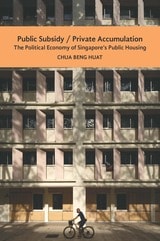
Public Subsidy, Private Accumulation
The Political Economy of Singapore's Public HousingBeng Huat Chua
National University of Singapore Press, 2024
The achievement of Singapore’s national public housing program is impressive by any standard. Within a year of its first election victory in 1959, the People's Action Party began to deliver on its promises. By the 1980s, 85% of the population had been rehoused in modern flats. Now, decades later, the provision of public housing shapes Singapore's environment. The standard accounts of this remarkable transformation leave many questions unanswered, from the historical to urgent matters of current policy. Why was housing such a priority in the 1960s? How did the provision of social welfare via public housing shape Singapore's industrialization and development over the last 50 years? Looking forward, can the HDB continue to be both a source of affordable housing for young families and a mechanism for retirement savings? What will happen when 99-year leases expire?
Public Subsidy, Private Accumulation is a culmination of Chua Beng Huat's study of Singapore's public housing system, its dynamics, and the ways it functions in Singapore's politics. The book will be of interest to citizens and to scholars of the political economy of Asian development, social welfare provision, and Singapore.
Public Workers in Service of America
A ReaderEdited by Frederick W. Gooding Jr. and Eric S. Yellin
University of Illinois Press, 2023
From white-collar executives to mail carriers, public workers meet the needs of the entire nation. Frederick W. Gooding Jr. and Eric S. Yellin edit a collection of new research on this understudied workforce. Part One begins in the late nineteenth- and early twentieth century to explore how questions of race, class, and gender shaped public workers, their workplaces, and their place in American democracy. In Part Two, essayists examine race and gender discrimination while revealing the subtle contemporary forms of marginalization that keep Black men and Black and white women underpaid and overlooked for promotion. The historic labor actions detailed in Part Three illuminate how city employees organized not only for better pay and working conditions but to seek recognition from city officials, the public, and the national labor movement. Part Four focuses on nurses and teachers to address the thorny question of whether certain groups deserve premium pay for their irreplaceable work and sacrifices or if serving the greater good is a reward unto itself.
Contributors: Eileen Boris, Cathleen D. Cahill, Frederick W. Gooding Jr., William P. Jones, Francis Ryan, Jon Shelton, Joseph E. Slater, Katherine Turk, Eric S. Yellin, and Amy Zanoni
Public and Private in Thought and Practice
Perspectives on a Grand DichotomyEdited by Jeff Weintraub and Krishan Kumar
University of Chicago Press, 1997
In contexts ranging from friendship, the family, and personal life to nationalism, democratic citizenship, the role of women in social and political life, and the contrasts between western and (post-)Communist societies, this book brings out the ways the various uses of the public/private distinction are simultaneously distinct and interconnected. Public and Private in Thought and Practice will be of interest to students and scholars in disciplines including politics, law, philosophy, history, sociology, and women's studies.
Contributors include Jeff Weintraub, Allan Silver, Craig Calhoun, Daniela Gobetti, Jean L. Cohen, Jean Bethke Elshtain, Alan Wolfe, Krishan Kumar, David Brain, Karen Hansen, Marc Garcelon, and Oleg Kharkhordin.
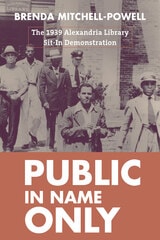
Public in Name Only
The 1939 Alexandria Library Sit-In DemonstrationBrenda Mitchell-Powell
University of Massachusetts Press, 2022
Library History Round Table Reads Selection, March 2024
Alexandria Historical Society Special Merit Award, 2023
When Alexandria, Virginia’s first public library, was constructed just a few blocks from his home, Samuel Wilbert Tucker, a young, Black attorney, was appalled to learn that he could not use the library because of his race. Inspired by the legal successes of the NAACP in discrimination cases, he organized a grassroots protest to desegregate the library that his tax dollars supported.
Public in Name Only tells the important, but largely forgotten, story of Tucker and a group of Black citizens who agitated for change in the terms and conditions of their lives. Employing the combined strategies of direct-action public protest, nonviolent civil disobedience, and municipal litigation, Tucker’s initiative dovetailed with the national priorities and tactics of larger civil rights organizations. While Tucker’s campaign did not end with the desegregation of the Alexandria Library, but instead resulted in the creation of a “separate-and-unequal” Jim Crow Black branch, the sit-in demonstration represents a momentous early struggle for racial equity waged through civil rights activism.
Published Essays, 1929-1933 (CW8)
Eric Voegelin & Edited, Translated, & Intro by Thomas W. Heilke & John von Heyking
University of Missouri Press, 2003
This volume of The Collected Works contains essays published by Eric Voegelin between 1929 and 1933, the period between the publication of his first book, On the Form of the American Mind, and Hitler's rise to power, as well as Voegelin's two books analyzing the explosive race issues posed by National Socialism. The essays herein reflect the intellectual and political tumult of the period and their author's maturing grasp of political reality as he moved away from positivism and Kelsen's "Pure Theory of Law" toward a more refined and open philosophical stance. The heart of this shift is signaled by his emphasis on philosophical anthropology and on the decisive importance of the moral substance basic to political communities.
The topics of the essays are grouped around major themes in sociological theory, political science, and the theory of law. They illuminate the theoretical and practical impact of Voegelin's experiences in America as he increasingly engages European theories of state, especially the social theories of leading French and German scholars. In content, these essays include such pragmatic concerns as American theories of property, economic transactions, due process of law, and Austrian constitutional reforms.
Voegelin also explores the technically complex speculative matters surrounding sovereignty and law, Max Weber's science, and the spiritual form of Europe. He analyzes Kant's understanding of moral duty and the meaning of solidarity as the substance of democratic society. Through these discourses, readers can see how the theme of divine transcendence increasingly finds expression during this crucial early stage of Voegelin's scholarly life. Thus, these studies mark the early path Voegelin took in making his arduous journey from legal scholar to philosophical political scientist. They display his increasingly resolute attention-- against challenges both existential and urgently political--to a growing insight into what it means to be fully human as he struggles toward an eventual philosophy of politics and history sufficient to amplify that noble insight.
Published Essays, 1934-1939 (CW9)
Eric Voegelin, Edited & Intro by Thomas W. Heilke, & Translated by M. J. Hanak
University of Missouri Press, 2001
In this collection of essays, which covers the years from 1934 to1939, we see Eric Voegelin in the role of both scholar and public intellectual in Vienna until he was forced to flee the Nazi terror that descended on Austria in 1938. Revealing the broad spectrum of thinking and scientific study of this relatively young scholar, Voegelin's essays range from Austrian politics, Austrian constitutional history, and European racism to questions of the formation and expression of public opinion, theories of administrative law, and the role of political science in public university education. Several essays serve as useful commentaries on, elaborations of, or synopses of arguments Voegelin made in the five books he had published between 1928 and 1938.
Within these topical headings, there are multiple thematic threads that wind their way through these essays and that remain of interest to contemporary readers. Thirteen of the pieces contained in this collection are short items that Voegelin published in trade journals and newspapers, of which nine appeared in the Wiener Zeitung in 1934 and the Neue Freie Presse in 1937. In these we see two brief periods in which Voegelin played the role of public intellectual not only as a lecturer but also in print.
These essays will be of interest to a wide range of scholars, including constitutional historians, historians of political science, political theorists, and students of Voegelin's later work.
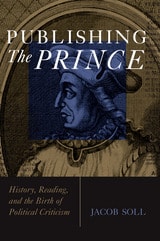
Publishing The Prince
History, Reading, and the Birth of Political CriticismJacob Soll
University of Michigan Press, 2010
As new ideas arose during the Enlightenment, many political thinkers published their own versions of popular early modern "absolutist" texts and transformed them into manuals of political resistance. As a result, these works never achieved a fixed and stable edition. Publishing The Prince illustrates how Abraham-Nicolas Amelot de La Houssaye created the most popular late seventeenth- and eighteenth-century version of Machiavelli's masterpiece. In the process of translating, Amelot also transformed the work, altering its form and meaning, and his ideas spread through later editions.
Revising the orthodox schema of the public sphere in which political authority shifted away from the crown with the rise of bourgeois civil society in the eighteenth century, Soll uses the example of Amelot to show for the first time how the public sphere in fact grew out of the learned and even royal libraries of erudite scholars and the bookshops of subversive, not-so-polite publicists of the republic of letters.
Jacob Soll is Associate Professor of History at Rutgers University.
Cover art courtesy of Annenberg Rare Book Room and Manuscript Library, University of Pennsylvania
Jacket Design: Stephanie Milanowski
"Jacob Soll traces the origins of Enlightenment criticism to the practices of learned humanists and hard-pressed literary entrepreneurs. This learned and lively book is also a tour de force of historical research and interpretation."
---Anthony Grafton, author of Cardano's Cosmos and Bring Out Your Dead
"Brilliant. How the printed page changed political philosophy into investigative reporting, and reason of state into the unmasking of power."
---J. G. A. Pocock, author of The Machiavellian Moment
"Soll's path-breaking study is a 'must read' for all those interested in the history of political thought and early modern intellectual history."
---Barbara Shapiro, University of California Berkeley
"Soll has done [Amelot] and his context justice, writing as he does with a clear, singular, and welcome voice."
---Margaret C. Jacobs, American Historical Review
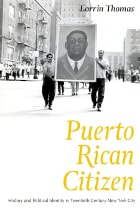
Puerto Rican Citizen
History and Political Identity in Twentieth-Century New York CityLorrin Thomas
University of Chicago Press, 2010
Building its incisive narrative from a wide range of archival sources, interviews, and first-person accounts of Puerto Rican life in New York, this book illuminates the rich history of a group that is still largely invisible to many scholars. At the center of Puerto Rican Citizen are Puerto Ricans’ own formulations about political identity, the responses of activists and ordinary migrants to the failed promises of American citizenship, and their expectations of how the American state should address those failures. Complicating our understanding of the discontents of modern liberalism, of race relations beyond black and white, and of the diverse conceptions of rights and identity in American life, Thomas’s book transforms the way we understand this community’s integral role in shaping our sense of citizenship in twentieth-century America.
Pulled Over
How Police Stops Define Race and CitizenshipCharles R. Epp, Steven Maynard-Moody, and Donald P. Haider-Markel
University of Chicago Press, 2014
Pulled Over deftly traces the strange history of the investigatory police stop, from its discredited beginning as “aggressive patrolling” to its current status as accepted institutional practice. Drawing on the richest study of police stops to date, the authors show that who is stopped and how they are treated convey powerful messages about citizenship and racial disparity in the United States. For African Americans, for instance, the experience of investigatory stops erodes the perceived legitimacy of police stops and of the police generally, leading to decreased trust in the police and less willingness to solicit police assistance or to self-censor in terms of clothing or where they drive. This holds true even when police are courteous and respectful throughout the encounters and follow seemingly colorblind institutional protocols. With a growing push in recent years to use local police in immigration efforts, Hispanics stand poised to share African Americans’ long experience of investigative stops.
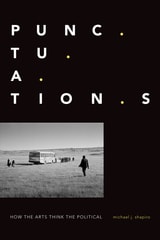
Punctuations
How the Arts Think the PoliticalMichael J. Shapiro
Duke University Press, 2019
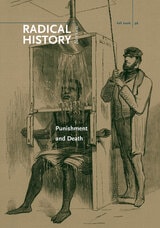
Punishment and Death
The Need for Radical Analysis, Volume 2006Ethan Blue and Patrick Timmons, eds.
Duke University Press, 0
The issue’s contributors—comprising both academics and activists—examine the practices of punishment and death imposed upon citizens, particularly through penal systems. One contributor exposes how the indignation and outrage many Americans expressed toward the military torture at Abu Ghraib do not extend to similar instances of torture (beatings, “shower-baths,” sexual abuse, etc.) against inmates of color within the U.S. prison system. Another contributor reflects on the unexpected but effective alliance between antiprison activists and the environmental justice movement in California, which worked to stop the massive prison-building boom of the late twentieth and early twenty-first centuries. Bringing a longer sweep of Western colonialism into view, another essay reveals the racial prejudices within disciplinary processes of Puerto Rico that lingered even after the island’s emancipation from the Spanish American empire, leading to unequal distribution of punishment on both colonial and domestic subject populations.
Contributors. Ethan Blue, Rose Braz, Helena Cobban, Craig Gilmore, Alan Eladio Gómez, R. J. Lambrose, Heather Jane McCarty, Dylan Rodríguez, Kelvin Santiago-Valles, Carolyn Strange, Patrick Timmons
Punishment and Political Order
Keally McBride
University of Michigan Press, 2007
Most of us think of punishment as an ugly display of power. But punishment also tells us something about the ideals and aspirations of a people and their government. How a state punishes reveals whether or not it is confident in its own legitimacy and sovereignty. Punishment and Political Order examines the questions raised by the state’s exercise of punitive power—from what it is about human psychology that desires sanction and order to how the state can administer pain while calling for justice. Keally McBride's book demonstrates punishment's place at the core of political administration and the stated ideals of the polity.
"From start to finish this is a terrific, engaging book. McBride offers a fascinating perspective on punishment, calling attention to its utility in understanding political regimes and their ideals. She succeeds in reminding us of the centrality of punishment in political theory and, at the same time, in providing a framework for understanding contemporary events. I know of no other book that does as much to make the subject of punishment so compelling."
—Austin Sarat, Amherst College
"Punishment and Political Order will be welcome reading for anyone interested in understanding law in society, punishment and political spectacle, or governing through crime control. This is a clear, accessible, and persuasive examination of punishment—as rhetoric and reality. Arguing that punishment is a complex product of the social contract, this book demonstrates the ways in which understanding the symbolic power and violence of the law provides analytical tools for examining the ideological function of prison labor today, as well as the crosscutting and contingent connections between language and identity, legitimation and violence, sovereignty and agency more generally."
—Bill Lyons, Director, Center for Conflict Management, University of Akron
"Philosophical explorations of punishment have often stopped with a theory of responsibility. McBride's book moves well beyond this. It shows that the problem of punishment is a central issue for any coherent theory of the state, and thus that punishment is at the heart of political theory. This is a stunning achievement."
—Malcolm M. Feeley, University of California at Berkeley
Keally McBride is Assistant Professor of Politics at the University of San Francisco.
Purple Power
The History and Global Impact of SEIUEdited by Luís LM Aguiar and Joseph A. McCartin
University of Illinois Press, 2023
Luís LM Aguiar and Joseph A. McCartin edit essays on one of contemporary labor’s bedrock organizations. The contributors explore key episodes, themes, and features in the union’s recent history and evaluate SEIU as a union with global aspirations and impact. The first section traces the SEIU’s growth in the last and current centuries. The second section offers in-depth studies of key campaigns in the United States, including the Justice for Janitors and Fight for $15 movements. The third section focuses on the SEIU’s work representing low-wage workers in Canada, Australia, Europe, and Brazil. An interview with Justice for Janitors architect Stephen Lerner rounds out the volume.
Contributors: Luís LM Aguiar, Adrienne E. Eaton, Janice Fine, Euan Gibb, Laurence Hamel-Roy, Tashlin Lakhani, Joseph A. McCartin, Yanick Noiseux, Benjamin L. Peterson, Allison Porter, Alyssa May Kuchinski, Maite Tapia, Veronica Terriquez, and Kyoung-Hee Yu
Pursuing Justice in Africa
Competing Imaginaries and Contested PracticesJessica Johnson
Ohio University Press, 2018
Pursuing Justice in Africa focuses on the many actors pursuing many visions of justice across the African continent—their aspirations, divergent practices, and articulations of international and vernacular idioms of justice. The essays selected by editors Jessica Johnson and George Hamandishe Karekwaivanane engage with topics at the cutting edge of contemporary scholarship across a wide range of disciplines. These include activism, land tenure, international legal institutions, and postconflict reconciliation.
Building on recent work in sociolegal studies that foregrounds justice over and above concepts such as human rights and legal pluralism, the contributors grapple with alternative approaches to the concept of justice and its relationships with law, morality, and rights. While the chapters are grounded in local experiences, they also attend to the ways in which national and international actors and processes influence, for better or worse, local experiences and understandings of justice. The result is a timely and original addition to scholarship on a topic of major scholarly and pragmatic interest.
Contributors:
Felicitas Becker, Jonathon L. Earle, Patrick Hoenig, Stacey Hynd, Fred Nyongesa Ikanda, Ngeyi Ruth Kanyongolo, Anna Macdonald, Bernadette Malunga, Alan Msosa, Benson A. Mulemi, Holly Porter, Duncan Scott, Olaf Zenker.
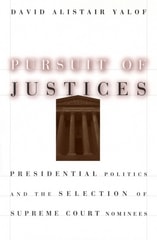
Pursuit of Justices
Presidential Politics and the Selection of Supreme Court NomineesDavid Alistair Yalof
University of Chicago Press, 1999
Yalof draws on the papers of seven modern presidents, from Truman to Reagan, and firsthand interviews with key figures, such as Ramsey Clark, Edwin Meese, and President Gerald Ford. He documents and analyzes the selection criteria these presidents used, the pool of candidates from which they chose, their strategies, and the political pressures affecting their decisions, both successes and failures. Yalof also disputes much conventional wisdom about the selection process, including the widely held view that presidents choose nominees primarily to influence future decisions of the high court. In a substantial epilogue, Yalof offers insightful observations about the selections of Presidents George Bush and Bill Clinton.
By focusing on a neglected area of presidential politics, Yalof offers a fascinating and unprecedented glimpse into the intricate world of executive branch decisionmaking and the Supreme Court appointment process as a whole.
Winner of the 2000 Richard E. Neustadt Award for Best Book on the American Presidency
Push Back, Move Forward
The National Council of Women's Organizations and Coalition AdvocacyLaura R. Woliver
Temple University Press, 2018
The coalition known as the National Council of Women’s Organizations no longer exists today, but the history and the lessons learned from the NCWO’s activism remain as important as ever—perhaps even more so in this age of Trump. Laura Woliver spent fifteen years doing fieldwork and conducting research and interviews to understand how the NCWO coalition group functioned. The result is her impressive study, Push Back, Move Forward.
Woliver explores the foundational work of the NCWO and member groups to promote women’s economic security, citizen status, and political rights. She investigates women’s access to previously “male only” organizations, such as private clubs; the increase in voter participation generated by measures such as early voting; advocacy campaigns for such benefit programs as Social Security and the Affordable Care Act; and global human and women’s rights activism. In addition, she examines the accomplishments of women of color, both alongside and within the NCWO, who orient their politics toward achieving justice and attaining rights.
Push Back, Move Forward artfully documents this important group’s activities while also gleaning larger lessons about coalition organizations.
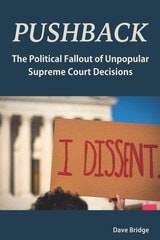
Pushback
The Political Fallout of Unpopular Supreme Court DecisionsDave Bridge
University of Missouri Press, 2024
Certain to appeal to anyone interested in American political science and history, Pushback closes with a detailed examination of the unequivocally countermajoritarian Supreme Court ruling of our lifetimes, Dobbs v. Jackson Women’s Health Organization, which overturned Roe. For the first time in 50 years, conditions are ripe for a party to win votes by campaigning against the will of the Court. Upcoming elections will tell if the Republicans overplayed their hand, or if Democrats will play theirs as skillfully as did the GOP after Roe.
Pushing Back the Gates
Neighborhood Perspectives on University-Driven Revitalization in West PhiladelphiaHarley F Etienne
Temple University Press, 2013
As college and university administrators expand and develop their urban campuses, they have also become developers—and primary drivers—of neighborhood change. But how do institutions contend with urban real estate needs, revitalization opportunities, and community outreach? And how do the residents benefit? Pushing Back the Gates provides a lively discussion of neighborhood-level perspectives of the dynamic changes brought about by institutions' urban planning efforts.
Harley Etienne outlines the rationale for university-driven development and neighborhood revitalization balanced by caution for the limitations of the model. He provides a summary of the University of Pennsylvania's West Philadelphia Initiatives and the challenges and successes of this unique plan. Etienne also examines the implementation of similar efforts at different universities around the country.
Pushing Back the Gates speaks to communities, university leaders, and urban developers who navigate the boundary between neighborhood revitalization through physical development and investments in incumbent populations and human capital.
Putting Children First
How Low-Wage Working Mothers Manage Child CareAjay Chaudry
Russell Sage Foundation, 2004
Putting Faith in Partnerships
Welfare-to-Work in Four CitiesStephen V. Monsma
University of Michigan Press, 2004
In this groundbreaking study of a politically controversial topic---the debut offering in Alan Wolfe's Contemporary Political and Social Issues series---author Stephen Monsma avoids overheated rhetoric in favor of a careful, critical analysis of the hard evidence on whether public-private partnerships really work.
The book is based on in-depth studies of social service programs in Los Angeles, Chicago, Philadelphia, and Dallas. By examining public-private partnerships between government offices and nonprofit organizations, Monsma seeks to understand how these partnerships affect the balance between government's efforts to deal with social problems and the rights of individual citizens to control their own lives.
Putting Faith in Partnerships answers many previously unanswered questions in what may be the most controversial public policy debate today: about the feasibility and wisdom of government agencies forming partnerships with private organizations to provide essential public social services.
Stephen V. Monsma is Professor of Political Science at Pepperdine University. He has served as director of the Office of Quality Review in Michigan's Department of Social Services and is a widely recognized expert on the role of faith-based organizations in social service programs.
Putting Federalism in Its Place
The Territorial Politics of Social Policy RevisitedScott L. Greer, Daniel Béland, André Lecours, and Kenneth A. Dubin
University of Michigan Press, 2023
What does federalism do to welfare states? This question arises in scholarly debates about policy design as well as in discussions about the right political institutions for a country. It has frustrated many, with federalism seeming to matter in all sorts of combinations with all sorts of issues, from nationalism to racism to intergovernmental competition. The diffuse federalism literature has not come to compelling answers for very basic questions.
Scott L. Greer, Daniel Béland, André Lecours, and Kenneth A. Dubin argue for a new approach—one methodologically focused on configurations of variables within cases rather than a fruitless attempt to isolate “the” effect of federalism; and one that is substantively engaged with identifying key elements in configurations as well as with when and how their interactions matter. Born out of their work on a multi-year, eleven-country project (published as Federalism and Social Policy: Patterns of Redistribution in Eleven Countries, University of Michigan Press, 2019), this book comprises a methodological and substantive agenda. Methodologically, the authors shift to studies that embraced and understood the complexity within which federal political institutions operate. Substantively, they make an argument for the importance of plurinationalism, changing economic interests, and institutional legacies.
Putting Inequality in Context
Class, Public Opinion, and Representation in the United StatesChristopher Ellis
University of Michigan Press, 2017
Christopher Ellis argues citizens’—and legislators’—views of class politics are driven by lived experience in particular communities. While some experience is formally political, on an informal basis citizens learn a great deal about their position in the broader socioeconomic spectrum and the social norms governing how class intersects with day-to-day life. These factors are important for policymakers, since most legislators do not represent “the public” at large, but specific constituencies.
Focusing on U.S. congressional districts as the contextual unit of interest, Ellis argues individuals’ political behavior cannot be separated from their environment, and shows how income’s role in political processes is affected by the contexts in which citizens and legislators interact. Political inequality exists in the aggregate, but it does not exist everywhere. It is, rather, a function of specific arrangements that depress the political influence of the poor. Identifying and understanding these factors is a crucial step in thinking about what reforms might be especially helpful in enhancing equality of political voice.