Results by title
22279 books match the query 'Social Science' and 1104 start with p
Posterity Is Now
Practicing Museum Anthropology, Collections Care, and Collaborative Research with Indigenous PeoplesJennifer A. Shannon
University of Wyoming Press, 2025
In this handbook based on over twenty years of teaching and practice at the intersection of museums, anthropology, and Indigenous peoples, Jennifer A. Shannon covers both the theoretical (i.e., exploring the idea of objects as kin) and the pragmatic (i.e., guidelines for how to design and budget collaborative projects). She advocates for fundamental change in how anthropological research design and practice are done within and beyond the museum and how leadership and staff view the very purpose of the museum. She also demonstrates how collaborative museum anthropology can be a model for the fields of anthropology, public scholarship, and social science research more broadly.
Posterity Is Now is a starting point, a “companion to practice,” written in accessible language and equally relevant for use in university classrooms, by qualitative researchers, and by practitioners in museums and cultural centers.
Postfeminist War
Women in the Media-Military-Industrial ComplexMary Douglas Vavrus
Rutgers University Press, 2019

Postgenomics
Perspectives on Biology after the GenomeSarah S. Richardson and Hallam Stevens, editors
Duke University Press, 2015
Contributors. Russ Altman, Rachel A. Ankeny, Catherine Bliss, John Dupré, Michael Fortun, Evelyn Fox Keller, Sabina Leonelli, Adrian Mackenzie, Margot Moinester, Aaron Panofsky, Sarah S. Richardson, Sara Shostak, Hallam Stevens
Posthegemony
Political Theory and Latin AmericaJon Beasley-Murray
University of Minnesota Press, 2010
In his thorough examination, Beasley-Murray undoes the dominant narrative of hegemonic projects and counterhegemonic resistance, of civilization and subalternity, to reveal instead a history of failed contracts and unpredicted insurgencies.
Posthumanism and the Graphic Novel in Latin America
Edward King and Joanna Page
University College London, 2017

Postindian Aesthetics
Affirming Indigenous Literary SovereigntyEdited by Debra K. S. Barker and Connie A. Jacobs
University of Arizona Press, 2022
The works featured are inventive and current, and the writers covered are visionaries who are boldly redefining Indigenous literary aesthetics. The artists covered include Orlando White, LeAnne Howe, Stephen Graham Jones, Deborah Miranda, Heid E. Erdrich, Sherwin Bitsui, and many others.
Postindian Aesthetics is expansive and comprehensive with essays by many of today’s leading Indigenous studies scholars. Organized thematically into four sections, the topics in this book include working-class and labor politics, queer embodiment, national and tribal narratives, and new directions in Indigenous literatures. By urging readers to think beyond the more popularized Indigenous literary canon, the essays in this book open up a new world of possibilities for understanding the contemporary Indigenous experience.
The volume showcases thought-provoking scholarship about literature written by important contemporary Indigenous authors who are inspiring critical acclaim and offers new ways to think about the Indigenous literary canon and encourages instructors to broaden the scope of works taught in literature courses more broadly.
ContributorsEric Gary Anderson
Ellen L. Arnold
Debra K. S. Barker
Laura J. Beard
Esther G. Belin
Jeff Berglund
Sherwin Bitsui
Frank Buffalo Hyde
Jeremy M. Carnes
Gabriel S. Estrada
Stephanie Fitzgerald
Jane Haladay
Connie A. Jacobs
Daniel Heath Justice
Virginia Kennedy
Denise Low
Molly McGlennen
Dean Rader
Kenneth M. Roemer
Susan Scarberry-García
Siobhan Senier
Kirstin L. Squint
Robert Warrior
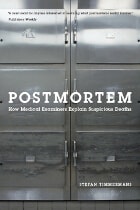
Postmortem
How Medical Examiners Explain Suspicious DeathsStefan Timmermans
University of Chicago Press, 2006
Postmortem goes deep inside the world of medical examiners to uncover the intricate web of pathological, social, legal, and moral issues in which they operate. Stefan Timmermans spent years in a medical examiner’s office, following cases, interviewing examiners, and watching autopsies. While he relates fascinating cases here, he is also more broadly interested in the cultural authority and responsibilities that come with being a medical examiner. Although these professionals attempt to remain objective, medical examiners are nonetheless responsible for evaluating subtle human intentions. Consequently, they may end—or start—criminal investigations, issue public health alerts, and even cause financial gain or harm to survivors. How medical examiners speak to the living on behalf of the dead, is Timmermans’s subject, revealed here in the day-to-day lives of the examiners themselves.
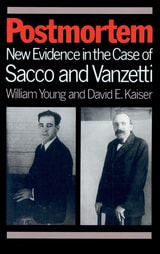
Postmortem
New Evidence in the Case of Sacco and VanzettiWilliam Young
University of Massachusetts Press, 1985
Over six decades after the polemical Sacco and Vanzetti case, in which the two anarchist Italian immigrants were convicted of first-degree murder and executed by the Commonwealth of Massachusetts, Young and Kaiser revisit the case's evidence as well as the key actors who determined its outcome. The authors situate their meticulous reexamination of the court evidence and prosecuting and defense arguments within the long-standing dispute between political leftists and conservatives regarding the integrity of the conviction, edifying the left's accusations of anti-Italianism and anti-anarchism. Their analysis magnifies both the likelihood of contrived evidence and the fallibility of our criminal justice system's impartiality, pointing to important questions concerning the nature of a fair trial and the influence of prejudice and politics in juridical processes. As such, Postmortem functions as a detailed introduction to the infamous 1921 Sacco and Vanzetti trial as well as a meditation on enduring dilemmas of the American judicial branch.
Postnationalism Prefigured
Caribbean BorderlandsCarnegie, Charles V
Rutgers University Press, 2002
Carnegie shows not only that the nation-state is an exhausted form of political organization, but that in the Caribbean the ideological and political reach of the nation-state has always been tenuous at best. Caribbean peoples, he suggests, live continually in breach of the nation-state configuration. Drawing both on his own experiences as a Jamaican-born anthropologist and on the examples provided by those who have always considered national borders as little more than artificial administrative nuisances, Carnegie investigates a fascinating spectrum of individuals, including Marcus Garvey, traders, black albinos, and Caribbean Ba’hais. If these people have not themselves developed a scholarly doctrine of transnationalism, they have, nevertheless, effectively lived its demand and prefigured a postnational life.
Postpolitics and the Aesthetic Imagination
Juan Meneses
University of Minnesota Press, 2025
Igniting political power through the lens of art and the imagination
Postpolitics and the Aesthetic Imagination investigates the erosion of meaningful political action in today’s world. Gathering writings from an array of scholars, editor Juan Meneses asks: can an aesthetic theory of postpolitics help us understand and counteract the most insidious processes of depoliticization?
The contributors to this volume explore how the aesthetic imagination can play a crucial role in reenvisioning key political elements, including governance, agency, rights, and responsibility. With a survey of various artistic mediums—film, dance, music, literature, and digital media—the essays illustrate how the aesthetic can reveal ways to breathe new life into the work of emancipatory politics. Reclaiming the arts and humanities as vital to political life, the contributors revisit but also move beyond the social sciences’ central focus on neoliberalism and public administration to address other topics such as tech-capitalism, race, environmental violence, and patriarchy.
Postpolitics and the Aesthetic Imagination argues for a conscious deployment of aesthetics to resist political anesthesia and promote a more just society, underscoring the role of the imagination in political engagement and change.
Contributors: Jacquelyn Arcy, U of Wisconsin–Parkside; Christopher Breu, Illinois State U; Stephen Charbonneau, Florida Atlantic U; Eric Lemmon, Webster U; Robert P. Marzec, Purdue U; Allison Page, Rutgers U–Camden; Matthew Scully, U of Lausanne; Erik Swyngedouw, U of Manchester; Sherryl Vint, U of California, Riverside.

Potters and Communities of Practice
Glaze Paint and Polychrome Pottery in the American Southwest, AD 1250 to 1700Edited by Linda S. Cordell and Judith A. Habicht-Mauche
University of Arizona Press, 2012
The peoples of the American Southwest during the 13th through the 17th centuries witnessed dramatic changes in settlement size, exchange relationships, ideology, social organization, and migrations that included those of the first European settlers. Concomitant with these world-shaking events, communities of potters began producing new kinds of wares—particularly polychrome and glaze-paint decorated pottery—that entailed new technologies and new materials. The contributors to this volume present results of their collaborative research into the production and distribution of these new wares, including cutting-edge chemical and petrographic analyses. They use the insights gained to reflect on the changing nature of communities of potters as they participated in the dynamic social conditions of their world.
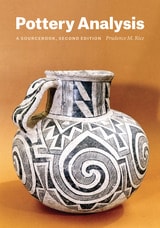
Pottery Analysis, Second Edition
A SourcebookPrudence M. Rice
University of Chicago Press, 2015
This new edition fully incorporates more than two decades of growth and diversification in the fields of archaeological and ethnographic study of pottery. It begins with a summary of the origins and history of pottery in different parts of the world, then examines the raw materials of pottery and their physical and chemical properties. It addresses ethnographic and ethnoarchaeological perspectives on pottery production; reviews the methods of studying pottery’s physical, mechanical, thermal, mineralogical, and chemical properties; and discusses how proper analysis of artifacts can reveal insights into their culture of origin. Intended for use in the classroom, the lab, and out in the field, this essential text offers an unparalleled basis for pottery research.
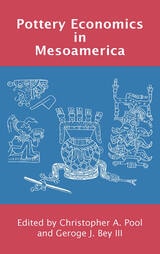
Pottery Economics in Mesoamerica
Edited by Christopher A. Pool and George J. Bey III
University of Arizona Press, 2008
Nine chapters written by some of the most well known and respected scholars in the field offer readers an in-depth look at key advances from the past fifteen years. These scholars examine ethnoarchaeological studies and the Preclassic/Formative, Classic, and Postclassic periods and cover geographic areas from eastern to central Mesoamerica. In a series of case studies, contributors address a range of new and developing theories and methods for inferring the technological, organizational, and social dimensions of pottery economics, and draw on a range of sociopolitical examples. Specific topics include the impacts and costs of innovations, the role of the producer in technological choices, the outcomes when errors in vessel formation are tolerated or rectified, the often undocumented multiple lives and uses of ceramic pieces, and the difficulties associated with locating and documenting ceramic production areas in tropical lowlands.
A compelling collection that clearly integrates and synthesizes a wide array of data, this book is the definitive text on pottery economics in Mesoamerica and an important contribution to the fields of anthropology, archaeology, ancient history, and the economics of pre-industrial societies.
CONTENTS
Acknowledgments
1 . Conceptual Issues in Mesoamerican Pottery Economics
Christopher A. Pool and George J. Bey III
2 . An Ethnoarchaeological Perspective on Local Ceramic Production and Distribution in the Maya Highlands
Michael Deal
3 . Why Was the Potter’s Wheel Rejected? Social Choice and Technological Change in Ticul, Yucatán, Mexico
Dean E. Arnold, Jill Huttar Wilson, and Alvaro L. Nieves
4 . Ceramic Production at La Joya, Veracruz: Early Formative Techno Logics and Error Loads
Philip J. Arnold III
5 . Blanco Levantado: A New World Amphora
George J. Bey III
6 . Pottery Production and Distribution in the Gulf Lowlands of Mesoamerica
Barbara L. Stark
7 . Household Production and the Regional Economy in Ancient Oaxaca: Classic Period Perspectives from Hilltop El Palmillo and Valley-Floor Ejutla
Gary M. Feinman and Linda M. Nicholas
8 . Pottery Production and Exchange in the Petexbatun Polity, Petén, Guatemala
Antonia E. Foias and Ronald L. Bishop
9 . Aztec Otumba, AD 1200--1600: Patterns of the Production, Distribution, and Consumption of Ceramic Products
Thomas H. Charlton, Cynthia L. Otis Charlton, Deborah L. Nichols, and Hector Neff
References Cited
About the Contributors
Index
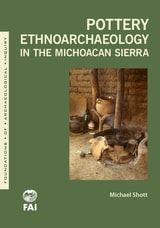
Pottery Ethnoarchaeology in the Michoacán Sierra
Michael J. Shott
University of Utah Press, 2018
Over a five-year period Shott inventoried the household pottery of about twenty-five homes in five towns in Michoacán, Mexico, recording age and types of use. He also looked at a subsample on a monthly basis over two years to estimate the magnitude of early vessel failure that would go unnoticed in an annual census. His analysis of about 900 vessels clearly shows that context does not explain use life, but vessel size does. Bigger pots last longer. Consulting other ethnoarchaeological sources for comparison and cross-cultural perspectives, Shott shows that his results can be applied to other archaeological datasets for determining numbers of original whole vessels as well as site occupation span.
Pottery and Chronology at Angel
Sherri Hilgeman
University of Alabama Press, 2000
By analyzing the pottery found at a well-known archaeological site, Hilgeman constructs the long-awaited timeline for the rise and decline of this ancient society.
Located near present-day Evansville, Indiana, the Angel site is one of the important archaeological towns associated with prehistoric Mississippian society. More than two million artifacts were collected from this site during excavations from 1939 to 1989, but, until now, no systematic survey of the pottery sherds had been conducted. This volume, documenting the first in-depth analysis of Angel site pottery, also provides scholars of Mississippian culture with a chronology of this important site.
Angel is generally thought to have been occupied from before A.D. 1200 to 1450, but scholars have been forced to treat this period as one chronological unit without any sense of the growth and decline of the society that occupied it. Using radiocarbon assays and an analysis of its morphological and stylistic attributes of pottery, Sherri Hilgeman is able to divide the occupation of Angel into a series of recognizable stages. She then correlates those stages with similar ones at other archaeological excavations—especially nearby Kincaid—making it possible to compare Angel society with other native cultures of the lower Ohio Valley. Through this important contribution to native pottery studies, Hilgeman opens a window into the lifeways of prehistoric Angel society and places that society in the larger context of Mississippian culture.
Pottery and People
James Skibo
University of Utah Press, 1998
This volume emphasizes the complex interactions between ceramic containers and people in past and present contexts.
Pottery, once it appears in the archaeological record, is one of the most routinely recovered artifacts. It is made frequently, broken often, and comes in endless varieties according to economic and social requirements. Moreover, even in shreds ceramics can last almost forever, providing important clues about past human behavior.
The contributors to this volume, all leaders in ceramic research, probe the relationship between humans and ceramics. Here they offer new discoveries obtained through traditional lines of inquiry, demonstrate methodological breakthroughs, and expose innovative new areas for research. Among the topics covered in this volume are the age at which children begin learning pottery making; the origins of pottery in the Southwest U.S., Mesoamerica, and Greece; vessel production and standardization; vessel size and food consumption patterns; the relationship between pottery style and meaning; and the role pottery and other material culture plays in communication.
Pottery and People provides a cross-section of the state of the art, emphasizing the complete interactions between ceramic containers and people in past and present contexts. This is a milestone volume useful to anyone interested in the connections between pots and people.
Pottery of the Great Basin and Adjacent Areas
UUAP 111Suzanne Griset
University of Utah Press, 1986

Poultry Science, Chicken Culture
A Partial AlphabetSquier, Susan M
Rutgers University Press, 2010
Spanning fascinating and diverse fields, Susan Merrill Squier assesses the chicken as the focus of film, photography, and visual art in many media; details some of the roles played by chickens and eggs in the development of embryology, biology, and regenerative medicine; traces the iconic figure of the chicken (and the chicken thief) in political discourse during the 2008 presidential election; demonstrates the types of knowledge that have been lost as food production moved from small-scale farming to industrial agriculture; investigates the connection between women and chickens; analyzes the fears and risks behind the panic around avian flu; and scrutinizes the role of chicken farming in international development. A combination of personal passion and surprising scholarly information, Poultry Science, Chicken Culture will change forever the way you think about chickens.

Poverty and Antitheatricality
Form and Formlessness in Latin American Literature, Art, and TheoryStephen Buttes
Rutgers University Press, 2025
Poverty and Place
Ghettos, Barrios, and the American CityPaul A. Jargowsky
Russell Sage Foundation, 1997
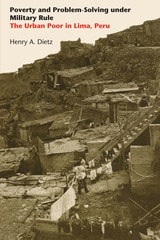
Poverty and Problem-Solving under Military Rule
The Urban Poor in Lima, PeruBy Henry A. Dietz
University of Texas Press, 1980
Poverty and the Quest for Life
Spiritual and Material Striving in Rural IndiaBhrigupati Singh
University of Chicago Press, 2015
The Indian subdistrict of Shahabad, located in the dwindling forests of the southeastern tip of Rajasthan, is an area of extreme poverty. Beset by droughts and food shortages in recent years, it is the home of the Sahariyas, former bonded laborers, officially classified as Rajasthan’s only “primitive tribe.” From afar, we might consider this the bleakest of the bleak, but in Poverty and the Quest for Life, Bhrigupati Singh asks us to reconsider just what quality of life means. He shows how the Sahariyas conceive of aspiration, advancement, and vitality in both material and spiritual terms, and how such bridging can engender new possibilities of life.
Singh organizes his study around two themes: power and ethics, through which he explores a complex terrain of material and spiritual forces. Authority remains contested, whether in divine or human forms; the state is both despised and desired; high and low castes negotiate new ways of living together, in conflict but also cooperation; new gods move across rival social groups; animals and plants leave their tracks on human subjectivity and religiosity; and the potential for vitality persists even as natural resources steadily disappear. Studying this milieu, Singh offers new ways of thinking beyond the religion-secularism and nature-culture dichotomies, juxtaposing questions about quality of life with political theologies of sovereignty, neighborliness, and ethics, in the process painting a rich portrait of perseverance and fragility in contemporary rural India.
Poverty in Common
The Politics of Community Action during the American CenturyAlyosha Goldstein
Duke University Press, 2012

Poverty in the Pandemic
Policy Lessons from COVID-19Zachary Parolin
Russell Sage Foundation, 2023
Drawing on dozens of data sources ranging from debit and credit card spending, the first national databases of school and childcare center closures in the U.S., and bi-weekly Census-run surveys on well-being, Parolin finds that entering the pandemic in poverty substantially increased a person’s likelihood of experiencing negative health outcomes due to the pandemic, such as contracting and dying from COVID, as well as losing their job. Additionally, he found that students from poor families suffered the greatest learning losses as a result of school closures and the shift to distance learning during the pandemic.
However, unprecedented legislative action by the U.S. government, including the passage of the Families First Coronavirus Response Act (FFCRA), the Coronavirus Aid, Relief, and Economic Security (CARES) Act, and the American Rescue Plan (ARP) helped mitigate the economic consequences of the pandemic and lifted around 18 million Americans out of poverty. Based on the success of these policies, Parolin concludes with policy suggestions that the U.S. can implement in more ‘normal’ times to improve the living conditions of low-income households after the pandemic subsides, including expanding access to Unemployment Insurance, permanently expanding the Child Tax Credit, promoting greater access to affordable, high-quality healthcare coverage, and investing more resources into the Census Bureau’s data-collection capabilities. He also details a method of producing a monthly measurement of poverty, to be used in conjunction with the traditional annual measurement, in order to better understand the intra-year volatility of poverty that many Americans experience.
Poverty in the Pandemic provides the most complete account to date of the unique challenges that low-income households in the U.S. faced during the COVID-19 pandemic.
Poverty of the Imagination
The Cold War and the Social Science of Development in Latin AmericaPatrick Iber
University of Chicago Press, 2026
Explores the history of the “science of development” during the Cold War and how experts across the social sciences tried to create the tools to address the problem of poverty across Latin America.
In the mid-twentieth century, Latin America had the world’s starkest internal inequality. In Brazil in 1960, for example, the top 10 percent took upward of 60 percent of the country’s total income, while its entire bottom half took only 10 percent. As Patrick Iber shows in Poverty of the Imagination, this problem of poverty and social inequality focused the attention of social scientists on the task of articulating a “science of development.” In the context of the Cold War, this project drew the attention of the US government and the Ford Foundation, which hoped that peaceful development would prevent revolutions.
This book examines the five central frameworks that emerged to explain poverty: from dependency theory on the Marxist left; to theories of modernization, the culture of poverty, and marginality in the center; to neoliberalism on the right. Iber shows how each rose (and fell) by connecting them to political projects such as the War on Poverty in the United States and the dictatorship of Augusto Pinochet in Chile. Through vivid portraits of key thinkers, he shows how each was shaped by the environment of the Cold War and the presence of the Ford Foundation. It is a story with surprising turns: What began for Ford as a Cold War project to support university “modernization” changed as dictatorships took control of much of the region. Then, Ford took the side of the dissidents, supporting an antipoverty agenda for the restoration of democracy. A guide to some of the most important ideas in global development and Latin American studies alike, this book also shows how scholars and institutions faced down authoritarian threats—and won.
Poverty, Charity, and Motherhood
Maternal Societies in Nineteenth-Century FranceChristine Adams
University of Illinois Press, 2010
Poverty, Inequality, and the Future of Social Policy
Western States in the New World OrderKatherine McFate
Russell Sage Foundation, 1995
Power
Keith Dowding
University of Minnesota Press, 1996
Power Despite Precarity
Strategies for the Contingent Faculty Movement in Higher EducationJoe Berry
Pluto Press, 2021
Higher education is the site of an ongoing conflict. At the heart of this struggle are the precariously employed faculty 'contingents' who work without basic job security, living wages or benefits. Yet they have the incentive and, if organized, the power to shape the future of higher education.
Power Despite Precarity is part history, part handbook and a wholly indispensable resource in this fight. Joe Berry and Helena Worthen outline the four historical periods that led to major transitions in the worklives of faculty of this sector. They then take a deep dive into the 30-year-long struggle by California State University lecturers to negotiate what is recognized as the best contract for contingents in the US.
The authors ask: what is the role of universities in society? Whose interests should they serve? What are the necessary conditions for the exercise of academic freedom? Providing strategic insight for activists at every organizing level, they also tackle 'troublesome questions' around legality, union politics, academic freedom and how to recognize friends (and foes) in the struggle.
Power Despite Precarity
Strategies for the Contingent Faculty Movement in Higher EducationJoe Berry
Pluto Press, 2021
Higher education is the site of an ongoing conflict. At the heart of this struggle are the precariously employed faculty 'contingents' who work without basic job security, living wages or benefits. Yet they have the incentive and, if organized, the power to shape the future of higher education.
Power Despite Precarity is part history, part handbook and a wholly indispensable resource in this fight. Joe Berry and Helena Worthen outline the four historical periods that led to major transitions in the worklives of faculty of this sector. They then take a deep dive into the 30-year-long struggle by California State University lecturers to negotiate what is recognized as the best contract for contingents in the US.
The authors ask: what is the role of universities in society? Whose interests should they serve? What are the necessary conditions for the exercise of academic freedom? Providing strategic insight for activists at every organizing level, they also tackle 'troublesome questions' around legality, union politics, academic freedom and how to recognize friends (and foes) in the struggle.
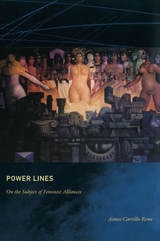
Power Lines
On the Subject of Feminist AlliancesAimee Carrillo Rowe
Duke University Press, 2008
Combining theory, criticism, and narrative nonfiction, Carrillo Rowe develops a politics of relation that encourages the formation of feminist alliances across racial and other boundaries within academia. Such a politics of relation is founded on her belief that our subjectivities emerge in community; our affective investments inform and even create our political investments. Thus experience, consciousness, and agency must be understood as coalitional rather than individual endeavors. Carrillo Rowe’s conversations with academic feminists reveal that women who restrict their primary allies to women of their same race tend to have limited notions of feminism, whereas women who build transracial alliances cultivate more nuanced, intersectional, and politically transformative feminisms. For Carrillo Rowe, the institutionalization of feminism is not so much an achievement as an ongoing relational process. In Power Lines, she offers a set of critical, practical, and theoretical tools for building and maintaining transracial feminist alliances.
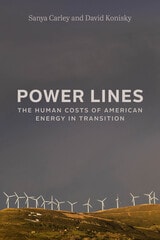
Power Lines
The Human Costs of American Energy in TransitionSanya Carley and David Konisky
University of Chicago Press, 2025
On American energy and its persisting power to destroy.
In the United States, the promise of a green-energy future is complicated by its realities. The country’s legacy energy systems are decrepit; the rollout of new technologies is unequal and piecemeal; households find themselves increasingly without reliable or affordable access; and Americans are excluded from the decisions that shape their energy futures. Having power in America has become an exercise in race, class, and wealth—in more ways than one.
Power Lines is a sweeping portrait of American energy in the twenty-first century, rendered in terms of its increasing—and inevitable—human costs. Coal miners in West Virginia lose their livelihoods as energy markets change; historically marginalized households cannot easily access new technologies; children in “sacrifice zones” adjacent to mineral-mining sites suffer health problems and limited resources; and cities and towns are burdened from the production of alternative energies.
Sanya Carley and David Konisky show current challenges and an uncertain future of America’s greatest policy imperative. The result is not only sobering but also essential for planning and pursuing a clean-energy transition that improves on the errors of the past.
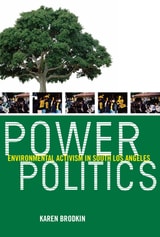
Power Politics
Environmental Activism in South Los AngelesBrodkin, Karen
Rutgers University Press, 2009
Power Politics is a rich and readable study of a grassroots campaign where longtime labor and environmental allies found themselves on opposite sides of a conflict that pitted good jobs against good air. Karen Brodkin analyzes how those issues came to be opposed and in doing so unpacks the racial and class dynamics that shape Americans' grasp of labor and environmental issues. Power Politics' activists stood at the forefront of a movement that is building broad-based environmental coalitions and placing social justice at the heart of a new and robust vision.
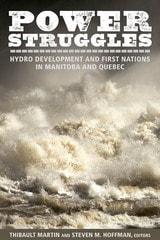
Power Struggles
Hydro Development and First Nations in Manitoba and QuebecThibault Martin
University of Manitoba Press, 2008
Power and Everyday Life
The Lives of Working Women in Nineteenth-Century BrazilDias, Maria Odila Silva
Rutgers University Press, 1995
This important new work is a study of the everyday lives of the inhabitants of São Paulo in the nineteenth century. Full of vivid detail, the book concentrates on the lives of working women--black, white, Indian, mulatta, free, freed, and slaves, and their struggles to survive. Drawing on official statistics, and on the accounts of travelers and judicial records, the author paints a lively picture of the jobs, both legal and illegal, that were performed by women. Her research leads to some surprising discoveries, including the fact that many women were the main providers for their families and that their work was crucial to the running of several urban industries. This book, which is a unique record of women’s lives across social and race strata in a multicultural society, should be of interest to students and researchers in women’s studies, urban studies, historians, geographers, economists, sociologists, and anthropologists.
Power and Everyday Life
The Lives of Working Women in Nineteenth-Century BrazilDias, Maria Odila Silva
Rutgers University Press, 1995
This important new work is a study of the everyday lives of the inhabitants of São Paulo in the nineteenth century. Full of vivid detail, the book concentrates on the lives of working women--black, white, Indian, mulatta, free, freed, and slaves, and their struggles to survive. Drawing on official statistics, and on the accounts of travelers and judicial records, the author paints a lively picture of the jobs, both legal and illegal, that were performed by women. Her research leads to some surprising discoveries, including the fact that many women were the main providers for their families and that their work was crucial to the running of several urban industries. This book, which is a unique record of women’s lives across social and race strata in a multicultural society, should be of interest to students and researchers in women’s studies, urban studies, historians, geographers, economists, sociologists, and anthropologists.
Power and Identity at the Margins of the Ancient Near East
Sara Mohr
University Press of Colorado, 2022
The borderlands of hegemonic entities within the Near East and Egypt pressed against each other, creating cities and societies with influence from several competing polities. The peoples, cities, and cultures that resulted present a unique lens by which to examine how states controlled and influenced the lives, political systems, and social hierarchies of these subjects (and vice versa). This volume addresses the distinct traditions and experiences of areas beyond the core; terminology used when discussing empire, core, periphery, borderlands, and frontiers; conceptualization of space; practices and consequences of warfare, captive-taking, and slavery; identity- and secondary state–formation; economy and society; ritual; diplomacy; and the negotiation of claims to power.
It is imperative that historians and social scientists understand the ways in which these cultures developed, spread, and interacted with others along frontier edges. Using an intersectional approach across disciplines, Power and Identity at the Margins of the Ancient Near East brings together professionals from archaeology, religious studies, history, sociology, and anthropology to make new contributions to the study of the frontier.
Contributors: Alexander Ahrens, Peter Dubovský, Avraham Faust, Daniel E. Fleming, Mahri Leonard-Fleckman, Alvise Matessi, Ellen Morris, Valeria Turriziani, Eric M. Trinka
Power and Identity in Archaeological Theory and Practice
Case Studies from Ancient MesoamericaEleanor Harrison-Buck
University of Utah Press, 2012
The contributions to this volume represent a diverse array of Mesoamerican archaeological studies that are all theo-retically rooted to larger, global debates concerning issues of power and identity—two logically paired concepts. While social identity has been the focus of more critical analysis in recent years, the concept of power has received far less attention. Most studies focus on large-scale, institutional forms of power and the ruling body. Here, the focus is on relations of power, addressing broader segments of society outside the dominant group, that often are ignored in traditional reconstructions of past societies.
Harrison-Buck has compiled works that address a common criticism of social theory in the field of anthropological archaeology—the lack of strong case studies and corroborating facts supporting the abstract and often complex social theoretical concepts presented by scholars. Each contributor offers innovative method and theory and provides alternative and varied approaches to understanding power and identity in the archaeological record. They draw from a wide range of related disciplines and theoretical frameworks, including feminism, queer theory, cognitive studies, and postcolonial theory. The provocative case studies and exciting theoretical applications presented here will stimulate lively debate among scholars working both in and outside of Mesoamerica.

Power and Its Disguises
Anthropological Perspectives on PoliticsJohn Gledhill
Pluto Press, 2000
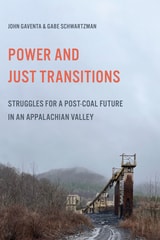
Power and Just Transitions
Struggles for a Post-Coal Future in an Appalachian ValleyJohn Gaventa and Gabe Schwartzman
University of Illinois Press, 2026
Power and Performance
Ethnographic Explorations through Proverbial Wisdom and Theater in Shaba, ZaireJohannes Fabian
University of Wisconsin Press, 1990
In 1985 Johannes Fabian, while engaged in fieldwork in the Shaba province of Zaire, first encountered this saying. Its implications—for the charismatic religious movements Fabian was examining, for the highly charged political atmosphere of Zaire, and for the cultures of the Luba peoples—continued to intrigue him, though its meaning remained elusive. On a later visit, he mentioned the saying to a company of popular actors, and triggered an ethnographic brainstorm. “Spontaneously, they decided it would be just the right topic for their next play. On the spot they began planning—suggestions for a plot were made, problems of translating the French term ‘pouvoir’ were debated, several actors cited sayings and customs from their home villages. . . .”
Power and Performance examines traditional proverbs about power as it illustrates how the performance of Le pouvoir se mange entier was created, rehearsed, and performed. The play deals with the issue of power through a series of conflicts between villagers and their chief. Both rehearsal and performance versions of the text of this drama are included, in Swahili and in English translation.

Power and Possibility
Essays, Reviews, and InterviewsElizabeth Alexander
University of Michigan Press, 2007
A volume in the Poets on Poetry series, which collects critical works by contemporary poets, gathering together the articles, interviews, and book reviews by which they have articulated the poetics of a new generation.
Elizabeth Alexander is considered one of the country's most gifted contemporary poets, and the publication of her essays in The Black Interior in 2004 established her as an astute critic and cultural commentator as well. Arnold Rampersad has called Alexander "one of the brightest stars in our literary sky . . . a superb, invaluable commentator on the American scene." In this new collection of her essays, reviews, and interviews, Alexander again focuses on African American artistic production, particularly poetry, and the cultural contexts in which it is created and experienced.
The book's first section, "Black Arts 101," takes up the poetry of Paul Laurence Dunbar, Sterling Brown, Lucille Clifton, Gwendolyn Brooks, and Rita Dove (among others); artist Romare Bearden; dancer Bill T. Jones; and dramatist August Wilson. A second section, "Black Feminist Thinking," provides engaging meditations ranging from "My Grandmother's Hair" and "A Very Short History of Black Women and Food" to essays on the legacies of Toni Cade, Audre Lorde, and June Jordan. The collection's final section, "Talking," includes interviews, a commencement address---"Black Graduation"---and the essay "Africa and the World."
Elizabeth Alexander received a B.A. from Yale University, an M.A. from Boston University, and a Ph.D. in English from the University of Pennsylvania. She has published four books of poems: The Venus Hottentot (1990); Body of Life (1996); Antebellum Dream Book (2001); and, most recently, American Sublime (2005), which was one of three finalists for the Pulitzer Prize. Her play, Diva Studies, was produced at the Yale School of Drama. She is presently Professor of American and African American Studies at Yale University.
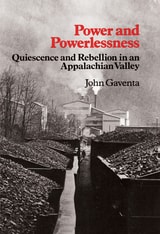
Power and Powerlessness
Quiescence and Rebellion in an Appalachian ValleyJohn Gaventa
University of Illinois Press, 1980
Using Clear Fork Valley in central Appalachia as an empirical example, Gaventa attempts to discern the "hidden faces of power" - those forces which shape actions and consciousness in ways not readily apparent in formal American political processes. He seeks to clarify and expand upon past theories (by such writers as Bachrach and Lukes) on the nature and maintenance of power.
The region studied here is characterized by stark incongruity - the co-existence of massive natural wealth (coal and land) with pervasive human poverty attended by high unemployment, limited education, malnutrition, and the prevalent hazards of mining coal: black lung, dismemberment, death, and ecological ruin. This has been the region's status quo under the decades of domination by a British company and its absentee owners. Despite these departure conditions and frequently violent union struggles, culminating in the 1969 murder of UMW reformist Jock Yablonski, acquiescence to this status quo has been maintained. Gaventa searches out the answers to how and why wealth and poverty continue to coexist and the powerless continue to accede to the powerful. His astute analysis poses broader questions about the politics of poverty, working-class consciousness, and corporate power in America.
Power and Protest in the Countryside
Studies of Rural Unrest in Asia, Europe, and Latin AmericaRobert P. Weller and Scott Guggenheim
Duke University Press, 1993

Power and Society in Greater NY
David C. Hammack
Russell Sage Foundation, 1982
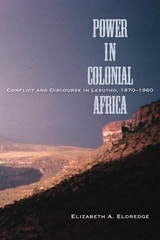
Power in Colonial Africa
Conflict and Discourse in Lesotho, 1870–1960Elizabeth A. Eldredge
University of Wisconsin Press, 2007
In Power in Colonial Africa: Conflict and Discourse in Lesotho, 1870–1960, Elizabeth A. Eldredge analyzes a panoply of archival and oral resources, visual signs and symbols, and public and private actions to show how power may be exercised not only by rulers but also by the ruled. The BaSotho—best known for their consolidation of a kingdom from the 1820s to 1850s through primarily peaceful means, and for bringing colonial forces to a standstill in the Gun War of 1880–1881—struggled to maintain sovereignty over their internal affairs during their years under the colonial rule of the Cape Colony (now part of South Africa) and Britain from 1868 to 1966. Eldredge explores instances of BaSotho resistance, resilience, and resourcefulness in forms of expression both verbal and non-verbal. Skillfully navigating episodes of conflict, the BaSotho matched wits with the British in diplomatic brinksmanship, negotiation, compromise, circumvention, and persuasion, revealing the capacity of a subordinate population to influence the course of events as it selectively absorbs, employs, and subverts elements of the colonial culture.
“A refreshing, readable and lucid account of one in an array of compositions of power during colonialism in southern Africa.”—David Gordon, Journal of African History
“Elegantly written.”—Sean Redding, Sub-Saharan Africa
“Eldredge writes clearly and attractively, and her studies of the war between Lerotholi and Masupha and of the conflicts over the succession to the paramountcy are essential reading for anyone who wants to understand those crises.”—Peter Sanders, Journal of Southern African Studies
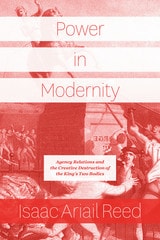
Power in Modernity
Agency Relations and the Creative Destruction of the King’s Two BodiesIsaac Ariail Reed
University of Chicago Press, 2020
He mobilizes this theory to investigate the onset of modernity in the Atlantic world, with a focus on rebellion, revolution, and state formation in colonial North America, the early American Republic, the English Civil War, and French Revolution. Modernity, Reed argues, dismantled the “King’s Two Bodies”—the monarch’s physical body and his ethereal, sacred second body that encompassed the body politic—as a schema of representation for forging power relations. Reed’s account then offers a new understanding of the democratic possibilities and violent exclusions forged in the name of “the people,” as revolutionaries sought new ways to secure delegation, build hierarchy, and attack alterity.
Reconsidering the role of myth in modern politics, Reed proposes to see the creative destruction and eternal recurrence of the King’s Two Bodies as constitutive of the modern attitude, and thus as a new starting point for critical theory. Modernity poses in a new way an eternal human question: what does it mean to be the author of one’s own actions?

Power of Nature
Archaeology and Human-Environmental Dynamicsedited by Monica L. Smith
University Press of Colorado, 2022
Climatic events, pathogens, and animals as nonhuman agents, ranging in size from viruses to mega-storms, have presented our species with dynamic conditions that overwhelm human capacities. In some cases, people have modified architecture to deal with a constant onslaught of storms, as in Japan or the Caribbean; in other cases, they have welcomed the occasional natural disaster as a chance to start fresh or to put into place new ideas and practices, as in the case of ancient Roman cities. Using the concept of “agency” as one in which multiple sentient and nonhuman actors interact in a landscape, and exploring locations such as the Caribbean, the Pacific, South Asia, the Andes, the Mediterranean, Mesoamerica, North America, and the Arctic, the authors provide compelling explanations of the effect of an entire realm of natural powers that beset human societies past and present—from storms, earthquakes, and fires to vegetation, domestic animals, and wild birds. Throughout, the emphasis is on the philosophical and engineering adjustments that people make to stay resilient when facing the perpetual changes of the natural world.
Using an archaeological perspective, The Power of Nature illustrates and analyzes the many
ways that people do not control their environments. It will be of interest to archaeologists, as well as scholars in science, biology, botany, forestry, urban studies, and disaster management.
Contributors: Steven Ammeran, Traci Ardren, Katelyn J. Bishop, Karen Mohr Chávez, Sergio Chávez, Stanislava Chávez, Emelie Cobb, Jago Cooper, Harper Dine, Chelsea Fisher, Jennifer Huebert, Dale L. Hutchinson, Sara L. Juengst, Kanika Kalra, François Oliva, Matthew C. Peros, Jordan Pickett, Seth Quintus, John Robb, Monica L. Smith, Jillian A. Swift, Silvia Tomášková, Kyungsoo Yoo
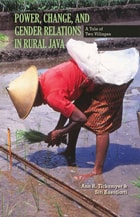
Power, Change, and Gender Relations in Rural Java
A Tale of Two VillagesAnn R. Tickamyer
Ohio University Press, 2012
Women’s status in rural Java can appear contradictory to those both inside and outside the culture. In some ways, women have high status and broad access to resources, but other situations suggest that Javanese women lack real power and autonomy. Javanese women have major responsibilities in supporting their families and controlling household finances. They may also own and manage their own property. Yet these symbols and potential sources of independence and influence are determined by a culturally prescribed, state-reinforced, patriarchal gender ideology that limits women’s autonomy. Power, Change, and Gender Relations in Rural Java examines this contradiction as well as sources of stability and change in contemporary Javanese gender relations.
The authors conducted their research in two rural villages in Yogyakarta, Indonesia, during three important historical and political periods: the end of the New Order regime; the transitional period of reformation; and the subsequent establishment of a democratic government. Their collaboration brings a unique perspective, analyzing how gender is constructed and reproduced and how power is exercised as Indonesia faces the challenges of building a new social order.
Power, Community and the State
The Political Anthropology of Organisation in MexicoMonique Nuijten
Pluto Press, 2003