Results by title
18284 books match the query 'United States' and 850 start with p
Prosthetic Memories
Postcolonial Feminisms in a More-Than-Human WorldHyaesin Yoon
Duke University Press, 2025
Prostitution, Polygamy, and Power
Salt Lake City, 1847-1918Jeffrey Nichols
University of Illinois Press, 2002
Jeffrey Nichols examines how prostitution became a focal point in the moral contest between Mormons and gentiles and aided in the construction of gender systems, moral standards, and the city's physical and economic landscapes. Gentiles likened polygamy to prostitution and accused polygamous Mormons of violating Christian norms of family structure and sexual behavior. Defending their church and its ideals, Mormons blamed gentiles for introducing the sinful business of prostitution into their honorable city. Nichols traces the interplay of prostitution and reform from the 1890s, when the Church of Jesus Christ of Latter-day Saints began to move away from polygamy, to World War I, when Mormon and gentile moral codes converged at the expense of prostitutes. He also considers how the conflict over polygamy distinguished Salt Lake City from other cities struggling to abolish prostitution in the Progressive Era.

Protecting American Health Care Consumers
Eleanor DeArman Kinney
Duke University Press, 2002
To promote and ensure consumer protection in an increasingly adversarial and complicated health-care culture, Kinney first analyzes the procedures by which consumer concerns are presently discerned and resolved and then explains why these systems are unsatisfactory. She also discusses problematic procedures for making coverage policy and quality standards and proposes reforms in a variety of processes that would enable all consumers, including the uninsured, to influence key policies and standards and also to raise concerns and obtain appropriate remedies.
As the first comprehensive treatment of administrative procedures in American health plans and other such institutions, Protecting American Health Care Consumers will be welcomed by state and federal policymakers, managed care executives, and lawyers charged with designing and implementing protections for consumers in public and private health plans.

Protecting Intellectual Freedom in Your Public Library
American Library Association, 2012

Protecting Women
Labor Legislation in Europe, the United States, and Australia, 1880-1920Edited by Ulla Wikander, Alice Kessler-Harris, and Jane Lewis
University of Illinois Press, 1995
Protecting the Empire’s Frontier
Officers of the 18th (Royal Irish) Regiment of Foot during Its North American Service, 1767–1776Steven M. Baule
Ohio University Press, 2013
Protecting the Empire’s Frontier tells stories of the roughly eighty officers who served in the 18th (Royal Irish) Regiment of Foot, which served British interests in America during the crucial period from 1767 through 1776. The Royal Irish was one of the most wide-ranging regiments in America, with companies serving on the Illinois frontier, at Fort Pitt, and in Boston, New York, and Philadelphia, with some companies taken as far afield as Florida, Spanish Louisiana, and present-day Maine. When the regiment was returned to England in 1776, some of the officers remained in America on staff assignments. Others joined provincial regiments, and a few joined the American revolutionary army, taking up arms against their king and former colleagues.
Using a wide range of archival resources previously untapped by scholars, the text goes beyond just these officers’ service in the regiment and tells the story of the men who included governors, a college president, land speculators, physicians, and officers in many other British regular and provincial regiments. Included in these ranks were an Irishman who would serve in the U.S. Congress and as an American general at Yorktown; a landed aristocrat who represented Bath as a member of Parliament; and a naval surgeon on the ship transporting Benjamin Franklin to France. This is the history of the American Revolutionary period from a most gripping and everyday perspective.
An epilogue covers the Royal Irish’s history after returning to England and its part in defending against both the Franco-Spanish invasion attempt and the Gordon Rioters. With an essay on sources and a complete bibliography, this is a treat for professional and amateur historians alike.
Protest and Propaganda
W. E. B. Du Bois, the CRISIS, and American HistoryEdited by Amy Helene Kirschke and Phillip Luke Sinitiere
University of Missouri Press, 2013
In looking back on his editorship of Crisis magazine, W. E. B. Du Bois said, “We condensed more news about Negroes and their problems in a month than most colored papers before this had published in a year.” Since its founding by Du Bois in 1910, Crisis has been the primary published voice of the NAACP. Born in an age of Jim Crow racism, often strapped for funds, the magazine struggled and endured, all the while providing a forum for people of color to document their inherent dignity and proclaim their definitive worth as human beings.
As the magazine’s editor from 1910 until 1934, Du Bois guided the content and the aim of Crisis with a decisive hand. He ensured that each issue argued for civil rights, economic justice, and social equality, always framing America’s intractable color line in an international perspective. Du Bois benefited from a deep pool of black literary and artistic genius, whether by commissioning the visual creativity of Harlem Renaissance artists for Crisis covers or by publishing poems and short stories from New Negro writers. From North to South, from East to West, and even reaching across the globe, Crisis circulated its ideas and marshaled its impact far and wide.
Building on the solid foundation Du Bois laid, subsequent editors and contributors covered issues vital to communities of color, such as access to resources during the New Deal era, educational opportunities related to the historic Brown decision, the realization of basic civil rights at midcentury, American aid to Africa and Caribbean nations, and the persistent economic inequalities of today’s global era.
Despite its importance, little has been written about the historical and cultural significance of this seminal magazine. By exploring how Crisis responded to critical issues, the essays in Protest and Propaganda provide the first well-rounded, in-depth look at the magazine's role and influence. The authors show how the essays, columns, and visuals published in Crisis changed conversations, perceptions, and even laws in the United States, thereby calling a fractured nation to more fully live up to its democratic creed. They explain how the magazine survived tremendous odds, document how the voices of justice rose above the clamor of injustice, and demonstrate how relevant such literary, journalistic, and artistic postures remain in a twenty-first-century world still in crisis.
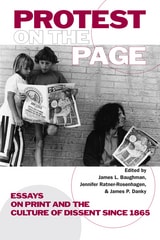
Protest on the Page
Essays on Print and the Culture of Dissent since 1865Edited by James L. Baughman, Jennifer Ratner-Rosenhagen, and James P. Danky
University of Wisconsin Press, 2015

Protestant Nation
The Fragile Christian Roots of America's GreatnessAlain Besançon
St. Augustine's Press, 2017
Protestant--Catholic--Jew
An Essay in American Religious SociologyWill Herberg
University of Chicago Press, 1983
"In Protestant-Catholic-Jew Will Herberg has written the most fascinating essay on the religious sociology of America that has appeared in decades. He has digested all the relevant historical, sociological and other analytical studies, but the product is no mere summary of previous findings. He has made these findings the basis of a new and creative approach to the American scene. It throws as much light on American society as a whole as it does on the peculiarly religious aspects of American life. Mr. Herberg. . . illumines many facets of the American reality, and each chapter presents surprising, and yet very compelling, theses about the religious life of this country. Of all these perhaps the most telling is his thesis that America is not so much a melting pot as three fairly separate melting pots."—Reinhold Niebuhr, New Yorks Times Book Review
Protocols of Liberty
Communication Innovation and the American RevolutionWilliam B. Warner
University of Chicago Press, 2013

Proud Warriors
African American Combat Units in World War IIAlexander M. Bielakowski
University of North Texas Press, 2021
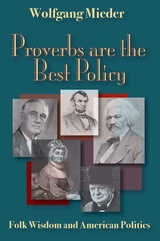
Proverbs Are The Best Policy
Folk Wisdom And American PoliticsWolfgang Mieder
Utah State University Press, 2005
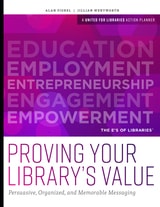
Proving Your Library's Value
Persuasive, Organized, and Memorable MessagingAlan Fishel
American Library Association, 2020
You know the value of your library, but elected officials, donors, community leaders, funders, and other important stakeholders may not. How can you make the library a priority for these groups, who may have preconceived notions about what the library does, as you compete with other important community organizations for funding? In this book from United for Libraries, you’ll learn how to use The E’s of Libraries® (Education, Employment, Entrepreneurship, Engagement, and Empowerment) to quickly demonstrate why your library is essential and worthy of funding, using messaging that is organized, persuasive, and memorable. With the help of worksheets, charts, and prompts, you will learn how to
- use language designed to win over stakeholders, funders, and partners;
- craft custom messaging in several formats that is easily accessible and memorable, including elevator speeches, budget presentations, and annual appeals; and
- create presentations and other materials tailored to any audience based on the sample documents included.
This book's innovative framework can be used by any size or type of library, and by any library advocate, including Friends groups, library staff, trustees, and foundations.
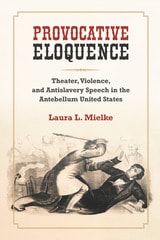
Provocative Eloquence
Theater, Violence, and Antislavery Speech in the Antebellum United StatesLaura L. Mielke
University of Michigan Press, 2019
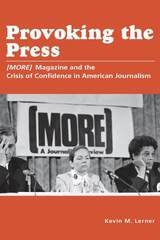
Provoking the Press
(MORE) Magazine and the Crisis of Confidence in American JournalismKevin M. Lerner
University of Missouri Press, 2023
Two of these new journalists, a Pulitzer Prize—winning, Harvard-educated New York Times reporter named J. Anthony Lukas, and a former Newsweek media writer named Richard Pollak, founded a journalism review called (MORE) in 1971, with its pilot issue appearing the same month that the Times began publishing the Pentagon Papers. (MORE) covered the press with a critical attitude that blended seriousness and satire—part New York Review of Books, part underground press. In the eight years that it published, (MORE) brought together nearly every important American journalist of the 1970s, either as a writer, a subject of its critical eye, or as a participant in its series of raucous "A.J. Liebling Counter-Conventions"—meetings named after the outspoken press critic—the first of which convened in 1974. In issue after issue the magazine considered and questioned the mainstream press's coverage of explosive stories of the decade, including the Watergate scandal; the "seven dirty words" obscenity trial; the debate over a reporter's constitutional privilege; the rise of public broadcasting; the struggle for women and minorities to find a voice in mainstream newsrooms; and the U.S. debut of press baron Rupert Murdoch.
In telling the story of (MORE) and its legacy, Kevin Lerner explores the power of criticism to reform and guide the institutions of the press and, in turn, influence public discourse.
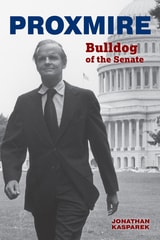
Proxmire
Bulldog of the SenateJonathan Kasparek
Wisconsin Historical Society Press, 2019
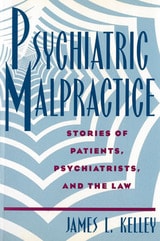
Psychiatric Malpractice
Stories of Patients, Psychiatrists, and the LawKelley, James L
Rutgers University Press, 1996
• Two weeks after Johnny Moore was discharged from a psychiatric hospital, the deeply troubled teenager took a lethal overdose of the antidepressant prescribed by his psychiatrist.
• Dennis Gould suffered from paranoid schizophrenia. He let a streetcar cut off his right arm rather than carry out his divine mission to kill his ex-girlfriend, Shelley Rotman; three years later––while under psychiatric care and after several hospitalizations––Gould stabbed the young woman to death with his left arm.
• After seven months of psychotherapy as his only treatment in a private psychiatric hospital, Raphael Osheroff’s symptoms of the agitated depression that had destroyed his medical practice and personal life were more severe than ever. At a second hospital, Osheroff was given the antidepressant drugs he had been asking for––and he rapidly improved.
• Joan Barkley went to Dr. Jonathan Fox for help in overcoming her addiction to Darvon. After a year of therapy, the twice-weekly sessions turned into intense sexual encounters, which continued for two years.
James Kelley tells the true stories of people who sought help from psychiatrists and ended up suing them for malpractice. These tales are compelling, tragic, and sometimes bizarre. They offer a unique view into a relationship that is normally confidential and caring––but can be catastrophic when it goes wrong. Kelley discusses several cases that received national attention: former Reagan administration press secretary James Brady's suit against the psychiatrist who had been treating John Hinckley; the Tarasoff decision that established the psychiatrist’s duty to warn potential victims of a patient’s threats; and the disciplinary proceedings against Dr. Margaret Bean-Bayog for her unusual “mothering” treatment of Paul Lozano.
Kelley accompanies detailed accounts of courtroom clashes––based on court records––with clear, even-handed treatments of four kinds of psychiatric malpractice cases: a patient’s suicide, a patient’s violence against other people, a psychotherapist's sexual misconduct, and the use of unconventional treatments. With a wealth of examples, he explains the role of psychiatrists as expert witnesses against each other, the difficulties of predicting the outcomes of these suits, and the balances psychiatrists and judges have to strike between the duties owed to patients, on the one hand, and to society on the other.
Whether you identify with the patients or the psychiatrists, you will find these tales unforgettable. Kelley writes in nontechnical language for the general reader, stressing the human elements. His lucid analyses of key, current issues make his book essential reading for professionals in mental health or law––and for anyone contemplating a malpractice suit.

Psychological Testing and American Society, 1890-1913
Sokal, Michael M
Rutgers University Press, 1990
Public Administration's Final Exam
A Pragmatist Restructuring of the Profession and the DisciplineMichael M. Harmon
University of Alabama Press, 2006
A bold rethinking of public administration through the lens of pragmatism, governance, and democratic practice.
Michael Harmon employs the literary conceit of a Final Exam, first “written” in the early 1930s, in a critique of the field’s answers to the legitimacy question. Because the assumptions that underwrite the question preclude the possibility of a coherent answer, the exam should be canceled and its question rewritten. Envisaging a public administration no longer hostage to the legitimacy question, Harmon explains how the study and practice of public administration might proceed from adolescence to maturity.
Drawing chiefly from pragmatist philosophy, he argues that despite the universal rejection of the “politics/administration” dichotomy on factual grounds, the pseudo-problem of legitimacy nonetheless persists in the guise of four related conceptual dualisms: 1) values and facts, 2) thinking and doing, 3) ends and means, and 4) theory and practice. Collectively, these dualisms demand an impossible answer to the practical question of how we might live, and govern, together in a world of radical uncertainty and interdependence. Only by dissolving them can the legitimacy question (Woodrow Wilson’s ghost) finally be banished, clearing away the theoretical debris that obscures a more vital and useful conception of governance.
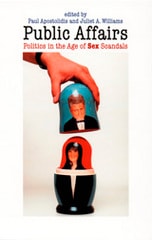
Public Affairs
Politics in the Age of Sex ScandalsPaul Apostolidis and Juliet A. Williams, eds.
Duke University Press, 2004
The essays in Public Affairs reflect on a number of sex scandals while emphasizing the Clinton/Lewinsky affair, certainly the most avidly followed and momentous sex scandal in American political history. Leading scholars situate contemporary public affairs in the context not only of earlier sex scandals in American politics (such as Thomas Jefferson’s and Sally Hemings’s affair), but also of more purely political scandals (including Teapot Dome and Watergate) and sex scandals centered around public figures other than politicians (such as the actor Hugh Grant and the minister Jimmy Swaggart). Some essays consider the Clinton affair in light of feminist and anti-racist politics, while others discuss the dynamics of scandals as major media events. By charting a critical path through the muck of scandal rather than around it, Public Affairs illuminates why sex scandals have become such a prominent feature of American public life.
Contributors. Paul Apostolidis, Jodi Dean, Joshua Gamson, Theodore J. Lowi, Joshua D. Rothman, George Shulman, Anna Marie Smith, Jeremy Varon, Juliet A. Williams
Public Debate in the Civil War Era
A Rhetorical History of the United States, Volume IVDavid Zarefsky
Michigan State University Press, 2023
Public Dollars, Private Stadiums
The Battle over Building Sports StadiumsDelaney, Kevin J.
Rutgers University Press, 2003
The authors provide an eye-opening account of recent battles over publicly financed stadiums in some of America’s largest cities. Their interviews with the key decision makers present a behind-the-scenes look at how and why powerful individuals and organizations foist these sports palaces on increasingly unreceptive communities.
Delaney and Eckstein show that in the face of studies demonstrating that new sports facilities don’t live up to their promise of big money, proponents are using a new tactic to win public subsidies¾intangible “social” rewards, such as prestige and community cohesion. The authors find these to be empty promises as well, demonstrating that new stadiums may exacerbate, rather than erase, social problems in cities.
Public Enemies, Public Heroes
Screening the Gangster from Little Caesar to Touch of EvilJonathan Munby
University of Chicago Press, 1999
Beginning in the early 1930s, these films told compelling stories about ethnic urban lower-class desires to "make it" in an America dominated by Anglo-Saxon Protestant ideals and devastated by the Great Depression. By the late 1940s, however, their focus shifted to the problems of a culture maladjusting to a new peacetime sociopolitical order governed by corporate capitalism. The gangster no longer challenged the establishment; the issue was not "making it," but simply "making do."
Combining film analysis with archival material from the Production Code Administration (Hollywood's self-censoring authority), Munby shows how the industry circumvented censure, and how its altered gangsters (influenced by European filmmakers) fueled the infamous inquisitions of Hollywood in the postwar '40s and '50s by the House Committee on Un-American Activities. Ultimately, this provocative study suggests that we rethink our ideas about crime and violence in depictions of Americans fighting against the status quo.
Public Face Of Modernism
Little Magazines, Audiences, And Reception, 1905-1920Mark S. Morrisson
University of Wisconsin Press, 2000
The phenomenal successes of new advertising agencies and mass market publishers did elicit what Morrisson calls a "crisis of publicity" for some modernists and for many concerned citizens in both countries. But, as Morrisson demonstrates, the vast influence of these industries on consumers also had a profound and largely overlooked effect upon many modernist authors, artists, and others. By exploring the publicity and audience reception of several of the most important modernist magazines of the period, The Public Face of Modernism shows how modernists, far from lamenting the destruction of meaningful art and public culture by the new mass market, actually displayed optimism about the power of mass-market technologies and strategies to transform and rejuvenate contemporary culture—and, above all, to restore a public function to art.
This reconstruction of the "public face of modernism" offers surprising new perceptions about the class, gender, racial, and even generational tensions within the public culture of the early part of the century, and provides a rare insight into the actual audiences for modernist magazines of the period. Moreover, in new readings of works by James Joyce, George Bernard Shaw, Wyndham Lewis, Ford Madox Ford, T. S. Eliot, William Carlos Williams, and many others, Morrisson shows that these contexts also had an impact on the techniques and concerns of the literature itself.
Public Financing in American Elections
Edited by Costas Panagopoulos
Temple University Press, 2011
Reformers argue that public financing of campaigns will help rescue American democracy from the corruptive influence of money in elections. Public Financing in American Elections evaluates this claim and aims to remove much of the guesswork from the discussion about public finance.
Featuring some of the most senior scholars in political science and electoral studies, this book provides an up-to-date treatment of campaign finance research and thinking about public campaign financing reforms. Exploring proposals at the local, state, and federal levels, the contributors provide a comprehensive overview of public financing initiatives in the United States and discuss their impact. Focused analyses of several current public programs are also presented.
Public Humanities
Engaging Community, Empowering Civic Discourse, and Reshaping AcademiaMolly Todd
Michigan State University Press, 2025
Public Interests
Media Advocacy and Struggles over U.S. TelevisionPerlman, Allison
Rutgers University Press, 2016
Nearly as soon as television began to enter American homes in the late 1940s, social activists recognized that it was a powerful tool for shaping the nation’s views. By targeting broadcast regulations and laws, both liberal and conservative activist groups have sought to influence what America sees on the small screen. Public Interests describes the impressive battles that these media activists fought and charts how they tried to change the face of American television.
Public Lands, Public Debates
A Century of ControversyChar Miller, editor
Oregon State University Press, 2012
—Char Miller, from the introduction
Public Libraries Going Green
Kathryn American Library Association
American Library Association, 2010
Public Libraries and Internet Service Roles
American Library Association, 2009
Public Libraries and Resilient Cities
Michael Dudley
American Library Association, 2012
Public Library Services for the Poor
Doing All We CanGlen E. Holt
American Library Association, 2010
Public Library Start-Up Guide
Christine Lind Hage
American Library Association, 2004
Public Management Reform and Innovation
Research, Theory, and ApplicationH. George Frederickson
University of Alabama Press, 1999
A foundational examination of how research, theory, and innovation shape effective public management and democratic governance.
The subject of reform in the public sector is not new; indeed, its latest rubric, reinventing government, has become good politics. Still, as the contributors ask in this volume, is good politics necessarily good government?
Given the growing desire to reinvent government, there are hard questions to be asked: Is the private sector market model suitable and effective when applied to reforming public and governmental organizations? What are the major political forces affecting reform efforts in public management? How is public management reform accomplished in a constitutional democratic government? How do the values of responsiveness, professionalism, and managerial excellence shape current public management reforms? In this volume, editors H. George Frederickson and Jocelyn M. Johnston bring together scholars with a shared interest in empirical research to confront head-on the toughest questions public managers face in their efforts to meet the demands of reform and innovation.
Throughout the book, the authors consider the bureaucratic resistance that results when downsizing and reinvention are undertaken simultaneously, the dilemma public managers face when elected executives set a reform agenda that runs counter to the law, and the mistaken belief that improved management can remedy flawed policy.
Public Modalities
Edited by Daniel C. Brouwer and Robert Asen
University of Alabama Press, 2010
A bold rethinking of public discourse, Public Modalities explores how people shape civic life through protest, media, and identity in an ever-evolving public sphere.
This book explores the ways that scholars, journalists, politicians, and citizens conceive of “the public” or “public life,” and how those entities are defined and invented. For decades, scholars have used the metaphors of spheres, systems, webs, or networks to talk about, describe, and map various practices. This volume proposes a new metaphor—modalities—to suggest that publics are forever in flux, and much more fluid and dynamic than the static models of systems or spheres would indicate—especially in the digital age, where various publics rapidly evolve and dissipate.
Contributors to the volume—employing approaches from the fields of communication studies, English, sociology, psychology, and history—explore a broad range of texts and artifacts that give rise to publics, and discuss what they reveal about conceptualizations of social space. By focusing on process in public engagement, these scholars highlight questions of how people advance their interests and identities, and how they adapt to situational constraints.
Bringing together scholars in rhetorical, cultural, and media studies, this collection of new case studies illustrates a modalities approach to the study of publics. These case studies explore the implications of different ways of forming publics, including alternative means of expression (protests, culture jamming); the intersection of politics and consumerism (how people express their identities and interests through their consumer behavior); and online engagement (blogs as increasingly important public fora). In doing so, they raise important questions of access, community, and political efficacy
Public Opinion and American Foreign Policy
Ole R. Holsti
University of Michigan Press, 1996

Public Opinion and American Foreign Policy, Revised Edition
Ole R. Holsti
University of Michigan Press, 2004
Thoroughly revised edition of an essential text, incorporating a wealth of new material on American foreign policy since 9/11.
The second edition of this concise masterwork includes vast amounts of new material on American foreign policy in the post-9/11 era, including the war in Iraq. Holsti explores the poorly understood role of public opinion in international affairs, looking at Americans' capacity to make informed judgments about issues far removed from their personal experience.
"Impressively comprehensive and current: an excellent revision of a book by the #1 authority on the topic. This new edition will remain at the forefront for consultation and textbook adoption on the topic for years to come."
-Bruce Russett, Yale University
"I thought the first edition was the best single treatment of the subject-so, apparently, did the student who 'borrowed' my copy-and this is a worthy successor. The new edition almost flawlessly accomplishes the goal Holsti sets for himself: an update of his landmark book in light of emerging research and the dramatically changed state of the world that confronts U.S. foreign policy."
-Randy Siverson, University of California, Davis
"For those who are curious about the impact of 9/11 on American public opinion, for serious students of the relationship between foreign policy and public opinion, for anyone who wants to understand contemporary American opinion about the United States' place in the world, and for citizens tired of conventional wisdom about a difficult and important subject, Holsti's study is not only interesting and topical, it is essential."
-Maxine Isaacs, Kennedy School of Government, Harvard University
"In an age of almost weekly polling on foreign policy, Holsti's insights are indispensable. He delivers double tour de force in this new edition, providing his own current and historical research along with a comprehensive synthesis of the existing literature. His analysis of the relationships between public opinion and foreign policy since 9/11 will prove particularly valuable for students and scholars alike."
-Richard Eichenberg, Tufts University
"Holsti combines a vast knowledge of political history and a mastery of the relevant scholarship with up-to-date empirical data to address the question of what role the general public can play in shaping foreign policy. This revised edition is a remarkable achievement."
-Shoon Murray, School of International Service, American University
Public Policy and the Income Distribution
Alan J. Auerbach
Russell Sage Foundation, 2006
Public Pulpits
Methodists and Mainline Churches in the Moral Argument of Public LifeSteven M. Tipton
University of Chicago Press, 2008
Documenting a wide range of reactions to two radically different events—the invasion of Iraq and the creation of the faith-based initiatives program—Tipton charts the new terrain of religious and moral argument under the Bush administration from Pat Robertson to Jim Wallis. He then turns to the case of the United Methodist Church, of which President Bush is a member, to uncover the twentieth-century history of their political advocacy, culminating in current threats to split the Church between liberal peace-and-justice activists and crusaders for evangelical renewal. Public Pulpits balances the firsthand drama of this internal account with a meditative exploration of the wider social impact that mainline churches have had in a time of diverging fortunes and diminished dreams of progress.
An eminently fair-minded and ethically astute analysis of how churches keep moral issues alive in politics, Public Pulpits delves deep into mainline Protestant efforts to enlarge civic conscience and cast clearer light on the commonweal and offers a masterly overview of public religion in America.

Public Reactions to Nuclear Waste
Citizens’ Views of Repository SitingRiley E. Dunlap, Michael E. Kraft, and Eugene A. Rosa, eds.
Duke University Press, 1993
A much-needed supplement to the largely technical literature on this problem, the book provides extensive studies of the reaction of citizens--whether rural or urban, near-site residents or prospective visitors--to proposed nuclear waste sites around the nation, particularly Nevada's Yucca Mountain. Conducted by distinguished sociologists, psychologists, political scientists, and economists, these studies constitute the most comprehensive account available of the impact of public perceptions and opinions on the nuclear waste policy process in the United States. As such, the collection will clarify the politics of nuclear waste siting and will give impetus to the stalled debate over the issue.
Contributors. Rodney K. Baxter, Julia G. Brody, Bruce Clary, Lori Cramer, William H. Desvousges, Riley E. Dunlap, Douglas Easterling, Judy K. Fleishman, James Flynn, William R. Freudenburg, Michael E. Kraft, Richard S. Krannich, Howard Kunreuther, Mark Layman, Ronald L. Little, Robert Cameron Mitchell, Alvin H. Mushkatel, Joanne M. Nigg, K. David Pijawka, Eugene A. Rosa, Paul Slovic
Public Relations and the Press
The Troubled EmbraceKarla Gower
Northwestern University Press, 2007
A democracy works when individuals have access to reliable information upon which to base decisions—information that in our day comes from the mass media. But what if journalists do not have the wherewithal to question their sources and evaluate the information they provide? This, Karla K. Gower explains, is precisely what happens when economic and competitive pressures shift power from the journalist to the source—and the source, not the journalist, controls the flow of information to the public. Gowers describes a situation in which people, “informed” by practitioners of public relations, do not have sufficient information to make valid decisions. At stake is the core credibility of the press itself, and therefore the essential claim of journalism to a privileged role in a democratic social order.
Public Scholarship in Communication Studies
Edited by Thomas J Billard and Silvio Waisbord
University of Illinois Press, 2024
Thomas J Billard and Silvio Waisbord curate essays from a wide range of specialties within the study of communication. Aimed at scholars and students alike, the contributors use approaches from critical meditations to case studies to how-to guides as they explore the possibilities of seeing shared knowledge not as a gift to be granted but as an imperative urging readers to address the problems of the world. Throughout the volume, the works show that a pivot to ideas of scholarship as public service is already underway in corners of communication studies across the country.
Visionary and provocative, Public Scholarship in Communication Studies proposes a needed reconsideration of knowledge and a roadmap to its integration with community.
Contributors: Elaine Almeida, Becca Beets, Thomas J Billard, Danielle K. Brown, Aymar Jean Christian, Stacey L. Connaughton, Paula Gardner, Larry Gross, Amy Jordan, Daniel Kreiss, Rachel Kuo, Susan Mancino, Shannon C. McGregor, Philip M. Napoli, Todd P. Newman, Srividya Ramasubramanian, Chad Raphael, Sue Robinson, Silvio Waisbord, Yidong Wang, and Holley Wilkin
Public Sector Payrolls
Edited by David A. Wise
University of Chicago Press, 1987
The volume, developed from a 1984 National Bureau of Economic Research conference, focuses on various labor issues in military and other governmental employment. Several contributors discuss compensation in the armed forces and its relationship to that in the private sector, as well as the interaction between the military and the private sector in the employment of youth. This latter is of particular interest because studies of youth employment have generally ignored the important influence of military hiring practices on labor market conditions. In other contributions, the response of wages and employment in the public sector to economic conditions is analyzed, and a detailed study of government pension plans is presented. Also included is a theoretical and empirical analysis of comparable worth in the public sector from the viewpoint of analytical labor economics. The volume concludes with a look at public school teachers' salaries in the context of current debates over improving the quality of American education.
A valuable resource to policymakers, Public Sector Payrolls will be an important addition to research in the field of labor economics.
Public Television
Politics and the Battle over Documentary FilmBullert, B.J.
Rutgers University Press, 1997
Through detailed chronologies, B. J. Bullert traces how independently produced documentaries pushed the limits of public television between 1985 and 1993. She interviews the key players, film makers, programmers, journalists, and representatives of interest groups to illuminate how together they sought to frame and constrain viewers on perceptions of provocative works. Their stories are set against the backdrop of a larger story about the relationship between federal funding for the arts and public broadcasting and the promise of a democratic society. Bullert brings to light the subtle forces and interests that effectively control the style and content of documentaries that have been broadcast with the PBS logo.
When film makers brought uncommon realities to the public television airwaves, a complex collective response from station programmers, interest groups, journalists, and viewers ensued. Public Television charts the communication process through which visions of reality deemed threatening to some are packaged to make them more palatable for public television viewers.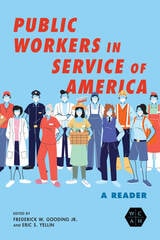
Public Workers in Service of America
A ReaderEdited by Frederick W. Gooding Jr. and Eric S. Yellin
University of Illinois Press, 2023
From white-collar executives to mail carriers, public workers meet the needs of the entire nation. Frederick W. Gooding Jr. and Eric S. Yellin edit a collection of new research on this understudied workforce. Part One begins in the late nineteenth- and early twentieth century to explore how questions of race, class, and gender shaped public workers, their workplaces, and their place in American democracy. In Part Two, essayists examine race and gender discrimination while revealing the subtle contemporary forms of marginalization that keep Black men and Black and white women underpaid and overlooked for promotion. The historic labor actions detailed in Part Three illuminate how city employees organized not only for better pay and working conditions but to seek recognition from city officials, the public, and the national labor movement. Part Four focuses on nurses and teachers to address the thorny question of whether certain groups deserve premium pay for their irreplaceable work and sacrifices or if serving the greater good is a reward unto itself.
Contributors: Eileen Boris, Cathleen D. Cahill, Frederick W. Gooding Jr., William P. Jones, Francis Ryan, Jon Shelton, Joseph E. Slater, Katherine Turk, Eric S. Yellin, and Amy Zanoni
Publishing Blackness
Textual Constructions of Race Since 1850George Hutchinson and John K. Young, Editors
University of Michigan Press, 2013
From the white editorial authentication of slave narratives, to the cultural hybridity of the Harlem Renaissance, to the overtly independent publications of the Black Arts Movement, to the commercial power of Oprah's Book Club, African American textuality has been uniquely shaped by the contests for cultural power inherent in literary production and distribution. Always haunted by the commodification of blackness, African American literary production interfaces with the processes of publication and distribution in particularly charged ways. An energetic exploration of the struggles and complexities of African American print culture, this collection ranges across the history of African American literature, and the authors have much to contribute on such issues as editorial and archival preservation, canonization, and the "packaging" and repackaging of black-authored texts. Publishing Blackness aims to project African Americanist scholarship into the discourse of textual scholarship, provoking further work in a vital area of literary study.
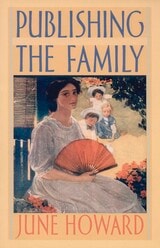
Publishing the Family
June Howard
Duke University Press, 2001
Publishing the Family describes the sources and controversial outcome of a fascinating literary experiment. Howard embeds the story of The Whole Family in the story of Harper & Brothers’ powerful and pervasive presence in American cultural life, treating the publisher, in effect, as an author.
Each chapter of Publishing the Family casts light on some aspect of life in the United States at a moment that arguably marked the beginning of our own era. Howard revises common views of the turn-of-the-century literary marketplace and discusses the perceived crisis in the family as well as the popular and expert discourses that emerged to remedy it. She also demonstrates how creative women like Bazar editor Elizabeth Jordan blended their own ideas about the “New Woman” with traditional values. Howard places these analyses in the framework of far-reaching historical changes, such as the transformation of the public meaning of emotion and “sentimentality.” Taken together, the chapters in Publishing the Family show how profoundly the modern mapping of social life relies on boundaries between family and business, culture and commerce, which The Whole Family and Publishing the Family constantly unsettle.
Publishing the Family will interest students and scholars of American history, literature, and culture, as well as those studying gender, sexuality, and the family.
Pueblo
Mountain, Village, DanceVincent Scully
University of Chicago Press, 1989
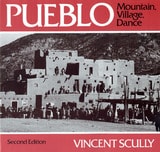
Scully's observations, presented in lively prose and exciting photographs, are based on his own personal experiences of the Southwest; on his exploration of the region of the Rio Grande and the Hopi mesas; on his witnessing of the dances and ceremonies of the Pueblos and others; and on his research into their culture and history. He draws on the vast literature inspired by the Native Americans—from early exploration narratives to the writing of D. H. Lawrence to recent scholarship—to enrich and support his unique approach to the subject.
To this second edition Scully has added a new preface that raises issues of preservation and development. He has also written an extensive postscript that reassesses the relationship between nature and culture in Native American tradition and its relevance to contemporary architecture and landscape.
"Coming to Pueblo architecture as he does from a provocative study of sacred architecture in ancient Greece, Scully has much to say that is both striking and moving of the Pueblo attitudes toward sacred places, the arrangement of structures in space, the lives of men and beasts, and man's relation to rain, earth, vegetation."—Robert M. Adams, New York Review of Books

Pueblos, Plains, and Province
New Mexico in the Seventeenth CenturyJoseph P. Sánchez
University Press of Colorado, 2024
In Pueblos, Plains, and Province Joseph P. Sánchez offers an in-depth examination of sociopolitical conflict in seventeenth-century New Mexico, detailing the effects of Spanish colonial policies on settlers’, missionaries’, and Indigenous peoples’ struggle for economic and cultural control of the region. Sánchez explores the rich archival documentation that provides cultural, linguistic, and legal perspectives of the values of the period.
Spanish dual Indian policies for Pueblo and Plains tribes challenged Indigenous political and social systems to conform to the imperial structure for pacification purposes. Meanwhile, missionary efforts to supplant Indigenous religious beliefs with a Christian worldview resulted, in part, in a syncretism of the two worlds. Indigenous resentment of these policies reflected the contentious disagreements between Spanish clergymen and civil authorities, who feuded over Indigenous labor and encroachment on tribal sovereignties with demands for sworn loyalty to Spanish governance. The little-studied “starvation period” adversely affected Spanish-Pueblo relationships for the remainder of the century and contributed significantly to the battle at Acoma, the Jumano War, and the Pueblo Revolt of 1680.
Pueblos, Plains, and Province shows how history, culture, and tradition in New Mexico shaped the heritage shared by Spain, Mexico, the United States, and Native American tribes and will be of interest to scholars and students of Indigenous, colonial, and borderlands history.