Results by title
18284 books match the query 'United States' and 850 start with p
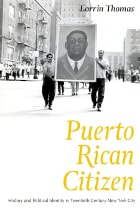
Puerto Rican Citizen
History and Political Identity in Twentieth-Century New York CityLorrin Thomas
University of Chicago Press, 2010
Building its incisive narrative from a wide range of archival sources, interviews, and first-person accounts of Puerto Rican life in New York, this book illuminates the rich history of a group that is still largely invisible to many scholars. At the center of Puerto Rican Citizen are Puerto Ricans’ own formulations about political identity, the responses of activists and ordinary migrants to the failed promises of American citizenship, and their expectations of how the American state should address those failures. Complicating our understanding of the discontents of modern liberalism, of race relations beyond black and white, and of the diverse conceptions of rights and identity in American life, Thomas’s book transforms the way we understand this community’s integral role in shaping our sense of citizenship in twentieth-century America.
Puerto Rican Diaspora
Historical PerspectivesCarmen Teresa Whalen
Temple University Press, 2005

Puerto Rican Jam
Rethinking Colonialism and NationalismNegron-Muntaner, Frances
University of Minnesota Press, 1997
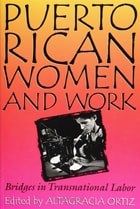
Puerto Rican Women and Work
Bridges in Transnational Laboredited by Altagracia Ortiz
Temple University Press, 1996
Puerto Rican Women and Work: Bridges in Transnational Labor is the only comprehensive study of the role of Puerto Rican women workers in the evolution of a transnational labor force in the twentieth century.
This book examines Puerto Rican women workers, both in Puerto Rico and on the U.S. mainland. It contains a range of information--historical, ethnographic, and statistical. The contributors provide insights into the effects of migration and unionization on women's work, taking into account U.S. colonialism and globalization of capitalism throughout the century as well as the impact of Operation Bootstrap. The essays are arranged in chronological order to reveal the evolutionary nature of women's work and the fluctuations in migration, technology, and the economy. This one-of-a-kind collection will be a valuable resource for those interested in women's studies, ethnic studies, and Puerto Rican and Latino studies, as well as labor studies.
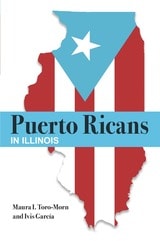
Puerto Ricans in Illinois
Maura I. Toro-Morn and Ivis Garcia
Southern Illinois University Press, 2024
As the first book to document the experiences of Puerto Ricans in the state of Illinois, this inviting book maps the pedacito de patria (little piece of home) that many Puerto Ricans have carved from the bitter hardships faced in Illinois. Authors Maura Toro-Morn and Ivis García illustrate the multiple paradoxes underlying the experience of Puerto Ricans in Illinois: an island people in a heartland state, native-born citizens living an immigrant’s experience, climate refugees in the Midwest. They live a vaivén (coming and going). This volume partially exposes these paradoxes through a narrative of common survival and achievement. Along the proud Paseo Boricua (Puerto Rican Promenade) in Chicago and in smaller cities around the state, Puerto Ricans find and create the means to keep their national identity while contributing to the health and wealth of their adopted state.
From the voices of the people, the authors offer readers an opportunity to learn about the history of Puerto Rico, the migration of Puerto Ricans to Illinois, and the cultural, economic, and political contributions of the Puerto Rican women, men, and families that call Illinois home. In Chicago and across the heartland, Puerto Ricans have negotiated the gap between home and country, mobilized state-wide against the federal government’s virtual abandonment in the aftermath of Hurricane Maria. A compelling weave of scholarship summary, archival research, and extensive sociological study including interviews conducted across the state, the book documents just how much many fail to know about a growing and transforming community in Illinois. The stories of Puerto Ricans are here.
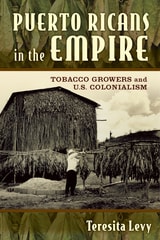
Puerto Ricans in the Empire
Tobacco Growers and U.S. ColonialismTeresita A. Levy
Rutgers University Press, 2015
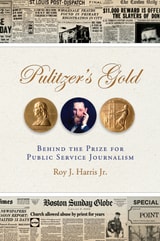
Pulitzer's Gold
Behind the Prize for Public Service JournalismRoy J. Harris, Jr.
University of Missouri Press, 2008
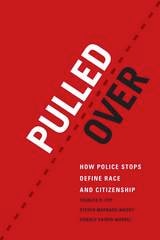
Pulled Over
How Police Stops Define Race and CitizenshipCharles R. Epp, Steven Maynard-Moody, and Donald P. Haider-Markel
University of Chicago Press, 2014
Pulled Over deftly traces the strange history of the investigatory police stop, from its discredited beginning as “aggressive patrolling” to its current status as accepted institutional practice. Drawing on the richest study of police stops to date, the authors show that who is stopped and how they are treated convey powerful messages about citizenship and racial disparity in the United States. For African Americans, for instance, the experience of investigatory stops erodes the perceived legitimacy of police stops and of the police generally, leading to decreased trust in the police and less willingness to solicit police assistance or to self-censor in terms of clothing or where they drive. This holds true even when police are courteous and respectful throughout the encounters and follow seemingly colorblind institutional protocols. With a growing push in recent years to use local police in immigration efforts, Hispanics stand poised to share African Americans’ long experience of investigative stops.
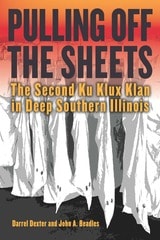
Pulling off the Sheets
The Second Ku Klux Klan in Deep Southern IllinoisDarrel Dexter and John A. Beadles
Southern Illinois University Press, 2024
WINNER, Certificate of Excellence in “Scholarly Publications” from the Illinois State Historical Society’s 2025 Best of Illinois History Awards!
Unmasking old-time racism in southern Illinois
Pulling off the Sheets tells the previously obscured history of the Second Ku Klux Klan which formed in deep southern Illinois in the early 1920s. Through meticulous research into both public and private records, Darrel Dexter and John A. Beadles recount the Klan’s mythical origins, reemergence, and swift disappearance. This important historical account sets out to expose the lasting impact of the Klan on race relations today.
The ideation of the Klan as a savior of the white race and protector of white womanhood was perpetuated by books, plays, and local news sources of the time. The very real but misplaced fear of Black violence on whites created an environment in which the Second Klan thrived, and recruitment ran rampant in communities such as the Protestant church. Events like the murder of Daisy Wilson intensified the climate of racial segregation and white supremacy in the region, and despite attempts at bringing justice to the perpetrators, most failed. The Second Klan’s presence may have been short-lived, but the violence and fear it inflicted continues to linger.
This disturbing historical account challenges readers to “pull back the sheet” and confront the darkest corners of their past. Dexter and Beadles emphasize the importance of acknowledging the damage that white supremacy and racism cause and how we can move toward healing.
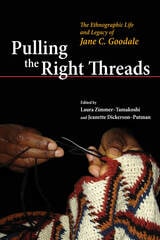
Pulling the Right Threads
The Ethnographic Life and Legacy of Jane C. GoodaleEdited by Laura Zimmer-Tamakoshi and Jeanette Dickerson-Putman
University of Illinois Press, 2007
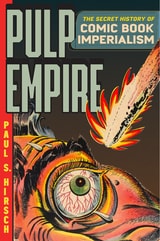
Pulp Empire
The Secret History of Comic Book ImperialismPaul S. Hirsch
University of Chicago Press, 2021
In the 1940s and ’50s, comic books were some of the most popular—and most unfiltered—entertainment in the United States. Publishers sold hundreds of millions of copies a year of violent, racist, and luridly sexual comics to Americans of all ages until a 1954 Senate investigation led to a censorship code that nearly destroyed the industry. But this was far from the first time the US government actively involved itself with comics—it was simply the most dramatic manifestation of a long, strange relationship between high-level policy makers and a medium that even artists and writers often dismissed as a creative sewer. In Pulp Empire, Paul S. Hirsch uncovers the gripping untold story of how the US government both attacked and appropriated comic books to help wage World War II and the Cold War, promote official—and clandestine—foreign policy and deflect global critiques of American racism.
As Hirsch details, during World War II—and the concurrent golden age of comic books—government agencies worked directly with comic book publishers to stoke hatred for the Axis powers while simultaneously attempting to dispel racial tensions at home. Later, as the Cold War defense industry ballooned—and as comic book sales reached historic heights—the government again turned to the medium, this time trying to win hearts and minds in the decolonizing world through cartoon propaganda.
Hirsch’s groundbreaking research weaves together a wealth of previously classified material, including secret wartime records, official legislative documents, and caches of personal papers. His book explores the uneasy contradiction of how comics were both vital expressions of American freedom and unsettling glimpses into the national id—scourged and repressed on the one hand and deployed as official propaganda on the other. Pulp Empire is a riveting illumination of underexplored chapters in the histories of comic books, foreign policy, and race.
Pulpits of the Lost Cause
The Faith and Politics of Former Confederate Chaplains during ReconstructionSteve Longenecker
University of Alabama Press, 2023
A comparison of the faith and politics of former Confederate chaplains with intriguing insights about the evolution of their postwar beliefs and the Lost Cause
Pulpits of the Lost Cause: The Faith and Politics of Former Confederate Chaplains during Reconstruction is the first in-depth study of former chaplains that juxtaposes their religion and politics, thereby revealing important insights about the Lost Cause movement. Steve Longenecker demonstrates that while some former chaplains vigorously defended the Lost Cause and were predictably conservative in the pulpit, embracing orthodoxy and resisting religious innovation, others were unexpectedly progressive and advocated on behalf of evolution, theological liberalism, and modern biblical criticism.
Former Confederate chaplains embodied both the distinctive white, Southern, regional identity and the variation within it. Most were theologically conservative and Lost Cause racists. But as with the larger South, variation abounded. The Lost Cause, which Longenecker interprets as a broad popular movement with numerous versions, meant different things to different chaplains. It ranged from diehard-ism to tempered sectional forgiveness to full reconciliation to a harmless once-a-year Decoration Day ritual.
This volume probes the careers of ten former chaplains, including their childhoods, wartime experiences, Lost Cause personas, and theologies, making use of manuscripts and published sermons as well as newspapers, diaries, memoirs, denominational periodicals, letters, and the books they themselves produced. In theology, many former chaplains were predictably conservative, while others were unexpectedly broad-minded and advocated evolution, theological liberalism, and modern Biblical criticism. One former chaplain became a social-climbing Harvard progressive. Another wrote innovative, liberal theology read by European scholars. Yet another espoused racial equality, at least in theory if not full practice. Additionally, former chaplains often exhibited the fundamental human trait of compartmentalization, most notably by extolling the past as they celebrated the Lost Cause while simultaneously looking to the future as religious progressives or New South boosters. The stereotypical preacher of the Lost Cause—a gray-clad Bible thumper—existed sufficiently to create the image but hardly enough to be universally accurate.
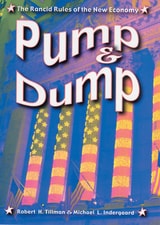
Pump and Dump
The Rancid Rules of the New EconomyTillman, Robert H
Rutgers University Press, 2005
In Pump and Dump: The Rancid Rules of the New Economy,Robert H. Tillman and Michael L. Indergaard argue that these scandals are symptoms of a corporate governance problem that began in the 1990s as New Economy pundits claimed that advances in technology and forms of business organization were changing the rules. A decade later, it looked more like a case of no rules. Endless revelations of fraud in the wake of corporate bankruptcies left ordinary investors bewildered and employees out of work with little or nothing.
Tillman and Indergaard observe that victims were taken in by organized behavior that calls to mind “pump and dump” schemes where shadowy swindlers push penny stocks. Yet, in the 1990s it was high-profile firms and high-status accomplices (financial analysts, bankers, and accountants) who used powerful institutional levers to pump the value of stock—duping investors while insiders sold their holdings for fantastic profits before the crash.
The authors explain how it was that so much of corporate America came to resemble a two-bit securities scam by focusing on the rules that mattered in three critical industries—energy trading, telecommunications, and dot-coms. Free-market hype and policies at the national level set the tone. While Wall Street wrapped itself in star-spangled packaging and celebrated its purported “democratization,” in the real halls of democracy congressional allies of business gutted protections for ordinary investors. In the regulatory vacuum that resulted, business professionals who were supposed to watch corporations instead promoted New Economy doctrines and worked with executives to tout their firms as New Economy contenders. Ringleaders in the inner circles that committed fraud made their own rules, which they enforced through a mix of bribery and bullying.
At a time when there is growing debate about proposals to privatize programs like Social Security and to promote an “ownership society,” Pump and Dump offers a path-breaking analysis of America’s most urgent economic problem: a system that relies on self-regulation and the rancid politics that continue to support the short-term interests of financial elites over the long-term interests of most Americans.
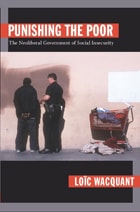
Punishing the Poor
The Neoliberal Government of Social InsecurityLoïc Wacquant
Duke University Press, 2009
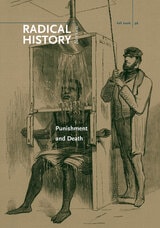
Punishment and Death
The Need for Radical Analysis, Volume 2006Ethan Blue and Patrick Timmons, eds.
Duke University Press, 0
The issue’s contributors—comprising both academics and activists—examine the practices of punishment and death imposed upon citizens, particularly through penal systems. One contributor exposes how the indignation and outrage many Americans expressed toward the military torture at Abu Ghraib do not extend to similar instances of torture (beatings, “shower-baths,” sexual abuse, etc.) against inmates of color within the U.S. prison system. Another contributor reflects on the unexpected but effective alliance between antiprison activists and the environmental justice movement in California, which worked to stop the massive prison-building boom of the late twentieth and early twenty-first centuries. Bringing a longer sweep of Western colonialism into view, another essay reveals the racial prejudices within disciplinary processes of Puerto Rico that lingered even after the island’s emancipation from the Spanish American empire, leading to unequal distribution of punishment on both colonial and domestic subject populations.
Contributors. Ethan Blue, Rose Braz, Helena Cobban, Craig Gilmore, Alan Eladio Gómez, R. J. Lambrose, Heather Jane McCarty, Dylan Rodríguez, Kelvin Santiago-Valles, Carolyn Strange, Patrick Timmons
Punishment and Inequality in America
Bruce Western
Russell Sage Foundation, 2006
Punishment and Political Order
Keally McBride
University of Michigan Press, 2007
Most of us think of punishment as an ugly display of power. But punishment also tells us something about the ideals and aspirations of a people and their government. How a state punishes reveals whether or not it is confident in its own legitimacy and sovereignty. Punishment and Political Order examines the questions raised by the state’s exercise of punitive power—from what it is about human psychology that desires sanction and order to how the state can administer pain while calling for justice. Keally McBride's book demonstrates punishment's place at the core of political administration and the stated ideals of the polity.
"From start to finish this is a terrific, engaging book. McBride offers a fascinating perspective on punishment, calling attention to its utility in understanding political regimes and their ideals. She succeeds in reminding us of the centrality of punishment in political theory and, at the same time, in providing a framework for understanding contemporary events. I know of no other book that does as much to make the subject of punishment so compelling."
—Austin Sarat, Amherst College
"Punishment and Political Order will be welcome reading for anyone interested in understanding law in society, punishment and political spectacle, or governing through crime control. This is a clear, accessible, and persuasive examination of punishment—as rhetoric and reality. Arguing that punishment is a complex product of the social contract, this book demonstrates the ways in which understanding the symbolic power and violence of the law provides analytical tools for examining the ideological function of prison labor today, as well as the crosscutting and contingent connections between language and identity, legitimation and violence, sovereignty and agency more generally."
—Bill Lyons, Director, Center for Conflict Management, University of Akron
"Philosophical explorations of punishment have often stopped with a theory of responsibility. McBride's book moves well beyond this. It shows that the problem of punishment is a central issue for any coherent theory of the state, and thus that punishment is at the heart of political theory. This is a stunning achievement."
—Malcolm M. Feeley, University of California at Berkeley
Keally McBride is Assistant Professor of Politics at the University of San Francisco.

Punitive Damages
How Juries DecideCass R. Sunstein, Reid Hastie, John W. Payne, David A. Schkade, and W. Kip Viscu
University of Chicago Press, 2002
But how do juries actually make decisions about punitive damages? To find out, the authors-experts in psychology, economics, and the law-present the results of controlled experiments with more than 600 mock juries involving the responses of more than 8,000 jury-eligible citizens. Although juries tended to agree in their moral judgments about the defendant's conduct, they rendered erratic and unpredictable dollar awards. The experiments also showed that instead of moderating juror verdicts, the process of jury deliberation produced a striking "severity shift" toward ever-higher awards. Jurors also tended to ignore instructions from the judges; were influenced by whatever amount the plaintiff happened to request; showed "hindsight bias," believing that what happened should have been foreseen; and penalized corporations that had based their decisions on careful cost-benefit analyses. While judges made many of the same errors, they performed better in some areas, suggesting that judges (or other specialists) may be better equipped than juries to decide punitive damages.
Using a wealth of new experimental data, and offering a host of provocative findings, this book documents a wide range of systematic biases in jury behavior. It will be indispensable for anyone interested not only in punitive damages, but also jury behavior, psychology, and how people think about punishment.
Punjabi Rebels of the Columbia River
The Global Fight for Indian Independence and CitizenshipJohanna Ogden
Oregon State University Press, 2024
Oregon is commonly perceived to have little, let alone notable, South Asian history. Yet in the early 1900s Oregon was at the center of two entwined quests for Indian independence and civic belonging that rocked the world.
Punjabi Rebels of the Columbia River traces the stories of the radical Indian independence organization known as Ghadar and Bhagat Singh Thind’s era-defining US Supreme Court citizenship case. Ghadar sought the overthrow of India’s British colonizers while Thind utilized sanctioned legal channels to do so. Despite widely differing strategies, both the movement and the man were targeted, often in coordination, by the highest levels of the US and British governments. The empires’ united message: India would not be an independent country and Indians could not be citizens. In the decades that followed, it was a verdict Indians refused to abide.
Johanna Ogden’s detailed history of migrants’ experience expands the time frame, geographic boundaries, and knowledge of the conditions and contributions of Indians in North America. It is the story of a people’s awakening amid a rich community of international workers in an age of nationalist uprisings. To understand why one of the smallest western Indian settlements became a resistance center, Punjabi Rebels mines the colonial underpinnings of labor, race, and place-making and their regional and global connections, rendering a history of whiteness and labor as much as of Indian-ness and migration. The first work to rejoin the lived experience of Thind and Ghadar activists, Punjabi Rebels complicates our understanding not just of the global fight for Indian political rights but of multi-racial democracy.
Punk Slash! Musicals
Tracking Slip-Sync on FilmBy David Laderman
University of Texas Press, 2010
Punk Slash! Musicals is the first book to deal extensively with punk narrative films, specifically British and American punk rock musicals produced from roughly 1978 to 1986. Films such as Jubilee, Breaking Glass, Times Square, Smithereens, Starstruck, and Sid and Nancy represent a convergence between independent, subversive cinema and formulaic classical Hollywood and pop musical genres.
Guiding this project is the concept of "slip-sync." Riffing on the commonplace lip-sync phenomenon, "slip-sync" refers to moments in the films when the punk performer "slips" out of sync with the performance spectacle, and sometimes the sound track itself, engendering a provocative moment of tension. This tension frequently serves to illustrate other thematic and narrative conflicts, central among these being the punk negotiation between authenticity and inauthenticity.
Laderman emphasizes the strong female lead performer at the center of most of these films, as well as each film's engagement with gender and race issues. Additionally, he situates his analyses in relation to the broader cultural and political context of the neo-conservatism and new electronic audio-visual technologies of the 1980s, showing how punk's revolution against the mainstream actually depends upon a certain ironic embrace of pop culture.

Punks in Peoria
Making a Scene in the American HeartlandJonathan Wright and Dawson Barrett
University of Illinois Press, 2021
Synonymous with American mediocrity, Peoria was fertile ground for the boredom- and anger-fueled fury of punk rock. Jonathan Wright and Dawson Barrett explore the do-it-yourself scene built by Peoria punks, performers, and scenesters in the 1980s and 1990s. From fanzines to indie record shops to renting the VFW hall for an all-ages show, Peoria's punk culture reflected the movement elsewhere, but the city's conservatism and industrial decline offered a richer-than-usual target environment for rebellion. Eyewitness accounts take readers into hangouts and long-lost venues, while interviews with the people who were there trace the ever-changing scene and varied fortunes of local legends like Caustic Defiance, Dollface, and Planes Mistaken for Stars. What emerges is a sympathetic portrait of a youth culture in search of entertainment but just as hungry for community—the shared sense of otherness that, even for one night only, could unite outsiders and discontents under the banner of music.
A raucous look at a small-city underground, Punks in Peoria takes readers off the beaten track to reveal the punk rock life as lived in Anytown, U.S.A.

Pup and Pokey
Seth Kantner
University of Alaska Press, 2014
Gently inspired by the fable of “The Lion and the Mouse,” Pup and Pokey teaches young readers about living in the wilderness and the sometimes unexpected connections that arise in our lives. Pup and Pokey is the first children’s book from acclaimed Alaska author Seth Kantner. With Kantner’s storytelling and Beth Hill’s original illustrations, Pup and Pokey is a touching outdoor adventure story that only two talented Alaskans could tell.

Pura Belpré Awards
Celebrating Latino Authors and IllustratorsRose Zertuche Treviño
American Library Association, 2006

Purchasing Population Health
Paying for ResultsDavid A. Kindig
University of Michigan Press, 1997
Pure Adulteration
Cheating on Nature in the Age of Manufactured FoodBenjamin R. Cohen
University of Chicago Press, 2019
In the latter nineteenth century, extraordinary changes in food and agriculture gave rise to new tensions in the ways people understood, obtained, trusted, and ate their food. This was the Era of Adulteration, and its concerns have carried forward to today: How could you tell the food you bought was the food you thought you bought? Could something manufactured still be pure? Is it okay to manipulate nature far enough to produce new foods but not so far that you question its safety and health? How do you know where the line is? And who decides?
In Pure Adulteration, Benjamin R. Cohen uses the pure food crusades to provide a captivating window onto the origins of manufactured foods and the perceived problems they wrought. Cohen follows farmers, manufacturers, grocers, hucksters, housewives, politicians, and scientific analysts as they struggled to demarcate and patrol the ever-contingent, always contested border between purity and adulteration, and as, at the end of the nineteenth century, the very notion of a pure food changed.
In the end, there is (and was) no natural, prehuman distinction between pure and adulterated to uncover and enforce; we have to decide. Today’s world is different from that of our nineteenth-century forebears in many ways, but the challenge of policing the difference between acceptable and unacceptable practices remains central to daily decisions about the foods we eat, how we produce them, and what choices we make when buying them.

Pure Beauty
Judging Race in Japanese American Beauty PageantsRebecca Chiyoko King-O’Riain
University of Minnesota Press, 2006
Purging the Poorest
Public Housing and the Design Politics of Twice-Cleared CommunitiesLawrence J. Vale
University of Chicago Press, 2013

Puritan Spirits in the Abolitionist Imagination
Kenyon Gradert
University of Chicago Press, 2020
Puritan Spirits in the Abolitionist Imagination reveals how the leaders of the nineteenth-century abolitionist movement—from landmark figures like Ralph Waldo Emerson to scores of lesser-known writers and orators—drew upon the Puritan tradition to shape their politics and personae. In a striking instance of selective memory, reimagined aspects of Puritan history proved to be potent catalysts for abolitionist minds. Black writers lauded slave rebels as new Puritan soldiers, female antislavery militias in Kansas were cast as modern Pilgrims, and a direct lineage of radical democracy was traced from these early New Englanders through the American and French Revolutions to the abolitionist movement, deemed a “Second Reformation” by some. Kenyon Gradert recovers a striking influence on abolitionism and recasts our understanding of puritanism, often seen as a strictly conservative ideology, averse to the worldly rebellion demanded by abolitionists.
Purity in Print
Book Censorship in America from the Gilded Age to the Computer AgePaul S. Boyer
University of Wisconsin Press, 2002
The first edition of Purity in Print documented book censorship in America from the 1870s to the 1930s, embedding it within the larger social and cultural history of the time. In this second edition, Boyer adds two new chapters carrying his history forward to the beginning of the twenty-first century.
Purple Passages
Pound, Eliot, Zukofsky, Olson, Creeley, and the Ends of Patriarchal PoetryRachel Blau DuPlessis
University of Iowa Press, 2012
Purple Power
The History and Global Impact of SEIUEdited by Luís LM Aguiar and Joseph A. McCartin
University of Illinois Press, 2023
Luís LM Aguiar and Joseph A. McCartin edit essays on one of contemporary labor’s bedrock organizations. The contributors explore key episodes, themes, and features in the union’s recent history and evaluate SEIU as a union with global aspirations and impact. The first section traces the SEIU’s growth in the last and current centuries. The second section offers in-depth studies of key campaigns in the United States, including the Justice for Janitors and Fight for $15 movements. The third section focuses on the SEIU’s work representing low-wage workers in Canada, Australia, Europe, and Brazil. An interview with Justice for Janitors architect Stephen Lerner rounds out the volume.
Contributors: Luís LM Aguiar, Adrienne E. Eaton, Janice Fine, Euan Gibb, Laurence Hamel-Roy, Tashlin Lakhani, Joseph A. McCartin, Yanick Noiseux, Benjamin L. Peterson, Allison Porter, Alyssa May Kuchinski, Maite Tapia, Veronica Terriquez, and Kyoung-Hee Yu

Purshia
The Wild And Bitter RosesJames A. Young
University of Nevada Press, 2002
A useful and complete summary of all the scientific information available on one of the most significant plant species in the western and intermountain regions. Among the plant species of the great Basin rangeland, the Purshia—ancient members of the rose family evolved to survive the aridity and temperature extremes of this harsh region—are one of the most important. This book-length study of this key plant species provides a comprehensive examination of the biology and ecology of the species and region.

Pursuing Opportunitites Through Partnerships
Higher Education and CommunitiesBRUCE A. BEHRINGER
West Virginia University Press, 2004
In 1998, the W.W. Kellogg Foundation provided funding for four universities to collaborate with surrounding communities on mutually beneficial projects, through the Expanding Community Partnerships Program. In a series of innovative learning collaborations, East Tennessee University, the University of Texas at El Paso, West Virginia University, and Northeastern University established strong, sustainable partnerships with organizations in their local communities. Although each university approached its partnering differently, they all shared the goal of benefiting the underserved communities where they are located and transforming their institutions by enhancing students’ educational experiences and strengthening faculty, student, administration, and staff relationships with local residents. This book shares those relationship-building experiences of the four universities and communities. Highly recommended for all public and higher education administrators; for students and teachers of education, business, and sociology; and for those interested in innovative business and social-service models.
Pursuit of Justices
Presidential Politics and the Selection of Supreme Court NomineesDavid Alistair Yalof
University of Chicago Press, 1999
Yalof draws on the papers of seven modern presidents, from Truman to Reagan, and firsthand interviews with key figures, such as Ramsey Clark, Edwin Meese, and President Gerald Ford. He documents and analyzes the selection criteria these presidents used, the pool of candidates from which they chose, their strategies, and the political pressures affecting their decisions, both successes and failures. Yalof also disputes much conventional wisdom about the selection process, including the widely held view that presidents choose nominees primarily to influence future decisions of the high court. In a substantial epilogue, Yalof offers insightful observations about the selections of Presidents George Bush and Bill Clinton.
By focusing on a neglected area of presidential politics, Yalof offers a fascinating and unprecedented glimpse into the intricate world of executive branch decisionmaking and the Supreme Court appointment process as a whole.
Winner of the 2000 Richard E. Neustadt Award for Best Book on the American Presidency
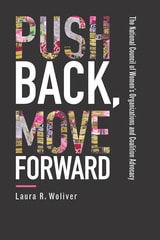
Push Back, Move Forward
The National Council of Women's Organizations and Coalition AdvocacyLaura R. Woliver
Temple University Press, 2018
The coalition known as the National Council of Women’s Organizations no longer exists today, but the history and the lessons learned from the NCWO’s activism remain as important as ever—perhaps even more so in this age of Trump. Laura Woliver spent fifteen years doing fieldwork and conducting research and interviews to understand how the NCWO coalition group functioned. The result is her impressive study, Push Back, Move Forward.
Woliver explores the foundational work of the NCWO and member groups to promote women’s economic security, citizen status, and political rights. She investigates women’s access to previously “male only” organizations, such as private clubs; the increase in voter participation generated by measures such as early voting; advocacy campaigns for such benefit programs as Social Security and the Affordable Care Act; and global human and women’s rights activism. In addition, she examines the accomplishments of women of color, both alongside and within the NCWO, who orient their politics toward achieving justice and attaining rights.
Push Back, Move Forward artfully documents this important group’s activities while also gleaning larger lessons about coalition organizations.
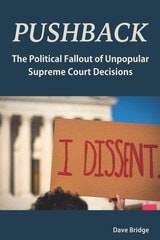
Pushback
The Political Fallout of Unpopular Supreme Court DecisionsDave Bridge
University of Missouri Press, 2024
Certain to appeal to anyone interested in American political science and history, Pushback closes with a detailed examination of the unequivocally countermajoritarian Supreme Court ruling of our lifetimes, Dobbs v. Jackson Women’s Health Organization, which overturned Roe. For the first time in 50 years, conditions are ripe for a party to win votes by campaigning against the will of the Court. Upcoming elections will tell if the Republicans overplayed their hand, or if Democrats will play theirs as skillfully as did the GOP after Roe.
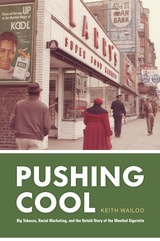
Pushing Cool
Big Tobacco, Racial Marketing, and the Untold Story of the Menthol CigaretteKeith Wailoo
University of Chicago Press, 2021
Police put Eric Garner in a fatal chokehold for selling cigarettes on a New York City street corner. George Floyd was killed by police outside a store in Minneapolis known as “the best place to buy menthols.” Black smokers overwhelmingly prefer menthol brands such as Kool, Salem, and Newport. All of this is no coincidence. The disproportionate Black deaths and cries of “I can’t breathe” that ring out in our era—because of police violence, COVID-19, or menthol smoking—are intimately connected to a post-1960s history of race and exploitation.
In Pushing Cool, Keith Wailoo tells the intricate and poignant story of menthol cigarettes for the first time. He pulls back the curtain to reveal the hidden persuaders who shaped menthol buying habits and racial markets across America: the world of tobacco marketers, consultants, psychologists, and social scientists, as well as Black lawmakers and civic groups including the NAACP. Today most Black smokers buy menthols, and calls to prohibit their circulation hinge on a history of the industry’s targeted racial marketing. In 2009, when Congress banned flavored cigarettes as criminal enticements to encourage youth smoking, menthol cigarettes were also slated to be banned. Through a detailed study of internal tobacco industry documents, Wailoo exposes why they weren’t and how they remain so popular with Black smokers.

Pushing the Envelope
The American Aircraft IndustryDonald M. Pattillo
University of Michigan Press, 2001
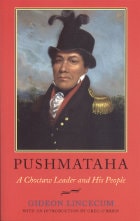
Pushmataha
A Choctaw Leader and His PeopleGideon Lincecum, with an introdution by Greg O'Brien
University of Alabama Press, 2004
Comprises two valuable, original, and difficult-to-find pieces on Choctaw history and culture that originally appeared in the 1904 and 1906 volumes of Publications of the Mississippi Historical Society
This important book comprises two articles that appeared in the 1904 and 1906 volumes of Publications of the Mississippi Historical Society. In “Life of Apushimataha,” Gideon Lincecum tells the story of Choctaw chief Pushmataha, who was born in Mississippi in 1764. A fearless warrior, his name literally means “one whose tomahawk is fatal in war or hunting.” As a charismatic leader, his foresight in making an alliance with General Andrew Jackson brought the Choctaws into war with the Creek Nation and into the War of 1812 but served to their benefit for many years with the United States government. In 1824, Pushmataha traveled to Washington, DC, to negotiate the Treaty of Doak’s Stand as pressure grew for Choctaw removal to Oklahoma Territory, but he fell ill and died there. He was buried with full military honors in the Congressional Cemetery at Arlington.
In “Choctaw Traditions about Their Settlement in Mississippi and the Origin of Their Mounds,” Lincecum translates a portion of the Skukhaanumpula—the traditional history of the tribe, which was related to him verbally by Chata Immataha, “the oldest man in the world, a man that knew everything.” It explains how and why the sacred Nanih Waya mound was erected and how the Choctaws formed new towns, and it describes the structure of leadership roles in their society.

Putting Assessment Into Action
Selected ProjectsEric Ackermann
Assoc of College & Research Libraries, 2015
Putting Assessment into Action
Selected Projects from the First Cohort of the Assessment in Action GrantEric Ackermann
Assoc of College & Research Libraries, 2015
Putting Faith in Partnerships
Welfare-to-Work in Four CitiesStephen V. Monsma
University of Michigan Press, 2004
In this groundbreaking study of a politically controversial topic---the debut offering in Alan Wolfe's Contemporary Political and Social Issues series---author Stephen Monsma avoids overheated rhetoric in favor of a careful, critical analysis of the hard evidence on whether public-private partnerships really work.
The book is based on in-depth studies of social service programs in Los Angeles, Chicago, Philadelphia, and Dallas. By examining public-private partnerships between government offices and nonprofit organizations, Monsma seeks to understand how these partnerships affect the balance between government's efforts to deal with social problems and the rights of individual citizens to control their own lives.
Putting Faith in Partnerships answers many previously unanswered questions in what may be the most controversial public policy debate today: about the feasibility and wisdom of government agencies forming partnerships with private organizations to provide essential public social services.
Stephen V. Monsma is Professor of Political Science at Pepperdine University. He has served as director of the Office of Quality Review in Michigan's Department of Social Services and is a widely recognized expert on the role of faith-based organizations in social service programs.
Putting Inequality in Context
Class, Public Opinion, and Representation in the United StatesChristopher Ellis
University of Michigan Press, 2017
Christopher Ellis argues citizens’—and legislators’—views of class politics are driven by lived experience in particular communities. While some experience is formally political, on an informal basis citizens learn a great deal about their position in the broader socioeconomic spectrum and the social norms governing how class intersects with day-to-day life. These factors are important for policymakers, since most legislators do not represent “the public” at large, but specific constituencies.
Focusing on U.S. congressional districts as the contextual unit of interest, Ellis argues individuals’ political behavior cannot be separated from their environment, and shows how income’s role in political processes is affected by the contexts in which citizens and legislators interact. Political inequality exists in the aggregate, but it does not exist everywhere. It is, rather, a function of specific arrangements that depress the political influence of the poor. Identifying and understanding these factors is a crucial step in thinking about what reforms might be especially helpful in enhancing equality of political voice.
Putting On Appearances
Gender and AdvertisingDiane Barthel
Temple University Press, 1989
In this lively critical analysis, Diane Barthel reveals the previously overlooked and underestimated depth of cultural meaning behind contemporary American advertising. Focusing mainly on ads for beauty products directed at women, she demonstrates how stereotypical gender identities are emphasized and how advertising itself creates a gendered relationship with the consumer. She explores psychological, sociological, and cultural messages in advertising to show how Putting on Appearances is anything but a purely personal matter, and how the social realities in which we are forced to live are conditioned by the personal appearances we choose to create.
Most advertisements are not sexually obvious, but rely instead on sexual story-telling in which seduction, deception, and passion are portrayed as acceptable means for achieving selfhood. Advertisements that proclaim, "Now is the time to paint your knees" speak with one form of authority: those that present the voice of the all-knowing scientist or the nurturing mother rely on others. Celebrities figure as professional beauties and wise older sisters, sharing their secrets with the consumer. "The Gentle Treatment Great Model Search Made Me a Star. Now it’s your turn."
Inseparable from the clothes we wear and the products we use are our ideas and fantasies about our bodies. Beauty products present beauty rituals as transcendent occasions, and diet products call up religious imagery of guilt and salvation. The body itself is to be anxiously manipulated and systematically worked over until the consumer "turns her body into...an advertisement for herself, a complicated sign to be read and admired."
In the series Women in the Political Economy, edited by Ronnie J. Steinberg.
Putting Poor People to Work
How the Work-First Idea Eroded College Access for the PoorKathleen M. Shaw
Russell Sage Foundation, 2006
Putting Their Hands on Race
Irish Immigrant and Southern Black Domestic WorkersDanielle T. Phillips-Cunningham
Rutgers University Press, 2020
Putting Their Hands on Race offers an important labor history of 19th and early 20th century Irish immigrant and US southern Black migrant domestic workers. Drawing on a range of archival sources, this intersectional study explores how these women were significant to the racial labor and citizenship politics of their time. Their migrations to northeastern cities challenged racial hierarchies and formations. Southern Black migrant women resisted the gendered racism of domestic service, and Irish immigrant women strove to expand whiteness to position themselves as deserving of labor rights. On the racially fractious terrain of labor, Black women and Irish immigrant women, including Victoria Earle Matthews, the “Irish Rambler”, Leonora Barry, and Anna Julia Cooper, gathered data, wrote letters and speeches, marched, protested, engaged in private acts of resistance in the workplace, and created women’s institutions and organizations to assert domestic workers’ right to living wages and protection.

Putting the Horse before Descartes
My Life's Work on Behalf of AnimalsAuthored by Bernard Rollin
Temple University Press, 2011
When philosopher Bernard Rollin was six years old, he visited an animal shelter and was told about unwanted dogs being put to sleep. The event shaped his moral outlook and initiated his concern for how animals were treated. In his irreverent memoir, Putting the Horse before Descartes, Rollin provides an account of how he came to educate himself and others about the ethical treatment of animals and work toward improvements in animal welfare.
Rollin describes, in witty, often disarming detail, how he became an outspoken critic of how animals were being treated in veterinary and medical schools as well as in research labs. Putting the Horse before Descartes showcases the passionate animal advocate at his best. He recalls teaching veterinary students about ethical issues. He also recalls face-offs with ranchers and cowboys about branding methods and roping competitions in rodeos. In addition, he describes his work to legally mandate more humane conditions for agricultural and laboratory animals. As public concern about animal welfare and the safety of the food supply heighten, Rollin carries on this work all over the world—in classrooms, lecture halls and legislatures, meetings of agricultural associations and industrial settings, as well as in print.
Putting the Horse before Descartes, ultimately, is more than a memoir. Rollin offers a wide-ranging discussion of ethical issues in many settings and he testifies to the myriad ways that people of good conscience accept their ethical responsibility in regard to animals.
Putting the Humanities PhD to Work
Thriving in and beyond the ClassroomKatina L. Rogers
Duke University Press, 2020

Pyrocene Park
A Journey into the Fire History of Yosemite National ParkStephen J. Pyne
University of Arizona Press, 2023
In the last decade, fire has blasted into public attention. California’s blazes have captured national and global media interest with their drama and urgency. Expand the realm of fire to include the burning of fossil fuels, and the fire story also subsumes climate change. Renowned fire historian Stephen J. Pyne argues that the relationship between fire and humans has become a defining feature of our epoch, and he reveals how Yosemite offers a cameo of how we have replaced an ice age with a fire age: the Pyrocene.
Organized around a backcountry trek to a 50-year experiment in restoring fire, Pyrocene Park describes the 150-year history of fire suppression and management that has led us, in part, to where the park is today. But there is more. Yosemite’s fire story is America’s, and the Earth’s, as it shifts from an ice-informed world to a fire-informed one. Pyrocene Park distills that epic story into a sharp miniature.
Flush with people, ideas, fires, and controversy, Pyrocene Park is a compelling and accessible window into the American fire scene and the future it promises.

purplish
poetry anger publicsJosé Felipe Alvergue
University of Iowa Press, 2025
purplish challenges the idea of an objective or unbiased cultural rationale to purple regions in America by historicizing how anger has been systemically cleansed from the collective sentiments regarding nation-building throughout key moments of our national heritage.