Results by title
5550 books match the query 'Biography & Autobiography' and 171 start with p
Percy Bysshe Shelley
Poet and RevolutionaryJaqueline Mulhallen
Pluto Press, 2015
An engaging look at one of English history and literature’s most compelling, complicated, and talented figures, Percy Bysshe Shelley will be a valuable contribution to our understanding of the man and his work.

Perennial Ceremony
Lessons and Gifts from a Dakota GardenTeresa Peterson
University of Minnesota Press, 2024
Travel through a garden’s seasons toward healing, reclamation, and wholeness—for us, and for our beloved relative, the Earth
In this rich collection of prose, poetry, and recipes, Teresa Peterson shares how she found refuge from the struggle to reconcile her Christianity and Dakota spirituality, discovering solace and ceremony in communing with the earth. Observing and embracing the cycles of her garden, she awakens to the constant affirmation that healing and wellness can be attained through a deep relationship with land, plants, and waters. Dakota people call this way of seeing and being in the world mitakuye owasin: all my relations. Perennial Ceremony brings us into this relationship, as Peterson guides us through the Dakota seasons to impart lessons from her life as a gardener, gatherer, and lover of the land.
We see the awakening of Wetu (spring), a transitional time when nature comes alive and sweet sap flows from maples, and the imperfect splendor of Bdoketu (summer), when rain becomes a needed and nourishing gift. We share in the harvesting wisdom of Ptaŋyetu (fall), a time to savor daylight and reap the garden’s abundance, and the restorative solitude of Waniyetu (winter), when snow blankets the landscape and sharpens every sound. Through it all, Peterson walks with us along the path that both divides and joins Christian doctrine, everyday spiritual experience, and the healing powers of Indigenous wisdom and spirituality.
In this intimate seasonal cycle, we learn how the garden becomes a healing balm. Peterson teaches us how ceremony may be found there: how in the vegetables and flowers, the woods, the hillsides, the river valley—even in the feeding of friends and family—we can reclaim and honor our relationship with Mother Earth. She encourages us to bring perennial ceremony into our own lives, inviting us on a journey that brings us full circle to makoce kiŋ mitakuye: the land is my relative.
Perfect Dirt
And Other Things I've Gotten WrongKeegan Lester
West Virginia University Press, 2021
Words have meaning and meaning evolves over time. In Perfect Dirt, Keegan Lester drags us through his failure to grasp the meaning that always seems to be just beyond his fingertips. These lyrical vignettes depict a lifelong search for home, identity, and the language to say the things we wish we could tell people in the moment.
Born in Southern California to parents who had migrated from West Virginia and South Florida, Lester spent summers with his grandparents in Morgantown, which instilled a deep anchor of place that continued to call to him, an Appalachian at heart even while living in New York City as a poet. As small successes started to come his way—a book and numerous tours—so did crises. Lester’s father, meanwhile, experiencing his own life crisis, embarked on a journey to sail the Caribbean. Both end up lost.
Part memoir, part tour diary, part homage to the places and people who have made him who he is, Perfect Dirt digs into the sometimes painful, sometimes jubilant questions of identity and success. This is a book searching to better understand the world and our place in it, the family we’re born into, and the family we make along the way.
Performing Chance
The Art of Alison Knowles In/Out of FluxusNicole L. Woods
University of Chicago Press, 2026
Alison Knowles stands out as the sole female artist among the founders of Fluxus, yet she has remained an enigmatic, underrecognized figure in the history of art. Performing Chance fills a gap in the record, bringing to light Knowles’s transformative body of work as it evolved from abstract painting in the late 1950s, to silkscreens, print media, and performance in the early 1960s, to groundbreaking works in digital poetry, acoustical art, and large-scale installations in the late 1960s-70s.
Through her access to previously unpublished archival materials and direct interviews with the artist, Nicole L. Woods provides close readings of pivotal works, disclosing the ways Knowles instituted formal tactics that moved beyond modernist painting, championed principles of indeterminacy and chance, and fostered sociopolitical consciousness. Situating Knowles’s innovations in various media within the distinct cultural contexts of Wiesbaden, London, Paris, New York City, and Los Angeles, Performing Chance brings this key artist back to her rightful place as a leader of the postwar avant-garde and provides a nuanced history of the role of women artists in Fluxus and beyond.
Peril in the Ponds
Deformed Frogs, Politics, and a Biologist's QuestJudy Helgen
University of Massachusetts Press, 2012
By the 1990s, wetlands across the United States were endangered from pollution and decades of drainage to convert them into farmland and urban developments. But when deformed frogs—many with missing legs or eyes, footless stumps, or misshapen jaws—began to emerge from Minnesota wetlands, alarm bells went off. What caused such deformities? Pollution? Ultraviolet rays? Biological agents? And could the mysterious cause also pose a threat to humans?
Judy Helgen writes with passionate concern about vulnerable frogs and wetlands as she navigates through a maze of inquisitive media and a reluctant government agency. She reports on the complexity of a growing catastrophe for frogs and broadens the issue as she researches and meets with scientists from around the world. She affirms the importance of examining aquatic life to understand pollution and the need to rescue our remaining wetlands. She also shares the fears expressed by the teachers, students, and other citizens who found these creatures, sensed a problem, and looked to her for answers. Ultimately, this is a story about the biological beauty of wetlands and our need to pay attention to the environment around us.
Period Piece
Gwen Raverat
University of Michigan Press, 1991
Permafrost Is an Archive
and Other Inheritances from the Alaska-Yukon BorderlandsCorinna Cook
West Virginia University Press, 2026
The Yukon Ice Patch Project reveals ancient lives. A road through the boreal forest reads like a map of climate upheaval. Those houses with broken doorknobs—a legacy of government regulation over Indigenous life. Corinna Cook, who was born white on Áak’w Kwáan Tlingit land in Juneau, Alaska, wrestles with the past and future into Canada’s Yukon Territory. With writing that blends research and reverie, her essays ask how we might come into right relations with our most difficult, shared histories. How can we carry the past together, in a good way, as the land melts? The answers—elusive as they are—carry global resonance, taking shape through a deeply personal lens combined with careful study of local arts, artifacts, maps, and the land we depend on.
Persevered
A Maternal Mental Health MemoirKara Zivin
Ohio University Press, 0
If you think you know what mental health during and after pregnancy looks like, Persevered: A Maternal Mental Health Memoir will make you reconsider. Dr. Kara Zivin offers a rare, unfiltered look at what happened when a respected mental health researcher faced her own grave battle with depression and anxiety during and after pregnancy. This book is a raw personal account of surviving the darkest moments of new motherhood while juggling high expectations at home and at work.
Zivin takes the reader on an intimate and eye-opening journey that weaves together her perinatal medical records, journal entries, research, and imperfect memories. The story unfolds across hospital rooms, the author’s home, and the university where she works, highlighting the complexity of holding on to one’s identity when everything feels uncertain. Zivin writes with striking honesty about the confusion, guilt, and isolation that so many mothers experience alone but rarely admit to others. Her willingness to lay bare her struggles and her gradual journey toward hope and recovery makes every page feel authentic and deeply relatable.
Persevered moves beyond one woman’s survival, breaking the silence that still surrounds maternal mental health. Zivin’s story reminds us that reaching out, sharing our experiences, and demanding better support can make a difference, not just for mothers but for families and communities. This memoir is for anyone who has ever felt overwhelmed, anyone who has supported a loved one through challenging times, or anyone who believes that honest storytelling can spark real change.

Person and Myth
Maurice Leenhardt in the Melanesian WorldJames Clifford
Duke University Press, 1992
Personal Memoirs of John H. Brinton
Civil War Surgeon, 1861-1865John H. Brinton. Preface by John S. Haller, Jr. Foreword by John Y. Simon
Southern Illinois University Press, 1996
John Hill Brinton (1832–1907) met, observed, and commented on practically the entire hierarchy of the Union army; serving as medical director for Ulysses S. Grant, he came into contact with Philip H. Sheridan, John C. Frémont, Henry W. Halleck, William A. Hammond, D. C. Buell, John A. Rawlins, James Birdseye McPherson, C. F. Smith, John A. McClernand, William S. Rosecrans, and his first cousin George Brinton McClellan. John Y. Simon points out in his foreword that Brinton was one of the first to write about a relatively obscure Grant early in the war:
"Brinton found a quiet and unassuming man smoking a pipe—he could not yet afford cigars— and soon recognized a commander with mysterious strength of intellect and character."
Positioned perfectly to observe the luminaries of the military, Brinton also occupied a unique perspective from which to comment on the wretched state of health and medicine in the Union army and on the questionable quality of medical training he found among surgeons. With both A.B. and A.M. degrees from the University of Pennsylvania and postgraduate training in Paris and Vienna at a time when most medical schools required only a grammar school education, Brinton was exceptional among Civil War doctors. He found, as John S. Haller, Jr., notes in his preface, "the quality of candidates for surgeon’s appointments was meager at best." As president of the Medical Examining Board, Brinton had to lower his standards at the insistence of Secretary of War Edwin Stanton. Haller points out that one "self-educated candidate for an appointment as brigade surgeon explained to the board that he could do ‘almost anything, from scalping an Indian, up and down.’" Brinton assigned this singular candidate to duty in Kansas "where Brinton hoped he would do the least amount of damage." Throughout the war, the dearth of qualified surgeons created problems.
Brinton’s memoirs reveal a remarkable Civil War surgeon, a witness to conditions in Cairo, the Battle of Belmont, and the Siege of Fort Donelson who encountered almost every Union military leader of note.
Brinton wrote his memoirs for the edification of his family, not for public consumption. Yet he was, as Haller notes, a "keen observer of character." And with the exception of Brinton’s acceptance of late nineteenth-century gossip favorable to his cousin General McClellan, Simon finds the memoirs "remarkable for accuracy and frankness." His portrait of Grant is vivid, and his comments on the state of medicine during the war help explain, in Haller’s terms, why the "Civil War was such a medical and human tragedy."

Personal Writings Of Eliza Roxcy Snow
Maureen Beecher
Utah State University Press, 2000

Peter Nielsen’s Story
Niels Thorpe
University of Minnesota Press, 1949
Peter Nielsen's Story was first published in 1949. Minnesota Archive Editions uses digital technology to make long-unavailable books once again accessible, and are published unaltered from the original University of Minnesota Press editions.
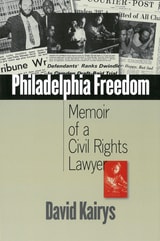
Philadelphia Freedom
Memoir of a Civil Rights LawyerDavid Kairys
University of Michigan Press, 2008
"David Kairys is one of the grand long-distance runners in the struggle for justice in America. His brilliant legal mind and superb lawyerly skills are legendary. This marvelous book is his gift to us!"
---Cornel West, Professor of Religion and African American Studies, Princeton University, and award-winning author of Race Matters
Philadelphia Freedom is the spellbinding tale of an idealistic young lawyer coming of age in the political cauldron of the 1960s and 1970s. From his immersion in the civil rights movement to his determined court battles to quell criminal violence by Philadelphia police, Kairys recounts how he helped make history in the city of brotherly love."
---William K. Marimow, Editor and Executive Vice President, Philadelphia Inquirer, and recipient of two Pulitzer Prizes
"In the current climate of political deception and the trampling of our civil rights, Kairys's compelling book is a clenched fist, a prayer for social justice and a call to conscience."
---Steve Lopez, Los Angeles Times columnist and former Philadelphia Inquirer columnist
"With engaging, insider stories of innovative legal strategies of a truly creative lawyer, this book evokes the ebullient spirit of progressive social change launched in the 1960s and should be read by aspiring and practicing lawyers as well as anyone interested in American social history. Philadelphia Freedom reads like a suspense novel and reveals how novel legal and political thinking can and does make a real difference to individuals and to the quality of justice."
---Martha L. Minow, Jeremiah Smith, Jr. Professor of Law, Harvard University
"David Kairys's compelling book properly explains the vital role that civil rights attorneys play in our system of justice."
---Judge John E. Jones III, United States District Court for the Middle District of Pennsylvania, and presiding judge in the landmark Kitzmiller v. Dover Area School District case
A memoir that is also a compelling page-turner, Philadelphia Freedom is the poignant, informative, often inspiring account of renowned civil-rights lawyer David Kairys's personal quest for achieving social justice during the turbulent 1960s and 70s.
Philadelphia Freedom brings us intimately and directly into Kairys's burgeoning law career and the struggles of the 60s as his professional and private life navigated the turmoil and promise of the civil rights and antiwar movements.
Many of the cases Kairys took on involved discrimination and equal protection, freedom of speech, and government malfeasance. Kairys is perhaps most well known for his victory in the Camden 28 draft board case, in which the FBI set up a sting of the Catholic anti-war left at the behest of the highest levels of government.
The stories and cases range from nationally important and recognizable---the family of the scientist the CIA unwittingly gave LSD in the 1950s; the leading race discrimination case against the FBI; Dr. Benjamin Spock's First Amendment case before the Supreme Court; the city handgun lawsuits Kairys conceived---to those he encountered in his early work as a public defender. The characters include public figures such as FBI Directors J. Edgar Hoover and Louis Freeh; CIA Director William Colby; Pennsylvania Senator Arlen Specter; New York Attorney General Eliot Spitzer; U.S. Attorneys General Edward Levi and John Mitchell; Georgia Governor Lester Maddox; Pennsylvania Governor, former Philadelphia Mayor, and Democratic National Committee chair Ed Rendell; Philadelphia Mayor and Police Commissioner Frank Rizzo. But some of the most memorable are not well known, involving regular people caught up in the often heartless machinery of the courts and legal system.
Though it reads like a novel, with all the elements of character, plot, and suspense, Philadelphia Freedom also has historical significance as a firsthand account of the 1960s and 70s and contains social commentary about race as well as insights and major perspectives on the nature and social role of law.
David Kairys is Professor of Law at Beasley School of Law, Temple University. He was a full-time civil rights lawyer from 1968 to 1990.
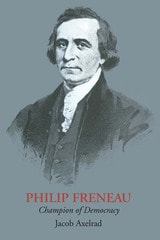
Philip Freneau
Champion of DemocracyBy Jacob Axelrad
University of Texas Press, 1967
Philip Freneau was a poet, editor, and mariner. A graduate of Princeton, he was the roommate of James Madison and a classmate of Hugh Henry Brackenridge and Aaron Burr. When the colonies rebelled against England, he supported his newly born nation as a privateer, spending some time in a British prison as a result. He also served, more effectively, as “the poet of the Revolution.” Later he became the journalistic voice of the democrats.
Ardently devoted to liberty, he believed himself to be a defender of the common man, for whom he fought selflessly and often vitriolicly throughout his life. In newspapers such as The Freeman’s Journal, The New York Daily Advertiser, The National Gazette, The Jersey Chronicle, and The Time-Piece, he published articles, letters, and poems, instructing the citizens of the new Republic about their rights, and attacking those who, he believed, were infringing on those rights. In the midst of the controversy in which he was so often involved, he also found time to write a small body of poetry whose sensitivity and beauty mark him as the poetic equal of his European contemporaries, and, in fact, as a precursor of the new Romantic movement
In Philip Freneau: Champion of Democracy Jacob Axelrad provides a detailed biography of this pensman of the Revolution and early Republic. He gives a sympathetic, imaginative, perceptive, yet objective interpretation of Freneau and his place in history, and at the same time he presents a delightfully readable and clear picture of the period during which the poet lived.
These pages not only re-create the battles between Whig and Tory, federalist and democrat, but they also are alive with the activities and philosophies of the men who made American history. James Madison, Thomas Jefferson, Alexander Hamilton, George Washington, John Adams, James Monroe go about the business of creating and shaping a new country, and as they do, they move into and out of the life of the poet of Monmouth, influencing him in a variety of ways.
Above all, Axelrad brings to life for the reader the man Freneau: simple, direct, often uncritical in his devotion to the cause he believed in; courageous in sustaining his stand against strong opposition; disillusioned and pessimistic about human nature, yet boldly optimistic about the future of humanity and of his country. And always behind the furor the reader is aware of the man struggling to provide a living for himself and his family, and never quite succeeding.
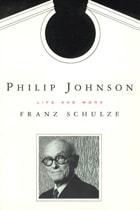
Philip Johnson
Life and WorkFranz Schulze
University of Chicago Press, 1996
The only child of a wealthy Midwestern family, Philip Johnson was a millionaire by the time he graduated from Harvard, and in 1932 he helped stage the historic International Style exhibition at the Museum of Modern Art. A patron of the arts and a political activists who flirted with the politics of Hitler, Huey Long, and Father Coughlin, he went on to create controversial and historical structures such as the Glass House, the Roofless Church, the AT & T Building, the Crystal Cathedral, and many more. Johnson's personal charms paired with his manipulative ploys—like his "borrowing" of designs—shine through in this biography.
Drawing on Johnson's correspondence, personal photographs, and speeches, and on interviews with his friends and contemporaries, Schulze fills the biography with fascinating information on the architect's family, travels, friends and lovers, and his many buildings and spaces themselves.
Franz Schulze is a professor of art at Lake Forest College. He is the author of Fantastic Images: Chicago Art since 1945, One Hundred Years of Chicago Architecture, and Mies van der Rohe: A Critical Biography.
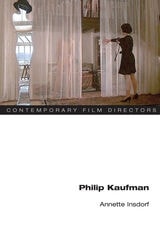
Philip Kaufman
Annette Insdorf
University of Illinois Press, 2012
Philip Pendleton Barbour in Jacksonian America
An Old Republican in King Andrew’s CourtWilliam S. Belko
University of Alabama Press, 2016
Barbour, a Virginia lawyer, participated in America’s transition from a mostly republican government to a truer majority democracy, notably while serving as the twelfth Speaker of the United States House of Representatives and later as an associate justice of the United States Supreme Court. After being elected to the US Congress during the War of 1812, Barbour also emerged as one of the foremost champions of states’ rights, consistently and energetically fighting against expansions of federal powers. He, along with other Jeffersonian Old Republicans, opposed federal plans for a national tariff and internal improvements. Later, Barbour became one of the first Jeffersonian politicians to join the Jacksonian Democrats in Jackson’s war against a national bank.
Barbour continued to make crucial strides in support of states’ rights after taking his seat on the United States Supreme Court in 1836 under Chief Justice Roger Taney. He contributed to the Charles River Bridge v. Warren Bridge and Briscoe v. Bank of Kentucky decisions, which bolstered states’ rights. He also delivered the opinion of the court in New York v. Miln, which provided the basis for the State Police Powers Doctrine.
Expertly interweaving biography, history, political science, and jurisprudence, Philip Pendleton Barbour in Jacksonian America remembers the man whose personal life and career were emblematic of the decades in which the United States moved from the Age of Jefferson to the Age of Jackson, contributing to developments that continue to animate American politics today.
Philippe Aries and the Politics of French Cultural History
Patrick H. Hutton
University of Massachusetts Press, 2004
The author of Centuries of Childhood and other landmark historical works, Philippe Ariès (1914–1984) was a singular figure in French intellectual life. He was both a political reactionary and a path-breaking scholar, a sectarian royalist who supported the Vichy regime and a founder of the new cultural history—popularly known as l'histoire des mentalités—that developed in the decades following World War II. In this book, Patrick H. Hutton explores the relationship between Ariès's life and thought and evaluates his contribution to modern historiography, in France and abroad.
According to Hutton, the originality of Ariès's work and the power of his appeal derived from the way he drew together the two strands of his own intellectual life: his enduring ties to the old cultural order valued by the right-wing Action Française, and a newfound appreciation for the methodology of the leftist Annales school of historians. A demographer by training, he pioneered a new route into the history of private life that eventually won him a wide readership and in late life an appointment to the faculty of the prestigious École des Hautes Études en Sciences Sociales. At the same time, he fashioned himself as a man of letters in the intellectual tradition of the Action Française and became a perspicacious journalist as well as a stimulating writer of autobiographical memoirs. In Hutton's view, this helps explain why, more than any other historian, Philippe Ariès left his personal signature on his scholarship.
Philo T Farnsworth
Donald Godfrey
University of Utah Press, 2001
Philo T. Farnsworth (1906–1971) has been called the "forgotten father of television." He grew up in Utah and southern Idaho, and was described as a genius by those who knew and worked with him. With only a high school education, Farnsworth drew his first television schematic for his high school teacher in Rigby, Idaho. Subsequent claims and litigation notwithstanding, he was the first to transmit a television image.
Farnsworth filed ten patents between 1927 and 1929 for camera tubes (transmitting), circuitry, and the cathode ray tube (viewing). After his early years as an inventor in San Francisco, he worked as an engineer, doing battle with RCA in the 1930s over patent rights, formed the Farnsworth Television Company in the 1940s, and worked for IT&T after their purchase of the Farnsworth enterprises. Every television set sold utilized at least six of his basic patents.
Because of endless legal wrangling with RCA over patent rights, he received very little financial reward for his television patents. Donald Godfrey examines the genius and the failures in the life of Philo Farnsworth as he struggled to be both inventor and entrepreneur.
Philosophical Writings
Simone de Beauvoir; Edited by Margaret A. Simons with Marybeth Timmermann and Mary Beth Mader;Foreword by Sylvie Le Bon de Beauvoir
University of Illinois Press, 2021
Beauvoir's philosophical work suffers from a lack of English-language translation or, worse, mistranslation into heavily condensed popular versions. Philosophical Writings provides an unprecedented collection of complete, scholarly editions of philosophical texts that cover the first twenty-three years of Beauvoir's career, including a number of recently discovered works. Ranging from metaphysical literature to existentialist ethics, Philosophical Writings brings together diverse elements of Beauvoir's work while highlighting continuities in the development of her thought. Each of the translations features detailed notes and a scholarly introduction explaining its larger significance.
Revelatory and long overdue, Philosophical Writings adds to the ongoing resurgence of interest in Beauvoir's thought and to her growing influence on today's philosophical curriculum.
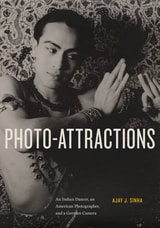
Photo-Attractions
An Indian Dancer, an American Photographer, and a German CameraAjay Sinha
Rutgers University Press, 2022
Art historian Ajay Sinha uses these hitherto unpublished photographs and archival research to raise provocative and important questions about photographic technology, colonial histories, race, sexuality and transcultural desires. Challenging the assumption that Gopal was merely objectified by Van Vechten’s Orientalist gaze, he explores the ways in which the Indian dancer co-authored the photos. In Sinha’s reading, Van Vechten’s New York studio becomes a promiscuous contact zone between world cultures, where a “photo-erotic” triangle is formed between the American photographer, Indian dancer, and German camera.
A groundbreaking study of global modernity, Photo-Attractions brings scholarship on American photography, literature, race and sexual economies into conversation with work on South Asian visual culture, dance, and gender. In these remarkable historical documents, it locates the pleasure taken in cultural difference that still resonates today.
Photographic
The Life of Graciela IturbideIsabel Quintero
J. Paul Getty Trust, The, 2021
Renowned Mexican photographer Graciela Iturbide was born in Mexico City in 1942, the oldest of thirteen children. When tragedy strikes Graciela as a young mother, she turns to photography for solace and understanding.
From then on Graciela embarks on a photographic journey that takes her throughout her native Mexico, from the Sonora Desert to Juchitán to Frida Kahlo’s bathroom, and then to the United States, India, and beyond.
Photographic is a symbolic, poetic, and deeply personal graphic biography of this iconic photographer. Graciela’s journey will excite young adults and budding photographers, who will be inspired by her resolve, talent, and curiosity.
Ages twelve and up
Physician to the World
The Life of General William C. GorgasJohn M. Gibson
University of Alabama Press, 1989
The remarkable story of the physician whose public health victories changed the world.
Physician to the World by John M. Gibson is a study of the career of William Crawford Gorgas, focusing primarily on the 22 years from the Spanish-American War until his death at the age of 65. The book details the medical community’s gradual acceptance of the mosquito theory as the cause for yellow fever epidemics and follows Gorgas as his initial skepticism gave way to belief while he participated in Walter Reed’s massive cleanup of Havana. From this success Gorgas moved to the Panama Canal Zone and a bureaucratic quagmire as he attempted to apply sanitary principles there to control yellow fever and malaria. As canal construction proceeded, assorted red-tape and critics repeatedly thwarted Gorgas’s efforts. His particular nemesis was the imperious engineer George Goethals, who ruled the construction project with an iron hand. Gorgas’s dogged persistence to make Panama healthy for both Americans and natives eventually succeeded, enabling the project to be completed with minimum loss of life. During World War I Gorgas became U.S. Surgeon General, and finally his reputation equaled his accomplishments. He traveled widely in Europe, South Africa, and South America on behalf of public health improvements and was about to begin another such journey when he died of complications from a stroke in London in 1920.
Picasso and the Chess Player
Pablo Picasso, Marcel Duchamp, and the Battle for the Soul of Modern ArtLarry Witham
University Press of New England, 2013
Pickin’ Cotton on the Way to Church
The Life and Work of Father Boniface Hardin, OSBNancy Van Note Chism
Indiana Historical Society Press, 2019
Pierre Guyotat et l’Algérie
Edited by Catherine Brun, Guillaume Fau, and Donatien Grau
Diaphanes, 2024
Pierre Guyotat est une figure majeure, avant même Tombeau pour cinq cent mille soldats et bien au-delà, de la mémoire de la guerre d’indépendance algérienne. Idiotie est l’une des œuvres récentes les plus importantes sur ce sujet. C’est le fait de la guerre, vécue en appelé jugé récalcitrant et mis au cachot, mais aussi des voyages post-indépendance, de la rencontre avec la langue, la géologie, la faune et la flore algériennes, de la défense publique de Mohamed Laïd Moussa. Les fictions, les carnets sont marqués par l’empreinte de la terre, des langues, des corps algériens.
Guyotat contribua aussi à établir, dans la création et l’action publique, des relations nouvelles avec l'Algérie, ses auteurs, comme avec celles et ceux qui, en France, venaient de ce pays.
Cet ouvrage offre la parole à des figures de la recherche et de la création issues d’Algérie, de France et d’ailleurs. Il permet de découvrir un regard unique sur l’Algérie, affectueux et savant, celui d’un des plus grands auteurs de langue française.
Contributions de Ferroudja Allouache, Amina Azza Bekkat, Catherine Brun, Donatien Grau, Denis Hollier, Karima Lazali, Gérard Nguyen Van Khan, Philippe Roger, Tiphaine Samoyault, Nadia Sebkhi, Todd Shepard, Noura Wedell.
Pieter Geyl and Britain
Encounters, Controversies, ImpactEdited by Stijn van Rossem and Ulrich Tiedau
University of London Press, 2022
Pieter Geyl (1887—1966) was undoubtedly one of the most internationally renowned Dutch historians of the twentieth century, but also one of the most controversial. Having come to the United Kingdom as a journalist, he started his academic career at the University of London in the aftermath of World War I and played an important role in the early days of the Institute of Historical Research. Known in this time for his reinterpretation of the sixteenth-century Dutch Revolt against the Habsburgs that challenged existing historiographies of both Belgium and the Netherlands but was also linked to his political activism in favor of the Flemish movement in Belgium, Geyl left his stamp on the British perception of Low Countries history before moving back to his country of origin in 1935. Having spent World War II in German hostage camps, he famously coined the adage of history being “a discussion without end” and reengaged in public debates with British historians after the war, partly conducted on the airwaves of the BBC. A prolific writer and an early example of a public intellectual, Geyl remains one of the most influential thinkers on history of his time. The present volume reexamines Geyl’s relationship with Britain (and the Anglophone world at large) and sheds new light on his multifaceted work as a historian, journalist, homme de lettres, and political activist.
Piip, Meierovics & Voldemaras
The Baltic StatesCharlotte Alston
Haus Publishing, 2010
Pilgram Marpeck
His Life and Social TheologyStephen B. Boyd
Duke University Press, 1992
Drawing on extensive archival data documenting Marpeck’s professional life, as well as on his numerous published and unpublished writings on theology and religious reform, Stephen B. Boyd traces Marpeck’s unconventional transition from mining magistrate to Anabaptist leader, establishes his connections with various radical social and religious groups, and articulates aspects of his social theology. Marpeck’s distinctive and eclectic theology, Boyd demonstrates, focused on the need for personal, uncoerced conversion, rejected state interference in the affairs of the church, denied the need for a monastic withdrawal from the secular world, and called for the Christian’s active pursuit of justice before God and among human beings.
Pilgrimage to Dollywood
A Country Music Road Trip through TennesseeHelen Morales
University of Chicago Press, 2014
In Pilgrimage to Dollywood, Morales sets out to discover Parton’s Tennessee. Her travels begin at the top celebrity pilgrimage site of Elvis Presley’s Graceland, then take her to Loretta Lynn’s ranch in Hurricane Mills; the Country Music Hall of Fame and the Grand Ole Opry in Nashville; to Sevierville, Gatlinburg, and the Great Smoky Mountains National Park; and finally to Pigeon Forge, home of the “Dolly Homecoming Parade,” featuring the star herself as grand marshall. Morales’s adventure allows her to compare the imaginary Tennessee of Parton’s lyrics with the real Tennessee where the singer grew up, looking at essential connections between country music, the land, and a way of life. It’s also a personal pilgrimage for Morales. Accompanied by her partner, Tony, and their nine-year-old daughter, Athena (who respectively prefer Mozart and Miley Cyrus), Morales, a recent transplant from England, seeks to understand America and American values through the celebrity sites and attractions of Tennessee.
This celebration of Dolly and Americana is for anyone with an old country soul who relies on music to help understand the world, and it is guaranteed to make a Dolly Parton fan of anyone who has not yet fallen for her music or charisma.
Pillar of Salt
An Autobiography, with 19 Erotic SonnetsBy Salvador Novo, Translated by Marguerite Feitlowitz, Introduction by Carlos Monsiváis
University of Texas Press, 2014
Written with exquisite sensitivity and wit, this memoir by one of Mexico’s foremost men of letters describes coming of age during the violence of the Mexican Revolution and “living dangerously” as an openly homosexual man in a brutally machista society.
Salvador Novo (1904–1974) was a provocative and prolific cultural presence in Mexico City through much of the twentieth century. With his friend and fellow poet Xavier Villaurrutia, he cofounded Ulises and Contemporáneos, landmark avant-garde journals of the late 1920s and 1930s. At once “outsider” and “insider,” Novo held high posts at the Ministries of Culture and Public Education and wrote volumes about Mexican history, politics, literature, and culture. The author of numerous collections of poems, including XX poemas, Nuevo amor, Espejo, Dueño mío, and Poesía 1915–1955, Novo is also considered one of the finest, most original prose stylists of his generation.
Pillar of Salt is Novo’s incomparable memoir of growing up during and after the Mexican Revolution; shuttling north to escape the Zapatistas, only to see his uncle murdered at home by the troops of Pancho Villa; and his initiations into literature and love with colorful, poignant, complicated men of usually mutually exclusive social classes. Pillar of Salt portrays the codes, intrigues, and dynamics of what, decades later, would be called “a gay ghetto.” But in Novo’s Mexico City, there was no name for this parallel universe, as full of fear as it was canny and vibrant. Novo’s memoir plumbs the intricate subtleties of this world with startling frankness, sensitivity, and potential for hilarity. Also included in this volume are nineteen erotic sonnets, one of which was long thought to have been lost.
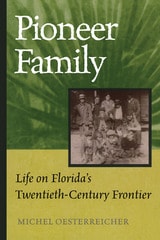
Pioneer Family
Life on Florida's Twentieth-Century FrontierMichel Oesterreicher
University of Alabama Press, 1996
Tracing the roots of resilience on the American frontier.
Pioneer Family is based on the recollections of Hugie and Oleta Oesterreicher, who lived in rural northeast Florida in the early decades of the twentieth century. Northeast Florida was still frontier country then, and Hugie and Oleta were pioneers. Although the time and setting of their story are particular, the theme of survival during hard times is universal. Born in a cypress cabin on the edge of the great Durbin Swamp located midway between St. Augustine and Jacksonville, Hugie knew every alligator hole, every bog, every creek; he could dry venison so it lasted without refrigeration for months, could build a potato bank that kept potatoes warm all winter, and put down a well without machinery. He knew how to cope with rattlesnakes and moccasins. Early one morning in 1925, Hugie fell in love with a tall, brown-eyed girl as he passed her place on a cattle drive. He courted this girl, Oleta Brown, with no success at first, but finally they were married in 1927.
Their daughter retells their story from vivid accounts they gave of their childhood, courtship, early years of marriage, and struggles during the Great Depression. In an age bereft of heroes, the story of their courage, their faith, and their commitment provides a fascinating empathy with a time that has passed; a place that has disappeared.
Pioneer Printer
Samuel Bangs in Mexico and TexasBy Lota M. Spell
University of Texas Press, 1963
Samuel Bangs, the first printer in the territory that is now Texas, once owed his life to his printing press. One of the few survivors of the Mina Expedition to Mexico in 1817, Bangs wrote to Servando de Mier, “I had the good fortune, through the will of God, to have my life saved, as I was a printer.”
Bangs was not always so fortunate. Losses and disappointments plagued him throughout his career, and he spent many miserable months in Mexican jails. But his ingenuity in the face of adversity, his courage and charm, stamped him not only as a storybook hero but as a man whose virtues were large enough to be their own reward.
Lota Spell’s fine biography of Samuel Bangs is at the same time a fascinating history of northern Mexico (including Texas) in the first half of the nineteenth century. Through the successes and failures of an individual it presents the facts about the operation of a business during a time of important political and economic change.
Even more important is its contribution to our knowledge of printing and of the contemporary periodical press. Although first of all a printer, Samuel Bangs was also involved in the production of newspapers, making this book a detailed history of journalism in the Mexico and Texas of his day. His printing office also functioned as a typographer’s school, through which he instituted the apprentice system in the Southwest; and as a result of his interest in presses as a commodity of trade, the first business for merchandising and servicing printing presses in the area was developed.
This narrative, combining the story of a man’s life, the history of his times, and the development of his profession, fills a gap in our knowledge of Mexico and Texas, and does it with perception and charm.
Pirouettes on a Postage Stamp
An Interview-Novel with Questions Asked and Answers Recorded by László SzigetiBohumil Hrabal
Karolinum Press, 2008
Pirouettes on a Postage Stamp carried Hrabal’s experimentation to the field of autobiography. On its surface a verbatim record of an oral interview conducted by Hungarian journalist László Szigeti, the book confuses and confounds with false starts, digressions, and philosophical asides. Yet despite all the games and distractions, Hrabal’s personality shines through, compelling and unforgettable, making Pirouette on a Postage Stamp an unexpected treat for any lover of Czech literature.
Place Envy
Essays in Search of OrientationMichael Lowenthal
The Ohio State University Press, 2026
Growing up in places where his family had no past, and met mostly by silence from his Holocaust-refugee grandparents, Michael Lowenthal longed to be from somewhere. Then he realized he was gay and felt displaced from his own displaced family. Place Envy—his first book of essays after five acclaimed books of fiction—chronicles his quest for orientation in the world: as an agnostic Jew, as a queer traveler and lover, and as a writer who can tell or twist the truth. Yearning for a queer lineage, he obsesses about an uncle who perished at Bergen-Belsen but then finds, in his grandmother’s German hometown, a more surprising legacy. He lives with a Pennsylvania Amish family; accompanies blind gay men on a Mexican cruise; plays jazz with Sun Ra, the Afrofuturist who claimed to hail from Saturn; and pursues a clarifying love affair in Brazil. Collectively, these essays recount Lowenthal’s many journeys of dislocation and relocation: to foreign countries and subcultures and to the riskiest shores of family and self.
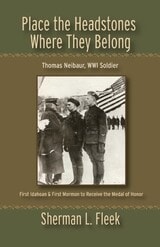
Place the Headstones Where They Belong
Thomas Neibaur, World War 1 SoldierSherman L. Fleek
Utah State University Press, 2008
young Thomas Neibaur found himself in the core of the American Expeditionary Force’s most important offensive.
After becoming separated in advance of his unit, he, despite serious wounds, single-handedly stopped a German
counterattack at a critical hill known as Côte de Châtillon. For this remarkable feat of valor, he received the Medal of
Honor and other awards, becoming the first Idaho and first Mormon recipient of the nation’s highest combat award.
But after a heroic return and brief celebrity, his life followed a tragic downward arc, culminating in his attempt to return
his medal because, as he put it, it could not feed his family.
Places in the Bone
A MemoirDine, Carol
Rutgers University Press, 2005
In a series of unflinching vignettes laced with heartbreak and often with humor, Places in the Bone gives an unforgettable account of loss and survival, childhood secrets banished from memory, and the power of language to retrieve the missing parts of oneself and one’s past. Woven together with unmistakable lyricism, Carol Dine’s narrative moves back and forth in time and place—from the childhood bedroom that fills her with fear, to a hospital room after her surgery for breast cancer, to an adobe hut in a New Mexico artists’ colony where she escapes and finds her voice.
This voice, it turns out, is a chorus—a harmony of cries, both anguished and triumphant. Among them we hear a young girl speak about the abuse by her father; we hear the tormented reflections of a mother who, for several years after a divorce, loses contact with her young son; and we hear the testimony of a cancer survivor. Through it all, we feel the determination, courage, and creativity of a woman who has spent more than two decades confronting her past, her body, and her identity. Despite her struggles, Dine finds positive influences in her life, including her mentor, Anne Sexton, who recognizes the fire in her words, and Stanley Kunitz, whose indomitable spirit provides enduring inspiration.
More than a story of personal loss, the memoir moves us with its humanity, its unnerving wit, and its defiant faith. As the fragments come together, we experience Dine’s joy in living and her reconciliation with the past that allow her to renew bonds with her son, her sister, and her mother. In page after page, we witness the power of art to refigure a body, to transform suffering, and ultimately, to redeem.
Plague Years
A Doctor's Journey through the AIDS CrisisRoss A. Slotten, MD
University of Chicago Press, 2020
This is an auto-narrated audiobook edition of this book.
In 1992, Dr. Ross A. Slotten signed more death certificates in Chicago—and, by inference, the state of Illinois—than anyone else. As a family physician, he was trained to care for patients from birth to death, but when he completed his residency in 1984, he had no idea that many of his future patients would be cut down in the prime of their lives. Among those patients were friends, colleagues, and lovers, shunned by most of the medical community because they were gay and HIV positive. Slotten wasn’t an infectious disease specialist, but because of his unique position as both a gay man and a young physician, he became an unlikely pioneer, swept up in one of the worst epidemics in modern history.
Plague Years is an unprecedented first-person account of that epidemic, spanning not just the city of Chicago but four continents as well. Slotten provides an intimate yet comprehensive view of the disease’s spread alongside heartfelt portraits of his patients and his own conflicted feelings as a medical professional, drawn from more than thirty years of personal notebooks. In telling the story of someone who was as much a potential patient as a doctor, Plague Years sheds light on the darkest hours in the history of the LGBT community in ways that no previous medical memoir has.
Plague Years
A Doctor’s Journey through the AIDS CrisisRoss A. Slotten, MD
University of Chicago Press, 2020
Plague Years is an unprecedented first-person account of that epidemic, spanning not just the city of Chicago but four continents as well. Slotten provides an intimate yet comprehensive view of the disease’s spread alongside heartfelt portraits of his patients and his own conflicted feelings as a medical professional, drawn from more than thirty years of personal notebooks. In telling the story of someone who was as much a potential patient as a doctor, Plague Years sheds light on the darkest hours in the history of the LGBT community in ways that no previous medical memoir has.
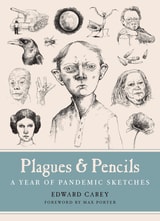
Plagues and Pencils
A Year of Pandemic SketchesEdward Carey, with a foreword by Max Porter
University of Texas Press, 2022
Honorable Mention, 2022 Nonfiction Prize, Writers' League of Texas
A remarkable collection of words and illustrations documenting the first year of the pandemic.
In March 2020, as lockdowns were imposed around the world, author and illustrator Edward Carey raced home to Austin, Texas. The next day, he published on social media a sketch of “A Very Determined Young Man.” The day after, he posted another drawing. One year and one hundred and fifty Tombow B pencil stubs later, he was still drawing.
Carey’s pencil fills the page with the marvelous and intriguing, picturing people, characters, animals, monsters, and his favorite bird to draw, the grackle. He reaches into history and fiction to escape grim reality through flights of vivid imagination—until events demand the drawings “look straight on.”
Breonna Taylor, the Brontë sisters, John Lewis, King Lear, and even the portraits that mark the progress of the year for the Very Determined Young Man combine into a remarkable document of the pandemic and its politics. For Carey, though, trapped inside a home he loves, these portraits are something more, a way to chart time, an artist’s way of creating connection in isolation. With an introduction by Max Porter, this exceptional collection from the acclaimed author of Little marks a year of a man trapped with his pencil, determined to find solace amid uncertainty.
Plain Folk
The Life Stories of Undistinguished AmericansEdited by David M. Katzman and William M. Tuttle, Jr.
University of Illinois Press, 1982
Plain
A Memoir of Mennonite GirlhoodMary Alice Hostetter
University of Wisconsin Press, 2022
This quietly powerful memoir of longing and acceptance casts a humanizing eye on a little-understood American religious tradition and a woman’s striving to grow within and beyond it.
Plaintext
EssaysNancy Mairs
University of Arizona Press, 1986
Play Like a Man
My Life in Poster ChildrenRose Marshack
University of Illinois Press, 2023
An inside look at a scene and a career, Play Like a Man is the evocative and humorous tale of one woman’s life in the trenches and online.
Playing Hearts
Dan Kois
Duke University Press, 2027
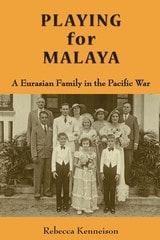
Playing for Malaya
A Eurasian Family in the Pacific WarRebecca Kenneison
National University of Singapore Press, 2011
So begins a stunning personal account of a Eurasian family living in Malaya. One of the many gaps in Reggie's account of his family was that his mother was Eurasian. When Rebecca Kenneison discovered this omission after his death, she set out to learn more about her extended family on the other side of the world. Her voyage of discovery is compelling in itself, but Playing for Malaya has a much larger purpose. Set in the 1930s and 1940s, it recounts the experiences of an extended Eurasian family during the invasion and occupation of Malaya by the Japanese. Colonial society considered Eurasians insufficiently European to be treated as British, but they seemed all too European to the Japanese, who subjected the Eurasian community to discrimination and considerable violence. Because many Eurasians, including members of the Kenneison family, supported the Allied cause, their wartime experiences are an extraordinary account of tragedy, heroism and endurance, presented here with great consequence and clarity.
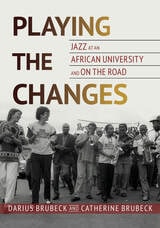
Playing the Changes
Jazz at an African University and on the RoadDarius Brubeck and Catherine Brubeck
University of Illinois Press, 2024
Catherine and Darius Brubeck’s 1983 move to South Africa launched them on a journey that helped transform jazz education. Blending biography with storytelling, the pair recount their time at the University of KwaZulu-Natal, where they built a pioneering academic program in jazz music and managed and organized bands, concerts, and tours around the world.
The Brubecks and the musicians faced innumerable obstacles, from the intensification of apartheid and a lack of resources to the hardscrabble lives that forced even the most talented artists to the margins. Building a program grounded in multi-culturalism, Catherine and Darius encouraged black and white musicians to explore and expand the landscape of South African jazz together Their story details the sometimes wily, sometimes hilarious problem-solving necessary to move the institution forward while offering insightful portraits of South African jazz players at work, on stage, and providing a soundtrack to the freedom struggle and its aftermath.
Frank and richly detailed, Playing the Changes provides insiders’ accounts of how jazz intertwined with struggle and both expressed and resisted the bitter unfairness of apartheid-era South Africa.
Playing the Ponies and Other Medical Mysteries Solved
Stuart B. Mushlin, MD, FACP
Rutgers University Press, 2017
With over forty years of experience as a sought after diagnostician, Dr. Stuart Mushlin has cracked his share of medical mysteries, ones in which there are bigger gambles than playing the ponies at the track. Some of his patients show up with puzzling symptoms, calling for savvy medical detective work. Others seem to present cut-and-dry cases, but they turn out to be suffering from rare or serious conditions.
In Playing the Ponies and Other Medical Mysteries Solved, Dr. Mushlin shares some of the most intriguing cases he has encountered, revealing the twists and turns of each patient’s diagnosis and treatment process. Along the way, he imparts the secrets to his success as a medical detective—not specialized high-tech equipment, but time-honored techniques like closely observing, touching, and listening to patients. He also candidly describes cases where he got things wrong, providing readers with honest insights into both the joys and dilemmas of his job.
Dr. Mushlin does not just treat diseases; he treats people. And this is not just a book about the ailments he diagnosed; it is also about the scared, uncertain, ailing individuals he helped in the process. Filled with real-life medical stories you’ll have to read to believe, Playing the Ponies is both a suspenseful page-turner and a heartfelt reflection on a life spent caring for patients.
Playing with Dynamite
Sharon Harrigan
University of Wisconsin Press, 2017
Playing with Dynamite is about the family secrets that can distance us from each other and the honesty that can bring us closer. It’s about a daughter who goes looking for her father but finds her mother instead. It’s about memory and truth, grieving and growing, and what it means to go home again.
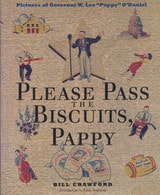
Please Pass the Biscuits, Pappy
Pictures of Governor W. Lee "Pappy" O'DanielBy Bill Crawford
University of Texas Press, 2004
Long before movie stars Ronald Reagan and Arnold Schwarzenegger became governors of California, a popular radio personality with no previous political experience—who wasn't even registered to vote—swept into the governor's office of Texas. W. Lee "Pappy" O'Daniel was a 1930s businessman who discovered the power of radio to sell flour. His musical shows with the Light Crust Doughboys (which launched the career of Bob Wills) and his radio homilies extolling family and Christian values found a vast, enthusiastic audience in Depression-era Texas. When Pappy decided to run for governor in 1938 as a way to sell more flour—a fact he proudly proclaimed throughout the campaign—the people of Texas voted for him in record numbers. And despite the ineptitude for politics he displayed once in office, Texans returned him to the governorship in 1940 and then elected him to the U.S. Senate in 1941 in a special election in which he defeated Lyndon Johnson, as well as to a full term as senator in 1942.
While the hit film O Brother, Where Art Thou? celebrated a fictional "Please Pass the Biscuits, Pappy" O'Daniel, this book captures the essence of the real man through photographs taken by employees of the Texas Department of Public Safety, most of which are previously unpublished. Reminiscent of the work of WPA photographers such as Russell Lee and Dorothea Lange, these photos record the last unscripted era of politics when a charismatic candidate could still address a crowd from an unpainted front porch or a mobile bandstand in the back of a truck. They strikingly confirm that Pappy O'Daniel's ability to connect with people was as great in person as on the radio.
To set the photos in context, Bill Crawford has written an entertaining text that discusses the political landscape in Texas and the United States in the 1930s, as well as the rise of radio as mass medium for advertising and entertainment. He also provides extensive captions for each picture. John Anderson, Photo Archivist of the Texas State Archives, discusses the work of Joel Tisdale and the other DPS photographers who left this extraordinary record of the greatest vote-getter in Texas history, who became one of America's first celebrities to cross the line from entertainment to political office.