Results by title
8113 books match the query 'Literary Criticism' and 405 start with p
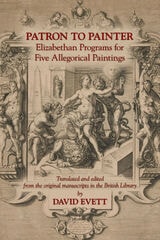
Patron to Painter
Elizabethan Programs for Five Allegorical PaintingsDavid Evett
Arizona Center for Medieval and Renaissance Studies, 2020
Patterns of Epiphany
From Wordsworth to Tolstoy, Pater, and Barrett BrowningMartin Bidney
Southern Illinois University Press, 1997
After explaining his new methodology, Bidney identifies and discusses epiphanies in the works of William Wordsworth, Samuel Taylor Coleridge, Matthew Arnold, Alfred Lord Tennyson, Walter Pater, Thomas Carlyle, Leo Tolstoy, and Elizabeth Barrett Browning. Taking his cue from the French philosopher Gaston Bachelard, Bidney postulates that any writer’s epiphany pattern usually shows characteristic elements (earth, air, fire, water), patterns of motion (pendular, eruptive, trembling), and/or geometric shapes. Bachelard’s analytic approach involves studying patterns of perceived experience—phenomenology—but unlike most phenomenologists, Bidney does not speculate on internal processes of consciousness. Instead, he concentrates on literary epiphanies as objects on the printed page, as things with structures that can be detected and analyzed for their implications.
Bidney, then, first identifies each author’s paradigm epiphany, finding that both the Romantics and the Victorians often label such a paradigm as a vision or dream, thereby indicating its exceptional intensity, mystery, and expansiveness. Once he identifies the paradigm and shows how it is structured, he traces occurrences of each writer’s epiphany pattern, thus providing an inclusive epiphanic portrait that enables him to identify epiphanies in each writer’s other works. Finally, he explores the implications of his analysis for other literary approaches: psychoanalytical, feminist, influence-oriented or intertextual, and New Historical.
Payback
The Case for RevengeThane Rosenbaum
University of Chicago Press, 2013

Peacemakers
Violence and Desire in Native American Myth and FictionScott Richard Lyons
Michigan State University Press, 2027
Employing the mimetic theory of René Girard as its heuristic, Peacemakers offers a unique analysis of Native American myth and fiction. It explores two important founding myths (Lac du Flambeau Ojibwe and Acoma Pueblo) and analyzes four modern novels: three from the Native American Renaissance of the 1960s and 1970s (N. Scott Momaday’s House Made of Dawn, James Welch’s Winter in the Blood, Leslie Marmon Silko’s Ceremony) and the fourth from the twenty-first century (Sherman Alexie’s Flight). While Native American literary criticism typically points to continuities across the traditional-modern divide, Scott Richard Lyons emphasizes a decisive break happening in the progressive era. Following Girard’s theory, Lyons finds that the Indigenous worlds of sacred tradition and secular modernity confront situations of mimetic desire and violence in significantly different ways, given their different cultural resources. Ultimately problems of violence and desire come down to questions of how people can live together peacefully with a sense of meaning and transcendence, questions that are more “religious” than “political.” Thus, the outlook of Peacemakers is more Shakespearian than Marxian.
Peer Gynt
Henrik Ibsen
University of Minnesota Press, 1980
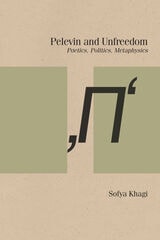
Pelevin and Unfreedom
Poetics, Politics, MetaphysicsSofya Khagi
Northwestern University Press, 2021
Sofya Khagi’s Pelevin and Unfreedom: Poetics, Politics, Metaphysics is the first book-length English-language study of Victor Pelevin, one of the most significant and popular Russian authors of the post-Soviet era. The text explores Pelevin’s sustained Dostoevskian reflections on the philosophical question of freedom and his complex oeuvre and worldview, shaped by the idea that contemporary social conditions pervert that very notion.
Khagi shows that Pelevin uses provocative and imaginative prose to model different systems of unfreedom, vividly illustrating how the present world deploys hyper-commodification and technological manipulation to promote human degradation and social deadlock. Rather than rehearse Cold War–era platitudes about totalitarianism, Pelevin holds up a mirror to show how social control (now covert, yet far more efficient) masquerades as freedom and how eagerly we accept, even welcome, control under the techno-consumer system. He reflects on how commonplace discursive markers of freedom (like the free market) are in fact misleading and disempowering. Under this comfortably self-occluding bondage, the subject loses all power of self-determination, free will, and ethical judgment. In his work, Pelevin highlights the unprecedented subversion of human society by the techno-consumer machine. Yet, Khagi argues, however circumscribed and ironically qualified, he holds onto the emancipatory potential of ethics and even an emancipatory humanism.
Penelope’s Bones
A New History of Homer's World through the Women Written Out of ItEmily Hauser
University of Chicago Press, 2025
Weaving together literary and archaeological evidence, Emily Hauser illuminates the rich, intriguing lives of the real women behind Homer’s Iliad and Odyssey.
Achilles. Agamemnon. Odysseus. Hector. The lives of these and many other men in the greatest epics of ancient Greece have been pored over endlessly in the past three millennia. But these are not just tales about heroic men. There are scores of women as well—complex, fascinating women whose stories have gone unexplored for far too long.
In Penelope’s Bones, award-winning classicist and historian Emily Hauser pieces together compelling evidence from archaeological excavations and scientific discoveries to unearth the richly textured lives of women in Bronze Age Greece—the era of Homer’s heroes. Here, for the first time, we come to understand the everyday lives and experiences of the real women who stand behind the legends of Helen, Briseis, Cassandra, Aphrodite, Circe, Athena, Hera, Calypso, Penelope, and more. In this captivating journey through Homer’s world, Hauser explains era-defining discoveries, such as the excavation of Troy and the decipherment of Linear B tablets that reveal thousands of captive women and their children; more recent finds like the tomb of the Griffin Warrior at Pylos, whose tomb contents challenge traditional gender attributes; DNA evidence showing that groups of warriors buried near the Black Sea with their weapons and steeds were, in fact, Amazon-like female fighters; a prehistoric dye workshop on Crete that casts fresh light on “women’s work” of dyeing, spinning, and weaving textiles; and a superbly preserved shipwreck off the coast of Turkey whose contents tell of the economic and diplomatic networks crisscrossing the Bronze Age Mediterranean.
Essential reading for fans of Madeline Miller or Natalie Haynes, this riveting new history brings to life the women of the Bronze Age Aegean as never before, offering a groundbreaking reassessment of the ancient world.
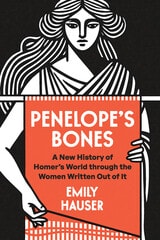
Penelope’s Bones
A New History of Homer’s World through the Women Written Out of ItEmily Hauser
University of Chicago Press, 2025
Achilles. Agamemnon. Odysseus. Hector. The lives of these and many other men in the greatest epics of ancient Greece have been pored over endlessly in the past three millennia. But these are not just tales about heroic men. There are scores of women as well—complex, fascinating women whose stories have gone unexplored for far too long.
In Penelope’s Bones, award-winning classicist and historian Emily Hauser pieces together compelling evidence from archaeological excavations and scientific discoveries to unearth the richly textured lives of women in Bronze Age Greece—the era of Homer’s heroes. Here, for the first time, we come to understand the everyday lives and experiences of the real women who stand behind the legends of Helen, Briseis, Cassandra, Aphrodite, Circe, Athena, Hera, Calypso, Penelope, and more. In this captivating journey through Homer’s world, Hauser explains era-defining discoveries, such as the excavation of Troy and the decipherment of Linear B tablets that reveal thousands of captive women and their children; more recent finds like the tomb of the Griffin Warrior at Pylos, whose tomb contents challenge traditional gender attributes; DNA evidence showing that groups of warriors buried near the Black Sea with their weapons and steeds were, in fact, Amazon-like female fighters; a prehistoric dye workshop on Crete that casts fresh light on “women’s work” of dyeing, spinning, and weaving textiles; and a superbly preserved shipwreck off the coast of Turkey whose contents tell of the economic and diplomatic networks crisscrossing the Bronze Age Mediterranean.
Essential reading for fans of Madeline Miller or Natalie Haynes, this riveting new history brings to life the women of the Bronze Age Aegean as never before, offering a groundbreaking reassessment of the ancient world.
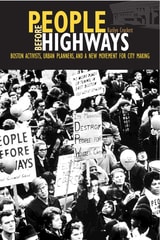
People before Highways
Boston Activists, Urban Planners, and a New Movement for City MakingKarilyn Crockett
University of Massachusetts Press, 2018
In 1948, inspired by changes to federal law, Massachusetts government officials started hatching a plan to build multiple highways circling and cutting through the heart of Boston, making steady progress through the 1950s. But when officials began to hold public hearings in 1960, as it became clear what this plan would entail—including a disproportionate impact on poor communities of color—the people pushed back. Activists, many with experience in the civil rights and antiwar protests, began to organize.
Linking archival research, ethnographic fieldwork, and oral history, Karilyn Crockett in People before Highways offers ground-level analysis of the social, political, and environmental significance of a local anti-highway protest and its lasting national implications. The story of how an unlikely multiracial coalition of urban and suburban residents, planners, and activists emerged to stop an interstate highway is one full of suspenseful twists and surprises, including for the actors themselves. And yet, the victory and its aftermath are undeniable: federally funded mass transit expansion, a linear central city park, and a highway-less urban corridor that serves as a daily reminder of the power and efficacy of citizen-led city making.
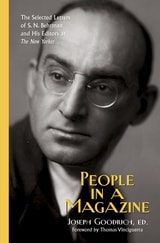
People in a Magazine
The Selected Letters of S. N. Behrman and His Editors at "The New Yorker"Joseph Goodrich
University of Massachusetts Press, 2018
Playwright, biographer, screenwriter, and critic S. N. Behrman (1893–1973) characterized the years he spent writing for The New Yorker as a time defined by “feverish contact with great theatre stars, rich people and social people at posh hotels, at parties, in mansions and great estates.” While he hobnobbed with the likes of Mary McCarthy, Elia Kazan, and Greta Garbo and was one of Broadway's leading luminaries, Behrman would later admit that the friendships he built with the magazine's legendary editors Harold Ross, William Shawn, and Katharine S. White were the “one unalloyed felicity” of his life.
People in a Magazine collects Behrman's correspondence with his editors along with telegrams, interoffice memos, and editorial notes drawn from the magazine's archives—offering an unparalleled view of mid-twentieth-century literary life and the formative years of The New Yorker, from the time of Behrman's first contributions to the magazine in 1929 until his death.
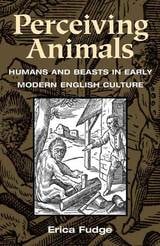
Perceiving Animals
Humans and Beasts in Early Modern English CultureErica Fudge
University of Illinois Press, 2000
In Perceiving Animals, the British scholar Erica Fudge traces the dangers and problems of anthropocentrism in texts written from 1558 to 1649. Meticulous examinations of scientific, legal, political, literary, and religious writings offer unique and fascinating depictions of human perceptions about the natural world.
Views carried over from bestiaries--medieval treatises on animals--
posited animals as nonsentient beings whose merits were measured solely by what provisions they afforded humans: food, medicine, clothing, travel, labor, scientific knowledge. Without consciences or faith, animals were deemed far inferior to humans.
While writings from the period asserted an enormous biological superiority, Fudge contends actual human behavior and logic worked, sometimes accidentally, to close the alleged gap. In the Bear Garden, even a man of the lowest social rank had power over a tortured animal, sinking him, though, below the beasts. The beast fable itself fails to show a true understanding of animals, as it merely attributes human characteristics to beasts in an attempt to teach humanist ideals. Scholars and writers continually turned to the animal world for reflection. Despite this, scientists of the period used animals for empirical and medical knowledge, recognizing biological and spiritual similarities but refusing to renege human superiority.
Including an insightful reexamination of Ben Jonson's Volpone and fascinating looks at works by Francis Bacon, Edward Coke, and Richard Overton, among others, Fudge probes issues of animal ownership and biological and spiritual superiority in early modern England that resonate with philosophical quandaries still relevant in contemporary society.
Peregrinations
Walking in American LiteratureAmy T Hamilton
University of Nevada Press, 2018
The land of the United States is defined by vast distances encouraging human movement and migration on a grand scale. Consequently, American stories are filled with descriptions of human bodies walking through the land.
In Peregrinations, Amy T. Hamilton examines stories told by and about Indigenous American, Euroamerican, and Mexican walkers. Walking as a central experience that ties these texts together—never simply a metaphor or allegory—offers storytellers and authors an elastic figure through which to engage diverse cultural practices and beliefs including Puritan and Catholic teachings, Diné and Anishinaabe oral traditions, Chicanx histories, and European literary traditions.
Hamilton argues that walking bodies alert readers to the ways the physical world—more-than-human animals, trees, rocks, wind, sunlight, and human bodies—has a hand in creating experience and meaning. Through material ecocriticism, a reading practice attentive to historical and ongoing oppressions, exclusions, and displacements, she reveals complex layerings of narrative and materiality in stories of walking human bodies.
This powerful and pioneering methodology for understanding place and identity, clarifies the wide variety of American stories about human relationships with the land and the ethical implications of the embeddedness of humans in the more-than-human world.

Perfect Copies
Reproduction and the Contemporary ComicShiamin Kwa
Rutgers University Press, 2023
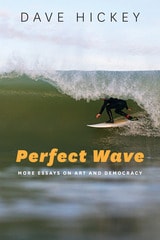
Perfect Wave
More Essays on Art and DemocracyDave Hickey
University of Chicago Press, 2017
When Dave Hickey was twelve, he rode the surfer’s dream: the perfect wave. And, like so many things in life we long for, it didn’t quite turn out—he shot the pier and dashed himself against the rocks of Sunset Cliffs in Ocean Beach, which nearly killed him.
Hickey went on to develop a career as one of America’s foremost critical iconoclasts, a trusted no-nonsense voice commenting on the worlds of art and culture. Perfect Wave brings together essays on a wide range of subjects from throughout Hickey’s career, displaying his breadth of interest and powerful insight into what makes art work, or not, and why we care. With Hickey as our guide, we travel to Disneyland and Vegas, London and Venice. We discover the genius of Karen Carpenter and Waylon Jennings, learn why Robert Mitchum matters more than Jimmy Stewart, and see how the stillness of Antonioni speaks to us today. Never slow to judge—or to surprise us in doing so—Hickey relates his wincing disappointment in the later career of his early hero Susan Sontag and shows us the appeal to our commonality that we’ve been missing in Norman Rockwell.
Bookended by previously unpublished personal essays that offer a new glimpse into Hickey’s own life—including the aforementioned conclusion to his surfing career—Perfect Wave is a welcome addition to the Hickey canon.
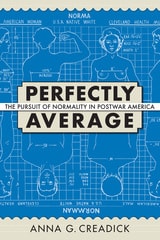
Perfectly Average
The Pursuit of Normality in Postwar AmericaAnna G. Creadick
University of Massachusetts Press, 2010
At the end of World War II, many Americans longed for a return to a more normal way of life after decades of depression and war. In fact, between 1945 and 1963 the idea of “normality” circulated as a keyword in almost every aspect of American culture. But what did this term really mean? What were its parameters? Whom did it propose to include and exclude?
In Perfectly Average, Anna Creadick investigates how and why “normality” reemerged as a potent homogenizing category in postwar America. Working with scientific studies, material culture, literary texts, film, fashion, and the mass media, she charts the pursuit of the “normal” through thematic chapters on the body, character, class, sexuality, and community.
Creadick examines such evidence as the “Norm and Norma” models produced during the war by sexologists and anthropologists—statistical composites of “normal” American bodies. In 1945, as thousands of Ohio women signed up for a Norma Look-Alike contest, a “Harvard Study of Normal Men” sought to define the typical American male according to specific criteria, from body shape to upbringing to blood pressure. By the early 1950s, the “man in the gray flannel suit” had come to symbolize what some regarded as the stultifying sameness of the “normalized” middle class. Meanwhile, novels such as From Here to Eternity and Peyton Place both supported and challenged normative ideas about gender, race, and sexuality, even as they worked to critique the postwar culture of surveillance—watching and being watched—through which normalizing power functioned.
As efforts to define normality became increasingly personal, the tensions em-bedded in its binary logic multiplied: Was normal descriptive of an average or prescriptive of an ideal? In the end, Creadick shows, a variety of statistics, assumptions, and aspirations converged to recast “normality” not as something innate or inborn, but rather as a quality to be actively pursued—a standard at once highly seductive and impossible to achieve because it required becoming perfectly average.
Perfidy and Passion
Reintroducing the IliadMark Buchan
University of Wisconsin Press, 2012
Homer’s Iliad is often considered a poem of blunt truthfulness, his characters’ motivation pleasingly simple. A closer look, however, reveals a complex interplay of characters who engage in an awful lot of lies. Beginning with Achilles, who hatches a secret plot to destroy his own people, Mark Buchan traces motifs of deception and betrayal throughout the poem. Homer’s heroes offer bluster, their passion linked to and explained by their lack of authenticity. Buchan reads Homer’s characters between the lies, showing how the plot is structured individual denial and what cannot be said.
Performance in America
Contemporary U.S. Culture and the Performing ArtsDavid Román
Duke University Press, 2005
The performances that Román analyzes range from localized community-based arts events to full-scale Broadway productions and from the controversial works of established artists such as Tony Kushner to those of emerging artists. Román considers dances produced by the choreographers Bill T. Jones and Neil Greenberg in the mid-1990s as new aids treatments became available and the aids crisis was reconfigured; a production of the Asian American playwright Chay Yew’s A Beautiful Country in a high-school auditorium in Los Angeles’s Chinatown; and Latino performer John Leguizamo’s one-man Broadway show Freak. He examines the revival of theatrical legacies by female impersonators and the resurgence of cabaret in New York City. Román also looks at how the performing arts have responded to 9/11, the U.S. invasion of Afghanistan, and the second war in Iraq. Including more than eighty illustrations, Performance in America highlights the dynamic relationships among performance, history, and contemporary culture through which the past is revisited and the future reimagined.
Performative Polemic
Anti-Absolutist Pamphlets and their Readers in Late Seventeenth-Century FranceKathrina Ann LaPorta
University of Delaware Press, 2021
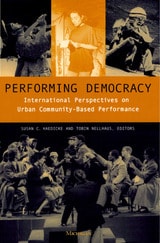
Performing Democracy
International Perspectives on Urban Community-Based PerformanceSusan C. Haedicke and Tobin Nellhaus, Editors
University of Michigan Press, 2001
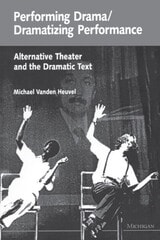
Performing Drama/Dramatizing Performance
Alternative Theater and the Dramatic TextMichael Vanden Heuvel
University of Michigan Press, 1993
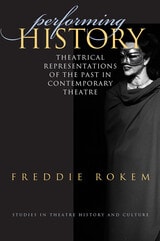
Performing History
Theatrical Representations of the Past in Conetmporary TheatreFreddie Rokem
University of Iowa Press, 2000

Performing Refuge and Risk
Precarious Theatre in East Central EuropeRachel Merrill Moss
University of Iowa Press, 2027

Performing Violence
Literary and Theatrical Experiments of New Russian DramaBirgit Beumers and Mark Lipovetsky
Intellect Books, 2009
The so-called “New Russian Drama” emerged at the end of the twentieth century, following a long period of decline in dramatic writing in the late Soviet and post-Soviet era. In Performing Violence, Birgit Beumers and Mark Lipovetsky examine the representation of violence in these new dramatic works by young Russian playwrights. Reflecting the disappointment in Yeltsin’s democratic reforms and Putin’s neoconservative politics, the plays focus on political and social representations of violence, its performances, and its justifications.
As the first English-language study of Russian drama and theatre in the twenty-first century, Performing Violence seeks a vantage point for the analysis of brutality in post-Soviet culture. While previous generations had preferred poetry and prose, this new breed of authors—the Presnyakov brothers, Evgeni Grishkovets, and Vasili Sigarev among them—have garnered international recognition for their fierce plays. This book investigates the violent portrayal of the identity crisis of a generation as represented in their theatrical works, and will be a key text for students and scholars of drama, Russian studies, and literature.
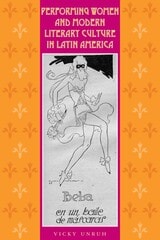
Performing Women and Modern Literary Culture in Latin America
Intervening ActsBy Vicky Unruh
University of Texas Press, 2006
Women have always been the muses who inspire the creativity of men, but how do women become the creators of art themselves? This was the challenge faced by Latin American women who aspired to write in the 1920s and 1930s. Though women's roles were opening up during this time, women writers were not automatically welcomed by the Latin American literary avant-gardes, whose male members viewed women's participation in tertulias (literary gatherings) and publications as uncommon and even forbidding. How did Latin American women writers, celebrated by male writers as the "New Eve" but distrusted as fellow creators, find their intellectual homes and fashion their artistic missions?
In this innovative book, Vicky Unruh explores how women writers of the vanguard period often gained access to literary life as public performers. Using a novel, interdisciplinary synthesis of performance theory, she shows how Latin American women's work in theatre, poetry declamation, song, dance, oration, witty display, and bold journalistic self-portraiture helped them craft their public personas as writers and shaped their singular forms of analytical thought, cultural critique, and literary style. Concentrating on eleven writers from Argentina, Brazil, Cuba, Mexico, Peru, and Venezuela, Unruh demonstrates that, as these women identified themselves as instigators of change rather than as passive muses, they unleashed penetrating critiques of projects for social and artistic modernization in Latin America.
Pericles on Stage
Political Comedy in Aristophanes' Early PlaysBy Michael Vickers
University of Texas Press, 1996
Since the eighteenth century, classical scholars have generally agreed that the Greek playwright Aristophanes did not as a matter of course write "political" plays. Yet, according to an anonymous Life of Aristophanes, when Dionysius the tyrant of Syracuse wanted to know about the government of Athens, Plato sent him a copy of Aristophanes' Clouds.
In this boldly revisionist work, Michael Vickers convincingly argues that in his earlier plays, Aristophanes in fact commented on the day-to-day political concerns of Athenians. Vickers reads the first six of Aristophanes' eleven extant plays in a way that reveals the principal characters to be based in large part on Pericles and his ward Alcibiades.
According to Vickers, the plays of Aristophanes—far from being nonpolitical—actually allow us to gauge the reaction of the Athenian public to the events that followed Pericles' death in 429 B.C., to the struggle for the political succession, and to the problems presented by Alcibiades' emergence as one of the most powerful figures in the state. This view of Aristophanes reaffirms the central role of allegory in his work and challenges all students of ancient Greece to rethink long-held assumptions about this important playwright.

Periodization
Cutting Up the Past, Volume 62Marshall Brown, ed.
Duke University Press, 0
This special issue of MLQ covers examples of periodization from the early modern to the present, including a range from the individual year to the longue durée and incorporates a variety of methods from close empirical study to global concern. In the lead essay, Russell A. Berman argues that periodization saves us from the dangers of both anachronism and presentism. Srinivas Aravamudan, updating Vico, reminds usthat we lose the past if we simply leave it unexamined. In “Perioddity” Timothy J. Reiss reflects on the crossings of chronology with geology in long-range and global perspectives.
This collection strives to turn discomfort with periodization into a constructive discourse.
Contributors. Srinivas Aravamudan, Russell Berman, Marshall Brown, Margreta de Grazia, Robert J. Griffin, Anne K. Mellor, Michael North, Timothy J. Reiss
Periodizing Jameson
Dialectics, the University, and the Desire for NarrativePhillip E. Wegner
Northwestern University Press, 2014
For a half century, the American intellectual Fredric Jameson has been a driving force in literary and cultural theory. In Periodizing Jameson, Phillip E. Wegner builds upon Jameson’s unique dialectical method to demonstrate the value of Jameson’s tools—periodization, the fourfold hermeneutic, and the Greimasian semiotic square, among others—and to develop virtuoso readings of Jameson’s own work and the history of the contemporary American university in which it unfolds.
Wegner shows how Jameson’s work intervenes in particular social, cultural, and political situations, using his scholarship both to develop original explorations of nineteenth-century fiction, popular films, and other promiment theorists, and to examine the changing fortunes of theory itself. In this way, Periodizing Jameson casts new light on the potential of and challenges to humanist intellectual work in the present.
Permanent Crisis
The Humanities in a Disenchanted AgePaul Reitter and Chad Wellmon
University of Chicago Press, 2021
Leads scholars and anyone who cares about the humanities into more effectively analyzing the fate of the humanities and digging into the very idea of the humanities as a way to find meaning and coherence in the world.
The humanities, considered by many as irrelevant for modern careers and hopelessly devoid of funding, seem to be in a perpetual state of crisis, at the mercy of modernizing and technological forces that are driving universities towards academic pursuits that pull in grant money and direct students to lucrative careers. But as Paul Reitter and Chad Wellmon show, this crisis isn’t new—in fact, it’s as old as the humanities themselves.
Today’s humanities scholars experience and react to basic pressures in ways that are strikingly similar to their nineteenth-century German counterparts. The humanities came into their own as scholars framed their work as a unique resource for resolving crises of meaning and value that threatened other cultural or social goods. The self-understanding of the modern humanities didn’t merely take shape in response to a perceived crisis; it also made crisis a core part of its project. Through this critical, historical perspective, Permanent Crisis can take scholars and anyone who cares about the humanities beyond the usual scolding, exhorting, and hand-wringing into clearer, more effective thinking about the fate of the humanities. Building on ideas from Max Weber and Friedrich Nietzsche to Helen Small and Danielle Allen, Reitter and Wellmon dig into the very idea of the humanities as a way to find meaning and coherence in the world.
Permissible Narratives
The Promise of Latino/a LiteratureChristopher González
The Ohio State University Press, 2017
Bringing together cultural critique, memory, narratology, cognition, and comprehension, González examines Latina/o authors—such as Oscar “Zeta” Acosta, Gloria Anzaldúa, Piri Thomas, Giannina Braschi, Gilbert Hernandez, Sandra Cisneros, and Junot Díaz—investigating how they successfully, and sometimes unsuccessfully, use the expansive canvas of narrative form to capture the imaginations of an open-minded readership. Permissible Narratives highlights both the inequitable accessibility of narrative devices and, crucially, the daring of Latina/o authors to nurture a readership to afford the same literary deference to them that is so often afforded to white, male, straight authors.
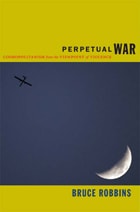
Perpetual War
Cosmopolitanism from the Viewpoint of ViolenceBruce Robbins
Duke University Press, 2012
Under these conditions, cosmopolitanism in the traditional sense—primary loyalty to the good of humanity as a whole, even if it conflicts with loyalty to the interests of one's own nation—becomes a necessary resource in the struggle against military aggression. To what extent does the "new" cosmopolitanism also include or support this "old" cosmopolitanism? In an attempt to answer this question, Robbins engages with such thinkers as Noam Chomsky, Edward Said, Anthony Appiah, Immanuel Wallerstein, Louis Menand, W. G. Sebald, and Slavoj Zizek. The paradoxes of detachment and belonging they embody, he argues, can help define the tasks of American intellectuals in an era when the first duty of the cosmopolitan is to resist the military aggression perpetrated by his or her own country.
Persecution and the Art of Writing
Leo Strauss
University of Chicago Press, 1988
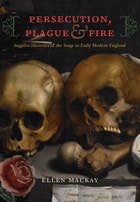
Persecution, Plague, and Fire
Fugitive Histories of the Stage in Early Modern EnglandEllen MacKay
University of Chicago Press, 2011
The theater of early modern England was a disastrous affair. The scant record of its performance demonstrates as much, for what we tend to remember today of the Shakespearean stage and its history are landmark moments of dissolution: the burning down of the Globe, the forced closure of playhouses during outbreaks of the plague, and the abolition of the theater by its Cromwellian opponents.
Persecution, Plague, and Fire is a study of these catastrophes and the theory of performance they convey. Ellen MacKay argues that the various disasters that afflicted the English theater during its golden age were no accident but the promised end of a practice built on disappearance and erasure—a kind of fatal performance that left nothing behind but its self-effacing poetics. Bringing together dramatic theory, performance studies, and theatrical, religious, and cultural history, MacKay reveals the period’s radical take on the history and the future of the stage to show just how critical the relation was between early modern English theater and its public.

Persephone's Girdle
Narratives of Rape in Seventeenth-Century Spanish LiteratureMarcia L. Welles
Vanderbilt University Press, 2000
Marcia Welles applies her extensive knowledge of Spanish Golden Age literature and her insightful grasp of current literary theory to synthesize a wide range of material into a uniquely engaging and refreshing interpretation of well-known texts. While the subject of rape and violence has been studied in other European literatures, Persephone's Girdle is the first to do so in the field of early modern Spanish literature.
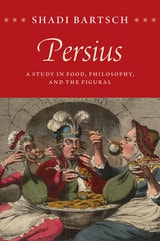
Persius
A Study in Food, Philosophy, and the FiguralShadi Bartsch
University of Chicago Press, 2015
In Persius, Shadi Bartsch explores this Stoic framework and argues that Persius sets his own bizarre metaphors of food, digestion, and sexuality against more appealing imagery to show that the latter—and the poetry containing it—harms rather than helps its audience. Ultimately, he encourages us to abandon metaphor altogether in favor of the non-emotive abstract truths of Stoic philosophy, to live in a world where neither alluring poetry, nor rich food, nor sexual charm play a role in philosophical teaching.
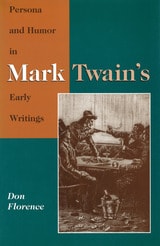
Persona and Humor in Mark Twain's Early Writings
Don Florence
University of Missouri Press, 1995
In Persona and Humor in Mark Twain's Early Writings, Don Florence explains that Samuel Clemens did more than use the borrowed name of Mark Twain to sign his writings. He also developed a separate identity, or persona, becoming "a literary personality in his own right."
Challenging mainstream Twain criticism on many fronts, Florence focuses exclusively on Twain's early writings. He demonstrates how Twain evolved in his early narratives into the "Mark Twain" we now recognize. Florence maintains that this process was evolutionary: Although Twain might have been dependent on Clemens for the initial experiences, they become Twain's experiences, necessary for his development as a persona. Traditionally, critics of Twain have been preoccupied with dualities, but Florence sees this emphasis upon polarities as an oversimplification. He argues that much of Twain's humor strives to shape more and more of the world, giving Twain multiple narrative voices and letting him be inclusive, not exclusive.
Finally, this study asserts that there is more continuity to Mark Twain's career than has been generally recognized. Many Twain scholars have argued that Twain's later writings are radically different from his earlier writings because of their emphasis upon illusion and dream. Florence argues that the preoccupation with illusion and fantasy is scarcely new. Whether Twain's mood is exuberant or dark, he emphasizes subjectivity over objectivity, the dominance of fantasy, the creative powers of humor, and his ability as persona to determine what we consider "reality." Florence contends that Twain's early writings show Mark Twain gradually evolving into a masterfully comic persona.
Jargon-free and eloquently written, Persona and Humor in Mark Twain's Early Writings provides a fascinating look at Mark Twain's developing genius and will be a welcome addition to Twain literature.
Perspectives of Roman Poetry
A Classics SymposiumEdited by G. Karl Galinsky
University of Texas Press, 1974
Written by leading specialists, the essays in Perspectives of Roman Poetry seek to provide a broad range of readers with a good understanding of some essential aspects of major Roman poets and poetic genres. The value of the essays is enhanced, for comparative purposes, by their extensive reference to modern authors. such as Shakespeare and Tolkien. For the modern reader, Latin quotations are accompanied by effective English translations.
The essays and their authors are as follows:
- "The Woman's Role in Latin Love Poetry," by Georg Luck
- "Autobiography and Art in Horace," by William S. Anderson
- "Some Trees in Virgil and Tolkien," by Kenneth J. Reckford
- "The Business of Roman Comedy," by Erich Segal
- "Ovid's Metamorphosis of Myth," by G. Karl Galinsky
Perspectives of Roman Poetry resulted from a symposium held at the University of Texas at Austin in 1972. These essays offer different and, in some cases, heterodox interpretations that will serve as a basis for future discussions.
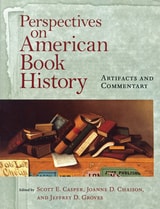
Perspectives on American Book History
Artifacts and CommentaryScott E. Casper
University of Massachusetts Press, 2002
A collection of primary source materials and original essays, Perspectives on American Book History is the first text designed for the growing number of courses in American print culture, as well as a unique supplement for courses in American literature and history. It seeks to fill the void that has developed as the expanding history of the book has moved out of the archive and scholarly journal and into the classroom. The volume includes an introductory essay by Robert A. Gross, chair of the program in the history of the book at the American Antiquarian Society, fourteen chapters composed of primary artifacts and original essays by rising scholars in the field, and an annotated bibliography of research sources.
Chapters trace topics in American print culture from Puritan New England to the future of newspapers in a digital age. The artifacts and documents, most of which have never before been anthologized, include excerpts from readers' diaries, accounts of the printing and publishing trades, materials from the alternative press, commentaries on authorship and reading, and visual images. The essays place these primary source materials in their historical, literary, and political contexts and model the ways students might approach them.
In addition to the editors and Robert A. Gross, the contributors are Nancy Cook, Patricia Crain, Ann Fabian, Alice Fahs, Ellen Gruber Garvey, Jen A. Huntley-Smith, Charles Johanningsmeier, Jill Lepore, Russell L. Martin, Trysh Travis, Glenn Wallach, and Susan S. Williams.
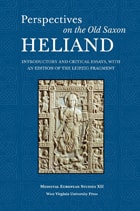
Perspectives on the Old Saxon Heliand
Introductory and Critical Essays, with an Edition of the Leipzig FragmentEdited by Valentine A. Pakis
West Virginia University Press, 2010
Heliand, the Old Saxon poem based on the life of Christ in the Gospels, has become more available to students of Anglo-Saxon culture as its influence has reached into a wider range of fields from history to linguistics, literature, and religion. In Perspectives on the Old Saxon Heliand, Valentine Pakis brings together recent scholarship that both addresses new turns in the field and engages with the relevant arguments of the past three decades. Furthering the ongoing critical discussion of both text and culture, this volume also reflects on the current state of the field and demonstrates how it has evolved since the 1970s.
Perspectives
Modes of Viewing and Knowing in Nineteenth-Century EnglandLinda M. Shires
The Ohio State University Press, 2009
Perverse Attachments
Reading Fiction Around 1800Anastasia Eccles
University of Chicago Press, 2026
This new theory of reader response describes “perverse attachment,” or the powerful desire to intervene in a story, even when it is impossible to do so.
Fiction has long inspired resistance in its readers: making them, for example, wish for a different plot, cringe at a moment of social discomfort, or itch to warn a character about an approaching calamity. These are symptoms of a condition that Anastasia Eccles calls “perverse attachment,” in which a person feels an urge to act on something beyond their control. Eccles theorizes this form of frustrated agency as a constitutive part of the experience of reading fiction, especially under the influence of literary sentimentalism in the late eighteenth and early nineteenth centuries. It was also, significantly, a defining aspect of the mass politics that emerged in the same period, which rested on the demands of new political subjects to participate in a process that excluded them.
Perverse Attachments recovers a repertoire of aesthetic responses keyed to the psychodynamics of modern political life: complicity, suspense, historical regret, and cringing. Combining identification and disidentification, immersion and detachment, these experiences challenge deep-seated binaries in our theories of reading and point toward a new account of the political stakes of literary form.
Through readings of works by Charlotte Smith, Walter Scott, Jane Austen, and others Eccles shows how this distinctive aesthetic and political relation shaped the major genres of Romantic fiction and gave rise to some of the novel’s characteristic forms, like the character type of the witness-protagonist and the techniques of free indirect discourse. The result is a major work in the theory of the novel and the history of readerly experience.

Perversion and the Social Relation
sic IVMolly Anne Rothenberg, Dennis A. Foster and Slavoj Zizek, eds.
Duke University Press, 2003
By focusing on perversion as a psychic structure rather than as aberrant behavior, the contributors provide an alternative to models of social interpretation based on classical Oedipal models of maturation and desire. At the same time, they critique claims that the perverse is necessarily subversive or liberating. In their lucid introduction, the editors explain that while fixation at the stage of the perverse can result in considerable suffering for the individual and others, perversion motivates social relations by providing pleasure and fulfilling the psychological need to put something in the place of the Father. The contributors draw on a variety of psychoanalytic perspectives—Freudian and Lacanian—as well as anthropology, history, literature, and film. From Slavoj Žižek's meditation on “the politics of masochism” in David Fincher's movie Fight Club through readings of works including William Styron's The Confessions of Nat Turner, Don DeLillo’s White Noise, and William Burroughs's Cities of the Red Night, the essays collected here illuminate perversion's necessary role in social relations.
Contributors. Michael P. Bibler, Dennis A. Foster, Bruce Fink, Octave Mannoni, E. L. McCallum, James Penney, Molly Anne Rothenberg, Nina Schwartz, Slavoj Žižek
Petersburg/Petersburg
Novel and City, 1900–1921Olga Matich
University of Wisconsin Press, 2010
Since its founding three hundred years ago, the city of Saint Petersburg has captured the imaginations of the most celebrated Russian writers, whose characters map the city by navigating its streets from the aristocratic center to the gritty outskirts. While Tsar Peter the Great planned the streetscapes of Russia’s northern capital as a contrast to the muddy and crooked streets of Moscow, Andrei Bely’s novel Petersburg (1916), a cornerstone of Russian modernism and the culmination of the “Petersburg myth” in Russian culture, takes issue with the city’s premeditated and supposedly rational character in the early twentieth century.
“Petersburg”/Petersburg studies the book and the city against and through each other. It begins with new readings of the novel—as a detective story inspired by bomb-throwing terrorists, as a representation of the aversive emotion of disgust, and as a painterly avant-garde text—stressing the novel’s phantasmagoric and apocalyptic vision of the city. Taking a cue from Petersburg’s narrator, the rest of this volume (and the companion Web site, stpetersburg.berkeley.edu/) explores the city from vantage points that have not been considered before—from its streetcars and iconic art-nouveau office buildings to the slaughterhouse on the city fringes. From poetry and terrorist memoirs, photographs and artwork, maps and guidebooks of that period, the city emerges as a living organism, a dreamworld in flux, and a junction of modernity and modernism.
Petersburg
The Physiology of a CityThomas Gaiton Marullo
Northwestern University Press, 2009
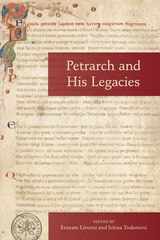
Petrarch and His Legacies
Edited by Ernesto Livorni and Jelena Todorovic
Arizona Center for Medieval and Renaissance Studies, 2021
This book gathers cutting-edge articles by prominent scholars reflecting on Petrarch’s poetry and his long legacy, from the Renaissance to the present day. The scholars engaged in this volume read Petrarch in the context of his own world and with a variety of theoretical and critical approaches, never overlooking the opportunity for an interdisciplinary reading that combines poetry and visual arts. The volume includes scholars from the United States and Europe (Italy, in particular), thus offering the opportunity to compare different theoretical approaches.
The articles in the second half of the volume celebrate Petrarch’s legacies beyond the historically fundamental Renaissance Petrarchism, while exploring the presence of Petrarch’s poetry in several cultural realities. The scholars also read Petrarch with necessary attention to new disciplines such as digital humanities. The richness of the volume lies in these innovative perusals of Petrarch’s works not only through the critical lens of dedicated scholars, but also through their readings of artists who throughout the centuries appreciated and revived Petrarch’s poetry in their own literary endeavors.
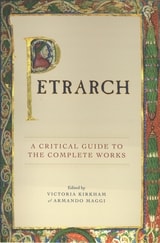
Petrarch
A Critical Guide to the Complete WorksEdited by Victoria Kirkham and Armando Maggi
University of Chicago Press, 2009
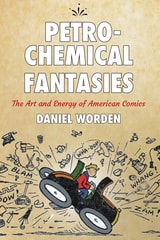
Petrochemical Fantasies
The Art and Energy of American ComicsDaniel Worden
The Ohio State University Press, 2024
Finalist, Comics Studies Society Charles Hatfield Book Prize 2025
Nominee, Eisner Award for Best Academic/Scholarly Work 2025
In Petrochemical Fantasies, Daniel Worden reveals the entwined history of comics and fossil fuels in the United States. From the 1840s to the present, comics have depicted the power, pollution, and rapid expansion of energy systems—especially the explosive growth of coal and oil. In the 1930s, some of the first comic books were the gas station giveaways Gulf Funny Weekly and Standard Oil Comics. And in recent years, comics have become one of the major sites for visualizing life after oil, a striking reversal of the medium’s early boosterism.
Surveying the work of acclaimed artists such as Nell Brinkley, George Herriman, Jack Kirby, Winsor McCay, and R. F. Outcault and recovering little-known works, Worden advances a new history of American comics in the Anthropocene. From late nineteenth- and early twentieth-century editorial cartoons and superhero comics that visualize our modern energy culture to contemporary comics grappling with climate crises, Petrochemical Fantasies places comics, environmental humanities, and energy studies in conversation with each other to unearth the crucial but overlooked history of comics’ place in US energy culture.
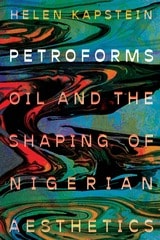
Petroforms
Oil and the Shaping of Nigerian AestheticsHelen Kapstein
West Virginia University Press, 2025
2026 PROSE Award Finalist, Humanities: Literature
Petroforms contributes a much-needed theory of form and genre to the cutting-edge field of petrocriticism, itself an offshoot of developments in postcolonial ecocriticism. Studies of resource fiction and inquiries in the energy humanities have recently taken their rightful place as necessary reflections on the role of the literary imagination in intervening in the Anthropocene as we find ourselves precariously placed in the face of a fossil fuel crisis, climate change, and mass extinctions.
With Petroforms, Helen Kapstein undertakes close readings of a range of Nigerian aesthetic forms: short stories, romance novels, documentary film, the “Nollywood” film industry, fine art sculpture, and poetry. She uses these forms to argue that the demands of paying attention to petroleum extraction, production, consumption, and distribution in the creation of resource fictions must necessarily alter and affect conventional forms and structures. What results is a new set of genre-bending forms, like documentary film that we can read as horror, in response to the forceful and fluid demands of the petroleum industry and its master narrative.
Nigeria is one of the world’s largest oil-producing nations, in which that production is concentrated in the Niger Delta, resulting in a local environment that has been steadily degraded by oil spills, flares, pollution, and contamination, and a local culture shaped by false scarcity in a space of abundance, murderous politics, and escalating violence. At the same time as the Niger Delta grounds Kapstein’s argument in its own political realities and cultural responses, Nigeria’s participation in a global economy of petrodependency allows her theory of petroforms to be extended and applied more generally.
What Peter Hitchcock calls “oil’s generative law” is that it is “everywhere and obvious, it must be opaque or otherwise fantastic.” He means the coexistence of oil’s taken-for-granted qualities is something constitutive of every level of everyday life and its spectacular displays—gushers, spills, explosions. Oil’s nature, the fact that it is everywhere, unctuously oozing into every corner of everyday life, means that it constantly spills over out of our existing forms, genres, and systems, demanding accommodation. To try to contain it, we create new forms. Thus, a petroform is simultaneously reactionary (a necessary response to oil’s pressures, a by-product of the commodity itself) and resistant (an attempt at containment, at generating a retort to the very thing that shapes it). Each form figures oil and then configures and reconfigures itself in reaction to it.
Phantasmatic Indochina
French Colonial Ideology in Architecture, Film, and LiteraturePanivong Norindr
Duke University Press, 1996
Analyzing the first Exposition Coloniale Internationale, held in Paris in 1931, Norindr shows how the exhibition’s display of architecture gave a vision to the colonies that justified France’s cultural prejudices, while stimulating the desire for further expansionism. He critiques the Surrealist counter-exposition mounted to oppose the imperialist aims of the Exposition Coloniale, and the Surrealist incorporation and appropriation of native artifacts in avant-garde works. According to Norindr, all serious attempts at interrogating French colonial involvement in Southeast Asia are threatened by discourse, images, representations, and myths that perpetuate the luminous aura of Indochina as a place of erotic fantasies and exotic adventures. Exploring the resilience of French nostalgia for Indochina in books and movies, the author examines work by Malraux, Duras, and Claudel, and the films Indochine, The Lover, and Dien Bien Phu.
Certain to impact across a range of disciplines, Phantasmatic Indochina will be of interest to those engaged in the study of the culture and history of Vietnam, Cambodia, Thailand, and Laos, as well as specialists in the fields of French modernism, postcolonial studies, cultural studies, and comparative literature.
Phantoms of a Blood-Stained Period
The Complete Civil War Writings of Ambrose BierceJames Russell Duncan
University of Massachusetts Press, 2002
Phenomenal Blackness
Black Power, Philosophy, and TheoryMark Christian Thompson
University of Chicago Press, 2022
Phenomenal Blackness examines the changing interdisciplinary investments of key mid-century Black writers and thinkers, including the growing interest in German philosophy and critical theory. Mark Christian Thompson analyzes this shift in intellectual focus across the post-war decades, placing Black Power thought in a philosophical context.
Prior to the 1960s, sociologically oriented thinkers such as W. E. B. Du Bois had understood Blackness as a singular set of socio-historical characteristics. In contrast, writers such as Amiri Baraka, James Baldwin, Angela Y. Davis, Eldridge Cleaver, and Malcolm X were drawn to notions of an African essence, an ontology of Black being. With these perspectives, literary language came to be seen as the primary social expression of Blackness. For this new way of thinking, the works of philosophers such as Adorno, Habermas, and Marcuse were a vital resource, allowing for continued cultural-materialist analysis while accommodating the hermeneutical aspects of Black religious thought. Thompson argues that these efforts to reimagine Black singularity led to a phenomenological understanding of Blackness—a “Black aesthetic dimension” wherein aspirational models for Black liberation might emerge.