Results by title
4917 books match the query 'Philosophy' and 321 start with p
Perspectives on Contexts
Edited by Paolo Bouquet, Luciano Serafini, and Richmond H. Thomason
CSLI, 2008
Most human thinking is thoroughly informed by context but, until recently, theories of reasoning have concentrated on abstract rules and generalities that make no reference to this crucial factor. Perspectives on Contexts brings together essays from leading cognitive scientists to forge a vigorous interdisciplinary understanding of the contextual phenomenon. Applicable to human and machine cognition in philosophy, artificial intelligence, and psychology, this volume is essential to the current renaissance in thinking about context.
Peter and Caesar
Political Authority and the Catholic ChurchEdward A. Goerner
St. Augustine's Press, 2020
Phenomenal Blackness
Black Power, Philosophy, and TheoryMark Christian Thompson
University of Chicago Press, 2022
Phenomenal Blackness examines the changing interdisciplinary investments of key mid-century Black writers and thinkers, including the growing interest in German philosophy and critical theory. Mark Christian Thompson analyzes this shift in intellectual focus across the post-war decades, placing Black Power thought in a philosophical context.
Prior to the 1960s, sociologically oriented thinkers such as W. E. B. Du Bois had understood Blackness as a singular set of socio-historical characteristics. In contrast, writers such as Amiri Baraka, James Baldwin, Angela Y. Davis, Eldridge Cleaver, and Malcolm X were drawn to notions of an African essence, an ontology of Black being. With these perspectives, literary language came to be seen as the primary social expression of Blackness. For this new way of thinking, the works of philosophers such as Adorno, Habermas, and Marcuse were a vital resource, allowing for continued cultural-materialist analysis while accommodating the hermeneutical aspects of Black religious thought. Thompson argues that these efforts to reimagine Black singularity led to a phenomenological understanding of Blackness—a “Black aesthetic dimension” wherein aspirational models for Black liberation might emerge.
Phenomenology and Deconstruction, Volume Four
SolitudeRobert Denoon Cumming
University of Chicago Press, 2001
After the war Heidegger disavowed Sartre, a move related to Heidegger's renunciation of his association with the phenomenological movement at large, and one that illustrates the dynamics of the history Cumming himself has completed. Serving as convincing punctuation for this remarkable series, this book demonstrates the importance of the history of philosophy in coming to grips with the proclaimed end of philosophy.
Phenomenology and Deconstruction, Volume One
The Dream is OverRobert Denoon Cumming
University of Chicago Press, 1991
In this analysis Cumming deals with how a philosophy can be vulgarized (as Heidegger's was by Nazism but in Heidegger's own view by Sartre), with problems of periodization, with how the history of philosophy can be disinguished as a philosophical discipline from intellectual history. Cumming also elaborates an analogy between a philosophical method and style.
Phenomenology and Deconstruction, Volume Three
Breakdown in CommunicationRobert Denoon Cumming
University of Chicago Press, 2001
history of philosophy demonstrates how frequently one philosopher
misunderstands another. The most notorious such breakdown in
communication in twentieth-century philosophy was between Husserl and
Heidegger. In the third volume of his history of the phenomenological
movement, Robert Denoon Cumming argues that their differences involve
differences in method; whereas Husserl follows a "method of
clarification," with which he eliminates ambiguities by relying on an
intentional analysis that isolates its objects, Heidegger rejects the
criterion of "clarity" and embraces ambiguities as exhibiting
overlapping relations.
Cumming also explores the differences between how
deconstruction—Heidegger's procedure for dealing with other
philosophers—is carried out when Heidegger interprets Husserl versus
when Derrida interprets Husserl. The comparison enables Cumming to
show how deconstruction is associated with Heidegger's arrival at the
end of philosophy, paving the way for the deconstructionist movement.
Phenomenology and Deconstruction, Volume Two
Method and ImaginationRobert Denoon Cumming
University of Chicago Press, 1992
Cumming also shows that conversion is not merely a personal predisposition of Sartre's—further manifest in his later conversions to Heidegger and to a version of Marxism. Conversion is also philosophical preoccupation, illustrated by the "conversion to the imaginary" whereby Sartre explains how he himself, as well as Genet and Flaubert, became writers. Finally, Cumming details how Husserl's phenomenological method contributed both to the shaping of Sartre's style as a literary writer and to his theory of style.
Phenomenology and Embodiment
Husserl and the Constitution of SubjectivityJoona Taipale
Northwestern University Press, 2014

Phenomenology and Theory of Science
Aron Gurwitsch
Northwestern University Press, 1974
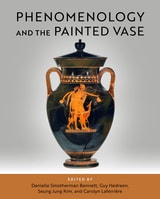
Phenomenology and the Painted Vase
Edited by Danielle Smotherman Bennett, Guy Hedreen, SeungJung Kim, and Carolyn Laferrière
University of Wisconsin Press, 2026
Most people today encounter ancient Greek vases as static, untouchable artifacts safely out of reach behind glass, in the quiet of a museum gallery. Once, however, these vessels were also useful objects, made to be held, filled, and generally used in a variety of settings, from the ritual to the quotidian. This volume considers these ancient vases together with the theoretical frameworks developed by pioneers of phenomenology such as Maurice Merleau-Ponty and Edmund Husserl, helping us encounter Greek vases as they once were. The principles of phenomenology require that we understand objects as active participants in shaping the manner in which humans experience the world. A phenomenological perspective allows us to see how the function and use of Greek vases shaped both their visual appearance and the perceptual experience of them—as well as our continued understanding of them today—while taking into account multisensory perspectives. With this alternative approach to the study of classical pottery, the authors offer new and illuminating insights not just into the objects in question but also into ancient Greek culture and life more broadly.
Phenomenology and the Problem of History
A Study of Husserl's Transcendental PhilosophyDavid Carr
Northwestern University Press, 2009
Phenomenology and the Social Sciences
Maurice Natanson
Northwestern University Press, 1973

Phenomenology for Actors
Theatre-Making and the Question of BeingDaniel Johnston
Intellect Books, 2021
In this book, Daniel Johnston examines how phenomenology can describe, analyze, and inspire theater-making. Each chapter introduces themes to guide the creative process through objects, bodies, spaces, time, history, freedom, and authenticity. Key examples in the work are drawn from Chekhov’s The Cherry Orchard, Sophocles’ Antigone, and Shakespeare’s Hamlet. Practical tasks throughout explore how the theatrical event can offer unique insights into being and existence, as Johnston’s philosophical perspective shines a light on broader existential issues of being. In this way, the book makes a bold contribution to the study of acting as an embodied form of philosophy and reveals how phenomenology can be a rich source of creativity for actors, directors, designers, and collaborators in the performance process.
Brimming with insight into the practice and theory of acting, this original new work stimulates new approaches to rehearsal and sees theater-making as capable of speaking back to philosophical discourse.
Phenomenology in Psychology and Psychiatry
A Historical IntroductionHerbert Spiegelberg
Northwestern University Press, 1972
Phenomenology in Psychology and Psychiatry is a historical introduction to phenomenology in psychology working from the general to the details of the subject.

Phenomenology of Merleau-Ponty
A Search For The Limits Of ConsciousnessGary Brent Madison
Ohio University Press, 1981
The first study of its kind to appear in English, The Phenomenology of Merleau-Ponty is a sustained ontological reading of Merleau-Ponty which traces the evolution of his philosophy of being from his early work to his late, unfinished manuscripts and working notes. Merleau-Ponty, who contributed greatly to the theoretical foundations of hermeneutics, is here approached hermeneutically.
Most commentators are agreed that towards the end Merleau-Ponty’s philosophy underwent a strange and interesting mutation. The exact nature of this mutation or conceptual shift is what this study seeks to disclose. Thus, although Madison proceeds in a generally progressive, chronological fashion, examining Merleau-Ponty’s major works in the order of their composition, his reading is ultmately regressive in that Merleau-Ponty’s earlier works are viewed in the light of the new and enigmatic ontological orientation which makes its appearance in his later work. The merit of this approach is that, as Paul Ricoeur has remarked, it enables the author to expose the “anticipatory, hollowed-out presence” of Merleau-Ponty’s late philosophy “in the difficulties of his early phenomenology,” such that “the unifying intention between his first philosophy of meaning and the body and the late, more ontological philosophy is made manifest.”
This book begins with a detailed study of Merleau-Ponty’s two major early works, The Structure of BehaviorThe Phenomenology of Perception. In the following three chapters, Madison traces the development of Merleau-Ponty’s thought from the beginning to the end of his philosophical career in regard to three topics of special concern to the French phenomenologist: painting, language, philosophy. In the final chapter, he is concerned to articulate, as much as the unfinished state of Merleau-Ponty’s final work allows, the unspoken thought of this work and of The Visible and Invisible in particular. Merleau-Ponty’s notion of “wild being” and his attempt to work out an “indirect” or “negative” ontology are thoroughly analyzed.
In the end the reader will see that through his self-criticism and the development in his own phenomenology Merleau-Ponty has brought phenomenology itself to its limits and to the point where it must transcend itself as a philosophy of consciousness in the Husserlian sense if it is to remain faithful to Husserl’s own goal of bringing “experience to the full expression of its own meaning.” Because Madison submits Merleau-Ponty to the same kind of interpretive retrieval as the latter did with Husserl, Roger Cailloise has said of this “clear and very complete book” that it “goes will beyond a simple exposition and merits being read as an original work.”

Phenomenology of the Alien
Basic ConceptsTranslated from the German by Alexander Kozin and Tanja Stähler
Northwestern University Press, 2011
With impressive erudition Waldenfels weaves in xenological themes from classical philosophy, contemporary phenomenology, literature, linguistics, sociology, and anthropology to address the boundaries of experience that unite and separate human beings, their collectives, their perceptions, and aspirations. While the debate has long raged in German-speaking circles, Waldenfels’s work is largely unavailable to the English-speaking audience, with the only other translation being The Order in the Twilight (1996). Phenomenology of the Alien is a superb introduction to both xenological phenomenology, and the the question of the alien as it has been unfolding in contemporary thought.
Phenomenology of the Social World
Alfred Schutz
Northwestern University Press, 1967
Phenomenology
Between Essentialism and Transcendental PhilosophyJ.N. Mohanty
Northwestern University Press, 1997
This collection of essays traces the themes of essentialism and transcendentalism as they have appeared in the development of phenomenology from Husserl to Derrida. Beginning with Husserl's major phenomenological themes--essence, meaning, transcendental subjectivity, and life-world--Mohanty examines the tensions within phenomenology in general and within Husserl's phenomenology in particular. The accessibility of these essays, coupled with Mohanty's consideration of lesser-known phenomenologists (Ingarden, Scheler, Hartmann, et. al.) mark this as a major updating of phenomenology for a contemporary audience.

Phenomenology
Responses and DevelopmentsEdited by Leonard Lawlor
University of Chicago Press, 2010
From Kant to Kierkegaard, from Hegel to Heidegger, continental philosophers have indelibly shaped the trajectory of Western thought since the eighteenth century. Although much has been written about these monumental thinkers, students and scholars lack a definitive guide to the entire scope of the continental tradition. The most comprehensive reference work to date, this eight-volume History of Continental Philosophy will both encapsulate the subject and reorient our understanding of it. Beginning with an overview of Kant’s philosophy and its initial reception, the History traces the evolution of continental philosophy through major figures as well as movements such as existentialism, phenomenology, hermeneutics, and poststructuralism. The final volume outlines the current state of the field, bringing the work of both historical and modern thinkers to bear on such contemporary topics as feminism, globalization, and the environment. Throughout, the volumes examine important philosophical figures and developments in their historical, political, and cultural contexts.
The first reference of its kind, A History of Continental Philosophy has been written and edited by internationally recognized experts with a commitment to explaining complex thinkers, texts, and movements in rigorous yet jargon-free essays suitable for both undergraduates and seasoned specialists. These volumes also elucidate ongoing debates about the nature of continental and analytic philosophy, surveying the distinctive, sometimes overlapping characteristics and approaches of each tradition. Featuring helpful overviews of major topics and plotting road maps to their underlying contexts, A History of Continental Philosophy is destined to be the resource of first and last resort for students and scholars alike.
Philo's Influence on Valentinian Tradition
Risto Auvinen
SBL Press, 2024
Philodemus, On Anger
David Armstrong
SBL Press, 2020
The first English translation of On Anger
This latest volume in the Writings from the Greco-Roman World series provides a translation of a newly edited Greek text of Philodemus’s On Anger, now supplemented with the help of multispectral imaging. As our sole evidence for the Epicurean view of what constitutes natural and praiseworthy anger as distinguished from unnatural pleasure in vengeance and cruelty for their own sake, this text is crucial to the study of ancient thought about the emotions. Its critique of contemporary Stoic and Peripatetic theories of anger offers crucial new information for the history of philosophy in the last two centuries BCE. The introduction and commentary also make use of newly revised texts and readings from several other ancient treatises on anger.
Features
- An apparatus representing work on the text since the papyrus was opened in 1805
- A full explication of the Epicurean theory of natural anger as an emotion without pleasure
- One of the Herculaneum papyri that survived the eruption of Vesuvius in 79 CE
Philodemus, On Death
W. Benjamin Henry
SBL Press, 2009

Philodemus, On Property Management
Voula Tsouna
SBL Press, 2013
Philology of the Flesh
John T. Hamilton
University of Chicago Press, 2018
In Philology of the Flesh, John T. Hamilton explores writing and reading practices that engage this notion in a range of poetic enterprises and theoretical reflections. By pressing the notion of philology as “love” (philia) for the “word” (logos), Hamilton’s readings investigate the breadth, depth, and limits of verbal styles that are irreducible to mere information. While a philologist of the body might understand words as corporeal vessels of core meaning, the philologist of the flesh, by focusing on the carnal qualities of language, resists taking words as mere containers.
By examining a series of intellectual episodes—from the fifteenth-century Humanism of Lorenzo Valla to the poetry of Emily Dickinson, from Immanuel Kant and Johann Georg Hamann to Friedrich Nietzsche, Franz Kafka, and Paul Celan—Philology of the Flesh considers the far-reaching ramifications of the incarnational metaphor, insisting on the inseparability of form and content, an insistence that allows us to rethink our relation to the concrete languages in which we think and live.

Philosopher On Dover Beach
Roger Scruton
St. Augustine's Press, 2017
“It is a great pity that we in the United States do not have our own Roger Scruton. As his . . . collection of essays reminds us, he is an accomplished philosopher who writes trenchantly about many important political, social and religious issues, who cares passionately about art and culture and who is also a brilliant conservative polemicist. . . .
“Mr. Scruton has two great virtues as a critic. One is his ability to combine a delicate appreciation of culture with the robust analytical skills of a trained philosopher. . . .
“Mr. Scruton’s other great virtue is his habit of assessing things from the inside, taking them on their own terms. If his judgments are often harsh, one nevertheless comes away feeling that he has made the best case possible for his subject. This makes his criticism more devastating yet also more generous than the criticism of most other commentator.” – Roger Kimball, New York Times Book Review
“Each essay has been constructed with considerable care, and the positions taken are clearly stated and soundly argued. . . . He shows . . . that the philosopher-critic is alive and well. . . . Recommended for all academic libraries.” – Library Journal
“[Scruton] writes eloquently of the way in which social bonds, if refashioned in contractual form. ‘become profane, a system of façade, a Disneyland version of what was formerly dignified and monumental.’” – Peter Clarke, London Review of Books
Philosophers Speak for Themselves
Berkeley, Hume, and KantEdited by Thomas Vernor Smith and Marjorie Grene
University of Chicago Press, 1957

Philosophers Speak for Themselves
From Descartes to LockeEdited by Thomas Vernor Smith and Marjorie Grene
University of Chicago Press, 1940
Philosophers at Table
On Food and Being HumanRaymond D. Boisvert and Lisa Heldke
Reaktion Books, 2016
Examining a cornucopia of literary works, myths, histories, and film—not to mention philosophical ideas—the authors make the case for a bona fide philosophy of food. They look at Babette’s Feast as an argument for hospitality as a central ethical virtue. They compare fast food in Accra to the molecular gastronomy of Spain as a way of considering the nature of food as art. And they bite into a slug—which is, unsurprisingly, completely gross—to explore tasting as a learning tool, a way of knowing. A surprising, original take on something we have not philosophically savored enough, Philosophers at Table invites readers to think in fresh ways about the simple and important act of eating.
Philosophers of the Renaissance
Paul Richard Blum
Catholic University of America Press, 2010
Philosophical Correspondence, 1759-1799
Immanuel Kant
University of Chicago Press, 1986
Philosophical Fragments
Friedrich SchlegelTranslated by Peter FirchowForeword by Rodolphe Gasche
University of Minnesota Press, 1991
Philosophical Fragments was first published in 1991. Minnesota Archive Editions uses digital technology to make long-unavailable books once again accessible, and are published unaltered from the original University of Minnesota Press editions.
At a time when the function of criticism is again coming under close skeptical scrutiny, Schlegel's unorthodox, highly original mind, as revealed in these foundational "fragments," provides the critical framework for reflecting on contemporary experimental texts.

Philosophical Imagination and Cultural Memory
Appropriating Historical TraditionsPatricia Cook, ed.
Duke University Press, 1993
Unlike analytic philosophy, a discipline supposedly liberated from any manifestation of cultural memory, the movement represented by these essays demonstrates how the inquiries, narratives, traditions, and events of our cultural past can mediate some of the most interesting exercises of the present-day philosophical imagination. Attesting to the power of historical tradition to enhance and redirect the prospects of philosophy these essays exemplify a new mode of doing philosophy.
The product of a National Endowment for the Humanities Summer Institute in 1990, it is the task of this book to show that history can be reclaimed by philosophy and resurrected in postmodernity.
Contributors. George Allan, Eva T. H. Brann, Arthur C. Danto, Lynn S. Joy, George L. Kline, George R. Lucas, Jr., Alasdair MacIntyre, Robert C. Neville, John Rickard, Stanley Rosen, J. B. Scheenwind, Donald Phillip Verene
Philosophical Instruments
Minds and Tools at WorkDaniel Rothbart. Foreword by Rom Harré
University of Illinois Press, 2006
The surprising roles of instruments and experimentation in acquiring knowledge
In Philosophical Instruments Daniel Rothbart argues that our tools are not just neutral intermediaries between humans and the natural world, but are devices that demand new ideas about reality. Just as a hunter's new spear can change their knowledge of the environment, so can the development of modern scientific equipment alter our view of the world.
Working at the intersections of science, technology, and philosophy, Rothbart examines the revolution in knowledge brought on by recent advances in scientific instruments. Full of examples from historical and contemporary science, including electron scanning microscopes, sixteenth-century philosophical instruments, and diffraction devices used by biochemical researchers, Rothbart explores the ways in which instrumentation advances a philosophical stance about an instrument's power, an experimenter's skills, and a specimen's properties. Through a close reading of engineering of instruments, he introduces a philosophy from (rather than of) design, contending that philosophical ideas are channeled from design plans to models and from model into the use of the devices.

Philosophical Legacies
Essays on the Thought of Kant, Hegel, and Their Contemporaries (Studies in Philosophy and the History of Philosophy, Volume 50)Daniel O. Dahlstrom
Catholic University of America Press, 2008
Philosophical Melancholy and Delirium
Hume's Pathology of PhilosophyDonald W. Livingston
University of Chicago Press, 1998
By demonstrating how a philosophical method can be used to expose the political motivations behind intellectual positions, historical events, and their subsequent interpretations, Livingston revitalizes Hume's thought and reveals its relevance for contemporary dicussions of politics, nationalism, and ideology for the first time.

Philosophical Perspectives on Metaphor
Mark Johnson, Editor
University of Minnesota Press, 1981
Philosophical Perspectives on Metaphor was first published in 1981. Minnesota Archive Editions uses digital technology to make long-unavailable books once again accessible, and are published unaltered from the original University of Minnesota Press editions.
"We are," says Mark Johnson, "in the midst of metaphormania." The past few years have seen an explosion of interest in metaphor as a vehicle for exploring the relations between language and thought. While a number of recent books have dealt with metaphor from the standpoints of several disciplines, there is no collection that shows the best of the work that has been done in the field of philosophy. Mark Johnson has brought together essays that define the central issues of the discussion in this field.
His introductory essay offers a critical survey of historically influential treatments of figurative language (including those of Aristotle, Hobbes, Locke, Kant, and Nietzsche) and sets forth the nature of various issues that have been of interest to philosophers. Thus, it provides a context in which to understand the motivations, influences, and significance of the collected essays. An annotated bibliography serves as a catalog of all relevant literature.
Philosophical Perspectives on Metaphor provides an entry point into the philosophical exploration of metaphor for students, philosophers, linguists, psychologists, artists, critics, or anyone interested in language and its relation to understanding and experience.
Philosophical Remarks
Ludwig Wittgenstein
University of Chicago Press, 1980
"[Philosophical Remarks] contains the seeds of Wittgenstein's later philosophy of mind and of mathematics. Principally, he here discusses the role of indispensable in language, criticizing Russell's The Analysis of Mind. He modifies the Tractatus's picture theory of meaning by stressing that the connection between the proposition and reality is not found in the picture itself. He analyzes generality in and out of mathematics, and the notions of proof and experiment. He formulates a pain/private-language argument and discusses both behaviorism and the verifiability principle. The work is difficult but important, and it belongs in every philosophy collection."—Robert Hoffman, Philosophy
"Any serious student of Wittgenstein's work will want to study his Philosophical Remarks as a transitional book between his two great masterpieces. The Remarks is thus indispensible for anyone who seeks a complete understanding of Wittgenstein's philosophy."—Leonard Linsky, American Philosophical Association
Philosophical Topics 22
The Philosophy of Daniel DennettChristopher S. Hill
University of Arkansas Press, 1995
Philosophical Topics 32.1-2
AgencyJohn M. Fischer
University of Arkansas Press, 2004
Luck Egalitarianism Interpreted and Defended
Richard J. Arneson
Three Theories of Self-Governance
Michael E. Bratman
Reflections on an Argument from Luck
Randolph Clarke
Responsibility for Character
Andrew Eshleman
Internally Doing and Intentionally Not Doing
Carl Ginet
Irreplaceability and Unique Value
Christopher Grau
Freedom, Hedonism, and the Intrinsic Value of Lives
Ishtiyaque Haji
Determinism, Randomness, and Value
Noa Latham
Responsibility and Globally Manipulated Agents
Michael McKenna
The Illusion of Conscious Will and the Causation of Intentional Actions
Alfred R.Mele
Deliberative Alternatives
Dana Nelkin
Reasons Explanation and Agent Control: In Search of an Integrated Account
Timothy O’Connor and John Ross Churchill
Moral Accountability
Marina Oshana
Is Our Conception of Agent-Causation Coherent?
Derk Pereboom
Responsibility and the Condition of Moral Sense
Paul Russell
Ignorance and Blame
Ira M. Schnall
Conflicting Attitudes,Moral Agency, and Conceptions of the Self
Angela M. Smith
Toward an Axiological Defense of Libertarianism
Daniel Speak
Free Agents
Galen Strawson
Libertarianism and Skepticism about Free Will: Some Arguments against Both
Manuel Vargas
Free Will Demystified: A Dispositional Account
Kadri Vihvelin
Constructing Normativity
R. Jay Wallace
Neurophilosophy of Moral Responsibility: The Case for Revisionist Compatibilism
Henrik Walter
Trying, Intending, and Attempted Crimes
Gideon Yaffe
Philosophical Topics 34.1 and 34.2
Analytic KantianismJames Conant
University of Arkansas Press, 2006
Issue Editor: James Conant
Contributors: Robert Brandom, Eli Friedlander, Michael Friedman, Hannah Ginsborg, Arata Hamawaki, Andrea Kern, Michael Kremer, Thomas Land, Thomas Lockhart, Béatrice Longuenesse, John McDowell, A.W. Moore, Sebastian Rödl, and Clinton Tolley.
Philosophical Topics 41.2
Envisioning Plurality: Feminist Perspectives on Pluralism in Ethics, Politics, and Social TheoryJean Keller
University of Arkansas Press, 2015
Contents:
Why a Feminist Volume on Pluralism? – Bonnie Mann and Jean Keller
PLURALISM ’S FAILURES AND CERTAIN CONDITIONS FOR THE POSSIBILITY OF SUCCESS
Indigenous Agencies and the Pluralism of Empire – Scott L. Pratt
What Would Philosophic Pluralism Look Like?: True Dialogue, Epistemic Credibility, Rational Parity, and Death in the University – Jennifer Lisa Vest
Asking Too Much? Civility vs. Pluralism – Alison Reiheld
Attending to Others: Simone Weil and Epistemic Pluralism – Shari Stone-Mediatore
FEMINIST PLURALISM AND RELIGIOUS WORLDVIEWS
Islamic Feminisms and Freedom – Allison Weir
Is an “Islamic Feminism” Possible?: Gender Politics in the Contemporary Islamic Republic of Iran – Paria Gashtili
Beyond the Modern/Religious Dichotomy: The Veil and Feminist Solidarity in Contemporary Turkey – Fulden Ibrahimhakkioglu
Philosophy, Religion, Race, and Queerness: A Question of Accommodation or Access – Kim Q. Hall
FEMINIST PLURALISM AND FUNDAMENTAL VALUES
Value Pluralism, Intuitions, and Reflective Equilibrium – Lisa Tessman
Radical-cum-Relation: Bridging Feminist Ethics and Native Individual Autonomy – Shay Welch
Philosophical Topics 42.1
The Second PersonJames Conant
University of Arkansas Press, 2016
Contents:
Introduction – James Conant and Sebastian Rödl
THE FUNDAMENTAL CHARACTER OF THE SECOND PERSON AS A FORM OF CONSCIOUSNESS
Action and Passion – Anton Ford
What Binds Us Together: Normativity and the Second Person – Glenda Satne
Alethic Holdings – Jeremy Wanderer
THE SECOND PERSON AS A FORM OF PRACTICAL CONSCIOUSNESS
The Transmission of Skill – Will Small
For Oneself and Toward Another: The Puzzle about Recognition – Matthias Haase
THE SECOND PERSON AS THE FORM OF PRIVATE LAW
The Very Thought of (Wronging) You – Ariel Zylberman
The Idea of an Ethical Community: Kant and Hegel on the Necessity of Human Evil and the Love to Overcome It – Wolfram Gobsch
The Social and the Sociable – Stephen Darwall
THE PLACE OF THE SECOND PERSON IN THEORETICAL KNOWLEDGE
Theoretical Anarchism – Benjamin McMyler
Darwall on Action and the Idea of a Second-Personal Reason – Fabian Börchers
Kant on Testimony and the Communicability of Empirical Knowledge – Alexandra Newton
Testimony and Generality – Sebastian Rödl
ADDRESS AND ACKNOWLEDGMENT
Understanding Others in Social Interactions – Monika Dullstein
What Is It to Know Someone? – David Lauer
On Address – Adrian Haddock
Philosophical Topics 44.1
Essays on the Philosophy of Frederick StoutlandMartin Gustafsson
University of Arkansas Press, 2016
Contents:
Introduction – Martin Gustafsson
Self-Awareness and Cognitive Agency in Descartes’s Meditations – Lilli Alanen
Why an Aristotelian Account of Truth Is (More or Less) All We Need – Jeff Malpas
The Social Aspects of Aristotle’s Theory of Action – Dorothea Frede
Voluntarism, Intellectualism, and Anselm on Motivation – Tomas Ekenberg
Why Kant is not a Kantian – James Conant
“A Contrast between Two Pictures”: The Case of Perception – Jennifer Hornsby
On What Is in Front of Your Nose – Anton Ford
Expression and Self-Consciousness – Stina Bäckström
Bodily Movement and Its Significance – Will Small
Anscombe’s Bird, Wittgenstein’s Cat: Intention, Expression, and Convention – Martin Gustafsson
Film Noir and Weakly Intentional Actions: An Anscombian Analysis – Elinor Hållén
Theory, Interpretation, and Law: Some Worries about Dworkin’s Account of Their Relation – Lisa Van Alstyne
Stoutland vs. Metaphysics – Lars Hertzberg
Philosophical Topics 45.2
Philosophy of LanguageJason Stanley
University of Arkansas Press, 2017
Contributors: Luvell Anderson, Keota Fields, Justin Khoo, Carlotta Pavese, Brian Rabern, Jennifer M. Saul, Una Stojnic, Eric Swanson, Lynne Tirrell
Contents:
Hermeneutical Impasses – Luvell Anderson
Intensional Liar – Keota Fields
Code Words in Political Discourse – Justin Khoo
A Theory of Practical Meaning – Carlotta Pavese
Racial Figleaves, the Shifting Boundaries of the Permissible, and the Rise of Donald Trump – Jennifer M. Saul
Omissive Implicature – Eric Swanson
Toxic Speech: Toward an Epidemiology of Discursive Harm – Lynne Tirrell
SYMPOSIUM ON TWO DIMENSIONAL SEMANTICS
On the Connection between Semantic Content and the Objects of Assertion – Una Stojnić
A Bridge from Semantic Value to Content – Brian Rabern
Philosophical Witnessing
The Holocaust as PresenceBerel Lang
Brandeis University Press, 2012

Philosophical Writings
Simone de Beauvoir; Edited by Margaret A. Simons with Marybeth Timmermann and Mary Beth Mader;Foreword by Sylvie Le Bon de Beauvoir
University of Illinois Press, 2021
Beauvoir's philosophical work suffers from a lack of English-language translation or, worse, mistranslation into heavily condensed popular versions. Philosophical Writings provides an unprecedented collection of complete, scholarly editions of philosophical texts that cover the first twenty-three years of Beauvoir's career, including a number of recently discovered works. Ranging from metaphysical literature to existentialist ethics, Philosophical Writings brings together diverse elements of Beauvoir's work while highlighting continuities in the development of her thought. Each of the translations features detailed notes and a scholarly introduction explaining its larger significance.
Revelatory and long overdue, Philosophical Writings adds to the ongoing resurgence of interest in Beauvoir's thought and to her growing influence on today's philosophical curriculum.
Philosophies of Art and Beauty
Selected Readings in Aesthetics from Plato to HeideggerAlbert Hofstadter and Richard Kuhns
University of Chicago Press, 1964
This anthology of primary texts gathers an incredibly large number of the most important philosophical writings on art and aesthetics from the ancient Greeks to contemporary thought. Albert Hofstadter and Richard Kuhns present English-language translations of works of
- Plato
- Aristotle
- Plotinus
- Augustine
- Marsilio Ficino
- Earl of Shaftesbury
- Kant
- Schelling
- Hegel
- Schopenhauer
- Nietzsche
- Benedetto Croce
- John Dewey
- Heidegger

Philosophies singulières
Conversation avec Michaël CrevoisierMehdi Belhaj Kacem and Bernard Stiegler
Diaphanes, 2021
En effet, bien que les œuvres de ces deux auteurs soient singulières, l’une et l’autre procèdent d’une même exigence qui les place au centre de la tradition philosophique : produire un système conceptuel qui donne à penser la nouveauté de la situation historique. À quoi bon la cohérence d’une philosophie qui ne nous dirait rien de ce qu’est devenu le monde ? Que vaudrait l’abstraction conceptuelle si celle-ci n’était pas au service de la compréhension de ce qui nous transforme ? Ainsi, les deux auteurs nous appellent à ne pas oublier : l’enjeu de la philosophie n’est pas la philosophie. Cette exigence critique, la présente conversation la réfléchit à bras le corps, non sans détours et tourments, mais avec franchise et esprit de liberté.

Philosophizing the Everyday
Revolutionary Praxis and the Fate of Cultural TheoryJohn Roberts
Pluto Press, 2006
John Roberts argues that this understanding of the everyday downgrades its revolutionary meaning and philosophical implications. Bringing radical political theory back to the centre of the discussion, he shows how notions of cultural democratization have been oversimplified. Asserting that the everyday should not be narrowly identified with the popular, Roberts critiques the way in which the concept is now overly associated with consumption and 'ordinariness'.
Engaging with the work of key thinkers including, Lukács, Arvatov, Benjamin, Lefebvre, Gramsci, Barthes, Vaneigem, and de Certeau, Roberts shows how the concept of the everyday continues to be central to debates on ideology, revolution and praxis. He offers a lucid account of different approaches that developed over the course of the twentieth century, making this an ideal book for anyone looking for a politicised approach to cultural theory.
John Roberts is a Senior Research Fellow in Fine Art at the University of Wolverhampton. He is the author of The Art of Interruption: Realism, Photography and the Everyday (Manchester University Press, 1997) and The Philistine Controversy (Verso, with Dave Beech, 2002), plus other books and numerous articles, in Radical Philosophy and elsewhere.
Philosophy 101 by Socrates
An Introduction to Philosophy via Plato's ApologyPeter Kreeft
St. Augustine's Press, 2002
“If only every introductory course were as engaging as Philosophy 101 by Peter Kreeft! Kreeft offers a marvelous way of using Plato’s Apology both to introduce the whole scope of philosopher and to evoke a personal response. Even the diffident freshman, prone to keeping a new subject like philosopher as arm’s length, will feel the enchantment of love-for-wisdom that philosophy is supposed to be.” – Joseph W. Koterski, S.J., chair, Department of Philosophy, Fordham University
“A terrific introduction to philosophy through this not uncontroversial commentary on Plato’s Apology. Not everyone will agree that Socrates provided the best possible defense for himself nor that he intended to. But Kreeft’s is an eminently defensible reading of the Apology and will awaken many a student to the delights of Plato and Philosophy. The comparisons of Socrates with Christ are fascinating. This book will go a long way to consoling those who are not privileged to have Socrates or Kreeft as teachers in the flesh.” – Janet Smith, Sacred Heart Major Seminary, Detroit