Results by title
2916 books match the query 'Politics and government' and 195 start with p
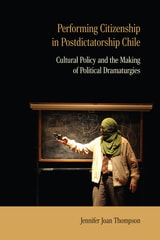
Performing Citizenship in Postdictatorship Chile
Cultural Policy and the Making of Political DramaturgiesJennifer Joan Thompson
Northwestern University Press, 2025
Offering a nuanced understanding of the performing arts’ relationship to politics
Through careful readings of key political performances in Chile's transition from military dictatorship to neoliberal democracy, Jennifer Joan Thompson examines how the production and aesthetics of theater are intertwined in processes of democratization, enactments of citizenship, and the development of cultural policy. Performing Citizenship in Postdictatorship Chile: Cultural Policy and the Making of Political Dramaturgies reveals how artists performed changing models of democratic citizenship. Thompson traces the ways artists confronted and resisted the military dictatorship of Augusto Pinochet, how they then reimagined the body politic during the early transitional period and challenged official constructions of history and memory as the transition to democracy progressed, how they critiqued Chile’s neoliberal economic model and its violence, and, finally, how they have made claims for feminist and Indigenous citizen subjectivities throughout Chile’s current social crisis. Incorporating archival and ethnographic research alongside readings of theatrical and political performances, this study offers a nuanced understanding of the performing arts’ relationship to politics, one that accounts for the ways artists and the state collaborate in the production of the political imagination.
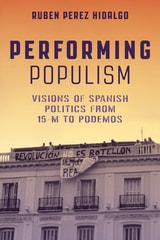
Performing Populism
Visions of Spanish Politics from 15-M to PodemosRuben Perez Hidalgo
Vanderbilt University Press, 2023
The book's first part examines how the 15-M movement created a new way of seeing that in turn led to a new way of doing politics in Spain. Part Two focuses on the multiple ramifications of that new vision once the people stopped marching and the movement became less visible.
From electoral posters to fiction films, documentaries, and internet memes, Performing Populism traces the ways that collective Spanish identities evolved from a period when "the people" seemed to have been willingly subsumed under the apathetic ideation of the middle-class consumer to the moment in 2011 when a crisis of representation forced many into political consciousness. This rude awakening kickstarted the reconstruction of a Spanish "us" that staged exhibitions of popular will on par with and parallel to the Arab Spring, but in a European register that embraced the countercultural through art that disremembered its political past but could not escape the ghostly shadow of its history.

Pericles on Stage
Political Comedy in Aristophanes' Early PlaysBy Michael Vickers
University of Texas Press, 1996
Since the eighteenth century, classical scholars have generally agreed that the Greek playwright Aristophanes did not as a matter of course write "political" plays. Yet, according to an anonymous Life of Aristophanes, when Dionysius the tyrant of Syracuse wanted to know about the government of Athens, Plato sent him a copy of Aristophanes' Clouds.
In this boldly revisionist work, Michael Vickers convincingly argues that in his earlier plays, Aristophanes in fact commented on the day-to-day political concerns of Athenians. Vickers reads the first six of Aristophanes' eleven extant plays in a way that reveals the principal characters to be based in large part on Pericles and his ward Alcibiades.
According to Vickers, the plays of Aristophanes—far from being nonpolitical—actually allow us to gauge the reaction of the Athenian public to the events that followed Pericles' death in 429 B.C., to the struggle for the political succession, and to the problems presented by Alcibiades' emergence as one of the most powerful figures in the state. This view of Aristophanes reaffirms the central role of allegory in his work and challenges all students of ancient Greece to rethink long-held assumptions about this important playwright.

Peripheral Visions
Deterrence Theory and American Foreign Policy in the Third World, 1965-1990Ted Hopf
University of Michigan Press, 1994
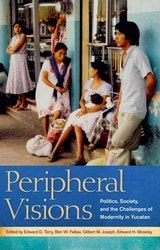
Peripheral Visions
Politics, Society, and the Challenges of Modernity in YucatanEdward D. Terry
University of Alabama Press, 2010
The essays in this collection illuminate both the processes of change and the negative reactions that they frequently elicited
Yucatan has been called “a world apart”—cut off from the rest of Mexico by geography and culture. Yet, despite its peripheral location, the region experienced substantial change in the decades after independence. As elsewhere in Mexico, apostles of modernization introduced policies intended to remold Yucatan in the image of the advanced nations of the day. Indeed, modernizing change began in the late colonial era and continued throughout the 19th century as traditional patterns of land tenure were altered and efforts were made to divest the Catholic Church of its wealth and political and intellectual influence. Some changes, however, produced fierce resistance from both elites and humbler Yucatecans and modernizers were frequently forced to retreat or at least reach accommodation with their foes.
Covering topics from the early 19th century to the late 20th century, the essays in this collection illuminate both the processes of change and the negative reactions that they frequently elicited. The diversity of disciplines covered by this volume—history, anthropology, sociology, economics—illuminates at least three overriding challenges for study of the peninsula today. One is politics after the decline of the Institutional Revolutionary Party: What are the important institutions, practices, and discourses of politics in a post-postrevolutionary era? A second trend is the scholarly demystification of the Maya: Anthropologists have shown the difficulties of applying monolithic terms like Maya in a society where ethnic relations are often situational and ethnic boundaries are fluid. And a third consideration: researchers are only now beginning to grapple with the region’s transition to a post-henequen economy based on tourism, migration, and the assembly plants known as maquiladoras. Challenges from agribusiness and industry will no doubt continue to affect the peninsula’s fragile Karst topography and unique environments.
Contributors: Eric N. Baklanoff, Helen Delpar, Paul K. Eiss, Ben W. Fallaw, Gilbert M. Joseph, Marie Lapointe, Othón Baños Ramírez, Hernán Menéndez Rodríguez, Lynda S. Morrison, Terry Rugeley, Stephanie J. Smith
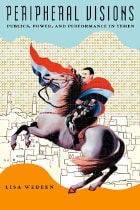
Peripheral Visions
Publics, Power, and Performance in YemenLisa Wedeen
University of Chicago Press, 2008
Lisa Wedeen, who spent a year and a half in Yemen observing and interviewing its residents, argues that national solidarity in such weak states tends to arise not from attachments to institutions but through both extraordinary events and the ordinary activities of everyday life. Yemenis, for example, regularly gather to chew qat, a leafy drug similar to caffeine, as they engage in wide-ranging and sometimes influential public discussions of even the most divisive political and social issues. These lively debates exemplify Wedeen’s contention that democratic, national, and pious solidarities work as ongoing, performative practices that enact and reproduce a citizenry’s shared points of reference. Ultimately, her skillful evocations of such practices shift attention away from a narrow focus on government institutions and electoral competition and toward the substantive experience of participatory politics.

Persecution and Rescue
The Politics of the “Final Solution” in France, 1940-1944Wolfgang Seibel
University of Michigan Press, 2016
Drawing on German and French sources, Wolfgang Seibel traces the twisted process of political decision-making that shaped the fate of the Jews in German-occupied France during World War II. By analyzing the German-French negotiations, he reveals the underlying logic as well as the actual course of the bargaining process as both the Vichy Regime and the Germans sought a stable relationship. Yet that relationship was continually reshaped by the progress of the war, Germany’s deteriorating prospects, France’s economic and geopolitical position, and the Vichy government’s quest for domestic political support. The Jews’ suffering intensified when the Germans had the upper hand; but when the French felt empowered, the Vichy Regime stopped collaborating in the completion of the “final solution.” Persecution and Rescue: The Politics of the “Final Solution” in France, 1940–1944 demonstrates the ways in which political circumstances can mitigate—or foster—mass crime.
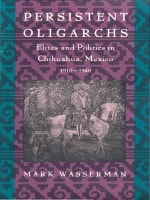
Persistent Oligarchs
Elites and Politics in Chihuahua, Mexico 1910–1940Mark Wasserman
Duke University Press, 1993
Chihuahua boasted one of the strongest pre-revolutionary elite networks, the Terrazas-Creel family. Wasserman describes this group's efforts to maintain its power after the Revolution, including its use of economic resources and intermarriage to forge partnerships with the new, revolutionary elite. Together, the old and new elites confronted a national government that sought to reestablish centralized control over the states and the masses. Wasserman shows how the revolutionary government and the popular classes, joined in opposition to the challenge of the elites, finally formalized into a national political party during the 1930s.
Persistent Oligarchs concludes with an account of the Revolution's ultimate outcome, largely accomplished by 1940: the national government gaining central control over politics, the popular classes obtaining land redistribution and higher wages, and regional elites, old and new, availing themselves of the great opportunities presented by economic development. A complex analysis of revolution as a vehicle for both continuity and change, this work is essential to an understanding of Mexico and Latin America, as well as revolutionary politics and history.

Perspectives on Milwaukee's Past
Edited by Margo Anderson and Victor Greene
University of Illinois Press, 2008
In this volume, a diverse group of scholars explores key themes in the distinctive history of Milwaukee, from settlement to the present, both in terms of the area's internal development and its comparative standing with other Great Lakes cities. Contributors discuss the importance of socialism and labor in local politics; Milwaukee's ethnic diversity, including long-standing African American, Latino, and Asian communities as well as an unusually large and significant German American population; the function and origins of the city's residential architecture; and the role of religious and ethnic culture in forming the city's identity. Rich in detail, the essays also challenge readers and researchers to pursue additional research on the city and the region by identifying critical areas and methods for future investigations into Milwaukee's past.
Contributors are Margo Anderson, Steven M. Avella, John D. Buenker, Jack Dougherty, Eric Fure-Slocum, Victor Greene, Thomas C. Hubka, Judith T. Kenny, Genevieve G. McBride, Aims McGuinness, Anke Ortlepp, Joseph A. Rodriguez, and N. Mark Shelley.
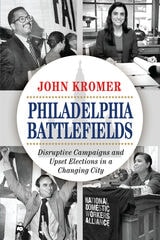
Philadelphia Battlefields
Disruptive Campaigns and Upset Elections in a Changing CityJohn Kromer
Temple University Press, 2020
Should the surprisingly successful outcomes achieved by outsider candidates in Philadelphia elections be interpreted as representing fundamental changes in the local political environment, or simply as one-off victories, based largely on serendipitous circumstances that advanced individual political careers? John Kromer’s insightful Philadelphia Battlefields considers key local campaigns undertaken from 1951 to 2019 that were extraordinarily successful despite the opposition of the city’s political establishment.
Kromer draws on election data and data-mapping tools that explain these upset elections as well as the social, economic, and demographic trends that influenced them to tell the story of why these campaign strategies were successful. He deftly analyzes urban political dynamics through case studies of newcomer Rebecca Rhynhart’s landslide victory over a veteran incumbent for Philadelphia City Controller; activist Chaka Fattah’s effective use of grassroots organizing skills to win a seat in Congress; and Maria Quiñones-Sánchez’s hard-fought struggle to become the first Hispanic woman to win a City Council seat, among others.
Philadelphia Battlefields shows how these candidates’ efforts to increase civic engagement, improve municipal governance, and become part of a new generation of political leadership at the local and state level were critical to their successes.
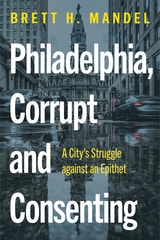
Philadelphia, Corrupt and Consenting
A City’s Struggle against an EpithetBrett H. Mandel
Temple University Press, 2023
He examines the costs of corruption, both financial and nonpecuniary, and considers the opportunity cost that corruption imposes. Mandel explores the nature and development of Philadelphia’s unique culture of corruption, emphasizing how machine politics and self-dealing are entwined with city history, creating a culture that allows corruption to thrive. In addition, he provides practical, achievable policies and actions that can produce positive change in Philadelphia and elsewhere.
Mandel seeks to provide insight into how our collective actions or inattention give consent to the corruption, as well as its roots and effects, and the reasons for its persistence. Philadelphia, Corrupt and Consenting is a critique, but above all, it is a call to action.

Phoenix
The History of a Southwestern MetropolisBradford Luckingham
University of Arizona Press, 1989

Photopoetics at Tlatelolco
Afterimages of Mexico, 1968By Samuel Steinberg
University of Texas Press, 2016
In the months leading up to the 1968 Olympic games in Mexico City, students took to the streets, calling for greater democratization and decrying crackdowns on political resistance by the ruling PRI party. During a mass meeting held at the Plaza of the Three Cultures in the Tlatelolco neighborhood, paramilitary forces opened fire on the gathering. The death toll from the massacre remains a contested number, ranging from an official count in the dozens to estimates in the hundreds by journalists and scholars. Rereading the legacy of this tragedy through diverse artistic-political interventions across the decades, Photopoetics at Tlatelolco explores the state’s dual repression—both the massacre’s crushing effects on the movement and the manipulation of cultural discourse and political thought in the aftermath.
Examining artifacts ranging from documentary photography and testimony to poetry, essays, chronicles, cinema, literary texts, video, and performance, Samuel Steinberg considers the broad photographic and photopoetic nature of modern witnessing as well as the specific elements of light (gunfire, flares, camera flashes) that ultimately defined the massacre. Steinberg also demonstrates the ways in which the labels of “massacre” and “sacrifice” inform contemporary perceptions of the state’s blatant and violent repression of unrest. With implications for similar processes throughout the rest of Latin America from the 1960s to the present day, Photopoetics at Tlatelolco provides a powerful new model for understanding the intersection of political history and cultural memory.

Physics Demonstrations
A Sourcebook for Teachers of PhysicsJulien Clinton Sprott
University of Wisconsin Press, 2015
Dr. Sprott shares demonstrations tested over many years in his popular public lectures on “The Wonders of Physics,” which appeal to general audiences and to students from grade school to graduate school. Science teachers at all levels will find a wealth of detail showing how to present these demonstrations to students with flair. Science professionals will find indispensable information for creating educational and entertaining public programs. Organized to teach the six major areas of classical physics—motion, heat, sound, electricity, magnetism, and light—Physics Demonstrations includes:
• a brief description of each demonstration
• materials lists, with sources for common materials
• preparation procedures
• discussions of the physics principles demonstrated
• potential safety hazards
• references for further information.
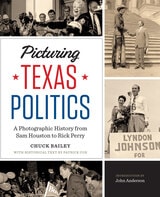
Picturing Texas Politics
A Photographic History from Sam Houston to Rick PerryBy Chuck Bailey; with historical text by Patrick Cox; introduction by John Anderson
University of Texas Press, 2015
With rare, previously unpublished photographs and iconic images of politicians from the state’s founders to Ann Richards, George W. Bush, and Rick Perry, here is the first-ever photographic album of Texas politicians and political campaigns.
The Republic of Texas was founded in 1839, around the time that photography was being invented. So while there were no photographers at the Alamo or San Jacinto, they arrived soon after to immortalize, on film, Sam Houston, David Burnett, Mirabeau Lamar, and many other founding fathers of the Lone Star State. Over the following nearly two centuries, Texas politics and politicians have provided reliable, often dramatic, and sometimes larger-than-life subjects for photographers to capture in the moment and add to the historical record.
Picturing Texas Politics presents the first photographic album of Texas politicians and political campaigns ever assembled. Chuck Bailey has searched archives, museums, libraries, and private collections to find photographs that have never been published, as well as iconic images, such as Russell Lee’s pictures of one of Ralph Yarborough’s campaigns. These photographs are arranged into four chronological sections, each one introduced by historian Patrick Cox, who also provides informative photo captions. The photographs display power and political savvy from the early Republic to Lyndon Johnson and Bob Bullock; unmatched dedication to Texas in the Hobby and Bush families; and the growing influence of women in politics, from Miriam “Ma” Ferguson to Barbara Jordan, Ann Richards, and Kay Bailey Hutchison. With Sam Houston’s jaguar vest, W. Lee “Pappy” O’Daniel’s hillbilly band, a famous governor with an ostrich, and prominent Texans eating watermelons, shooting guns, and riding horses, this is Texas politics at its liveliest and best.
Pikillacta
The Wari Empire in CuzcoMcEwan, Gordon F.
University of Iowa Press, 2005
Pipe Politics, Contested Waters
Embedded Infrastructures of Millennial MumbaiLisa Bjorkman
Duke University Press, 2015
Despite Mumbai's position as India's financial, economic, and cultural capital, water is chronically unavailable for rich and poor alike. Mumbai's dry taps are puzzling, given that the city does not lack for either water or financial resources. In Pipe Politics, Contested Waters, Lisa Björkman shows how an elite dream to transform Mumbai into a "world class" business center has wreaked havoc on the city’s water pipes. In rich ethnographic detail, Pipe Politics explores how the everyday work of getting water animates and inhabits a penumbra of infrastructural activity—of business, brokerage, secondary markets, and sociopolitical networks—whose workings are reconfiguring and rescaling political authority in the city. Mumbai’s increasingly illegible and volatile hydrologies, Björkman argues, are lending infrastructures increasing political salience just as actual control over pipes and flows becomes contingent on dispersed and intimate assemblages of knowledge, power, and material authority. These new arenas of contestation reveal the illusory and precarious nature of the project to remake Mumbai in the image of Shanghai or Singapore and gesture instead toward the highly contested futures and democratic possibilities of the actually existing city.
Pitching Democracy
Baseball and Politics in the Dominican RepublicApril Yoder
University of Texas Press, 2023
How Dominicans contribute to Major League Baseball and what they receive in return.
From Juan Marichal and Pedro Martínez to Albert Pujols and Juan Soto, Dominicans have long been among Major League Baseball’s best. How did this small Caribbean nation become a hothouse of baseball talent? To many fans, the answer is both obvious and disconcerting: pro teams use their riches to develop talent abroad, creating opportunities for superhuman athletes and corrupt officials, while the rest of the population sees little benefit.
Yet this interpretation of history is incomplete. April Yoder traces how baseball has empowered Dominicans in their struggles for democracy and social justice. While the dictatorship of Rafael Trujillo saw the sport as a means of cementing its power at home and abroad, the Dominican people fashioned an emancipated civic sphere by seeing their potential for democratic success in their compatriots’ baseball success. Later, Dominicans articulated demands for democracy, economic opportunity, and civil rights through successful calls for public support of amateur and professional baseball. Today, Dominicans continue to demand that incentives for the baseball industry foster human as well as economic development. A revelatory and innovative history, Pitching Democracy restores agency to the Dominican people and honors their true love of the game.
Place and Politics in Modern Italy
John A. Agnew
University of Chicago Press, 2002
For Agnew, place is not just a static backdrop against which events occur, but a dynamic component of social, economic, and political processes. He shows, for instance, how the lack of a common "landscape ideal" or physical image of Italy delayed the development of a sense of nationhood among Italians after unification. And Agnew uses the post-1992 victory of the Northern League over the Christian Democrats in many parts of northern Italy to explore how parties are replaced geographically during periods of intense political change.
Providing a fresh new approach to studying the role of space and place in social change, Place and Politics in Modern Italy will interest geographers, political scientists, and social theorists.
Place and Replace
Essays on Western CanadaAdele Perry
University of Manitoba Press, 2013

Playful Protest
The Political Work of Joy in Latinx MediaKristie Soares
University of Illinois Press, 2023
Joy is a politicized form of pleasure that goes beyond gratification to challenge norms of gender, sexuality, race, and class. Kristie Soares focuses on the diasporic media of Puerto Rico and Cuba to examine how music, public activist demonstrations, social media, sitcoms, and other areas of culture resist the dominant stories told about Latinx joy. As she shows, Latinx creators compose versions of joy central to social and political struggle and at odds with colonialist and imperialist narratives that equate joy with political docility and a lack of intelligence. Soares builds her analysis around chapters that delve into gozando in salsa music, precise joy among the New Young Lords Party, choteo in the comedy ¿Qué Pasa U.S.A.?, azúcar in the life and death of Celia Cruz, dale as Pitbull’s signature affect, and Alexandria Ocasio-Cortez’s use of silliness to take seriously political violence.
Daring and original, Playful Protest examines how Latinx creators resist the idea that joy only exists outside politics and activist struggle.
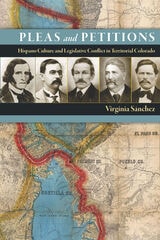
Pleas and Petitions
Hispano Culture and Legislative Conflict in Territorial ColoradoVirginia Sánchez
University Press of Colorado, 2021
Sánchez highlights the struggles experienced by Hispano territorial assemblymen trying to create opportunity and a better life in the face of cultural conflict and the institutional racism used to effectively shut them out of the process of establishing new laws and social order. For example, the federal and Colorado territorial governments did not provide an interpreter for the Hispano assemblymen or translations of the laws passed by the legislature, and they taxed Hispano constituents without representation and denied them due process in court.
The first in-depth history of Hispano sociopolitical life during Colorado’s territorial period, Pleas and Petitions provides fundamental insight into Hispano settlers’ interactions with their Anglo neighbors, acknowledges the struggles and efforts of those Hispano assemblymen who represented southern Colorado during the territorial period, and augments the growing historical record of Hispanos who have influenced the course of Colorado’s history.
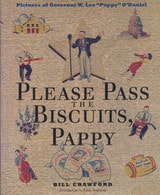
Please Pass the Biscuits, Pappy
Pictures of Governor W. Lee "Pappy" O'DanielBy Bill Crawford
University of Texas Press, 2004
Long before movie stars Ronald Reagan and Arnold Schwarzenegger became governors of California, a popular radio personality with no previous political experience—who wasn't even registered to vote—swept into the governor's office of Texas. W. Lee "Pappy" O'Daniel was a 1930s businessman who discovered the power of radio to sell flour. His musical shows with the Light Crust Doughboys (which launched the career of Bob Wills) and his radio homilies extolling family and Christian values found a vast, enthusiastic audience in Depression-era Texas. When Pappy decided to run for governor in 1938 as a way to sell more flour—a fact he proudly proclaimed throughout the campaign—the people of Texas voted for him in record numbers. And despite the ineptitude for politics he displayed once in office, Texans returned him to the governorship in 1940 and then elected him to the U.S. Senate in 1941 in a special election in which he defeated Lyndon Johnson, as well as to a full term as senator in 1942.
While the hit film O Brother, Where Art Thou? celebrated a fictional "Please Pass the Biscuits, Pappy" O'Daniel, this book captures the essence of the real man through photographs taken by employees of the Texas Department of Public Safety, most of which are previously unpublished. Reminiscent of the work of WPA photographers such as Russell Lee and Dorothea Lange, these photos record the last unscripted era of politics when a charismatic candidate could still address a crowd from an unpainted front porch or a mobile bandstand in the back of a truck. They strikingly confirm that Pappy O'Daniel's ability to connect with people was as great in person as on the radio.
To set the photos in context, Bill Crawford has written an entertaining text that discusses the political landscape in Texas and the United States in the 1930s, as well as the rise of radio as mass medium for advertising and entertainment. He also provides extensive captions for each picture. John Anderson, Photo Archivist of the Texas State Archives, discusses the work of Joel Tisdale and the other DPS photographers who left this extraordinary record of the greatest vote-getter in Texas history, who became one of America's first celebrities to cross the line from entertainment to political office.
Pluriversal Politics
The Real and the PossibleArturo Escobar
Duke University Press, 2020

Poindexter of Washington
A Study in Progressive PoliticsHoward W Allen
Southern Illinois University Press, 1981
In this study of Miles Poindexter, Insurgent Republican turned conservative, Howard W. Allen reaches beyond the traditional bounds of biography to present a history of the United States Congress during the Progressive era and the early years after World War I.
A congressman (1909–13)and a senator (1913–23), Miles Poindexter of Washington State was an outspoken, progressive reformer before World War I. He struggled to protect “the people” from “special interests,” particularly defending the interest of his section against eastern “colonialism.” A man with a penchant for absolute positions, Poindexter became caught up in the emotionalism of the Insurgent Republican revolt. At one time or another he championed Socialists, the IWW, the striking textile workers in Lawrence, Massachusetts—all unlikely causes for a middle-class lawyer from Spokane.
Regarding foreign policy, Poindexter was an uncompromising nationalist who, with Theodore Roosevelt, declared himself a member of the Progressive party in 1912.
After 1917 Poindexter actively tried to suppress opponents of the war. Following the war his targets were “Bolshevists” and other radicals. He also developed intense hostility toward Socialists, the IWW, and organized labor, fearing radicalism and labor. Reversing his former position, he allied himself with the eastern businessmen and regular Republicans in the Senate. Campaigning for the presidency in 1920, he appealed without success to the most conservative members of the party. He was defeated b a progressive Democrat in his 1922 bid for reelection to the Senate.
Allen examines the traditional sources—archival collections, newspaper files, and congressional reports. When he combines this material with a quantitative analysis of roll-call votes throughout Senator Poindexter’s years in Congress, he creates a remarkably useful method never before attempted in political biography.
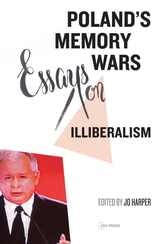
Poland's Memory Wars
Essays on IlliberalismJo Harper
Central European University Press, 2018
This volume of essays and interviews by Polish, British, and American academics and journalists provides an overview of current Polish politics for both informed and non-specialist readers. The essays consider why and how PiS, Law and Justice, the party of Jarosław Kaczynski, returned to power, and the why and how of its policies while in power. They help to make sense of how “history” plays a key role in Polish public life and politics.
The descriptions of PiS in Western media tend to rework old stereotypes about Eastern Europe that had lain dormant for some time. The book addresses the underlying question whether PiS was simply successful in understanding its electorate, and just helped Poland to revert to its normal state. This new Normal seems quite similar to the old one: insular, conservative, xenophobic, and statist.
The book looks at the current struggle between one ‘Poland’ and another; between a Western-looking Poland and an inward-looking Poland, the former more interested in opening to the world, competing in open markets, and working within the EU, and the latter more concerned with holding onto tradition.
The question of illiberalism has gone from an ‘Eastern’ problem (Russia, Turkey, Hungary, etc.) to a global one (Brexit and the U.S. elections). This makes the very specific analysis of Poland’s illiberalism applicable on a broader scale.
Polarization and Democracy in Latin America
Legacies of the Left TurnSantiago Anria and Kenneth M. Roberts
University of Chicago Press, 2026
An insightful examination of Latin America’s contemporary democratic landscape and how it is marked by patterns of polarization and volatility.
Although Latin American democracies have shown considerable resilience, today they face new forms of political polarization and instability. These challenges are closely connected to the legacies of the region’s “left turn,” which sought to transform entrenched inequalities and social hierarchies in the early twenty-first century. Unprecedented in its scope and duration, the left turn reflected an underlying realignment of political contestation in a highly unequal region. Yet despite notable achievements in addressing social needs, leftist parties struggled to deepen democracy by empowering popular majorities, and they faced powerful elite backlashes.
Through a comparative analysis of seven South American countries, Santiago Anria and Kenneth M. Roberts trace the different origins and trajectories in power of the populist and social democratic currents that emerged within the left turn. Anria and Roberts argue that today’s democratic orders face intensifying polarization and institutional fragility, even where social democratic parties made explicit efforts to build broad coalitions and temper political conflict. They show how activist networks and social movements on the left and the right triggered latent political conflicts and are now reshaping democratic competition and the terms of social inclusion in South American politics.
Poles Together?
The Emergence and Development of Political Parties in Postcommunist PolandAleks Szczerbiak
Central European University Press, 2001
This book fills a gap in the existing literature on how parties and party systems are developing in the new democracies of post-communist Central and Eastern Europe. It provides the first detailed, empirically based examination from a structural and organizational perspective of the new parties and political groupings that have emerged in Poland since the collapse of communism in 1989.
The author develops his argument on the basis of an analysis of five key structural and organizational variables: the internal distribution of power and modes of representation within the parties; the role of the party bureaucracy; the relationship between parties and their electorates; the development of parties as membership organizations; and the relationship between parties and the state.
As the first in-depth, empirically grounded single-country study of party structure and organization in post-communist Eastern Europe, the book provides an opportunity to draw broader conclusions about the process of Central and East European party development and will contribute significantly towards the development of a post-communist political party model. Szczerbiak sheds light on an important aspect of the more general process of post-communist democratization in the region and provides a major contribution to one of the least-explored areas of transition.
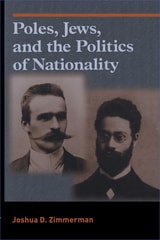
Poles, Jews, and the Politics of Nationality
The Bund and the Polish Socialist Party in Late Tsarist Russia, 1892–1914Joshua D. Zimmerman
University of Wisconsin Press, 2004
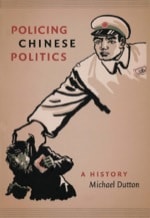
Policing Chinese Politics
A HistoryMichael Dutton
Duke University Press, 2005
The economic reform period that followed Mao Zedong’s rule contained a hint as to how the magic spell of political faith and commitment could be broken, but the cost of such disenchantment was considerable. This detailed, empirical tale of Chinese socialist policing is, therefore, more than simply a police story. It is a parable that offers a cogent analysis of Chinese politics generally while radically redrafting our understanding of what politics is all about. Breaking away from the traditional elite modes of political analysis that focus on personalities, factions, and betrayals, and from “rational” accounts of politics and government, Dutton provides a highly original understanding of the far-reaching consequences of acts of faith and commitment in the realm of politics.
Policy & Politics Japan
T. Pempel
Temple University Press, 1982

Policy & Politics West Germany
Peter Katzenstein
Temple University Press, 1987
Policy Dynamics
Edited by Frank R. Baumgartner and Bryan D. Jones
University of Chicago Press, 2002
To investigate these questions, Policy Dynamics draws on the most extensive data set yet compiled for public policy issues in the United States. Spanning the past half-century, these data make it possible to trace policies and legislation, public and media attention to them, and governmental decisions over time and across institutions. Some chapters analyze particular policy areas, such as health care, national security, and immigration, while others focus on institutional questions such as congressional procedures and agendas and the differing responses by Congress and the Supreme Court to new issues.
Policy Dynamics presents a radical vision of how the federal government evolves in response to new challenges-and the research tools that others may use to critique or extend that vision.
Policy Politics Canada
Carolyn J. Tuohy
Temple University Press, 1992
At a time when Canadian political institutions are being fundamentally questioned, this book provides a comparative perspective on the distinctive features of the Canadian policy process hich have enabled conflict to be resolved in the past. In comparison with other Western industrial nations, Canada's policies in some arenas appear as models of workable compromise; in others, they stand out as marked by continuing irresolution. In this first book-length treatment of Canadian public policy in comparative perspective, Carolyn Tuohy focuses on constitutional change, health care delivery, industrial relations and labor market policy, economic development and adjustment, oil and gas policy, and minority language rights.
What distinguishes Canada's characteristic policy process is its quintessential ambivalence: ambivalence about the appropriate role of the state, about definitions of political community, and about individual and collective values and conceptions of rights. Embedded in the country's political institutions, it has deep roots in Canada's relationship to the United States, its history of English-French tensions, and its regional diversity.
Examining in particular the delicate federal-provincial division of power and the legislative-judicial relationship, Tuohy discusses how the constitutional debates of the 1980s and 1990s are testing Canada's institutions to resolve conflict.
In the series Policy and Politics in Industrial States, edited by Douglas E. Ashford, Peter J. Katzenstein, and T.J. Pempel.

Polish-American Politics in Chicago, 1880-1940
Edward R. Kantowicz
University of Chicago Press, 1975
Kantowicz examines such questions as why Chicago, with the largest Polish population of any city outside of Poland, has never elected a Polish mayor. The author also examines the origins of the heavily Democratic allegiance of Polish voters. Kantowicz demonstrates that Chicago Poles were voting Democratic long before Al Smith, Franklin Roosevelt, or the New Deal.
Kantowicz has made extensive use of registration lists and voting records to construct a statistical picture of Polish-American voting behavior in Chicago. He draws on church records and census records to provide a detailed description of Chicago's many Polish neighborhoods. He also has studied the city's Polish-language press as well as the few manuscript collections left by Polish-American politicians. These collections, together with data gleaned from interviews with individuals who were acquainted with these figures, are used to sketch profiles of the political leaders of Polonia's capital.
Kantowicz focuses on the goals which the Polish-American community pursued in politics, the issues they deemed important, and the functions which politics served for them. He links this analysis to observations on the homeland and the reasons for which the Poles emigrated. In this context he is able to draw conclusions about the nature of the ethnic politics in general. His work will appeal to a variety of readers: urban and twentieth-century historians, political scientists, and sociologists.
Political Change and Underdevelopment
A Critical Introduction to Third World PoliticsVicky Randall and Robin Theobald
Duke University Press, 1998
This second edition has been expanded to include discussions of the international debt crisis, the impact of globalization on the postcolonial world, the rise of newly industrialized countries, and the upsurge in religion-based conflict in the post–Cold War era. Describing the strengths and weaknesses of the existing interpretive approaches to these issues, the authors explore the often difficult relationship between political change and economic development. At the same time they provide a comprehensive view into the turbulent politics of the Third World and suggest how future analysis can build on present approaches to reflect political reality more fully.
An essential text for students of political science and Third World societies, this volume will also interest anyone seeking a clearer understanding of the current issues underlying the politics of these countries.
Political Cultures in the Andes, 1750-1950
Nils Jacobsen and Cristóbal Aljovín de Losada, eds.
Duke University Press, 2005
The contributors foreground the struggles over democracy and citizens’ rights as well as notions of race, ethnicity, gender, and class that have been at the forefront of political debates and social movements in the Andes since the waning days of the colonial regime some two hundred years ago. Among the many topics they consider are the significance of the Bourbon reform era to subsequent state-formation projects, the role of race and nation in the work of early-twentieth-century Bolivian intellectuals, the fiscal decentralization campaign in Peru following the devastating War of the Pacific in the late nineteenth century, and the negotiation of the rights of “free men of all colors” in Colombia’s Atlantic coast region during the late colonial period. Political Cultures in the Andes includes an essay by the noted Mexicanist Alan Knight in which he considers the value and limits of the concept of political culture and a response to Knight’s essay by the volume’s editors, Nils Jacobsen and Cristóbal Aljovín de Losada. This important collection exemplifies the rich potential of a pragmatic political culture approach to deciphering the processes involved in the formation of historical polities.
Contributors. Cristóbal Aljovín de Losada, Carlos Contreras, Margarita Garrido, Laura Gotkowitz, Aline Helg, Nils Jacobsen, Alan Knight, Brooke Larson, Mary Roldan, Sergio Serulnikov, Charles F. Walker, Derek Williams
Political Epistemics
The Secret Police, the Opposition, and the End of East German SocialismAndreas Glaeser
University of Chicago Press, 2011
What does the durability of political institutions have to do with how actors form knowledge about them? Andreas Glaeser investigates this question in the context of a fascinating historical case: socialist East Germany’s unexpected self-dissolution in 1989. His analysis builds on extensive in-depth interviews with former secret police officers and the dissidents they tried to control as well as research into the documents both groups produced. In particular, Glaeser analyzes how these two opposing factions’ understanding of the socialist project came to change in response to countless everyday experiences. These investigations culminate in answers to two questions: why did the officers not defend socialism by force? And how was the formation of dissident understandings possible in a state that monopolized mass communication and group formation? He also explores why the Stasi, although always well informed about dissident activities, never developed a realistic understanding of the phenomenon of dissidence.
Out of this ambitious study, Glaeser extracts two distinct lines of thought. On the one hand he offers an epistemic account of socialism’s failure that differs markedly from existing explanations. On the other hand he develops a theory—a sociology of understanding—that shows us how knowledge can appear validated while it is at the same time completely misleading.
Political Essay on the Kingdom of New Spain, Volume 1
A Critical EditionAlexander von Humboldt
University of Chicago Press, 2019
Alexander von Humboldt was the most celebrated modern chronicler of North and South America and the Caribbean, and this translation of his essay on New Spain—the first modern regional economic and political geography—covers his travels across today’s Mexico in 1803–1804. The work canvases natural-scientific and cultural-scientific objects alike, combining the results of fieldwork with archival research and expert testimony.
To show how people, plants, animals, goods, and ideas moved across the globe, Humboldt wrote in a variety of styles, bending and reshaping familiar writerly conventions to keep readers attentive to new inputs. Above all, he wanted his readers to be open-minded when confronted with cultural and other differences in the Americas. Fueled by his comparative global perspective on politics, economics, and science, he used his writing to support Latin American independence and condemn slavery and other forms of colonial exploitation. It is these voluminous and innovative writings on the New World that made Humboldt the undisputed father of modern geography, early American studies, transatlantic cultural history, and environmental studies.
This two-volume critical edition—the third installment in the Alexander von Humboldt in English series—is based on the full text, including all footnotes, tables, and maps, of the second, revised French edition of Essai politique sur le royaume de de Nouvelle Espagne from 1825 to 1827, which has never been translated into English before. Extensive annotations and full-color atlases are available on the series website.
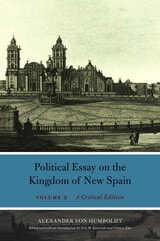
Political Essay on the Kingdom of New Spain, Volume 2
A Critical EditionAlexander von Humboldt
University of Chicago Press, 2019
Alexander von Humboldt was the most celebrated modern chronicler of North and South America and the Caribbean, and this translation of his essay on New Spain—the first modern regional economic and political geography—covers his travels across today’s Mexico in 1803–1804. The work canvases natural-scientific and cultural-scientific objects alike, combining the results of fieldwork with archival research and expert testimony.
To show how people, plants, animals, goods, and ideas moved across the globe, Humboldt wrote in a variety of styles, bending and reshaping familiar writerly conventions to keep readers attentive to new inputs. Above all, he wanted his readers to be open-minded when confronted with cultural and other differences in the Americas. Fueled by his comparative global perspective on politics, economics, and science, he used his writing to support Latin American independence and condemn slavery and other forms of colonial exploitation. It is these voluminous and innovative writings on the New World that made Humboldt the undisputed father of modern geography, early American studies, transatlantic cultural history, and environmental studies.
This two-volume critical edition—the third installment in the Alexander von Humboldt in English series—is based on the full text, including all footnotes, tables, and maps, of the second, revised French edition of Essai politique sur le royaume de de Nouvelle Espagne from 1825 to 1827, which has never been translated into English before. Extensive annotations and full-color atlases are available on the series website.
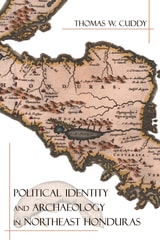
Political Identity & Arch
T Cuddy
University Press of Colorado, 2007
Political Leadership in Contemporary Japan
Terry Edward MacDougall, Editor
University of Michigan Press, 1982
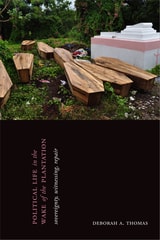
Political Life in the Wake of the Plantation
Sovereignty, Witnessing, RepairDeborah A. Thomas
Duke University Press, 2019
Political Power in Pre-Colonial Buganda
Economy, Society, and Warfare in the Nineteenth CenturyRichard Reid
Ohio University Press, 2002
Blessed with fertile and well-watered soil, East Africa’s kingdom of Buganda supported a relatively dense population and became a major regional power by the mid-nineteenth century. This complex and fascinating state has also long been in need of a thorough study that cuts through the image of autocracy and military might.
Political Power in Pre-Colonial Buganda explores the material basis of Ganda political power, gives us a new understanding of what Ganda power meant in real terms, and relates the story of how the kingdom used the resources at its disposal to meet the challenges that confronted it. Reid further explains how these same challenges ultimately limited Buganda’s dominance of the East African great lakes region.
Political Process and the Development of Black Insurgency, 1930-1970
Doug McAdam
University of Chicago Press, 1999
"[A] first-rate analytical demonstration that the civil rights movement was the culmination of a long process of building institutions in the black community."—Raymond Wolters, Journal of American History
"A fresh, rich, and dynamic model to explain the rise and decline of the black insurgency movement in the United States."—James W. Lamare, Annals of the American Academy of Political and Social Science
Political Radicalism in Late Imperial Vienna
Origins of the Christian Social Movement, 1848-1897John W. Boyer
University of Chicago Press, 1995
"Offers a comprehensive, multicausal study of the rise of Christian Socialism in Vienna, that phenomenon which was experienced nowhere else in urban Central Europe and which culminated in the famous clash between the Austrian establishment and the colourful, domineering lead of the movement, Karl, Lueger."—R.J.W. Evans, History
"Boyer's analysis is masterful in terms of research, exposition, and organization. His use of available economic data is judicious, and his sense of the social structure of late nineteenth-century Vienna is formidable."—William A. Jenks, American Historical Review
"To understand Viennese and even imperial politics in the latter half of the nineteenth century, Boyer's book is absolutely essential.""—Robert Wegs, Review of Politics
Political Recruitment across Two Centuries
Mexico, 1884-1991By Roderic Ai Camp
University of Texas Press, 1995
During more than twenty years of field research, Roderic Ai Camp built a monumental database of biographical information on more than 3,000 leading national figures in Mexico. In this major contribution to Mexican political history, he draws on that database to present a definitive account of the paths to power Mexican political leaders pursued during the period 1884 to 1992.
Camp’s research clarifies the patterns of political recruitment in Mexico, showing the consequences of choosing one group over another. It calls into question numerous traditional assumptions, including that upward political mobility was a cause of the Mexican Revolution of 1910.
Comparing Mexican practices with those in several East Asian countries also allows Camp to question many of the tenets of political recruitment theory. His book will be of interest to students not only of Mexican politics but also of history, comparative politics, political leadership, and Third World development.
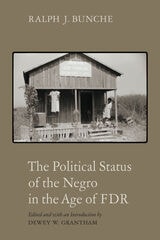
Political Status of the Negro in the Age of FDR
A Carnegie-Myrdal Report Emphasizing the American SouthRalph J. Bunche
University of Chicago Press, 1973
This volume presents the essence of a massive report prepared in 1940 by a team headed by political scientist and civil rights leader Ralph J. Bunche for the Carnegie Corporation’s Survey of the Negro in America. The report was used by Swedish social economist Gunnar Myrdal in writing his monumental An American Dilemma, and it shaped Myrdal’s treatment of the Black political experience. As a valuable historical document, it provides a backdrop against which we can measure change in the Black American’s political status and interpret the origins and consequences of the second Reconstruction.
The Political Status of the Negro introduces essential information about political practices in the Southern states. It offers insight into the historical, economic, sociological, and psychological factors that accounted for these practices, as well as some understanding of the myths, stereotypes, and symbols that contemporaries often used to explain and justify them. The study’s most enduring value lies in its wealth of personal interviews which were conducted in the South in the late 1930s and in its first-hand impressions of the African Americans and Southern politics.
The book is divided into two parts: The first contains Bunche’s explanations, comments, and analytical writings on the subject; the second includes almost all of the interviews and field reports. To this text historian Dewey W. Grantham added a comprehensive introduction that discusses Bunche and his work, the preparation of the research manuscript, and the book’s role in Gunnar Myrdal’s later work.
Political Strategies in Pre-Columbian Mesoamerica
Sarah Kurnick
University Press of Colorado, 2020
Political authority contains an inherent contradiction. Rulers must reinforce social inequality and bolster their own unique position at the top of the sociopolitical hierarchy, yet simultaneously emphasize social similarities and the commonalities shared by all. Political Strategies in Pre-Columbian Mesoamerica explores the different and complex ways that those who exercised authority in the region confronted this contradiction.
New data from a variety of well-known scholars in Mesoamerican archaeology reveal the creation, perpetuation, and contestation of politically authoritative relationships between rulers and subjects and between nobles and commoners. The contributions span the geographic breadth and temporal extent of pre-Columbian Mesoamerica—from Preclassic Oaxaca to the Classic Petén region of Guatemala to the Postclassic Michoacán—and the contributors weave together archaeological, epigraphic, and ethnohistoric data.
Grappling with the questions of how those exercising authority convince others to follow and why individuals often choose to recognize and comply with authority, Political Strategies in Pre-Columbian Mesoamerica discusses why the study of political authority is both timely and significant, reviews how scholars have historically understood the operation of political authority, and proposes a new analytical framework to understand how rulers rule.
Contributors include Sarah B. Barber, Joanne Baron, Christopher S. Beekman, Jeffrey Brzezinski, Bryce Davenport, Charles Golden, Takeshi Inomata, Arthur A. Joyce, Sarah Kurnick, Carlo J. Lucido, Simon Martin, Tatsuya Murakami, Helen Perlstein Pollard, and Víctor Salazar Chávez.
Political Trust in China
Lianjiang Li
University of Michigan Press, 2025